Geophysical Journal International
Geophys. J. Int. (2013)192, 671–675 doi: 10.1093/gji/ggs055
GJI
Seismology
E X P R E S S L E T T E R
A further study on seismic response of a set of parallel rock fractures
filled with viscoelastic materials
W. Wu,
1J. B. Zhu
2and J. Zhao
11Ecole Polytechnique F´ed´erale de Lausanne (EPFL), School of Architecture, Civil and Environmental Engineering, Laboratory of Rock Mechanics (LMR), CH-1015 Lausanne, Switzerland. E-mail: [email protected]
2Graduate Aeronautical Laboratories and Department of Mechanical and Civil Engineering, Division of Engineering and Applied Sciences,
California Institute of Technology, Pasadena, CA 91125, USA
Accepted 2012 November 2. Received 2012 October 3; in original form 2012 August 10
S U M M A R Y
The purpose of this study is to further investigate the seismic response of a set of parallel rock fractures filled with viscoelastic materials, following the work by Zhu et al. Dry quartz sands are used to represent the viscoelastic materials. The split Hopkinson rock bar (SHRB) technique is modified to simulate 1-D P-wave propagation across the sand-filled parallel fractures. At first, the displacement and stress discontinuity model (DSDM) describes the seismic response of a sand-filled single fracture. The modified recursive method (MRM) then predicts the seismic response of the sand-filled parallel fractures. The SHRB tests verify the theoretical predictions by DSDM for the sand-filled single fracture and by MRM for the sand-filled parallel fractures. The filling sands cause stress discontinuity across the fractures and promote displacement discontinuity. The wave transmission coefficient for the sand-filled parallel fractures depends on wave superposition between the fractures, which is similar to the effect of fracture spacing on the wave transmission coefficient for the non-filled parallel fractures.
Key words: Body waves; Seismic attenuation; Wave propagation; Fractures and faults.
1 I N T R O D U C T I O N
Rock fractures commonly exist in rock masses, and affect the phys-ical, mechanical and seismic properties of rock masses. When seis-mic waves propagate across rock masses, the fractures attenuate wave amplitude and decrease wave velocity. The understanding of the seismic response of rock fractures is of great interest to rock engineers, geophysicists and seismologists.
The boundary conditions of rock fractures are traditionally considered as stress continuity and displacement discontinuity (Schoenberg 1980; Pyrak-Nolte et al. 1990). The fractures are treated as non-welded contacts with negligible thickness compared to the wavelength. However, some of natural fractures are filled with viscoelastic materials, such as weathered rock, sand and clay. The thickness of the filling materials may not be ignored compared to the wavelength. Moreover, the density of the filling materials is not comparable to the rock density, and thus the initial mass of the fill-ing materials may affect wave propagation (Rokhlin & Wang 1991). The displacement and stress discontinuity model (DSDM) proposes that in addition to the displacement discontinuity, the stress across the filled fractures can be also considered as discontinuity (Zhu
et al. 2011). The seismic response of the filled fractures can be
pre-dicted according to the specific fracture stiffness, the wave angular
frequency and the impedances of the filling materials and the rock material.
A series of nearly parallel discontinuity planes in rock masses is generally known as a set. For a set of parallel fractures filled with viscoelastic materials, it is difficult to estimate the global stiffness of the complicated layered structure. In addition, mul-tiple wave reflections among fractures become another obstacle to predict the seismic response of the filled parallel fractures. The recursive method (RM) provides a practical method to char-acterize the interrelationship among a set of layers or fractures with respect to potential amplitude or stress and displacement (Treitel & Robinson 1966; Fuchs & M¨uller 1971). Nevertheless, the periodically layered structure makes the mathematical expres-sion and the computational process complex. Efforts thus have been persistently made to improve its computational efficiency (e.g. Kennett & Kerry 1979; Luco & Apsel 1983; Chen 1993). Zhu et al. (2012) enhanced the computational efficiency by in-troducing the modified recursive method (MRM) for the period-ically layered structure. It is capable of faster calculation for the layered structure, in which each fracture has similar physical and mechanical properties and spatial configurations. Therefore, MRM is appropriate to predict the seismic response of the filled parallel fractures.
C
imental technique to investigate the interaction between seismic wave and rock fractures. It also has the advantage to observe the low-frequency wave generation and propagation in a rock medium. The study modifies the technique and extends its application to investigate the seismic response of the filled parallel fractures. Dry quartz sands are used to represent the viscoelastic materials. The purpose of this study is to provide an insight into the seismic re-sponse of a set of parallel fractures filled with dry sands based on the theoretical predictions and the experimental investigations. At first, DSDM describes the seismic response of a sand-filled single fracture, which is verified by the SHRB tests. The MRM calculation then predicts the seismic response of the sand-filled parallel frac-tures according to the wave reflection and transmission coefficients for the sand-filled single fracture, the facture spacing and the wave-length. The MRM predictions are also verified by the SHRB tests on the sand-filled parallel fractures. Meanwhile, the study discusses the role of filling sands and the effect of fracture spacing on the seismic response of the sand-filled parallel fractures.
2 M E T H O D S 2.1 Theoretical models
DSDM proposes that rock fractures filled with dry sands can be described by the Kelvin model, which consists of one spring and one dashpot in parallel. The stress discontinuity across a filled sin-gle fracture is induced by the initial mass of the filling materials, and the displacement discontinuity is determined by the transmit-ted stress and the specific fracture stiffness. The specific viscosity is considered as zero for the fracture filled with dry sands. The wave reflection and transmission coefficients for a normally incident
P-wave propagation across a filled single fracture are expressed as
R1= i/(kn/ωZp)− idn 2− idn− i/(kn/ωZp) , (1) T1= 2 2− idn− i/(kn/ωZp) , (2)
where knis the specific fracture stiffness, that is, the stress change
per unit fracture closure in the study, Zpis the seismic impedance of
the rock material,ω is the wave angular frequency and dndenotes
the impedance ratio between the filling sands and the rock material
dn= Ze Zp = ωmn Zp = ωρ0h Zp , (3)
where Zeis the effective seismic impedance of the filling sands,
and the specific initial mass of the filling sands along the normal direction, mn, is equal to the sand density,ρ0, multiplied by the
fracture initial thickness, h. In this study, the specific initial mass is the initial mass of a unit square (the cross section of the bars).
MRM assumes that the physical and mechanical properties and the spatial configurations of rock fractures are similar, which is pos-sible in real rock masses. A normally incident P-wave is described as uo= A exp(−iωt + ikx), where uois the particle displacement, A
is the wave amplitude and k is the wave number. The wave reflec-tion and transmission coefficients across n fractures are Rnand Tn,
respectively. Due to multiple wave reflections among fractures, the reflected and the transmitted waves can be treated as the superpo-sition of reflected and transmitted waves arriving at different times. Zhu et al. (2012) found that the reflected and transmitted waves across n parallel fractures arriving at different times form a geomet-ric sequence with a common ratio of R12ei2ks, except the first ratio
parallel fractures, the wave reflection and transmission coefficients are R2= R1+ T2 1R1ei2ks 1− R2 1ei2ks , (4) T2= T2 1R1eiks 1− R2 1ei2ks , (5)
where s is the fracture spacing, and k= 2π/λ, λ is the wavelength. The wave transmission coefficient is defined as the ratio of the maximum strain of the transmitted wave to that of the correspond-ing incident wave in the time domain. In DSDM and MRM, the derived wave reflection and transmission coefficients for the single and parallel fractures are expressed in the frequency domain. The fast Fourier transform is used first to transform the recorded incident wave into the frequency domain. The derived wave transmission co-efficient multiplies the incident wave amplitude for each frequency to obtain the predicted transmitted wave amplitude. And then, the inverse fast Fourier transform is applied to transform the predicted transmitted wave amplitude into the time domain to calculate the wave transmission coefficient.
2.2 Experimental study
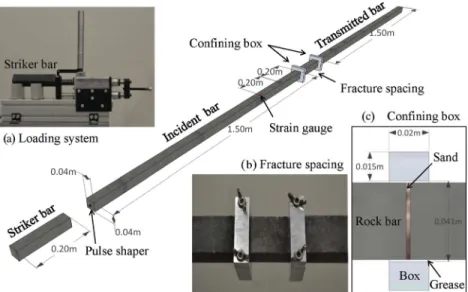
SHRB consists of a loading system with a striker bar, a pair of norite square bars with simulated filled fractures, and a LabVIEW data acquisition unit (Fig. 1). The low-rate loading system using a compressed spring as the energy source instantaneously launches the norite striker bar (Fig. 1a). The impact event between the striker bar and the incident bar generates a low-frequency sine wave (2 kHz) propagating in the bar system. A rubber disc with 10 mm in diameter and 1 mm thickness is used as the pulse shaper. Two groups of strain gauges connected in full-bridges are mounted on each bar to record waves. The recorded signal is superposed, consists of the incident and the reflected waves, due to the short length of two bars. With the application of the wave separation method, the stress time responses at the fracture interfaces (the back end of the incident bar and the front end of the transmitted bar) are analysed independently, allowing dynamic stress non-equilibrium across the fractures. For more details about the apparatus and the data analysis, refer to Wu
et al. (2012).
The filled single fracture was simulated by filling dry quartz sands in a pre-set gap between two bars. The quartz sands have a density of 2620 kg m–3, a porosity of 40 per cent and particle
size 1–2 mm. The reasons for using the sands representing filling materials include: (1) the water content in dry sands can be ignored at room temperature to consider the associated viscosity as zero, (2) the quartz sands commonly have a single mineral composition such that in each test the filling material composition is constant and independent to seismic response of filled fractures. For the study of the sand-filled parallel fractures, an additional norite bar was inserted between two bars as the fracture spacing (Fig. 1b). Two sand layers were filled in the two gaps between the bars and held by two confining boxes. A small grease layer was filled in the gap between the bar surface and the box inner surface to reduce the undesired friction (Fig. 1c). The confining box held the filling sands and made the sand layer in a uniaxial strain state. Fig. 2 shows the validation test conducted on the system without the filling sands. The nearly same stress time responses at the fracture front and rear interfaces indicate the integrity of the bars and limited wave attenuation in the measuring range.
Figure 1. Schematic view of the SHRB apparatus for P-wave propagation across a set of parallel fractures filled with dry sands.
Figure 2. Validation test of the SHRB system and stress time responses of
the sand-filled single and parallel fractures at the front and rear interfaces. 3 R E S U LT S A N D D I S C U S S I O N
Fig. 3 shows the stress–closure relationship of the sand-filled single fracture with 2 mm thickness. There were three tests performed on the sand-filled single fracture. According to DSDM, the stress time response at the fracture rear interface (the front end of the trans-mitted bar) represents the stress time response of the sand-filled single fracture. Although dynamic stress non-equilibrium across the fracture cannot be achieved (Fig. 2), the stress time response at the rear interface indicates the compaction degree of the filling sands and the energy portion that can be transmitted through the densifying sands. The reasons for dynamic stress non-equilibrium lie in two aspects, (1) the filling sands delay the arrival time of the stress at the rear interface, and (2) the energy attenuated by sand compaction is impressive compared with the incident energy. The seismic energy attenuation is mainly due to dynamic compaction of the sand layer, such as friction between grain contacts and ruptur-ing of weak grains. The process consumes considerable amount of incident energy and results in less energy transmitted through the fracture. The displacement discontinuity attributes to the discontin-uous stresses and the differences in the asperity deformation at the fracture interfaces. The time response of fracture closure is equal to
Figure 3. Stress–closure relationship of the sand-filled single fracture and
its wave transmission coefficient as a function of fracture specific stiffness.
the initial thickness of the fracture multiplied by the strain time re-sponse of the fracture, which is the time integral of the difference of particle velocity time responses at the front and rear interfaces over the fracture thickness. The specific fracture stiffness is obtained by measuring the gradient of the tangent to the pre-peak linear portion of the stress–closure curve. Fig. 3 also presents that the predicted wave transmission coefficients by DSDM and the wave transmission coefficients from the SHRB tests on the sand-filled single fracture agree well with each other. It means DSDM can physically describe the seismic response of the sand-filled single fracture. The differ-ences among these points may be due to the initial filling state of the sand layer.
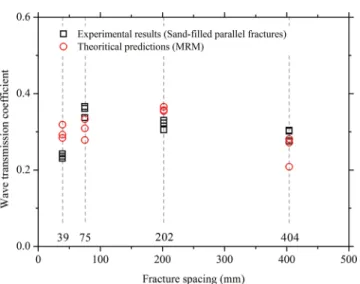
For a set of the sand-filled parallel fractures, each fracture with 2 mm thickness, four fracture spacing cases were investigated to es-timate the effect of fracture spacing on the seismic response of the sand-filled parallel fractures, for example, 39 mm, 75 mm, 202 mm and 404 mm. Three tests were carried out for each case. The mea-sured specific stiffness of the sand-filled single fracture was first applied in the DSDM prediction. After that, the recorded incident wave from each test and the predicted wave reflection and trans-mission coefficients for the sand-filled single fracture were used
Figure 4. Wave transmission coefficient as a function of fracture spacing
for the sand-filled parallel fractures.
in MRM to predict the seismic response of the sand-filled parallel fractures. Based on the MRM assumption, the physical and me-chanical properties of two sand-filled fractures in the parallel form are similar, such as the fracture thickness and the particle size of the filling sands.
Fig. 4 demonstrates that the wave transmission coefficients pre-dicted by MRM are close to the experimental results from the SHRB tests for the sand-filled parallel fractures. According to the MRM predictions, the wave transmission coefficient for the sand-filled parallel fractures increases with increasing fracture spacing when the fracture spacing is much smaller than the incident wavelength. The wave transmission coefficient then decreases from a maxi-mum value with increasing fracture spacing. In these ranges, wave superposition between the fractures has a great effect on the wave transmission coefficient. This phenomenon is similar to the previous theoretical solutions for predicting the seismic response of the non-filled parallel fractures (Zhao et al. 1999; Zhao et al. 2006a). The increase of the wave transmission coefficient is due to increasing global stiffness of the layered structure with small fracture spacing (Zhao et al. 2006b). Furthermore, the wave transmission coefficient becomes a constant value with increasing fracture spacing when wave superposition has no effects on the wave transmission coef-ficient. SHRB is unable to perform this case. The low loading rate impact cannot generate a high-amplitude incident wave across a very long rock–sand layered structure, because of the low tensile strength of rock material.
The effect of fracture spacing on the wave transmission coeffi-cient can be also observed based on the loading rate at the fracture rear interface. The pre-peak slope of stress time response at the front end of the transmitted bar is considered as the energy trans-mission rate, reflecting the compaction degree of the sand layer. According to the stress time responses at the rear interface of the sand-filled parallel fractures (Fig. 2), the energy transmission rate of the sand-filled parallel fractures with 75 mm is higher than that of the other cases. The higher energy transmission rate indicates denser filling sands in the fractures. As the validation test shows that wave attenuation across a short range in the high-quality rock material can be ignored, the global stiffness of the layered struc-ture increases with denser sands. The specific fracstruc-ture stiffness of the sand-filled fractures increases with increasing loading rate, re-sulting in larger wave transmission coefficient (Wu et al. 2012). Therefore, the wave transmission coefficient for the sand-filled
par-interface.
The predicted wave transmission coefficient for the sand-filled parallel fractures reaches the maximum value when the fracture spacing is 202 mm. However, in the experimental results, the wave transmission coefficient for the sand-filled parallel fractures with 75 mm spacing is the largest one. The reasons for the difference between the theoretical predictions and the experimental results include the following: (1) the real experimental work is difficult to match the ideal theoretical assumption, for instance, the initial filling state and the compaction state of the sand layer in two fractures are probably different to some degree, (2) the specific fracture stiffness of a sand-filled single fracture may not precisely represent that of each one in the parallel form, and (3) the limited distinction may exist in the recorded incident waveform from each test.
4 C O N C L U S I O N S
The study provides an insight into the seismic response of a set of parallel fractures filled with viscoelastic materials, including the role of filling sands and the effect of fracture spacing. Dry quartz sands are used to represent of the viscoelastic materials. With the known specific stiffness of a sand-filled single fracture, MRM predicts the seismic response of the sand-filled parallel fractures based on the wave reflection and transmission coefficients for the single one derived by DSDM. The SHRB tests verify the theoretical predictions by DSDM for the sand-filled single fracture and by MRM for the sand-filled parallel fractures.
It is found that the filling sands delay the arrival time of the stress at the rear interface and consume considerable amount of incident energy, which cause stress discontinuity and promote displacement discontinuity. The change of the wave transmission coefficients for the non-filled and the filled parallel fractures is similar as a function of fracture spacing. It depends on how wave superposition between the fractures. The wave transmission coefficient for the sand-filled parallel fractures increases with higher loading rate at the fracture rear interface.
There are differences between the theoretical predictions and the experimental results. It is probably because both MRM and SHRB treat the rock–sand layered structure as an entirety in this study. The future study will consider the rate-dependency and the frequency-dependency of each fracture in the parallel form as well as wave superposition between the fractures.
A C K N O W L E D G M E N T S
This work is sponsored by the Swiss National Science Foundation (200021_124846).
R E F E R E N C E S
Chen, X., 1993. A systematic and efficient method of computing normal modes for multilayered half-space, Geophys. J. Int., 115, 391–409. Fuchs, K. & M¨uller, G., 1971. Computation of synthetic seismograms with
the reflectivity method and comparison with observations, Geophys. J. R.
astr. Soc., 23, 417–433.
Kennett, B.L.N. & Kerry, N.J., 1979. Seismic waves in a stratified half space,
Geophys. J. Int., 57, 557–583.
Luco, J.E. & Apsel, R.J., 1983. On the Green’s functions for a layered half-space. Part 1, Bull. seism. Soc. Am., 73, 909–929.
Pyrak-Nolte, L.J., Myer, L.R. & Cook, N.G.W., 1990. Transmission of seis-mic waves across single natural fractures, J. geophys. Res., 95, 8617–8638.
Rokhlin, S.I. & Wang, Y.J., 1991. Analysis of boundary conditions for elastic wave interaction with an interface between two solids, J. acoust. Soc. Am.,
89, 503–515.
Schoenberg, M., 1980. Elastic wave behavior across linear slip interface, J.
acoust. Soc. Am., 68, 1516–1521.
Treitel, S. & Robinson, E.A., 1966. Seismic wave propagation in layered media in terms of communication theory, Geophysics, 31, 17–32. Wu, W., Li, J.C. & Zhao, J., 2012. Loading rate dependency of dynamic
responses of rock joints at low loading rate, Rock Mech. Rock Eng., 45, 421–426.
Zhao, J. et al., 1999. Rock dynamics research related to cavern development for ammunition storage, Tunnel. Under. Space Tech., 14, 513–526.
Zhao, J., Cai, J.G., Zhao, X.B. & Li, H.B., 2006a. Experimental study of ultrasonic wave attenuation across parallel fractures, Geomech. Geoeng.:
Int. J., 1, 87–103.
Zhao, J., Zhao, X.B. & Cai, J.G., 2006b. A further study of P-wave attenu-ation across parallel fractures with linear deformattenu-ational behavior, Int. J.
Rock Mech. Min. Sci., 43, 776–788.
Zhu, J.B., Perino, A., Zhao, G.F., Barla, G., Li, J.C., Ma, G.W. & Zhao, J., 2011. Seismic response of a single and a set of filled joints of viscoelastic deformational behavior, Geophys. J. Int., 186, 1315–1330.
Zhu, J.B., Zhao, X.B., Wu, W. & Zhao, J., 2012. Wave propagation across joints filled with viscoelastic medium using modified recursive method,