Journal of Antimicrobial Chemotherapy (1982) 9, Suppl. C. 181-188
Sch 29482, laboratory evaluation of a new penem antibiotic
F. H. Kayser and I. Kuhn
Institute of Medical Microbiology, University of Zurich, 8028 Zurich, Switzerland
The antibacterial activity of a new penem antibiotic, Sch 29482 (SCH), was examined in comparison with appropriate cephalosporins and penicillins. The drug inhibited penicillinase-positive and negative staphylococci equally well, being 2-5 times more active than cephalothin or cefamandole and 10-20 times more active than methicillin. Staphylococci resistant to methicillin were susceptible to SCH in agar dilution tests. Staphylococci tolerant to methicillin were also tolerant to SCH. Streptococci and pneumococci were highly susceptible to the drug. The agent was of only moderate activity against enterococci, especially Streptococcus faecium strains. MICs of ampicillin and penicillin G against enterococci were 4-8 times lower than those of SCH. SCH was bactericidal. Neither the choice of the method used for susceptibility testing, nor the size of the inoculum nor various test media influenced the in-vitro activity of this drug against a representative collection of negative and Gram-positive bacteria.
Introduction
Sch 29482 (SCH) is a new penem antibiotic which is chemically related to the carbapenem antibiotic thienamycin. The present study was undertaken to compare the in-vitro efficacy of this drug with various other /Mactam antibiotics. Some 250 clinical isolates of Gram-positive cocci were included in the study to provide a good indication of the potential efficacy of SCH in clinical application for Gram-positive infections. With a representative number of Gram-negative and Gram-positive bacteria, the influence of various in-vitro parameters, such as method of susceptibility testing, test medium and inoculum size, on results obtained with SCH was examined. All our data emphasize the fact that this penem antibiotic possesses promising in-vitro characteristics and, therefore, warrants further laboratory and clinical evaluation.
Methods
Bacteria
The micro-organisms used were isolated from clinical material and identified according to standard procedures. About 250 Gram-positive organisms were examined. The collection of Gram-negative bacteria included: Escherichia coli (16 strains); Klebsiella pneumoniae (8 strains) ; Enterobacter aerogenes (4 strains); Enterobacter cloacae (4 strains); Serratia marcescens (5 strains); Proteus mirabilis (4 strains); Proteus vulgaris (4 strains); Providentia rettgeri (4 strains); Morganella morganii (4 strains) and Acinetobacter calcoaceticus (4 strains).
181
Antibiotics
Stock solutions of SCH, methicillin, penicillin G, ampicillin, cephalothin, cefamandole, cefaclor, cephalexin, cefoperazone and N-formimidoyl thienamycin were prepared in sterile distilled water and either used immediately or stored at -80°C, if necessary. All drugs were kindly provided by the pharmaceutical companies.
Susceptibility tests
Minimal inhibitory concentrations (MICs) were determined by serial twofold dilutions of antibiotics, usually in Mueller-Hinton agar (BBL), or in other broth or agar media as indicated in the text. Pneumococci and haemolytic streptococci were tested on agar containing 1% (w/v) Isovitalex (BBL) and 1% (w/v) haemoglobin (BBL). The inoculum in agar dilution was about 104 per spot, and in micro-broth dilution 5 x 10s to 106 per ml MICs were read after incubation at 37°C for 18 to 24 h. The MIC techniques corresponded to the procedures proposed by the National Committee of Clinical Laboratory Standards (1980).
Minimal bactericidal concentrations (MBCs) were determined by subculturing approximately 5 y\ of the medium in each well of an MIC plate on Mueller-Hinton agar. The MBC was the lowest concentration of antibiotic that caused a 99-9% reduction in the number of viable organisms.
Populations of methicillin-resistant staphylococci were analysed by disaggregation of overnight broth cultures (brief, controlled exposure to 20-kilocycle sound) and surface inoculation of appropriate dilutions on drug-containing Mueller-Hinton agar plates. Colony counts after 48 h of incubation at 30 or 37°C allowed calculation of the number of viable units among 108 colony forming units (cfu) resistant to each concentration of antimicrobial agent.
Tolerance in staphylococci was examined by plating 20 ^1 of each well of an MIC plate on Mueller-Hinton agar and counting the number of cfu. Kinetics of killing was investigated in 20 ml Mueller-Hinton broth, to which 100 times the MIC of drug was added. At appropriate time intervals, 0-4 ml samples were withdrawn, and incubated for 10 to 15 min at 20°C with 01 ml of a crude Bacillus cereus enzyme preparation (Sabath
et al., 1971). This served to destroy any drug and, thus to avoid carry-over of
bacteriostatic activity. Destruction of drug in the broth was examined by a plate assay, using Bacillus subtilis ATCC 6633 as test organism (Bennet et al., 1966).
Results
Activity against Gram-positive organisms
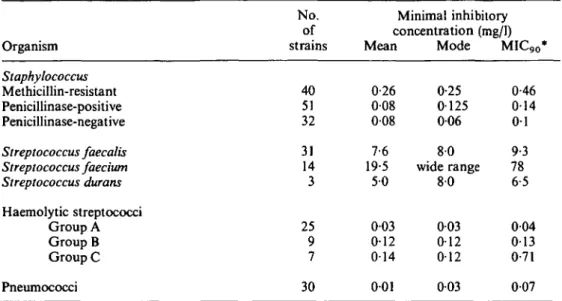
Table I summarizes MIC data of SCH against Gram-positive bacteria. As can be seen, the drug showed excellent activity against staphylococci and streptococci including the pneumococci. The drug showed activity against methicillin-resistant staphylococci also. Enterococci, especially Str. faecium, were not very susceptible to the agent. However, the incidence of Str. faecium among enterococci is only 1-8% in our area.
Table II compares the activity of various /J-lactam antibiotics against Staphylococcus
aureus (N = 35), Staph. epidermidis (N = 48) and methicillin-resistant Staph. aureus (N = 40). Staph. epidermidis includes coagulase-negative organisms. No further
183 Table I. Activity of Sch 29482 against Gram-positive bacteria
Organism Staphylococcus Methicillin-resistant Penicillinase-positive Penicillinase-negative Streptococcus faecalis Streptococcus faecium Streptococcus durans Haemolytic streptococci Group A Group B Group C Pneumococci No. of strains 40 51 32 31 14 3 25 9 7 Minimal inhibitory concentration (mg/1) Mean 0-26 0 0 8 0 0 8 7-6 19-5 5 0 0 0 3 0-12 0 1 4 Mode 0-25 0125 0 0 6 8 0 wide range 8 0 003 012 012 MIC9 0-46 014 0 1 9-3 78 6-5 0 0 4 0 1 3 0-71 30 001 003 007
•Concentration required to inhibit 90% of the strains examined.
Table II. Comparative activity of /Mactam antibiotics against Staph. aureus (N = 35), Staph.
epidermidis (N = 48), and methicillin-resistant Staph. aureus (N = 40)
Antibiotic SCH Methicillin Penicillin G Cephalothin Cefamandole Cefaclor Cefoperazone N-Formimidoyl thienamycin SCH (30°C) Penicillinase positive MIC (mean) 008 2 0 0-2 0-34 4-22 1-33 0 0 3 — Penicillinase negative MIC (mean) 008 1-2 002 016 0-24 1 96 102 003 — Methicillin-resistant MIC (mean) MIC 9 0*
0-26 4-8 0-9 1-9 33-7 8-7 008 1-6 0-46 7-2 2-5 4-8 73 18-7 0 1 4 •Concentration required to inhibit 90% of the examined strains.
Incubation was carried out at 37°C, unless otherwise indicated, for 24 h.
and negative strains. Only the thienamycin compound had similar activity. SCH and thienamycin also showed activity against methicillin-resistant organisms, when tested in agar dilution with an inoculum of 10* per spot and incubated for 24 h at 37°C. These two drugs were more active than cefamandole or cephalothin, which were shown elsewhere to be the most active /Mactam drugs against methicillin-resistant staphylococci (Kayser, 1980). Incubation of plates at 30°C increased MICs of SCH approximately 10 times.
184 F. H. Kayser and I. Kuhn 8 § ~ 6 (J _ 5 o
1 «
•5 3s
F l z~iz
HZ
SCH^ (37°C;48h) 1 - 1 r' L_
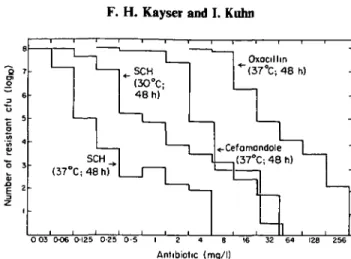
^SCH (30°C; 48 h) 1 Oxocillin <"(37°C;48 h) 1—1 1 <-Cefomondole 1 ,(37°C; 46 1 1 1 h) -0 -03 0-06 0125 0 2 5 0-5 1 2 4 B 16 32 64 128 256 Antibiotic (mg/l)Figure 1. Composition of highly methicillin-resistant Staph. aureus strain EK 695 of cells with different
levels of resistance to SCH, cefamandole and oxacillin
It is well known that populations of methicillin-resistant staphylococci are composed of cells differing widely in their resistance to /Mactam antibiotics. This heterogeneity was also observed in case of SCH (see Figure 1). However, the resistant minorities in populations are less resistant to SCH than to oxacillin or cefamandole.
Penicillin-tolerant staphylococci are known to be susceptible to penicillins in MIC tests, but highly resistant to the killing effect of these drugs (Sabath et al., 1977). We examined the tolerance phenomenon in 32 Staph. aureus and epidermidis strains (16 of each species) against methicillin and SCH. Only one Staph. aureus culture was found to be tolerant to the two drugs. Figure 2 demonstrates the kinetics of killing of the tolerant
icr Staph. aureus, tolerant 8 12 16 I n c u b a t i o n ( h ) 20 2 4
Figure 2. Rates of killing of Staph. aureus strain FK. 484 and FK 485 by methicillin and SCH. Strain
Table HI. Comparative activity of /J-lactam antibiotics against enterococci (N = 48)
Minimal inhibitory concentration (mg/1) Antibiotic Mean SCH Penicillin G Ampicillin Methicillin Cephalothin Cefamandole Cefaclor Cefoperazone N-Formimidoyl thienamycin 9-8 21 0-7 34-9 34-4 29-8 1190 28-5 4-3 lode 8 2 1 32 32 32 128 32 MIC90* 300 100 2-9 1570 1300 1000 2200 900 8 0 Concentration required to inhibit 90% of the examined strains.
and a non-tolerant strain by methicillin and SCH. Destruction of drugs during growth of the tolerant culture in comparison with the non-tolerant culture did not occur.
Table HI summarizes MIC data of /?-lactam antibiotics against enterococci. Although SCH was not as active as penicillin or ampicillin against enterococci, it showed some activity, which was about 4 times greater than the activity of cephalosporins. Thienamycin also proved to have a moderate activity against these problem bacteria.
All drugs were active against /J-haemolytic streptococci and pneumococci (see Table IV). Penicillin G and thienamycin were most active, closely followed by SCH, ampicillin and cefamandole.
Examination of bactericidal activity of SCH gave MBC values which were identical to MICs against most of 80 Gram-positive strains examined. MBCs for methicillin-resistant staphylococci were 4-16 times, and for the tolerant Staph. aureus culture, more
Table IV. Comparative activity of /Mactam antibiotics against streptococci and pneumococci Antibiotic SCH Penicillin G Ampicillin Methicillin Cephalothin Cefaclor Cefalexin Cefamandole Cefoperazone TV-Form imidoyl thienamycin Group A (W =25) 0 0 3 0004 0 0 1 0 1 3 0-25 0-25 0-5 0 0 3 0 1 3 < 0 0 3 Mode Group B (N = 9) 013 0 0 3 0 1 0-5 0-25 8 0 8 0 0 1 3 0-25 sSO-03 MIC (mg/1) Group C (JV=7) 013 001 003 0-25 0-25 2 0 2 0 006 0-25 «=003 Pneumococci (N = 30) 0 0 3 0008 0 0 1 0 0 6 0 0 6 0-25 1 0 0 0 6 0 0 6 <003
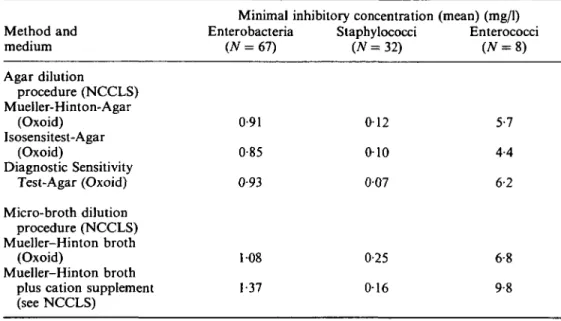
Table V. Effect of methods and media on in-vitro activity of Sch 29482 Method and medium Agar dilution procedure (NCCLS) Mueller-Hinton-Agar (Oxoid) Isosensitest-Agar (Oxoid) Diagnostic Sensitivity Test-Agar (Oxoid) Micro-broth dilution procedure (NCCLS) Mueller-Hinton broth (Oxoid) Mueller-Hinton broth plus cation supplement (see NCCLS) Minimal Enterobacteru (N = 67) 091 0-85 0-93 108 1 37 inhibitory concentration i Staphylococci (N = 32) 012 010 0 0 7 0-25 016 (mean) (mg/1) Enterococci (tf = 8) 5-7 4-4 6-2 6-8 9-8
than 100 times higher than MICs. Killing of Staph. aureus and enterococci was often less effective at higher drug concentrations.
In-vitro factors and activity of SCH
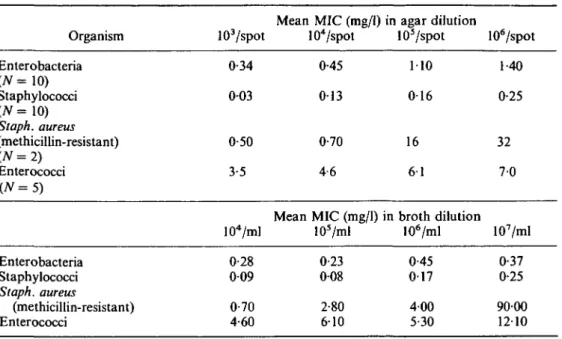
/Mactam antibiotics are known to be of varying stability to /J-lactamases. Instability of a drug to a /Mactamase can result in wide differences in MIC results according to the method used. Instability also can result in a significant inoculum effect. Activity of antimicrobials in vitro can also be influenced by the composition of the test medium. We, therefore, examined the influence of some in-vitro parameters on results obtained with SCH. The enterobacteria used for these tests were a representative collection of organisms as described in the 'Methods' section. Table V demonstrates that neither the method nor various media influenced MIC results of SCH. Table VI shows that the size of the inoculum also had no effects on test results. The only exceptions were methicillin-resistant staphylococci. Because of the typical heterogeneity (see Figure 1), MICs for methicillin-resistant staphylococci were greater at higher inoculum sizes.
Discussion
The penem antibiotic SCH has been shown in this study to be an excellent antibiotic against most species of Gram-positive organisms. In particular it exhibited some activity against methicillin-resistant staphylococci, although the typical characteristics of these bacteria—heterogeneity and influence of incubation temperature on phenotypic expression of resistance—were also observed with SCH. The drug was as active as penicillin G against penicillinase-negative variants of methicillin-resistant strains (data were not shown here) and, thus can be considered as a possible choice in the treatment of infections caused by such bacteria. This might be important in the future, because
Table VI. Effect of inoculum size on activity of Sch 29482 Organism Enterobacteria (N= 10) Staphylococci Staph. aureus (methicillin-resistant) (AT = 2 ) Enterococci (AT = 5 ) Enterobacteria Staphylococci Staph. aureus (methicillin-resistant) Enterococci 103/spot 0-34 0 0 3 0-50 3-5 104/ml 0-28 0 0 9 0-70 4-60 Mean MIC (mg/1) 107spot 0-45 013 0-70 4-6 Mean MIC (mg/1) 105/ml 0-23 008 2-80 610 in agar dilution 105/spot 110 016 16 6 1 in broth dilution 106/ml 0-45 0 1 7 4 0 0 5-30 106/spot 1-40 0-25 32 7 0 107/ml 0-37 0-25 9000 1210
there is a world-wide increase of epidemic infections in hospitals caused by staphylococci, simultaneously resistant to /?-lactam antibiotics, aminoglycosides and other antimicrobials (Shanson, Kensit & Duke, 1976; Crossley et al., 1979; Graham et
al., 1980; Amirak et al, 1981. Kayser, F. H., 1981 personal observation). SCH has also
been shown to be highly active against streptococci and pneumococci. Enterococci, however, were not as susceptible to SCH as to ampicillin or penicillin G, although they were more sensitive to this agent than to cephalosporin antibiotics. The good activity of SCH against the small collection of Gram-negative bacteria suggests that this drug has a broad antibacterial spectrum of activity.
Neither the size of the inoculum, the method used for susceptibility testing nor various test media affected the in-vitro activity of SCH against negative and Gram-positive bacteria. Such parameters can influence susceptibility testing of bacteria against /Mactam antibiotics that have a reduced stability to /J-lactamases. It was shown, for instance, that the in-vitro activity of cefoperazone, cefamandole and cephalothin against Gram-negative bacteria producing large amounts of TEM-/Mactamase, is highly dependent on the test method and the size of the inoculum used (Kayser, Huf & Homberger, 1981). Since such TEM-producers were among the strains examined and since neither the inoculum nor the method influenced the activity of SCH against these strains, it can be concluded that this drug is remarkably stable against the most frequently occurring /Mactamase of Gram-negative bacteria (Mathew, 1979).
References
Amirak, I. D., Li, A. K. C , Williams, R. J. & Noone, P. (1981). A fatal infection caused by methicillin-resistant Staphylococcus aureus acquiring resistance to gentamicin and fusidic acid during therapy. Journal of Infection 3, 50-8.
Bennett, J. V., Brodie, J. L., Benner, E. J. & Kirby, W. M. M. (1966). Simplified, accurate method for antibiotic assay of clinical specimens. Applied Microbiology 14, 170-7.
Crossley, K., Loesch, D., Landesman B., Mead, K., Chern, M. & Strate R. (1979). An outbreak of infections caused by strains of Siaphylococcus aureus resistant to methicillin and aminoglycosides. II. Epidemiological studies. Journal of Infectious Diseases 139, 273-87. Graham, D. R., Correavillasenor, A., Anderson, R. L., Vollman, J. H. & Baine, W. B. (1980).
Epidemic neonatal gentamicin-methicillin-resistant Staphylococcus aureus infection associated with nonspecific topical use of gentamicin. Journal of Pediatrics 97, 972-8. Kayers, F. H. (1980). Die Resistenz methicillin-resistenter Staphylokokken gegenuber neuen
Cephalosporin-Antibiotika. Infection 8, 165-70
Kayser, F. H., Huf, E. & Homberger, F. (1981). The microbiology of cefoperazone. Infection 9, Suppl. 1, 6-12.
Mathew, M. (1979). Plasmid-mediated /?-lactamases of Gram-negative bacteria: properties and distribution. Journal of Antimicrobial Chemotherapy 5, 349-58.
National Committee of Clinical Laboratory Standards (NCCLS). (1980). Standard methods for dilution antimicrobial susceptibility tests for bacteria which grow aerobically. NCCLS Proposed Standard: PSM-7.
Sabath, L. D., Casey, J. I., Ruck, P. A., Stumpf, L. L. & Finland, M. (1971). Rapid microassay of gentamicin, kanamycin, neomycin, streptomycin, and vancomycin in serum or plasma. Journal of Laboratory and Clinical Medicine 78, 457-63.
Sabath, L. D., Wheeler, N., Laverdiere, M., Blazevic, D. & Wilkinson, B. J. (1977). A new type of penicillin resistance of Staphylococcus aureus. Lancet i, 443-6.
Shanson, D. C , Kensit, J. G. & Duke, R. (1976). Outbreak of hospital infections with a strain of Staphylococcus aureus resistant to gentamicin and methicillin. Lancet ii, 1347-8.