SYSTEMATICS
Phylogenetic Relationships of the Bumblebee Subgenus Pyrobombus
(Hymenoptera: Apidae) Inferred from Mitochondrial Cytochrome B
and Cytochrome Oxidase I Sequences
STELLA KOULIANOSExperimental Ecology, ETH Zu¨rich, ETH Zentrum NW, 8092 Zu¨rich, Switzerland
Ann. Entomol. Soc. Am. 92(3): 355Ð358 (1999)
ABSTRACT Traditionally, the genus Bombus (Apidae: Apinae: Bombini) is divided into several
subgenera. This study derives an approximation of the relationships between 10 species of the subgenus Pyrobombus (from both Europe and North America), B. lapidarius L. and B. sichelii Radoszkowski from the subgenus Melanobombus, and B. terrestris L. from the subgenus Bombus s. str.,by comparing the mitochondrial cytochrome b and cytochrome oxidase I (COI) genes. Although bootstrap values for deep branches are mostly low, the sequences show signiÞcant phylogenetic signal, low homoplasy, and all trees share some patterns that are consistent with those from other phylogenetic studies on bumblebees. These results show that the subgeneric names Pyrobombus and Melanobombusdo not accurately reßect phylogeny, and therefore it would seem wise to revise the existing system into monophyletic species-groups or even ignore the subgeneric names altogether.
KEY WORDS Pyrobombus, bumblebees, cytochrome b, cytochrome oxidase I, mitochondrial
DNA, phylogeny
BUMBLEBEES OF THE subgenus Pyrobombus (Apidae: Apinae: Bombini: Bombus) are Holarctic. Pyrobombus is the largest subgenus of Bombus, comprising of .40 species (Williams 1994), and accounts for almost half of the North American fauna. Like all bumblebees, species of this subgenus are morphologically very sim-ilar (Williams 1985, 1994), and this has resulted in much confusion about species deÞnitions because they are also highly polymorphic with respect to coat color (Scholl et al. 1995). Pyrobombus, however, has been found to be heterogeneous with respect to en-zymes (Pekkarinen et al. 1979, Pamilo et al. 1987, Scholl et al. 1995) and male marking pheromones (Svensson 1979).
The close relationship of Pyrobombus to the subge-nus Melanobombus has been established by both mor-phological (Plowright and Stephen 1973) and molec-ular (Pamilo et al. 1987, Pedersen 1996) studies. Pyrobombushas been found to be paraphyletic by an extensive morphological study using wing venation by Plowright and Stephen (1973) and a molecular study, which only included 2 Pyrobombus species, by Ped-ersen (1996). These 2 studies show a close association between B. lapidarius L. (Melanobombus) and the Pyrobombus species B. bimaculatus Cresson and B. pratorumL. There is, however, evidence to the con-trary (i.e., no association between B. pratorum and B. lapidarius) from the morphology of the penis valve (Williams 1985). Plowright and StephensÕs (1973) study also separated 6 species from the main Pyrobom-buscluster and grouped these with species belonging to Bombus s. str.
The current study provides a comparison of the mitochondrial cytochrome b and cytochrome oxidase I (COI) genes from 10 Pyrobombus species (from both Europe and North America), B. lapidarius and B. sich-eliiRadoszkowski from the subgenus Melanobombus, and B. terrestris L. from the subgenus Bombus s. str., to derive an approximation of the relationships among these species. Tetragona dorsalis Friese (Apidae: Api-nae: Meliponini), identiÞed as the sister group to the Bombini by several independent studies (Cameron 1991, 1993; Sheppard and McPheron 1991; Koulianos et al. 1999), and Apis mellifera L. (Apidae: Apinae: Apini) (Crozier and Crozier 1993) were used as out-groups.
Materials and Methods
Total DNA was extracted from part of the thorax or from 2 legs of single individuals of 10 Pyrobombus species (Table 1), B. lapidarius, B. sichelii, and the outgroup T. dorsalis using a modiÞcation of the pro-tocol of Edwards and Hoy (1993), as in Koulianos et al. (1999).
A 716-bp fragment of the cytochrome b gene was ampliÞed from these bees (excluding T. dorsalis, for which the sequence was already available, see Table 1) using 2 oligonucleotide primers [CATTATT(G/ A)TCC(T/A)AATATTGA(A/T)ATTGC and ATTA CACCTCCTAATTTATTAGGAAT] (59 ends corre-sponding to positions 11168 and 11884, respectively, in Crozier and Crozier [1993]), and Taq polymerase (Promega, Wallisellen, Switzerland) in a Perkin Elmer (Rotkreuz, Switzerland) Cetus thermal cycler for 40
cycles under the following conditions: denaturation at 928C for 1 min, annealing at 408C for 1 min, and ex-tension at 728C for 1 min. A 521-bp fragment of the COI gene was also ampliÞed from these bees (exclud-ing those already sequenced by Pedersen [1996]; see Table 1 again) using primers AP-L-2176 and AP-H-2650, and conditions in Pedersen (1996). All products were puriÞed using the Wizard polymerase chain re-action (PCR) Preps DNA PuriÞcation System (Pro-mega).
One individual per species was sequenced in both directions from the puriÞed double-stranded PCR product, by Microsynth GmbH (Bulgach, Switzer-land).
Sequence information was aligned by eye. Diver-gence between bumblebee species (d) was estimated by the method of Tajima and Nei (1984). Parsimony analyses were carried out separately on the cyto-chrome b and COI sequences, as well as on the com-bined sequences using PAUP 4.0 d64 (Swofford, per-sonal communication) and a branch and bound search. Support for the nodes was estimated by 1,000 bootstrap replications using Seqboot, Dnapars, and Consense in PHYLIP 3.57c (Felsenstein 1995). Max-imum likelihood analyses were performed using PAUP 4.0 d64 and corrected with an estimated shape param-eter of the gamma distribution.
For each of the data partitions, PAUP 4.0 d64 was used to evaluate the strength of the phylogenetic sig-nal by performing skewness tests (Hillis and Huelsen-beck 1992) using 10,000 randomly selected trees, and to assess the impact of character homoplasy by re-weighting characters based on their rescaled consis-tency indices and reanalyzing them with parsimony. All voucher specimens are kept at Experimental Ecology, ETH Zu¨rich, Switzerland.
Results and Discussion
Five hundred and eighty-six base pairs from the cytochrome b gene, 333 bp from the COI gene, and the
combined sequences were compared with estimate the phylogenetic relationships among the species in-cluded in this study and to assess the phylogenetic informativeness of these sequences. All new se-quences have been deposited in GenBank and are accessible by the numbers AF066969Ð72, 84Ð85, 89, 91, AF077918Ð19, and AF084908Ð17.
Pairwise distances from the combined sequences ranged from 0.06 to 0.14 (Table 2). The distance be-tween B. sichelii and the Pyrobombus species B. jonel-lusKirby, B. hypnorum L., and B. lapponicus F. was as low or lower than comparisons within the Pyrobombus subgenus. In general, the largest distances were ob-tained by comparing B. terrestris, B. lapidarius, and B. bifariusCresson to each other and any other species. The distance between B. lapponicus and B. monticola Smith calculated from the COI sequences alone was 0.006, .10-fold smaller than all other comparisons. This suggests that B. monticola and B. lapponicus are not 2 separate species, contrary to evidence from mor-phology, behavior, and male marking pheromones (Svensson 1979).
Parsimony analysis of the cytochrome b gene yielded 133 informative characters, 2 most-parsimo-nious trees, a skewness value of g15 21.26 (P , 0.01),
and a homoplasy index of 0.08. Analysis of the COI gene yielded 51 informative characters, 12 most-par-simonious trees, a skewness value of g15 20.44 (P ,
0.01), and a homoplasy index of 0.06. Analysis of the combined sequences yielded 175 informative charac-ters, 1 most-parsimonious tree, a skewness value of g1
5 21.32 (P , 0.01), and a homoplasy index of 0.05. The skewness values show that the cytochrome b, COI, and combined sequences all contain highly sig-niÞcant nonrandom structure which is likely to reßect phylogenetic signal. The topology based on the anal-ysis of the COI region showed the lowest average bootstrap values and the lowest homplasy index, which is consistent with the Þndings of Sanderson and Donoghue (1996) and Kuzoff et al. (1998) that ho-moplasy indices are not inversely proportional to av-erage bootstrap values.
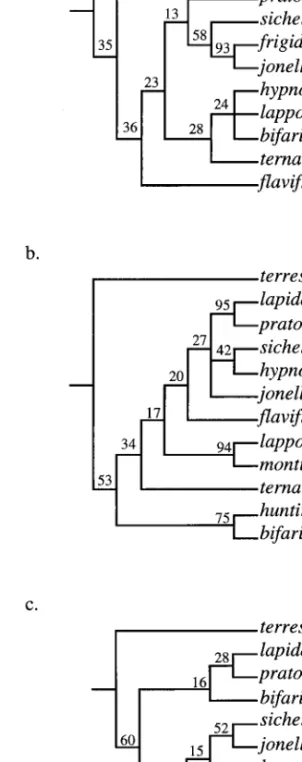
The parsimony trees obtained from the analyses are shown in Fig. 1. There are some differences in the topologies obtained from the 3 data partitions, how-ever, the trees also share some patterns. For example, Table 1. List of taxa used
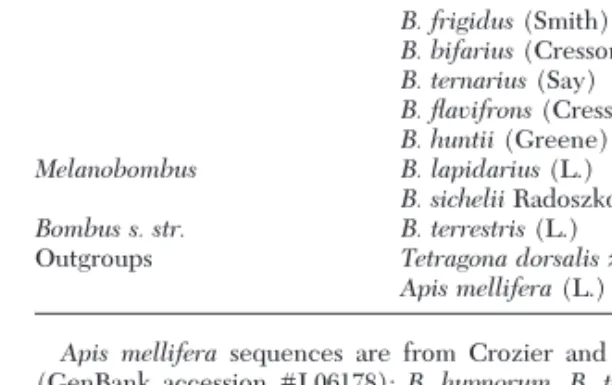
Pyrobombus Bombus lapponicus(F.) B. jonellus(Kirby) B. hypnorum(L.) B. pratorum(L.)
B. monticolaSmith (COI only) B. frigidus(Smith) (cyt b only) B. bifarius(Cresson) B. ternarius(Say) B. flavifrons(Cresson) B. huntii(Greene) (COI only) Melanobombus B. lapidarius(L.)
B. sicheliiRadoszkowski Bombus s. str. B. terrestris(L.)
Outgroups Tetragona dorsalis ziegleri(Friese) Apis mellifera(L.)
Apis mellifera sequences are from Crozier and Crozier (1993) (GenBank accession #L06178); B. hypnorum, B. terrestris, and B. lapidariusCOI sequences are from Pedersen (1996) (GenBank ac-cession #L26569-70, 73); and B. terrestris and T. dorsalis cytochrome b sequences are from Koulianos et al. (in press) (GenBank accession #AF002721, 25).
Table 2. Pairwise distances calculated according to Tajima and Nei (1984) for the combined cytochrome b and COI sequences
2 3 4 5 6 7 8 9 10 1 0.14 0.12 0.11 0.12 0.11 0.14 0.12 0.12 0.13 2 Ñ 0.11 0.12 0.11 0.10 0.11 0.11 0.12 0.13 3 Ñ 0.07 0.08 0.08 0.10 0.09 0.09 0.12 4 Ñ 0.07 0.07 0.09 0.07 0.09 0.11 5 Ñ 0.07 0.11 0.08 0.09 0.12 6 Ñ 0.09 0.06 0.08 0.10 7 Ñ 0.09 0.10 0.13 8 Ñ 0.09 0.12 9 Ñ 0.12
1, B. terrestris; 2, B. lapidarius; 3, B. sichelii; 4, B. jonellus; 5, B. hypnorum;6, B. lapponicus; 7, B. pratorum; 8, B. ternarius; 9, B. flavi-frons;10, B. bifarius.
in all trees B. terrestris is basal to all other bumblebees included in the analysis. In 2 of the 3 trees (Fig. 1 b and c), B. lapidarius clusters with B. pratorum. Finally, in all trees B. sichelii clusters within the Pyrobombus species than with B. lapidarius, which is currently in the same subgenus.
Many patterns shown here are consistent with those from other phylogenetic studies on bumblebees (e.g., Plowright and Stephen 1973, Scholl et al. 1995, Ped-ersen 1996). Scholl et al. (1995) screened 18 enzymes and found a close association between B. jonellus from Europe and B. frigidus Smith from North America to the exclusion of B. pratorum also from Europe. Both parsimony and maximum likelihood analyses of the cytochrome b gene also cluster B. jonellus with B. frigidus to the exclusion of the other European Py-robombusspecies present. The grouping of B. bifarius, B. ternariusSay, and B. huntii Greene, based on brood-rearing, colony-development characteristics, and wing venation (Plowright and Stephen 1973), is only partially supported by both analyses of the COI region, which includes all 3 species. In Fig. 1b, B. bifarius clusters with B. huntii, and B. ternarius is the sister group of all the other Pyrobombus species and both Melanobombusspecies. In Fig. 1c, B. ternarius clusters with B. lapponicus to the exclusion of B. bifarius. The close relationship between B. lapidarius and B. pra-torumis well supported from Fig. 1b and is consistent with the results of Pedersen (1996).
The trees inferred from the cytochrome b and COI genes by both parsimony and maximum likelihood methods show that the subgeneric names Pyrobombus and Melanobombus do not accurately reßect phylog-eny. One solution would be to include both B. lapi-dariusand B. sichelii within the subgenus Pyrobombus. However, it would be necessary also to reappraise the remaining species within Melanobombus. Because other subgenera (e.g., Mendacibombus, Sibiricobom-bus) (Williams 1985, 1994) and Fervidobombus (S.K., unpublished data) have also been found to be paraphyletic or even polyphyletic, it would seem wise to revise the existing system into monophyletic spe-cies-groups or even to ignore the subgeneric names altogether (Williams 1994).
Acknowledgments
I thank Horst Schwarz, Regula Schmid-Hempel, and Paul Schmid-Hempel for help with collecting bees and advice during the course of this work, and the Swiss National Sci-ence Foundation for grant support (#31Ð45798.95).
References Cited
Cameron, S. A. 1991. A new tribal phylogeny of the Apidae
inferred from mitochondrial DNA sequences, pp. 71Ð87. InD. R. Smith [ed.], Diversity in the genus Apis. West-view, Boulder, CO.
1993. Multiple origins of advanced eusociality in bees
in-ferred from mitochondrial DNA sequences. Proc. Natl. Acad. Sci. U.S.A. 90: 8687Ð8691.
Fig. 1. Relationship of the 10 Pyrobombus species to each
other. Trees a-c were obtained by parsimony analysis of the cytochrome b, COI and combined sequences, respectively. Trees a and b are consensus trees. Numbers at nodes are bootstrap percentages (1,000 replicates). Bs and Ml repre-sent the subgenera Bombus s. str. and Melanobombus, respec-tively. All other taxa are from the subgenus Pyrobombus.
*, Represents species for which only 1 gene region was
sequenced and therefore are missing from tree c. Maximum likelihood trees did not differ signiÞcantly from the parsi-mony trees for the same data partition.
Crozier, R. H., and Y. C. Crozier. 1993. The mitochondrial
genome of the honeybee Apis mellifera: complete se-quence and genome organization. Genetics 133: 97Ð117.
Edwards, O. R., and M. A. Hoy. 1993. Polymorphism in two
parasitoids detected using random ampliÞed polymor-phic DNA by the polymerase chain reaction. Biol. Con-trol 3: 243Ð257.
Felsenstein, J. 1995. PHYLI, p. 3.57c: phylogeny inference
package. The University of Washington, Seattle, WA.
Hillis, D. M., and J. P. Huelsenbeck. 1992. Signal, noise, and
reliability in molecular phylogenetic analyses. J. Hered. 83: 189Ð195.
Koulianos, S., R. Schmid-Hempel, D. W. Roubik, and P. Schmid-Hempel. 1999. Phylogenetic relationships
within the Apinae (Hymenoptera) and the evolution of eusociality. J. Evol. Biol. (in press).
Kuzoff, R. K., J. A. Sweere, D. E. Soltis, P. S. Soltis, and E. A. Zimmer. 1998. The phylogenetic potential of entire 26S
rDNA sequences in plants. Mol. Biol. Evol. 15: 251Ð263.
Pamilo, P., A. Pekkarinen, and S. L. Varvio. 1987. Clustering
of bumble bee subgenera based on interspeciÞc genetic relationships (Hymenoptera, Apidae: Bombus and Psi-thyrus). Ann. Zool. Fenn. 24: 19Ð27.
Pedersen, B. V. 1996. A phylogenetic analysis of cuckoo
bumblebees (Psithyrus, Lepeletier) and bumblebees (Bombus, Latreille) inferred from sequences of the mi-tochondrial gene cytochrome oxidase I. Mol. Phylogenet. Evol. 5: 289Ð297.
Pekkarinen, A., S. L. Varvio-Aho, and P. Pamilo. 1979.
Evo-lutionary relationships in northern European Bombus and Psithyrusspecies (Hymenoptera, Apidae) studied on the basis of allozymes. Ann. Entomol. Fenn. 45: 77Ð80.
Plowright, R. C., and W. P. Stephen. 1973. A numerical
taxanomic analysis of the evolutionary relationships of
Bombusand Psithyrus (Apidae: Hymenoptera). Can. En-tomol. 105: 733Ð743.
Sanderson, M. J., and M. J. Donoghue. 1996. The
relation-ship between homoplasy and conÞdence in a phyloge-netic tree, pp. 67Ð89. In M. J. Sanderson and L. Hufford [eds.], Homoplasy and the evolutionary process. Aca-demic, New York.
Scholl, A., R. W. Thorp, J. A. Bishop, and E. Obrecht. 1995.
The taxanomic status of Bombus alboanalis Franklin and its relationship with other taxa of the subgenus Pyrobom-busfrom North America and Europe. Pan-Pac. Entomol. 71: 113Ð120.
Sheppard, W. S., and B. A. McPheron. 1991. Ribosomal
DNA diversity in Apidae, pp. 89Ð102. In D. R. Smith [ed.], Diversity in the genus Apis. Westview, Boulder, CO.
Svensson, B. G. 1979. Pyrobombus lapponicus auct., in
Eu-rope recognised as two species: P. lapponicus (Fabricius, 1793) and P. monticola (Smith, 1849) (Hymenoptera, Apoidea, Bombinae). Entomol. Scand. 10: 275Ð296.
Tajima, F., and M. Nei. 1984. Estimation of evolutionary
distance between nucleotide sequences. Mol. Biol. Evol. 1: 269Ð285.
Williams, P. H. 1985. A preliminary cladistic investigation
of relationships among the bumble bees (Hymenoptera, Apidae). Syst. Entomol. 10: 239Ð255.
1994. Phylogenetic-relationships among bumble bees (Bombus Latr.): a reappraisal of morphological evidence.
Syst. Entomol. 19: 327Ð344.
Received for publication 25 August 1998; accepted 3 Novem-ber 1998.