Gas Phase Chromatography Experiments with Bromides of Tantalum
and Element 105
By H. W. Gäggeler, D. T. Jost, J. Kovacs, U. W, Scherer, A. Weber, D. Vermeulen
Paul Scherrer Institut, CH-5232 Villigen, Switzerland
A. Türler, K. £. Gregorich, R. A. Henderson, K. R. Czerwinski, B. Kadkhodayan, D. M. Lee, M. Nurmia, D. C. Hoffman
Lawrence Berkeley Laboratory, Berkeley, CA 94720, USA
J. y . Kratz, M. K. Gober, H. P. Zimmermann
Institut für Kernchemie, Universität Mainz, D-6500 Mainz, Federal Republic of Germany
M. Schädel, W. Brüchle, E. Schimpf
Gesellschaft für Schwerionenforschung mbH, D-6100 Darmstadt, Federal Republic of Germany
and I. Zvara
Joint Institute for Nuclear Research, Dubna, USSR (Received October 28,1991)
Element 105 / Transition metal group V / Chemical properties / Bromides / Volatility / Gas chromatography
Abstract
The retention behavior of volatile bromide molecules of short-lived isotopes of tantalum and element 105 in KCl coated quartz columns was studied using continuous isothermal gas chromatography. HBr and HBr saturated with BBrs vapor were used as reactive gases. The isotopes were produced in the fusion reactions ^ ° N e + " " Eu and ^^O + ^^^Bk, respectively. The reac-tion producta were transported from the accelerator to the chromatography set-up with a gas-jet system using an aerosol with He as carrier gas and KCl as transporting particles. The measured retention times are compared to those of " ' N b bro-mides from a previous study. The retention times of niobium and tantalum bromides are very similar, in agreement with expec-tations based on the nearly identical Sublimation enthalpies of N b B r j and TaBr;. For the bromides of element 105, higher retention times are found, indicating a lower volatility of lOSBrs than of NbBrs and TaBrs. On the basis of empirical systematics, a Sublimation enthalpy of 138± 15 kJ/mol can be estimated for 105Br5 from the experimental data.
1. Introduction
Recently, considerable interest has been drawn to the chemical properties of the heaviest Clements. At very high atomic numbers, relativistic eflfects influenae the electronic structure of the atoms even for valence elec-trons [1—6]. Calculations, taking relativistic terms into account, show a strong stabilization of shells with low angular momenta such as the spherical s and Pii2 Orbitals. Based on this, it was suggested that lawrencium (Lr) and element 104 might behave like volatile ;7-elements [4]. This would be in contrast to
expectations based on their positions in the periodic table of Clements which would indicate that Lr should behave like an actinide and element 104 like a tran-sition metal of group 4. However, no experimental evidence for a /»-element behavior in Lr [7, 8] or el-ement 104 [9] has been found so far.
Recently, relativistic self-consistent Dirac-Slater calculations have been performed for chemical species of element 105. Properties of Compounds of element 105 in aqueous Solution [10] as well as for gaseous halides [11] were calculated. It was predicted that, e.g., the pentachlorides and pentabromides of element 105 should be more volatile than those of its chemical homologs of the transitions metals of group 5, N b and T a [ l l ] .
These theoretical predictions have stimulated ex-perimental efforts to search for "relativistic effects" in the chemical behavior of the heaviest Clements. How-ever, such investigations are extremely difficult be-cause only a few atoms of short-lived isotopes can be produced at heavy ion accelerators. Under thesc conditions, the classical law of mass action is not a priori valid [12], In addition, if the kinetics of the chemical reactions are too slow the volatile molecules cannot be formed in due time [13]. This necessitates investigations with molecules of chemical homologs with similar volatility which are also produced at sub-tracer levels. In addition, thermodynamic properties, such as Sublimation or evaporation enthalpies, boiling and melting points etc. cannot be measured in single-atom chemistry. However, it has been shown [14], that correlations cxist between macrochemical quantitites, such as the boiling point or the Sublimation enthalpy, and the microchemical quantity adsorption enthalpy. In gas phase chemistry experiments, adsorption
en-thalpies of Single atoms or molecules with the surface of the chromatography columns can be determined, either by measuring the deposition temperature in a thermochromatographic column [15] or by determin-ing the retention time in an isothermal column [16],
The heaviest element whose chemical properties have been investigated is element 105. Early studies were performed by Zvara et al. [17, 18] with volatile Chlorides and bromides in gas thermochromatography experiments. They showed that these halides deposit in glass and nickel columns at temperatures significantly higher than those of the same Compounds of niobium. The authors concluded that lOSCls and lOSBrj are less volatile than N b C l j and NbBrs, respectively. However, in order to compare the experimentally de-termined deposition temperatures for Compounds of niobium and of element 105 some theoretical calcu-lations were needed to take account of the very large differences in half-lives of the nuclides used (®°Nb with
Ti/2 = 14.6 h and 2®M05 with 7^1/2 = 1.8 s). Recently, these results were confirmed by additional measure-ments [19],
Gregorich et al. [20] and Kratz et al. [21] performed first studies in the aqueous phase and showed that element 105 has properties which are typical for a transition metal of group 5 such as a pronounced Sorption on glass surfaces from concentrated nitric acid Solution [22]. Experiments to study the extraction behavior from mineral acid solutions into methyl isobutyl ketone [20] and triisooctyl amine [21] showed that element 105 behaves similarly to niobium and not like its direct homolog in the periodic table, tantalum. This surprising result was the object of further studies which were performed with diisobutylcarbinol as ex-tractant [23].
In the current work the gas Chromatographie behavior of the bromides of tantalum and element 105 in KCl covered quartz columns was studied. Some of the results were presented earlier [24, 25]. All exper-iments were performed with the chromatography sys-tem OLGA II [26]. This device allows the determi-nation of retention times of volatile species in iso-thermal columns by using the half-lives of the nuclides as a " d o c k " [16].
2. Experimental
Element 105 was produced at the LBL 88-inch cyclo-tron in the ^«O-h^'^^Bk reaction. A 114-MeV + beam passed through a 1.8 mg/cm^ HAVAR window foil, 0.2 mg/cm^ of N j cooHng gas and a 2.49 mg/cm^ Be target backing foil before it entered the 0.54 mg/ cm^ thick ^'^^Bk (as an oxide) target. The experiments were performed less than 75 days after the Bk was chemically separated from Cf. Hence, only a small fraction of the 330-d ^''^Bk had decayed into The calculated energy in the target was 98 to 99 MeV. At this bombarding energy the nuclides 2^^105 and " M 0 5 from the 5n and 4n reaction
Chan-nels are produced with cross sections of 6 + 3 nb and 2 + 1 nb, respectively [27]. ^ ^ ^ 0 5 has a half-Hfe of 34 s and decays by a-emission (67%) and by spontaneous fission (SF) (33%) [27, 33]. " M 0 5 has a half-life of 27 s and decays by a-emission (43%) and by SF (57%) [27]. Hence, at our bombarding energy the total cross sections for production of a-decaying isotopes of el-ement 105 is 4.9 nb, and that of SF decaying isotopes of element 105 is 3.1 nb. Typical beam currents applied to the target were 0.5 particle nA of
Tantalum isotopes were produced at the same
cyclotron using the reaction (approx. 0.25 mg/cm^ on 4.5 mg/cm^ Be). Actual beam currents
were 0.07 to 0.15 particle ^A. The same set-up was used as above and the energy in the target was 143 MeV. The experiments were performed with the isotopes i^^Ta (^1/2 = 20 s), i®®Ta (ri/2 = 32s), and i^^Ta (7-1/2 = 78 s).
The reaction products recoiling out of the target were stopped in a collection Chamber which was con-tinuously flushed with a He gas-jet loaded with KCl particles at a rate of about 1 1/min He. The KCl par-ticles were generated in an oven kept at 680 °C by passing the carrier gas (He) over a porcelain boat containing the KCl.
The pressure in the target recoil Chamber was about 1.3 bar. The products of nuclear reactions re-coiling from the target attached to the KCl aerosol particles and were transported through a 2 mm I.D. and about 10 m long Polyethylene capillary to the gas chromatography set-up. A schematic drawing [26] of the gas chromatography and counting device is shown in Fig. 1. Reaction products were stopped on a quartz wool plug {1=5 mm) inserted into an empty quartz tube (I.D. = 6 mm, / = 2 5 c m ) . The tube ended in a 5 cm long capillary shaped exit (I.D. = 1 mm). The column was placed in a five-section oven (HERAEUS). At the position of the quartz wool plug, the temperature was kept fixed at a value of about 900 °C, significantly above the melting point of KCl (T^m.p. = 770°C). All other sections of the oven formed an isothermal section in the quartz tube. The tempera-ture of this isothermal section could be varied between 200 and 700 °C. Each experiment lasted typically 2 to 6 hours in case of element 105 and about 5 min for tantalum. At the position of the quartz wool plug, 100 ml/min HBr^ was added as brominating agent. This flow rate was found to be Optimum [28]. In some experiments the HBr gas was mixed with BBra vapor by passing HBr over liquid BBrj kept at 0°C. Despite careful cleaning of all gases, boron oxide was formed with the trace amounts of oxygen in the system which probably entered the system via diffusion of air through the Polyethylene transport capillary. This white powder deposited onto the walls of the capillary and lowered the transport yields of the products. Moreover, final samples had poor a-resolutions.
In the experiments with element 105, the quartz columns were pre-treated before each experiment by heating them for about 15 min in a flowing HBr gas
HBr/BBra Gas-Jet
(He/KCI) Capillary
^ Exhaust
Fig. 1. Schematic drawing of the gas chemistry and counting device OLGA (On-Line Gas chemistry /Ipparatus). Products transported by a gas-jet system are continuously fed into a chromatography column (Si02) and collected on a quartz wooi plug. By melting of the transporting particles (KCl) and by interaction with a reactive gas (e.g., HBr), volatile Compounds are formed which are transported through an isothermal second part of the column and ejected into a recluster unit. By reattach-ment of these molecules on new particles they can be transported through a capillary to a tape system. Here the particles contain-ing the separated molecules are deposited. From time to time the tape is moved stepwise to bring the deposited activity in front
of PIPS detectors for a- and SF-counting.
and He/KCl gas-jet at 700 °C. This treatment turned out to be necessary to obtain reproducible results.
In the experiments with tantalum reasonable yields were only obtained in experiments where the HBr gas contained BBrs vapor.
After the chromatography column the volatile species were injected into a recluster Chamber (I.D. = 7 cm, / = 6 0 cm). This unit was flushed with 2 //min N2 loaded with new KCl particles. The total gas (about 3.1 //min) containing the products under study at-tached to the KCl particles was then transported through a capillary (I.D. = 2 mm, 1 = 5 m) to the counting device, a modified magnetic tape Station. Here, in a collection Chamber the products were de-posited on the surface of a conventional Computer tape. Every 30 s the tape was stepped to transport the activity in front of 450 mm^ PIPS (passivated ion-implanted planar Silicon) detectors (CANBERRA) for a- and SF-counting. The data were stored in an event-by-event mode using CAMAC electronics connected to a /iVAX. Data transfer and analysis were performed with the PSI-TANDEM [29] and the CERN-PAW [30] Software packages [31].
The distance between the end of the capillary and the tape surface was 6 mm [26]. The visible deposits on the tape (KCl or B2O3) had < 6 mm diameter. The distance between tape and detector surface was 3 mm and the efficiency for a-counting was 38%. By differ-ential pumping, the pressures were kept at about 17 mbar in the collection Chamber and 20 mbar in the
120
Time [ s ]
Fig. 2. Spontaneous fission activity measured in the ' ® 0 + reaction during a direct catch experiment with a beam dose of 8.7 • 10'® particles. The fit to the data results in a short-lived component with 7'i/2 = 2 8 ± 8 s and a long-lived component from produced in this reaction via ingrowth from
[32].
counting area. Due to the thickness of the tape (6.7 mg/cm^), it was only possible to perform a- and SF-counting from the front side of the tape.
For the chemistry experiments with tantalum, the counting device was identical to that used for the study of niobium [28]. It consisted of an aerosol particle absorbing glass fiber filter Station mounted on top of a high purity Ge y-ray detector for continuous monitoring of the y-rays of the tantalum isotopes of interest.
3. Results
3.1. D i r e c t c a t c h e x p e r i m e n t s
During each series of experiments, one direct catch (DC) measurement was made. These measurements were used to normalize the chemical yields.
In the DC runs, the quartz column was empty and not heated. All gas flow rates were kept the same as in the chemistry experiments.
An absolute yield of the gas-jet transport system was not determined. However, based on some esti-mates made via a-Unes from long-lived actinides mea-sured in the ^'^'Bk experiments [32], we obtained typical transport plus deposition yields on the tape of about 60 + 20%.
The a-particle spectra measured in the ^ ®0 + experiments showed mainly lines from short-lived iso-topes of polonium and ^"Bi. These nuclides were most likely produced in nucleon transfer reactions between and a Pb contamination in the target. Unfortunately, the contamination was rather high and prevented a detection of the ^^^105 (8.45-8.67 MeV) [27,33] and ^^^los (8,35 MeV) [27] a-lines. The Bi and Po activities also obscured a-a correlation measure-ments with the corresponding Lr daughter nuclides. Detection of and ^^^105 was therefore possible only via their SF decay. In Fig. 2 the SF-decay curve is shown which was accumulated during several DC
runs with a total of 8.7 -10^® ions. A two-component fit [34] results in a short-lived activity with a half-life of 28 + 8 s, in agreement with the presence of and and a long-lived component which we attribute to Under the assumption of a gas-jet transport plus deposition yield of 60 + 20%, the cross section of the short-lived component amounts to 4.1 + 1.6 nb. This cross section is in good agreement with the value of 3.1 nb estimated above for the sum of the SF branches of plus ^^^105 at this bombarding energy. Kratz et al. [21] found for the same bombarding energy in the chemically separated element 105 fraction « « 3 0 s SF activity with a cross section of 4 nb.
3 . 2 . E x p e r i m e n t s w i t h t a n t a l u m
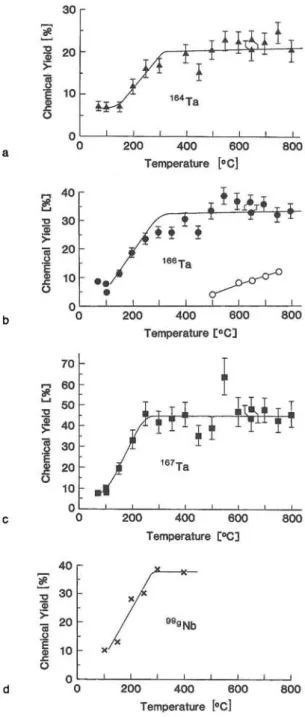
Fig. 3a through 3 c show the chemical yields for differ-ent tantalum isotopes using HBr containing B B r j vapor as reactive gas. In general, for temperatures above 100°C the yields increase and reach a plateau at about 300°C. The absolute value of the maximum chemical yield is dependent on the half-life of the nuclide. This has already been observed in previous studies [24, 25, 28]. It can be explained by the time needed in the recluster unit for the molecules to re-attach on new KCl particles before transport to the detector. This time was estimated to be 18 to 25 s [24, 25, 28], in agreement with a value of about 20 s deduced from Fig. 3.
In Fig. 3b, the yield curve with pure HBr as reac-tive gas is also shown for ^®®Ta. For temperatures above 500 °C, slowly increasing yields are found which reach a value of only 15% at 750°C. Both the shape of this curve and the low chemical yield values indicate that with pure HBr no quantitative bromination of tantalum can be achieved.
In Fig. 3d, the yield curve from Ref. [28] for 15-s is shown. These measurements were performed with pure HBr. In contrast to tantalum, pure HBr produces volatile niobium bromide molecules with high yields for temperatures > 300 °C. Their retention behavior is very similar to that of tantalum bromide molecules formed with HBr/BBrs as reactive gas.
3 . 3 . E x p e r i m e n t s w i t h e l e m e n t 105
In the first preliminary experiments [24] HBr contain-ing BBrs vapor was used as the reactive gas. However, due to the experimental problems caused by the depo-sition of B2O3 (see above) most of the studies described in this work were performed with pure HBr. Only at two temperatures (200 and 400 °C), additional exper-iments were made with HBr containing B B r j vapor.
Monitoring the a-count rates of polonium isotopes produced during the on-line experiment, we found that yield fluctuations of + 2 0 % occurred due to fluctu-ations of the transportation yields during the long measurements. We have therefore normalized the
30
l
1 10
,
40 •0 30 (D > 0 20 ü E 0) 10 .c ü 0 1 6 4 Ta -J I L 200 400 600 800 Temperature [°C] 200 400 600 Temperature ["C] 200 400 600 800 Temperature ["C] 200 400 600 800 Temperature [°C]Fig. 3. Chemical yields for three isotopes of Ta behind a quartz column heated at different temperatures using a He/KCl gas-jet transport system and HBr saturated with BBrs vapor as reactive gas (Figs. 3a through 3c). The open circles in Fig. 3b depict data measured with pure HBr. Fig. 3d shows the yield data for ®®«Nb from Ref [28] measured with the same system. They were
obtained with pure HBr. The lines are drawn to guide the eye.
chemical yields of element 105 to those of 45-s 2i2m2pQ P J - Q J J J a previous study [24] it is known that polonium forms volatile bromides with high, constant yields down to temperatures of about 300 °C.
The determination of the chemical yields of el-ement 105 bromides was made by the measurel-ement of the SF-decay of the isotopes ^ ^ ^ 0 5 and ^ ^ ^ 0 5 . Fig. 4 summarizes the measured SF activity from the sum of all gas chemistry experiments. A short-hved activity with a half-life of 4 4 l i 2 s was found which agrees
T i m e [ s ]
Fig. 4. Measured spontaneous fission events from all gas chemis-try experiments. The solid line is a maximum likelihood fit to the data giving a half-life of 411 {f s, with the 68% confidence
limits indicated by the dashed line.
120
(HBr/BBrj) O ^®®Ta(HBr)
200 400
Temperature |
Flg. 6. Relative chemical yields for bromides of (from Ref [28]) with pure HBr and of ^««Ta and plus with pure HBr, and with HBr containing BBra vapor, respectively. Also shown are the results from R e f [24] for element 105 bro-mides with HBr containing BBrj vapor at 300 and 400°C. The value at 400°C was averaged with the result from this work (see
Fig. 5). •O 1 0.5 200 400 600 Temperature [°C] 800
Fig. 5. Relative chemical yields for element 105 bromides with pure HBr as reactive gas as a function of the temperature of the isothermal part of the quartz chromatography column (open squares), and with HBr containing BBrs vapor (closed squares). A relative chemical yield of 1 corresponds to an absolute
chemi-cal yield o f 4 0 ± 1 0 % .
within the given error with the expected value of « 3 0 s.
In Fig. 5, the relative chemical yields of element 105 bromides are shown for the temperature ränge 200 to 700 °C. The relative chemical yield of 1 corresponds to an absolute chemical yield of 40 + 10%. The errors given in Fig. 5 represent Statistical uncertainties only. For the yield values at, e.g., 400°C and 700°C the total SF-count rates were 20 (11/6/3/0 events in detectors 1/2/3/4 at 30 s steps) and 19 (7/7/3/2), respectively.
In a Single run, we tried to form volatile Chlorides with HCl gas instead of HBr. For a gas flow rate of 100 ml/min HCl and a temperature of 700 °C no formation of volatile 105 Chlorides was observed.
4. Discussion
Figure 6 summarizes the results from this work, those for niobium bromides with pure HBr [28], and for element 105 bromides with HBr containing BBra vapor [24]. From the results of element 105 bromides from Ref. [24], only the yields at r < 4 0 0 ° C , averaged
with the results from this work, are shown. At higher temperatures the yields dropped because of a non-optimum diameter of the exit capillary of the chromatography column (see Refs. [26, 28]).
The curves for niobium bromides with HBr and tantalum bromides with HBr/BBrj are very similar. This is in line with the nearly identical values of the boiling points or Sublimation enthalpies for N b B r j and TaBrs. They are 356 and 344°C, and I I I and
106kJ/Mol, respectively [35]. However, on the basis of our study, no conclusive answer to the question can be given whether the pure bromide molecules or the oxy-bromide molecules are formed. It can be expected that the properties of NbOBra and T a O B r j molecules should also be very similar, though no detailed litera-ture data exist. However, since with the very strong brominating agent HBr/BBrs Ta behaves like Nb, we believe that most likely the molecules transported along the column are the pentabromides rather than the oxy-bromides. It is interesting to note that bromi-nation of niobium is easier to achieve than is that of tantalum.
The onset of increasing relative chemical yields for element 105 bromides is shifted by about 130±60°C towards higher temperatures compared to those of niobium and tantalum bromides. Also, with the strongly brominating agent HBr/BBra the yield curve did not change compared to pure HBr. This again supports the conclusion that most likely the molecule which we investigated in our work is lOSBrs and not any less volatile oxy-bromide [36]. From this result we conclude that element 105 bromide has a higher adsorption enthalpy on the surface of the columns than does TaBrs or NbBrs. From this we conclude that lOSBrs is less volatile than NbBrs and TaBrj. This is in agreement with thermochromatographic studies [18,19], but disagrees with very recent theoreti-cal predictions on the chemitheoreti-cal properties of group 5 halides [11].
From the measured retention temperatures the adsorption enthalpy can be calculated using Eq. (1) [16]:
Table 1. Adsorption enthalpies {AH^ for niobium, tantalum, and element 105 bromides in the KCl coated quartz columns, and determination of the Sublimation enthalpy {AH^ of element 105 bromide
Element Nuclide Tm Tsox AHl Ref AH,
(='r)[s] [°C] [kJ/mol] [kJ/mol]
Tantalum 32 190+40 88+ 4 this work 106"
Niobium »»«Nb 15 190+40 85+ 4 Ref. [28] I I I "
105 262JQ5_^263JQ5 « 3 0 320 + 50 113±11 this work 138 + 15'
" Calculated with Eqs. (1) and (2). '' Experimental value from Ref. [35].
' Deduced from Eq. (3) as described in the text below.
{ t x p { - A H J R T ) Q X v { A S J R ) } ] l v o T (1)
where t, is the retention time, TQ is 298 K, 0 is the cross section of the tube (0.283 cm^), d is the diameter of the tube (0.6 cm), L is the length of the isothermal part of the tube (11 cm), AHa is the adsorption en-thalpy, R is the gas constant (8.31 J/molK), T i s the temperature (K), VQ is the gas flow rate (18.33 cm^/s) and ASa is the adsorption entropy, calculated (for mobile adsorption at a certain Standard condition [15]) with
ASa = i?ln[l c m - i • vS\RT/2nM)'i^] + R/2 (2)
where Vq is the characteristic frequency of the adsorb-ent on the surface ( « l O ' ^ s " ' ) and M i s the mol mass of adsorbed molecules.
From the measured yield curves, the retention times (tr) were determined as described in Ref. [16] by taking the temperature value at a relative chemical yield of 0.5 (7^50%) to correspond to a equal to the half-life of the nuclide. Table 1 shows the adsorption enthalpies calculated from the data depicted in Fig. 5, assuming the volatile molecules to be the penta-bromides.
It is interesting to note that our T^ox values and the deduced adsorption enthalpies are higher than some literature data obtained with the gas thermo-chromatography technique with pure quartz columns. By intercomparison of the formulae given for gas thermochromatography [37] and for isothermal chromatography with short-lived isotopes [16] it can be shown, that T^ should be nearly the same as T^ox, i.e.,
TjixTso%-In our opinion, the differences between our T^ox values and some T^ values from the literature are likely to be caused by the different surfaces of the Chromatographie columns. In gas thermochromatog-raphy experiments the adsorption behavior (i.e., depo-sition temperatures) of volatile bromides on different surfaces was studied in Ref. [38]. Besides pure quartz surfaces, also quartz columns which were coated by salts such as NaBr, KBr and CsBr were investigated. The adsorption enthalpies were found to be lowest for a pure quartz surface. The deposition temperature, i.e. adsorption enthalpy, was found to increase as a function of the ionic radius of the alkali metal of the salt. The formation of mixed Compounds of the type
Table 2. Adsorption temperatures, T^, from thermochromatog-raphy (TC) experiments and retention temperatures, T^ox, from on-line isothermal chromatography (IC) for transition metal
bromides of group 5 on different surfaces Com- Surface Tempera- Technique Reference
pound ture [K] NbBr, Si02 320 TC [19] NbBrs SiOj 398 + 30 TC [38] NbBr, Si02 313 + 10 TC [39] NbBrs Si02 315 TC [40] NbBrs NiBrj 325 TC [18] NbBrs NiBrj 350 TC [41] N b B r j NaBr 403 + 30 TC [38] NbBrs KCl 463 + 40 IC [28] NbBrs KBr 473 + 15 TC [38] NbBrs CsBr 613 + 15 TC [38] NbBrs S i O j / C i H / 450+50 TC [42] TaBrs SiOj 335 TC [19] TaBrj SiOj 315 TC [39] TaBrs NiBr2 350 TC [41]
TaBrs KCl 463 + 40 IC this work
105Brs SiOi 460 TC [19]
105Brs NiBrj 450 TC [18]
105Brs KCl 593 + 50 IC this work This experiment was performed in a quartz column with C2H6 as carrier gas.
KMBrg with M = Nb, Ta was proposed as an expla-nation.
In our work, the chromatography columns were fed continuously with KCl from the gas-jet transpor-tation system. Since the temperature at the quartz wool plug was kept at 900 °C, the vapor pressure of KCl was high enough to evaporate from the quartz wool plug and to enter the isothermal section of the chromatography column. Indeed, after each exper-iment the columns were covered by visible amounts of white deposits. Therefore, we assume that in our experiments Sorption on KCl was studied.
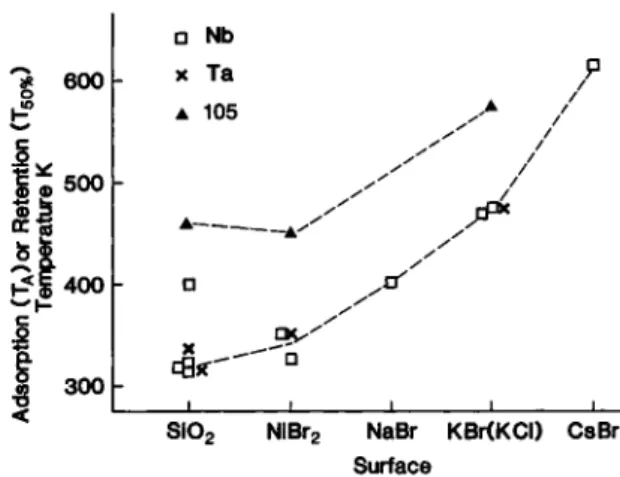
To Support this Interpretation we have summarized the Ta and T^ox temperatures from the literature and from this work for transition metals of group 5 bro-mides on different surfaces in Table 2. The data were not corrected for minor changes of the T^ and T^^y^ values due to the different half-lives of the nuclides used. The corrections are expected to be less than ±25°C [37]. The data are depicted in Fig. 7. They show that the temperatures are lowest for quartz and
• Nb 1 600 X Ta • 105 5 a> 500
II
•31
400 • * c a j f ' f 300 1 < SiOz / fNIBrz NaBr KBKKCI) CsBr Surface
Fig. 7. Adsorption temperatures (T^) from gas-thermochroma-tography experiments and retention temperatures {T^oy^ from on-line isothermal gas chemistry experiments for niobium, tanta-lum and element 105 bromides on different surfaces, from the
literature and from this work.
NiBr2 surfaces. For surfaces coated by NaBr, KBr (or KCl), and CsBr, the and T^oy^ temperatures are significantly higher than those for quartz. These data show a clear increase in the and Tso»/ temperatures as a function of the radius of the metal ion (0.72 Ä for
+ , 0.95Ä for N a + , 1.33 Ä for K + , and 1.69 Ä for Cs^). The shift in T^ and 750% between quartz and sah covered surfaces must be due to a change in adsorption enthalpy. For the KCl system, on the basis of Eq. (1) an average value for A{AHa) (=zli/„[KCl]
- zl/f„[Quartz]) of about 26 kJ/mol results for NbBrs, TaBrs and lOSBrj. It is interesting to note that the reaction [KNbCleL ^ [KCIJ^ + (NbCls)^ is by about 40 kJ/mol more endothermic than the vaporization of NbCls (see Ref. [14]). Unfortunately, for the corre-sponding bromide system thermodynamic literature data are lacking.
As mentioned in the introduction, from retention data of chromatography experiments with Single mol-ecules, thermodynamic quantities of macro amounts can only be deduced on the basis of empirical rules. For bromides on quartz surfaces, the deposition tem-peratures in gas thermochromatography experiments were found to be proportional to the Sublimation en-thalpies, AH^, of the bromides [39]:
T'xLK] = (3.3 + 0.3) J/f,[kJ/mol] + constant. (3) If we assume that this empirical law also holds for surfaces different from quartz — with different values for the constant — we can determine the AH^ value for lOSBrj. Based on the retention data listed in Table 1, and taking the literature values for AH^ of N b B r j and TaBrj, one can deduce & AH^ value for lOSBrs of 138 ± 15 kJ/mol (see Table 1).
5. Conclusions
On-line isothermal gaschromatography with quartz columns was used to determine the adsorption behavior of the transition metals of group 5, niobium.
tantalum, and element 105, under brominating con-ditions. It is assumed that the molecules investigated are the pentabromides. The retention behavior, ex-pressed in terms of the 750% values, was found to be the same for NbBrs and TaBrs. This is expected be-cause of the nearly identical boiling points and Subli-mation enthalpies of these Compounds. For element 105 bromide a stronger adsorption on the column surface is found. This can be interpreted as a lower volatility of lOSBrs compared to NbBrs and TaBrs. Since our experiments do not allow a determination of the chemical structure of the volatile molecules passing through the column, it is possible that the studies with element 105 were made with oxy-bro-mides. However, the similar chromatograms observed with pure HBr and with HBr containing BBrj vapor as reactive gas (Fig. 5) would be very surprising for oxy-bromides because BBra strongly reacts with trace amounts of oxygen in the system. The lower volatility of 105Brs relative to NbBrs and TaBrs is at variance with theoretical expectations [11].
Since the gas-jet transport technique continuously feeds KCl into the quartz chromatography column we assume that the adsorption chromatography separa-tions occurred on a KCl surface. This Interpretation is supported by an intercomparison of our results with data from the literature (see Fig. 7).
Based on an empirical relationship in the literature between deposition temperatures from gas thermo-chromatographic measurements with the Sublimation enthalpies for bromides [39] we deduce a Sublimation enthalpy for 105Br5 of about 140 kJ/mol.
Referenes
1. Desdaux, J. P., Fricke, B.: J. Phys. 41, 943 (1980). 2. Brewer, L. J.: High Temp. Sei. 17,1 (1984).
3. Pyykkö, P., Desdaux, J. P.: Acc. Chem. Res. 12,276 (1979). 4. Kdler, O. L.: Radiochim. Acta 37,169 (1984).
5. Glebov, V. A., Kasztura, L., Nefedov, V. S., Zhuikov, B. L.: Radiochim. Acta 46,117 (1989).
6. Johnson, E., Fricke, B., Keller, O. L., Nestor, C. W., Tucker, T. C.: J. Chem. Phys. 93, 8041 (1990).
7. Jost, D. T., Gäggeler, H. W., Vogel, Ch., Schädel, M., Jäger, E., Eichler, B., Gregorich, K. E., Hoffman, D. C.: Inorg. Chim. Acta 146, 255 (1989).
8. Eichler, B., Hübener, S., Gäggeler, H. W., Jost, D. T.: Inorg. Chim. Acta 146, 261 (1989).
9. Zhuikov, B. L., Glebov, V. A., Nefedov, V. S., Zvara, I.: J. Radioanal. N u d . Chem. 143(1), 103 (1990).
10. Pershina, V., Sepp, W. D., Fricke, B.: Scientific Report 1990 Gesellschaft für Schwerionenforschung mbH, Darmstadt, GSI-91-1, p. 274 (1991), unpublished.
11. Pershina, V., Sepp, W. D., Fricke, B.: Scientific Report 1990, Gesellschaft für Schwerionenforschung mbH, Darmstadt, GSI-91-1, p. 275 (1991), unpubUshed.
12. Guillaumont, R., Adloff, J. P., Peneloux, A., Delamoye, P.: Radiochim. Acta 54,1 (1991).
13. Zvara, I.: Pure Appl. Chem. 53, 979 (1981).
14. Zvara, I., Chuburkov, Yu. T., Bdov, V. Z., Buklanov, G. V., Zakhvataev, B. B., Zvarova, T. S., Maslov, O. D., Caletka, R., Shalaevski, M. R.: J. Inorg. N u d . Chem. 32, 1885 (1970).
16. Gäggeler, H., Domhöfer, H., Schmidt-Ott, W. D., Greulich, N., Eichler, B.: Radiochim. Acta 38, 103 (1985).
17. Zvara, I., Belov, V., Korotkin, Yu. S., Shalayevski, M. R., Shchegolev, V. A., Hussonois, M., Zager, B. A.: Report J I N R P12-5120, D u b n a (1970).
18. Zvara, I., Belov, V. Z., Domanov, V. P., Shalaevskii, M. R.: Radiokhimiya 18(3), 371 (1976).
19. Zvara, I., Timokhin, S. N., Chuburkov, Yu. T., Yakushev, A. B., Gorki, B.: Joint Institute for Nuclear Research, Lab-oratory for Nuclear Reactions, Dubna, Scientific Report 1 9 8 9 - 1 9 9 0 , E7-91-75, p. 36f (1991), unpublished.
20. Gregorich, K. E., Henderson, R. A., Lee, D. M., Nurmia, M. J., Chasteler, R. M., Hall, H. L., Bennett, D. A., Gannet, C. M., Chadwick, R. B., Leyba, J. D., HofTman, D. C., Herrmann, G.: Radiochim. Acta 43, 233 (1988).
21. Kratz, J. V., Zimmermann, H. F., Scherer, U. W., Schädel, M., Brüchle, W., Gregorich, K. E., Gannett, C. M., Hall, H. L., Henderson, R. A., Lee, D. M., Leyba, J. D., Nurmia, M. J., Hoffman, D. C., Gäggeler, H., Jost, D., Baltensperger, U., Ya Nai-Qi, Türler, A., Lienert, Ch.: Radiochim. Acta 48,121 (1989).
22. Weis, M., Ahrens, H., Denschlag, H. O., Fariwar, M., Herrmann, G., Trautmann, N . : Radiochim. Acta 42, 102 (1987).
23. Gober, M. K., Kratz, J. V., Zimmermann, H. F., Schädel, M., Brüchle, W., Schimpf, E., Gregorich, K. E., Türler, A., Hannink, N . J., Czerwinski, K. R., Khadkhodayan, B., Lee, D. M., Nurmia, M . J., H o f f m a n , D. C., Gäggeler, H., Jost, D., Kovacs, J., Scherer, U. W., Weber, A.: Radiochim. Acta 57, 77 (1992).
24. Gäggeler, H. W., Jost, D. T., Baltensperger, U., Ya Nai-Qi, Gregorich, K. E., Gannett, L. M., Hall, H. L., Henderson, R. A., Lee, D. M., Li, J. D., Nurmia, M. J., Hoffman, D. C., Türler, A., Lienert, Ch., Kratz, J. V., Zimmermann, H. F., Scherer, U. W.: Report Paul Scherrer Institut FSI-49 (1989).
25. Türler, A., Gäggeler, H. W., Gregorich, K. E., Barth, H., Brüchle, W., Czerwinski, K. R., Gober, M. K., Hannink, N. J., Henderson, R. A., Hoffman, D. C., Jost, D. T., Kacher, C. D., Kadkhodayan, B., Kovacs, J., Kratz, J. V., Kreek, S. A., Lee, D. M., Leyba, J. D., Nurmia, M. J., Schädel, M., Scherer, U. W., Schimpf, E., Vermeulen, D., Weber, A., Zimmermann, H. F., Zvara, I.: Froc. M A R C II Conf., Kona, Hawaii, April 1991, J. Radioanal. Nucl. Chem., in press.
26. Gäggeler, H. W., Jost, D. T., Baltensperger, U., Weber, A., Kovacs, A., Vermeulen, D., Türler, A.: Nucl. Instrum. Methods A309, 201 (1991).
27. Kratz, J. V., Gober, M. K., Zimmermann, H. P., Schädel, M., Brüchle, W., Schimpf, E., Gregorich, K. E., Türler, A., Hannink, N. J., Czerwinski, K. R., Kadkhodayan, B., Lee, D . M., Nurmia, M. J., Hoffman, D. C., Gäggeler, H., Jost, D., Scherer, U. W., Weber, A.: Phys. Rev. C, 45,1064 (1992). 28. Ya Nai-Qui, Jost, D. T., Baltensperger, U., Gäggeler, H . :
Radiochim. Acta 4 7 , 1 (1989).
29. Schlepütz, F. W.: IEEE Trans. Nucl. Sei. 36(5), 1630 (1989). 30. Brun, R . : C E R N program library entry Q121, C E R N
Geneva (1989).
31. Jost, D. T., Vermeulen, D.: Proc. 7'" Conf. R E A L TIME, Jülich, June 1991; Preprint Paul Scherrer Institut, Villigen, PSI-91-15 (1991); IEEE Trans. Nucl. Sei., in press.
32. Gäggeler, H., Jost, D., von Gunten, H. R.: Measurement of
above target cross sections from the reaction
Internal Report Eidg. Institut für Reaktorforschung, Würenlingen, TM-44-87-04 (1987), unpublished.
33. Ghiorso, A., Nurmia, M., Eskola, K . : Phys. Rev. C4, 1850 (1971).
34. Gregorich, K. E.: Nucl. Instrum. Methods A302,135 (1990). 35. Handbook of Chemistry and Physics, C R C Press, 55'" Ed.
(1975).
36. F o r an intercomparison of Chlorides and oxy-chlorides, see: V. P. Domanov, U. J. Kim, S. S. Bedronosov, I. A. Kopylova, V. Ya. Lebedev, Report J I N R , P6-88-633, D u b n a (1988).
37. Eichler, B., Gäggeler-Koch, H., Gäggeler, H . : Radiochim. Acta 26, 193 (1979).
38. Tsalas, S., Bächmann, K., Heinlein, G . : Radiochim. Acta 29, 217 (1981).
39. Kim, U. J., Timokhin, C. N., Zvara, L : Isotopenpraxis 24(1), 30 (1988).
40. Zvara, I., Keller, O. L., Silva, R. J., Tarrant, J. R.: J. Chromatogr. 103, 77 (1975).
41. Belov, V. Z., Zvarova, T. S., Shalaevski, M. R.: Report J I N R Fl 2-8216, Dubna (1974).
42. Silva, R. J., Trautmann, N., Zendel, M., Dittner, P. F., Stender, E., Ahrens, H . : Nucl. Instrum. Methods 147, 371 (1977).

![Fig. 5). •O 1 0.5 200 400 600 Temperature [°C] 800](https://thumb-eu.123doks.com/thumbv2/123doknet/14888160.647926/5.892.88.437.117.353/fig-o-temperature-c.webp)