Introduction
Multiple Sclerosis (MS) confronts patients, partners, and their children with a wide array of challenges revolving around how to make sense of the disease experience and integrate it into their personal life.
MS is a complex disease where clinical manifesta-tions and course vary considerably from one patient to another. It is now recognized, that despite its physical basis, psychiatric, and cognitive abnormal-ities are common in this disease and add consider-ably to the distress and disability of the patient Barbara Steck
Felix Amsler Andrea Grether
Alexandra Schwald Dillier Christiane Baldus Miriam Haagen L. Diareme John Tsiantis Ludwig Kappos Dieter Bu¨rgin Georg Romer
Mental health problems in children of
somatically ill parents, e.g. multiple
sclerosis
Accepted: 14 September 2006 Published online: 29 November 2006
j Abstract Objectives Based on
the investigation of 144 families (144 patients affected by Multiple Sclerosis (MS), 109 partners, and 192 children) examined in three different European child and ado-lescent psychiatric University centres by means of question-naires, we evaluated the preva-lence of psychological symptoms in the offspring and associated risk factors such as duration and severity of the disease as well as depression of the ill and the healthy parent. Results Indicate that the severe disease of MS is associated with depression of the ill and healthy parent. Ill parents, especially ill mothers, as well as depressed ill, or depressed healthy parents evaluate their children’s mental health problems with a higher prevalence within the internalizing spectrum. Healthy parents report normal psycholog-ical adjustment of their children. If two parents present a depressive state, the prevalence of relevant psychological internalizing symp-toms is twice or three times as
high as the age norms. Conclusion Children in families with a parent affected by MS and associated depression of the parental couple are at high risk of mental health problems, especially internalizing disorders. In focusing on the mental health of children one must also be aware of the potential opportunities to address the par-ents’ own psychological needs.
j Key words multiple sclerosis –
parental depression – mental health problems in children
ECAP
589
B. Steck Æ F. Amsler Æ A. Grether A.S. Dillier Æ D. Bu¨rgin
Child and Adolescent Psychiatry University of Basel Schaffhauserrheinweg 55 4058 Basel, Switzerland L. Kappos Neurology Department University of Basel Universita¨tsspital, Petersgraben 4 4053 Basel, Switzerland
C. Baldus Æ M. Haagen Æ G. Romer Department of Child and Adolescent Psychiatry and Psychotherapy University Medical Centre Hamburg-Eppendorf Martinistr. 52
20246 Hamburg, Germany L. Diareme Æ J. Tsiantis Department of Child Psychiatry Athens University Medical School ‘‘Adhia Sophia’’ Children’s Hospital Thivon and Levathias
EL-11527 Goudi, Greece PD Dr. med. B. Steck (&) Im Erlisacker 12
4103 Bottmingen, Switzerland E-Mail: [email protected]
(Brassington and Marsch 1998). The lifetime preva-lence of depression in MS patients is estimated to be 47%–54% (Feinstein2004; Minden2000). These rates of depression are higher in MS patients than in the general population and among patients with general medical conditions (Minden et al.1987). Changes in family roles, loss of work, income, or social status, and caregiver burnout are common in these families. Thus MS represents a disease condition that has the potential to affect the partner and children in a number of ways.
Somatic illness in a parent is a risk factor for psychiatric disorder in children (Romer et al. 2002; Rutter1966). A significant physical disease in a parent has an impact on children’s development and psy-chosocial functioning (Armsden and Lewis 1993; Steck et al.2001; Worsham et al.1997). The diagnosis of a severe somatic disease such as MS is one of the most life-changing events for patients, their families, and their children (Burnfield 1985; Kalb 1996; Steck
2000, 2002; White et al. 1996). In understanding the impact of the chronic somatic illness and in formu-lating interventions, it is helpful to consider, besides the developmental issues of the individual family member, also their interplay with the development of the family life cycle and the chronic illness itself (Rolland1999).
This study investigated some risk factors of the outcome of psychological problems in families with a parent and children affected by MS on the basis of the following hypotheses:
j Parents associated hypothesis
H1: Depression score is higher in ill parents than in healthy parents; there is mutual influence with respect to depressive symptoms between the parental couple.
H2: Disease variables such as duration and severity of MS are associated with depression in ill and healthy parents.
j Children associated hypothesis
H3: Children of somatically ill parents will be at higher risk for psychological problems mea-sured by symptom checklists than age norms; prevalent psychological symptoms in children exposed to parental MS will be found predomi-nantly in the internalizing spectrum.
H4: Somatically ill parents tend to perceive more psychological problems in their children than healthy parents.
H5: The more severe the parental illness, the more the psychological symptoms found in his children. H6: Low depression scores in ill and healthy parents
will predict good psychological adjustment in their children.
j Country associated hypothesis
H7: Gender and age of parents and offspring, disease variables, BDI, CBCL, and YSR values will show no major differences between countries.
j Statistics
Differences between groups are compared with Chi square statistics (H4, H6, H7), t-tests (H1, H4), or one-way ANOVA with post hoc analysis including Bonferroni correction (H5, H6, H7).
Correlations between measures are calculated with Pearson correlation coefficients (H1, H2, H5, H6).
Comparison with norm values are calculated with Chi square statistics or one sample t-tests (H3).
Subjects and methods
j Participants
The patients were recruited from the University hos-pitals of Hamburg (Germany; a special neurological outpatient service for patients with MS) of Athens (Greece; 5 neurological clinics, including the Univer-sity) and of Basel (Switzerland; a specialized multi-disciplinary team in the neurology department).
Demographics
Parents completed a self-report form to provide information on demographic variables such as age, gender, nationality of family members as well as educational levels, and work situation of both parents. Illness status and illness severity was measured by the responsible physician, using the Karnofsky scale, an index for the clinical estimate of a patient’s phys-ical state, and performance. High percentage indicates minor symptoms, with the possibility of leading a normal life; low percentage indicates severe disease symptoms, or disability, with the necessity of insti-tutional care.
Depression of the parents was assessed by the short form of the Beck Depression Inventory (BDI), which is a valid and reliable measure of depressive symp-toms in both depressed and medical populations (Beck et al. 1961, 1988) and has been widely used in
MS-patients, (e.g., Arnett et al. 2002; Feinstein and Feinstein 2001; Landro et al. 2004). ‘‘Somatic’’ BDI items might be valid as depression indicators for at least some MS patients (Aikens et al.1997).
Child behavior checklist (CBCL, Achenbach1991a) The CBCL is the best known of rating scale and checklist used to assess child mental health and behavior. It was used because of the ease with which it can be completed in population-based studies. Mo-ther and faMo-ther were both asked to complete the CBCL for each child, 6–18 years old. We evaluated these results separately and calculated the mean of both parent’s rating as ‘overall rating’.
The youth self report (YSR, with a setting identical to the CBCL) was completed by adolescents (age 11 or older); it provides a self-report measure of current behavioral and psychological status (Achenbach
1991b) and includes 102 items of the behavior prob-lems from the CBCL, reworded in the first person.
According to national norms (Do¨pfner et al.1994a,
b; Roussos et al. 1999, 2001; Steinhausen et al. 1996,
1999) raw values of CBCL and YSR internalizing, externalizing, and total scores were transformed into standardized T-scores. To discriminate between rele-vant problems (need for diagnostic, counseling, or treatment) and non-relevant problems, we used the criteria T ‡ 60 proposed by Achenbach (1991a, b) to define C values, indicating cases with relevant prob-lems. Around 17% of the children in the norm sample were rated as having relevant problems.
Possible sources of bias are different recruitment procedures (e.g., the questionnaires were mailed or handed over to the participants or filled out in an interview) and non-responders.
Results
j Demographic and clinical data (Table1)
Around 46% of the families are Swiss, 37% Greeks, and 17% Germans. Around 71.5% of the patients are
female and 28.5% male. This reflects the fact that the ratio of women to men with MS is 3 to 2. The gender distribution is similar among the three population samples. The distribution according to age and gen-der of the children is almost equal and does not differ between the three centres. Around 62.5% of the chil-dren are below, 37.5% above 12 years.
Mean score of the Karnofsky-Index is 70.9 and there are significant (F = 3.96; P = 0.022) differences between the three countries: highest in Germany, followed by Greece and Switzerland. There are no gender differences.
Work situation (data not shown) of ill parents differs significantly (P < 0.001) between the three countries: there are more ill parents fully employed in Greece, whereas in Germany and Switzerland more ill parents are partly employed. Work situation of heal-thy parents does not show any significant difference. Highest education (data not shown) of ill and healthy parents does not differ significantly in the three cen-tres (no differences between fathers or mothers and ill or healthy parents).
The BDI of ill parent and healthy parent differ significantly (F = 3.12; P = 0.048) between the coun-tries. The mean value of ill parents is 12.6 (corre-sponding to a mild depressive symptomatology) and differs significantly form the mean value of healthy parents 6.2 (F = 42.7; P < 0.001) (H1); 59.5% of all ill parents (68.6% of males and 56.0% of females) eval-uate themselves as being depressed, whereas this is only true for 20.4% of the healthy parents (13.6% of males and 31.2% of females). The correlations be-tween duration of the disease (mean of duration for ill fathers is 6.5 years, for ill mothers 7.7 years) and severity of the illness are significant (r = )0.33; P < 0.01), as well as between the severity of the dis-ease and the depression of the ill parent (r = )0.30; P < 0.01). The longer the duration of and the more severe the disease, the more depressed is the ill par-ent. The more depressed the ill parent, the higher the depression score of the healthy parent (r = 0.23; P < 0.05) (H2).
Table 1 Gender and age of patients,
partners and children per country Germany Greece Switzerland Total
Male patient (N) 5 15 21 41 Female patient (N) 20 38 45 103 Male offspring (N) 24 28 47 99 Female offspring (N) 17 25 51 93 Age of patient 41.4 (±5.0) 40.4 (±4.7) 40.8 (±6.6) 40.8 (±5.7) Age of partner 42.9 (±3.2) 41.9 (±5.2) 42.9 (±7.7) 42.5 (±6.2) Age of children 10.5 (±3.3) 10.3 (±3.9) 9.3 (±4.8) 9.8 (±4.8) Karnofsky 80.5 (±10.5) 70.4 (±19.1) 68.0 (±19.2) 70.9 (±18.4) BDI patient 13.2 (±6.8) 14.3 (±7.7) 10.7 (±7.4) 12.6 (±7.5) BDI partner 7.2 (±6.6) 7.4 (±6.0) 4.6 (±4.5) 6.2 (±5.7) Severity of disease and depression of patient and partner
j Psychososocial problems (measured by CBCL/YSR)
(Table 2)
All overall CBCL T and C scores (the mean of both parent’s rating) does not differ between countries with one exception: Swiss parents indicate a signifi-cantly (8.1%; P < 0.01) smaller percentage of cases with relevant internalizing problems (C values) than Greek parents (29.4%) and German parents (31.7%).
CBCL T overall externalizing and total scores do not differ significantly from the norm values of 50, whereas internalizing scores are significantly higher than norm values (H3). Ill parents rate their children’s internalizing problems significantly higher than norm values, while healthy parents’ ratings do not differ from the norm (H4).
CBCL C scores
Ill parents rate their children as having significantly relevant internalizing problems, whereas healthy parents’ rating do not indicate an increased percent-age of relevant problems (H4).
All YSR T and C scores do not differ significantly between countries.
YSR T scores are significantly over the norm for internalizing disorders (H3). YSR C scores do not indicate an increased percentage of relevant problems. To compare simultaneously the influence of fa-ther–mother and patient-healthy person, we calcu-lated a two-way ANOVA and found an interaction effect between gender and illness for internalizing disorders (F = 5.7, P < 0.05) and total score (F = 3.3, P < 0.1): ill mothers show the highest values in all three dimensions.
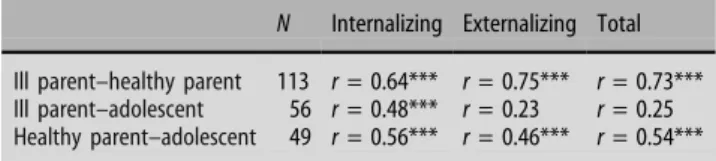
The correlations (Table3) between the CBCL T values of the ill and the healthy parents for all dimensions are significant as well as between the
CBCL T values of the parents and the YSR T values of the adolescents for internalizing disorders. The cor-relations are higher between the YSR T values and the CBCL T values, evaluated by the healthy parent, than the ones evaluated by the ill parent. Yet the differ-ences between the correlation coefficients of the healthy parent and the ill parent with the adolescents do not achieve a significant level (Fishers z-values; data not shown).
The results of the correlations (Table 4) between the psychosocial problems (CBCL T values) evaluated by the ill and the healthy parent and different variables (gen-der, age, illness duration and severity, depression) show that only the severity of the disease and the depression of the parents are influencing the evaluation of the psychosocial problems in children. There is a significant inverse correlation between the Karnofsky Index and the CBCL T values (externalizing and total score). The more severely ill the parent is, the higher he or she evaluates the child as presenting psychosocial problems (H5). The correlations between the depres-sion score of the ill mother, the somatically healthy parents (father and mother), and the CBCL T values are significant. The higher the depression score of the ill mother, the healthy father and the healthy mother, the higher their scoring for psychosocial problems in their children, particularly for internalizing symptoms, and for the total score (H6).
Table 2 CBCL and YSR T and C values overall (the mean of both parent’s rating) evaluated by the ill, the healthy parent and the adolescent
N T Comparison norma C Comparison normb CBCL overall Int 154 52.3 ** 21.4% t
Ext 154 51.2 15.5%
Tot 154 51.5 16.9%
CBCL ill parent Int 148 52.4 * 23.0% **
Ext 150 51.5 t 18.7%
Tot 148 51.9 t 21.6% t
CBCL healthy parent Int 119 51.3 21.0%
Ext 120 50.2 15.0%
Tot 119 50.5 14.3%
YSR Int 66 53.2 ** 23.9% t
Ext 66 51.8 18.2%
Tot 66 52.09 t 18.2%
Comparison with norm values
t: * P < 0.1; ** P < 0.05; *** P < 0.01; P < 0.001 a
T values are compared with 50 (norm) b
C values are compared with 17%
Table 3 Correlation between the psychosocial problems (CBCL, respectively YSR T values) evaluated by the ill parent, the healthy parent, and the ado-lescent
N Internalizing Externalizing Total Ill parent–healthy parent 113 r = 0.64*** r = 0.75*** r = 0.73*** Ill parent–adolescent 56 r = 0.48*** r = 0.23 r = 0.25 Healthy parent–adolescent 49 r = 0.56*** r = 0.46*** r = 0.54*** * P < 0.05; ** P < 0.01; *** P < 0.001
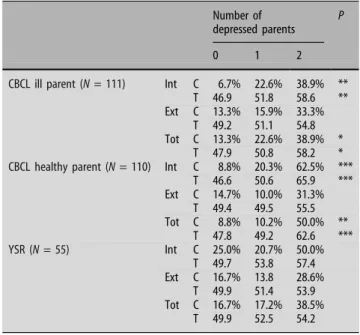
CBCL T and C scores of ill and healthy parents (Table5) show a highly significant increase for internalizing disorders (P < 0.1–P < 0.001) and total problems (P < 0.05–P < 0.001) depending on the presence of none, one or two depressed parents. Especially the presence of two depressed parents in-creases the CBCL values remarkably.
YSR C and T scores (Table5): C scores for inter-nalizing symptoms are almost three times, for total scores twice as high as the age norms in the presence of two depressed parents. They do not reach signifi-cant values, probably due to the small number.
Discussion
j Depression of parents
Around 59% of all patients and 20% of the partners evaluate themselves as being depressed and the depression score is higher in ill parents than in healthy parents (confirming our first hypothesis).
Depression of the ill parent
Somatic disease and psychological disorders are clo-sely interrelated (Verhaak1997). According to Steele et al. (1997) increased illness severity predicted in-creased parental depressive symptoms. Numerous studies have identified elevated depressive symptom scores in MS patients, and studies of depressive dis-orders have clearly documented elevated prevalence rates in MS patients (Feinstein 2004; Minden 2000). The literature does not identify any specific pattern of neurological involvement as being consistently asso-ciated with depressive symptoms or disorders. Psy-chosocial risk factors contribute to the etiology of depression in MS, but the relative importance of var-ious risk factors is not clearly determined. Biological, psychological, and social risk factors are all potentially important (Patten et al. 2000). Feinstein (2004)
esti-mates the lifetime prevalence of mayor depression to be approximately 50%. Complaints such as irritability and sadness, hallmarks of affective instability, are of-ten indicative of high levels of psychological distress. Given that depression and chronic medical conditions have unique and additive effects on patient function-ing (Wells et al. 1989), it is of crucial importance to detect and treat depressive symptoms.
Depression of the somatically healthy parent
Psychological distress affects not only the chronically ill patient but also the caregiver (Aronson 1997). Caring is associated with experience of multiple losses (Cheung and Hocking 2004). Somatic, anxiety and depressive symptoms are common in these caring partners, and it is important for the professional healthcare team to recognize these symptoms and provide appropriate support (O’Brien 1993; Hakim et al.2000; Knight et al.1997).
j Depression, disease, and demographic variables
Our results indicate that severe disease is associated with depression of ill and healthy parents (corre-sponding to the second hypothesis). The research on the potential associations between depression, physi-cal disability and illness course in MS shows no consistent results (Minden and Schiffer 1990; Noy et al. 1995) According to a study by Mohr et al. (1997), depression (measured by the BDI) was
sig-Table 4 Correlation between the psychosocial problems (CBCL T values) evaluated by the ill and the healthy parent and different variables (gender, age, illness duration and severity, depression)
N Internalizing Externalizing Total Gender of child 154 r = 0.08 r = 0.11 r = 0.09 Gender of patient 154 r = 0.12 r = 0.06 r = 0.14 Age of child 154 r = 0.11 r = 0.01 r = 0.05 Duration of illness 152 r =)0.06 r =)0.04 r =)0.07 Karnofsky 142 r =)0.14 r =)0.18* r =)0.19* BDI ill mother 105 r = 0.36*** r = 0.15 r = 0.26** BDI ill father 44 r = 0.29 r = 0.12 r = 0.24 BDI healthy mother 41 r = 0.35* r = 0.19 r = 0.41** BDI healthy father 78 r = 0.36** r = 0.23* r = 0.33** * P < 0.05; ** P < 0.01; *** P < 0.001
Table 5 Influence of number of depressed parents on CBCL and YSR T and C values of somatically ill and healthy parents and adolescents
Number of depressed parents
P
0 1 2
CBCL ill parent (N = 111) Int C 6.7% 22.6% 38.9% ** T 46.9 51.8 58.6 ** Ext C 13.3% 15.9% 33.3%
T 49.2 51.1 54.8 Tot C 13.3% 22.6% 38.9% *
T 47.9 50.8 58.2 * CBCL healthy parent (N = 110) Int C 8.8% 20.3% 62.5% ***
T 46.6 50.6 65.9 *** Ext C 14.7% 10.0% 31.3% T 49.4 49.5 55.5 Tot C 8.8% 10.2% 50.0% ** T 47.8 49.2 62.6 *** YSR (N = 55) Int C 25.0% 20.7% 50.0% T 49.7 53.8 57.4 Ext C 16.7% 13.8 28.6% T 49.9 51.4 53.9 Tot C 16.7% 17.2% 38.5% T 49.9 52.5 54.2 t: P < 0.1 ; * P < 0.05 ; ** P < 0.01 ; *** P < 0.001
nificantly higher at more advanced levels of neuro-logical impairment than at lower levels (measured by the Kurtzke EDSS). Chwastiak et al. (2002) studied the relationship of depressive symptoms and severity, duration and course of MS in over 700 patients and concluded that the severity of illness was more strongly associated with depressive symptoms than was the pattern of illness. Clinically significant depressive symptoms were present in 41.8% of the patients, and 29.1% of the subjects had moderate to severe depression. Kroencke et al. (2001) found that the level of heightened uncertainty (e.g., with exac-erbations of MS) was associated with increase in depression. The results of Aikens et al. (1997) suggest that MS related depressive symptoms are a function of prior disease-related impairment and life stress. The incidence of pre-morbid depression or other psychi-atric disturbances may be relevant. The way in which a person reacts to MS does not necessarily relate to the severity of the disease. A person who is only mildly affected can be psychologically distraught, while someone who is severally handicapped may cope very well. Many factors play a part in deter-mining the individual’s response (Brassington and Marsch1998). These include the effect of disability on someone’s normal way of life, previous strategies and patterns of coping and the extent of support received from others.
j Mental health problems in children
CBCL T/C and YSR T/C values compared to the norm values
Both parents and offspring reported significantly higher scores for internalizing disorders only (T val-ues), according to our third hypothesis. Our results show gender and role differences: especially ill mothers scored high for psychological problems in their children, particularly for internalizing disorders. There are no discrepancies between the evaluations of ill and healthy parents, neither between the evaluation of ill or healthy parents and their children (T values). The differences between ill and healthy parents in their evaluation of their children having ‘‘relevant problems’’ (C values) are interesting. For ill parents their children present relevant internalizing psycho-logical problems, healthy parents and adolescents indicate no relevant problems. These results confirm our fourth hypothesis. The more severely ill the par-ent is, the higher he or she evaluates the child as presenting psychosocial problems (corresponding to our fifth hypothesis).
Ill and healthy parents perceive their children differently. Ill parents—who experience high anxiety
with their disease—may not accurately assess their children’s true emotional state. Healthy parents—on the contrary—may have a tendency to ignore prob-lems, therefore evaluating their children too positive. Youth may minimize their emotional difficulties or mask their true emotions to protect their parents. Parents often have difficulties in acknowledging the effect of the illness on children (Levine and Krieger
1993). The parental need to believe that children are not affected by their own MS prevents them from seeking help (Kalb 1996). False perceptions could possibly prevent children and adolescents from receiving appropriate mental health interventions (Heiney et al. 1997).
Especially ill mothers evaluate their children as presenting internalizing disorders. The results of Najman et al. (2001) show that the more emotionally disturbed the mother, the greater the degree to which she imputes the child to have behavioral problems (measured by the CBCL/YSR); the data sug-gest—according to the authors—that maternal health impairment is associated with biased observations.
j Psychosocial problems (CBCL T values) and parental
depression (measured by the BDI)
The higher the depression score especially of ill mothers and even more of healthy parents, the higher the psychosocial problems are evaluated in their children, particularly for internalizing symp-toms and for the total score. The depression of both parents predicts twice to three times a higher per-centage of relevant internalizing problems in their children and adolescents. These findings confirm our sixth hypothesis. The high potential risk for mental health disorders in offspring of a depressed parental couple indicates strongly the main target of pre-ventive interventions. Steele et al. (1997) in his studies shows that parental illness impacts child internalizing symptoms by operation through parental depressive symptoms. There is ample evi-dence for the association between parental mental disorders and children’s adjustment (Beardslee et al.
1998; Davies and Windle 1997; Olfson et al. 2003) and between the adverse effect of maternal depres-sion on children’s psychological health (Brennan et al. 2000, 2003). Our findings confirm previous studies, where the depression of parents affected by MS, followed by single parenthood, represented the most unfavorable context for the development of children’s psychopathology (Steck et al. 2005). Fer-gusson et al. (1993) calculated that maternal depression had a causal influence, explaining about 7% of the error variance in maternal reports. They concluded that use of maternal reports to measure
child behavior could result in serious overestimation of correlations between maternal depression and child behavior. Depressed mothers reported a three time greater risk of serious emotional problems in their children compared to non-psychiatric controls (Weissman et al.2004). The results of a longitudinal study (Anderson and Hammen 1993), suggest that the psychosocial problems (measured by the CBCL) observed in children of mothers with recurrent depressions are long-lasting and are apparent in their functioning both at home and at school (CBCL for teachers).
Numerous studies indicate that the quality of the emotional availability of the healthy parent may compensate for the inattentiveness of the ill parent. The child’s significant relationship with the healthy non-depressed parent may be a key protective factor for his psychological adjustment (Davies and Windle
1997; Leinonen et al.2003).
j Differences between countries
The investigated sample size of patients, partner, and children was highest in Switzerland, followed by Greece and Germany. This raises the question whe-ther these differences in cohort size introduce a bias. Disease severity varies significantly between the three countries, which might be explained by dif-ferences in referral patterns. The mean values of depression of ill and healthy parents differ signifi-cantly between the three countries, being lowest in Switzerland. Therefore it is not surprising that Swiss parents evaluate their children (CBCL C values) at 92% within the norm (i.e., presenting no internaliz-ing disorders, in comparison to the significant lower percentage by Greek and German parents. Socio-culturally mediated factors may influence differences in illness behavior and defense mechanism. Parents affected by MS and their family fear stigmatization through their physical disability. Some parents even wish—as long as possible—to keep their disease secret and therefore do not acknowledge associated depressive symptoms. They underestimate the emo-tional distress of their children, since any psycho-logical or mental health problem would mean further stigmatization (Steck et al. 2005). Another source of bias may be the different handling of questionnaires: they were mailed, handed over to the participants, or filled out in an interview.
Conclusions
Ill and healthy parents with depression and partic-ularly the depressed parental couple overestimate the
potential risk of mental health problems, especially internalizing symptoms, in their children. Healthy parents and partially also adolescents underestimate this risk. Comprehensive care of the person with MS involves the entire family. When the parent with MS is evaluated, the healthy parent should be included. The careful assessment of disease variables in ill and healthy parents is needed to devise individualized treatment approaches to manage problems that might arise in both, for example depression. The importance of the healthy parent’s mental health and emotional availability for the children has to be emphasized. The results suggest a number of inter-ventions, which may reduce the negative effects of parental MS on a child. Specifically interventions aimed at helping parents to cope with the illness situation and to decrease individual parental depressive symptoms (Landoni et al. 2000; Leahey and Wright 1985; Minden 1992; Padrone 1994; Steinglass 1992) may work to help children with their psychosocial adjustment. According to Beardl-see et al. (1993), a preventive intervention is mean-ingful for children whose parents are depressed. For White (1998), to treat the family with a parent af-fected by MS is to provide the patient with essential care. One does not need to treat all aspects of the family to show fundamental improvement in the system. If the healthy parent attends a support group, his or her ability to care for the patient may increase what could reduce his or her own depres-sion.
Despite a number of strengths of this study, it is not without its limitations. Our results must be con-sidered cautiously, given the heterogeneous nature of the sample, e.g., the implications of the parental dis-ease, the time since onset and diagnosis and the varying duration of exposure of children to the parental illness. Other limitations are associated with this investigation, and the findings should therefore be evaluated with appropriate prudence. Neuropsy-chological investigation has not been conducted, so the influence of cognitive disorders on associated depression in ill and healthy parents was not evalu-ated, neither the psychosocial impact of cognitive impairment on family and especially children. Chil-dren’s concern and emotional distress are more strongly associated with less apparent psychological changes such as cognitive dysfunction or depression than with the more visible, physical symptoms, e.g., ambulation (Kalb 1996). Longitudinal research is needed to understand clearly the interactions between normal developmental variations and the variations produced by the presence of a chronic physical illness of parents children and adolescents. One cannot ex-clude the eventual bias in the data collection by three different teams.
j Acknowledgement This study is part of an international
multi-site research project, which was supported by a grant from the European Union in its 5th Framework Program. ‘‘Quality of Life’’ (QLGT-2001–02378): ‘‘Mental Health Prevention in a Target Group at Risk: Children of Somatically Ill Parents (COSIP)’’. The following institutions and Principal Investigators collaborated in this project: (1) Dept. of Child and Adolescent Psychiatry and Psychotherapy, University Hospital Hamburg-Eppendorf, Germany (Dr. med. Georg Romer); (2) Dept. of Child and Adolescent Neuropsychiatry, University of Vienna, Austria (Prof. Dr. med. M. Friedrich); (3) Department of Psychology, University of Aarhus, Denmark (M.
Thastum, Ph. D.); (4) Child Psychiatry Clinic, Turku University Hospital, Finland (Prof. Dr. J. Piha); (5) Department of Child Psychiatry, Athens University Medical School, Greece (Prof. Dr. J. Tsiantis); (6) Clinic of Child and Adolescent Psychiatry, University of Medicine and Pharmacy, Bucharest, Romania (Prof. Dr. S. Mi-lea); (7) Clinic of Child and Adolescent Psychiatry, University of Basel, Switzerland (PD Dr. B. Steck); (8) Department of Psycho-logical Medicine, Royal Marsden Hospital, Sutton, United Kingdom (M. Watson, Ph. D.). This study was also supported by the Swiss Multiple Sclerosis Society.
References
1. Achenbach T (1991a) Manual for the child behaviour checklist and 1991 profile. University of Vermont, Department of Psychiatry, Burlington 2. Achenbach T (1991b) Manual of the
youth self report and 1991 profile. University of Vermont, Department of Psychiatry, Burlington
3. Aikens JE, Fischer JS, Namey M, Ru-dick, RA (1997) A replicated prospec-tive investigation of life stress, coping, and depressive symptoms in multiple sclerosis. J Behav Med 20(5):433–445 4. Anderson CA, Hammen CL (1993)
Psychosocial outcomes of children of unipolar depressed, bipolar, medically ill and normal women: a longitudinal study. J Consult Clin Psychol 61(3):448–454
5. Armsden G, Lewis FM (1993) The child’s adaptation to parental medical illness: Theory and clinical implica-tions. Patient Education and Counsel-ing 22(3):153–165
6. Arnett PA, Higginson CI, Voss WD, Randolph JJ, Grandey AA (2002) Relationship between coping, cognitive dysfunction and depression in multiple sclerosis. Clin Neuropsychol 16(3):341–355
7. Aronson KJ (1997) Quality of life among persons with multiple sclerosis and their caregivers. Neurology 48:74– 80
8. Beardslee WR, Salt P, Portefield K, et al. (1993) Comparison of preventive interventions for families with parental affective disorder. J Am Acad Adolesc Psychiatry 32:254–263
9. Beardslee WR, Versage EM, Gladstone TRG (1998) Children of affectively ill parents. A review of the past 10 years. J Am Acad Child Adolesc Psychiatry 37:1134–1141
10. Beck AT, Steer RA, Garbin MG (1988) Psychometric properties of the Beck Depression Inventory: twenty-five years of evaluation. Clin Psychol Rev 8:77–100
11. Beck AT, Ward C, Mendelson M, Mock J, Erbaugh, J (1961) An inventory for measuring depression. Arch Gen Psy-chiatry 4:53–63
12. Brassington JC, Marsh NV (1998): Neuropsychological aspects of multiple sclerosis. Neuropsychol Rev 8(29):43– 77
13. Brennan PA, Hammen C, Andersen MJ, Bor W, Najman JM, Williams GM (2000) Chronicity, severity and timing of maternal depressive symptoms: relationship with child outcomes at age 5. Dev Psychopathol 36:759–766 14. Brennan PA, Broque RL, Hammen C
(2003) Maternal depression, parent– child relationship, and resilient out-comes in adolescence. J Am Acad Child Adolesc Psychiatry 42:1469–1477 15. Burnfield A (1985) Multiple sklerose: a
personal exploration. Souvenir Press Ltd, London
16. Cheung J, Hocking, P (2004) The experience of spousal carers of people with multiple sclerosis. Qual Health Res 14(2):153–166
17. Chwastiak L, Ehde DM, Gibbons LE, Sullivan M, Bowen JD, Kraft, GH (2002) Depression symptoms and severity of illness in multiple sclerosis: epidemiologic study of a large com-munity sample. Am J Psychiatry 159:1862–1868
18. Davies PT, Windle, M (1997) Gender-specific pathways between maternal depressive symptoms, family discord, and adolescent adjustment. Dev Psy-chol 33:657–668
19. Do¨pfner M Schmeck K, Berner W (1994a) Handbuch: Elternfragebogen u¨ber das Verhalten von Kindern und Jugendlichen, Forschungsergebnisse zur deutschen Fassung der Child Behaviour Checklist (CBCL), 1.Auflage, KJFD, Arbeitsgruppe Kinder-, Jugend-und familiendiagnostik. Ko¨ln
20. Do¨pfner M Schmeck K, Lehmkuhl G (1994b) Handbuch: Fragebogen fu¨r Jugendliche, Forschungsergebnisse zur deutschen Fassung des Youth Self
Re-port (YSR) der Child Behaviour Checklist (CBCL), 1.Auflage, KJFD, Arbeitsgruppe Kinder-, Jugend-und familiendiagnostik. Ko¨ln
21. Feinstein A, Feinstein K (2001) Depression associated with multiple sclerosis looking beyond diagnosis to symptom expression. J Affect Disord 66:193–198
22. Feinstein A (2004) The neuropsychia-try of multiple sclerosis. Can J Psychi-atry 49(3):157–163
23. Fergusson DM, Lynskey MT, Horwood LJ (1993) The effect of maternal depression on maternal ratings of child behaviour. J Abnorm Child Psychol 21:245–269
24. Hakim EA, Bakheit AM, Bryant TM, Roberts MW, McIntosh-Michaelis SA, Spackman AJ, Martin JP, McLellan DL (2000) The social impact of multiple sclerosis: a study of 305 patients and their relatives. Disabil Rehabil 22(6):288–293
25. Heiney SP, Bryant LH, Walker S, Par-rish RS, Provenzano FJ, Kelly KE (1997) Impact of parental anxiety on child emotional adjustment when a parent has cancer. Oncol Nurs Forum 24(4):655–661
26. Kalb RC (1996) The impact of multiple sclerosis on the family. Int MSJ 3(2):65–69
27. Knight RG, Devereux RC, Godfrey HPD (1997) Psychosocial conse-quences of caring for a spouse with multiple sclerosis. J Clin Exp Neuro-psychol 19(1):7–19
28. Kroencke DG, Denney DR, Lynch SG (2001) Depression during exacerba-tions in multiple sclerosis: the impor-tance of uncertainty. Mult Scler 7:237– 242
29. Landoni MG, Giordano MT, Guidetti GP (2000) Group psychotherapy expe-riences for people with multiple scle-rosis and psychological support for families. J Neurovirol 6 (Suppl 2):S168– S171
30. Landrø NI, Gulowsen Celius E, Sletvold H (2004) Depressive symptoms ac-count for deficient information pro-cessing speed but not for impaired working memory in early phase mul-tiple sclerosis (MS). J Neurol Sci 217:211–216
31. Leahey M, Wright L (1985) Intervening with families with chronic illness. Fam Syst Med 3(1):60–69
32. Leinonen JA, Solantaus TS, Punamaki RL (2003) Parental mental health and children’s adjustment: the quality of marital interaction and parenting as mediating factors. J Child Psychol Psychiatry Allied Disciplines 44(2):227–241
33. Levine HB, Krieger JG (1993) Adjust-ment of adult children of parents with MS. Institute for Health Policy, Mas-sachusetts
34. Minden SL, Orav J, Reich P (1987) Depression in multiple sclerosis. Gen Hosp Psychiatry 9:93–97
35. Minden SL, Schiffer RB (1990) Affec-tive disorders in multiple sclerosis. Review and recommendations for clinical research. Arch Neurol 47(1):98–104
36. Minden SL (1992) Psychotherapy for people with multiple sclerosis. J Neu-ropsychiatry Clin Neurosci 4(2):198– 213
37. Minden SL (2000) Mood disorders in multiple sclerosis: diagnosis and treatment. J Neurovirol 6(Suppl 2):S160–S167
38. Mohr DC, Goodkin DE, Gatto N, Wende JVd (1997) Depression, coping and level of neurological impairment in multiple sclerosis. Mult Scler 3(4):254–258
39. Najman JM, Williams GM, Nikles J, Spence S, Bor W, O’Callaghan R, Le Broque R, Andersen MJ, Schuttlewood GJ (2001) Bias influencing maternal reports of child behaviour and emo-tional state. Soc Psychiatry Psychiatr Epidemiol 36:186–194
40. Noy S, Achiron A, Gabbay U, Barak Y, Rotstein Z, Laor N, Sarova-Pinhas I (1995) A new approach to affective symptoms in relapsing-remitting mul-tiple sclerosis. Compr Psychiatry 36(5):390–395
41. O’Brien MT (1993) Multiple sclerosis: stressors and coping strategies in spousal caregivers. J Community Nurs 10:123–135
42. Olfson M, Marcus SC, Druss B, Pincus HA, Weissmann MM (2003) Parental depression, child mental health prob-lems, and health care utilization. Med Care 41(6):716–721
43. Padrone FJ (1994) Psychotherapeutic issues with family members of persons with physical disabilities. Am J Psy-chiatry 48(2):195–207
44. Patten SB, Metz LM, Reimer MA (2000) Biopsychosocial correlates of lifetime major depression in a multiple sclero-sis population. Mult Scler 6:115–120 45. Rolland JS (1999) Parental illness and
disability: a family systems framework. J Fam Ther 21:242–266
46. Romer G, Barkmann C, Schulte-Mark-wort M, Thomalla G, Riedesser P (2002) Children of somatically ill par-ents: a methodologic review. Clin Child Psychol Psychiatry 7(1):17–38 47. Roussos A, Karantanos G, Richardson
C, Hartmann C, Karajiannis D, Ky-pranos S, Lazaratou H, Maihaira O, Tassi M, Zoubou V (1999) Achenbach’s child behaviour checklist and teacher’s report form in a normative sample of greek children. Eur Child Adolesc Psychiatry 8(3):165–172
48. Roussos A, Francis K, Zoubou V, Ki-prianos S, Prokopiou A (2001) The standardization of Achenbach’s youth self-report in Greece in a national sample of high school students. Eur Child Adolesc Psychiatry 10:47–53 49. Rutter M (1966) Children of sick
par-ents. An environmental and psychiatric study. Oxford University Press, Lon-don
50. Steck B (2000) The psychosocial im-pact of multiple sclerosis on families and children. Int MS J 7(2):63–70 51. Steck B (2002) Multiple Sklerose und
Familie, Psychosoziale Situation und Krankheitsverarbeitung. Karger Ver-lag, Basel
52. Steck B, Amsler F, Dillier AS, Grether A, Kappos L, Bu¨rgin D (2005) Indica-tion for psychotherapy in offspring of a parent affected by a chronic somatic diseas (e.g. multiple sclerosis). Psy-chopathology 38:38–48
53. Steck B, Amsler F, Kappos L, Bu¨rgin D (2001) Gender-specific differences in the process of coping in families with a parent affected by a chronic somatic disease (e.g. multiple sclerosis). J Psy-chopathol 34:236–244
54. Steele RG, Forehand R, Armistead L (1997) The role of family processes and coping strategies in the relationship between parental chronic illness and childhood internalizing problems.Jof abnorm. Child Psychol 25(2):83–94 55. Steinhausen H-C, Metzke CW,
Kan-nenberg R (1996) Elternfragebogen u¨ber das Verhalten von Kindern und Jugendlichen. Zu¨rich: Psychiatrische Universita¨ts-Poliklinik fu¨r Kind 56. Steinhausen H-C, Metzke CW,
Kan-nenberg R (1999) Fragebogen fu¨r Ju-gendliche. Zu¨rich: Psychiatrische Universita¨ts-Poliklinik fu¨r Kind 57. Steinglass P (1992) Multifamily group
therapy, multiple sclerosis and the family. Demos Publications, New York pp 83–96
58. Verhaak PF (1997) Somatic disease and psychological disorder. J Psychosom Res 42(3):261–273
59. Weissman MM, Feder A, Pilowsky DJ, Olfson M, Fuentes M, Blanco C, Lan-tigua R, Gameroff MJ, Shea S (2004) Depressed mothers coming to primary care: maternal reports of problems with their children. J Affectice Disord 78:93–100
60. Wells KB, Stewart A, Hays RD, Burnam MA, Rogers W, Daniels M, Berry S, Greenfield S, Ware J (1989) The func-tioning and well-being of depressed patients. Results from the medical outcomes study. JAMA 262:914–919 61. White DM, Catanzaro RN, Buchholz A
(1996) Psychological issues among adolescents in families in which a parent has multiple sclerosis. Report to the National Multiple Sclerosis Society, New York
62. White DM (1998) Treating the family with multiple sclerosis. Phys Med Rehabil Clin N Am 9(3):675–687 63. Worsham N, Compas B, Sydney E
(1997) Children’s coping with parental illness. In: Sandler W (ed) Handbook of children’s coping: linking theory and intervention. New York, pp 195– 213