ENVIRONMENTAL MICROBIOLOGY
Co-Evolutionary Dynamics of the Bacteria
Vibrio sp.
CV1 and Phages V1G, V1P1, and V1P2: Implications
for Phage Therapy
Camilo Barbosa&Patrick Venail&Angela V. Holguin& Martha J. Vives
Received: 31 August 2012 / Accepted: 28 August 2013 / Published online: 8 September 2013 # Springer Science+Business Media New York 2013
Abstract Bacterial infections are the second largest cause of mortality in shrimp hatcheries. Among them, bacteria from the genus Vibrio constitute a major threat. As the use of antibiotics may be ineffective and banned from the food sector, alterna-tives are required. Historically, phage therapy, which is the use of bacteriophages, is thought to be a promising option to fight against bacterial infections. However, as for antibiotics, tance can be rapidly developed. Since the emergence of resis-tance is highly undesirable, a formal characterization of the dynamics of its acquisition is mandatory. Here, we explored the co-evolutionary dynamics of resistance between the bacteria Vibrio sp. CV1 and the phages V1G, V1P1, and V1P2. Single-phage treatments as well as a cocktail composed of the three phages were considered. We found that in the presence of a single phage, bacteria rapidly evolved resistance, and the phages decreased their infectivity, suggesting that monotherapy may be an inefficient treatment to fight against Vibrio infec-tions in shrimp hatcheries. On the contrary, the use of a phage cocktail considerably delayed the evolution of resistance and sustained phage infectivity for periods in which shrimp larvae are most susceptible to bacterial infections, suggesting the simultaneous use of multiple phages as a serious strategy for the control of vibriosis. These findings are very promising in
terms of their consequences to different industrial and medical scenarios where bacterial infections are present.
Introduction
Aquaculture in marine environments is one of the fastest growing food production sectors worldwide [1]. However, the marine environment supports a broad variety of bacterial pathogens threatening the survival of marine animals and thus negatively influencing food production [2]. To prevent such bacterial infections, the prophylactic use of antibiotics (AB) is widespread, but several concerns arise from this practice. First, while laboratory trials have demonstrated the effective-ness of AB against bacterial infections, field studies show less satisfactory results [3,4]. Second, there is evidence regarding the emergence of AB resistance [2, 5, 6], and third, the presence of AB residuals on animal tissue that will eventually reach human consumers may help develop AB resistance among opportunistic human pathogens [2,4]. These consid-erations have lead the use of AB to be unsuitable and restricted from aquaculture systems, generating the need for developing new alternatives to control bacterial infections.
Over the last decade, the use of bacteriophages (phages), viruses that specifically infect bacteria and act as their natural predators [7–9], has reemerged as an alternative method to fight against bacterial infections in diverse industrial contexts [10–16]. However, as for antibiotics, bacteria may evolve resistance [17]. Thus, in order to use phage therapy as an efficient method for the control of bacterial infections, a detailed evaluation of the dynamics of resistance and infectiv-ity is needed [18,19]. Controlled laboratory experiments have revealed that the long-term interaction between bacteria and phage may result in a dynamic process of infection and the development of resistance [20–26], forcing both organisms to
C. Barbosa
:
A. V. Holguin:
M. J. VivesDepartment of Biological Sciences, Faculty of Sciences, Universidad de los Andes, Bogotá, Colombia
C. Barbosa
Department of Evolutionary Ecology and Genetics, Zoological Institute, Christian-Albrechts University of Kiel, Kiel, Germany P. Venail (*)
Institut F.A. Forel, Faculté des Sciences, Université de Genève, Versoix, Switzerland
e-mail: [email protected] DOI 10.1007/s00248-013-0284-2
rapidly evolve and allowing them to stably co-exist. Those dynamics of co-existence have been described as a model of antagonistic co-evolution in which a permanent evolutionary arms race takes place [22, 23,25,26]. Susceptible bacteria generate or activate a resistance mechanism and grow in spite of the pressure exerted by the phage. As the resistance spreads through the bacterial population, the susceptibility diminishes; meanwhile, newly evolved phages emerge and overcome the resistance barrier. The antagonistic co-evolutionary theory suggests that bacterial populations may be less susceptible to phages they have met in the past while more susceptible to those they have not yet meet [22,23]. In other cases, if phages evolve faster than their host bacteria, they can get specialized on their contemporary hosts and be better adapted to their contemporary hosts compared to past and future hosts [27]. Alternatively, the long-term co-existence of phage and bacte-ria may not be possible if all bactebacte-ria become resistant or all bacteria are susceptible [28]. Thus, the experimental study of the long-term dynamics of resistance is not only necessary for the formal characterization of the bacteria/phage interaction; it may also provide valuable information to the advantage of phage therapy [29].
In shrimp hatcheries (Penaeus monodon and Litopenaeus vannamei), one of the most common bacterial infections is caused by luminescent bacteria from the genus Vibrio (i.e., Vibrio harveyi, Vibrio campbellii, and Vibrio parahaemolyticus) that produces a significant increase in shrimp mortality especially during larval stages [14, 30–32]. While phage therapy represents a promising strategy for controlling bac-terial infections in shrimp hatcheries [4,13, reviewed by14,
33], the long-term dynamics between bacteria and phages has not been elucidated, and not much is known on the acquisition of resistance. For phage therapy purposes, the characterization of the evolutionary dynamics is crucial to find how quickly the resistance appears and, given the case, how long it takes the phage to regain infectivity. Moreover, as a strategy to increase the success of phage therapy, the simultaneous incorporation of multiple phages (cocktail) has been recently implemented [16,17,34–39]. The use of phage cocktails may not only augment the spectrum of antimicrobial activity but may also decrease or delay the evolution to resistance [34,36,38]. The rationale is that the probability of multiple independent resistance mutations to occur is lower than that of a single mutation. Additionally, the development of multi-resistance may be accompanied by a higher cost for the bacteria.
The main goal of this study was to experimentally evaluate the co-evolutionary dynamics of Vibrio sp. CV1 and three lytic phages V1G, V1P1, and V1P2 in order to characterize the emergence of resistance and explore the most suitable conditions to increase phage therapy success. We also ex-plored the co-evolutionary response of bacterial resistance to a phage cocktail composed of the three phages.
Materials and Methods Microorganisms
Researchers at the Research Center for the Aquaculture in Colombia (CENIACUA) (Cartagena, Colombia) isolated the Vibrio sp. strain CV1 from infected larvae of the white shrimp Litopenaeus setiferus that was reported to be lethal for the crustacean (communication from CENIACUA). Taxonomic confirmation of the bacterial isolate was done through the amplification and sequencing of the 16S rRNA gene (MACROGEN Inc., #60-24, Gasan-dong, Geumchen-gu, Seoul, South Korea). Isolation of phages was carried out by selective enrichment of the sediment samples from CENIACUA's shrimp hatcheries in 30 ml LB broth in which the Vibrio sp. CV1 was previously inoculated and statically incubated for 24 h at 30 °C. After incubation, the enriched culture was centrifuged (8,500 rpm for 30 min) and filtered (0.22-μm pore size) for serial plating and incubation (24 h at 30 °C). Three phages (hereafter named V1G, V1P1, and V1P2) were isolated based in plaque size and morphology only (no electron microscopy or host range tests were performed) and purified until pure single plaques were obtained. Each phage was able to significantly reduce Vibrio sp. CV1 counts. Each phage was concentrated by ultracentrifugation (20,000×g for 1 h), and high titer stocks were stored at 4 °C in SM buffer (for 1,000 ml 50 mM Tris–HCl, 100 mM NaCl, 8 mM MgSO× 7H2O, and 5 ml gelatin 2 %) until used.
Individual Phage Co-Evolution Experiment
In this experiment, phages V1G, V1P1, and V1P2 were indi-vidually cultured with the bacteria Vibrio sp. CV1 and prop-agated together for 12 days, allowing both organisms to co-evolve. It has been shown that this is the period of time in which Vibrio counts increase the most and reach a steady state in infected tanks containing shrimp larvae [14]. Prior to the experiment, Vibrio sp. CV1 was activated in Luria–Bertani (LB) broth for 20 h at 30 °C, and the phages were suspended in a highly concentrated stock. To initiate the experiment, six 25-ml glass vials containing 6 ml of LB broth were inoculated with 106cells of Vibrio sp. CV1 and 107viral particles of each phage separately as described in Buckling and Rainey [22]. The six replicates of each bacteria–phage cultures were prop-agated into fresh broth (hereafter transfer) every 48 h for a total of 12 days (five transfers). At each transfer and at the end of the experiment, five bacterial isolates were randomly pick-ed from each replicate culture after plating in the LB agar, and one phage isolate was collected after centrifugation (8,500 rpm for 30 min) with 0.1 vol chloroform and filtered through a 0.22-μm disposable filter. Overall, for each bacte-ria–phage culture replicate, we collected 30 bacterial and 6 phage isolates per transfer and stored them at−80 and 4 °C,
respectively, until the end of the experiment to perform resistance/infection tests (described below). In total, 540 bac-teria isolates and 108 phage isolates were collected along the individual phage co-evolution experiment.
Individual Phage Evolution Experiment
In this experiment, the evolving phages V1G, V1P1, and V1P2 were cultured with a non-evolving Vibrio sp. CV1. As for the co-evolution experiment, six replicated microcosms (25-ml glass vials containing 6 ml of LB broth) were initially inoculated with 106 cells of Vibrio sp. CV1 and 107viral particles of each phage separately and statically incubated at 30 °C for a total period of 12 days. In opposition to the co-evolution experiment, at each transfer (after 48 h of growth), the evolving phages were isolated from its contemporary bacteria, and 60μl of phage culture was transferred into fresh media containing the ancestral bacterial host (Vibrio sp. CV1, from the beginning of the experiment), thus preventing co-evolution to happen. This experiment would allow obtaining distinct evolved phages to evaluate their infectivity relative to the co-evolution experiment, therefore controlling for the confounding effects of the evolution of infectivity due either by drift or by adaptation to the abiotic conditions from changes actually driven by co-evolution (i.e., presence of an evolving host [23]). Bacteria and phages were isolated at each transfer and preserved as for the co-evolutionary experiment to perform resistance/infection tests (described below). Measuring Bacterial Resistance and Phage Infectivity In order to evaluate the resistance of bacteria against phages (which is the opposite of the infectivity of the phage), a spot plaque technique was performed [22]. Agar plates were incu-bated for 18 h at 30 °C, after which the presence or absence of phage plaques was recorded; the presence of plaques indicated bacterial susceptibility (phage infectivity), whereas the ab-sence of plaques indicated resistance. For the three bacteria– phage treatments, at each transfer and for each replicate, bacterial resistance was determined as a ratio of the number of resistant isolates to the total number of isolates tested (n =5). Measuring Co-Evolution of Phage and Bacteria
For each bacterial isolate from the co-evolution experiment, we assayed the resistance against phages from the same trans-fer (contemporary, e.g., bacteria from transtrans-fer #3 against phages from transfer #3), from phages isolated two transfers back in time (past phages, e.g., bacteria from transfer #3 against phages from transfer #1), and against phages from two transfers ahead in time (future phages, e.g., bacteria from transfer #3 against phages from transfer #5). Under the influ-ence of antagonistic co-evolution, the bacteria should be more
resistant to phages they have already met (past phages) than to contemporary phages and should be more resistant to contem-porary phages than to phages they have not encountered yet (future phages) [22,23]. The opposite is expected for phage infectivity. To establish if antagonistic co-evolution occurred, we performed for every transfer an analysis of the slope of bacterial resistance against time (resistance-to-time) [39]. In order to test for significance, a randomization test (n = 18, m =100,000) for each transfer was performed using the R platform, considering the pairwise analysis of the time-versus-resistance slope as a dependent variable.
Resistance to Ancestral Phage
We also assayed the susceptibility of the bacteria from each transfer against the ancestral phage to test whether resistance against it evolved during the experiment. This would help evaluate how resistant the co-evolving bacterial clones were in relation to the initial phage.
Phage Cocktail Evaluation
We performed the same set of experiments and analysis pre-viously described, but instead of using individual phages, we used a cocktail containing the three of them simultaneously (V1G, V1P2, and V1P1).
Results
Resistance to Contemporary Phages
At the first transfer, resistance of Vibrio sp. CV1 against contemporary phages depended on the phage considered (Fig. 1a), showing low resistance to contemporary V1G, intermediate resistance to contemporary V1P1, and high re-sistance to contemporary V1P2. At transfer #2, after a slight reduction in resistance against contemporary V1P2 and im-portant increases in resistance against V1G and V1P1 relative to transfer #1, the resistance of Vibrio sp. CV1 against the three contemporary phages reached similarly high levels. Despite one exception at transfer #4 (phages V1G and V1P1), the resistance of co-evolving Vibrio sp. CV1 to all contemporary phages remained high for the rest of the experiment reaching levels of complete resistance at transfers #5 and #6.
Co-Evolutionary Dynamics
Evidence of antagonistic co-evolutionary patterns when using individual phages was rather scarce (resistance-to-time slopes not different from zero, Fig. 1a). No evidence of arms race patterns was observed for phages V1P1 and V1G at any stage of the experiment. The only evidence of antagonistic
co-evolutionary dynamics came from the first three transfers when using phage V1P2 for which we observed a negative resistance-to-time slope at transfer #1 (bacteria more resistant to contemporary than to future phage). A positive resistance-to-time slope (bacteria more resistant to future than to con-temporary or past phage) was observed at transfers #2 and #3 when using phage V1P2.
Resistance to Ancestral Phages
When tested against the ancestral strains of V1G, V1P1, and V1P2, we found that at the first transfer, the resistance of co-evolved Vibrio sp. CV1 ranged from low to intermediate, depending on the phage (Fig. 1b). Resistance to all three ancestral phages increased during the co-evolution experiment and reached 100 % resistance levels at the fourth transfer (8 days of co-evolution, Fig.1b), though increase of resistance over time against ancestral V1P2 was more gradual than resistance against ancestral V1P1 and specially V1G, which abruptly increased at transfer #2.
Evolutionary Dynamics
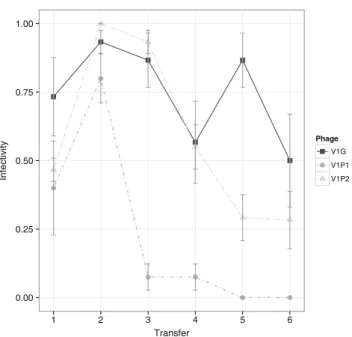
When confronted to non-evolving bacteria, the temporal dy-namics of infectivity of the three individual phages presented rather similar patterns (Fig. 2). After an initial increase in infectivity that lasted either only one (V1P1) or two transfers (V1G and V1P2), the infectivity of all the three evolving phages decreased. The infectivity of V1P1 abruptly decreased at transfer #3 and maintained very low values for the rest of the experiment. The infectivity of evolving V1G and V1P2 against non-evolving bacteria also decreased over time, but was higher than the infectivity of V1P1 by the end of the experiment.
Resistance to the Phage Cocktail
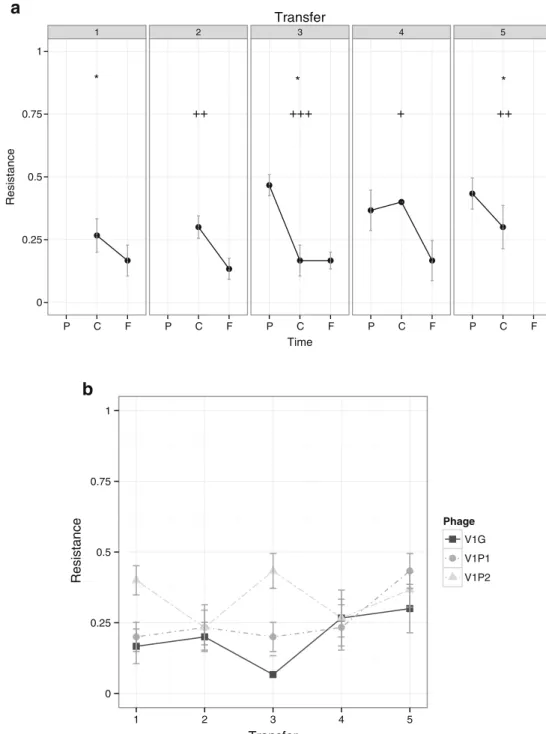
When the bacteria Vibrio sp. CV1 co-evolved with the phage cocktail that included the three phages, its resistance against contemporary phages remained relatively low and stable dur-ing all the experiment (Fig. 3a). Co-evolving bacteria were
1 2 3 4 5 6 0.25 0.50 0.75 1.00 P C F P C F P C F P C F P C F P C F Time R e sistance Phage V1G V1P1 V1P2 Transfer
a
0 0.25 0.5 0.75 1 1 2 3 4 5 6 Transfer Resistance Phage V1G V1P1 V1P2b
Fig. 1 Co-evolutionary dynamics of Vibrio sp. CV1 resistance against individual phages V1G (black squares), V1P1 (gray circles), and V1P2 (light gray triangles). a At each transfer, the mean bacterial resistance was evaluated against phages from two transfers back in time (P), against contemporary phages (C), and against phages from two transfers ahead in the future (F). Co-evolutionary change is detected by exploring the patterns in the slope formed between resistance to future and contemporary phages, and between resistance tocontemporary and past phages at each transfer. The alpha symbol corresponds to a level of significance of p <0.05 for the slope pattern at each transfer. Only V1P2 has a slope significantly different than 0 in transfers 1, 2, and 3. For transfers 1 and 2, the phages from two transfers back were not available. Vertical lines represent standard errors. b Resistance of co-evolved bacteria against the ancestral phage
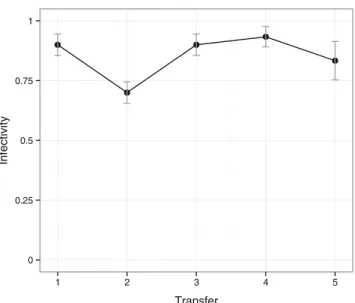
often more susceptible (less resistant) to future phages than to phages from the past (i.e., transfers #1, #3, and #5 show a negative slope, significantly different from 0, p <0.05, Fig.3a), revealing the signature pattern of antagonistic co-evolution. The co-evolved bacteria remained a low resistance against any of the three ancestral phages along all the experiments (Fig.3b). When only the phages but not the bacteria were allowed to evolve, infectivity levels of the cocktail remained high during all the experiment (low bacterial resistance, Fig.4).
Discussion
This study was designed to evaluate the co-evolutionary in-teractions of the lytic phages V1G, V1P1, and V1P2, and their natural host, the bacteria Vibrio sp. CV1. Despite some slight differences in the temporal dynamics of infectivity among the phages, our experiments revealed a rapid increase in the frequency of resistant bacteria to all three individual phages (Fig.1a). The bacteria that evolved resistance during the co-evolution experiment remained resistant against the ancestral phage strains, suggesting that resistance to the co-evolving phage population also conferred resistance to the ancestral phage (Fig.1b). The data collected from the evolution exper-iment, in which the bacteria were not allowed to evolve, revealed that the infectivity of the individual phages decreased over time (Fig.2). This suggests that in addition to the rapid evolution of bacterial resistance observed in the co-evolution treatment, co-evolved phages may have also evolved low infectivity throughout the experiment. Therefore, the evolution of bacterial resistance and lower phage infectivity together
contributed to the absence of co-evolutionary patterns ob-served here (Fig.1a). Under the evolution of bacterial resis-tance alone, one would expect that the bacteria will be more resistant to the past than to the future phages (negative resistance-to-time slopes). Under the evolution of lower infec-tivity alone, one would expect that the bacteria will be more resistant to the phages from the future than to the phages from the past (positive resistance-to-time slopes).
The emergence of resistance against single phages has already been reported in other aquaculture systems [41,42] including for the genus Vibrio [43]. Bacterial resistance mech-anisms against bacteriophages aim to disrupt a crucial step of infection. These include (1) receptor modifications to prevent adsorption, (2) superinfection systems which inhibit DNA entry, (3) restriction–modification complexes to block invad-ing genetic material, (4) the CRISPR-Cas loci which specifi-cally target a sequence of the invading genetic material by activating a complex repertoire of small RNA fragments, and (5) abortive systems that destroy an infected cell after infec-tion is successful [28,44–46] [reviewed by 47]. While we have no information allowing us to directly contrast these mechanisms, the fact that none of the phages regained infec-tivity suggests that resistant bacteria may modify or even dispose the receptor involved in the interaction with each phage alone. Additionally, the fact that the evolution of resis-tance against contemporary phages was not accompanied by a cost against the ancestral phage is in accordance with this hypothesis. Noteworthy, having a CRISPR-Cas locus would also explain the dynamics we observed in our data.
We were somehow surprised by the incapacity of the phages to re-infect their host, considering previous reports of an increase of infectivity over short evolutionary scales against a single host [23,40,47]. However, the fact that infectivity decreased over time in the evolution treatment suggests that lower infectivity may have also been selected and would help explain the incapacity of the phages to regain infectivity in the co-evolution treatment. It has been suggested that the evolu-tion of phage infectivity is shaped by the presence of a strong trade-off between virulence (e.g., infectivity) and reproduction [47]. Viruses with low virulence as the ones observed here may be stably maintained by having high reproductive ca-pacity. Furthermore, a mathematical model suggests that the evolutionary stable (ES) level of parasite virulence is also affected by the proportion of resistant host present [48]. As the resistant population remains high, the ES of the pathogen is significantly reduced. Noteworthy, in the case where host resistance is allowed to co-evolve with parasite virulence, it has been observed that parasite infectivity is even further reduced [48].
Previous studies have revealed the importance of co-evolution in terms of co-existence, population differentiation, and molecular evolution [21–25, 27, 49–51]. For instance, Buckling and Rainey [22] observed a time-lagged
co-0.00 0.25 0.50 0.75 1.00 1 2 3 4 5 6 Transfer Infectivity Phage V1G V1P1 V1P2
Fig. 2 Mean infectivity of evolved phages V1G (black squares), V1P1 (gray circles), and V1P2 (light gray triangles) at each transfer against contemporary Vibrio sp. CV1. Vertical lines represent standard errors
evolution when Pseudomonas fluorescens SBW25 was confronted to its lytic phage SBW25Φ2. In that system, sev-eral cycles of resistant and susceptible bacteria were obtained followed by different infectious and non-infectious phages, allowing the long-term co-existence of the phage and its host bacteria. In accordance with our results, resistance to contem-porary phages reached high levels after only a few transfers; but contrary to our findings, phages were able to regain infectivity. The observed incapacity of the mentioned phages to maintain or regain infectivity supposes a strong limitation for their persistence [49,52]. A possible explanation for the
persistence of the phages despite their extremely low infectiv-ity is that some sensitive bacteria were still present in low frequencies, allowing the phage to reproduce [52,53]. In fact, this has been shown in long-term experiments for the co-evolutionary dynamics of Escherichia coli with the T4 [28] and the RNA Qβ lytic phages [54]. Stable co-existence was observed between resistant and sensitive populations of the host, as well as for T4. Mainly, when spontaneous resistant mutants rose, both the susceptible and resistant populations co-existed at similar levels, while phages increased their numbers only after prolonged seasons at low densities [28].
1 2 3 4 5 0 0.25 0.5 0.75 1 P C F P C F P C F P C F P C F Time Resistance Transfer
a
+ +++ ++ ++ * * * 0 0.25 0.5 0.75 1 1 2 3 4 5 Transfer R esistance Phage V1G V1P1 V1P2b
Fig. 3 Co-evolutionary changesin Vibrio sp. CV1 resistance against the phage cocktail composed of V1G, V1P1, and V1P2. a At each transfer, the mean bacterial resistance was evaluated against phages from two transfers back in time (P), against contemporary phages (C), and against phages from two transfers ahead in the future (F). The co-evolutionary change is detected by exploring the patterns in the slope formed between future and contemporary phages, and between contemporary and past phages at each transfer. b Resistance of co-evolved bacteria against each of the three ancestral phages. Asterisk corresponds to a level of significance of p <0.05 for the slope pattern at each transfer. For transfers 1 and 2, the phages from two transfers back were not available. Plus sign indicates the significance level of the difference of the mean resistance proportion between the phage cocktail treatment and the single-phage treatments: p <0.05=single plus sign, p <0.01=double plus sign. and p <<0.001=triple plus sign. Vertical lines represent standard errors
Co-existence was also observed in long-term evolution with Qβ [54]. In this case, E. coli showed partial resistance follow-ed by stepwise improvements in growth rate. Conversely, Qβ counter adapted by increasing release efficiency and decreas-ing virulence [54]. Furthermore, whole-genome analysis showed accelerated evolution, despite differences in genome size and mutation rates, in both host and the phage, allowing co-existence [54].
In opposition to monophage treatments, the use of a phage cocktail avoided Vibrio sp. CV1 to evolve resistance, and average resistance levels against the phage cocktail were much lower compared to any of the monophage treatments (Fig. 1a vs. Fig. 3a). Additionally, in the presence of three phages, the co-evolving bacteria did not become resistant against the ancestral phages (Fig. 3b). These results are in accordance with the mounting evidence of phage cocktails delaying the emergence of resistance compared to monophage therapy in E. coli [16,34], Vibrio cholerae [43], Pseudomonas aeruginosa [39], Salmonella sp. [37], and Klebsiella pneumoniae [17]. Although some resistant bacteria may also evolve when a cocktail is used, a much longer time is needed to accumulate enough mutations to develop resistance. Reductions in bacterial cell densities using a cocktail may result in lower mutation rates, thus limiting the potential for bacterial resistance evolution. Altogether, our results indicate that the incapacity of bacteria to evolve resistance in presence of the phage cocktail is in fact due to the diversity of the phages since none of them could individually account for the observed high infectivity levels by itself. Perhaps the most original finding of our study is that the presence of multiple phages resulted in a pattern of antagonistic co-evolution, with Vibrio sp. CV1 being more sensitive to phages never encoun-tered before than to past or contemporary phages. This pattern
contrasted with the three monophage treatments in which antagonistic co-evolution patterns were absent and suggested a permanent arms race between the bacteria developing resis-tance and the phage cocktail overcoming those defenses. In a recent effort to overcome the emergence of bacterial resistance against phages, Gu and colleagues [17] performed what they called a“step-by-step” approach to isolate three phages that together formed a very effective phage cocktail to fight against K. pneumoniae infections in mice. The principle of this meth-od was to track the emergence of resistant bacteria over time and to isolate infectious phage for each newly emerged resis-tant bacteria. As a result, because the three phages targeted different hosts, the phage cocktail delayed the emergence of resistance and increased mice survival. In accordance with the observed delay in the emergence of resistance when a cocktail was used, it is possible that our three phages are targeting different bacterial genotypes present in the culture. This sug-gests that the emergence of resistance in the presence of multiple phages, which requires the modification of multiple receptors, may represent a higher cost than developing resis-tance against a single phage [40,55].
We acknowledge some limitations in the present work. First, our study was limited to the exploration of the outcome of co-evolution. We did not consider the genetic aspects of resistance acquisition or of infectivity. Future research should not only focus on the trends, such as the ones mentioned here, but should also explore the underlying mechanisms. We also believe that the results presented here require validation under natural conditions. For instance, experiments need to be performed in the field, where the influence of other biotic and abiotic factors may modify the resistance of bacteria or the infectivity of the phages and hence alters the success of phage therapy in terms of shrimp survival, though, we still believe our results are promising in terms of their conse-quences to different industrial or medical scenarios. At pres-ent, the design of phage cocktails with antimicrobial purposes is entering a new era on its development by incorporating different methods of phage isolation [17] and exposition [39]. Our data underline the importance of also exploring the dy-namics of co-evolution when considering phages for bacterial control, in particular because the acquisition of resistance may be accompanied by the incapacity of phage to regain infectiv-ity. An important conclusion from our study is that due to the rapid emergence of bacterial resistance and the incapacity of phages to regain infectivity, phage therapy using a single phage may be an inefficient treatment against vibriosis in shrimp hatcheries. As an interesting perspective, given the limited capacity of bacteria to develop resistance against a phage cocktail [17, 37–40], simultaneously using multiple phages may represent a more effective strategy for the control of bacterial infections. Our study provides valuable informa-tion corroborating the recent evidence in favor of the utiliza-tion of phage cocktails.
0 0.25 0.5 0.75 1 1 2 3 4 5 Transfer Infectivity
Fig. 4 Mean infectivity of evolved phages at each transfer against contemporary Vibrio sp. CV1. Vertical lines represent standard errors
Acknowledgments We would like to give special thanks to CENIACUA, Banco de Santander award for innovative science and to the Facultad de Ciencias of Universidad de los Andes, Bogotá, Colombia for their financial support. We also want to thank Angus Buckling for the useful discussion and comments on the project.
References
1. Bostock J, McAndrew B, Richards R, Jauncey K, Telfer T, Lorenzen K, Little D, Ross L, Handisyde N, Gatward I, Corner R (2010) Aquaculture: global status and trends. Phil Trans R Soc B Biol Sci 365:2897–2912. doi:10.1098/rstb.2010.0170
2. Defoirdt T, Sorgeloos P, Bossier P (2011) Alternatives to antibiotics for the control of bacterial disease in aquaculture. Curr Opin Microbiol 14:251–258. doi:10.1016/j.mib.2011.03.004
3. Gómez G, Balcázar J, Ma S (2007) Probiotics as control agents in aquaculture. J Ocean Univ China (English Edition) 6:76–79. doi:10. 1007/s11802-007-0076-8
4. Defoirdt T, Boon N, Sorgeloos P, Verstraete W, Bossier P (2007) Alternatives to antibiotics to control bacterial infections: luminescent vibriosis in aquaculture as an example. Trends Biotechnol 25:472– 479. doi:10.1016/j.tibtech.2007.08.001
5. McPhearson RM, DePaola A, Zywno SR, Motes ML Jr, Guarino AM (1991) Antibiotic resistance in Gram-negative bacteria from cultured catfish and aquaculture ponds. Aquaculture 99:203–211. doi:10. 1016/0044-8486(91)90241-x
6. Miranda CD, Zemelman R (2002) Bacterial resistance to oxytetracy-cline in Chilean salmon farming. Aquaculture 212:31–47. doi:10. 1016/s0044-8486(02)00124-2
7. Breitbart M, Salamon P, Andresen B, Mahaffy JM, Segall AM, Mead D, Azam F, Rohwer F (2002) Genomic analysis of uncultured marine viral communities. Proc Natl Acad Sci 99:14250–14255. doi:10. 1073/pnas.202488399
8. Hambly E, Suttle CA (2005) The viriosphere, diversity, and genetic exchange within phage communities. Curr Opin Microbiol 8:444– 450. doi:10.1016/j.mib.2005.06.005
9. Weinbauer MG (2004) Ecology of prokaryotic viruses. FEMS Microbiol Rev 28:127–181. doi:10.1016/j.femsre.2003.08.001
10. Housby JN, Mann NH (2009) Phage therapy. Drug Discov Today 14: 536–540
11. Hanlon GW (2007) Bacteriophages: an appraisal of their role in the treatment of bacterial infections. Int J Antimicrob Agents 30:118– 128. doi:10.1016/j.ijantimicag.2007.04.006
12. Mathur M, Vidhani S, Mehndiratta P (2003) Bacteriophage therapy: an alternative to conventional antibiotics. J Assoc Physicians India 51:593–596
13. Karunasagar I, Shivu MM, Girisha SK, Krohne G, Karunasagar I (2007) Biocontrol of pathogens in shrimp hatcheries using bacteriophages. Aquaculture 268:288–292. doi:10.1016/j.aquaculture.2007.04.049
14. Vinod MG, Shivu MM, Umesha KR, Rajeeva BC et al (2006) Isolation of Vibrio harveyi bacteriophage with a potential for biocon-trol of luminous vibriosis in hatchery environments. Aquaculture 255:117. doi:10.1016/j.aquaculture.2005.12.003
15. Kutateladze M, Adamia R (2010) Bacteriophages as potential new therapeutics to replace or supplement antibiotics. Trends Biotechnol 28:591–595
16. O'Flynn G, Ross RP, Fitzgerals GF, Coffey A (2004) Evaluation of a cocktail of three bacteriophages for biocontrol of Escherichia coli o157:H7. Appl Environ Microbiol 70:3417–3424. doi:10.1128/ AEM.70.6.3417-3424.2004
17. Gu J, Liu X, Li Y, Han W, Lei L, Yang Y, Zhao H, Gao Y, Song J, Lu R, Sun C, Feng X (2012) A method for generation phage cocktail with great therapeutic potential. PLoS ONE 7:e31698. doi:10.1371/ journal.pone.0031698
18. Chao L, Levin BR, Stewart FM (1977) A complex community in a simple habitat: an experimental study with bacteria and phage. Ecology 58:369–378
19. Jessup CM, Forde SE (2008) Ecology and evolution in microbial systems: the generation and maintenance of diversity in phage-host interactions. Res Microbiol 159:382–389. doi:10.1016/j.resmic. 2008.05.006
20. Woolhouse MEJ, Webster JP, Domingo E, Charlesworth B, Levin BR (2002) Biological and biomedical implications of the co-evolution of pathogens and their hosts. Nat Genet 32:569–577. doi:10.1038/ ng1202-569
21. Brockhurst MA, Morgan AD, Rainey PB, Buckling A (2003) Population mixing accelerates coevolution. Ecol Lett 6:975–979. doi:10.1046/j.1461-0248.2003.00531.x
22. Buckling A, Rainey PB (2002) Antagonistic coevolution between a bacterium and a bacteriophage. Proc R Soc London, Ser B 269:931– 936. doi:10.1098/rspb.2001.1945
23. Poullain V, Gandon S, Brockhurst M, Buckling A, Hochberg M (2008) The evolution of specificity in evolving and coevolving antagonistic interactions between a bacteria and its phage. Evolution 62:1–11. doi:10.1111/j.1558-5646.2007.00260.x
24. Mizoguchi K, Morita M, Fischer CR, Yoichi M, Tanji Y, Unno H (2003) Coevolution of bacteriophage PP01 and Escherichia coli 0157:H7 in continuous culture. Appl Environ Microbiol 69:170–176 25. Paterson S, Vogwill T, Buckling A, Benmayor R, Spiers AJ, Thomson NR, Quail M, Smith F, Walker D, Libberton B, Fenton A, Hall N, Brockhurst MA (2010) Antagonistic coevolution accelerates molecu-lar evolution. Nature 464:275–278. doi:10.1038/nature08798
26. Thompson JN (2005) Coevolution: the geographic mosaic of coevo-lutionary arms races. Curr Biol 15:R992–R994
27. Gomez P, Buckling A (2011) Bacteria-phage antagonistic coevolu-tion in soil. Science 332:106–109
28. Bohannan BJM, Lenski RE (2000) Linking genetic change to com-munity evolution: insights from studies of bacteria and bacterio-phage. Ecol Lett 3:362–377
29. Levin BR, Bull JJ (2004) Population and evolutionary dynamics of phage therapy. Nat Rev 2:166–173
30. Chrisolite B, Thiyagarajan S, Alavandi SV, Abhilash EC, Kalaimani N, Vijayan KK, Santiago TC (2008) Distribution of luminescent Vibrio harveyi and their bacteriophages in a commercial shrimp hatchery in South India. Aquaculture 275:13–19
31. Karunasagar I, Pai R, Malathi GR, Karunasagar I (1994) Mass mortality of Penaeus monodon larvae due to antibiotic-resistant Vibrio harveyi infection. Aquaculture 128:203–209
32. Otta S, Karunasagar I, Karunasagar I (2001) Bacteriological study of shrimp, Penaeus monodon Fabricius, hatcheries in India. J Appl Ichthyol 17:59–63. doi:10.1046/j.1439-0426.2001.00249.x
33. Oliveira J, Castilho F, Cunha A, Pereira MJ (2012) Bacteriophage therapy as a bacterial control strategy in aquaculture. Aquac Int 20: 879–910
34. Tanji Y, Shimada T, Fukudomi H, Miyanaga K, Nakai Y, Unno H (2005) Therapeutic use of phage cocktail for controlling Escherichia coli O157:H7 in gastrointestinal tract of mice. J Biosci Bioeng 100: 280–287. doi:10.1263/jbb.100.280
35. Carvalho CM, Gannon BW, Halfhide DE, Santos SB, Hayes CM, Roe JM, Azeredo J (2010) The in vivo efficacy of two administration routes of a phage cocktail to reduce numbers of Campyllobacter coli and Campyllobacter jejuni in chickens. BMC Microbiol 10:232 36. Oliveira A, Sereno R, Azeredo J (2010) In vivo efficiency evaluation
of a phage cocktail in controlling severe colibacillosis in confined conditions and experimental poultry houses. Vet Microbiol 146:303– 308. doi:10.1016/j.vetmic.2010.05.015
37. Turki Y, Ouzari H, Mehri I, Ammar AB, Hassen A (2012) Evaluation of a cocktail of three bacteriophages for the biocontrol of Salmonella of wastewater. Food Res Int 45:1099–1105. doi:10.1016/j.foodres. 2011.05.041
38. Chan BK, Abedon ST (2012) Phage therapy pharmacology: phage cocktails. Adv Appl Microbiol 78:1–23
39. Hall AR, De Vos D, Friman V-P, Pirnay J-P, Buckling A (2012) Effects of sequential and simultaneous applications of bacteriophages on populations of Pseudomonas aeruginosa in vitro and in wax moth larvae. Appl Environ Microbiol 78:5646–5652
40. Buckling A, Wei Y, Massey RC, Brockhurst MA, Hochberg ME (2006) Antagonistic coevolution with parasites increases the cost of host deleterious mutations. Proc R Soc B Biol Sci 273:45–49. doi:10. 1098/rspb.2005.3279
41. Imbeault S, Parent S, Lagacé M, Uhland CF, Blais J-F (2006) Using bacteriophages to prevent furunculosis caused by Aeromonas salmonicida in farmed Brook trout. J Aquat Anim Heal 18:203–214 42. Matsuoka S, Hashizume T, Kanzaki H et al (2007) Phage therapy against beta-hemolytic streptococcicosis of Japanese flounder Paralichthys olivaceus. Fish Pathol 42:181–189
43. Wei Y, Kirby A, Levin BR (2011) The population and evolutionary dynamics of Vibrio cholerae and its bacteriophage: conditions for maintaining phage-limited communities. Am Nat 178:715–725. doi:
10.1086/662677
44. Gottesman S (2011) Microbiology: dicing defense in bacteria. Nature 471:588–589
45. Horvath P, Barrangou R (2010) CRISPR/Cas, the immune system of bacteria and archaea. Science 327:167–170
46. Labrie SJ, Samson JE, Moineau S (2010) Bacteriophage resistance mechanisms. Nat Rev Microbiol 8:317–327
47. Messenger SL, Molineux IJ, Bull JJ (1999) Virulence evolution in a virus obeys a trade off. Proc R Soc London, Ser B 266:397–404 48. Gandon S, van Baalen M, Jansen VAA (2002) The evolution of parasite
virulence, superinfection, and host resistance. Am Nat 159:658–669 49. Lenski RE, Levin BR (1985) Constraints on the coevolution of
bacteria and virulent phage: a model, some experiments, and predic-tions for natural communities. Am Nat 125:585–602
50. Morgan AD, Bonsall MB, Buckling A (2010) Impact of bacterial mutation rate on coevolutionary dynamics between bacteria and phages. Evolution 64:2980–2987
51. Schrag ST, Mittler JE (1996) Host-parasite coexistence: the role of spatial refuges in stabilizing bacteria-phage interactions. Am Nat 148:348–377
52. Lythgoe KA, Chao L (2003) Mechanisms of coexistence of a bacteria and a bacteriophage in a spatially homogeneous environment. Ecol Lett 6:326–334
53. Fischer CR, Yoichi M, Unno H, Tanji Y (2004) The coexistence of Escherichia coli serotype O157:H7 and its specific bacteriophage in continuous culture. FEMS Microbiol Lett 241:171–177
54. Kashiwagi A, Yomo T (2011) Ongoing phenotypic and genetic changes in experimental coevolution of RNA bacteriophage Qβ and Escherichia coli . PLoS Genet 7(8):e1002188. doi:10.1371/ journal.pgen.1002188
55. Koskella B, Lin DM, Buckling A, Thompson JN (2012) The costs of evolving resistance in heterogeneous parasite environments. Proc R Soc London, Ser B 279:1896–1903