READ THESE TERMS AND CONDITIONS CAREFULLY BEFORE USING THIS WEBSITE.
https://nrc-publications.canada.ca/eng/copyright
Vous avez des questions? Nous pouvons vous aider. Pour communiquer directement avec un auteur, consultez la première page de la revue dans laquelle son article a été publié afin de trouver ses coordonnées. Si vous n’arrivez pas à les repérer, communiquez avec nous à [email protected].
Questions? Contact the NRC Publications Archive team at
[email protected]. If you wish to email the authors directly, please see the first page of the publication for their contact information.
NRC Publications Archive
Archives des publications du CNRC
This publication could be one of several versions: author’s original, accepted manuscript or the publisher’s version. / La version de cette publication peut être l’une des suivantes : la version prépublication de l’auteur, la version acceptée du manuscrit ou la version de l’éditeur.
Access and use of this website and the material on it are subject to the Terms and Conditions set forth at
International Collaboration in Developing Online Resources for
Teaching Democracy
Goldfarb, Ilia; Kondratova, Irina; Kinnie, B.
https://publications-cnrc.canada.ca/fra/droits
L’accès à ce site Web et l’utilisation de son contenu sont assujettis aux conditions présentées dans le site LISEZ CES CONDITIONS ATTENTIVEMENT AVANT D’UTILISER CE SITE WEB.
NRC Publications Record / Notice d'Archives des publications de CNRC:
https://nrc-publications.canada.ca/eng/view/object/?id=73ae01e6-38f5-4dbc-9906-75af1d297fe1 https://publications-cnrc.canada.ca/fra/voir/objet/?id=73ae01e6-38f5-4dbc-9906-75af1d297fe1
National Research Council Canada Institute for Information Technology Conseil national de recherches Canada Institut de technologie de l'information
International Collaboration in Developing Online
Resources for Teaching Democracy *
Goldfarb, I., Kondratova, I., Kinnie, B.
October 2002
* published in Proceedings of the NAWEB 2002, Eighth International North American Web Based Learning Conference, University of New Brunswick, Fredericton, NB, Canada. October 19-22, 2002. pp. 43-52. NRC 45792.
Copyright 2002 by
National Research Council of Canada
Permission is granted to quote short excerpts and to reproduce figures and tables from this report, provided that the source of such material is fully acknowledged.
International collaboration in developing online resources for
teaching democracy
Ilia Goldfarb, The Spirit of Democracy Project, Faculty of Education
University of New Brunswick (Canada)
Irina Kondratova, NRC, IIT e-Business (Canada)
Heather Boyd Kinnie, The Spirit of Democracy Project, Faculty of Education
University of New Brunswick (Canada)
Abstract
The Spirit of Democracy project began in the summer of 2000. The project aims to strengthen the commitment to democratic ideals and institutions in Russia. The objective of the project is to enhance the capacity of civic educators to develop and sustain a dynamic and vibrant program of citizenship education. This goal is being met through supporting teachers in Canada and Russia by providing online resources and training that will assist them in engaging their students in a thoughtful consideration of the ideas that shape democratic societies.
We live in a new and exciting time. Boundaries between countries and continents are fading, and developments in information technologies and interconnectivity are facilitating the spread of democracy. Web media, by its nature is the most democratic type of modern media and is ideally suited for conveying the “spirit of democracy ”. The Web also serves as a unique source of “live” information by providing hypertext links to government organizations, international organizations, educational Web sites, and online magazines. The pedagogical approaches adapted by the project include blended learning, situated learning, and creative use of Web media to effectively teach democracy on the Web.
The project Web site brings together a community of practice in cyberspace – a community of social studies researchers and teachers from Russia and Canada. We believe that in order for the existing Spirit of Democracy’s virtual community to continue to grow and function successfully it would be necessary to create a supporting management framework for a second phase of the project. We believe that a logical extension of the project would be to create a “Spirit of Democracy” portal that will accommodate resources to support the work of the “Spirit of Democracy” ’s community members and Russian-led Centers of Excellence in Civic Education.
International collaboration in developing online resources for teaching
democracy
Introduction
The organizing idea for this project was born several years ago when two Canadian researchers, Andrew Hughes and Alan Sears witnessed a compelling appeal from colleagues from Argentina at a civic education conference. Argentinean educators, working to foster an emerging democratic culture in their country said “Don’t teach us about the structures of democracy - we know all about the structures of democracy; teach us the spirit of democracy” (The Spirit of Democracy, 2002a). This appeal captured the essence of concerns that Canadians later explored with their colleagues at the Russian Association for Civic Education.
On-going collaboration between Canadian and Russian educators resulted in the Spirit of Democracy project being initiated by the University of New Brunswick Faculty of Education Citizenship
Education Research and Development Group in Partnership with the Russian Association for Civic Education and Uchitelskaya Gazeta. The project began in April 1, 2000 and was made possible through a financial contribution by the Canadian International Development Agency.
The Spirit of Democracy project aims to strengthen the commitment to democratic ideals and institutions in Russia. The objective of the project is to enhance the capacity of civic educators to develop and sustain a dynamic and vibrant program of citizenship education. This goal is being met through supporting teachers in Canada and Russia by providing resources and training that will assist them in engaging their students in a thoughtful consideration of the ideas that shape democratic societies.
To accomplish these goals, the principal focus of the project is on the creation of on-line citizenship education resources intended for use by teachers in Russia and Canada. The pedagogical approaches adapted by the project include blended learning, situated learning, and creative use of Web media to effectively teach democracy on the Web. Project participants make considerable efforts to keep the project site a truly democratic learning environment, including links to national and international democratic sources.
Web and Democracy
We live in a new and exciting time. Boundaries between countries and continents are fading due to the interconnectivity provided by the Internet, and developments in information technologies force businesses and governments to develop new strategies to incorporate new technologies in their everyday lives. Milliron and Miles (2000) give examples of the US electoral process going high tech as well as a Web-based fundraising that enables Americans to better participate in the political process. USA, Canada and other countries are entering the 21- century as emerging “digital democracies”.
Is there a direct relation between the Web and Democracy? It was believed for some time that connectivity facilitates the spread of democracy:
.
Freedom is fostered when the means of communication are dispersed, decentralized, and easily available, as are printing presses or microcomputers. Central control is more likely when the means of communication are concentrated, monopolized, and scarce (Pool, 1983).
However, the evidence of a distinct relationship between democracy and connectivity was mostly anecdotal. Stefik (1999) describes numerous reports on the pivotal role of communications technologies in the democratic developments worldwide including an increase in e-mail and fax information exchanges during the break up of the U.S.S.R. and the Tianamen Square riots in China. The direct connection between connectivity and democracy was proven scientifically only in 1997 by Christofer Kedzie. Kedzie’s research (Kedzie, 1997) was the first study providing hard scientific data to support the notion that the development of communications technology has a profound influence on democratic freedoms and values. Using statistical analysis, Kedzie found strong correlation between interconnectivity and democracy:
Empirical evidence confirms the postulated correlation between democracy and network interconnectivity. Despite the inherent limitations of statistical analyses, several analytic perspectives, every model, set of statistical tests and functional form in this study is consistent with the hypothesis that interconnectivity is a powerful predictor of democracy, more than any of democracy's traditional correlates… Interconnectivity correlates strongly not only with the level of democracy, but also with the change of democracy over ten years (Kedzie, 1997).
Web media, by its nature, is the most democratic type of modern media and is ideally suited for conveying the “spirit of democracy ”. In this paper authors are using the Web media definition from Huss (1999), where the Web media is defined as the use of the text, images, animations, sounds and video on the Web, supported by Hypertext Markup Language (HTML).
For social studies educators, Web media provides important advantages over other communication media such as interactivity and user involvement. Web-based studies immerse students in an online learning environment that allows them to access all original materials, even those provided for teachers. The Web also serves as a unique source of “live” information. For example, by providing hypertext links to government organizations, international organizations, educational Web sites, and online magazines, The Spirit of Democracy learning materials are always up-to date and offer information on recent important developments in the area of Citizenship and Social Studies in Canada, Russia and all over the world.
The Spirit of Democracy Project
Learning approach
The Spirit of Democracy project is using the Web to deliver online resources: content, instructions, along with a discussion environment for teachers and students. These curriculum resources can be used as a complete set of materials or as individual lesson topics for different subjects such as Social Studies, History, Citizenship Education, etc. The Canadian and Russian project teams are developing project materials for similar topics based on local context. As a result, the information presented on the Canadian site is relevant to the lives of young Canadians, and the content on the Russian site may differ and is relevant to the lives of Russian students.
The Spirit of Democracy project’s learning approach is based on the ideas of Lev Semenovich Vygotsky who is widely known as “The Mozart of Psychology”. Vygotsky, along with Piaget and Bruner, developed the foundation for the concepts of Situated Learning and Anchored Instruction (The Spirit of Democracy 2002b). The Situated Learning approach is based on Situated Cognition Theory that suggests that learning is tied to authentic activity, context and culture (Brown et al. 1989):
An authentic context for citizenship learning must be a situation in which “real” citizens might be required to think and to act. It can be current, historical, or both; it can be near or far in both time and place (Hughes et al. 2000).
Hung (2001) applies Vygotsky’s theory to design principles of Web-based learning and establishes connections between principles drawn from Vygotskian thought and design considerations for Web-based learning. For example, he relates Principle A “ Learning is demand driven - dependent on engagement in practice” to a requirement for a Web learning environment to have personalized content for the learner. Principle B “ Learning is a social act/construction mediated between social beings through language, signs, genres, and tools” is related to such design considerations as social, communicative and collaborative dimensions of Web-based learning. Principle E “ Learning is embedded in rich cultural and social context – acquiring both implicit and explicit knowledge” – Hung suggests that a Web-based learning environment should allow learners to access learning materials in the local context. Principle G “ Learning is to transfer knowledge from one situation to another, discovering relational and associated meanings in concepts” is related by Hung to a Web-based learning environment that facilitates learning through observation of visual artifacts. The above design considerations for Web-based learning closely coincide with the design methodology implemented by the Spirit of Democracy project. The project Web site provides personalized resources for Canadian and Russian teachers and students (Principle A). Collaborative dimensions are addressed by providing a Discussion board for students and teachers (Principle B). The project Web site consists of two separate sites (Russian and Canadian) that provide resources based on the local context (Principle E), and visuals play a prominent role in the collection of project’s online learning resources (Principle G).
Creative use of Web media
The Spirit of Democracy project provides teachers and students with a wide range of “real life” situations. The project is using a “blended learning” approach in which teachers use online materials in combination with conventional classroom training.
Within the project, developers, on both sides, create learning opportunities using situations and springboards (anchors). The situations present democratic issues and concepts, for example, the value of loyalty, or the meaning of privacy. The uniqueness of the approach taken by the project is that researchers use authentic materials to involve students in learning and discovery. A very important role is assigned to visual materials. The situation is usually presented to students by showing a sequence of 8-10 pictures. The pictures should be descriptive enough to tell the story and appealing enough to draw the students in to a discussion about a particular topic. To achieve these results, the project illustrator works closely with researchers to portray the situations they want to use.
The topic of “Privacy” is a good example of such joint work between a researcher and an illustrator. One of the scenarios dealing with the topic of “Legal Aspects of Privacy” involves a discussion on the case of unreasonable search and seizure (Mr. Bagnell’s case). In the learning activity “You Be the
.
Judge” students need to learn all the details of the case and make a legal judgment (The Spirit of Democracy 2002c). The factual materials of the case are presented as a series of illustrations that lead students through the sequence of events of the actual case. One of the important conditions of this activity is to create an illusion of the court environment and help students experience the process of rendering a fair judgment. The use of visuals here is much more appropriate than the use of
newspaper or magazine articles. Such articles usually contain judgmental opinions that may influence students’ decisions one way or another. The researcher needed to spend a considerable amount of time working with the illustrator on the details of each scene, making sure that it properly presents all the facts of the case without any additional visual information that might influence students’ opinion. Along with the visual story presented through illustrations, the hypertext links allow students to learn the facts of the case and get additional supportive information, such as, excerpts from the Canadian Charter of Rights and Freedoms, the Controlled drugs and Substances Act, excerpts from precedents that deal with search and seizure cases and from the Privacy Act of New Brunswick, and a discussion of reasonable grounds. It is interesting to mention that our Russian colleagues were having a difficult time translating the word “privacy” as there is no equivalent in the Russian language. Currently, in Russia, people are using the English word “privacy” to convey the correct meaning of the concept. The idea of having a Privacy Commissioner is also something unheard of in Russian society. One more example of using images creatively to engage students in discussion about democratic issues, like “Freedom of religion”, is an interactive presentation of the famous Russian painting “Boyarynya Morozova” by Surikov (The Spirit of Democracy 2002d). In this painting, the artist depicts Feodosiya Morozova, who was an active supporter of the old-believer movement in the Russian church, and a crowd made up of vivid individuals. The image map of the painting is hyperlinked to the close-ups of the individual characters portrayed by the painter. During the class discussion the teacher can, using this interactive image, focus student’s attention on different human faces in this complex masterpiece portraying a whole range of attitudes towards religion. This helps to initiate a group discussion about a real historical event and how different people with their own beliefs and values view this event.
Unfortunately, the use of multimedia in this international project is heavily restricted by bandwidth limitations on the Russian partners’ side. Russian schools, especially in rural areas, have very slow Internet connections. Due to these limitations, in some cases video clips on springboards had to be substituted by a sequence of compressed images and songs were replaced by text. Fortunately, the Russian government is currently implementing reforms that encourage the use of modern
telecommunications technologies (Filippov, 1999) and we hope that the above limitations will soon disappear, allowing a full range of multimedia capabilities.
Internationalization and cultural issues
It is important to mention the creative approach in interface design utilized by the project. The majority of graphic navigation elements are intentionally designed as hypertext links and not as images. This approach allows the use of automatic translation tools to translate not only the content of individual web pages, but also the navigational elements, thus allowing international users access to the entire content of the Canadian Web site. In the future, with the development of the automatic translation technology, the content of the entire project site, including Russian web pages, will be available for international users. However, even today, using the Web-based automatic translation engine, there is an option to translate Canadian project pages into four languages such as French, Spanish, German and Italian.
The quality of the automatic translation is reasonably accurate, for example the French translation was evaluated and found to be of acceptable quality. However, this is not the case with all languages. For example, when using the service in Spanish, the word “spirit” in the phrase “Spirit of
Democracy” gets translated to the word "alcohol". We believe that, in the future, with the development of better translation tools, these problems will be solved.
Because of the international nature of this project, there was an opportunity to develop inter-cultural awareness and understanding between project teams. Most of the cultural issues were related to the Web site design and project logo. The process of logo design is an illustration of the complex issues that can arise between two teams working together in different countries with different histories and cultures.
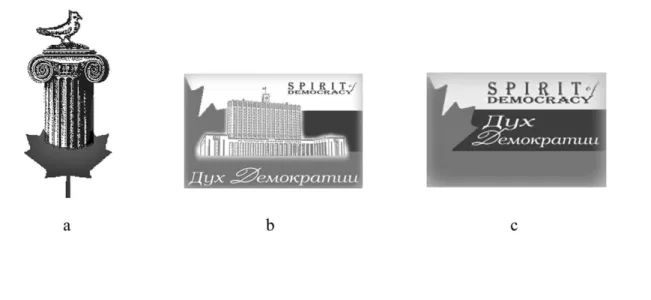
Figure 1. The Project Logo
At the beginning of the project it was decided that both teams, Russian and Canadian, would develop their own content, but there would only be one common logo for the project. The project asked a Canadian graphic artist to design the logo. The artist created the first version of the logo based on the popular Russian interpretation of democratic symbols (Figure 1, a). This logo was discussed during the meetings of the Canadian team and was rejected as being not a “true North American democratic symbol” and also having nothing to do with Russia. A second attempt produced a logo that used an image of the Russian “White House” (former parliament building) as a symbol of democracy (Figure 1.b). This logo was accepted by Canadian team, but strongly rejected by Russian team members. Russians informed us that government buildings in Russian culture are not associated with symbols of democracy.
Finally, the artist created the third version of the project logo. He worked with members of both teams to create a final version of the logo where he blended the two national flags in to one image, with typography as the main graphic element (Figure 1, c). What was achieved in the course of this effort represents true collaboration with an awareness of cultural differences and historical context.
It is worthwhile to mention a collaborative idea used in the design of a project site map. In fact, there are two different site maps, one for the Russian and one for the Canadian sections. Each navigational map provides hyperlinks not only to local pages, but also allows users to navigate the counterpart site, e.g. Canadian site map provides links not only to Canadian pages, but also helps Canadian users
.
navigate the Russian content, and vice versa. This setup allows users with limited knowledge of a foreign language to explore content on the “foreign” Web site.
Ideas for the Future of the Project
As a continuation of the project, currently there is a proposed plan to create several Civic Education Centers of Excellence in Russia. In these Centers Russian teachers would work on development of online curriculum resources. However, having the experience of the current phase of the project and knowing the general history of CIDA projects in Russia (Webster, 2002), the success of the
implementation of the second phase of the project will be much more predictable if the project can provide Canadian online support and recourses for these Russian-led Centers of Excellence. One of the advantages achieved during the current phase of the project is the development of
professional linkage between Canadian and Russian teachers. We witnessed that this linkage by itself stimulates partners and generates enthusiasm among participants. This linkage began to develop as a result of seminars for teachers in Canada and Russia on using the concept of the “spirit of democracy” and the collaborative development and use of on-line resource materials. Teachers in both countries, under the umbrella of the project, have begun to enthusiastically explore avenues of involvement with the project and with each other. Teacher-leaders in the regions of Moscow, Orel and Samara have conducted their own seminars for other new teachers and for regional school board authorities on the Spirit of Democracy, resulting in materials being incorporated into the curriculum in some areas. Furthermore, teacher-leaders in Russia continue to contribute lessons to the Russian Web site based on the core ideas of the project.
Teachers in Russia and Canada have begun to communicate with each other. For example, a strong connection has developed between Superior Middle School in Bathurst and Zelenograd School 1194 near Moscow. After a seminar for Canadian teachers at UNB in November of 2001, teachers of the Bathurst School became so interested in learning about Russia that they worked with their
administration to develop an integrated curriculum unit that incorporated the study of Russia into all Grade 6 subject areas for one semester. Students became so interested in learning more about Russia, and about exploring issues in the project and communicating with Russian students, that numerous students signed up for the School’s Human Right’s Club. With support from the Faculty of Education and the guidance of teachers in Russia and Canada, students of both countries began to communicate with each other. As a teacher from Zelenograd wrote to a teacher in Bathurst, “our students jump with joy at the chance to communicate with Canadian students”. Students from both schools have also exchanged photograph albums, drawings, and information about themselves and their communities (The Spirit of Democracy, 2002e).
The project site brings together a community of practice in cyberspace – a community of social studies researchers and teachers from Russia and Canada. We found that sharing experiences is a valuable part of the virtual community. The virtual community can form within a single school district, province, country and, in our case, between two countries, thus fading the boundaries
between counties and continents. International virtual communities can provide teachers, and, in turn, students with the opportunities to develop relationships with people from diverse cultures and
backgrounds and provide an environment that will transform participants into more tolerant and respectful citizens (Cifuentes & Murphy, 2000).
The concept of community of practice is well known in education and widely used in knowledge management literature. As broadly defined by Wender and Snyder (2000), community of practice is “a group of people informally bound together by shared expertise and passion for a joint enterprise”. Another essential part of the community of practice is a social dimension: “ Emphasis is on sharing of
knowledge between people, building communities of knowledge workers, sharing personal
experiences, building effective and socially satisfying network of people…” (Duek, 2001). Trentin (2001) underlines the importance for educators engaged in the network-based learning to learn from the experience of the business world where support of information technologies is combined with the knowledge and understanding of knowledge management methods, and the organization of
communities of practice engaged in collaborative learning.
In knowledge management research, the concept of communities of practice is normally applied to the communities inside of the business organizational structure, such as, “ learning communities” at Hewlett-Packard Company, and “knowledge networks” at IBM Global Services (Gongla & Rizzuto, 2001). However, this concept could also be extended to a much wider scale that includes involvement of practitioners from different organizations and even different counties.
In order for a community of practice to continue to exist and develop, it needs to be supported by a comprehensive knowledge management framework. This framework shall include several essential components such as supportive environmental factors, effective management system and some incentives for sharing (Gongla & Rizzuto, 2001). Thus, in order for the existing Spirit of
Democracy’s virtual community to continue to exist and function successfully, we believe it would be necessary to create a supporting management framework for the project.
One of the models of the supportive framework for the virtual community of practice that is well developed is the Web portal model. According to Bressler & Grantham (2000) the construction of Web portals is the major technological driver that enables the creation of online communities of practice. We believe that a logical extension of the project into the second phase would be to create a “Spirit of Democracy” portal that will accommodate resources to support the work of the “Spirit of Democracy” ’s community members and also will create an online collaborative work and learning environment.
A possible model for this type of collaborative work environment would be a model where the Web site would provide free access to the repository of resource materials, search and retrieval tools, and a discussion forum for scholars, teachers and students. The participating universities and organizations, schools, and teachers will submit raw materials (ideas, papers, pictures, lesson plans, springboards, etc.) in to the repository where they will be classified according to topics. A peer review process of submissions, by content experts from the social sciences and education community, will be
undertaken to assure the quality of submissions. The proposed Spirit of Democracy portal will provide an environment of a “live” and dynamic forum, where educators will exchange information, get peer reviews and comments on their work, and get valuable feedback from other educators and even from students.
A good example of a successful e-Democracy forum is Politalk (Politalk, 2002) – a forum that facilitates democratic deliberation. On this forum citizens debate important democratic issues such as campaign finance reform, globalization, transportation, etc. So far the forum was very successful in presenting a diverse set of opinions and also “…managed to avoid the “flaming”, ideological fixations and personality colorings that have afflicted other e-mail interchanges” (Bearse, 2002). Bearse
identified two main features of the forum that helped its success: 1) Recruitment of a cross-section of resource people that post background information, including government officials and experts. They also participate in discussions; 2) Having a good forum moderator who sets rules, monitor debates and archives the proceedings.
To assure successful functioning of the proposed Spirit of Democracy portal we believe it would be crucial to use similar strategies for building Canadian project support team. There is another very
.
compelling reason to have a forum with good support resources similar to Politalk for the Spirit of Democracy portal. In Russia, for historical reasons, there are not enough scholarly studies that support true democratic values. On the contrary, there are many studies (and many Russian scholars supporting them) that suggest that the Western style of democracy is the worst type of democracy or not a democracy at all (Dugin, 2000). In this situation, any democratic initiative, especially on the Internet, can be easily highjacked and Russian teachers will have a difficult time in bringing counter arguments without support from experienced social sciences scholars from Western democracies.
Conclusion
After two years we can already call this project a success – the Russian team have developed and posted on the project Web site more than 50 different topics related to citizenship and democracy, and the Canadian team posted about 30 such topics. Researchers and teachers develop these topics
collaboratively. Project materials posted on the Web have already been successfully tried by Canadian and Russian teachers in a classroom environment and received positive responses. Today many participating Canadian and Russian schools are, on a daily basis, using project’s Web-based resources to conduct classes and educate youngsters on democratic values and the spirit of
democracy.
References
Bearse, P., 2002 (to be published), Laboring in the Vineyards or The People, Yes: How “ordinary” People Can Make a Difference –Through Politics,
http://www.politalk.com/topics/election/posts/bearse.html
Bressler, S. E. & Grantham, C.E., 2000. Communities of commerce. McGraw-Hill.
Brown, J.S., Collings, A., & Duguid, P., 1989, Situated Cognition and the Culture of learning, Educational Researcher, 18 (1), 32-41.
Cifuentes, L. & Murphy, K.L., 2000, Promoting Multicultural Understanding and Positive Self-Concept Through a Distance Learning Community: Cultural Connections, Educational Technology Research and Development, Vol.48, No. 1, 69-83.
Duek, G., 2001, Views of Knowledge are Human Views, IBM Systems Journal, Vol.40, No.4, 885-888.
Dugin, A., 2000. Paradigm of the End, Elements, No.9, 31p. (in Russian), http://elem2000.virtualave.net/9paradig.html
Filippov, V., 1999, Laying the Foundations for Change, International Institute for Educational Planning, IIEP Newsletter, October-December 1999.
Gongla, P. & Rizzuto, C.R., 2001, Evolving Communities of Practice: IBM Global Services Experience, IBM Systems Journal, Vol.40, No. 4, 842-862.
Hughes, A., S., Long, N., & Perry, M., 2000, Learning the Spirit of Democracy: The Project’s Background and an Illustration. Proceedings of the Conference Citizenship 2020: Assuming Responsibility for Our Future, McGill Institute for the Study of Canada, Montreal.
Hung, D., 2001, Design Principles for Web-Based Learning: Implications from Vygotskian Thought, Educational Technology, May-June 2001, 33-41.
Kedzie, Christopher R., 1997, Communication and Democracy Coincident Revolutions and the Emergent Dictator's Dilemma, RGSD-127, Publication by RAND,
http://www.rand.org/publications/RGSD/RGSD127/index.html
Milliron, M.D. & Miles, C.L., 2000, Education in a Digital Democracy. Educause Review, Nov/Dec2000, Vol.35, Issue 6, p. 50-61.
Politalk, 2002, Civil Discussion on Controversial Topics, http://www.politalk.com/
Pool, Ithiel De Sola., 1983, Technologies of Freedom. Cambridge, Belknap Press of Harvard University Press.
Stefik, M., 1999, The Internet Edge: Social, Technical, and Legal Challenges for a Networked World, Massachusetts Institute of Technology.
The Spirit of Democracy Project, 2002a, Home Page, http://www.unb.ca/democracy/Project/Project2.html The Spirit of Democracy Project, 2002b, The Spirit of Democracy Learning Approach,
http://www.unb.ca/democracy/Project/IdeasInDemocracy/SituatedLearning/SituatedLearning1.html The Spirit of Democracy Project, 2002c, You Be the Judge,
http://www.unb.ca/democracy/Project/IdeasInDemocracy/privacy/LegalPrivacy/LegalPrivacy2.html The Spirit of Democracy Project, 2002d, Boyarynya Morozova,
http://www.unb.ca/democracy/Project/IncludeIdeas/RecentExamples/workshopFreedoms/FundamentalFreed oms.htm
The Spirit of Democracy Project, 2002e, Student works, http://www.unb.ca/democracy/russia/4workArea/rus/pic_kul.html
Trentin, G., 2001. From Formal Training to Communities of Practice via Network-Based Learning, Educational Technology, March-April 2001.
Webster, P., 2002, Ripped off in Russia, Macleans Magazine, May 20, 2002.
Wender, E.C. & Snyder, W.M., 2000, Communities of Practice: The Organizational Frontier, Harvard Business Review 78, No.1, 139-145.
© Copyright 2001. The authors, all authors’ names, assign to the University of New Brunswick and other educational and non-profit institutions a non-exclusive license to use this document for personal use and in courses of instruction provided that the article is used in full and this copyright statement is reproduced. The authors also grant a non-exclusive license to the University of New Brunswick to publish this document in full on the World Wide Web and on CD-ROM and in printed form with the conference papers, and for the document to be published on mirrors on the World Wide Web. Any other usage is prohibited without the express permission of the authors.