Change Management Approach for Enterprise Transformation and
Improvement
ARCH!WES
MASSACHUSETTS INSTITUTE OF TECHNOLOGYby
AUG 2
0
2013
Dmitry Uspenskiy
L
LIBRA RIES
Diploma, Electrical Engineering
Space Military Engineering Academy, Saint-Petersburg, 1993 PhD, Technical Science
Space Military Engineering Academy, Saint-Petersburg, 1997
Submitted to the System Design and Management Program in partial fulfillment of the requirements for the degree of
MASTER OF SCIENCE IN ENGINEERING AND MANAGEMENT
at the
MASSACHUSETTS INSTITUTE OF TECHNOLOGY
,
September 2012
©2012 Massachusetts Institute of Technology. All rights reserved.
The author hereby grants to MIT permission to reproduce and to distribute publicly paper and electronic copies of this thesis document in whole or in part
in any medium now known or hereafter created.
Signature of Author:
Dmitry Uspenskiy
System Design and Management Program Certified by:
Approved by:
Eric Rebentisch
Research Associate, Lean Advancement Initiative,
Thesis SupervisorChange Management Approach for Enterprise Transformation and
Improvement
by
Dmitry Uspenskiy
Submitted to the System Design and Management Program on September 28, 2012, in partial fulfillment of the
requirements for the degree of
Master of Science in Engineering and Management
Abstract
Enterprises, companies and organizations around the world strive to achieve competitive advantage by designing and implementing more advanced business and organizational architectures, streamlined and robust processes and structures, and effective and scalable management systems and practices. Industry, academia and management consulting companies have developed a variety of organizational models, change frameworks and transformation roadmaps to facilitate and to support business improvement activities and initiatives. The overall change management landscape, however, remains rather vague, overlapping and fragmented at the same time.
To reduce this ambiguity and to be able to make a better-educated choice of models and frameworks to use, a close examination, classification, mapping and analysis of leading models and frameworks is conducted here. Common themes and distinct features are identified. An alternative high level organizational model is proposed. The coupled nature and duality of organizational models and change frameworks are identified and explored. Macro and meso levels of change management are considered and bridged via the classification of change management actions and interventions and the decomposition of change management planning and transformation design phases. To complement high level change management frameworks with applied tools, a change management projects scoring approach called "BLUE-over-RED" is proposed. In addition, an attempt to formulate a formal problem of organization transition trajectory optimization using the apparatus of operations research and graph theory is made.
Thesis Supervisor: Eric Rebentisch
"The world would have been better off if books were written by those who really have something to say."
Table of Contents
1 In tro d u ction ...-. ...-9
1.1 M o tiv ation ... 9
1.2 T h esis G oal ... 9
1.3 Synergy of organizational models and change frameworks...10
1.3.1 Approaches to organizational change...11
1.3.2 Organization of the thesis ... 18
2 O rganizational M odels ... 20
2.1 Existing M odels... 20
2.1.1 McKinsey's 7S' and Organizational Health (OH) Frameworks ... 23
2.1.2 Galbraith's Star-model...26
2.1.3 MIT LAI Enterprise Architecting framework ... 27
2.1.4 Organizational Models' Analysis Summary ... 28
2.2 P roposed N ew M odel ... 28
2 .3 C o n clu sion ... 30
3 Transformation Frameworks and Change Management... 32
3.1 Comparison of enterprise transformation and improvement frameworks ... 32
3.1.1 Carnegie Mellon IDEAL framework ... 35
3.1.2 McKinsey's 5A's framework... 36
3.1.3 MIT ESAT framework ... 37
3.2 Frameworks Analysis Summary ... 37
4 Transformation Planning and Critical Success Factors... 43
4.1 Existing change and transformation projects scoring approaches ... 44
4.2 Suggested approach: Blue over Red ... 51
4.3 Project scoring and categorization ... 54
4.4 Blue over Red sum m ary ... 59
5 Formal methods of enterprise transition modeling...61
5.1 Problem definition and existing methods...64
5.2 Graph-based interpretation of transition path finding problem ... 68
5.3 Modeling, practical implications and interpretations ... 72
5.4 Summary and key takeaways of the formal approach...76
6 C on clu sion ... 77
List of Figures
Figure 1 The most prominent schools of thought in change management ... 12
Figure 2. Prime focus of various change management schools...14
Figure 3 Thesis structure and organization... 18
Figure 4 Nine elements of organizational health (http://solutions.mckinsey.com)...25
Figure 5 Variations of Star Model (Galbraith, 2002) ... 27
Figure 6. Proposed new organizational m odel... 29
Figure 7 Duality: model of organization and transformation framework...32
Figure 8 Identification of interventions and actionable items ... 40
Figure 9 Categorization of interventions and change actions ... 42
Figure 10 Change projects definition cycle... 43
Figure 11 DICE Scoreboard. (Sirkin, Keenan, Jackson 2005) ... 46
Figure 12 Beckhard's Change Formula as System Dynamics Model ... 49
Figure 13 BCG DICE Score vs. Bechhard's Change Formula ... 50
Figure 14 Blue over Red scoreboard... 56
Figure 15. Monte-Carlo simulation of Blue-over-Red project scores and outcomes ... 59
Figure 16 Effectiveness-efficiency transition space. (source: Gruenwald 2011)...63
Figure 17 Cumulative Payoff in the transformation phase ... 66
Figure 18 Graph model of enterprise system transition...70
Figure 19 Reference dependencies of payoff, cost, effectiveness and efficiency...74
List of Tables
Table 1 O rganizational M odels... 22
Table 2 Comparative mapping of transformation frameworks and models... 34
Table 3 Scoring table for the attributes in nominator ... 55
Table 4 Scoring table for the attributes in denominator ... 55
Table 5 Data collection for Blue-over-Red approach (notional)...58
I
Introduction
1.1 Motivation
Enterprises, companies and organizations around the world strive to achieve competitive advantage by designing and implementing more advanced business and organizational architectures, streamlined and robust processes and structures, effective and scalable management systems and practices. They are trying to eliminate inefficiencies and waste, to maximize value delivery, to optimize workflows and to
instantiate new, innovative approaches of project and program management, units' coordination, performance assessment, quality control and employees' motivation and engagement. While in some cases these improvement projects and transformation initiatives are driven by management teams within institutions, it is a common practice to engage management and operational consultants to define and to support such
projects and initiatives. Management consulting firms, industry and academic institutions have developed and employed a number of techniques, practices, frameworks and models for organizational and enterprise transformation and improvement. Some of these frameworks, often, have catchy names and are used
extensively as marketing and branding tools. It would be interesting to look behind the glossy billboards and to discover the real value and content of these frameworks and models, which is presumably hidden underneath the flashy acronyms, sexy diagrams and obsessive use of alliterations.
1.2 Thesis Goal
While many frameworks and models remain proprietary and are barely exposed to the outside world, a closer examination of these models and frameworks will be conducted to identify their key elements, strengths and weaknesses, distinct features and commonalities. Assessment of the applied context of these frameworks, level of
generalization, limitations, and gaps and overlaps between their components in order to create a systematic layout and a comparison map will be performed. Also, since
transformation and improvement of any organization, enterprise or institution assumes that certain actions need to be taken to change the state of the corresponding system I would like to evaluate how transformation and improvement frameworks are related with change management theory and practice. In addition, a detailed look at transformation planning phase improvement projects definition and change interventions sequencing is going to be taken. Applicability and relevance of some methods of operations research and formal methods will be examined. It will be studied, how these methods can be applied to facilitate transformation planning and optimal transition trajectory path finding.
Thus, I will try to evaluate the boundaries and to define the essence of existing models and frameworks, to formulate suggestions on how an ideal framework might look and propose an alternative model of organizations. This approach assumes a systematic analysis of established theory and practice in change management and enterprise transformation. The expected outcomes are an integration of change management and improvement implementation planning, methods of identification of interventions, and development of a change roadmap.
1.3 Synergy of organizational models and change frameworks
One of the key ideas, which are pursued here, is a demonstration of the fact that any transformation and improvement framework, which aspires to be complete and holistic, should be based on two key artifacts: a model of the organization/enterprise and a transformation, improvement or change management framework. Ideally, the transformation and improvement frameworks should be based and built upon a foundational model. However, it will be demonstrated through provided analysis, that while in some cases the transformation and improvement frameworks and organizational models are designed and work in tandem, in other cases organizational models and transformation frameworks are very loosely coupled or exist independently.A model of the organization is extremely important; it defines the approach we are
to explain how the observable behavior and performance of the organization is linked to
underlying components and artifacts of the model. However, often such a model represents a somewhat static snapshot of the organization and does not necessarily provide means and guidelines to define how to change the state of the organization and
transition to another orbit. This is where the transformation and improvement frameworks come into the play. These frameworks in the generic case do provide certain guidance and steps which need to be taken to make a change. One may argue that organizational change, transition and transformation is extremely subjective and depends a lot on the environment, context, personalities, surrounding landscape, and available actions and resources, and therefore it is very difficult to generalize and the applied value of such frameworks is limited. It might be true, but it is assumed that even
generic frameworks, which need a lot of customization and context-dependent adjustments, are better than pure ad-hoc approaches.
Another prime observation and conclusion is that most of the organizational models and transformational frameworks share the same core elements, while at the same time they
do have certain distinct features and characteristics. So it is interesting to trace the evolution of thought in this domain and see how the original ideas were further developed and elaborated by the followers.
1.3.1 Approaches to organizational change
There is no single, universally accepted school of thought and common approach for organizational design, change management and enterprise transformation. Since organizations are extremely complex and fluid socio-technical systems, this domain is certainly shaped by a cross section of management science, operations research,
sociology and even cognitive science. At least identify three prominent and distinctive approaches (Burnes, 2009) to change management and enterprise transformation can be identified. These approaches are called here the planning school, the learning school and the organizational development school.
1.3.1.1 The planning school
The planning school is probably the most representative and widely accepted, though often representatives of this school do not recognize each other and rarely reference each other, since most are attempting to provide unique contributions and rarely benchmark themselves to others. Most consulting organizations belong to this school since their business models often are based on short-term engagements, where the outcome or deliverables are usually recommended courses of actions, directions and lists of changes, which need to be implemented to improve business performance. So the premise is that it is possible to figure out in a short period of time what needs to be fixed/changed and then execute the proposed plan that will improve the situation.
Figure 1 The most prominent schools of thought in change management
Another branch of the planning school is represented by industry enterprises and
conglomerates. Big multinational corporations often have internal consulting units or groups, which are intended to improve business performance and operational efficiency within the organization and provide support to management in different improvement
PLANNING SCHOOL
Industry
Oracle, SAP, Siemens
Consulting: McKinsey, BQBain Academia: Ko er,
AI
MIt, Carnegie Mell1onORGANIZATIONAL.
DFVELOPMENT SCHOOL Lewinj Doppereei *Coaching *Cultue * Humaizatiot * Groups,1tears * Coimmunicationprojects. However, sometimes corporate consulting functions act almost like true
consulting firms, providing consulting services to external clients (Porsche Consulting, Hitachi Consulting, IBM Global Services). Sometimes these services are complementary to the products that are designed and sold by these organizations. E.g. SAP designs and develops flagship enterprise resource planning software (ERP), which is almost de-facto the standard among Fortune 500 companies. And either SAP itself or more often SAP partners provide services on deployment and implementation of ERP products to end customers. In fact, deployment of ERP systems is often a significant change management project by itself for organizations that decide to implement it. ERP systems nowadays go
way beyond pure business automation. They contain modules which can cover and model almost any business process, structure, role, decision rule and flow. Therefore in
many cases these systems are a critical piece of any change management project, and they often contain dedicated tools to facilitate organizational change execution and implementation, e.g. such as SAP Organizational Change Management Toolkit
(http://scn.sap.com/docs/DOC-8040).
Academic institutions such as Carnegie Mellon's the Software Engineering Institute and their extremely wide spread Capability Maturity Model (CMM) and (CMMI) and much less known "IDEAL" improvement framework also belong to "Planning School". The
Massachusetts Institute of Technology Sociotechnical Systems Research Center and Lean Advancement Initiative developed an enterprise architecting framework and Enterprise Strategic Analysis and Transformation framework (ESAT) (Nightingale; Srinivasan 2011). John Kotter from Harvard Business School, whose book "Leading Change" (Kotter, 1996), is considered as a seminal contribution to change management theory fits
squarely in this category.
Summarizing an overview of the planning school, a conclusion can be made that members of this school primarily treat change management and business performance improvement as an optimization problem. Change is largely accomplished through alignment, elimination of waste, maximizing utilization, solving problems of multiple
stakeholder satisfaction by changing primarily tangible things such as structures,
processes, rules, and responsibilities. While the planning approach to organizational design and transformation is often criticized for being somewhat mechanistically biased, strong belief in the rational nature of decision making and over-emphasis on monetary incentives of the people (Burnes, 2006), it still remains the most dominant methodology, de-facto employed in many enterprises, consulting companies and organizations in general.
9 Transformation is optimization problem
* Transformation is human capital problem
Learning School
L
Holistic continuous cycle & systems thinking
Figure 2. Prime focus of various change management schools
In fact, it wouldn't be a big stretch to claim that the entire multi-billion dollars
management consulting industry is in fact a flagship of the planning school. The very nature of consulting engagements is very adherent to the principles of the planning school: short term analysis, problems decomposition, data and metrics driven root cause analysis, identification of gaps and deficiencies, and, finally, outcome/deliverables in the
form of proposed corrective actions. Despite the known limitations and drawbacks of the planning school, since it remains a mainstream in real business world, the scope of
this thesis is limited to consideration of the planning school only, since detailed evaluation of the organizational development school, the learning school and other alternative approaches to organizational change is beyond the area this research. However, for the sake of completeness and better understanding of how the planning school is different from others, brief overview of the other two schools is included.
1.3.1.2 Organizational development, learning schools
Contrary to the planning school, the organizational development school considers people with their emotions, their needs, aspirations and a range of motivations, which is broader than just financial incentives, as a cornerstone of organizational design and change (French, Bell 1995). The Organizational Development (OD) school, associated with such figures as Lewin, Dopler, Shein and others claims to pursue goals that on the surface seem to be contradictory: achieving improvements in the organization's performance though humanism and harmony by increasing quality of working
conditions and climate within organizations and groups (Sullivan 2010). The emphasis is made on shaping the organizational culture, harmonization of group interactions and dynamics, involvement of individuals, attention to communication, and encouragement of new desired behaviors. Organizational development school practitioners seem to agree (Cummings, Worley, 2005) that the core values of this approach are equality, employee empowerment, consensus building, culture of collaboration and horizontal
relationships. The following key components of this school are usually outlined: Field Theory, Group Dynamics, Action Research and Lewin's Three-Step Model (Burnes,
2009).
Without diving deeper into the organizational development subject here, I would like conclude that the prime focus of this school of thought in the context of change management is on group behavior, engagement and participation on individual level, creating favorable conditions for change by eliminating restraining forces and
identifying required actions to change the status quo towards desired direction. In other words the business performance improvement problem is primarily related to human
capital, human development and interaction problems. It's needed to note that in fact there are certain similarities between planning school and OD school. E.g. the Action Research in OD is somewhat similar to generic planning-execution-control cycle: researching/analyzing the problem, identifying the required actions to mitigate or eliminate the problem and executing them, and, finally, evaluating outcomes and
effectiveness of actions taken. The major difference, however, is in implied context. In
the case of the planning school, the context is usually depersonalized, but systematic. It is driven by a "mutually exclusive, collectively exhaustive" (Cosentino, 2007) framework
- the bible of any aspiring management consultant. While people and groups are
certainly present in the analysis/framework, usually they are treated as yet another box
on a flow-chart diagram. The OD school, as it was noted earlier, does emphasize the importance of behaviors, relationships, power and resistance, while devoting little or no time to other aspects of business and organizational performance. Another major
difference is certainly a scope. Since OD by its definition is targeted on the group and individual level, it is often difficult to apply to bigger structures and scale it up for distributed entities, which are very common in our era of globalization. In turn, the planning school is almost scope agnostic: the bigger the problem, the better. Certainly, it
is fair to admit, that change management is only one aspect of business improvement engagements. There are other dimensions of management consulting practice, which are equally important, such as strategy, markets and marketing, technology, operations and the list goes on. Still, since business improvement of any kind does imply a need for
change, it is fair to compare the planning school with the organizational development school, since the underlying motivations are similar, while the methods and approaches are different.
The last representative, which is included into our systematization of change management theories and approaches, is the so-called "learning school". One of the most prominent and widely cited books on the topic of the learning organization is Peter Senge's The Fifth Discipline (1990), who introduced a set of interlinked practices or
"disciplines" which organizations need to cultivate in order to ensure acquiring of knowledge in an organizational context to be able to adapt and to implement changes
required to stay competitive (Senge, 1990). He argues that there are five components (disciplines), which are essential for an organization to become successful by transforming into a learning organization: personal mastery, systemic thinking, shared
vision, team learning and mental models. He also suggests that a traditional "analytical" approach of dealing with the complexities of real life organizations is flawed. Breaking down (decomposing) the bigger problem or system into smaller more tangible chunks represents a risk of losing a sense of "wholeness" and distorting original meanings and
dependencies. As an alternative he proposes a holistic approach to dealing with complexities and systems thinking as a way to understand interrelations, causalities, drivers and motivations. He believes that the organizational transformation process should be a continuous cycle of building organizational knowledge in a holistic and systematic manner, which is a prerequisite to success.
Comparing these tree different schools of change management conclusion can be made that no school is dominant or preferred over the others. They do share some similarities, but also have distinct and differentiating features. The Planning school or traditional
consulting school is attractive, since it is better structured, data driven, deals with
complexities by decomposing problems into smaller chunks and trying to enumerate all contributing factors of observable behaviors and outcomes. In the same time, it might be lacking a systematic approach and tends to deal with localized contexts and might not
take into account all implicit and explicit dependencies of various dimensions of the organizational models. Also, it devotes somewhat secondary attention to the "soft" side of organizations - people, their motivations, relationships, engagement, resistance and development. In contrast, the Organizational Development school almost solely focuses
on the soft side and tends to be applied on the group and individual level, while complex, multidimensional organizations seem to be out of scope. The Learning school, being very appealing in its proclaimed objectives and principles is probably the less practical of all three, since it gives somewhat limited guidance on implementation details.
In conclusion of this overview of the different change management approaches and theories, it seems to be logical to suggest that an "ideal" change management theory should aggregate best practices and build upon the strengths of these three schools.
These schools are not mutually exclusive and can be complementary. This suggestion
does not pretend to be very novel. There is already a tendency to apply the best suited tools and methods depending on context, which (Burnes, 2009) calls an emergent or contingent approach.
1.3.2
Organization of the thesis
Figure 3 represents the logical organization of this thesis, which comprises five chapters. Analysis starts on the meta-level with an evaluation and critical analysis of existing enterprise models and transformation and improvement frameworks. Then it will
descend to the meso-level and evaluate in detail one industry case and change management practice. Review and systematization of change management interventions
will be conducted, and an approach to the identification of relevant
dise
Models Transformation Frameworks
WHAT? WHY? HOW? WHO?
Change Management
Interventions and WHAT ARE THE TOOLS?
Action Areas
HOW TO USE TOOLS? WHAT IS THE TRAJECTORY?
Transformation Planning and Transition Path Finding: Interventions Scoring Formal Model
Figure 3 Thesis structure and organization
interventions for change management projects and initiatives is going to be suggested. Subsequent chapters are devoted to more applied problems of transformation planning,
change projects evaluation and prioritization, and formal methods of optimal organizational transition trajectory finding. Both final chapters start with a review and
analysis of existing methods, but provide alternative approaches to the problems by encapsulating strengths of the existing methods and eliminating their shortcomings.
2 Organizational Models
2.1 Existing Models
Since in context of given thesis organization is considered as a system, it is believed that before someone can start talking about transformation frameworks and organizational improvement approaches (which are intended to guide on how to change the state of the system), it is essential to define the model of the organization itself, or the model of the underlying system. There is a tendency to limit definition of organizational models to just organizational structure (e.g., the org. chart), definition of roles, responsibilities and
reporting hierarchy. However, it has been widely admitted that models of organizations go far beyond the structural dimension, e.g (Galbraith 2002, Keller 2011). Some influential and recognized organizational models are listed below:
* Galbraith's Five Star model (strategy, people, processes, rewards, structure);
" McKinsey's 7S' model (strategy, systems, structure, skills, style, staff, shared
values) and McKinsey's Organizational Health (OH) model;
* MIT LAI Eight Views Enterprise Architecting Framework (strategy, policy, organization, information, processes, knowledge, products, services);
* Carnegie Melon - Software Engineering Institute, Capability Maturity Model Integration.
This list does not pretend to be an all-inclusive list of the organizational models deserving attention. There are other, well-known and adopted models and frameworks. There is a prominent group of process-centric models/approaches, - such as Business-Process-Modeling (BPM) (Havey 2005), Business-Process-Reengineering (BPR) (Hammer & Champy, 1993), Business Process Management (BPM) (Gartner, 2012). This group, while being focused on continuous process optimization is not limited to it. It is an overall management approach, which strives for business effectiveness and efficiency. Another significant group is represented by IT-biased models and frameworks. The category of "Enterprise Architecture frameworks" is usually associated with such frameworks as The Zachman Framework for Enterprise Architectures, The Open Group Architecture Framework (TOGAF), Federal Enterprise Architecture (FEA).
Despite their IT driven origination, the scope of these frameworks is broader than just IT. It also includes consideration of complexity of the organizational system and
alignment of IT-enabled processes with business objectives, strategy and capabilities. (Sessions 2007)
Kaplan's Balanced Scorecard is yet another method and model of organizational performance and alignment. It is a multidimensional model, which main premise is that performance of the organization should not be judged exclusively by financial outcomes.
Other dimensions, such as customer perspective, business process perspective and learning and growth perspective are equally important and need to be aligned (Kaplan, Norton 1996). Ashridge Mission Model (Campbell, Nash 1992) would be another model in our extended list of organizational models. It is interesting, and different from some other models, in a sense that it tries to combine strategic direction, cultural motivators, behavioral and ethical aspects of organizational context. It also stresses the importance
of "purpose" of the organization and aligned company's and employees' values.
So, as it has been observed, the domain of organizational models is pretty vast and diverse. However, having enumerated some of the representative examples in different parts of the spectrum, the models, which are short-listed: Galbraith's Five Star,
McKinsey 7S' and McKinsey OH model, MIT LAI Eight Views Enterprise Architecting Framework and Carnegie Mellon's CMM(I) represent a more uniform subset of the models, which can be compared more easily, since they are defined in a similar context, serve somewhat similar purpose and often share the same terminology and notions.
Needless to mention, the selected models are rather high level and abstract. They cannot really be considered as true models, which can reflect with sufficient level of proximity a
real embodiment of organization and design details. Predominantly, they offer certain structured mental categories or so-called frameworks, which define a way of thinking
and reasoning about organizations. It is common for these frameworks to suggest decomposition of organizational design/architecture into secondary dimensions and then define respective attributes and subcomponents within every dimension. Some
frameworks define relationships (links) between dimensions, but in most cases it is postulated that everything in the organization is linked to everything else, so the notion of linkages becomes secondary, but can be categorized at the attribute level, such as strong/weak link, etc.
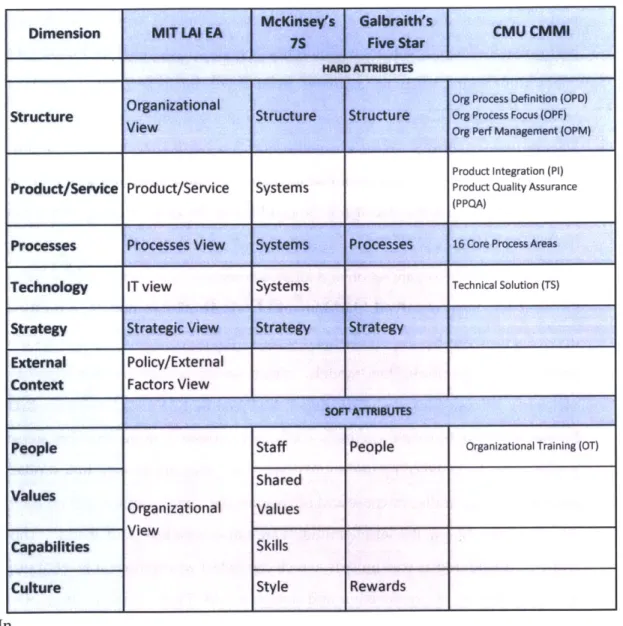
Table 1 Organizational Models
Dimension MIT LAI EA CMU CMMI
7S Five Sa
HARD ATTRIBUTES
Organizationa Org Process Definition (OPD)
Structure Structure
Structure
Org Process Focus (OPF)View Org Perf Management (OPM)
Product Integration (PI)
Product/Service Product/Service Systems Product Quality Assurance
(PPQA)
Processes Processes View Systems Processes 16 Core Process Areas
Technology IT view Systems Technical solution (TS)
Strategy Strategic View Strategy Strategy External Policy/External
Context Factors View
soIFATMBUTES
People Staff People Organizational Training (OT)
Shared Values
Organizational Values
View
Capabilities Skills
Culture Style Rewards
In
Table 1 an attempt is made to cross-map and match key components and categories of various models in order to understand what parts of the models are common and shared, and what elements are rather distinct and unique. A common list of dimensions
in the first column is derived from the intersection of distinct first level of decomposition components of given models. This common list of dimensions and categories of organizational models is not only important as a reasoning tool, but also serves as a foundation for change management frameworks, since often, a change management interventions catalog is structured along the same dimensions which are being used for defining base organizational models.
Following the McKinsey's tradition a set of common dimensions is divided into two sub
sets: "hard" and "soft" attributes. Some models, e.g. MIT LAI EA and CMMI do not have explicit differentiation between hard and soft attributes, while others have it clearly highlighted. There is a substantial overlap among these frameworks, but each one has its specifics and certain biases. Organizations, as sociotechnical systems, are certainly a composition of "hard" or tangible categories and "soft" or less tangible, usually people related categories. "Hard" categories include structures, processes,
strategy, policies, technology, products and services. In turn, "soft"
categories/dimensions include culture, values, people and their capabilities, motivations and drivers. Here the various organizational models will be reviewed in the chronological order they appeared.
2.1.1 McKinsey's 7S' and Organizational Health (OH) Frameworks
McKinsey's 7S' framework is first in our evaluation, since it was developed by
McKinsey and Company consultants in 1982 (Peters, Waterman 1982). It is claimed
that this book, "In Search of Excellence", was the first to break a traditional paradigm that the organization is a structure - "who does what" and "who reports to whom".
Instead of hierarchy and a traditional organization chart, 7S represents a set of interconnected categories, which are intended to represent soft and hard dimensions of organizational design. Strategy, systems and structure are considered to be "hard" dimensions, while skills, style, staff and shared values represent the "soft" side of the organization. Despite the fact that by now this framework is 30 years old it is still listed
on McKinsey's web-site as "...an important tool to understand the complexity of organizations. Today, more than ever, structure alone isn't organization."
(www.mckinseyquarterly.com).
However, recently, in 2011, McKinsey consultants Scott Keller and Colin Price published a new book -"Beyond performance" (Keller, Price 2011). While paying tribute to the 7S' framework legacy, they suggest that it is time for it to retire. They admit that among
companies which served as an example of excellence, by 2006 20% no longer were around and another 46% were struggling. They suggest that a key weakness of the legacy framework is its static nature and lack of dynamic perspective, which leads to a syndrome of short-term planning and a sole focus on reaching quarterly and annual targets, while longer-term sustainable growth is not in the picture. The authors suggest that overemphasis on performance leads to negligence in other aspects of a healthy business such as teamwork, investment in R&D, employees' loyalty and satisfaction, and other aspects of the business. It is interesting to see the alternatives McKinsey offers in the current context and environment. Firstly in addition to "performance" as an ultimate
measure of success they introduce a term of "organizational health". By "health" they mean the ability of the organization to sustain performance over time by superior alignment, execution and agility. In terms of the framework, now they suggest static and dynamic views. The static view is basically a replacement for the 7S framework, which is
now called the "Organizational Health Model", and consists of nine elements or components. Those components are direction, leadership, culture and climate, accountability, coordination and control, capabilities, motivation, external orientation
Figure 4 Nine elements of organizational health (http://solutions.mckinsey.com)
Certainly, the model is now more verbose than before, and there is no intention to review here every component in detail, since it is better to refer to the source (Keller, Price 2011). However, it would be interesting to compare the Organizational Health
(OH) Model to the legacy 7S' framework to see what is genuinely new and what is inherited from the old framework. The term strategy is now abandoned, but it appears to have been substituted with direction. Former "skills" seems to be a direct match with "capability". The key characteristic of the consulting framework is that it has to satisfy
the "mutually exclusive, collectively exhaustive" condition; while in the new "OH" model there seems to be an overlap between some of the elements (e.g. it is somewhat questionable whether accountability is a separate category and not a part of "coordination and control".) In any case both "accountability" and "coordination and control" can be mapped to 7S' "systems" and "structure". New categories of "Culture
and climate" as well as "Motivation" can probably be mapped to the former "shared values". The same would be true for "Leadership" in the new revision and "Style" in the old one. Thus, truly new elements of the latest "OH" organizational model are "Innovation" and "External Orientation". It can certainly be admitted that it is a step forward compared with the legacy 7S' model, which was somewhat self-centric, and did not include consideration of external links and alignment with major outside
stakeholders of the organization. "Innovation and Learning" is also a somewhat new element and I would venture to suggest that probably it has been inspired by subsequent work on learning organizations (e.g., Senge 1990). Thus, the new "Organizational Health" model is certainly an improvement compared with the legacy
7S' and probably better suited to the current environment, but it is hard to call it
radically different since it shares major categories with the previous framework. Our initial taxonomy of organizational models in Table 1 contains only original 7S' model, but it seems to be beneficial to analyze the evolution of the approach towards an organizational model and framework within a leading management consulting organization in the world. Clearly the new Organizational Health model does build upon its predecessor, but expands boundaries of the model and introduces certain new elements and categories such as innovation, external orientation, environment and leadership. However, the main change can be noticed in overall theme - performance and particular financial performance is no longer an ultimate measure of success. Focus is now on sustainable business practices, accountability, social responsibility and personnel development.
As it was mentioned earlier, (Keller, Price 2011) also introduced dynamic view or dynamic frames, or change framework, which is intended to complement the organizational model and provide guidance to achieve sustainable performance. So the new alliteration was born, which is now called 5A's, comprised of "Aspire", "Assess", "Architect", "Act" and "Advance". This framework will be reviewed in the next chapter, where different change management frameworks will be compared and evaluated.
2.1.2 Galbraith's Star-model
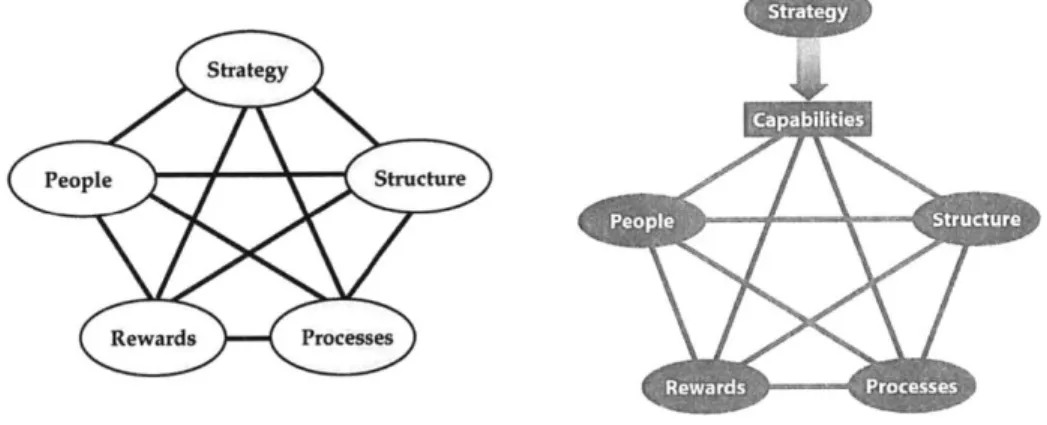
Galbraith's model (Galbraith, 2002) is the most succinct one and highlights the importance of the motivational aspect in organizational design, while not focusing on outcomes produced/generated by organization, such as products and services. While it claims to be a decision-making framework, it seems to be more relevant to call it a
decision support framework, since in essence, the five-star model first and foremost is a model, which allows decision makers to think about organizations in a structured way and to answer such questions as: how it is structured, what are the roles, how are decisions made, how is performance assessed and what behavior is encouraged, and how various elements or components of organization are aligned with strategy. It is easy to see that most of the elements are shared with McKinsey's 7S' framework.
Strategy
People Structure
Rewards Processes
Figure 5 Variations of Star Model (Galbraith, 2002)
2.1.3 MIT LAI Enterprise Architecting framework
The MIT LAI Enterprise Architecting framework seems to be the most comprehensive framework, which incorporates products and services dimensions. It also includes a policy dimension, which defines the constraints and context of operations and activities.
It does not clearly differentiate between hard/soft sides of enterprise and encapsulates/hides many soft subcomponents related to people, culture and skills within the organization dimension. Another key differentiator of LAI's framework is that it is assumed to be an "enterprise" level framework rather than an "organization" level framework, which requires an even more high-level approach to assessing design and
2.1.4 Organizational Models' Analysis Summary
It is easy to notice that these models/frameworks of organization/enterprise design/architecture are rather informal and loosely structured. Primary users of these frameworks are consultancies and executives/managers of the companies, which they can rely on (refer to) as reference models while going through due diligence, analysis of the current state and hypothesizing areas of improvement and required design changes to enhance the organizations' effectiveness and efficiency, and to define more radical transformational initiatives and projects.
However, these kinds of analyses using the modeling and design hypothesis definition process are significantly experiential, qualitative, heuristics-driven, and subjective at times. Introduction of a more formal approach through defining a model of the organization and its transformation is intended to provide a decision-making support foundation/basis which will enable decision makers to define more educated and fact-driven courses of action and interventions.
2.2 Proposed New Model
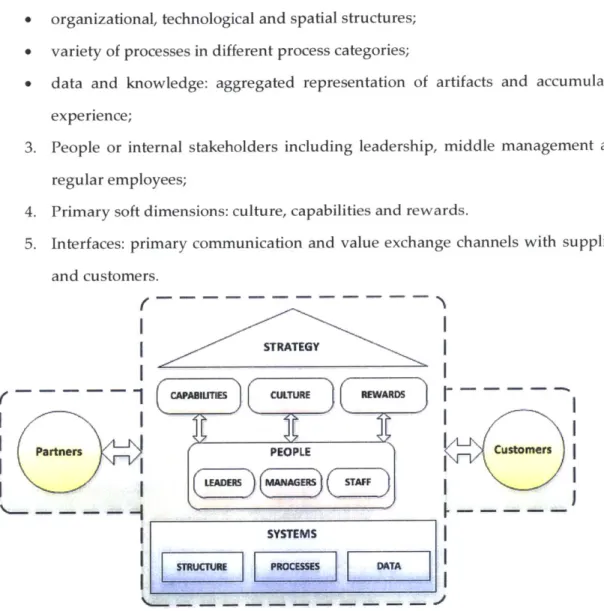
Based on previous critical analysis and evaluation of existing organizational models, the attempt to create an alternative model will be made. This model will draw upon the strengths of existing models, but will mitigate and eliminate their deficiencies. The suggested model highlights the fact that an organization is an open system and at least major external stakeholders such as customers and suppliers should always be brought into consideration, since they are key elements in overall value delivery and process flow. The suggested model also emphasizes a "soft" dimension of organization and illustrates the fact that "staff/people" is not a set of uniform elements. The model introduces three groups of internal stakeholders which in many cases have different motivations, objectives, rewards and essential capabilities. These differences should be taken into account while assessing the current state of the organization, defining the
desired state, or defining relevant actions and interventions. Thus, the proposed model is comprised of the following dimensions and components:
1. Strategy: the guiding roadmap, direction and purpose of the organization. 2. Systems:
* organizational, technological and spatial structures; * variety of processes in different process categories;
* data and knowledge: aggregated representation of artifacts and accumulated experience;
3. People or internal stakeholders including leadership, middle management and
regular employees;
4. Primary soft dimensions: culture, capabilities and rewards.
5. Interfaces: primary communication and value exchange channels with suppliers
and customers.
I
STRATEGYI(---1
CAPABIUTIES CULTURE REWARDSPartners PEOPLE Customers
LEDRS
MN G E )SASYSTEMS
SUCTURE PROCESSES DATA
Figure 6. Proposed new organizational model
The "hard" dimension of "systems" in the proposed model aggregates "structure" and "processes" components, which are available in all reviewed models, but adds another
decision making, which allows the decision makers and management in general to minimize "subjectivity" and close the feedback loop to evaluate the consequences of the actions taken and quickly adjust course if needed.
Comparing the proposed model with the other evaluated models the distinct features of the new model, which make it more relevant and usable, can be highlighted. The important difference is that the proposed model is an open or at least semi open system, and includes consideration of major dependencies and interfaces. It is an important consideration since no organization exists in vacuum, while both Galbraith's model and McKinsey's model do not consider explicitly these dependencies. Another feature, which is advocated here, is a significant emphasis on the soft dimension of the model or soft attributes of the organization. From our point of view it is people, talent acquisition, development of the professional capabilities, retention and career development that are the major basis and source of achieving competitive advantage in a modern economy.
2.3 Conclusion
Why is having a model of the organization or enterprise important for any change
management efforts or managing organization in general? It is believed that if there is no strong synergy between the model of organization and transformation or change management practice, it is doubtful that change management and business improvement efforts will succeed. While not being a precise refection of the organizations they represent, models serve as a basis and foundation for the reasoning process and help us to answer the question - "what is the organization?" Without answering this question, the attempt to answer the question "how to make this organization better?" is almost doomed. Being disconnected from an organizational model, transformation efforts and change initiatives can very quickly become ad-hoc, non-systemic actions, which are not planned and designed based on underlying available levers, adequate and sufficiently detailed understanding of existing phenomena, and implicit and explicit causal relationships. Using organizational models
in transformation planning and change management allows for providing better
support, logic and justification of planned actions, interventions and strategic shifts. Organizational models out there are very numerous and diverse and often are applicable in a certain context. The list of the models selected for more close analysis is similar in a way that they are fairly generic and universal. With certain assumptions they can be applied in various industries and environments. On the surface, evaluated models are rather simple and usually represented as a set of interdependent components, blocks, pillars, which represent different dimensions of the organizations. These components were mapped to some universal set of dimensions and noticed that in many cases there is a significant overlap between various models. At the same time, such a mapping helped us to identify the distinct features and key emphases of the
considered models and identify potential gaps in others. The attempt was made to enrich the field of knowledge of organizational models by synthesizing an alternative model which is intended to provide a well-rounded representation of the organization in the context of an open system with a clear distinction between the soft and hard
hemispheres of the organization and highlighting the imperative importance of overarching strategy and mission.
3 Transformation Frameworks and Change
Management
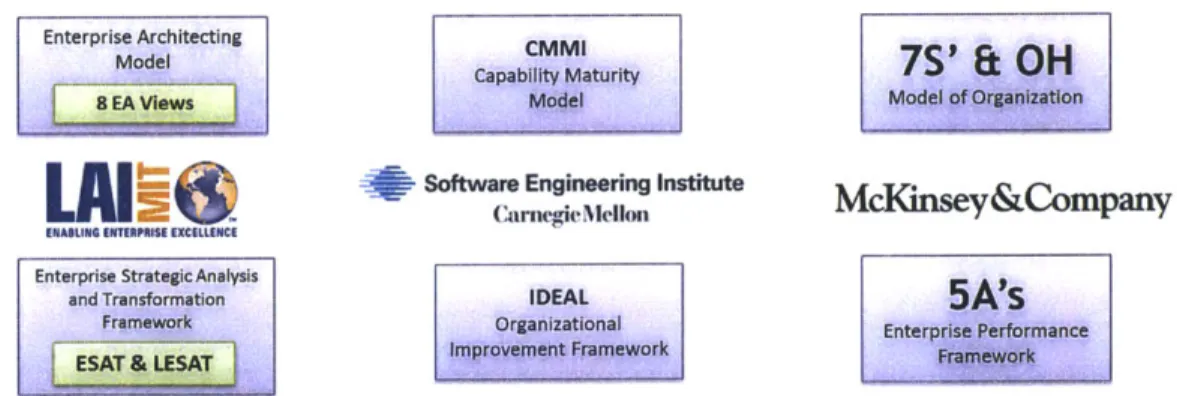
Now, once the representative set of organizational models is reviewed, a similar exercise with change management frameworks will be conducted. A deeper evaluation of the notion of change management, tools and methods in use will be executed. The importance of organizational models for successful transformation frameworks has been already mentioned, and it can be observed that at least three leading consulting and academic institution have in their arsenal both an organizational model and a transformation/change framework. Sometimes, organizational models are used independently of the framework and in some cases the link between the model and transformational framework is weak, but still, the tandem construction is there, even if it is not always explicitly visible and realized. So the different frameworks can be mapped and compared to identify common areas and distinct features. It will be also attempted to see how closely-coupled these frameworks are with their respective organizational models. Figure 7illustrates the observation of the pairs of organizational model-transformation frameworks in leading academic and consulting institutions.
Enterprise Architecting CMMI
Model Capabiity Maturity
7S'
OH
8 EA Views P Moo g prgaizin
Software Engineering InsitUte
McKinsey&Company
imsta MPN IXtLJCErnegieNkellonEnterprise Strategic Analysis
and Transformation IDEAL
Framework rgaiztiF mona k EnterprsP . rfmanc
Figure 7 Duality: model of organization and transformation framework
3.1
Comparison of enterprise transformation and improvement
frameworks
In our analysis of transformation frameworks a slightly different approach to what was employed for comparing organizational models is going to be used. It will not be tried to
find the "least common denominator". Instead, comparison of the selected contenders against a baseline, defined by forefathers of change: Kurt Lewin and John Kotter, will be performed. The list of the frameworks in comparison is as follows: MIT's Enterprise Strategic Analysis and Transformation framework (ESAT) (Nightingale, Srinivasan 2011), Carnegie Melon's IDEAL framework (Gremba, Myers 1997) and McKinsey's 7A's
framework (Keller, Price 2011). It is easy to notice, that the institutions behind the respective frameworks presented in this list are derived from our initial list of organizational models. However, Jay Galbraight, whose "Star" model (Galbraight 2002) was evaluated in previous chapter, to the best of publically available knowledge, did not develop a distinct transformational framework. Instead, he is extending his organizational model and markets it as universal all-inclusive methodology for organizational design and improvement. Therefore, it is decided to exclude it from consideration, since it is does not really fit our intended analysis and is somewhat biased towards the structural dimension.
Kurt Lewin's three step model (Lewin 1947) is one of the first and early models of organizational change. He argued that successful change or transformation should involve three main phases: unfreezing, moving and refreezing. One of his premises is
that individuals and organizations exist in quasi-stationary equilibrium, defined by the balance of driving and restraining forces. Therefore, in order to be able to change the state of the system, be it a person or organization, the mandatory pre-condition is to destabilize the system, to challenge the status quo or in other words "unfreeze" the state of the system. "Unfreezing", however, is just an enabling phase, and actual change or
transformation is conducted in the "moving" phase. This phase includes identification of actions, which should produce the desired outcome and their execution. Results of transformation can, however, be short-lived if the next phase - "refreezing" is missing. This phase is intended to ensure acceptance of a new equilibrium, new routines, norms and behaviors. This enables change to be sustainable and prevents slow regression to the origin point. It has been decided to refresh the memory and to recall the three-step
model since there is a tendency to forget about initial ideas, once their owners are no
longer in active duty. Nowadays, often, discussions about change management have a tendency to start with the seminal by many regards, but hardly the first work of John Kotter (Kotter 1996), which after more close consideration in many aspects is built upon ideas of Lewin's work. Detailed evaluation of Kotter's work and his 8-steps change framework or model is not included here, since it is very well known work which is included in the curriculum of many business schools. It is essential, however, to highlight the fact that this model is an application of ideas of Lewin's on the nature of the change in individuals and groups and translation and elaboration of these ideas in managerial terms and organizational context with a bit more prescriptive and better defined sequence of steps.
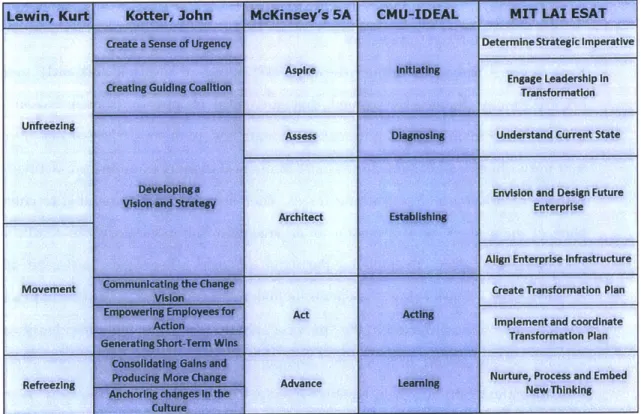
Table 2 Comparative mapping of transformation frameworks and models
Im plement and coordinate
Transformation Plan
Nurture, Process and Enibd
Refreezing Advance NwTikn
Table 2 represents a comparative mapping of the transformation frameworks under consideration alongside with Lewin's three-step model and Kotters's change framework.
In chronological sense, Lewin's model is obviously far ahead, it is followed by the Kotter's 8-steps model and CMU IDEAL framework, both dated 1996. The next in a row is MIT's ESAT framework, while McKinsey's 5A's is the latest arrival, published in 2011. Without going into in-depth analysis of the content of each and every step an early observation can be made that CMU IDEAL and McKinsey's 5A's have one-to-one mapping of steps and semantics of these steps seems to be very similar.
3.1.1 Carnegie Mellon IDEAL framework
Carnegie Mellon is one of the leading software engineering institutions in the world, and is very well known thanks to enormous popularity of their Capability Maturity Model (CMM), which was originally designed for the software industry and later generalized to a broader business processes context as a Capability Maturity Model
Integration (CMMI). Moreover, the latest CMMI version (SEI 2010, CMMI-DEV, V1.3) modestly defines itself as "a simplified representation of the world". There is no intention here challenging or accepting this bold statement, but in real life scenarios CMM(I) is typically applied as an appraisal framework, which provides a uniform 5
level continuous scale for assessing maturity of various process areas within organizations. In any case, while CMMI has a notional ideal state, which is presumably associated with the highest level of maturity, it does not provide directions or guidance on how to achieve this in a given context. To address this flaw of the capability maturity
model, SEI in 1996 developed a complimentary framework called IDEAL, an acronym which is comprised using names of sequential phases of transformations and organizational change. The model consists of five phases (Gremba, Myers 1997):
I - Initiating. Laying the groundwork for a successful improvement effort.
D - Diagnosing. Determining where you are relative to where you want to be.
E - Establishing. Planning the specifics of how you will reach your destination.
A - Acting. Doing the work according to the plan.
L - Learning. Learning from the experience and improving your ability to adopt new technologies in the future.
If one goes into details of every of these phases it becomes obvious that they can be
related fairly easily to the steps in Kotter's model. However, Kotter's model is certainly more illustrative and appealing, while IDEAL model is somewhat too "common sense" and too generic. As it was noticed before, both models: Kotter's and IDEAL were published the same year. But interestingly enough, the IDEAL framework has never been nearly as popular as its predecessor CMM/CMMI or competing Kotter's framework.
3.1.2 McKinsey's 5A's framework
This framework is the latest arrival to the change management and process improvement scene (Keller, Price 2011) from one of the most influential management consulting firms in the world. In the previous chapter their new organizational model, called Organizational Health model or (OH) was evaluated. It is presented as a successor of long lived 7S' model. In alignment with our premise, that comprehensive change management framework should rely on a strong organizational model; McKinsey introduced a notion of five frames or stages of organizational transformation. These stages are Aspire, Access, Architect, Act and Advance or collectively 5As. It would be a stretch to proclaim that this framework provides truly revolutionary approach to change process; however, it would be fair to admit, that it is articulated in a very appealing, simple and memorable manner, - it's McKinsey after all. In essence, these phases can be described by five basic questions:
" Aspire: where do we want to go?
* Access: How ready are we to go there?
* Architect: What do we need to do to get there? * Act: How do we manage the transition? * Advance: How do we keep moving forward?
Ironically, the 5As framework has exactly the same number of steps as IDEAL model and you really need to go into details in order to establish true differences between these two. Acceptance and proliferation of Lewin's ideas can also be observed. E.g. the
Learning phase of the IDEAL model and the Advance phase of the 5As model to some
extent reinforce and expand upon the Lewin's notion of "refreezing", stressing the fact that ability to sustain the change and using the result of transition as a platform for defining the next cycle of continuous improvement.
3.1.3 MIT ESAT framework
Enterprise Strategic Analysis and Transformation framework (Nightingale, Srinivasan 2011), originated within an academic institution, but nonetheless has been developed based on numerous industry case studies, with participation of major multinational enterprises and US government agencies. It was applied in real life context and
subsequently refined and enriched. Therefore it is rigorous enough, yet practical. The cornerstones of this framework are three continuous cycles: strategic planning cycle,
planning cycle and execution cycle. These cycles are further broken down into rather specific and prescriptive steps, which form the entire transformation roadmap. ESAT is also relying on enterprise architecture model, which comprises various lenses: leadership, stakeholders, process architecture, performance measurement, alignment,
resources, maturity and waste. The Enterprise model and transformation framework are pretty tightly coupled, which is considered to be differentiating feature of ESAT from the other frameworks which were reviewed. Every transformation step is designed from a different lenses perspective and defined in terms of prerequisites, constituent
activities, tools and overall alignment of transformation strategy and plan with enterprise vision, mission and objectives. Nonetheless, this framework, while being rather distinct and comprehensive, can also be mapped on steps level to other frameworks which were considered and the Kotter's model as a baseline as shown in Table 2.
3.2 Frameworks Analysis Summary
After conducting this review and comparative mapping of various frameworks it can be concluded that on a high level these methodologies/frameworks/models are somewhat
similar and use semantically equivalent phases of transformation/change under different labels. The devil, as always, is in the details, and all the frameworks which have been considered are important for overall understanding of the evolution of management science thoughts on organizational models and change frameworks. One may also argue that these frameworks can perfectly fit into Deming's (Deming 1986) definition of a universal management control cycle: Plan-Do-Check-Act (PDCA) or it's Six-Sigma interpretation Define-Measure-Analyze-Improve-Control (DMAIC), though the latter is rather specific to quality improvement rather than business transformation and change management. These additional references help to highlight the fact that the variety and diversity of various frameworks and tools for business/process improvement and transformation is already overwhelming. And probably the management science and practice does not need yet another framework, or, at least the author is not in a position to propose a meaningful alternative to existing venerable and proven methodologies. At the same time, there is always room for improvement and complementary, tactical tools and approaches, which would provide decision making support and more rigorous approach to transformation planning, risk assessment and evaluation of options, which will be introduced in subsequent chapters.
3.3 Change Management Interventions and Action Areas
So far organizational models, transformation frameworks, and change management in a broad sense have been under consideration and analysis. The term "broad" means that whenever there is a discussion about business improvement and organizational transformation, the entire journey can be described by a variety of frameworks that have been just considered. Starting from Kotter or Lewin, whatever your origin point is, they define phases, steps or frames of transition, which need to be passed to accomplish the ultimate goal. As it was discussed previously, most of the frameworks agreed on the fact
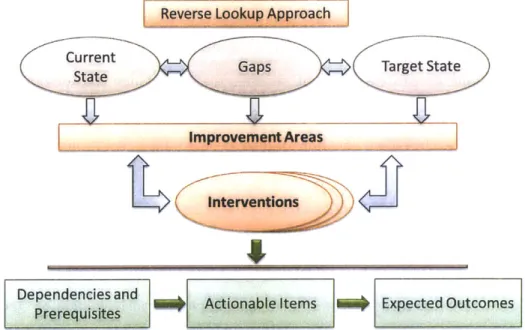
that essential prerequisites of any transition are the thorough and adequate understanding of the current state and some definition of the desired state or target. The result of differentiating between current and desired states gives the gap, which can be expressed as a cumulative numerical value in case of CMMI-like assessment tools are used or can also expressed in qualitative terms if more abstract and less data driven framework, such as McKinsey Organizational Health is used. Even in the CMMI case the
single number, which defines the gap typically can be broken down into gaps in various dimensions or process areas, if sticking to SEI notation. So, obviously, the goal of transformation is formulated as closing the gap. Depending on how significant the gap is it can be closed in one hop or can be a multiple stage iterative transition with
intermediate adjustments to the course of actions if required.
Thus, the actual transition from the current state to the desired state is the area of focus of change management in narrow sense. How to plan the transitions, what actions and in what sequence need to be taken, how to access and mitigate risks, how to control risks, to allocate resources and to engage people in transformation are the topics which
change management in "narrow" sense is concerned about. One may argue that all these items are in fact day-to-day activities and concerns of managers on all levels. It is a common practice that transformation or change at the end is typically driven and executed by management and leadership of the organizations with or without support of consultants and dedicated change teams. However, the objective of change