Brownfield Development
By
Shaun D. Ryan
Bachelor of Technology in Architecture Ryerson Polytechnical University, 1992
Submitted to the Department of Architecture
in Partial Fulfillment of the Requirements for the Degree of
Master of Science in Real Estate Development
at the
Massachusetts Institute of Technology September, 1997
C 1997 Shaun D. Ryan. All rights reserved.
The author hereby grants to MIT permission to reproduce and to distribute publicly paper and electronic copies of this thesis document in whole or in part.
Signature of Author:
Department ofirchitecture August 1, 1997
Certified by:
Lawrence
i'32W
Professor of Law and Environmental PolicyThesis Supervisor
Accepted by:
William C. Wheaton Chairman, Interdepartmental Degree Program in Real Estate Development
Brownfield Development
byShaun D. Ryan
Submitted to the Department of Architecture
on August 1, 1997 in Partial Fulfillment of the requirements for the Degree of
Master of Science in Real Estate Development
Abstract
-Brownfields" is the generic name now used to describe real estate properties with low to medium levels of contamination. Because of the manageable levels of
contamination, brownfields are increasingly seen today as potential development and investment opportunities rather than environmental nightmares. Two hundred thousand to five hundred thousand of such sites are estimated to exist across the U.S but attempts to clean them up has been extremely slow. It is an issue that has captured a great deal of political attention in the last twenty years while both the public and private sectors seek solutions.
Most studies on brownfields to date have focused on the public benefits to be achieved through redevelopment. This study will instead view things from the
perspective of the private sector and will attempt to increase our understanding of how the various parties involved in brownfield redevelopment evaluate, distribute and mitigate the various associated risks. This thesis, as part of a larger study, will explore brownfield redevelopment as a function of risk and return. Key questions will include: how are the additional risks involved in this type of project dealt with, what new tools are being developed for dealing with these risks and how are the various parties allocating these uncertainties among themselves?
Through the close examination of two case studies, some of these mysteries will be unraveled. The first case, a twelve acre site in Stamford Connecticut, was developed
by the Swiss Bank Corporation in cooperation with the city of Stamford and the State of Connecticut and will house the Bank's main North American operations. It is an
excellent example of what can be accomplished when the public and private sectors work together to solve the various problems of risk and liability associated with brownfield redevelopment. The second case study is an eleven acre site located in Massachusetts. In contrast to the first case, this property was purchased by a group of investors experienced specifically in brownfield redevelopment for the sole purpose of resale. It will provide the reader with a glimpse of the hurdles that must be overcome to make such a project successful and how detailed "knowledge of process" can add significant value to that project.
In view of these success stories, of which there are a limited number, certain lessons can be learned. For instance, special attention should be paid to issues as diverse as the company form, the intrinsic real estate value, the redevelopment team, the P & S agreement, and insurance. Throughout this process, one thing is clear; the private sector can help to solve these problems with the right incentives. The goal for public policy should, therefore, be to continually strive for a process that is less intimidating and more attractive to private sector investment.
Thesis Supervisor: Lawrence S. Bacow Professor of Law and Environmental Policy
TABLE OF CONTENTS
Chapter One
5
Overview
Introduction 5
Brownfields 6
Benefits to Brownfield Redevelopment 8
Risks: Traditional Real Estate Development vs. Brownfield Redevelopment 9
Recent Moves Towards Positive Change 10
Research Approach 12
Chapter Two
14
Risk-Sharing Mechanisms
Introduction 14
The Main Players 15
The Business Entity Decision 17
The Purchase and Sale Agreement 19
Environmental Assessments in a Purchase and Sale Agreement 20
The Financing Agreement - The Letter of Commitment 22
Remediation Contractor's Agreement 23
Occupancy Agreement (Sale or Lease) 24
Chapter Three
26
Case Study 1: Swiss Bank Corporation, Stamford, Connecticut
Introduction 26
Site Search and Selection Process 27
The Site 28
Estimated Cost of Remediation 30
The Memorandum of Understanding 31
The Land Title Transfer 34
Remediation Cost Sharing/Risk Sharing 35
Conclusions 39
Chapter Four
40
Case Study 2: 10 Trafalger Junction Road, Massachusetts
Introduction 41 The Site 42 Site History 42 XXX 10 Ltd. 45 The Process 46 The Risks 54 1997 57 Conclusions 57
Chapter Five
59
ConclusionsAppendices
64
Bibliography 71Chapter One
Introduction
The Industrial Revolution, begun in England in the early 1800's, started in earnest in the United States near the end of the 1 9th century. It was a period of unmatched
prosperity, optimism and change as the country transformed itself from an agricultural society to one primarily focused on manufacturing. Unfortunately, it was also a time of unparalleled destruction to the natural environment, polluting air, earth, and water. This negative impact was not immediately apparent to the majority of Americans but slowly the high price the environment was paying in the name of progress became obvious. By the early 1970's the U.S. government began to initiate crucial first steps to stop the destruction. By the end of that decade the country had become far more
"environmentally conscious" and environmental issues had risen to the forefront of the political arena.
Of primary importance was to find a viable solution for dealing with the multitude of contaminated industrial properties throughout the country. New laws were soon
passed to address these rising concerns but, unfortunately, they were too strict and inflexible. All contaminated sites were mandated to be returned to "pristine" conditions and almost anyone associated with them was potentially liable for the clean-up. As a result, investors, developers, and lenders avoided these properties like the plague and existing owners kept contamination a secret at all costs. Now, almost two decades later, few of these problems have been solved. In fact, matters have arguably been made worse in the last twenty years with the nation's major shift in industrial methods. Traditional heavy manufacturing has given way to light manufacturing and specialty production requiring smaller and more compact factories. Changing markets, international
competition, and advances in production technologies have driven this trend. Many communities have experienced plant downsizings and shutdowns, leaving underused or abandoned industrial sites in their wake.
However, the political climate is beginning to change. Federal, State and local governments are now attempting to attract the attention of the private sector by making redevelopment less risky and sufficiently profitable. The rules of the game are slowly changing but where it will lead is still relatively unknown.
Brownfields
"Brownfields" is the generic name used to describe most of these problem sites. Distinctions have been drawn between two types of contaminated sites; those on the National Priorities List and those with low to medium levels of contamination (i.e. brownfields). The National Priorities List contains 1,300 high priority sites representing the greatest environmental hazards. They can generally be characterized as sites with significant public health risks and extremely high clean-up costs. Brownfields, on the other hand, have more manageable levels of contamination and are increasingly seen as potential development and investment opportunities rather than environmental
nightmares. Estimates range from 200,000 to 500,000 of such sites across the U.S. and if all were remediated the price tag could reach $650 billion.' The Environmental
Protection Agency (EPA) estimates that 70 million Americans, including 10 million children, live within four miles of one of these sites.2
' U.S. EPA. Tool Kit of Technoloav Information Resources for Brownfield Sites, DRAFT Version, November 1996, p.1.
2 M2 Communications Limited, U.S. EPA: Administrator Cites 4 0 0th Superfund Cleanup, October 16, 1996.
In 1980, the Federal Government passed the Comprehensive Environmental Response, Compensation, and Liability Act (CERCLA) to address these environmental
concerns. The fundamental position embraced by CERCLA was that polluters should pay for their own cleanup. It was, and still is, the most significant environmental statute affecting the cleanup and transfer of contaminated properties. Ironically, this legislation severely hampered the very clean up effort that it was intended to encourage. CERCLA, or Superfund, as it is more commonly known, mandated strict, joint and several liability for all owners of a given property; all operators and tenants of that property; and all generators and transporters of hazardous materials to and from that property. In other words, it allows the government to go after past owner/operators of a site whose actions contributed to the contamination and to go after those parties with the greatest ability to pay, regardless of fault. Although this new law promoted greater awareness of pollution and convinced most people that it was cheaper to prevent contamination than to incur the liability and costs of cleaning it up, it also made the transfer of contaminated property nearly impossible. The fear of liability, rather than promoting cleanup, froze activity on these sites indefinitely. It wasn't long before involved parties began to fight fierce battles
in court. Past and present owners, developers, builders, tenants and government agencies all began pointing fingers at one another, spending billions of dollars in an effort to avoid or limit the astronomical costs involved in cleaning up the contamination. According to one study, more than one-third of the $11.3 billion spent by the private sector on Federal Superfund sites between 1980 and 1991 went towards litigation rather than cleanup.3
Adding to the problem by creating additional uncertainty was the 1990 United States v. Fleet Factors decision by the U.S. Court of Appeals. Fleet Factors held that a
lender could be considered an owner/operator if its involvement is "sufficiently broad to support the inference that it could affect hazardous waste disposal decisions if it so chose... it is not necessary for the secured creditor to actually involve itself in the day-to-day operations of the facility in order to be liable".4 This decision ran counter to the
secured creditor exemption in CERCLA and the uncertainty generated from this resulted in a scarcity of traditional debt capital available for the few remediation and
redevelopment efforts being attempted.
Benefits to Brownfield Redevelopment
Both government and private entities have much to gain by adapting brownfield sites into new uses. From the public perspective, redevelopment could restore not only the buildings and their physical environment, but also the jobs and vitality of the communities surrounding them. Revitalization would particularly benefit low-income and minority residents who have suffered the economic and health consequences of living near blighted buildings and contaminated lands. Reuse also can take advantage of
existing infrastructure systems and thus reduce suburban sprawl. By returning these facilities to productive use, cities can create jobs, boost tax revenues, and produce numerous social, environmental, and aesthetic benefits. The private sector, on the other
hand, has very different motivations and views brownfield redevelopment like any other investment opportunity - in terms of risk and return. Private capital will only invest in brownfields if the risks associated with the investments are justified by the potential financial rewards. In the last 18 months fund managers and advisers have begun forming alliances with real estate concerns and environmental consulting firms, with the specific
4
aim of acquiring, cleaning up, redeveloping and either managing or selling contaminated properties.5 Several billion dollars, according to some estimates, has been recently allocated to invest in environmentally impacted properties. 6
Risks: Traditional Real Estate Development vs. Brownfield Redevelopment
All real estate transactions entail risk. The "traditional" real estate development risks include:
1) Approval risk:
2) Construction risk:
3) Interest rate risk:
4) Market risk:
5) Operating risk:
the risk that the project will not receive the public approvals necessary to commence construction and occupancy,
the risk that the project will not be built on budget or on time, the risk that interest rates will rise during the construction and lease-up period in excess of budget expectations,
the risk that the project will not generate the expected cash flows in the marketplace either due to slower than expected lease-up or
sale, or due to lower than expected rents or sales prices,
the risk that the cost of operating the project once constructed will be in excess of budget.
Brownfield development introduces additional risks to those of a "traditional" real estate development project. For instance, investors in a brownfield project face the risk of future environmental liability that is rarely considered on a "clean site" project and can result in significant unforeseen financial obligations. Brownfield projects are also subject
to additional construction and operating risks since future remediation costs may arise either due to discovery of additional wastes on site, or due to the adoption of more
Washington D.C.: Northeast - Midwest Institute, 1997
5
Feldman, Amy, Brownfields Bear Fruit for Developers: Contaminated Sites Promise Bip Yields, Crain's
New York Business News, November 11, 1996 6 Ibid
stringent future regulations. Third party liability is also a major concern. For instance, properties that abut a source site are often contaminated through groundwater migration, opening the door for third party lawsuits. Finally, investors in a brownfield project face additional market risks. Will tenants be willing to locate to sites that have troubled environmental histories? Will space in such projects trade at a discount to the market because of the environmental history? The factor that makes all of these additional risks unacceptable to private sector investors is their inherent unpredictability. If these risks could be predicted and quantified with any degree of certainty, expected returns could be adjusted accordingly and many more brownfield projects could be undertaken. To date, this has been rare.
Recent Moves Towards Positive Change
Investment in brownfields can be stimulated in one of three ways: decrease the cost of the initial investment, decrease risk, or enhance returns. Progress has been made by both the private and the public sectors in each of these areas and this has led to recent increases in brownfield investment activity.
Cost reductions have been accomplished in the public arena though a range of policy initiatives. For instance, many states have begun to enact voluntary cleanup legislation which permits less stringent cleanup standards for properties intended for commercial and industrial use. This can significantly change the economics of
remediation, as typically 50% of the cost of remediation is incurred removing the last 5%
of the contaminants.7 This approach. known as "Risk -Based Corrective Action" or
7 Taylor, Rodney J., You Don't Have to Bet the Company, Willis Coroon Environmental Risk Management Services, June, 1996
"Rebecca," has been considered quite successful to date. Using this approach can save a developer a great deal of money and can easily turn an uneconomical project into a potentially profitable one. Policies addressing the need for reduced risk have also been established recently. For example, assurances are now sometimes given by the regulatory authorities that, once a remediation program is approved and completed, further
remediation will not be required. This "No Further Action" letter removes much of the investor's future potential liability, thereby effectively mitigating risk. The specific characteristics of brownfields initiatives vary from state to state, but they generally conform to this general description. Today, 30 states have enacted legislation with these or similar provisions, and at least 10 others have informally adopted them.8 These initiatives are advancing rapidly and are now recognized as the most practical incentive to cleanup contaminated sites.
In the private sector, the risks associated with the remediation process itself are becoming better understood with the successful cleanup of contaminated sites. Engineers and environmental consultants can adequately characterize the environmental conditions of most sites and they can provide estimates of cleanup costs that are associated with a chosen remediation technology. The variability in quantifying the contamination of a site, and in the ability to estimate cleanup costs depends on the nature and extent of the problem. For some contaminants (i.e., petroleum contamination in soil from a leaking underground tank), the accuracy of cost estimates for cleanup are usually within 90%.9 In other words, the safety factor investors must build in to their proformas is less than
10%. For other sites, where multiple contaminants are involved and/or groundwater
8 Pepper, Edith M., Lessons from the Field, Northeast - Midwest Institute, Washington, D.C. 1997 9 Taylor, Rodney J
remediation is required, the accuracy of cleanup estimates drops significantly. In some cases, the best guess of engineers may be off by as much as 50% or more.
Insurance protection has advanced significantly in the last few years as well and is now available for most of the risks associated with brownfield projects. By limiting or eliminating some of the risks faced by investors, developers, contractors, lenders and others, insurance can play an important role in promoting redevelopment.
Also important to bringing viable brownfield properties to the marketplace was the recent Security and Exchange Commission's change in financial accounting
standards. These new regulations have increased pressure on publicly traded
corporations for greater disclosure of environmental liabilities and recognition of reduced value due to environmental contamination." This should result in the direct write-down of property values on their financial statements and cause an immediate affect on
earnings. This should also impair their cash flows as more funds must be set aside in reserves to meet these liabilities. The impact of these new disclosure requirements will be to create greater incentives for property owners to either remediate or divest.
Research Approach
Most studies on brownfields to date have focused on the public benefits to be achieved through redevelopment. This study will instead view things from the
perspective of the private sector and will attempt to increase our understanding of how the various parties involved in brownfield redevelopment evaluate, distribute and mitigate the various associated risks. This thesis, as part of a larger study, will explore
'0 Ibid
brownfield redevelopment as a function of risk and return. Key questions will include: how are the additional risks involved in this type of project dealt with, what new tools are
being developed for dealing with these risks and how are the various parties allocating these uncertainties among themselves?
Brownfields are typically recognized for their complexity and this very
complexity has kept many from considering them as a viable possibility for investment and development. Through the close examination of two case study sites, some of these mysteries will be unraveled. By interviewing the participants and examining the actual documents used to allocate these risks, an understanding of the nature of the opportunity from the private sector's perspective can be gained. Such insights have important
implications for understanding the depth of this marketplace, and the effective crafting of public policy at the federal, state and local levels, thereby reducing barriers to
Chapter Two
Risk-Sharing Mechanisms
Real estate development is a multifaceted business. It is the art of building real estate value by managing development risk. It encompasses activities that range from the renovation and re-lease of existing buildings to the purchase of raw land and the sale of improved parcels. The developer, as the key player in the development process, will typically coordinate all the activities necessary to bring a project to fruition. In order to do this he or she must interact with a variety of different people: building professionals including architects, planners. contractors and consultants; people in the construction trades; tenants and customers; attorneys, bankers, and investors; city officials, inspectors, citizens' groups and community organizations; and end users be they tenants or
purchasers of the developed property. All of these "actors" have a stake in the outcome of a development project. Each has their own set of goals and objectives and each assumes a portion of the development risk. These criterion are expressed through the implementation of contract documents which set out in detail the obligations of each party towards all the other parties.
Before the emergence of environmental laws and litigation in the 1980's, developers and others were faced with traditional, well-understood risks when
considering the purchase and development of property. These risks typically were related to the market value of the property, the difficulty of obtaining the appropriate permits, the financing terms, and other project related factors. The term, "let the buyer beware" did not preclude savvy investors from taking chances on marginal or speculative deals. Now, with the introduction of environmental concerns, all the players in the development
process are exposed to greater risk. The contract documents used throughout the development process to mitigate and distribute these risks have therefore become increasingly important.
There are various documents used in the development of real estate that define the intentions and obligations of the involved parties. These documents, from the purchase and sale agreement to the leasing contracts, enable each participant in the development process to assume a certain level of confidence that each commitment will in fact come to pass. This allows all the players to move forward and begin spending time and resources towards their individual goals without fear of the deal "falling through". A detailed look at the main players and the more important documents will give the reader a sense for the conventional mechanisms for distributing risk and return and provide an important baseline from which to unravel the complexity of brownfields transactions.
The Main Players
Developing environmentally contaminated property has far-reaching implications for all the parties involved in the process but this is especially true for the following:
Buyers who may be forced to assume liability for remedial action costs regardless of their
responsibility for the presence of hazardous waste on the property. The costs to investigate and correct environmental problems can be tremendous, and the process, which typically requires governmental regulatory agency approval and supervision, can be lengthy.
Sellers who may be held responsible for the investigation and remedial action of
language. For instance, sellers have a legal obligation to disclose known problems to potential purchasers and, therefore, have an incentive to discover and quantify potential hazards before entering into negotiations with others.
Contractors who engage in remediation contracts with a property owner. They will be
exposed to potential liability through their handling of the contaminants.
Lending Institutions, since the relative value of the property or loan may be significantly
decreased due to the presence of environmental contamination. In some cases, lending institutions can be held directly responsible for investigation, remediation, and/or long-term oversight and monitoring costs. The 1990 U.S. vs. Fleet Factors decision
established that lending institutions did not necessarily have to foreclose on a property to be considered liable. It was enough to simply be deemed influential when decisions where being made'.
Landlords/Property Management Firms who may be responsible for the ultimate
environmental impact of their tenants' negligent actions.
Tenants, who may be subject to immediate termination of their lease upon failure to
disclose to the property owner information about known or suspected contamination., Tenants may also be liable for cleanup of their own contamination or, under certain circumstances, even that of former tenants'. Tenants may also make commitments to lease space in formerly contaminated properties contingent on proper remediation.
The Documents
The Business Entity Decision
When a property is being considered for acquisition, ownership, operation, or development, a decision must be made as to what type of business entity to form for this enterprise. This is an extremely important issue for two main reasons: 1) taxation
implications and 2) exposure to liability. Avoiding liability - or at least limiting it - is a dominant issue in the entity selection process of any company. Investors must be given the assurance that they are not putting their entire net worth on the line before they will consider investing in an enterprise. With brownfield re-development, the importance of
limited liability rises well above the norm. The potential costs of the unforeseen are astronomical so protection from disaster must be made available for the private sector players.
Equity investors subject themselves to three basic forms of liability: liability imposed by law, tort liability. and contract liabilities. Protection can be gained from the first two forms by choosing a limited liability entity but exposure to the third is always unavoidable. Liability imposed by law, such as unexpected contamination cleanup costs forced upon an owner by a governmental agency, is still a serious matter regardless of the reduced exposure. Investors are liable for up to 100% of their invested capital. The advantage of course is that they cannot be made liable for up to 100% of their net worth. Tort liability is also reduced through the use of a limited liability entity. If a neighbor suddenly fell ill and was convinced that it was from the contamination next door, he could file suit against the company. However, even if a court awarded damages equal to ten times the value of the property, the investor would only be liable up to the amount of their invested capital. This ability to limit all unknown risks and liabilities to the dollar
value of capital invested enables investors to inject life into countless projects that would otherwise be stillborn. Contract liabilities, on the other hand, are entered into deliberately by all parties. Each potential drawback has presumably been considered and priced into the deal. Given the business nature of contract liabilities, third parties, such as banks,
often require guarantees to provide some avenue for recourse, reducing the shield provided by the limited liability entity.
There are seven basic forms of business entity that exist in the U.S. today: Sole Proprietorships, General Partnerships, Limited Partnerships (LP's), Registered Limited Liability Partnerships (LLP's), Corporations (Corp's), Small Business Corporations (S Corp's), and Limited Liability Companies (LLC's). If limited liability status is the overriding issue, as it usually is in brownfield development, then the choice is narrowed to four entity forms: LP's, LLC's, Corp's, or S. Corp's. Each form has its pro's and
con's and to choose between them is sometimes difficult.
Limited Partnerships require limited partners and at least one general partner:
The limited partner's liability is limited to his or her capital investment unless he or she actively participates in the control of the business. Limited partners must be passive investors or they will lose their limited liability status. Limited partnerships are also required to have a General Partner with unlimited liability. This problem can sometimes be circumvented by structuring an entity, such as a corporation or an LLC, as the General Partner.
Limited Liability Companies are relatively new non-corporate entities organized
to limit liability of their members and also provide the opportunity for the flow-through tax treatment of partnerships. They are generally considered better than the limited partnerships on the issue of liability protection because they do not require a general
partner. Because they are such new entities, their status in the courts is still a bit uncertain..
Corporations are legal entities formed under state law that provides their owners
- the shareholders - with limited liability. The law treats a corporation as having an existence distinct from that of its owners and, accordingly, taxes the corporation as an entity separate from its shareholders. This double taxation is usually seen as a major disadvantage to this type of entity.
S. Corporations are treated as a partnership for tax purposes and as a corporation
on all other issues. It therefore offers limited liability for its shareholders without the burden of double taxation. However, for technical reasons, S. Corporations are rarely used to hold investment real estate.
The Purchase and Sale Agreement
The purchase and sale agreement is the central document of any real estate transaction. It specifies the business terms, provides a scenario for how the transaction will be closed, and defines the legal obligations of the parties before, at, and after the closing.13 From the seller's perspective, the P&S is the means by which the buyer
commits to the purchase. The seller wants a commitment because he will incur expenses and lose opportunities by holding his property off the market. A seller generally will not want to tie up his site unless he is reasonably confident that the deal will go through. The P&S gives him that level of confidence. The P&S agreement also serves to assure the buyer that the seller will go through with the deal. The buyer must spend substantial time, effort and money to prepare for the closing - examining title, inspecting and
surveying the property, reviewing leases and arranging financing14. The buyer would be reluctant to invest this much time if the seller could back out at the last minute for no reason.
Environmental Assessments in a P&S
When purchasing a property, buyers must automatically assume that it may be contaminated. The Superfund law has a safe harbor for innocent buyers of real estate who have no knowledge of hazardous substances on the property. However, the innocent buyer must show that he made "all appropriate inquiry into the previous ownership and uses of the property consistent with good commercial or customary practice in an effort to minimize liability." 5 This inquiry is known as an environmental assessment. The
scope and cost of the assessment depend on the price of the property. A thorough assessment generally has two parts: 1) an evaluation of all current and prior users of the property and 2) a physical inspection of the property.
In evaluating the uses of the property, a buyer should seek out as much
information as possible from the seller. Information pertaining to all current and past uses of the site by the seller and by previous owners is extremely valuable. The buyer should examine an abstract of title showing all prior titleholders and tenants under recorded leases to determine who used the property prior to the seller. Old surveys and land use maps can also provide clues to past uses of the property. Finally, the federal EPA and most affiliated state agencies have computer lists of sites at which hazardous
"3Mack, Robert W., Esq., Negotiating and Drafting the Purchase and Sale Agreement. Hale and Dorr, Boston
"4 Ibid
"5 Ruthven, Shawn, Negotiating the Purchase and Sale of Real Estate Transactions, Environmental Business
substances may have been released. Additional documents that could be reviewed include permits. manifests, reports of spills, litigation files, capital budgets, transfer documents to the seller. tax or utility records, notices regarding offsite contamination, and notices and tests regarding underground storage tanks.
The second part of the assessment process is a physical inspection of the property although the prospective purchaser will likely want to delay soil or materials testing until the last moment because of the high cost.
The final step in the assessment process is resolving problems that may have arisen. All problems might be corrected by the seller prior to closing or the buyer might assume the responsibility for cleanup and deduct the cost from the purchase price. The parties may also choose to do nothing at the time of sale but may enter into an agreement allocating responsibility if cleanup later proves to be unavoidable, perhaps with the seller posting a letter of credit or other security. Alternatively, the buyer may avoid the risk of responsibility all together by leasing the property or buying only the uncontaminated portions. Once the buyer owns the property, liability cannot be easily averted. No indemnity agreement among private parties is effective against the government and an asset purchase is always recognized as a transfer of all associated liabilities.
At some point near the closing of a transaction the buyer and seller must agree on what representations, warranties, conditions, and indemnification provisions to include in the sales contract. Obviously the fewer representations and warranties about the
condition of the property the seller can make, the less the potential liability will be. Most sellers would prefer to sell property in an "as is" condition, provided it doesn't' affect the sales price. However, even with an "as is" provision in the sales contract, it cannot
override a claim of fraud against the seller if the seller conceals known defects, such as site contamination. In fact, a statute enacted in California mandated written disclosure of hazardous substances by a seller if the seller merely has "reasonable cause to believe" that such hazardous substances exist on the property.'6 This seems to indicate that the principle of "buyer beware" is no longer applicable in the case of environmental contamination. Therefore, to avoid the risk of a lawsuit, the seller should attempt to identify the existence of any contamination risks as early in the process as possible. Once the risks are clear the seller should first try to allocate some of the cleanup risk to the buyer without reducing the purchase price and then try to limit the buyer's right to contract termination if hazardous substances are found.
Buyers and sellers of industrial and commercial property cannot avoid coming into contact with contamination. The issue is to identify the risk of cleanup claims as early in the transaction process as possible, identify the likely amount of such claims, and allocate that risk among the parties to the transaction.
The Financing Agreement - the commitment letter
The term "financing" in its broadest sense, means using other people's money. In real estate transactions, financing usually refers to the use of a lending institution's funds
in the form of debt. There are four basic categories of real estate related loans available in the market today: acquisition and development loans, construction loans, interim and bridge loans, and permanent loans. Although designed for very different circumstances, these loans have similar lending guidelines and require similar borrower guarantees to
limit the bank's risk of lost interest, lost principle, or worse, additional liability over and above the amount of the loan.
The first step for a developer looking for debt financing for a project of any type is to get a commitment letter from a lender. The commitment letter represents the terms under which a lender is willing to advance funds against the project. The common terms that one finds in a commitment letter have to do with the nature of the security being offered and the amount of the loan, the timing, the repayment terms, the rights and obligations of the borrower as well as a set of representations and warranties from the seller. When dealing with properties with environmental histories concerns such as those mentioned earlier will have to be addressed.
To date, venture capital is the only common form of financing that is willing to take the real estate risk, the marketing risk, and the remediation risk of a Brownfield project. Although there are exceptions to the rule, self-appointed lending guidelines have kept most banks away from this "headache." Even with the Federal "Safe Harbor
Provisions," banks do not yet feel secure enough in the process to price the additional risks, which are perceived to be high. This is fortunately beginning to change, albeit slowly. Lenders are becoming more knowledgeable and confident with environmental risks. The wide availability of debt financing for brownfield redevelopment may be on the horizon.
Remediation contractors agreement
The remediation contractor's agreement is a contract between the property owner and the party responsible for clean-up. It defines the scope of the work, how much it is
going to cost, what constitutes performance by the contractor, and how that performance is to be judged. How the performance is to be judged will indicate to some extent who bears the risk of the unknown. In other words, is the contract complete when a third party engineer gives it a stamp of approval, is it complete when the government says it is done, or is it simply a lump sum contract that is complete when a certain defined amount of dirt is excavated and removed? The contractor's agreement will also shed light on the insurance requirements of the contractor. Who is insured, for how much, and under what circumstances?
A second agreement that may be significant is one between the land owner and the regulatory authority which stipulates what is legally required to meet regulatory obligations. This may include mention of documents like covenants not to sue and/or understandings outlining clean-up expectations under the Risk Based Corrective Action (Rebecca) legislation.
Occupancy agreement (lease or sale)
The occupancy agreements also distribute risk between buyers, sellers, and tenants and certain things affect the sharing of these risks. The timing of the deal is of critical importance. For instance, if the project is pre-leased or pre-sold before clean-up is complete, then the tenant or buyer may be sharing some of the remediation risk. More commonly contaminated property is not preleased so the developer may be bearing all the future marketing risk. Unless the developer is planning to occupy the property, there will always be a certain amount of risk associated with attracting future buyers or future
tenants. Even after a site has been cleaned up, a negative stigma often stays with the property and someone must bear the risk of this becoming an issue with future parties.
Obviously the language of the contract is also crucial to the distribution of risk. When negotiating an occupancy agreement with a future tenant, the landlord will want certain assurances that the tenants, especially industrial tenants, are not engaging in unlawful activities. On the other hand, some sophisticated tenants may want assurances from the landlord that the property that they're going to lease has no unresolved
environmental history.
If the property is being developed for sale, there may be issues of disclosure required by the seller and indemnifications by the buyer. One might also expect a sale agreement to include specific clauses obligating the seller to clean up the site to
satisfactory conditions, representations by the seller as to the level of clean-up, as well as the rights of the buyer to come on to the site, inspect and do its own testing to ensure confidence before going forward with the closing of the sale.
Chapter Three
Case Study 1
Swiss Bank Corporation - Stamford, Connecticut
Introduction
Swiss Bank Corporation (SBC) was established in 1872 and is headquartered in Base Switzerland. The Bank operates 282 branches in Switzerland and 65 additional branches, subsidiaries, and representative offices abroad. With more than 23,000 employees worldwide, SBC is one of the three largest banks in Switzerland and among the ten largest in Europe. SBC has a major presence in every financial market in the world and ranks as I of the 6 financially strongest institutions in the world with a AAA
rating.
On September 21, 1994, SBC executed agreements with the City of Stamford and the State of Connecticut providing for the relocation to Stamford of its main North American operation in a new 600,000 square foot facility. The 12 acre site is known locally as the "Gateway Site." It is bounded on the south by North State Street, on the west by Washington Blvd., on the north by St. John's Towers and Federal Street, and on the east by Atlantic Street. (See Map - Exhibit #1) SBC's selection of the Gateway Site concluded an extensive search of potential alternatives within the Metropolitan New York Area and represents the first large scale commitment of a financial services firm actively trading securities to a suburban location outside Manhattan. Most importantly, the site permitted a key development goal of SBC - to achieve full occupancy of phase I
by the end of 1997. It was also the first major commercial office project built in Stamford in the last five years. (See photo of model - Exhibit 2)
The site was created by the assemblage of 32 lots and the demapping of two streets. This was achieved through a complex alliance involving the Swiss Bank Corporation, the Stamford Urban Renewal Commission, and the State of Connecticut. Much of the site had been used for automobile repair shops, rental car agencies, and
filling stations so SBC conducted very thorough environmental examinations prior to land acquisition. Although contamination was found to be wide-spread throughout the site, most of it was found to be non-hazardous. Environmental remediation included excavation and removal of soil contamination, removal of buried gas and oil fuel tanks, and a limited amount of treatment to remove petroleum products from the ground water.
Site Search and Selection Process
In 1993, SBC developed a new strategy (Vision 2000), shifting its emphasis from Commercial Banking to Investment Banking and established the objective of becoming one of the leading international banks. As a result, SBC realized that these new business needs could not readily be satisfied in its current facilities. In December 1993, a proposal was presented to senior management for relocation and expansion of its New York
facilities. This proposal, completed by Donavan, a real estate advisory firm, included a review of ten sites that had been screened from more than 40 possibilities. As one of the
final ten, the Stamford site was very well known in the local real estate community. The City of Stamford had not been aggressively marketing the site but they were very
and build a "gateway" to the city, creating a transition from the railway and the highway to the Central Business District. Other sites making the final ten were in Westchester County, New York; and midtown and downtown Manhattan.
Analytic comparisons of these sites and associated issues were based on data provided by various consultants who offered expertise in real estate, tax, remediation costs, construction costs, operational costs, labor force, legal, and other issues. Although SBC had no previous experience in brownfield development, most of the properties under consideration were contaminated to one degree or another because it had been very difficult to find suitable greenfield sites within the desirable geographic radius. The analysis concluded that Stamford was the preferred location for five main reasons: the large size and configuration of the site; its excellent location in a major downtown core with proximity to multi-mode transportation center; the ability to achieve full occupancy of Phase I by year-end 1997; the willingness of the state to eventually issue a "Covenant Not to Sue," and perhaps most importantly, the generous corporate tax incentives offered by the state.
The Site
Current and past land use on the 32 parcels of land which make up the SBC site include service stations, photo processing stores, car rental agencies, parking lots, office space and other uses. The city of Stamford had already done a Phase I and II
environmental assessment on the 12 acre parcel before SBC arrived on the scene. The phase I analysis consisted of an historical survey outlining the various past uses of each property. The phase II analysis consisted of a dozen borings and was done as an
inexpensive first look at whether contamination actually existed. Then, at SBC's request, a detailed Phase III analysis was done in early 1995 by Metcalf and Eddy Inc., one of the four firms approved by the Department of Environmental Protection (DEP) to do the work. This investigation included geo-probes looking for underground tanks,
groundwater wells, approximately 120 soil borings, magnamometer studies, etc. A number of areas of contaminated soil and groundwater were detected during this
investigation. The contaminants detected on the site were primarily petroleum-related compounds, plus isolated pockets of heavy metals (primarily lead).
Under the regulations set out by the DEP, the site had previously been given a GB groundwater classification, indicating that groundwater is not used, nor needed, for drinking water purposes. In the GB aquifer, remediation is not required below the water table unless the new structure is built below that level. The need for groundwater
remediation in this area is governed by the following:
Surface Water Criteria - If groundwater contamination discharges to a surface water and interferes with the attainment of surface water quality standards, then groundwater remediation would be required.
Volatilization Criteria.-The proposed clean-up regulations include volatilization criteria for contaminated groundwater within 15 feet of the ground surface or a building. The intent of these criteria is to prevent human exposure to vapors from contaminated groundwater.
Non-aqueous Phase Contaminants (free product) - If free product is found in the groundwater, it must be remediated to the extent practicable.
Benzene, toluene, and xylene were detected above the volatilization criteria during the remedial investigation and benzene exceeded this criteria over the widest area. Metcalf and Eddy conducted surveys to determine the elevations of the water table. This elevation was compared with the planned elevations for the new structure to establish where groundwater remediation might be necessary. In the area of the Phase 1 office tower, the groundwater was measured at a geodectic elevation of between 7 and 8 feet. The base floor elevation in the office tower was found to be at 24 feet. Therefore, the volatilization criteria were not applicable to the office tower area because the base of the building was approximately 16 feet above the water table. However, in the Phase 1 parking/trading area, the groundwater was at an approximate geodectic elevation of 8 to
12 feet and the proposed basement floor of the parking garage was at an elevation of 3.5 feet The volatilization criteria were therefore applicable to this area so groundwater remediation was required.
Based on groundwater sample results and the distance to the closest surface water, off-site migration of groundwater, which could impact surface waters, does not appear to have occurred. Therefore, no groundwater remediation was necessary to protect surface water.
Estimated Cost of Remediation
In 1995 Metcalf and Eddy did a feasibility study that recommended excavation and off-site disposal as the most effective means of soil remediation since contamination would be removed and the remedy would be permanent. "Excavation and off-site
disposal is particularly suitable for small volumes of contamination where the mobilization and/or long-term operating requirements of other alternatives are not practical. Also, excavation and disposal is expedient and no permitting delays are generally encountered."'7
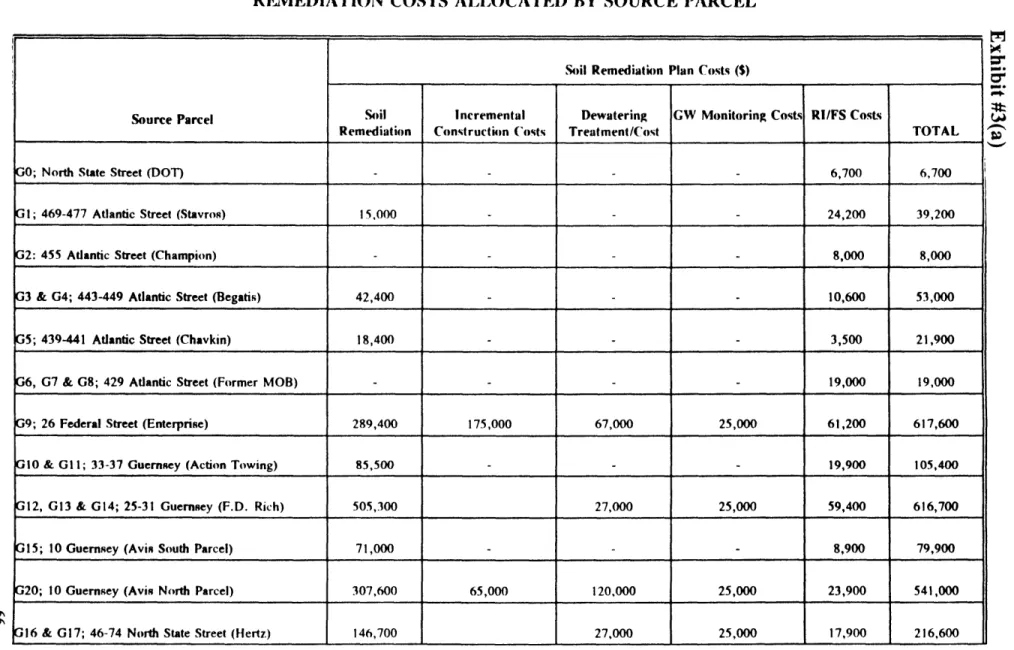
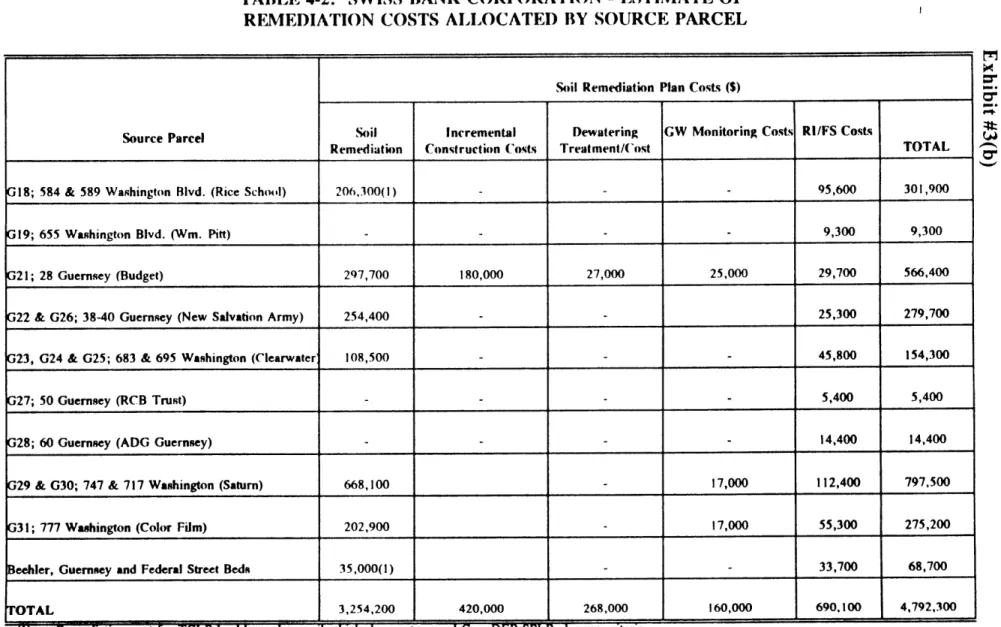
They also conducted estimates on a parcel-by-parcel basis. A summary of this estimate is shown in exhibit #3. A 20% contingency was carried for each parcel to account for uncertainty in subsurface contamination volume estimates and for potential unknown conditions. The exception to the 20% contingency is parcel G3 1, where the scope of the investigation was curtailed due to limited access. A 50% contingency was, therefore. carried to account for the greater level of uncertainty. The total estimated cost
of remediation as of February 1995 was $4,792,300. This included soil remediation, incremental construction costs, dewatering treatment costs, groundwater monitoring costs, and RI/FS (remedial investigation/feasibility study) costs.
The Memorandum of Understanding
Ultimately what convinced the Swiss Bank to accept Stamford as the best site alternative was an agreement negotiated between the Bank, the State of Connecticut, and the City of Stamford. A detailed Memorandum of Understanding (MOU) was signed on September 21", 1994 which held each party to various commitments. Without this successfully negotiated MOU, the deal would almost certainly have been lost.
For their part, the Bank promised to complete phase 1 construction no later than December 31st, 1997. This included a state-of-the-art trading floor and adjoining 14 story
office tower totaling approximately 600,000 square feet of trading floor/office and
500,000 square feet of structured parking. This development, with its significant
allocations to green space, would not only beautify the area dramatically, but would also act as a "gateway" to downtown Stamford from the south by car, bus, and rail. This "gateway" would include a safe,. comfortable, attractive, and activated street-level
pedestrian connection between the Stamford Transportation Center (STC) and the rest of Central Business District (CBD). A major consideration in the design of SBC's site plan has been to provide routes of pedestrian circulation which strengthen the link between the CBD and the STC through active, landscaped areas on the Swiss Bank site. SBC also guaranteed approximately 350 new jobs during the two year construction period, at least 2,000 permanent jobs with the completion of phase 1, and a total of 3,000 permanent jobs by the year 2008. In addition to these job creation guarantees, SBC promised to hire as much local labor as possible and agreed to an ambitious "Workforce Development Program." This program involved creating a joint task force with the State and the City to identify the Bank's entry-level and continuing education needs and then developing the curricula and programs necessary to meet those needs. Then, rather than developing their own internal training programs, the Bank promised to leverage existing training and educational resources as much as possible. These resources included the new downtown Stamford campus of UConn, Norwalk Community Technical College, and the Stamford Public Schools. The last major incentive the SBC development offered to its hosts was a dramatic increase in cash flow to the public coffers. According to the Stamford Tax Assessor, properties in the project site were currently generating $435,000 per year in property taxes. Phase 1 of the Swiss Bank project would increase that tax yield to over
$1.5 million per year and the complete project would increase it to over $3.5 million annually.
In return for these promises from SBC, the state agreed to provide a 10 year 50% credit against SBC's Connecticut corporate income tax, provided that they completed phase I by the agreed date and that they maintained a total employment level in Connecticut of 2,000 employees. In the event that SBC employment in Connecticut reaches 3,000 employees by the tenth year, the State promised to provide an additional 5 year, 25% credit against Connecticut corporate income tax. The State also agreed to
provide partial funding, under certain circumstances' , to complete environmental remediation of the site.
The City agreed to transfer the former Municipal Office Building, the former Rice School, Beehler Street, Guernsey Street, and a portion of Federal Street to SBC for the price of $1. These parcels had an estimated value of $5 million. A series of potential million dollar penalties were also negotiated to encourage the timely completion of all phases of the project since the City would sustain losses if portions of the project were eliminated or came on line later than promised.
Arguably, the most critical condition to the success of the SBC development was the designation of the "Gateway" district as a "Redevelopment Area." Once the area was so designated, and therefore officially condemned, the Stamford Urban Redevelopment Commission (URC) acquired all non city-owned properties in the project area using funds provided by Swiss Bank Corporation. This was accomplished using its power of eminent domain. The URC could not legally use this power unless the area was designated a "Redevelopment Area" so the official designation was a crucial turning
point in the process. Without the power of eminent domain, land assemblage can be extremely expensive and difficult. Existing owners typically learn of the assemblage before it is complete and begin to demand exorbitant, and sometimes prohibitive, prices for their land. To avoid this, the URC, as part of the overall Memorandum of
Understanding, agreed to assemble the entire 12 acre site, including all privately owned parcels, as shown on the "existing conditions map" of Exhibit #2. In addition, the URC also agreed to provide relocation assistance to all commercial and residential tenants in finding new accommodations in accordance with statutory requirements, with funds supplied by SBC.
Land Title Transfer
Environmental clean-up of the site was scheduled to commence immediately following completion of the land assemblage process, a process which effectively transferred control of the entire 12 acre property to the URC. It was an important
requirement of SBC that the title of the property be held by the URC until: 1) remediation was complete, and 2) the "Covenant Not To Sue" was issued by the DEP. Although the Bank was accepting financial risk, controlled by environmental offsets to property cost, it did not want to assume any environmental liability so it was imperative to stay out of the chain of ownership until the last minute19. It should be noted, however, that SBC was already financially committed to the project once the land assemblage process began so their ability to walk away was limited.
18 Please see following section, "Risk Sharing/Cost Sharing with the Public Sector" for further explanation. '9 Environmental offsets of property cost is explained more thoroughly in the next section.
A problem soon arose from this plan. SBC was unable to get a building permit for the phase 1 building until they held title to the land and they didn't want the title until their liability was nullified. This necessity to avoid liability, combined with the very tight construction schedule, compelled the SBC to subdivide the newly assembled 12 acre site into 5 separate legal properties: lots A, B, C, D, and E. (Please see site plan - exhibit #4) Relocation of existing tenants, remediation, implementation of the Covenant Not To Sue, and the land title transfer could all be done more quickly for site A, the phase 1 lot, than it could be done for the project in its entirety. Thus, by subdividing the site they were able to fast-track phase 1 and still make their deadline to complete by December 1997. Clean-up of the phase 1 site was complete by the beginning of March 1996, the Covenant Not To Sue was issued March 14t*, 1996, and the title to Lot A was transferred from the
URC to SBC at the end of that month. The same process was followed for the other four parcels and title to the entire 12 acres was transferred to SBC in June 1997.
Remediation Cost Sharing/Risk Sharing
With: Previous owners
Since the entire 12 acre parcel was condemned and all the private sites were taken through the URC's power of eminent domain, SBC's risk of unknown remediation costs was practically eliminated. Instead of offering the owners fair market value minus the estimated value of remediation, remediation was done first and the actual cost was deducted from the price. Thus, the owners were first relocated, remediation was completed, and then the owners were paid. This would not have been possible without the power of the URC.
The SBC hired the New York office of Hines Interests, a world renowned real estate development company, to work on their behalf throughout the entire development process. One of the many areas where Hines added significant value was in the land assemblage and relocation process. Each property was appraised to establish the
"Unimpaired Value" using both the sales comparison method and the income approaches to value. A risk/stigma adjustment was then used to establish actual estimated value. The owners were informed that their property was either contaminated or was at the very least stigmatized due to neighboring contaminants. The risk/stigma adjustment discounts the property's market value due to:
* the property's general lack of ability to obtain financing due to contamination " the fear of hidden clean-up costs or additional time required to clean-up the
site
* the relative availability of similar property substitutes, which are not contaminated
Each offer was therefore adjusted downward by 10% due to the risk/stigma associated with the site. Properties that were actually contaminated were valued in the same fashion with the actual cost of clean-up added to the total deduction.
With: The Public Sector
The risk of remediation costs was also shared between SBC, the City of Stamford, and the State of Connecticut. Set out in the Memorandum of Understanding, in cases where a property had a negative or zero market value, SBC and the State were to split the excess cost of environmental clean-up, over market value, on a 50/50 basis, up to a maximum of $3 million each for the entire project. Since the city had limited funds, the
state stepped in and made this offer. motivated by the promise of significant increases to the state income tax coffers. Although no single property ended up with a zero or negative value, this clause gave SBC a back door in case expenses got out of hand. One may argue that this was false security since the bank was already heavily committed to the project by this time but it was none-the-less included as a provision.
This cost sharing arrangement between SBC and the State was limited to environmental contamination originating on non-City owned parcels within the project area, but included the cost of the clean-up of contamination which migrated onto City-owned parcels from other parcels within the project area. The State was also responsible for 100% of the cost of clean-up of contamination which has migrated onto City-owned parcels from parcels outside the project area. The City, on the other hand, was
responsible for the cost of clean-up of contamination which had migrated from city-owned parcels to other parcels within the project area. It was assumed by all participants that the sources of contamination could be easily identified. Luckily, not a single
contamination migration issue was raised throughout the entire remediation process so this theory went untested.
With: The Remediation Contractor
The clean-up itself was overseen by Turner Construction, as construction
manager, and subcontracted out to Earth Technology Inc. The issue of sharing the risk of unforeseen contaminants arose in contract negotiations between SBC, Hines, Turner, and Earth Technology but it was ultimately seen as too costly an alternative. Unforeseen costs must be anticipated by the contractors whether there is a high possibility of such an
occurrence or not and the higher the uncertainty, the higher the contractor's contingency price. If SBC had insisted on a strict lump sum contract the remediation bids would have been raised accordingly. Since SBC had just completed a very extensive investigation process, they were relatively confident that sharing this risk was an unnecessary cost.
Therefore, a contract was drawn up between Earth Technology Inc. and Turner Construction for $541,500. This price included "all site remediation (including transportation and disposal) work in accordance with the contract documents." In accordance with a normal construction contract, it was agreed that the contract
documents were not complete but that the subcontractor was responsible to provide a complete job "consistent with the design intent." Along with this lump sum portion of the contract, unit prices were agreed upon for all anticipated and unanticipated "extra" work required to complete the clean-up to the required standards. The risk of unforeseen contamination was therefore set squarely on the shoulders of the SBC. For instance, line 7 & 9 on page 31 of the contract reads:
Line 7: "This contract includes all site remediation as follows: All labor equipment, materials, and other costs to locate, remove and dispose of 29 underground storage tanks (including cleaning and rinsate of these tanks), oil/water separators, hydraulic lifts, and floor drain systems as required and identified by the contract documents. Note: No cost is included in the base bid for removal and disposal of residuals from the items included above. Removal and disposal of these residuals will be handled via the unit prices listed below."
Line 9: "This Subcontractor includes transportation and disposal of contaminated material per the unit price schedule attached. This contract includes a base amount of 6000 tons of transportation and removal at