HAL Id: cea-01871426
https://hal-cea.archives-ouvertes.fr/cea-01871426
Submitted on 10 Sep 2018
HAL is a multi-disciplinary open access
archive for the deposit and dissemination of
sci-entific research documents, whether they are
pub-lished or not. The documents may come from
teaching and research institutions in France or
abroad, or from public or private research centers.
L’archive ouverte pluridisciplinaire HAL, est
destinée au dépôt et à la diffusion de documents
scientifiques de niveau recherche, publiés ou non,
émanant des établissements d’enseignement et de
recherche français ou étrangers, des laboratoires
publics ou privés.
modulation
Rida Chall, Benoit Miscopein, Dimitri Kténas
To cite this version:
Rida Chall, Benoit Miscopein, Dimitri Kténas. MAC design for 5G dense networks based on FBMC
modulation. 12th EAI International Conference on Cognitive Radio Oriented Wireless Networks
(Crowncom 2017), Sep 2017, Lisbonne, Portugal. pp.310-321, �10.1007/978-3-319-76207-4_26�.
�cea-01871426�
FBMC modulation
Rida El Chall, Benoit Miscopein, and Dimitri Kt´enas CEA-Leti Minatec, 17 rue des Martyrs, 38054 Grenoble Cedex 9, France
Abstract. The fifth generation (5G) of wireless networks is currently
under investigation in order to address the well-known challenges of the high capacity demands and traffic volume. The promising solutions to meet these targets can be achieved through ultra-densification, efficient use of spectrum and advanced filtered modulation techniques. In this paper, we present an enhanced MAC protocol for 5G small cells operating at 5 GHz and assuming an FBMC physical layer. The proposed MAC design consists of scheduled-based and contention-based access schemes and involves a listen before talk (LBT) procedure to comply with ETSI regulations. The performance of the proposed FBMC-MAC design is then evaluated in dense deployment scenarios under different PHY/MAC parameter settings. Moreover, we study the performance of FBMC-MAC systems in the context of coexistence with WiFi systems.
Key words: 5G, FBMC, multiple access MAC design, LBT, LBE, dense
small cell networks, contention access, scheduled access, CSMA/CA
1 Introduction
The ever increasing demand for higher data rate and reliable communications poses significant challenges for the existing wireless networks. Fifth generation (5G) cellular networks are expected to meet these intense demands as well as to support different kinds of applications and quality of service (QoS) requirements. Those included, enhanced mobile broadband, ultra-reliable and low-latency com-munications, and massive machine-type communications [1].
As far as capacity improvement is concerned, the common approaches are based on ultra-densification, exploitation of heterogeneous resources in available licensed, lightly-licensed and unlicensed spectrum bands; the spectrum resources being possibly used assuming traffic steering or aggregation mechanisms.
Moreover, relying on a modulation technique with higher efficiency than the one used in 4G is another key aspect of 5G network design. Among different possibilities, filter-bank multi-carrier (FBMC) modulation is considered as a candidate for 5G systems [2]. Indeed, FBMC through the use of well-designed prototype filters overcomes the limitations of the widely-used orthogonal fre-quency division multiplexing (OFDM) technique in terms of tight timing and frequency synchronization requirements. It can provide a very sharp frequency confinement of the signal which translates into a better spectrum utilization.
In this paper, we first present an overview of FBMC modulation and physi-cal layer assumptions considered through our work. Consequently, we propose a medium access control (MAC) protocol for dense small cell networks operating in 5 GHz unlicensed band. This MAC design is based on beacon enabled super-frame similar to existing solutions [3, 4] with novel extension in order to support broadband traffic, multi-user channel access and to take advantage of FBMC signaling mainly to facilitate the resource allocation and channel access in up-link. In particular, the design is a mix of contention-based and scheduled-based access schemes that enable flexible use of radio resources and spectrum. Since the unlicensed 5 GHz band is considered, the proposed MAC performs listen before talk (LBT) in order to comply with the ETSI regulatory requirements [5] and to ensure fair coexistence with neighboring technologies. In this band, two variants of channel access mechanisms are possible to comply with the regu-lation: frame-based equipment (FBE) and load-based equipment (LBE). LBE has been recently adopted by 3GPP within the licensed-assisted access (LAA) framework for component carriers in 5 GHz band [6]. Similarly, in the proposed MAC design we rely on LBE as the channel access method used by the small cell to perform clear channel assessment (CCA) before transmitting. Second, we investigate the impact of PHY configuration parameters and MAC-related pa-rameters on the performance of the proposed MAC design in dense deployment scenarios. Additionally, we analyze the fairness of coexistence of FBMC-MAC system when sharing the channel with a WiFi system.
The remainder of the paper is organized as follows. Section 2 describes the main features of FBMC modulation and physical layer assumptions. Section 3 presents the proposed MAC design and describes the frame structure as well as channel access modes. In section 4, the simulation results related to the PHY-MAC designs are shown. Finally, the conclusions are given in section 5.
2 FBMC and PHY assumptions
FBMC is a multi-carrier modulation considered as a 5G waveform candidate in order to address the OFDM limitations of reduced spectral efficiency and strict synchronization requirements [2]. Indeed, OFDM filters the sub-carriers using a rectangular pulse in the time domain leading to large side-lobes, thus important adjacent channel leakages. It requires the insertion of cyclic prefix (CP) inducing a loss in the spectral efficiency. Moreover, OFDM suffers from high sensitivity to carrier frequency offset and high peak-to-average power ratio (PAPR) that limit uplink multi-user transmissions. In contrast, FBMC modulation uses a set of filters that synthesize and analyze each sub-carrier individually [7]. A proper design of the prototype filter can provide a very sharp spectral localization that allows multiple access and broadband data transmission.
The prototype filter is characterized by its overlapping factor K, which is the number of multi-carrier symbols that overlap in the time domain. The overlap-ping factor K has an impact on determining the optimum spectrum utilization,
the level of adjacent channel leakage (ACL) and the residual symbol inter-ference. In particular, offset quadrature amplitude modulation (OQAM) com-bined with Nyquist constraints on the prototype filter is considered to guarantee orthogonality between adjacent symbols and adjacent carriers while providing maximum spectral efficiency [2].
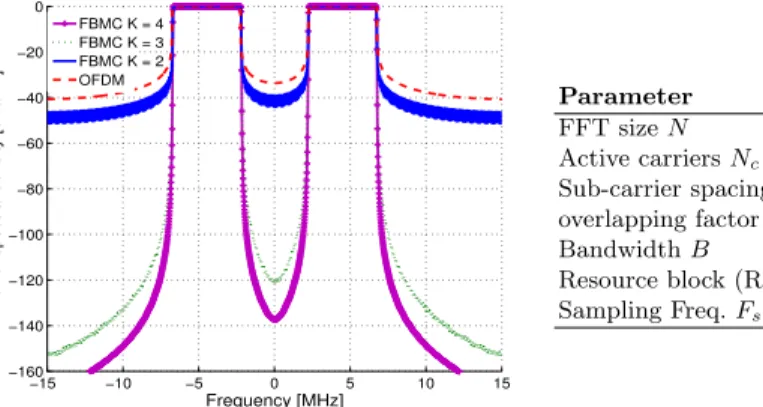
Figure 1 shows the power spectral density for OFDM and FBMC for several values of K. As it can be seen in the figure, a larger value of K (K = 4) is able to achieve better frequency localization and lower out-of-band emissions on adjacent channel (< −100 dBc). At the contrary, for K = 2, the leakage level increases significantly, and is only 10 dB lower than OFDM.
−15 −10 −5 0 5 10 15 −160 −140 −120 −100 −80 −60 −40 −20 0 Frequency [MHz]
Power spectral density [dBc/Hz]
FBMC K = 4 FBMC K = 3 FBMC K = 2 OFDM Parameter 20 MHz band FFT size N 512 Active carriers Nc 330 Sub-carrier spacing ∆f 60 kHz overlapping factor K 4 Bandwidth B 19.8 MHz Resource block (RB) 180 kHz Sampling Freq. Fs 30.72 MHz
Fig. 1. Power spectral density of OFDM and FBMC with several values of K (left)
and FBMC parameters for a 20 MHz carrier (right)
Compared to CP-OFDM, this excellent spectral localization of FBMC signal implies a set of characteristics that can exploited at MAC layer to optimize the medium access:
– Relaxed synchronicity: In CP-OFDM, simultaneous transmissions in contigu-ous bands have to respect a timing misalignment smaller than the CP length in order to avoid inter-carrier interference. By contrast, FBMC can gracefully tolerate asynchronous uplink communications on contiguous band, because of the very small level of adjacent carrier interference if a guard band of at least one sub-carrier spacing is introduced [8].
– Efficient use of allocated spectrum: In FBMC, the insertion of CP is not required and very low adjacent channel leakage ratio (ACLR) is achieved. Consequently, the MAC layer can manage in an efficient way the allocation of (thin) resource blocks, even if they are fragmented and spread in the band. – Relaxed uplink power control: Along the same idea of very low ACLR, the
uplink signal in contiguous bands can be transmitted without a strict power control. Indeed, provided that ACLR is more than 60 dB, two simultaneous signals on contiguous channels can arrive on a small cell with a very large difference of uplink received power.
In this work, the FBMC physical layer is assumed to rely on a particular implementation of FBMC called frequency spreading FBMC (FS-FBMC) ac-cording to the parameters specified in Figure 1 for 20 MHz channel bandwidth. The total number of sub-carriers is set to 512 with sub-carrier spacing of 60 kHz and overlapping factor of 4. These parameters allow to reach the same level of performance of LTE-PHY with 2048 sub-carries and 15 kHz sub-carrier spac-ing [8]. We note that the reduction of the number of sub-carriers by a factor of 4 reduces the PAPR which presents another advantage for uplink communi-cation and allows also to reduce the complexity of FFT implementation. More details about the FBMC modulation and the filter coefficients can be found in [2], whereas implementation issues are presented in [9].
3 FBMC-MAC protocol design
This section presents the design of MAC protocol for 5G small cells to support broadband traffic operating in 5 GHz unlicensed spectrum. Compared to the state of the art of PHY/MAC systems [3, 4], this design supports the use of FBMC physical layer, multiple access operation and incorporate LBT mecha-nisms to comply with ETSI regulatory requirements in the 5 GHz band [5]. 3.1 MAC superframe design
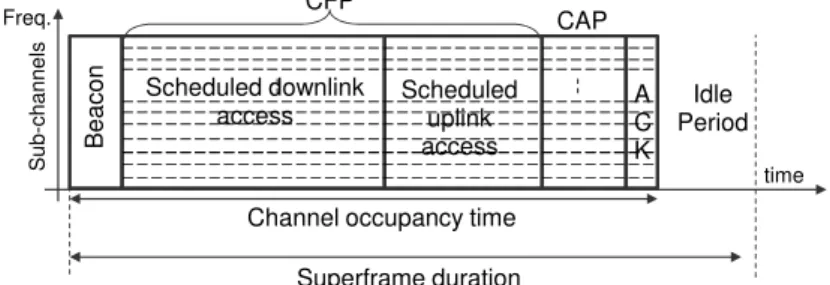
The MAC design is based on a beacon-enabled superframe, that specifies a com-bination of contention-based and scheduled-based access schemes close to the ex-isting systems [3, 4]. The basic network operation mode is a master-slave mode, with the small cell (SC) being the master of user equipments (UEs) within the radio range. More specifically, the superframe consists of a beacon period, a con-tention free period (CFP), a concon-tention access period (CAP) and an idle period as illustrated in Figure 2. The length of the active superframe part is the channel occupancy time (COT) that is subdivided into multiple time slots, each slot has a duration of 1 ms.
In the beacon period, the SC transmits beacon frames spanning on the whole band during one time slot. The beacon frames provide the basic timing for UEs synchronization and carry the control information for device discovery, network organization and resource allocations.
CFP is the scheduled access period composed of variable time slots that are especially allocated to downlink and uplink data communications. The alloca-tion of resources is generally based on UE priority, QoS requirements and the availability of resources, the allocation being described in the beacon. We note that uplink data traffic is usually initiated by UE through sending an uplink grant request to the SC in a previous superframe, whereas downlink data traffic may be either requested by UE or initiated by the SC.
Meanwhile, the CAP is composed of small number of slots and used by UEs to send control and command frames such as association requests, ACK/NACK,
channel quality indicator (CQI) reports and service establishment requests. On the other hand, control information, e.g. CQI, ACK, may be multiplexed with data in an uplink CFP slot when an active UE has both scheduled uplink and downlink traffic, thus allowing more flexibility in resource allocation.
As far as scheduled uplink traffic is concerned, the SC may configure an ACK slot at the end of the CAP in order to send grouped acknowledgments, if any, for the uplink received data in the CFP.
At the end of the superframe, an idle period is considered that can be ad-vantageously used by SCs to sense the channel and feed the spectrum manager with sensing report accordingly.
It is interesting to note that the superframe structure can be dynamically adjusted depending on the traffic type and network load. Indeed, the length of CFP can be tuned to support a given traffic profile like a possible traffic imbalance between uplink and downlink. Alternatively, the CAP duration can also be tuned to provide a better reliability to ACK and CQI updates when the number of active UEs is getting large.
CAP Freq. CFP B e a c o n Scheduled uplink access Scheduled downlink access S u b -c h a n n e ls Idle Period
Channel occupancy time
A C K
Superframe duration
time
Fig. 2. MAC superframe structure for broadband access in 5 GHz
3.2 Multiple access
In the proposed FBMC-MAC design, multiple user access is supported both in CFP and CAP to allow efficient and dynamic share of the allocated spectrum.
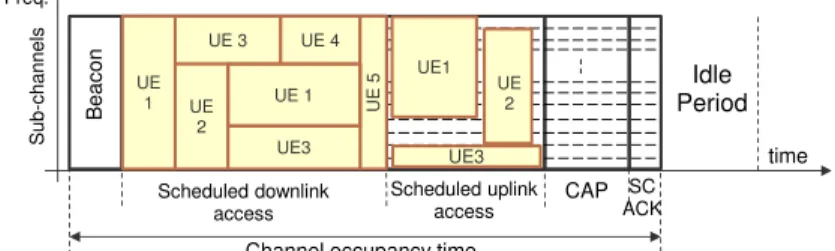
In the CFP, multiple access is based on OFDMA-like approach for both up-link and downup-link channels, using the same concept of resource block (RB) of LTE systems but applied to FBMC modulation. In FBMC-MA, a RB is an allo-cation of 3 active sub-carriers, i.e. 180 kHz, during a time slot. In this MAC, the scheduler is in charge of allocating both uplink and downlink resource blocks to active UEs, assuming the same kind of schedulers as those used in LTE. Interest-ingly, as FBMC tolerates asynchronous transmissions with the aforementioned guard interval constraint, uplink resource allocation can be done quite straight-forwardly by the small cell using the same modulation scheme for both uplink and downlink communication. Figure 3 depicts the multiple access scheme on the superframe, for the scheduled access parts.
On the other hand, the multiple access in the CAP is based on multi-channel contention scheme. The CAP is therefore subdivided into several sub-channels,
where each elementary sub-channel is composed of 17 active sub-carriers and one inactive sub-carrier as a guard band (6 resource blocks). Thus, 9 sub-channels and 18 sub-channels are assumed available for a system bandwidth of 10 MHz and 20 MHz, respectively. UEs attempt to access the channel both in time and fre-quency domains using a multi-channel carrier sense multiple access with collision avoidance (CSMA/CA) algorithm [10]. Prior to transmission, UE first performs channel sensing to identify the set of idle sub-channels. If all sub-channels are busy, UE defers access until a sub-channel becomes available. Otherwise, UE se-lects one sub-channel and initiates a random back-off counter. Next, UE should perform CCA using a back-off procedure. If the channel is found busy during a back-off slot, UE may switch to another available sub-channel by maintaining the back-off counter. Otherwise, UE decrements the counter and transmits the frame when this counter reaches zero.
CAP Freq. B e a c o n Scheduled downlink access S u b -c h a n n e ls Idle Period
Channel occupancy time
SC ACK time UE 3 UE 2 UE 4 U E 5 UE3 UE 1 UE 1 Scheduled uplink access UE1 UE3 UE 2
Fig. 3.Multiple access scheme in the scheduled part of the MAC superframe
3.3 Shared spectrum utilization modes
Since the operation in the 5 GHz band is assumed, the SC has to comply with the LBT rule and shall perform a CCA procedure before the transmission of a MAC superframe to avoid interference with others systems. As stated before, the MAC design proposed in this paper can comply with the 2 access options specified by ETSI, which are namely FBE and LBE [5].
FBE defines a fixed timing frame for channel access, where the SC performs CCA in a fixed frame period. This access mode can induce unfair channel access in dense environment since a SC may get a definitive access to the channel and may block the activity of surrounding SCs.
In contrast, LBE relies on a flexible contention scheme prior to triggering the superframe emission that guarantees a better fairness in dense deployments. This channel access scheme has been retained for the LAA procedure in 3GPP specifications [6]. In our design, we have defined a set of parameters for LBE, based on the 3GPP specifications; they are shown in Figure 4. In this access mode, the SC performs an initial CCA over mp slot durations of a defer
dura-tion Td. If the channel is found busy during one slot, the SC repeats the initial
CCA. Otherwise, the SC shall perform an extended CCA (E-CCA) check over N consecutive time periods of duration Ts. N is randomly selected in the interval
out to be negative, i.e. channel is busy, an initial CCA is performed maintain-ing the current value of N . Otherwise, the SC decrements the counter N and performs transmission of the superframe during COT when N reaches zero. We assume that COT = 10 ms and Ts = 9 µs. The LBE procedure is shown in
Figure 4 for an example of N = 3. More details about access priority of LBE access mode, the contention window size and the duration of the superframe can be found in [6]. time C C A C C A E -C C A C C A C C A C C A Frame E -C C A E -C C A E -C C A E -C C A (transmit) E-CCA busy Freeze Access mode Td[µs] CW 1 mp = 3 16 + 9 × mp[15-63] 2 mp = 7 16 + 9 × mp[15-1023]
Fig. 4. LBE channel access for N = 3 and access mode parameters
4 Performance Evaluation
In this section, we first describe the system-level simulation scenarios and various PHY/MAC parameters considered for assessing the performance of the proposed MAC design. Simulation results are presented and analyzed in a second step. 4.1 Simulation assumptions
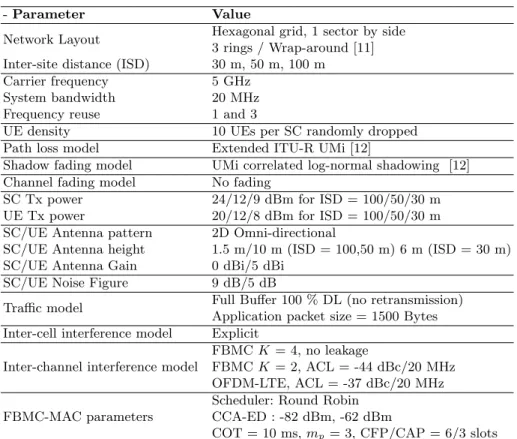
We consider an outdoor deployment scenario based on regular hexagonal grid composed of 3 rings of 37 SCs, applying the wrap-around technique [11]. For each SC, we consider 10 UEs with distances to the SC being randomly distributed. The simulations are carried out in non-fading channel, using an extension of the Urban Micro (UMi) model [12], with spatial correlation of the LOS/NLOS and shadowing [11]. Several inter-site distances (ISDs) are considered to evaluate the performance of MAC design in different degrees of network densification and different energy detect (ED) thresholds ranging from -62 dBm to -82 dBm are considered to evaluate the impact of the CCA sensitivity with respect to densi-fication. In terms of traffic, 100% downlink full buffer pattern is considered as a worst case scenario. Adaptive modulation and coding (AMC) scheme is used by the SC similarly to LTE system based on CQI reports sent by UEs. Con-sequently, the SC assigns a suitable modulation and coding scheme (MCS) for each UE depending on channel conditions, that determines the transport block (TB) size to be transmitted on one slot. The interference between adjacent chan-nels is modeled using out-of-band emissions masks for the considered underlying PHYs, e.g. FBMC and OFDM. For FBMC with K = 4, no out-of-band emission is assumed. In case of OFDM and FBMC with K = 2, the average of interference level on adjacent channel is assumed equal to -37 dBc and -44 dBc for 20 MHz band, respectively. The main simulation parameters are summarized in Table 1. In addition, two main coexistence scenarios are considered: non-coexistence and coexistence scenarios. In the non-coexistence scenario, we evaluate the per-formance of MAC design when it operates without any other interfering system.
In case of the coexistence scenario, we focus on investigation the impact of WiFi system (operator B) on the performance of FBMC-MAC system (operator A) using the same 20 MHz channel. In this case, we assume that WiFi APs are ran-domly dropped in the area with one AP per SC. WiFi uses standard distributed coordination function (DCF) CSMA/CA (without RTS/CTS signaling) with ex-ponential back-off mechanism and transmission duration of 5 ms are assumed.
The performance metrics used in the evaluation are as follows: per-UE throughput, UE transmission delay, and channel occupancy statistics. Per-UE throughput is defined as the ratio of the number of correctly received bits over the given simulation time. The transmission delay is the averaged time required to successfully deliver a packet once it is at the head of the MAC queue. The mean channel occupancy is defined as the average of the total transmission time of SCs or WiFi APs over the simulation time, which is considered to evaluate the fairness of coexistence between FBMC-MAC and WiFi systems.
Table 1.Simulation parameters
- Parameter Value
Network Layout Hexagonal grid, 1 sector by side
3 rings / Wrap-around [11]
Inter-site distance (ISD) 30 m, 50 m, 100 m
Carrier frequency 5 GHz
System bandwidth 20 MHz
Frequency reuse 1 and 3
UE density 10 UEs per SC randomly dropped
Path loss model Extended ITU-R UMi [12]
Shadow fading model UMi correlated log-normal shadowing [12]
Channel fading model No fading
SC Tx power 24/12/9 dBm for ISD = 100/50/30 m
UE Tx power 20/12/8 dBm for ISD = 100/50/30 m
SC/UE Antenna pattern 2D Omni-directional
SC/UE Antenna height 1.5 m/10 m (ISD = 100,50 m) 6 m (ISD = 30 m)
SC/UE Antenna Gain 0 dBi/5 dBi
SC/UE Noise Figure 9 dB/5 dB
Traffic model Full Buffer 100 % DL (no retransmission)
Application packet size = 1500 Bytes
Inter-cell interference model Explicit
Inter-channel interference model
FBMC K = 4, no leakage
FBMC K = 2, ACL = -44 dBc/20 MHz OFDM-LTE, ACL = -37 dBc/20 MHz FBMC-MAC parameters
Scheduler: Round Robin CCA-ED : -82 dBm, -62 dBm
COT = 10 ms, mp = 3, CFP/CAP = 6/3 slots
4.2 Simulation results
Non-coexistence scenario In the non-coexistence scenario, the impact of inter-cell interference on the MAC performance is investigated assuming vari-ous system parameter settings.
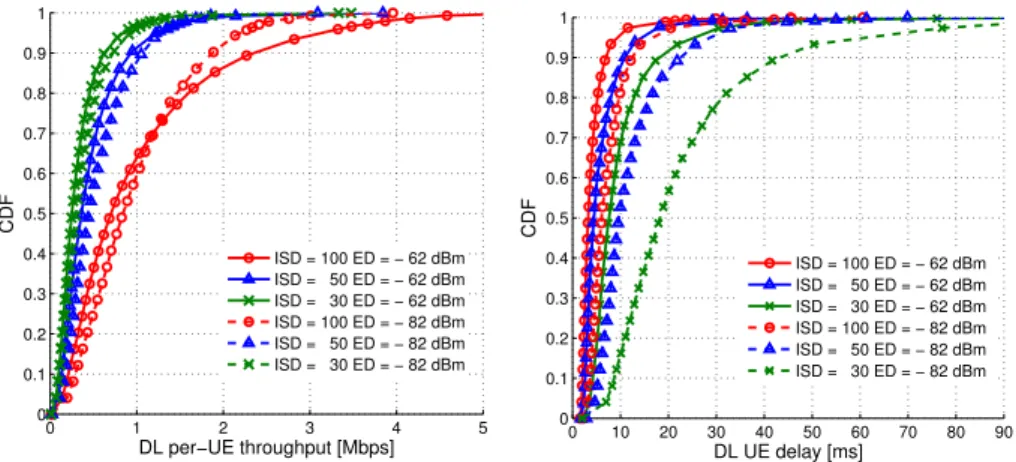
Figure 5 shows CDFs of per-UE throughput and UE delay of FBMC-MAC, given different ISDs and ED thresholds. It is observed that per-UE throughput decreases while transmission delay increases as the network is getting denser. This is due to the increase in UE density which leads to an increase of the of-fered load per km2 resulting in higher level of interference. This higher level of interference affects the channel quality leading to reducing the per-UE through-put and increasing the channel access delay. The impact of varying ED threshold is also depicted in Figure 5. The results show that lowering ED threshold from -62 dBm to -82 dBm improves per-UE throughput performance for dense sce-narios (ISD = 30 m and 50 m) due to the reduction of interference level and collision probabilities coming from the overall activity of cells. However, with ISD = 100 m, this increase of ED sensitivity improves the throughput of cell-edge UE, still because of interference level reduction, while degrading the throughput of cell-center UE because more often SCs defer their transmissions. We notice that increasing ED thresholds results in reducing UE transmission delay, due to the increase of channel access opportunities of SCs.
0 1 2 3 4 5 0 0.1 0.2 0.3 0.4 0.5 0.6 0.7 0.8 0.9 1 CDF DL per−UE throughput [Mbps] ISD = 100 ED = − 62 dBm ISD = 50 ED = − 62 dBm ISD = 30 ED = − 62 dBm ISD = 100 ED = − 82 dBm ISD = 50 ED = − 82 dBm ISD = 30 ED = − 82 dBm 0 10 20 30 40 50 60 70 80 90 0 0.1 0.2 0.3 0.4 0.5 0.6 0.7 0.8 0.9 1 CDF DL UE delay [ms] ISD = 100 ED = − 62 dBm ISD = 50 ED = − 62 dBm ISD = 30 ED = − 62 dBm ISD = 100 ED = − 82 dBm ISD = 50 ED = − 82 dBm ISD = 30 ED = − 82 dBm
Fig. 5. CDFs of per-UE throughput (left) and transmission delay (right)
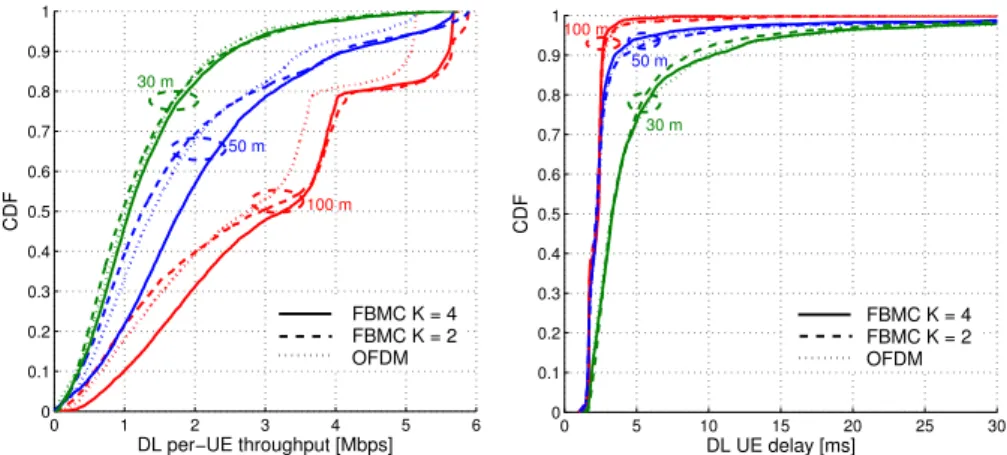
Figure 6 depicts per-UE throughput performance of FBMC with K = 4, K = 2 and ODFM using frequency reuse 3, where adjacent SCs are assigned to different 20 MHz channels. Comparing to the results with single channel in Figure 5, it is observed that using a frequency reuse 3 significantly improves the performance as the contention for superframes is applied on more resource by the SCs. The increase of UE throughput is approximately 2.5 to 3 times higher compared to a single channel. The mean transmission delay is also significantly reduced as well as better channel access fairness is achieved. The impact of PHY modulation is illustrated in Figure 6. The results show that using FBMC with K = 2 or OFDM reduces the throughput performance compared to FBMC K = 4, especially for cell edge UEs. This stems from the adjacent channel in-terference caused by OFDM and FBMC with K = 2, which affects the channel
conditions as the level of interference is increased, this is particularly true for dense networks. Consequently, lower MCS will be assigned to UE data resulting in throughput degradation. The average UE throughput improvement of FBMC with K = 4 compared to CP-OFDM is about 7.5%, 14% and 13% with ISD = 30, 50 and 100 m, respectively. In case ISD = 100 m, the curves tend to reach a saturation throughput since the majority of UEs experience good channel con-ditions, and are assigned the higher MCS. It is also observed that there is no significant impact on UE delay since the traffic load in the system has not been changed regardless of adjacent channel leakages.
0 1 2 3 4 5 6 0 0.1 0.2 0.3 0.4 0.5 0.6 0.7 0.8 0.9 1 CDF DL per−UE throughput [Mbps] FBMC K = 4 FBMC K = 2 OFDM 30 m 50 m 100 m 0 5 10 15 20 25 30 0 0.1 0.2 0.3 0.4 0.5 0.6 0.7 0.8 0.9 1 CDF DL UE delay [ms] 100 m 50 m 30 m FBMC K = 4 FBMC K = 2 OFDM
Fig. 6.CDFs of per-UE throughput (left) and transmission delay (right) using different
PHYs (FBMC K = 4, 2, OFDM), ED = -62 dBm, Frequency reuse 3
Coexistence scenario Herein we investigate the impact of WiFi system on FBMC-MAC performance and we evaluate the fairness of coexistence by com-paring the mean channel occupancy of both systems.
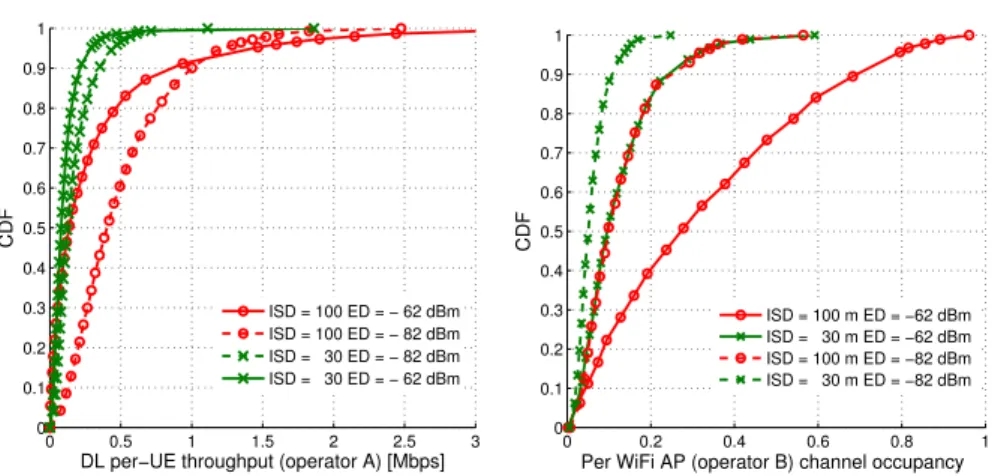
Figure 7 shows the impact of WiFi on the per-UE throughput of FBMC-MAC system and the impact on the channel occupancy of WiFi APs. Due to the shared channel nature and the existence of additional interference caused by WiFi system, we observe significant throughput degradation compared to non-coexistence scenario in Figure 5. We can see that lowering ED threshold to -82 dBm improves throughput performance and results in reducing the channel occupancy of WiFi system (Figure 8). Indeed, using an ED threshold of -62 dBm for both systems may result on severe interference and collision and degrade significantly the throughput performance of FBMC-MAC system.
The effect of using similar and asymmetrical ED thresholds of both systems is shown in Figure 8. The results show that using asymmetrical ED threshold improves the performance of one system at the expense of the other system whose activity is almost zero. On the contrary, using same ED threshold allows fair channel occupancy, in which better FBMC-MAC performance is achieved by lowering ED threshold of both systems to -82 dBm as shown in Figure 7.
0 0.5 1 1.5 2 2.5 3 0 0.1 0.2 0.3 0.4 0.5 0.6 0.7 0.8 0.9 1 CDF
DL per−UE throughput (operator A) [Mbps] ISD = 100 ED = − 62 dBm ISD = 100 ED = − 82 dBm ISD = 30 ED = − 82 dBm ISD = 30 ED = − 62 dBm 0 0.2 0.4 0.6 0.8 1 0 0.1 0.2 0.3 0.4 0.5 0.6 0.7 0.8 0.9 1 CDF
Per WiFi AP (operator B) channel occupancy ISD = 100 m ED = −62 dBm ISD = 30 m ED = −62 dBm ISD = 100 m ED = −82 dBm ISD = 30 m ED = −82 dBm
Fig. 7. CDFs of per-UE throughput for FBMC-MAC (operator A - left) and channel
occupancy for WiFi APs (operator B - right)
! " # " $ %& & ! " # " $ '() * '() * ! "! #$ % & % "' () ) #$ % & % ' *+, - *+, -.,/ ..,() )
Fig. 8.Mean channel occupancy of FBMC-MAC (operator A) and WiFi (operator B),
using similar ED threshold (left) and asymmetrical ED threshold (right)
Moreover, we have investigated the impact of FBMC-MAC (operator A) on the performance of WiFi (operator B) by considering that both operators deploy WiFi (i.e., FBMC-MAC SCs are replaced by WiFi APs). Although this is not shown in this paper, we have observed that the mean channel occupancy of operator B is similar if operator A deploys either WiFi or FBMC-MAC systems. It indicates that the LBT feature of FBMC-MAC is an efficient mechanism to provide fair coexistence with other systems operating in the same band.
5 Conclusion
In this paper, a MAC protocol for 5G small cells operating in 5 GHz band has been presented. The proposed design exploits the benefit of FBMC modu-lation and allows asynchronous multi-user communications and efficient use of spectrum. It is based on beacon enabled superframe with scheduled-based and
contention-based access schemes, in which superframe transmission is triggered by LBT procedure to coexist with others systems in the 5 GHz band. The per-formance of the proposed FBMC-MAC design in case of non-coexistence and coexistence scenarios has been investigated for various network densities, phys-ical layer configurations and LBT sensitivities. The results show that FBMC-MAC design using well designed filter outperforms CP-OFDM systems in dense situations. We show also that FBMC-MAC design provides promising features for throughput improvement and fair coexistence with other systems (WiFi) through adjusting LBT thresholds. Future steps include further investigation of the performance of FBMC-MAC design, considering other network layouts (e.g. indoor hotspots), and others traffic models like uplink traffic where FBMC PHY features may provide additional gains compared to CP-OFDM systems.
Acknowledgments
The research leading to these results received funding from the European Com-mission H2020 program under grant agreement n671705 (SPEED-5G project).
References
1. NGMN: 5G White Paper, http://www.ngmn.org/home.html, July (2015)
2. M.Bellanger et al.: FBMC physical layer: a primer, http://www.ict-phydyas.org (2010)
3. ECMA 392 standard: MAC and PHY for Operation in TV White Space. Second edition, June (2012)
4. IEEE 1900.7-2015 standard: Radio Interface for White Space Dynamic Spectrum Access Radio Systems Supporting Fixed and Mobile Operation, December (2015) 5. ETSI EN 301 893 V1.7.2, Broadband Radio Access Networks (BRAN): 5 GHz high
performance RLAN; Harmonized EN covering the essential requirements of article 3.2 of the R&TTE Directive, July (2014)
6. 3GPP TS 36.213, Evolved Universal Terrestrial Radio Access (E-UTRA), Physical layer procedures. Version 14.2.0, March (2017)
7. B. Saltzberg: Performance of an efficient parallel data transmission system. In: IEEE Trans. on Comm. Tech., vol. 15, no. 6, Dec. (1967)
8. R. Gerzaguet, et al: Comparative study of 5G waveform candidates for below 6GHz air interface. In: ETSI workshop on future radio technologies, Air interfaces, Sophia Antipolis, Feb. (2016)
9. Vincent Berg et al.: A flexible radio transceiver for TVWS based on FBMC. In: Microprocessors and Microsystems, Volume 38, Issue 8, pp. 743–753, Nov. (2014) 10. H. Kwon, H. Seo, S. Kim, and B. G. Lee: Generalized CSMA/CA for OFDMA
systems: protocol design, throughput analysis, and implementation issues. In: IEEE Transactions on Wireless Communications, vol. 8, no. 8, pp. 4176–4187, Aug. (2009) 11. M. Filo, R. Edgar, S. Vahid, R. Taffazolli: Implications of wrap-around for TGax
Scenario 3 and Scenario 4, Sept. (2015)
12. 3GPP TS 36.814: Evolved Universal Terrestrial Radio Access (E-UTRA), further advancements for E-UTRA physical layer aspects. Version 9.2.0, March (2017)