30 2C -19 70 60 52 51 61 6,3 100
GC
2s•C 5° tip min. 4 ra,. 46 26 ir
60 124 1123 126 12/ 120 114 113 10, 118 11211009 0217 02 129 iv 128 17,0 isoth. 190 125160 92 96 0. 96 1 95 90 70 104 90 3 92 70 76 7z Q ,39,
,,,:3 110 I 50 40 107 109 105GC-MS Analysis of the "Semi-Volatiles"
of Cigarette Smoke*
by K. Grob, Department of Organic Chemistry, University of Zurich, Switzerland,
and J. A. Voellmin, Chemistry Laboratory, University Pediatric Department, Kinderspital Zurich, Switzerland
There is strong evidence that the approxiinately 1,300 substances identified in cigarette smoke repre-sent less than half of the actual number of components. Whereas further identifications are predominantly ac-complished after separating whole smoke into rela-tively small fractions of homologues, there is still great interest for direct analysis of the complex mixture.
Separations without preliminary fractionation have been reported for the gas phase (2,3) and for the vapor phase (4). This paper deals with the more volatile part (b.p. ca. 180-350°C) of the particulate phase of smoke for which the term of "semi-volatiles" (SV) has been applied (5). The SV roughly comprise one-fourth of the total number of smoke components.
The direct analysis of the SV has long been troubled by two problems. First it is difficult to prepare a repre-sentative sample of SV out of the total particulate mat-ter of the smoke. The second problem lies in the simul-taneous presence of important acidic (e.g. phenols) as
well as basic (e.g. alkaloids) constituents, each group strongly affecting the resolution of the other.
The first difficulty is overcome by splitless injec-tion (6,7) of a dilute soluinjec-tion of total particulate phase
*Abstract of a Paper Published in Germ,an (1).
1. Grob, K. and Voellmin, J. A., Beit. Tabakforsch. 5, (1969).
2. Newsome, R. J. Norman, V. and Keith, C. H., Tobacco Sci. 9, 24 (1965).
3. Philippe, R. J., Moore, H., Honeycutt, R. G. and Ruth, J. M., Anal. Chem. 36, 859 (1964).
4. Grob, K., Beit. Tabakforsch. 3, 403 (1966).
5. Williamson, J. T., Graham, J. F. and Altman, D. R., Beit. Tabakforsch. 3, 233 (1965).
6. Grob, K. and Grob, G., J. Chromatog. Sci. 7, 584 (1969). 7. Grob, K. and Grob, G., J. Chromatog. Sci. 7, 587 (1969).
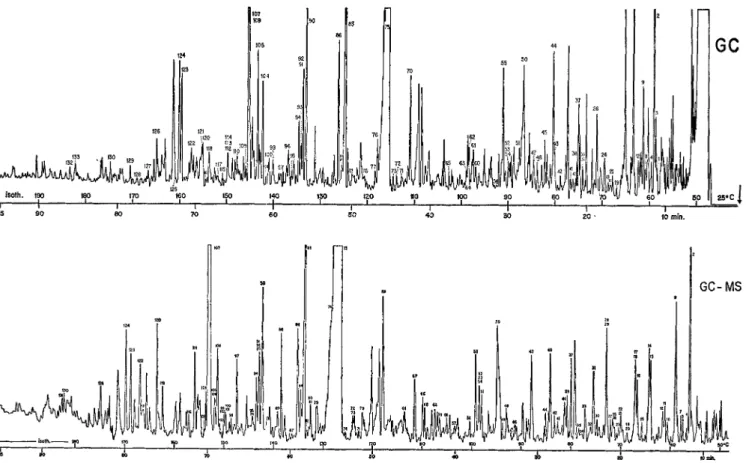
Figure 1. 4.0 1.1,1 of smoke solution injected with solvent by-passing without splitting on 1 m inlet capillary. Glass
capil-218 • APRIL 1970
lary column, 55 m/.35 mm coated with Emulphor 0.
Detec-tion: GC: FID, GC/MS: total ion monitor.
Identified Components 62 naphthalene (GC) (MS)
(GC): by gas chromatography 63 propiophenone (GC)
(MS) by mass spectrometry 64 aniline (GC)
65 n-pentadecane (GC) (MS) 1 2,6-dimethylpyridine (GS) 66 C151126 (MS) 2 limonene (GC) (MS) 67 C151-130 (MS) 3 pyridine (GC) 68 methylacetophenone (MS) 4 methylpyrazine (GC) (MS) 69 C13H220 (MS) 5 Cralkylbenzene (MS) 70 2-methylnaphthalene (GC) (MS)
6 n-undecane (GC) (MS) 71 benzyl alcohol (GC) (MS)
7 acetoin ? (MS) 72 1-methylnaphthalene (GC) (MS) 8 anisole (GC) 73 n-hexadecane (GC) (MS) 9 2,5-dimethylpyridine (GC) (MS) 74 a-tolunitrile (MS) 10 Cralkylbenzene (MS) 75 nicotine (GC) (MS) 11 Cralkylbenzene (MS) 76 quinoline (GC) (MS) 12 3-methylpyridine (GC) (MS) 77 2,6-dimethylphenol (GC) (MS) 13 Cralkylbenzene (MS) 78 1-methylindole (GC) (MS) 14 quinone ? (MS) 79 dimethoxybenzene (MS) 80 dimethylnaphthalene 15 Cralkylbenzene (MS) (MS) 16 C,'-alkylbenzene (MS) 81 biphenyl (GC) (MS) 17 Cralkylbenzene (MS) 82 dimethylnaphthalene (MS) 83 phenol 18 Cralkylbenzene (MS) (GC) (MS) 19 2,4-dimethylpyridine (GC) (MS) 84 n-heptadecane (GC) (MS) 20 C,'-alkylbenzene (MS) 85 1,6-dimethylnaphthalene (GC) (MS) 86 o-cresol 21 2,3-dimethylpyridine (GC) (MS) (GC) (MS) 22 n-dodecane (GC) (MS) 87 dimethylnaphthalene (MS) 23 indan (GC) (MS) 88 C19H38 (MS) 24 2-vinylpyridine (GC) 89 methylquinoline (MS) 25 Cralkylbenzene (MS) 90 p-cresol (GC) (MS) 26 furfural (GC) (MS) 91 m-cresol (GC) (MS) 27 C,'-alkylbenzene (MS) 92 o-ethylphenol (GC) (MS) 28 C4'-alkylbenzene (MS) 93 2,5-dimethylphenol (GC) (MS) 29 Cralkylbenzene (MS) 94 2,4-dimethylphenol (GC) (MS) 30 methylanisole (MS) 95 n-octadecane (GC) (MS) 31 dimethylpyrazole (MS) 96 acenaphthene (GC) (MS) 32 methylanisole (MS) 97 1,2-dimethylindole (GC) (MS) 33 C5-alkylbenzene (MS) 98 1-octadecene (MS) 34 C,'-alkylbenzene (MS) 99 acenaphthylene (GC) (MS) 35 indene (GC) (MS) 100 3,5-dimethylphenol (GC) (MS) 101 trimethylphenol 36 durene (GC) (MS) 37 pyrrole (GC) (MS) 102 C201-14 0 (MS) 38 benzofuran (GC) 103 myosmine (GC) (MS) 39 vinylpyridine (MS) 104 3-ethylphenol (GC) (MS) 40 2-acetylfuran (GC) (MS) 105 4-ethylphenol (GC) (MS) 41 benzaldehyde (GC) (MS) 106 trimethylphenol (MS) 42 n-tridecane (GC) (MS) 107 neophytadiene (GC) (MS) 43 tetralin (GC) (MS) 108 3,4-dimethylphenol (GC) (MS)
44 1-tridecene (GO) (MS) 109 n-nonadecane (GC) (MS)
45 5-methylfurfural (GC) (MS) 110 2,3,5-trimethylphenol (GC)
46 benzonitrile (GC) (MS) 111 C„H„ (MS)
47 dihydrobenzofuran (GC) 112 pyrocatechol (GC)
48 methylindene (MS) 113 eugenol (GC)
49 methylindene (MS) 114 carbazole (GC)
50 propylene glycol (GC) (MS) 115 7-methylindole (GC)
51 acetylmethylfuran (GC) 116 trimethylphenol (MS)
52 acetophenone (GC) (MS) 117 fluorene (GC)
53 n-tetradecane (GC) (MS) 118 nicotyrine (GC) (MS)
54 p-tolualdehyde (GC) (MS) 119 o-methoxyphenol (GC)
55 furfuryl alcohol (GC) (MS) 120 n-eicosane (GC) (MS)
56 1-tetradecene (GC) (MS) 121 glycerol (GC) (MS) 57 C151426 (MS) 122 isoeugenol (GC) (MB) 58 C„H„ (MS) 123 vinylphenol (GC) (MS) 59 C15H24 (MS) 124 indole (GC) (MS) 60 menthol (GC) 125 coumarin (GC) 61 3-cyanopyridine (GC) 126 3-methylindole (GC)
127 2-methylindole (GC) 128 5-methylindole (GC) 129 trans-stilbene (GC) 130 n-docosane (GC) (MS) 131 3-ethylindole (MS) 132 anthracene (GS) 133 phenanthrene (GC)
prepared by extraction of the loaded glass fiber filter with benzene/methanol (3+2). To produce the lower
chromatogram in Figure 1, 4.0 jul of smoke solution
were injected on the capillary column, using the sol-vent bypassing technique (7) without stream splitting. Under these conditions the SV were vaporized rela-tively slowly on a glass tube at 150°C into a 1 m long inlet capillary held at room temperature. After remov-ing and cleanremov-ing the vaporizer tube retainremov-ing the less volatile substances, the inlet capillary was connected to the capillary column and analysis was started. At the given vaporizer temperature the substances eluted before m- and p-cresol were vaporized completely as proven by the fact that further heating of the vaporizer did not affect the peak heights for these substances whereas subsequent peaks became larger.
Simultaneous separation of acids and bases cannot be performed ideally since the adsorption of acidic substances on the column is intensified after the pass-age of a basic sample component, and vice versa. The column used was, therefore, pretreated to reduce
ad-sorption of solutes to a minimum. The corresponding, purely inorganic modification of the glass surface is laborious and is still under study.
All separations were run on a full glass gas chro-matograph from Carlo Erba, Milano, Model GI, as described earlier (6).
The upper chromatogram in Figure 1 was pro-duced after connecting the column to the jet type molecular separator (8) of a mass spectrometer LKB 9000. This coupling procedure did not cause any sig-nificant loss of resolution. From the mass spectra it became evident that most of the approximately 350 peaks were still composed of two or more substances. We thus estimate that the actual number of SV con-stituents is at least around 1,000. We are continuing the work by using more efficient columns with the aim of extending as much as possible our knowledge of the composition of the SV.
Acknowledgment
This investigation has generously been sponsored
by F. J. Burrus & Cie., Boncourt, Switzerland. n
Manuscript received October 17, 1969
8. Novotny, M., Chromatographia 2, 350 (1969).