British Journal of Nutrition (1991), 66, 129-138
Short-term effect of whole milk and milk fermented by
Pseudornonas fluorexens on plasma lipids in adult boars
B Y P E T E R STOLL', A N D R E A S G U T Z W I L L E R ' , M A R T I N JOST',H E I N E R S C H N E E B E R G E R ' , R O B E R T SIEBER', H A N N E S B. S T A E H E L I N 3 , C H R I S T T A N S T E F F E N ' A N D G U E N T H E R R I T Z E L 4
Swiss Federal Research Station for Animal Production, CH-1725 Posieux, Switzerland Swiss Federal Dairy Research Institute, CH-3097 Liebefeld, Switzerland
Geriatric Clinic, University Hospital Basel, CH-4031 Basel, Switzerland Unit of Social and Preventive Medicine, University of Basel, CH-4052 Basel, Switzerland
(Received 13 February 1990 ~ Accepted 6 November 1990)
The short-term effects of whole milk and milk fermented by Pseudomonaspuorescens, of the amino acid composition of the diet and of feeding frequency on the level of plasma lipids, were investigated in six 1-year-old adult boars. The experimental diets contained equal amounts of protein, carbohydrates, fat and cholesterol. After an adaptation period of 5 d for each experimental treatment, blood was collected a t regular intervals during 48 h and plasma levels of cholesterol, triacylglycerol, high-density-lipoprotein (HDL)-cholesterol and low-density-lipoprotein (LDL)-cholesterol were examined. All variables except HDL-cholesterol showed distinct diurnal fluctuations, which were substantially influenced by feeding frequency. Variations in the amino acid composition of the experimental diets, which were within a physiological range, had no effect on the level of plasma lipids. Plasma lipid levels were significantly lower when the animals received the diets containing milk instead of the diet without milk: cholesterol, triacylglycerol, and LDL-cholesterol were reduced by 5.6, 5.8 and 10 % respectively (pondered means) while HDL-cholesterol remained unaffected. Fermentation of whole milk by P. fluorescens reduced the lipid-lowering effect. Our findings suggest that the intake of diets containing milk results in a lower plasma cholesterol and LDL-cholesterol level than the intake of diets with a similar nutrient content which do not contain milk.
Whole milk: Fermented milk: Plasma lipids: Plasma cholesterol: Pig
Reduction in fat intake, substitution of saturated fats for oils rich in unsaturated fatty acids, and abstention or only moderate alcohol consumption are the recommendations for patients suffering from hyperlipoproteinaemia (Levy & Feinleib, 1980). According to these recommendations, whole milk has to be considered an unfavourable food for people with hyperlipidaemia, since more than 50% of its energy comes from milk fat which has a
po1yunsaturated:saturated fatty acid ratio (P:S) of 0.05. It was assumed that a high milk
intake would increase the serum level of total cholesterol and of low-density-lipoprotein cholesterol (LDL-Chol) (Levy & Feinleib, 1980).
Mann & Spoerry (1974) discovered that the intake of large amounts of fermented cow's milk by African Maasai tribesmen actually lowered their serum cholesterol level. Mann (1977) postulated that a heat- and acid-resistant 'milk factor', of unknown chemical identity, had a cholesterol-lowering effect and that fermenting milk with certain Pseudomonas strains increased the concentration of that factor in milk (Mann, 1983). The findings of Mann & Spoerry (1974) led to numerous investigations. Several authors claimed that milk and milk products had a cholesterol-reducing effect in man (Ritzel, 1975; Ritzel
et af. 1981 ; Howard, 1977; Micheli et al. 1982) and in laboratory animals (Jones et al. 1985; Norton et al. 1987). According to Kritchevsky e l al. (1979), Papa et al. (1982) and Dull et al. (1983) milk intake may influence cholesterol biosynthesis. In other investigations, however, no cholesterol-lowering effect of milk and milk products was observed (Hussi et al. 1981 ; Keim et al. 1982; Pulusani & Rao, 1983).
Growing pigs which were fed on diets with adequate and balanced nutrient contents (Agricultural Research Council, 1981) were used in our studies to determine the effect of various milk constituents on the plasma lipid level (Ritzel et al. 1979; Stahelin et al. 1980, 1981). Pigs were chosen as the model for humans, since lipid metabolism and the distribution of plasma lipids are similar in man and swine (Knipping et al. 1975; Chapman & Goldstein, 1976). The evaluation of our experiments with pigs did not confirm the hypothesis that milk contains a cholesterol-lowering factor, but suggested that subtle differences in the amino acid composition of the various experimental diets might have caused the observed differences in the plasma lipid levels (Wanner et al. 1985). In a trial with growing pigs weighing 30 kg we observed diurnal variations in the serum cholesterol level (P. Stoll, unpublished results). Hence, the question arose whether experimental conditions had masked the effect of a possible milk factor in our previous experiments (i.e. blood samples taken at different times of day in the various studies, rapidly-growing animals etc.). The present experiment should allow us to distinguish clearly between the effect of minor changes in the amino acid composition of the diet and the effect of the hypothetical milk factor on the plasma lipid level of adult swine. The influence of milk fermented by the PseudomonasJluorescens strain reported by Mann (1983) and of feeding frequency on the plasma lipids were also studied.
M A T E R I A L S A N D M E T H O D S
Animals
Six I-year-old adult boars of the Large White breed, weighing 16@170 kg, were chosen for the experiment. They were kept in individual pens (2.6 x 1.7 m). At 2 weeks before the start of the experiment silastic catheters were implanted in their jugular veins (for details of the operation and of the catheter care, see Gutzwiller, 1988).
Feeds
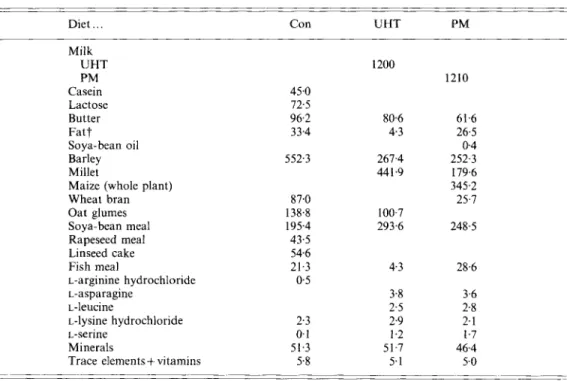
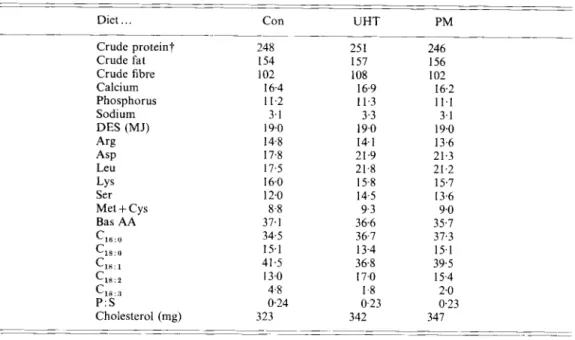
Three different diets were used in the trial; a control diet without milk (diet Con), a diet containing ultra-high-temperature-treated (UHT) whole milk (diet UHT), and a diet containing milk fermented by P . Jluorescens (diet PM). The three diets were formulated with an optimizing program for mixed feeds in order to fulfil the following criteria : (1) milk provided 17.7 YO of digestible energy in the diets UHT and PM ; (2) the three diets contained comparable amounts of casein, lactose and milk fat; (3) the three diets contained equal amounts of digestible energy, crude protein (nitrogen x 6.25), crude fat, crude fibre, minerals (calcium, phosphorus and sodium) and a constant P: S ; (4) the three diets contained equal amounts of lysine, methionine and cystine. The level of arginine was slightly higher and asparagine, leucine and serine levels were slightly lower in the control diet than in the two milk diets.
According to our hypothesis (Wanner et al. 1985) the amino acid pattern of the control diet would lower the plasma cholesterol concentration, while that of the two milk diets would induce an increase in plasma cholesterol. (Wanner et al. (1985) reported that arg : lys, asp:lys, leu:lys and ser:lys values of 0.89-1.12, 1.22-1.31, 1.12-1.41 and 0.5M.79 respectively will lower, while 0.75-0.89, 1.3 1-1.59, 1.41-1.5 and 0.794.87 respectively will increase plasma lipid levels.) Different amounts of the various feed ingredients were used
Table 1. Ingredients ( g ) of the daily experimental rations, a control diet (Con), a diet containing ultra-high-temperature-treated milk ( U H T ) and a diet containing milk fermented by Pseudomonas fluorescens (PM)* ~ _ _ Diet . . . Con U H T PM Milk UHT PM Casein Lactose Butter Fat? Soya-bean oil Barley Millet
Maize (whole plant) Wheat bran Oat glumes Soya-bean meal Rapeseed meal Linseed cake Fish meal L-arginine hydrochloride L-asparagine L-leucine L-lysine hydrochloride L-serine Minerals
Trace elements+ vitamins
45.0 72.5 96.2 33.4 552.3 87.0 138.8 195.4 43.5 54.6 21.3 0.5 2.3 0 1 51.3 5.8 1200 80.6 4.3 267.4 441.9 100.7 293.6 4.3 3% 2.5 2.9 1.2 51.7 5.1 1210 61.6 26.5 0.4 252.3 179.6 345.2 25.7 248.5 28.6 3.6 2.8 2.1 1.7 46.4 5.0 _ _ _ _ _ _ _ _ _ _ _ _ _ _ _ ~
* Diets were formulated by an optimizing program for mixed feeds; for details, see pp, 13&131.
t Mixed fat (700 g lard, 300 g tallow/kg).
to formulate the three diets in order to fulfil the previously mentioned criteria for the diets (Table 1). The nutrient contents as well as the amino acid and fatty acid composition of the milk were modified by fermentation with P.Juorescens. It was, therefore, necessary to use different amounts of the various feed ingredients, even in the two milk diets, in order to obtain rations with equal nutrient levels, amino acid composition and P : S. Protein, fat and
carbohydrate provided 25, 30 and 45 % of the digestible energy. Dietary fat had a P : S of
0.23-0.24. No cholesterol was added to the diets. The daily rations with a native cholesterol content of 323-347 mg (Table 2) corresponded to a low-cholesterol experimental diet.
One batch of UHT milk, filled in 1-litre tetra-packs, was used for diet UHT and for the production of the fermented milk. For that purpose, a P.fIuorescens strain mentioned by Mann (1983) (ATCC 17297; DSM 50091 from the German collection of micro-organisms in Gottingen) was obtained. The milk was placed aseptically in 10-litre glass retorts, inoculated with 2 YO inoculum containing 3 x log colony forming units (CFU)/ml, and incubated for 7 d at 30" under forced ventilation. The average microbial count of the fermented milk was 1.9 x lo9 CFU/ml. The Pseudomonas-treated milk was then stored at 3" and fed within 1 week.
Feeding
The animals were fed at energy maintenance level. At 2 weeks before the start of the experiment, the animals were switched to a high-fat diet resembling, in composition, the milk diets. Experimental feeds were mixed in the feeding trough with milk (diets U H T and
Table 2 . Analysed nutrient content ( g ) of the daily rations, a control diet (Con), a diet containing ultra-high-temperature-treated milk ( U H T ) and a diet containing milk fermented by Pseudomonas fluorescens
( P W *
~.
Diet . . . Con UHT PM
Crude protein? 248 25 1 246
Crude fat I54 157 156
Crude fibre 102 108 I02
Phosphorus 11.2 11.3 11.1 ____ ~~ ~. Calcium 16.4 16.9 16.2 Sodium 3.1 3.3 3.1 DES (MJ) 19.0 19.0 19.0 Arg 14.8 14.1 13.6 ASP 17.8 21.9 21.3 Leu 17.5 21.8 21.2 LYS 16.0 15-8 15.7 Ser 12.0 14.5 13.6 Met
+
Cys 8.8 9-3 9.0 Bas AA 37.1 3 6 6 35.7c,,:,
34.5 36.7 37.3c,,:,
15.1 13.4 15.1 Cl":, 41.5 36.8 39.5 C1*:* 13.0 17.0 15.4 C,,:, 4.8 1-8 2.0 Cholesterol (mg) 323 342 347 P :s
0.24 0-23 0.23 ~~ ~~ ~ ~~~ ~~ ~~DES, digestible energy swine; Bas AA, basic amino acids; P : S , polyunsaturated: saturated fatty acids.
* For details of diets, see pp. 13CL-131 and Table I .
t
Nitrogen x 6.25.PM) or water (diet Con). The daily ration was either fed once daily at 07.30 hours or was distributed in three meals of equal amount at 07.30, 12.30 and 16.30 hours. The animals had free access to self-watering nipples.
Blood sampling and chemical analysis
Since stress reactions influence the concentration of plasma lipids (Wilson rt al. 1972; Levy & Feinleib, 1980) special attention was paid to avoid stressing the animals when blood was collected. Blood samples were drawn via the jugular catheters. The boars remained in their habitual large pens and were able to move freely throughout the duration of the experiment, even when blood was collected. During the last 2 d of each experimental period, blood samples of I0 ml were drawn each hour from 06.00 hours to 20.00 hours, and at 22.00 and 24.00 hours. They were placed in tubes containing 150 I.U. Li-heparin. Immediately after blood collection, samples were centrifuged at 1500 g for 15 min. The plasma from each sample was distributed between six Eppendorf tubes (1.5 ml plasma+45 I.U. Li-heparin) and stored at -20" until required for analysis. Total cholesterol (Chol) and triacylglycerol (Tgl) were determined in duplicate using two of the six tubes, and when large variations occurred, a third tube was analysed. Chol was determined according to the CHOD-PAP method (Boehringer test kit) and Tgl according to a fully enzymic<olorimetric method (Tri Int kit; Hoffmann-La Roche, Basel) using a Cobas Mira autoanalyser. Sample means were calculated from three to six analysed values. High-density-lipoprotein-cholesterol (HDL-Chol) was determined in duplicate in the supernatant fluid after precipitation in phosphotungstic acid. LDL-Chol was calculated by subtracting HDL-Chol from Chol.
L I P I D - L O W E R I N G E F F E C T O F F E R M E N T E D M I L K
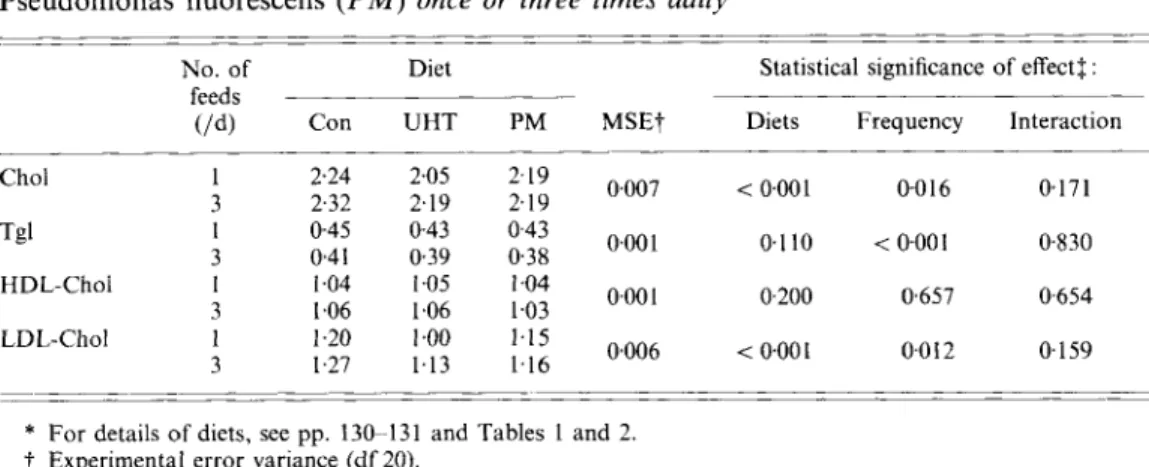
Table 3 . Mean daily plasma concentration (mmoljl) of total cholesterol (Chol), triacylglcyerol (Tgl), high-density-lipoprotein and low-density-lipoprotein-cholesterol ( H D L - Chof and LDL-Chot respectively) in six boars ofered a control diet (Con), a diet containing ultra-high-temperature-treated milk ( U H T ) and a diet containing milk fermented by Pseudomonas fluorescens ( P M ) once or three times daily*
-
No. of Diet Statistical significance of effectf :
feeds -
(/d) Con UHT P M MSEt Diets Frequency Interaction
~~ < 0~001 0016 0.171 0.110 < 0 0 0 1 0.830 0.200 0.657 0654 < 0.001 0.0 I2 0.159 Chol I 2.24 2.05 2.19 o,oo7 Tgl 1 045 043 0.43 o,ool HDL-Chol 1 1.04 1.05 1.04 o,ool LDL-Chol 1 1.20 1.00 1.15 o,oo6 3 2.32 2.19 2.19 3 0.41 0.39 0.38 3 1.06 1.06 1.03 3 1.27 1.13 1.16 _ _ _ ~ ~
* For details of diets, see pp. 130- 131 and Tables 1 and 2.
7 Experimental error variance (df 20).
4 Significance of overall tests for effects of diet, feeding frequency and their interaction from the analysis of variance.
Experimental design and statistical analysis
The experiment was designed as a Latin square with six treatments, three diets and two feeding frequencies (Kirk, 1982). Therefore, each diet was fed to each animal once daily during one treatment period and three times daily during another period.
Each treatment period lasted 1 week. Boars were switched directly from one treatment to another, thus, the whole experiment was completed in 6 weeks. Since the plasma lipid level of pigs responds quickly to dietary changes, as we have seen in former experiments (P. Stoll, unpublished results), we chose short experimental periods in order to minimize the risk of complications related to the catheters such as loss of catheter patency and infection. Long-term effects on atherosclerosis are only seen after dietary periods lasting several months or years.
Concentrations of Chol, Tgl, HDL-Chol and LDL-Chol in the plasma were averaged (surface under the curve divided by time) over the last 2 d of every period for each pig. Analyses of variance appropriate to a Latin square design were carried out using these mean values. Individual comparisons between treatment means were made using orthogonal contrasts (Kirk, 1982). Quoted levels of significance are two-sided. Diurnal patterns in the plasma lipid concentrations were estimated by averaging samples taken at the same time of day on 2 d in all six boars.
R E S U L T S
All boars completed the trial in good health. No animal showed any sign of disease or lost
weight. The variables packed cell volume and the activities of the enzymes alanine aminotransferase (EC 2 . 6 . 1 . 2 ; ALT) and asparagine aminotransferase (EC 2 . 6 . 1 . I ;
AST) in plasma remained constant during the experiment. The feed was never refused by
the boars and was consumed, on average, within 13 min when fed once, and within 10 min when distributed three times daily. The average weight gain during the whole experimental period was 1.7 kg, which corresponds to 10 gjkg body-weight. Thus, the weight of the animals remained virtually constant.
1.10 1.05
-
W a, 0-
-
Y & 1.00 ln 0 0 c 0-
s
.- Y (v a,-
IX 0.95 0.90 0.85 I 06.00 l l l l l l l l l ~ ~ ~ l ~ ~ l l ~ 10.00 14.00 18.00 22.00Time of day (hours)
Fig. I . Diurnal plasma cholesterol profile of the six boars fed on the three diets once daily (daily mean 1.00). (-),
Control diet; (...), diet containing ultra-high-temperature-treated milk; (--), diet containing milk fermented by
Pseudomonusfluorescens. For details of diets, see pp. 130-131 and Tables 1 and 2. 1, Feeding time.
The plasma lipid levels in response to the six experimental treatments are shown in Table 3. Despite the high lipid content of the diets, plasma lipids were low compared with values from humans.
The comparison between the control diet (Con) and the two diets containing milk (UHT and PM) shows that the intake of whole and fermented milk lowered. Chol, Tgl and LDL- Chol in the plasma by 5.6 ( P < O.OOl), 5.8 ( P = 0.041) and 10% (P < 0.001) respectively (mean values of the two milk treatments). HDL-Chol remained unaffected.
When diet UHT instead of diet Con was fed plasma levels of Chol and LDL-Chol were substantially lower (7-1 and 13-6% respectively; P < 0-001). The differences were less pronounced between diet PM and diet Con. When fermented milk instead of whole UHT milk was fed, there was a tendency for plasma Chol to be higher ( P = 0.063), while LDL-
Chol was significantly higher ( P = 0.013).
The effect of feeding frequency on mean plasma lipid levels was not identical for the different plasma lipids. HDL-Chol was not affected by meal frequency. Mean Tgl values were reduced by 10 YO when three meals daily were eaten instead of one meal daily. When diet Con and diet PM were fed, Chol and LDL-Chol were not influenced by feeding
I I I I I , I I I I 1.10 1.05 1 .oo 0.95 0.90 0.85
u
06.00 //
I I I I I I U 18.00 22.00Time of day (hours)
Fig. 2. Diurnal plasma cholesterol profile of the six boars fed on the three diets three times daily (daily mean 1.00).
(-), Control diet; (...), diet containing ultra-high-temperature-treated milk; (----), diet containing milk fermented by Pseudomonuspuorescens. For details of diets, see pp. 13C-131 and Tables 1 and 2. 1, Feeding time.
frequency. In contrast, feeding diet UHT three times daily, instead of once daily, caused an increase in mean Chol and LDL-Chol in the plasma of 6.9 ( P = 0.01) and 13.7 % ( P =
0.006) respectively. The same results were obtained when the plasma profiles of days 1 and 2 were evaluated separately.
Except for HDL-Chol, all variables showed distinct diurnal fluctuations, which were influenced by feeding frequency (Figs. 1 and 2).
D I S C U S S I O N
Whole unfermented milk lowered plasma lipids more efficiently than fermented milk, while plasma lipids were highest when the control diet (diet Con) containing casein, butterfat and lactose was fed. These findings support the hypothesis of Mann (1977) that milk contains a cholesterol-lowering factor. The results further suggest that there is no enrichment of this milk factor in milk fermented by P.JEuorescens as has been claimed by Mann (1983). The fermentation process, on the contrary, decreases the concentration or the activity of this milk factor.
pattern of diet Con did not lower the plasma lipid concentration. This result contradicts our hypothesis that minor changes in the amino acid pattern of the diets, and not the milk ingredients, had lowered the plasma lipid levels of growing pigs in our previous studies (Wanner et al. 1985). There are several reasons why we consider the results of the present trial to be more valid than those of our previous investigations. In our previous studies plasma lipid levels were probably influenced by uncontrollable factors such as growth rate of the animals and stress of blood sampling by venepuncture. The use of adult animals with catheters, which were accustomed to handling, allowed us in the present experiment to draw numerous blood samples daily without disturbing the boars. These diurnal plasma lipid profiles yielded more accurate information than the blood lipid levels which had been determined in our previous studies.
Effects of various dietary amino acids on the plasma cholesterol concentration have been described in the rat and in the rabbit. The different response of plasma lipids to diets containing casein or soya-bean protein has frequently been explained by differences in the amino acid composition of those two proteins (Huff & Carroll, 1980; Nagata et a/. 1981). Particularly strong effects of individual amino acids, as reported in different publications, can partly be attributed to diets which, with respect to requirements, contained insufficient amounts of certain amino acids or had an unbalanced amino acid composition. Difficulties may occur when results obtained with rabbits or rats are compared. Important differences exist not only in amino acid requirements of rabbits and rats (Rogers et al. 1978; Lebas, 1987), but also in their reaction to malnutrition and to amino acid imbalances. A study of the literature showed, in accordance with the results from Hevia et al. (1980a, b), that rats responded to deficiencies or imbalances of amino acids in the diet by becoming hypocholesterolaemic. By contrast, in rabbits, underfeeding with amino acids causes an increase in serum cholesterol. The same holds true for amino acid imbalances (Kritchevsky et al. 1978; Hermus, 1979; Katan et a!. 1982). It has been shown in humans that neither the replacement of soya-bean protein by casein, nor the amino acid pattern of the ingested protein had a significant influence on plasma lipid levels when the diets contained adequate amounts of amino acids (Sacks et a/. 1983).
Of considerable importance are the observations that all plasma lipids except HDL-Chol show distinct diurnal fluctuations. Feeding frequency (i.e. one or three meals daily) consistently influenced that diurnal profile. The diurnal profiles resembled each other in the three feeding treatments. Increasing the feeding frequency lowered peak and mean plasma Tgl levels of the boars. This indicates that the body can dispose of dietary fat more efficiently when the total daily amount is ingested in several meals. The fact that the mean plasma Chol and LDL-Chol concentrations were higher when diet UHT was fed three times daily instead of once daily, while in the two other dietary treatments this variable was unaffected by feeding frequency, lacks explanation. Since the plasma values represent integration of the profile over 48 h, differences in nutrient absorption rates are not responsible for the observed result. Chol and LDL-Chol values were still lower, however, when diet U HT was fed three times daily than when the other two diets were fed.
Conclusions
The results of our experiment indicate that it may not be correct to predict the effect of cow’s milk on plasma lipid levels entirely on the basis of its nutrient content. Milk seems to possess properties which counteract the cholesterol-raising effect of milk fat.
Unexpectedly high diurnal fluctuations of the plasma cholesterol concentration show that mean daily cholesterol levels, rather than fasting levels, should be determined in swine used in experiments on lipid metabolism. This applies even to a greater extent for plasma Tgl and LDL-Chol.
Future studies will clarify whether the observed short-term effects of milk will remain unchanged in long-term feeding trials and whether the response of humans to milk is similar to that of swine.
This work was supported in part by a grant from the Central Association of Swiss Milk Producers, CH-3005 Bern. The authors thank J. L. Gafner for the production of the fermented milk, A. Oberhansli and M. Barman for the clinical chemical analysis and B. Wirz for the care of the animals.
R E F E R E N C E S
Agricultural Research Council ( I 98 I). The Nutrient Requirements of Pigs. Slough : Commonwealth Agricultural Bureaux.
Chapman, M. J. & Goldstein, S. (1976). Comparison of the serum low density lipoprotein and of its apoprotein
in the pig, rhesus monkey and baboon with that in man. Atherosclerosis 25, 267-291.
Dull, B. J., McCarthy, R. D. & Kilara, A. (1983). The modulating effect of an inhibitor of cholesterolgenesis present in bovine milk upon the synthesis of cholesterol, dolichol and ubiquinone. Atherosclerosis 49, 23 1-239.
Gutzwiller, A. (1988). Intravenous catheters for long-term blood collection in adult boars. Journal of Veterinary Medicine A 35, 77LL774.
Hermus, R. J. J. (1979). Amino acid composition of dietary protein as determinant of serum cholesterol level. Var Foda, Suppl. 3. 181.
Hevia, P., Kari, F. W., Ulman, E. A. & Visek, W. J. ( 1 9 8 0 ~ ) . Serum and liver lipids in growing rats fed casein with L-lysine. Jounzul of Nutrition 110, 1 2 2 4 1 230.
Hevia, P., Ulman, E. A., Kari, F. W. & Visek, W. J. (1980b). Serum lipids of rats fed excess L-lysine and different carbohydrates. Journal of Nutririon 110, 1231-1239.
Howard, A. N. (1977). Hypocholesterolaemic effect of milk. Lancer ii, 255-256.
Huff, M. W. & Carroll, K. K . (1980). Effects of dietary proteins and amino acid mixtures on plasma cholesterol levels in rabbits. Journal of Nutrition 110, 1 6 7 6 1 685.
Hussi, E., Miettinen, T. A., Ollus, A , , Konstiainen, E., Ehnholm, Ch., Haglund, B., Huttunen, J. K . & Manninen, V. (1981). Lack of serum cholesterol-lowering effect of skimmed milk and butter milk under controlled conditions. Atherosclerosis 39, 267-272.
Jones, G . , Shahani, K. M . & Amer, M . A. (1985). The effect of acidophilus yogurt on serum cholesterol, triglyceride, and lipoprotein levels of weanling pigs. Journal qfDairy Science 68, Suppl. 1, 84.
Katan, M. B., Vroomen, L. H . M . & Hermus, R. J. J. (1982). Reduction of casein-induced hypercholesterolaemia and atherosclerosis in rabbits and rats by dietary glycine, arginine and alanine. Atherosclerosis 43, 38 1-391.
Keim, N. L., Marlett, J. A,, Amundson, C. H. & Hagemann, L. D. (1982). Comparison of rat hepatic cholesterol biosynthesis during skim milk versus whey permeate ingestion. Journal ?/Dairy Science 65, 22742280. Kirk, R. E. (1982). Experimental Design, 2nd ed. Belmont, California: Brooks/Cole Publishing Co.
Knipping, G . M. J., Kostner, G. M. & Holasek, A. (1975). Studies on the composition of pig serum lipoproteins, isolation and characterization of different apoproteins. Biochimicu et Biophysica Acta 393, 88-99.
Kritchevsky, D., Tepper, S . A., Morrissey, R. B., Czarnecki, S . K. & Klurfeld, D. M . (1979). Influence of whole or skim milk on cholesterol metabolism in rats. Americun Journal Of Clinical Nutrition 32, 597-600.
Kritchevsky, D., Tepper, S. A. & Story, J. A. (1978). Influence of soy protein and casein on atherosclerosis in rabbits. Federation Proceedings 37, 747.
Lebas, F. (1987). Nutrition of rabbits. In Feeding of Non-ruminant Livestock, pp. 63-69 [J. Wiseman, editor].
London : Butterworths.
Levy, R. I. & Feinleib, M. (1980). Risk factors for coronary artery disease and their management. In Heart Diseuse, pp, 12461278 [E. Braunwald, editor]. Philadelphia: W. B. Saunders.
Mann, G. V. (1977). Hypocholesterolaemic effect of milk. Luncer ii, 556.
Mann, G . V. (1983). Method of producing milk factor. CIS Putent no. 4411916.
Mann, G. V. & Spoerry, A. (1974). Studies of a surfactant and cholesteremia in the Maasai. Aniericun Journal of Clinicul Nutrition 27, 464-469.
Micheli, H., Schucan, C . & Bachmann, C. (1982). Plasma cholesterol in four Swiss cities: relationship with alcohol and milk consumption. In Lipoproteins and Coronary Atherosclerosis, pp. 17-23 [G. Noseda, C. Fragiacomo,
R. Fumagalli and R. Paoletti, editors]. Amsterdam : Elsevier Biomedical Press B.V.
Nagata, Y . , Tanaka, K. & Sugano, M . (1981). Further studies on the hypocholesterolaemic effect OF soya-bean protein in rats. British Journal of Nutrition 45, 233-241,
Norton, S. A , , Beames, C. G., Maxwell, C. V. & Morgan, G . L. (1987). Effect of dietary whey upon the serum cholesterol of the pig. Nutrition Reports International 36, 273-279.
Papa, C. M., McCarthy, R. D . & Kilara, A. (1982). Isolation and characterization of the non-ion-dialyzable inhibitor of hepatic cholesterolgenesis present in bovine milk. Milk Science International 37, 257-260.
Pulusani, S. R. & Rao, D. R. (1983). Whole body, liver and plasma cholesterol levels in rats fed thermophilus, bulgaricus and acidophilus milks. Journal of Food Science 48, 280 ~ 2 8 1.
Ritzel, G. (1975). Evaluation von Ernahrungserhebungen im Rahmen der Basler Studie 111. (Evaluation of nutrition surveys in the Basle Study 111). In Zur Ernahrungssituation der schweizerischen Bevolkerung, pp. 57-82 [G. Brubacher and G. Ritzel, editors]. Bern: Hans Huber.
Ritzel, G., Stahelin, H . B., Gutzwiller, F., Schucan, C. & Wiithrich, P. (1981). Ernahrungsverhalten, Verzehrsgewohnheiten und Massenindex in vier Schweizer Stadten. (Eating habits and body mass index in four Swiss towns). Schweizerische Medizinische Wochenschrift 11 I , Suppl. 12, 32-39.
Ritzel, G., Stahelin, H. B., Schneeberger, H., Wanner, M. & Jost, M . (1979). Serum lipids in swine fed large quantities of whey. International Journal f o r Vitamin and Nutrition Research 49, 41 9 4 2 7 .
Rogers, A . E., Benevenga, N. J., Forbes, R. M . , Nordstrom, J. W. &Wolf, G. (1978). Nutrient requirements of the laboratory rat. In Nutrient Requirements of Domestic Anima1.v: Nutrient Requirements of Laboratory Animals, 3rd ed., pp. 7-37. Washington, DC: National Academy of Sciences.
Sacks, F. M., Breslow, J. L., Wood, P. G. & Kass, E. H . (1983). Lack of an effect of dairy protein (casein) and soy protein on plasma cholesterol of strict vegetarians. An experiment and a critical review. Journal qf Lipid Research 24, I 0 12-- 1020.
Stahelin, H. B., Oberhansli, A., Wanner, M., Jost, M., Schneeberger, H . & Ritzel, G. (1980). Effect of whey feeding on serum lipids in swine. In Diet and Drugs in Atherosclerosis, pp. 4 1 4 6 [G. Noseda, B. Lewis and R. Paoletti, editors]. New York: Raven Press.
Stahelin, H . B., Ritzel, G., Wanner, M., Jost, M. & Schneeberger, H . (1981). Hypocholesterolemic effect of milk constituents in growing swine. International Journul /iw Vitamin and Nutrition Research 51. 198-200. Wanner, M., Stoll, P., Stahelin, H., Schneeberger, H., Jost, M., Danuser, J. & Ritzel, G. (1985). Wirkung von
Milchbestandteilen auf den Lipidstoffwechsel. (Effect of milk constituents on lipid metabolism). Zeitschrift f i r
Ernahrun~sM~issenscha~t 24, 141-1 57.
Wilson, G. D. A., Harvey, D . G. & Snook, C. R. (1972). A review of factors affecting blood biochemistry in the pig. British Veterinary Journal 128, 596-610.