Prevalence and Genotyping of Tick-Borne Encephalitis Virus in
Questing Ixodes ricinus Ticks in a New Endemic Area in
Western Switzerland
E. LOMMANO, C. BURRI, G. MAEDER, M. GUERNE, V. BASTIC, E. PATALAS,ANDL. GERN1
Institute of Biology, Laboratory of Eco-Epidemiology of Parasites, University of Neuchaˆtel, Emile-Argand 11, 2000 Neuchaˆtel, Switzerland
J. Med. Entomol. 49(1): 156Ð164 (2012); DOI: http://dx.doi.org/10.1603/ME11044
ABSTRACT Tick-borne encephalitis virus (TBEV) is the causative agent of tick-borne encephalitis (TBE) and causes neurological disease in humans in Eurasia. TBEV is transmitted by ticks of the genus
Ixodes.Currently 10,000 Ð12,000 clinical cases are reported annually in⬇30 TBE endemic countries. Since 1990 the epidemiology of TBE is characterized by a global increase of clinical cases and an expansion of risk areas. Similar trends are also observed in Switzerland but few studies conÞrmed the emergence of new TBE foci by detecting viral RNA in Þeld-collected ticks. In this study, free-living
Ixodes ricinus(L.) ticks from one nonendemic and three new TBE endemic regions located in the Western part of Switzerland were screened during four consecutive years (2007Ð2010) for the presence of TBEV. A total of 9,868 I. ricinus ticks (6,665 nymphs and 3,203 adults) were examined in pools for TBEV by real-time reverse transcription polymerase chain reaction. Our results conÞrmed the presence of viral RNA in 0.1% (6/6120) of questing ticks collected in one new endemic region. Among TBE endemic sites, the minimal infection rate per 100 ticks tested ranged from 0.21 (1/477) to 0.95 (1/105). Four positive samples were sequenced and phylogenetic analysis of the NS5 gene showed that all TBEV nucleotide sequences belonged to the European subtype and were split into two distinct lineages originating probably independently from two distinct foci located NorthÐEast and East of the study region.
KEY WORDS tick-borne encephalitis virus, Ixodes ricinus, Switzerland, phylogeny
Tick-borne encephalitis (TBE) is a viral zoonosis that can affect humans after the bite of infected Ixodes
ricinusticks in Western Europe and Ixodes persulcatus in Eastern Europe and Asia. The causal agent, the tick-borne encephalitis virus (TBEV) is an arbovirus, member of the Flaviviridae family and of the
Flavivi-rusgenus (Mandl et al. 1997). Three TBEV subtypes are distinguished: the European, the Far Eastern and the Siberian subtypes (Ecker et al. 1999).
TBE is endemic in many Eurasian countries and has a wide geographic occurrence extending from Eastern France to Japan (Hayasaka et al. 1999). Since 1990 the number of reported cases has increased in many Eu-ropean countries where TBEV is present (Su¨ss 2008, Randolph et al. 2008). For example, between 1976 and 1989, an average of 2,755 TBE cases was documented annually in Europe and Russia while between 1990 and 2007 the average was 8,755 annual cases (Su¨ss 2008).
In Switzerland, such an increase in the number of cases was also observed with a peak of 245 cases re-ported in 2006 while there was a mean of 92 annual cases between 1995 and 2004 (Randolph et al. 2008).
However, since 2006, the annual incidence is again around 100 cases (Swiss Federal OfÞce of Public Health [SFOPH] 2010). Krech et al. (1969) and Spiess et al. (1969) reported the Þrst human cases of TBE in the NorthÐEast of Switzerland in 1969. Since then and until 1999 all TBE cases were limited to the known distribution perimeter of TBE endemic areas reported by Wyler and Matile in 1984. This perimeter included the North and Eastern parts of the country with the East of the lake of Neuchaˆtel as western limit. How-ever, between 2000 and 2006, TBE cases were regis-tered West and South of the Lake of Neuchaˆtel, out-side this perimeter (de Vallie`re et al. 2006, Schlaeßi et al. 2007) and in the Jura Mountains (SFOPH 2007). Thereby, three new TBE endemic regions were rec-ognized by the SFOPH in the Western part of the country (SFOPH 2007). In Switzerland, an area is considered as TBE endemic by the SFOPH when three clinical cases have been reported in this area or when TBEV has been detected in its vector I. ricinus. Nevertheless, very few studies have been conducted in this country on the prevalence of TBEV in I. ricinus ticks. The most recent studies reported TBEV in ticks from TBE endemic sites with a prevalence of the virus ranging from 0.04% to 14.3% (Wicki et al. 2000, Casati 1Corresponding author, e-mail: [email protected].
et al. 2006, Burri et al. 2011). Finally a study based on a national screening to assess prevalence of TBEV in
I. ricinus ticks from 165 collection sites reported a mean TBEV prevalence of 0.46% (Ga¨umann et al. 2010).
Here, we screened for TBEV questing I. ricinus ticks collected at 49 sites located in the three new TBE endemic regions (SFOPH 2007) and in a neighboring nonendemic region (North of the Lake of Neuchaˆtel) to determine the geographic distribution of TBEV infected ticks. We also analyzed the genetic diversity of TBEV strains and their phylogeny to evaluate whether TBEV might have been imported in these new endemic regions from other parts of Switzerland.
Materials and Methods
Study Area and Tick Sampling. This study was
car-ried out in the Western part of Switzerland in three new TBE endemic regions located outside a perimeter of distribution of TBE endemic sites delimited since 1984 by Wyler and Matile (1984) (Fig. 1). The studied regions were the following: region A (Plaine de lÕOrbe), region B (South of the Lake of Neuchaˆtel), and region C (Jura Mountains, Moutier) (Fig. 1c, Fig.
2). In addition, investigation of TBEV in ticks was also conducted in the periurban forest of Neuchaˆtel, re-gion D (North of the Lake of Neuchaˆtel) (Fig. 2).
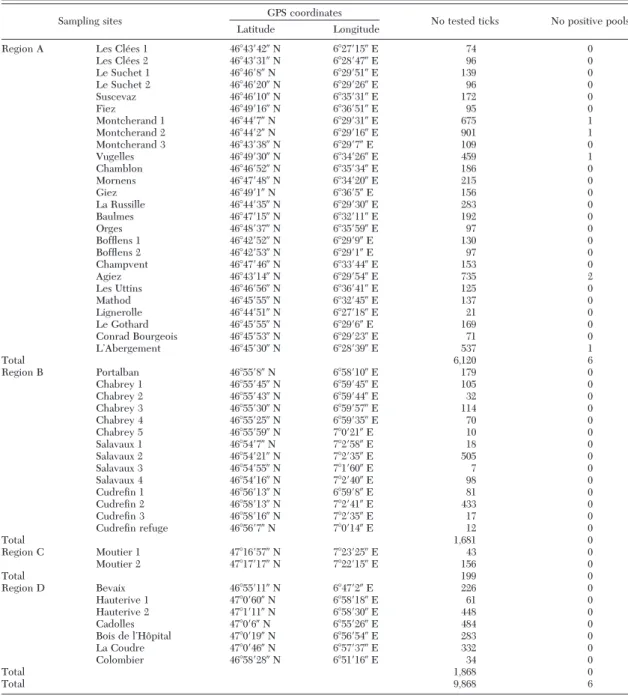
Ticks were collected at 26 sites in endemic region A, 14 sites in region B and at two sites in region C (Table 1). Most of these sites were selected according to TBE cases reported by de Vallie`re et al. (2006), Schlaeßi et al. (2007), and SFOPH (2007). In region D, seven sites were selected (Table 1). All sites were localized in mixed deciduous forests.
Questing I. ricinus ticks were collected with a 1-m2 white ßag in spring and summer of 2007, 2008, 2009, and 2010. Each site was prospected for TBEV between one and four times during the study period. All col-lected ticks were washed in ethanol 70%, dried, pooled from 1 to 25 nymphs and from 1 to 12 males or females and stored at⫺20⬚C until processed for TBEV detec-tion.
TBEV RNA Isolation and Amplification. Ticks were
crushed in pools in 300l of TRIzol (Invitrogen, Basel, Switzerland) containing a 3-mm ball with a mixer mill MM 300 (Retsch, Arlesheim, Switzerland) during 3 min for nymphs and 5 min for adults. RNA was ex-tracted according to Invitrogen protocol (Chomczyn-ski and Sacchi 1987). Incubation times were 10 min for
Fig. 1. Temporal evolution of the geographic distribution of TBE endemic areas in Switzerland. (a) Situation in 1984 according to Wyler and Matile (1984), (b) Situation in March 2006 (modiÞed from SFOPH 2006), (c) Situation in November 2006 (modiÞed from SFOPH 2007), (d) Situation in November 2010 (modiÞed from SFOPH 2010). A circle represents the perimeter of the geographic distribution of TBE endemic areas (dots) between 1984 until March 2006. Black arrow A: Region A, black arrow B: Region B, black arrow C: Region C, empty arrow 1: Liestal (BL), empty arrow 2: Thun/Belp (BE). (Online Þgure in color.)
chloroform and 10 min for isopropanol. Centrifugation time after adjunction of isopropanol was 15 min and 6 min after adjunction of 75% ethanol. Samples were then dried for 30 Ð 40 min, eluted in 30l of RNase-free water (Qiagen, Hombrechtikon, Switzerland) and stored at ⫺20⬚C until analysis by real-time reverse transcription (RT)-polymerase chain reaction (PCR). A negative control was included during each extrac-tion procedure consisting of reagents without ticks.
TBEV RNA reverse transcription and ampliÞcation were performed in an iCycler (Biorad, Reinach, Basel Land, Switzerland) as described in Burri et al. (2011) and modiÞed from Schwaiger and Cassinotti (2003). Reaction volume (25l) consisted in 12.5 l of reac-tion mix (containing dNTPs, 0.04 mM each), primers and probes: 3M of F-TBE1 (5⬘GGG CGG TTC TTG TTC TCC 3⬘), 0.6M of R-TBE1 (5⬘ACA CAT CAC CTC CTT GTC AGA CT 3⬘), and 0.8M of probe TBE-WT (5⬘FAM-TGA GCC ACC ATC ACC CAG ACA CA-TAMRA 3⬘), 0.5l Superscript III Platinum
Taq (Invitrogen, Basel, Switzerland, Superscript III Platinum One-step quantitative system) and 5l of template RNA. The TBEV RNA extract was Þrst re-verse transcribed into complementary DNA (cDNA) at 42⬚C for 30 min and then incubated for 10 min at 95⬚C. Directly after reverse transcription the noncod-ing region localized in 3⬘ (NCR3⬘) was ampliÞed at 95⬚C for 15 s, 60⬚C for 1 min during 45 cycles according to Schwaiger and Cassinotti (2003). To monitor the real-time RT-PCR, a human TBEV isolate was used as positive control (provided by P. de Mendonc¸a, Lud-wig-Maximillians-Universita¨t, Mu¨nchen, Germany). Negative controls (5l RNase-free water; Qiagen) were included during the real-time RT-PCR ampliÞ-cation steps to exclude false-positive results.
Confirmation of Positive Real-Time RT-PCR Re-sults and Sequencing of NS5 Gene. Amplicons that
were positive by real-time RT-PCR were conÞrmed by amplifying the nonstructural protein NS5 using prim-ers described in Puchhammer-Sto¨ckl et al. (1995). Reaction mix for ampliÞcation was modiÞed after Sak-sida et al. (2005). Before ampliÞcation 10l of RNA was transcribed into cDNA according to Invitrogen protocol. The Þrst ampliÞcation was performed in a reaction volume of 50l containing 5 l of Qiagen Buffer 10⫻, 200M of each dNTP, 0.2 M each of primers FSM-1 and FSM-2 (Puchhammer-Sto¨ckl et al. 1995), 1.5 U per test of DNA Taq polymerase (Qiagen) and 10l of cDNA. AmpliÞcation was performed in 40 cycles (94⬚C, 30 s; 40⬚C, 30 s; 72⬚C, 30 s) followed by a 5 min elongation step (72⬚C). For the nested PCR, a 50l reaction mixture consisting in 5 l of Qiagen Buffer 10⫻, 200M of each dNTP, 0.2 M each of inner primers FSM-1i and FSM-2i (Puchhammer-Sto¨ckl et al. 1995), 1.5 U per test of DNA Taq poly-merase and 2 l of ampliÞed DNA was used. The nested PCR program used the following conditions: 94⬚C, 2 min for an initial denaturation step followed by 40 cycles of ampliÞcation (94⬚C, 30 s; 53⬚C, 30 s; 72⬚C, 30 s) and 72⬚C, 5 min for the Þnal elongation. Obtained ampliÞed products (252 nucleotides) were visualized using an agarose gel 2% stained with red gel (Brunschwig, Basel, Switzerland) and visualized un-der UV light. All ampliÞed products detected positive for TBEV were puriÞed with a kit (Promega, Madison, WI) and sent for sequencing to Microsynth (Balgach, Switzerland).
Estimation of Infection Prevalence. TBEV infection
prevalence in ticks was expressed as the minimum infection rate (MIR) per 100 tested ticks based on the
Fig. 2. Geographic location of TBE endemic regions A (West of the lake of Neuchaˆtel), B (South of the lake of Neuchaˆtel), C (Jura Mountains, Moutier), and TBE nonendemic region D (North of the Lake of Neuchaˆtel) where questing ticks were collected. For TBEV endemic region A, tick sampling sites are shown with black dots and stars indicate that TBE infected ticks were sampled at these sites. Sites 1: Montcherand 2; 2: Vugelles, 3: Agiez; 4: Abergement; 5: Montcherand 1; 6: Mathod; 7: Les Cle´es 1; 8: Le Suchet 1; 9: Le Suchet 2; 10: Suscevaz; 11: Fiez; 12: Montcherand 3; 13: Chamblon; 14: Mornens; 15: Giez; 16: La Russille; 17: Baulmes; 18: Orges; 19: Bofßens 1; 20: Bofßens 2; 21: Champvent; 22: Les Uttins; 23: Les Cle´es 2; 24: Lignerolle; 25: Le Gothard; 26: Conrad Bourgeois.
assumption that at least one tick was positive within a positive pool.
Phylogenetic Analyses. NS5 sequences of different
TBEV strains and a closely related ßavivirus chosen from the NCBI GenBank database were used for genetic com-parison: Omsk hemorrhagic fever (GenBank accession number AY323489); Siberian strain Vaslichenko (AF069066); Russian strains Zausaev (AF527415), 886Ð84 (EF469662), 178Ð79 (EF469661), and Glubinnoe 2004 (DQ862460); Finnish strains Kokkola-8 (DQ451298), Kokkola-84 (DQ451305), Kokkola-86 (DQ451307), Kok-kola-4 (DQ451297), Kokkola-39 (DQ451302), and
Kum-linge (AJ298321); Sofjin-HO strain (AB062064); MDJ-01(AY217093); Senzhang (AY182009); Turkish strain (DQ235151); Greek strain (DQ235153); Slovenian strains Stefanja Gora (EU057639), Sodraica (EU057638), and Ka-mnik EU057641; Czech Republic strain (DQ153877); Aus-trian strains Hypr (U39292), Neudoerß (U27495), and U27491; Italian strains FVG Pt12 (FJ159007), FVG BM Forni di Sotto (FJ159002), and FVG ML Raccolana (FJ159003); Lithuanian strains Lith413 (DQ112086), Lith414 (DQ112087), and Lith418 (DQ112088); German strain K23 (AM600965); and Swiss strains NETBE1 (HM450136), NETBE2 (HM450137),
Table 1. Details on collection sites of questing ticks and TBEV infection in ticks
Sampling sites GPS coordinates No tested ticks No positive pools
Latitude Longitude
Region A Les Cle´es 1 46⬚43⬘42⬙ N 6⬚27⬘15⬙ E 74 0
Les Cle´es 2 46⬚43⬘31⬙ N 6⬚28⬘47⬙ E 96 0 Le Suchet 1 46⬚46⬘8⬙ N 6⬚29⬘51⬙ E 139 0 Le Suchet 2 46⬚46⬘20⬙ N 6⬚29⬘26⬙ E 96 0 Suscevaz 46⬚46⬘10⬙ N 6⬚35⬘31⬙ E 172 0 Fiez 46⬚49⬘16⬙ N 6⬚36⬘51⬙ E 95 0 Montcherand 1 46⬚44⬘7⬙ N 6⬚29⬘31⬙ E 675 1 Montcherand 2 46⬚44⬘2⬙ N 6⬚29⬘16⬙ E 901 1 Montcherand 3 46⬚43⬘38⬙ N 6⬚29⬘7⬙ E 109 0 Vugelles 46⬚49⬘30⬙ N 6⬚34⬘26⬙ E 459 1 Chamblon 46⬚46⬘52⬙ N 6⬚35⬘34⬙ E 186 0 Mornens 46⬚47⬘48⬙ N 6⬚34⬘20⬙ E 215 0 Giez 46⬚49⬘1⬙ N 6⬚36⬘5⬙ E 156 0 La Russille 46⬚44⬘35⬙ N 6⬚29⬘30⬙ E 283 0 Baulmes 46⬚47⬘15⬙ N 6⬚32⬘11⬙ E 192 0 Orges 46⬚48⬘37⬙ N 6⬚35⬘59⬙ E 97 0 Bofßens 1 46⬚42⬘52⬙ N 6⬚29⬘9⬙ E 130 0 Bofßens 2 46⬚42⬘53⬙ N 6⬚29⬘1⬙ E 97 0 Champvent 46⬚47⬘46⬙ N 6⬚33⬘44⬙ E 153 0 Agiez 46⬚43⬘14⬙ N 6⬚29⬘54⬙ E 735 2 Les Uttins 46⬚46⬘56⬙ N 6⬚36⬘41⬙ E 125 0 Mathod 46⬚45⬘55⬙ N 6⬚32⬘45⬙ E 137 0 Lignerolle 46⬚44⬘51⬙ N 6⬚27⬘18⬙ E 21 0 Le Gothard 46⬚45⬘55⬙ N 6⬚29⬘6⬙ E 169 0 Conrad Bourgeois 46⬚45⬘53⬙ N 6⬚29⬘23⬙ E 71 0 LÕAbergement 46⬚45⬘30⬙ N 6⬚28⬘39⬙ E 537 1 Total 6,120 6 Region B Portalban 46⬚55⬘8⬙ N 6⬚58⬘10⬙ E 179 0 Chabrey 1 46⬚55⬘45⬙ N 6⬚59⬘45⬙ E 105 0 Chabrey 2 46⬚55⬘43⬙ N 6⬚59⬘44⬙ E 32 0 Chabrey 3 46⬚55⬘30⬙ N 6⬚59⬘57⬙ E 114 0 Chabrey 4 46⬚55⬘25⬙ N 6⬚59⬘35⬙ E 70 0 Chabrey 5 46⬚55⬘59⬙ N 7⬚0⬘21⬙ E 10 0 Salavaux 1 46⬚54⬘7⬙ N 7⬚2⬘58⬙ E 18 0 Salavaux 2 46⬚54⬘21⬙ N 7⬚2⬘35⬙ E 505 0 Salavaux 3 46⬚54⬘55⬙ N 7⬚1⬘60⬙ E 7 0 Salavaux 4 46⬚54⬘16⬙ N 7⬚2⬘40⬙ E 98 0 CudreÞn 1 46⬚56⬘13⬙ N 6⬚59⬘8⬙ E 81 0 CudreÞn 2 46⬚58⬘13⬙ N 7⬚2⬘41⬙ E 433 0 CudreÞn 3 46⬚58⬘16⬙ N 7⬚2⬘35⬙ E 17 0 CudreÞn refuge 46⬚56⬘7⬙ N 7⬚0⬘14⬙ E 12 0 Total 1,681 0 Region C Moutier 1 47⬚16⬘57⬙ N 7⬚23⬘25⬙ E 43 0 Moutier 2 47⬚17⬘17⬙ N 7⬚22⬘15⬙ E 156 0 Total 199 0 Region D Bevaix 46⬚55⬘11⬙ N 6⬚47⬘2⬙ E 226 0 Hauterive 1 47⬚0⬘60⬙ N 6⬚58⬘18⬙ E 61 0 Hauterive 2 47⬚1⬘11⬙ N 6⬚58⬘30⬙ E 448 0 Cadolles 47⬚0⬘6⬙ N 6⬚55⬘26⬙ E 484 0 Bois de lÕHoˆpital 47⬚0⬘19⬙ N 6⬚56⬘54⬙ E 283 0 La Coudre 47⬚0⬘46⬙ N 6⬚57⬘37⬙ E 332 0 Colombier 46⬚58⬘28⬙ N 6⬚51⬘16⬙ E 34 0 Total 1,868 0 Total 9,868 6
NETBE3 (HM450138), NETBE4 (HM450139), NETBE5 (HM450140), NETBE6 (HM450141), NETBE7 (HQ883372).
Phylogenetic analyses were performed using Bioedit (http://www.mbio.ncsu.edu/bioedit/bioedit.html) and PHYLIP 3.69 (http://evolution.gs.washington.edu/ phylip/getme.html) (Felsenstein 1993). First 1000 boot-strap replicates of the sequence data (SEQBOOT) were executed. Then, distance matrices were calculated by using KimuraÕs two-parameter model (DNADIST) and analyzed by the neighbor-joining algorithm (NEIGHBOR). Alternatively, the DNAPARS program was used to Þnd the trees with maximum parsimony. The bootstrap support percentages of particular branching points were calculated from these trees (CONSENSE). The resulting phylogenetic tree was presented using the program TreeView 1.6.6 (http://taxonomy.zoology. gla.ac.uk/rod/treeview.html) (Page 1996). Alignment of the sequences was performed using ClustalW2.0.12 (Thompson et al. 1994).
Results
Between 2007 and 2010, a total of 9,868 I. ricinus ticks (6,665 nymphs, 1,699 males, and 1,504 females) collected at 49 sites (Table 1) in four different regions (A, B, C, and D) located in the Western part of Swit-zerland (Fig. 2) were tested for the presence of TBEV by pools.
In region A, a total of 6,120 ticks (3,965 nymphs and 2,155 adults) collected at 26 sites were tested for TBEV in 602 pools (265 pools of 1Ð25 nymphs and 337 pools of 1Ð12 adults) (Table 1). TBEV-speciÞc RNA was detected in 6/602 pools of ticks collected at 5/26 sites (Table 2; Fig. 2). Two pools of eight and 20 nymphs were infected in 2007, one pool of 10 females in 2008, two pools of 10 and 20 nymphs in 2009 and one pool of 11 nymphs in 2010. Overall, the MIR per 100 tested nymphs for TBEV was 0.13 (5/3965 [95% CI: 0.04 Ð 013]) and 0.1 for females (1/1023 [95% CI: 0 Ð 0.54]) corresponding to a global MIR of 0.1 (6/6120 [95% CI: 0.04 Ð 0.21]). No male was found infected with TBEV. Among the Þve sites where TBEV-speciÞc RNA was detected in ticks, the MIR per 100 tested ticks ranged from 0.21 (1/477 [95% CI: 0.01Ð1.16]) (site 3, in 2009) to 0.95 (1/105 [95% CI: 0.02Ð5.19]) (site 3, in 2008) (Table 2) and the mean of MIR was 0.37 (6/1621 [95% CI: 0.14 Ð 0.8]) per 100 tested ticks. At one site (site 3), we could detect TBEV in ticks over two consecutive
years (2008 and 2009) whereas in all other sites the virus was detected only sporadically in ticks over the study period although at two sites (sites 1 and 5) ticks were collected during four consecutive years (Fig. 2; Table 2). No TBEV could be detected in ticks col-lected in TBE endemic regions B (n⫽ 1,681) and C (n ⫽ 199) nor in the nonendemic region D (n ⫽ 1,868).
Sequencing of the TBEV NS5 gene was possible for 4/6 positive samples and resulted in 209 Ð211 nt am-plicons (corresponding to the 252 nt bands without primers sequences). The NS5 gene sequences were submitted to the NCBI GenBank database (http:// www.ncbi.nlm.nih.gov/PubMed/) under the follow-ing accession numbers: HQ883373 (NETBE8), HQ883374 (NETBE9), HQ883375 (NETBE10), and HQ883376 (NETBE11) (Table 2). All TBEV se-quences obtained in this study belonged to the Euro-pean subtype relating them closely to Neudoerß strain (U27495) but none of them were 100% identical to Neudoerß strain. To relate the obtained TBEV nucle-otide sequences with other TBEV sequences available in GenBank, a phylogenetic tree was constructed on the basis of the NS5 gene (Fig. 3). Two different lineages of TBEV sequences were clearly distinguish-able in this region. First, a group of three genetically identical sequences (from sites 3 and 5, NETBE9, NETBE10, and NETBE11) showed 100% homology with a previously identiÞed sequence (strain NETBE7, HQ883372) (Fig. 4) obtained from ticks collected at Liesberg, Canton Basel Land (BL), a new endemic region situated inside the perimeter of TBEV distribution known since 1984, North East of region A (Fig. 1d) (SFOPH 2010). Second, one single sequence (from site 2, NETBE8) segregated in a group of strains (HM450136, HM450137, HM450138, HM450140, HM450141; Burri et al. 2011) identiÞed in ticks col-lected at Thun/Belp, Canton Bern, an endemic region located East of region A (Fig. 1d) and also included in the perimeter of TBEV distribution known since 1984, although this strain showed a divergence of 2.4% with the other sequences (Figs. 3 and 4).
Discussion
TBE is an increasing health problem in Eurasian countries with thousands of cases reported annually (Su¨ss 2003). The distribution maps are generally elab-orated with registered autochthonous cases of the
Table 2. Details on TBEV detected in ticks collected at five sites located in region A
Sitesa
Locality Sampling year No infected/
analyzed ticks MIR
b 95% CI NS5 sequence name Accession no 1 Montcherand 2 2007 1/170 0.59 0.02Ð3.23 Ñ Ñ 2 Vugelles 2007 1/339 0.29 0.01Ð1.63 NETBE8 HQ883373 3 Agiez 2008 1/105 0.95 0.02Ð5.19 NETBE9 HQ883374 3 Agiez 2009 1/477 0.21 0.01Ð1.16 NETBE10 HQ883375 4 Abergement 2009 1/281 0.36 0.01Ð1.97 Ñ Ñ 5 Montcherand 1 2010 1/249 0.40 0.01Ð2.22 NETBE11 HQ883376
aSite numbers refer to site numbers shown on Fig. 2.
disease and few studies investigated the prevalence of TBEV in questing ticks. In Switzerland recent studies estimated the TBEV prevalence in free-living ticks (Wicki et al. 2000, Casati et al. 2006, Ga¨umann et al. 2010, Burri et al. 2011). During the last decade new TBE endemic areas emerged in the Western part of the country following the recording of clinical cases (SFOPH 2007). Therefore, we focused our attention on these new TBE endemic regions (regions A, B, and C) as well as on a neighboring region (region D). We investigated questing I. ricinus ticks for TBEV during four consecutive years to evaluate TBE risks. In this study, TBEV could not be detected in ticks collected in two out of three endemic regions (B and C) nor in the nonendemic region D. In region B, clinical cases were recently reported by de Vallie`re et al. (2006) and in 2010, Ga¨umann et al. detected TBEV in one pool of ticks with a local prevalence of 0.2% (1/500, Cudre-Þn). An explanation for this discrepancy could be that our sampling site did not exactly overlap the TBE site investigated by Ga¨umann et al. (2010). In fact, it has been reported that within a focus TBEV infected ticks
are not uniformly distributed (Blaskovic and Nosek 1972). Clinical cases were reported in region C (Jura Mountains, Moutier) (SFOPH 2006) but we were not able to conÞrm the presence of TBEV in ticks. Simi-larly, Ga¨umann et al. (2010) were not able to detect TBEV in ticks collected in this region. Part of expla-nation can be that the sampling sizes in both studies were too small (n⫽ 199 in this study and n ⫽ 392 in Ga¨umann et al. 2010) to detect TBEV in ticks all the more so because the prevalence of TBEV in ticks is low. Nonendemic region D, located North of the Lake of Neuchaˆtel, was considered in this study because it is adjacent to known TBE endemic areas (SFOPH, http://www.bag.admin.ch/themen/medizin/00682/ 00684/01069/index.html?lang ⫽ fr). As no clinical TBE cases have been reported in this region and no TBEV has been detected in ticks (n⫽ 1868) we con-clude that currently the risk of TBEV infection is either very low or even absent in this region.
The presence of TBEV in questing ticks could be conÞrmed in one endemic region (region A, Plaine de lÕOrbe), situated West of the Lake of Neuchaˆtel, with
Fig. 3. Phylogenetic tree based on the NS5 gene. Only bootstrap valuesⱖ90% are shown. The tree is rooted by the Omsk-hemorragic fever virus. The TBEV sequences obtained in this study are shown in bold.
a global MIR of 0.1 per 100 tested ticks (6/6120). This prevalence is in accordance with the study of Burri et al. (2011) carried out in a known endemic region located near Bern (Switzerland) and is also in line with TBEV prevalence recorded in Europe (Durmisi et al. 2011, DÕAgaro et al. 2009, Ga¨umann et al. 2010, Han et al. 2001).
In region A, TBEV infected ticks were detected at 5/26 sites. We could not detect viral RNA in ticks collected at the other investigated sites located in region A, even if they had been reported as endemic by de Vallie`re et al. (2006), Schlaeßi et al. (2007) and SFOPH (2007). That could be explained by the low number of analyzed ticks at each of these sites (⬍300 ticks) in relation to the low mean TBEV MIR in natural
foci (0.37 per 100 tested ticks). This explanation seems to be consistent because at each site where TBEV was detected in ticks at least 450 ticks were screened (Ta-ble 1). This is exempliÞed by results from Ga¨umann et al. (2010) who reported 2/555 TBEV infected ticks at site six (Fig. 2) whereas we could not detect the virus in the 137 ticks we analyzed.
Phylogenetic analysis provided evidence that TBEV strains circulating in endemic region A belonged to the European subtype and that among them two dif-ferent clusters were distinguishable. Each of these clusters included strains originating from two geo-graphical distant areas (Liestal, BL and Thun/Belp, BE) in Switzerland located in the perimeter of TBE distribution known since 1984 (Wyler and Matile
Fig. 4. Comparison of NS5 gene encoding sequences of TBEV strains obtained in this study (in bold) with previously identiÞed Swiss strains (nt 7,788Ð7,988).
1984) (Fig. 1d). The presence of two different lineages in region A, located outside the perimeter, suggests that TBE foci (at site 2, and at sites 3 and 5) emerged independently of each other after the introduction of TBEV infected ticks probably infesting migrating birds coming from the North-East, for example. This is sup-ported by studies reporting that birds may carry TBEV infected ticks (Ernek et al. 1968, Waldenstro¨m et al. 2007).
Our results conÞrm the presence of TBEV in ticks collected in a new TBE endemic region in the Western part of Switzerland and underline risk of exposure to TBEV infected ticks in this region. Phylogenetic anal-ysis showed that TBEV strains obtained from this re-gion belonged to the European subtype. They were closely related to Swiss strains previously identiÞed in the North and East of the country that could be ex-plained by the introduction of TBEV infected ticks via migrating birds into regions where biotic and abiotic conditions were favorable for the maintenance of TBEV in ticks and vertebrate hosts.
Acknowledgments
Results are parts of the Ph.D. thesis of Lommano E. and Burri C. This work was Þnancially supported by the Swiss National Foundation (grants 320000 Ð113936/1 and 310030 Ð 127064/1). We are grateful to I. Golovljova (National Insti-tute for Health Development, Tallinn, Estonia) for her in-troduction in phylogenetic analyses. We thank P. de Mendonc¸a (Ludwig-Maximillians-Universita¨t, Mu¨nchen, Germany) for providing TBEV positive control. We would also like to thank M. Bouzelboudjen, N. Tonetti, and Y. Triponez (University of Neuchaˆtel, Neuchaˆtel, Switzerland) for their help in generating the map of sampling sites.
References Cited
Burri, C., V. Bastic, G. Maeder, E. Patalas, and L. Gern. 2011.
Microclimate and the zoonotic cycle of tick-borne en-cephalitis virus in Switzerland. J. Med. Entomol. 48: 939 Ð 944.
Blaskovic, D., and J. Nosek. 1972. The ecological approach
to the study of tick-borne encephalitis. Prog. Med. Virol. 14: 275Ð320.
Casati, S., H. Sager, L. Gern, and J. C. Piffaretti. 2006.
Pres-ence of potentially pathogenic Babesia sp. for human in
Ixodes ricinusin Switzerland. Ann. Agric. Environ. Med. 13: 65Ð70.
Chomczynski, P., and N. Sacchi. 1987. Single-step method
of RNA isolation by acid guanidinium thiocyanate-phe-nol-chloroform extraction. Anal. Biochem. 162: 156 Ð159.
D’Agaro, P., E. Martinelli, P. Burgnich, F. Nazzi, S. Del Fabbro, A. Iob, M. Ruscio, P. Pischiutti, and C. Campello. 2009. Prevalence of tick-borne encephalitis virus in
Ix-odes ricinusfrom a novel endemic area of North Eastern Italy. J. Med. Virol. 81: 309 Ð316.
Durmisi, E., N. Knap, A. Saksida, T. Trilar, D. Duh, and T. Avsic-Zupanc. 2011. Prevalence and molecular
charac-terization of tick-borne encephalitis virus in Ixodes ricinus ticks collected in Slovenia. Vector Borne Zoonotic Dis. 11: 659 Ð 664.
Ecker, M., S. L. Allison, T. Meixner, and F. X. Heinz. 1999.
Sequence analysis and genetic classiÞcation of tick-borne
encephalitis viruses from Europe and Asia. J. Gen. Virol. 80: 179 Ð185.
Ernek, E., O. Kozuch, M. Lichard, and J. Nosek. 1968. The
role of birds in the circulation of tick-borne encephalitis virus in the Tribec region. Acta Virol. 12: 468 Ð 470.
Felsenstein, J. 1993. PHYLIP: phylogeny inference
pack-age, version 3.5c. University of Washington, Seattle, WA. (http://evolution.gs.washington.edu/phylip/getme.html)
Ga¨umann, R., K. Mu¨hlemann, M. Strasser, and C. M. Beuret. 2010. High-throughput procedure for tick surveys of
tick-borne encephalitis virus and its application in a na-tional surveillance study in Switzerland. Appl. Environ. Microbiol. 76: 4241Ð 4249.
Han, X., M. Aho, S. Vene, M. Peltomaa, A. Vaheri, and O. Vapalahti. 2001. Prevalence of tick-borne encephalitis
virus in Ixodes ricinus ticks in Finland. J. Med. Virol. 64: 21Ð28.
Hayasaka, D., Y. Suzuki, H. Kariwa, L. Ivanov, V. Volkov, V. Demenev, T. Mizzutani, T. Gojobori, and X. Takashim. 1999. Phylogenetic and virulence analysis of tick-borne
encephalitis viruses from Japan and far ÐEastern Russia. J. Gen. Virol. 80: 3127Ð3135.
Krech, U., F. Jung, and M. Jung. 1969. Zentraleuropa¨ische
Zeckenenzephalitis in der Schweiz. Schweiz. Med. Wschr. 99: 282Ð285.
Mandl, C. W., M. Ecker, H. Holzmann, C. Kunz, and F. X. Heinz. 1997. Infectious cDNA clones of tick-borne
en-cephalitis virus European subtype prototypic strain Neu-doerß and high virulence strain Hypr. J. Gen. Virol. 78: 1049 Ð1057.
Page, R.D.M. 1996. TREEVIEW: an application to display
phylogenetic trees on personal computers. Comput. Appl. Biosci. 12: 357Ð358.
Puchhammer-Sto¨ckl, E., C. Kunz, C. W. Mandl, and F. X. Heinz. 1995. IdentiÞcation of tick-borne encephalitis
vi-rus ribonucleic acid in tick suspensions and in clinical specimens by a reverse transcription-nested polymerase chain reaction assay. Clin. Diagn. Virol. 4: 321Ð326.
Randolph, S. E., L. Asokliene, T. Avsic-Zupanc, A. Bor-mane, C. Burri, L. Gern, I. Golovljova, Z. Hubalek, N. Knap, M. Kondrusik, et al. 2008. Variable spikes in
tick-borne encephalitis incidence in 2006 independent of variable tick abundance but related to weather. Parasit. Vectors 1: 44.
Saksida, A., D. Duh, S. Lotric-Furla, F. Strle, M. Petrovec, and T. Avsic-Zupanc. 2005. The importance of tick-borne
encephalitis virus RNA detection for early differential diagnosis of tick-borne encephalitis. J. Clin. Virol. 33: 331Ð335.
Schlaefli, R., D. Randin, P. Wyss, S. de Vallie`re, P. Meylan, and A. Cometta. 2007. Me´ningo-ence´phalite
verno-estivale dans le Nord Vaudois. Rev. Med. Suisse 3: 2609 Ð2613.
Schwaiger, M., and P. Cassinotti. 2003. Development of a
quantitative real-time RT-PCR assay with internal control for the laboratory detection of tick-borne encephalitis virus (TBEV) RNA. J. Clin. Virol. 27: 136 Ð145.
Spiess, H., M. Mummenthaler, S. Burkhardt, and H. Keller. 1969. Zentraleuropa¨ische Enzephalitis (Zeckenenz-ephalitis) in der Schweiz. Schweiz. Med. Wschr. 99: 277Ð 282.
Su¨ss, J. 2003. Epidemiology and ecology of TBE relevant to
the production of effective vaccines. Vaccine 21 (Suppl. 1): S19 ÐS35.
Su¨ss, J. 2008. Tick-borne encephalitis in Europe and
be-yond-the epidemiological situation as of 2007. Euro. Sur-veill. 13. pii: 18916.
(SFOPH) Swiss Federal Office for Public Health. 2006.
En-ce´phalite a` tiques: Recommandations pour la vaccination contre lÕence´phalite a` tiques. Bull. OFSP 13: 225Ð231.
(SFOPH) Swiss Federal Office for Public Health. 2007.
En-ce´phalites a` tiques: nouvelle augmentation du nombre de cas rapporte´s en 2006. Bull. OFSP 4: 57Ð60.
(SFOPH) Swiss Federal Office for Public Health. 2010.
En-ce´phalite a` tiques (FSME), Extension des foyers naturels (re´gions dÕende´mie). (http://www.bag.admin.ch/themen/ medizin/00682/00684/01069/index.html?lang⫽fr)
Thompson, J. D., D. G. Higgins, and T. J. Gibson. 1994.
Clustal W: improving the sensitivity of progressive mul-tiple sequence alignment through sequence weighting, position-speciÞc gap penalties and weight matrix choice. Nucleic Acids Res. 22: 4673Ð 4680.
de Vallie`re, S., A. Cometta, H. Zimmermann, B. Vaudaux, and P. Meylan. 2006. Evidence of new foci of tick-borne
encephalitis in the French speaking part of Switzerland. Rev. Med. Suisse 2: 2189 Ð2194.
Waldenstro¨m, J., A. Lundkvist, K. I. Falk, U. Garpmo, S. Bergstro¨m, G. Lindegren, A. Sjo¨stedt, H. Mejlon, T. Fransson, P. D. Haemig, and B. Olsen. 2007. Migrating
birds and tick-borne encephalitis virus. Emerg. Infect. Dis. 13: 1215Ð1218.
Wicki, R., P. Sauter, C. Mettler, A. Natsch, T. Enzler, N. Pusterla, P. Kuhnert, G. Egli, M. Bernasconi, R. Lienhard, et al. 2000. Swiss army survey in Switzerland to
deter-mine the prevalence of Francisella tularensis, members of the Ehrlichia phagocytophila genogroup, Borrelia
burgdor-ferisensu lato, and tick-borne encephalitis virus in ticks. Eur. J. Clin. Microbiol. Infect. Dis. 19: 427Ð 432.
Wyler, R., and H. Matile. 1984. Die Zeckenenzephalitis in
der Schweiz. Ph.D. dissertation. Institut fu¨r Virologie der Universita¨t Zu¨rich, Switzerland.