Reaction Textures and Metamorphic Evolution of
Sapphirine-bearing Granulites from the Gruf Complex,
Italian Central Alps
by G. T. R. DROOP1* AND K. BUCHER-NURMINEN2**
department of Geology and Mineralogy, University of Oxford, Parks Road,
Oxford 0X1 3PR, England,'''Miner-alogical Institute, University of Basel, Bernoullistrasse 30, 4056 Basel, Switzerland
(Received 30 May 1983; in revised form 29 February 1984)
A B S T R A C T
Mineral chemistries and textures are described from a suite of sapphirine-bearing granulites from the Gruf Complex of the Italian Central Alps. The granulites contain combinations of garnet, orthopyroxene, sapphirine, sillimanite, cordierite, biotite, quartz, spinel, corundum, staurolite, plagioclase, K-feldspar, ilmenite and rutile, in assemblages with low (usually negative) variance. They are outstanding in that they preserve a textural and chemical record of a protracted metamorphic evolution.
Reaction textures are common and include: (i) pseudomorphs (e.g. of sillimanite after kyanite); (ii) relatively coarse-grained monomineralic reaction rims (e.g. of cordierite between sapphirine and quartz); (iii) fine-grained symplectitic coronas (e.g. of orthopyroxene + sapphirine round garnet); (iv) inclusions, in garnet cores, of minerals (e.g. staurolite) not found elsewhere in the rocks.
Detailed microprobe study has revealed large chemical variations within each phase. Different textural types of each phase have different compositions, and strong zoning is preserved in garnet (Mg/(Mg + Fe) from 0-30 to 0-61) and coarse sapphirine. Inclusion populations in garnet correlate with host composition.
The textural and chemical features are interpreted in terms of successive equilibrium assemblages and reactions. Metamorphic conditions operative at each stage in the evolution are calculated using published geothermometers and geobarometers as well as thermodynamically calibrated MAS and FASH equilibria. The results are used to construct a P-T—time path for the sapphirine-granulites, which can be summarized as follows:
(i) Increasing Tat high P (>7 kb). Partial melting. (ii) A maximum 7"of - 8 3 0 °C attained at - 1 0 kb.
(iii) Almost isothermal decompression, reaching 750 °Cat - 5 kb, under conditions of low /iH ,o-(iv) Further cooling, and decompression. Localized hydration. Rocks exposed.
The P-T—time path is interpreted as the product of a single metamorphic cycle (the tertiary 'Lepontine' event) and is extrapolated to the Gruf Complex as a whole. When combined with published geochronological data, the results indicate an average uplift rate in excess of 2 mm/yr for the Gruf Complex between 38 and 30 Ma ago.
An in situ partial melting origin for the sapphirine-granulites is favoured. Extraction of an iron-rich granitic liquid from a normal pelitic palaeosome could generate a refractory residue with the required Mg, Al-rich composition. The change in bulk solid composition during partial melting is thought to account for the extraordinarily strong zoning in the garnets.
I N T R O D U C T I O N
Rocks which preserve a record of an extended metamorphic evolution are the exception rather than the rule. Outstanding examples of such rocks are found among the * Present address: Department of Geology, University of Manchester, Oxford Road, Manchester, M13 9PL, England.
•* Institutt for Geologi, Universitetet i Oslo, Postboks 1047, Blindern, 0316 Oslo, Norway. I Journal of Petrology. Vol. 25. Vtn I. pp. 766-S03I
GRUF COMPLEX GRANULITES 767
t
N—-v
2 t 2 ^ 3 B | 4 l v ^ 5 L U 6 H ^ 7 r 1 8
FIG. 1. Sketch-map of the Bergell area, northern Italy (adapted from Triimpy, 1980). 1. Bergell tonalite. 2. BergeU granodiorite. 3. Novate granite. 4. Ultramafics, metavolcanics etc. of ophiolite zones. 5. Pennine nappes (names in capital letters). 6. Austroalpine nappes. 7. Southern Alps. 8. Quaternary. EL. Engadine Line. IL. Insubric Line. —|— Sillimanite isograd. 'Sapphirine locality. (B: Bresciadega locality; C: Val Conco locality.) Inset: location ofmap area relative to Switzerland.
sapphirine-bearing aluminous magnesian granulites from the Gruf Complex of the Italian Central Alps. This paper is an attempt to extract historical information from mineral textures and chemistry with the aim of providing constraints on the tectono-thermal evolution of the Gruf Complex.
The Gruf Complex is a high grade gneiss unit of the Pennine Zone situated entirely within the Lepontine sillimanite zone (Fig. 1). The Gruf Complex underlies the Bergell Granite Complex; its tectonic position in the sequence of the Pennine nappes is uncertain, though it probably correlates with the Zone of Bellinzona (Wenk, 1973). It is composed mainly of migmatitic biotite-feldspathic gneisses and cordierite-bearing pelitic gneisses (Wenk et al.,
1974; Bucher-Nurminen & Droop, 1983), but ultramafic and calc-silicate rocks occur locally (Moticska, 1970). Hercynian Rb/Sr whole-rock ages have been obtained from some of the migmatitic gneisses (Gulson, 1973).
The Gruf sapphirine-granulites contain garnet, orthopyroxene, sillimanite, sapphirine, cordierite, biotite, quartz, spinel, corundum, staurolite, plagioclase, K-feldspar, ilmenite and rutile. They were discovered by Cornelius (1916) as rare blocks in a single fossil scree fan 1-3 km east of Bresciadega in Val Codera (Fig. 1). Recent scree deposits nearby contain no sapphirine-granulite boulders, suggesting that the outcrops are small, if not already totally eroded away. Wenk et al. (1974) report one boulder of sapphirine-bearing rock at a second locality in Val Codera (southern end of Val Conco; Fig. 1). No sapphirine-granulites have been found in situ.
Although many workers have studied the Gruf sapphirine-granulites, there is still no consensus regarding the origin of their unusual Mg,Al-rich bulk compositions or their
768 G. T. R. DROOP AND K. BUCHER-NURMINEN
metamorphic history. Some textural and mineralogical aspects were discussed by Cornelius & Dittler (1929) who concluded that the rocks had had a complex history and postulated meta-somatic action of pegmatitic fluids from the nearby Bergell intrusion on a biotite-rock protolith to account for the present bulk compositions. Barker (1964) identified four successive mineral assemblages on the basis of textural evidence. Ackermand & Seifert (1969) invoked a two-stage metamorphic history and calculated a pressure of 12 kb for the earlier ('pre-intrusive granulite fades') stage, though no indication was given of the methods used. In his field study of the Gruf Complex, Moticska (1970) briefly described the sapphirine-granulites and stressed that they contain disequilibrium mineral assemblages. Wenk et ah (1974), in discussing the cordierite-bearing metapelites of the Bergell region, calculated conditions of 1000 °C and 8 kb for the sapphirine-granulites assuming the mineral assemblage had equilibrated in a single-stage metamorphism. Recently, Hoernes & Friedrichsen (1980) have obtained concordant oxygen isotope temperatures of between 658 and 686 °C from minerals separated from one specimen.
Our samples revealed a large number of mineral textures not recorded by previous workers. These textures confirm earlier observations that the rocks had a complicated metamorphic history and suggest that present mineral assemblages were never in chemical equilibrium on the scale of a thin-section. This is borne out by the low variance of these assemblages (—3 in some samples). In this paper we describe these textures in detail and use them to trace the evolution of the rocks in terms of successive equilibrium mineral assemblages and reactions; we then attempt to calculate the pressure and temperature conditions operative at each stage.
PETROGRAPHY
1. Macroscopic features
The three petrographic varieties of sapphirine-bearing rock are as follows:
(a) Granulites (samples AL18, AL20, AL21, TS100, Codl2). This is the most common type at the Bresciadega locality. These rocks are dense, coarse-grained, non-foliated, and dark-coloured due to a high modal proportion of ferro-magnesian silicates (> 90 per cent). Large (>2 cm) irregular to sub-rounded garnet porphyroblasts are set in a matrix (grain size 1-3 mm) in which sapphirine, orthopyroxene, cordierite, biotite and K-feldspar are clearly distinguishable. In some samples, K-feldspar is concentrated in irregular monomineralic patches.
(b) Schist (AL41). In this rock (from Bresciadega), biotite is abundant and forms streaks which define a rudimentary schistosity. Garnet is less prominent than in the granulites and 2—4 mm ellipsoidal pale blue patches rich in fine-grained sapphirine are conspicuous.
(c) Mixed rocks (AL19, Cod6A). In this type, dark sapphirine-bearing rock is closely associated with paler quartose rock resembling metapelitic gneiss found in situ. In AL19 (from Bresciadega), half of the rock is composed of'normal' sapphirine-granulite ((a) above); this is separated from pale foliated garnetiferous quartzo-feldspathic gneiss by a sharp and concordant planar contact. There is a more intimate association of dark and light material in Cod6A (the Val Conco boulder reported by Wenk et al. (1974)), in which randomly distributed dark lensoid fragments (up to 20 cm long) rich in garnet, biotite and fine grained sapphirine are set in a matrix of medium coarse-grained quartzo-feldspathic rock containing garnet and biotite.
The Bresciadega samples may well have been derived from a single lens-like body similar to, but much larger than, those in Cod6A. If so AL19 may be a sample across the margin of the lens.
GRUF COMPLEX GRANULITES 769
2. Microscopic features
The mineral assemblages of rocks studied in this paper are listed in Table 1. (a) Granulites
Most samples have a modal compositionclose to: orthopyroxene, 25 per cent; sapphirine, 20 per cent; cordierite, 20 per cent; biotite, 15 per cent; garnet, 8 per cent; feldspars, 5 per cent; quartz, 3 per cent; sillimanite, 2 per cent; spinel, corundum and other accessories, 2 per cent.
Garnet. Garnet diameters range from 1 to 20 mm. The larger grains tend to be subrounded,
though occasionally have a fragmented atoll-like appearance, while smaller ones have irregular lobate shapes. Crystal faces are absent. Grain boundaries are strongly embayed (Figs. 2, 3) suggesting that garnet has been resorbed. Two other features support this: (i) small ragged 'islands' of garnet up to 3 mm away from the nearest large grain (Figs. 2, 4c); (ii) the almost ubiquitous 0-1-2 mm wide symplectitic corona around each garnet (Figs. 2, 3, 4a, 4b). These coronas are composed predominantly of orthopyroxene + cordierite symplectite (Figs. 3, 4a) similar to those described by Schreyer & Abraham (1978), Leyreloup et al. (1975) and Vielzeuf (1980) from coronas around garnet in other pelitic granulites. Locally, the coronas contain fan-shaped patches of very finely intergrown orthopyroxene + sapphirine and small amounts of orthopyroxene + spinel symplectite (Fig.
4b). These two types of intergrowth are also known from textures in the pelitic granulites of
Madras (Grew, 1982a).
Sapphirine, orthopyroxene, cordierite, sillimanite, staurolite, biotite, spinel, corundum, quartz, plagioclase, K-feldspar, ilmenite, rutile and apatite have been observed as inclusions in garnet. Of these, staurolite, ilmenite, rutile and apatite are not found elsewhere in the rock. Many of the inclusions are composite, and a list of all recorded inclusion assemblages is given in Table 2. Some of the more common or significant types of composite inclusions are illustrated in Fig. 6.
T A B L E 1
Mineral assemblages of Gruf sapphirine-bearing rocks
Sample ' number AL18A AL19mel. AL19 leu. AL20A AL20B AL21 A U 1 TS100 Cod6A mel. Cod6A leu. Codl2 O X X X X X X X X X X X yroxen e 1 D. o
°
X2 X2 X2 X2 X2 P2 X2 X X in e lit e it e •S 1 .81 1 1
oo oo U X2 X X X2 X X X X X2 X X X2 X' X X X1 X X2 X X X2 X X X X 0 X1
• o Tl C•i i
0 0 O1 0 0x
cx
c X1 X1 X X 0 O 0 X: Essential mineral. 0 : Accessory mineral. 2 o 2o
1 0 'o
1P: Former existence inferred from
hyllit e H & ioti l nt h OQ < X X ' X 0 X X X X X-X X X X N <y X X X X X X X X pseudomorphs. a: Only as a retrogressive alteration product. c: Only as inclusions in garnet and
dS ] -fe l X X X X X X X prismatic sapphirine. las e g lag i 0 -X X X X X X X X X X 2 g O1 O1 •t; ~ hlo i al e me r U H = 0
o
1o
1o
1 X1 0 ' O1o
1 O' 0 •3 3 at O 0o
1o
1o
1o
1 0 ' c 8 N 0 0 0 0 0 0 0 0 0 it e pa t <o
o
o
o
1 0i: Only as inclusions in garnet s: Only in symplectite. leu:
mel
Leucosome. : Melanosome.
770 G. T. R. DROOP AND K. BUCHER-NURMINEN M 5mm M • D • O • O • + sa sp opx qz sill st cord biot
Fio. 2. Distribution of inclusion minerals in a garnet porphyroblast. TS100. S: area rich in symplectites. M: matrix of cordiente, biotite, sillimanite, sapphirine, quartz, orthopyroxene and feldspars. B: biotite corona. The
garnet is contoured in values of 100 Mg/(Mg + Fe2+).
Fio. 3. Garnet-breakdown textures. TS100 (x 70). g: garnet; o: orthopyroxene; si: sillimanite; o + c: orthopyroxene + cordiente symplectite; s + c; sapphirine + cordierite symplectite. The field of view was probably at one stage occupied entirely by garnet with quartz inclusions; mineralogy and textures were subsequently
GRUF COMPLEX GRANULITES 771
T A B L E 2
Mineral assemblages of single-phase and composite inclusions in garnet st st + sp* sill + biot st + sp* + sa*
sp st + sa* sill + plag sp + crm + sa sa sp + sa* opx + cord sp + crm + biot crm sp + crm opx + biot sp + sa* + biot sill sp + cord cord + biot sp + sill + cord opx sp + biot cord + plag sp + biot + ilm qz sp + plag biot + plag sp + ilm + rut biot sp + ilm biot + ilm sa + qz + biot plag sp + rut biot + rut sill + opx + cord* ilm sa + opx plag + ksp sill + opx + qz rut sa + plag sill + cord + biot ap crm + sill qz + biot + rut
crm + cord biot + plag + ilm crm + biot biot + rut + ap sill + opx sill + opx + qz + biot sill + cord sa + opx + qz + biot + ksp * Phase forming distinct reaction rims.
There is a distinct zonal distribution of inclusion types within garnets (Fig. 2). Staurolite, spinel and quartz inclusions are generally concentrated in the cores of larger garnets, while inclusions containing sapphirine, orthopyroxene and sillimanite are more common near the rims (Fig. 2).
Sapphirine. In the matrix of the granulites, sapphirine occurs in three distinct forms: (1) in
orthopyroxene + sapphirine symplectite near garnet (Fig. 4b); (2) in coronas of sapphirine + cordierite symplectite around sillimanite (Figs. 3, 4a, and Schreyer (1970) p. 159); (3) abundant, large (1-4 mm long) subhedral prismatic single twinned crystals, generally enclosed by cordierite (Figs. 4a, 5a, 5b, 5d). Prismatic sapphirine is commonly closely associated with (and locally partially or totally enclosed by) prismatic orthopyroxene, but the two minerals are generally separated by a thin selvage of cordierite (Fig. 4a). Many sapphirine prisms are distinctly zoned, with their colour becoming gradually darker towards their rims. This zoning is less obvious where sapphirine is not in direct contact with cordierite. The dark rims tend to follow the grain boundaries, even where the latter are very irregular. Prismatic sapphirines locally enclose grains of biotite, spinel (Fig. 5a), corundum, sillimanite and orthopyroxene.
Common assemblages involving sapphirine included in garnet are (a) sapphirine + orthopyroxene, and (b) sapphirine + spinel ± corundum (Fig. 6e). In (a), the sapphirine is invariably euhedral, unzoned and isolated from garnet by orthopyroxene (Fig. 6c). Composite sapphirine + orthopyroxene and sapphirine + spinel grains similar to (a) and (b) occur locally in the matrix cordierite near garnet and are presumed to be former inclusions subsequently exhumed during garnet resorption.
Sapphirine and quartz are not found in direct contact in the rock matrix. However, sapphirine and quartz were found in mutual grain contact in some composite inclusions in garnet (Fig. 6a, 6a^. In one case (Fig. 6a^, a euhedral sapphirine crystal is colour zoned in the opposite sense to matrix sapphirine. The assemblage sapphirine and quartz is rare and has been reported from only five other localities: (i) Peekskill, New York (Caporuscio & Morse, 1978), (ii) Labwor, Uganda (Nixon et ai, 1973), (iii) Wilson Lake, Labrador (Morse & Talley, 1971; Meng & Moore, 1972), (iv) Enderby Land, Antarctica (Dallwitz, 1968; Grew,
1980, 19826; Ellis et al., 1980; Ellis, 1980), (v) Chogar, Siberia (Karsakov et al., 1975).
(c ) (rf ) FIG . 4 . Minera l texture s i n sapphirine-granulites . (a) Fringe s o f orthopyroxen e + cordierit e ( o + c ) an d sapphirin e + cordierit e ( s + c ) symplectite s betwee n a n aggregat e o f sillimanit e prism s (si ) an d garne t (g) . Coars e sapphirin e (s ) an d orthopyroxen e ar e als o present . TSIO O (x22) . (b) Symplectiti c intergrowth s o f orthopyroxen e + sapphirin e ( o + s) , orthopyroxen e + spine l ( o + sp ) an d orthopyroxen e + cordierit e ( o + c ) replacin g garne t (g) . TS10 0 (x45) . (c ) Clos e associatio n o f prismati c orthopyroxen e (o ) an d prismati c sapphirin e (s ) breakdow n product s o f garne t (g) . Not e 'islands ' o f garne t withi n orthopyroxene . Cordierit e (c) , biotit e (b) , an d sillimanit e (si ) ar e als o present . AL2 1 (*15) . (d) Granulos e sapphirin e (s) , spine l (sp) . phlogopit e (b ) an d plagioclas e (p) . Melanosom e o f mixe d roc k Cod 6 A ( x 30) . Th e edg e o f th e melanosom e i s a t th e to p o f th e diagram . 5 0 o 50 o o •o > Z a oo C o X m 50 Z
c
50 Sz
m ZGRUF COMPLEX GRANULITES 773
(1) Large (0-5-4 mm) subhedral, prismatic grains (Figs. 3a, 4a, 4b) in contact with garnet, sapphirine, cordierite, biotite, feldspars and quartz. These grains are commonly surrounded by small biotite flakes (Fig. 5b), suggesting that some late breakdown to biotite has taken place. Prismatic orthopyroxenes locally enclose small grains of biotite and (rare) garnet (Fig. 4c). (2) Orthopyroxene + cordierite symplectite. (3) Orthopyroxene + sapphirine symplectite. (4) Orthopyroxene + spinel symplectite. Symplectites (2), (3) and (4) are found in coronas round garnet. (5) Small blebs in cordierite. (6) Reaction rims between quartz and coarse matrix biotite (Figs. 5c, 5d). (7) Extensive, optically continuous fringes between garnet and sillimanite or its breakdown products in TS100 (Fig. 3). (8) in exhumed orthopyroxene + sapphirine inclusions near garnet.
In addition to isolated orthopyroxene and orthopyroxene + sapphirine inclusions (Fig. 6c), garnets in TS100 contain composite orthopyroxene + sillimanite inclusions, each consisting of a euhedral sillimanite prism totally enclosed by orthopyroxene (Fig. 6b). The texture described under (7) above is probably a version of this texture, somewhat modified by subsequent sillimanite replacement by cordierite ± sapphirine.
Sillimanite. The bulk of the sillimanite in the rock matrix occurs as 1—3 mm long
polycrystalline aggregates of prismatic crystals (Fig. 4a). Many of these aggregates have sub-rectangular shapes and strongly resemble the sillimanite pseudomorphs after kyanite described by Chinner & Sweatman (1968) and Leyreloup et al. (1975).
Sillimanite inclusions in garnet occur both as single crystals (often with orthopyroxene, rarely spinel) and as aggregates of needles. Most matrix sillimanite aggregates and exhumed single-crystal inclusions are surrounded by a corona of sapphirine + cordierite symplectite (Figs. 3, 4a) and locally the sillimanite has been completely replaced (Fig. 3).
Cordierite. Cordierite is abundant. Grain size is variable; large twinned grains and small
granules are common. It is found in contact with all minerals except staurolite, ilmenite and rutile. Cordierite grains are generally euhedral against quartz (Fig. 50^.
Cordierite is commonly included in garnet rims (Fig. 2) where it is locally intergrown with orthopyroxene as in the symplectitic coronas around garnets.
Biotite. Large orange-brown biotite flakes are distributed evenly throughout the matrix,
where they make contact with all matrix minerals except sillimanite. Orthopyroxene reaction rims have developed locally along contacts with quartz (Fig. 5c). Small biotite flakes rim prismatic orthopyroxene (Fig. 5c) and form almost monomineralic shells enveloping the symplectic coronas around garnets (Fig. 2).
Biotite inclusions in garnet are common and show no zonal distribution, but close to garnet rims are paler, i.e. more magnesian, than matrix biotites.
Spinel. Green spinel is a minor phase, occurring mostly as inclusions in garnet. Composite
spinel + staurolite inclusions (in which spinel in places rims staurolite) are common in garnet cores (Fig. 6/) while spinel + sapphirine and (in AL19, AL20) spinel + corundum inclusions are found near garnet rims. Where they occur together, spinel is generally rimmed by sapphirine, but the reverse has also been found. Isolated spinel inclusions are found in both garnet core and rim regions, even in rocks (e.g. TS100) in which spinel is concentrated in garnet cores (Fig. 2).
Outside garnet, spinel is rare and occurs in four textures: (1) inclusions in prismatic sapphirine (Fig. 5a); (2) orthopyroxene + spinel symplectite near garnet (Fig. 4b); (3) small irregular grains (possibly replacing sapphirine) in some sapphirine + cordierite intergrowth; (4) composite sapphirine + spinel grains (presumably exhumed inclusions) in cordierite close to garnet.
Corundum. Corundum occurs only as inclusions in garnet (AL19, AL20, Cod 12) (Fig. 6e)
o
a
jo O O -o > Za
00 c n x m jo z cz
mz
(c ) Fio . 5 . Minera l texture s i n sapphirine-granulite s (cont.) - (a ) inclusio n o f spine l (sp ) i n prismati c sapphirin e (s ) associate d wit h orthopyroxen e (o ) cordierit e (c ) an d biotit e (b) . ALI8 A (x45) . (b) Prismati c orthopyroxen e (o ) an d sappharin e (s ) i n coars e microperthit e (k) . Rim s o f cordierit e (c ) surroun d th e orthopyroxen e an d sapphirine , an d secondar y biotite s (b ) fring e th e orthopyroxene . AL20 A (x45) . (c ) Reactio n rims o f orthopyroxen e (o ) betwee n coars e biotit e (b ) an d quart z (q) . AL20 B (x45) . id) Thic k reactio n rim o f idiomorphi c cordierit e (c ) betwee n prismati c sapphirin e (s ) an d quart z (q) . AL20 B (x22) .GRUF COMPLEX GRANULITES (b)
775
(0
(d)
FIG. 6. Composite inclusions in garnet, s: sapphirine; o: orthopyroxene; si: sillimanite; b: biotite; q: quartz; k: It-feldspar; sp: spinel; st: staurolite. (a), (b) and (c): in TSlOO garnet rims (x20); (</) and (<?): in AL20B garnet
rims (x 20); ( / ) : in TS100 garnet core (x 80).
Staurolite. The occurrence of staurolite is restricted to inclusions in garnet cores (TSlOO,
AL20). It is commonly associated with spinel (Fig. 6/).
Quartz. Quartz is present in small quantities both in garnets and in the matrix of the rocks.
Within garnet, quartz is in contact with biotite, orthopyroxene, sapphirine and garnet (Figs. 6a, 6d). In the matrix, quartz forms irregular, cuspate polycrystalline patches and is in contact with biotite, orthopyroxene, cordierite, K-feldspar and plagioclase. Matrix sapphirine prisms are invariably separated from quartz by a rim of cordierite at least 0-2 mm thick (Fig.
Sd). This cordierite is euhedral to quartz and seems to have grown at the expense of quartz
and sapphirine.
Plagioclase. Small, twinned, locally strained plagioclase grains are distributed sporadically
in the garnets and matrix.
K-feldspar. The K-feldspar is a microperthite with a blebby exsolution texture (Fig. 5b). In
the matrix, the grain size is generally large (1-4 mm), but small K-feldspars are found in composite inclusions in garnet (Fig. 6a). The margins of some matrix K-feldspars have been locally embayed by myrmekite.
Muscovite. Small patches of retrogressive sericite and coarser muscovite occur near late
fractures in TSlOO.
776 G. T. R. DROOP AND K. BUCHER-NURMINEN
(b) Schist (AL41)
This sample is texturally and mineralogically similar to those described above. The main differences are that AL41 contains (a) much more sillimanite, and hence much more sapphirine + cordierite symplectite, (b) no coarse biotite, (c) very few (and smaller) prismatic sapphirine grains, (d) anthophyllite, but no orthopyroxene. The anthophyllite occurs both as tiny blebs in cordierite near garnet (where it presumably replaces former symplectitic orthopyroxene) and as aggregates of aligned prisms in 1-2 mm long rectangular patches of anthophyllite ± talc ± phJogopite which are probably pseudomorphs after prismatic orthopyroxene.
Thus, AL41 would seem to be a sillimanite-rich variety of the sapphirine-granulite that has undergone some retrograde hydration.
(c) Mixed rocks (AL19, Cod6A)
The dark part of AL19 is sapphirine-granulite, as described in (a), above. The pale part of AL19 consists mainly of granular quartz, plagioclase (bytownite), and sub-poikilitic sector-twinned cordierite. Bands rich in small anhedral garnets and aggregates of sillimanite prisms define a crude foliation. Green spinel occurs locally in cordierite near sillimanite, but does not touch quartz.
The dark lenses in Cod6A are texturally and mineralogically different from the sapphirine-granulites described above. The minerals have a uniformly small grain size. Ellipsoidal patches (5 mm long) of granular sapphirine + plagioclase are embedded in a matrix of quartz + plagioclase + K-feldspar + garnet + orthopyroxene + biotite (Fig. Ad). Spinel appears instead of sapphirine within 1 mm from the edge of each lens.
The leucocratic portion of Cod6A consists of small (0.5 mm) rounded garnets and orthopyroxenes in a coarse, granular non-foliated matrix of quartz, perthite, plagioclase (oligoclase) and biotite.
WHOLE ROCK CHEMISTRY
Bulk analyses of sapphirine-granulites from the Bresciadega locality indicate that these
rocks have low SiO2 (~40 wt. per cent), high A12O3 (~25 wt. per cent), high MgO (~17 wt.
per cent) and high Mg/(Fe + Mg) (-0-76) (Cornelius & Dittler, 1929; Barker, 1964). Sapphirine rocks with similar compositions have been described by Lai et al. (1978) who present evidence that their rocks formed as Mg,Al-rich restites left after removal of Fe, Si-rich granitic liquids produced by 75-85 per cent partial melting of pelitic schist of average composition. Origins proposed for Mg, Al-rich sapphirine bearing rocks from other areas include (i) isochemical metamorphism of unusual sedimentary bulk compositions (e.g. McKie, 1959; Meng & Moore, 1972), (ii) metamorphism of hydrothermally altered basalts (e.g. Wilson, 1971), (iii) Mg-metasomatism of pelites (e.g. Muthuswami, 1949), and (iv) metamorphism of ultramafic rocks that have suffered metasomatism (e.g. Lensch, 1971). Cornelius & Dittler (1929) and Barker (1964) both favour explanation (iv) for the Codera rocks, but new evidence is presented below in support of a partial melting origin.
MINERAL CHEMISTRY
The mineral chemistry is discussed in detail because the thermodynamic calculations depend on it and very few analyses from these rocks have been published to date. Also, large variations in the compositions of certain minerals occur within each sample; these are reflected both in compositional zoning of individual grains and in differences in composition between grains of the same mineral in different textural settings.
TABL E 3 Representative microprobe analyses of garnet and orthopyroxene SiO 2 TiO j A1 A Fe O Mn O Mg O Ca O Na 2 O K, O Tota l Formula S i T i Al Fe' " Fe " M n M g C a N a K Tota l TSIOO 1 38-6 9 00 0 22-2 0 27-3 3 1-2 8 7-2 6 3-8 5 00 0 00 0 100-6 1 2-9 9 00 0 2-0 2 1-7 6 00 8 0-8 4 0-3 2 00 0 00 0 80 1 TS100 2 39-7 5 00 0 22-5 0 24-2 3 0-5 5 11-1 6 2-3 6 00 0 00 0 100-5 7 30 0 0-0 0 20 0 1-5 3 00 4 1-2 5 01 9 00 0 0-0 0 80 1 TSIOO 3 40-2 5 00 0 23-1 6 19-9 7 0-3 3 14-8 0 1 6 2 00 0 00 0 1001 3 2-9 8 00 0 20 2 1-2 4 0-0 2 1-6 3 01 3 00 0 00 0 80 2 Garnets TS100 4 40-6 2 00 0 23-1 5 21-2 1 0-3 1 14-6 7 0-9 2 0-0 0 00 0 100-8 8 12(0 ) 2-9 9 00 0 2-0 1 1-3 1 00 2 1 -6 1 0-0 7 00 0 00 0 8-0 1 TS100 5 40-6 2 00 0 231 0 21-2 8 0-4 5 14-3 3 11 0 0-0 0 0-0 0 100-8 8 2-9 9 00 0 20 1 1-3 1 00 3 1-5 7 00 9 0-0 0 00 0 80 0 CodSA 1, 39-2 2 00 0 22-0 4 24-9 9 0-8 9 10-8 9 1-8 7 00 0 0-0 0 99-9 0 2-9 9 00 0 1-9 8 1-5 9 00 6 1-2 4 0-1 5 00 0 0-0 0 80 1 AL19 1 39-8 2 00 0 22-6 1 24-7 8 0-3 9 11-3 6 1-6 2 00 0 00 0 100-5 8 30 0 00 0 2-0 1 1-5 6 00 3 1-2 8 01 3 0-0 0 00 0 8-0 1 TSIOO 6 49-2 6 0-1 3 9-4 7 17-9 7 0-2 3 22-7 5 00 6 00 0 00 0 99-8 7 1-8 0 00 0 0-4 1 0-5 5 00 1 1-2 4 0-0 0 00 0 00 0 4-0 1 TSIOO 7 49-7 2 01 1 8-6 2 18-7 8 01 9 22-7 2 00 6 00 2 00 0 100-2 2 1-8 1 00 0 0-3 7 0-5 7 00 1 1-2 3 00 0 00 0 0-0 0 4-0 0 TS100 8 50-1 4 0-1 7 10-2 4 13-7 8 00 0 25-9 9 01 7 00 0 00 0 100-4 9 1-7 8 00 0 0-4 3 0-4 1 0-0 0 1-3 8 00 1 0-0 0 0-0 0 40 1 AL20 1 49-4 5 0-1 1 10-9 3 13-3 0 0-1 5 25-9 6 01 4 00 5 00 0 1000 9 i-7 6 00 0 0-4 6 0-4 0 00 0 1-3 8 00 1 0-0 0 00 0 40 1 Orthopyroxenes TS100 9 501 2 0-2 0 9-3 6 16-1 1 01 1 24-6 4 0-0 6 0-0 2 00 0 100-6 2 TSIOO 10 54-0 6 00 0 2-3 4 16-8 7 01 4 26-7 0 01 0 0-0 0 00 0 100-2 1 6(0 ) 1-8 0 00 0 0-4 0 0-4 8 00 0 1-3 2 00 0 00 0 00 0 4-0 0 1-9 5 00 0 0-1 0 0-5 1 00 0 1-4 4 00 0 00 0 0-0 0 4-0 0 TS100 11 50-9 9 00 5 6-5 8 18-4 9 01 5 23-7 7 0-0 4 0-0 0 00 0 100-0 7 1-8 6 00 0 0-2 8 0-5 6 00 0 1-2 9 0-0 0 00 0 00 0 3-9 9 TSIOO 12 50-6 7 00 0 6-5 5 17-8 5 01 1 24-7 8 00 0 00 0 00 0 99-9 6 1-8 4 00 0 0-2 8 0-5 4 00 0 1-3 4 0-0 0 00 0 0-0 0 40 0 TS100 13 50-7 4 00 7 7-1 4 17-1 6 01 5 24-6 8 00 4 00 2 00 0 1000 0 1-8 4 00 0 0-3 1 0-5 2 00 0 1-3 3 00 0 00 0 0-0 0 4-0 0 Cod6A 2 490 3 0-0 0 5-0 0 27-0 7 01 6 180 4 01 1 01 1 00 0 99-7 5 1-8 7 00 0 0-2 3 0-8 7 00 0 10 3 00 0 0-0 0 0-0 0 4-0 0
o
r~ Tl Oo
2 mn
JOz
c
r m Garnets : TS100/1 : Inne r cor e (zon e (0) . TS100/2 : Oute r cor e (zon e (ii)) . T S 100/3 : Ri m (zon e (iii)) . T S 100/4 : Ri m (zon e (iii)) . T S 100/5 : Extrem e ri m (zon e (iv)) . Cod6A/l : Granulos e garne t i n leucosome . A L 19/1 : Granulos e garne t i n leucosome . Orthopyroxenes : T S 100/6 : T S 100/7 : TS100/8 : AL20/1 : T S 100/9 : Cor e o f matri x prismati c orthopyroxene . Ri m o f matri x prismati c orthopyroxene . In composit e orthopyroxen e + sapphirin e inclusio n show n i n Fig . 6c . Inclusio n i n prismati c sapphirine . In composit e orthopyroxen e + sillimanit e inclusio n show n i n Fig . 6b. TS100/10 : Reactio n rim betwee n biotit e an d quartz . TS100/11 : Smal l blebb y grai n i n cordierite . TS100/12 : I n orthopyroxen e + cordierit e symplectite . TSIOO/13 : I n orthopyroxen e + sapphirin e symplectite . Cod6A/2 : Granulos e orthopyroxen e i n leucosome .TABLE 4 Representative microprobe analyses ofsapphirine, cordierite and biotite SiO j TiO , A1 2 O3 Fe 2 O3 Fe O Mn O Mg O Ca O Na, 0 K2 O Tota l Formula Si Ti A l Fe' " Fe " M n M g C a N a K Tota l TS100 14 13-9 9 0-0 5 61-6 4 1-8 4 5-0 1 00 1 17-6 4 0-0 0 01 3 00 0 100-3 1 1-6 5 00 0 8-5 6 01 6 0-4 9 00 0 31 0 00 0 00 3 00 0 140 0 TS100 15 13-9 1 00 7 60-4 9 2-2 6 60 7 00 5 16-8 5 00 0 01 3 00 0 99-8 4 1-6 6 00 1 8-5 0 0-2 0 0-6 1 00 1 2-9 9 0-0 0 00 3 00 0 140 0 AL20 2 13-3 9 00 0 60-5 7 2-9 5 5-9 9 0-0 0 16-8 3 00 0 00 0 00 0 99-9 6 1-6 0 00 0 8-5 3 0-2 7 0-6 0 00 0 3-0 0 0-0 0 00 0 00 0 140 0 Sapphirines TS100 16 13-8 1 01 6 621 5 0-2 0 7-4 3 00 0 16-4 9 00 0 0-0 0 00 0 100-2 4 TS100 17 13-7 9 01 1 611 1 1-6 4 71 6 00 1 16-4 7 00 1 00 3 00 1 100-3 3 20(O ) 1-6 4 00 1 8-6 8 00 2 0-7 4 0-0 0 2-9 1 00 0 00 0 0-0 0 14-0 0 1-6 4 00 1 8-5 6 01 5 0-7 1 00 0 2-9 2 00 0 00 0 0-0 0 140 0 AL20 3 13-6 0 00 9 59-2 9 2-4 1 9-4 1 00 7 14-8 3 00 1 00 3 0-0 0 99-7 4 1-6 5 00 1 8-4 7 0-2 2 0-9 5 00 0 2-6 8 00 0 00 1 00 0 140 0 TS100 18 12-8 3 00 0 63-7 8 0-9 3 6-6 3 00 0 16-2 4 00 0 0-0 0 0-0 0 100-4 1 1-5 2 00 0 8-8 8 00 8 0-6 6 0-0 0 2-8 6 00 0 00 0 00 0 140 0 Cod6A 3 13-7 7 00 0 60-7 4 21 1 81 9 0-0 0 15-4 6 00 0 00 0 00 0 100-2 7 1-6 5 00 0 8-5 8 01 9 0-8 2 00 0 2-7 6 0-0 0 00 0 00 0 140 0 TS100 19 50-6 5 0-0 2 33-5 6 — 3-3 3 00 0 11-5 5 0-0 1 00 9 00 1 99-2 2 50 4 00 0 3-9 4 — 0-2 8 0-0 0 1-7 1 00 0 0-0 2 0-0 0 10-9 9 TS100 20 500 2 0-0 0 34-2 2 — 2-9 5 00 0 11-8 8 00 0 00 0 0-0 0 990 7 4-9 8 00 0 4-0 2 — 0-2 5 00 0 1-7 6 00 0 00 0 0-0 0 110 1 Cordierites TS100 21 501 6 00 0 34-2 8 — 2-7 7 0-0 0 11-7 3 0-0 0 0-0 0 0-0 0 98-9 4 18(0 ) 50 0 00 0 4-0 2 — 0-2 3 00 0 1-7 4 00 0 00 0 00 0 10-9 9 TS100 22 49-0 2 00 0 33-9 5 — 2-1 6 0-0 0 12-0 2 00 0 00 0 00 0 97-1 5 4-9 6 0-0 0 4-0 5 — 0-1 8 00 0 1-8 1 00 0 00 0 00 0 11-0 0 AL19 2 49-8 9 00 0 33-8 3 — 3-4 4 00 0 11-2 9 0-0 0 00 0 0-0 0 98-4 5 5-0 1 00 0 40 0 — 0-2 9 00 0 1-6 9 00 0 00 0 00 0 10-9 9 TS100 23 37-9 0 2-0 7 16-3 7 — 12-7 2 0-0 0 16-5 7 00 0 00 0 9-6 9 95-3 2 5-5 8 0-2 3 2-8 5 — 1-5 7 00 0 3-6 4 00 0 00 0 1-8 2 15-6 9 Biotites TS100 24 38-0 9 3-8 5 16-6 7 — 50 0 0-0 0 20-5 4 00 0 00 0 10-6 6 94-8 1 TS100 25 380 3 31 4 168 1 — 8-9 4 00 0 18-5 9 00 0 00 0 10-2 8 95-7 9 22(0 ) 5-4 8 0-4 2 2-8 3 — 0-6 0 00 0 4-4 0 0-0 0 00 0 1-9 6 15-6 9 5-5 0 0-3 4 2-8 6 — 10 8 0-0 0 4-0 0 00 0 00 0 1-9 0 15-6 8 TS100 26 37-9 9 3-0 0 16-9 3 — 8-5 0 0-0 0 18-6 4 00 0 00 0 10-2 6 95-3 2 5-5 0 0-3 3 2-8 9 — 10 3 00 0 4-0 3 00 0 00 0 19 0 15-6 8 O H 7> O o o > O 00 n X PI 5C
z
2z
tnz
Sapphirines : TS100/14 : Cor e o f matri x prismati c sapphirine . TS100/15 : Ri m o f matri x prismati c sapphirine . AL20/2 : I n composit e sapphirin e + spine l + corundu m inclusio n show n i n Fig . 6e. TS100/16 : I n composit e orthopyroxen e + sapphirin e inclusio n show n i n Fig . 6c . TS100/17 : I n composit e s a + op x + q z + bio t + ks p inclusio n show n i n Fig . 6a . AL2O/3 : Cor e ofsapphirin e crysta l i n composit e sapphirin e + quart z + biotit e inclusio n show n i n Fig . 6d. TS100/18 : I n sapphirin e + cordierit e symplectite . Cod6A/3 : Granulos e sapphirin e i n melanosome . Cordierites:TS100/19 : TS100/20 : TS100/21 : T S 100/22 : AL19/2 : Biotites : T S 100/23 : TS100/24 : TS100/25 : TS100/26 : In matrix , adjacen t t o prismati c orthopyroxene . In orthopyroxen e + cordierit e symplectite . In sapphirin e + cordierit e symplectite . Inclusio n i n garne t rim. In leucosome . Inclusio n i n garne t core . Inclusio n i n garne t rim . Cor e o f larg e matri x biotite . Smal l biotit e flak e i n cordierite .TABL E 5 Representative microprobe analyses of spinels, feldspars and other phases SiO j TiO , A1A , Fe 2 O , Fc O Mn O Mg O Ca O Na, 0 K, 0 Cr A Co O Zn O Tota l Formula Si Ti A l Fe' " Fe " M n M g C a N a K Cr Co Zn Tota l TSIOO 27 00 0 00 0 58-6 1 60 1 240 1 00 0 10-8 3 0-0 0 0-0 0 0 0 0 00 0 0-3 8 0-3 6 100-2 0 00 0 00 0 150 2 0-9 8 4-3 9 00 0 3-5 1 00 0 00 0 00 0 0-0 0 0-0 4 00 4 240 0 TSIOO 28 00 0 00 3 630 6 20 6 22-1 9 0-1 1 12-9 7 00 0 00 0 0-0 0 — — 00-4 3 00 0 00 0 15-6 6 0-3 3 3-9 1 00 2 40 7 00 0 00 0 00 0 — 240 0 Spinels ALI9 3 00 0 0-0 0 63-9 5 1-5 1 18-5 2 00 0 14-4 8 00 0 00 0 00 0 00 0 1-5 8 1000 4 TS100 29 0-0 0 00 2 62-4 9 3-3 8 20-2 9 00 7 141 6 00 0 00 0 00 0 — 100-4 1 32(O ) 00 0 00 0 15-7 6 0-2 4 3-2 8 0-0 0 4-4 8 00 0 00 0 0-0 0 0-0 0 00 3 240 0 00 0 0-0 0 15-4 6 0-5 3 3-5 6 00 1 4-4 3 00 0 00 0 00 0 — 24-0 0 TSIOO 30 00 0 00 3 60-9 2 3-3 0 240 0 o n 11-4 7 00 0 0-0 0 00 0 — 99-8 3 00 0 00 0 15-4 4 0-5 6 4-3 2 00 0 3-6 8 00 0 00 0 00 0 — 240 0 Cod6A 4 0-00 000 61-4 3 1-9 1 23-7 9 0-1 9 9-9 0 0-0 0 0-0 0 00 0 2-8 5 100-0 7 0-0 0 00 0 15-6 9 0-3 1 4-3 1 00 3 3-2 0 00 0 0-0 0 00 0 0-4 6 24-0 0
Sllli- manlte TSIOO 31 37-2
5 00 0 62-2 7 0-6 9 00 1 0 0 3 00 0 00 3 00 2 100-30 5(O ) 1-0 0 0-0 0 1-9 8 0-0 2 — 00 0 00 0 00 0 0-0 0 0-0 0 3-0 0
Corun- dum AL19 4 000 000 98-5 5 1-5 3 — 0-0 0 00 0 0-0 8 00 0 00 0 100-1 6 3(0 ) 00 0 0-0 0 1-9 9 00 2 00 0 00 0 00 0 00 0 00 0 2-0 1 Staurolite TSIOO 32 24-2 5 0-7 9 59-4 1 1-6 3 0-0 0 3 3 2 00 0 0-0 0 00 0 0-0 0 01 4 00 0 99-5 4 46(O ) 6 5 8 01 6 19-0 1 2-6 4 00 0 1-3 4 0-0 0 00 0 0-0 0 00 0 00 3 0-0 0 29-7 6 llmenite TSIOO 33 0-0 0 52-5 9 0-0 3 3-2 7 40-6 5 0-2 4 3-5 7 00 0 00 2 0-0 0 100-3 7 3(O ) 00 0 0-9 7 0-0 0 00 6 0-8 3 0-0 1 0-1 3 0-0 0 00 0 00 0 2-0 0 K-feldspars TSIOO 34 64-9 1 00 4 18-7 4 — 00 1 00 3 00 0 0-2 8 20 1 13-8 8 99-9 0 TSIOO 35 65-2 2 00 0 18-8 2 — 0-3 1 0-0 0 0-0 0 01 0 0-8 6 150 9 100-4 0 8(O ) 2-9 8 00 0 10 1 — 00 0 00 0 00 0 00 1 0-1 8 0-8 1 4-9 9 2-9 9 00 0 1-0 2 — 00 1 00 0 00 0 0-0 1 0-0 8 0-8 8 4-9 9 TSIOO 36 560 0 00 2 27-6 8 — 00 6 00 0 0-0 2 9-9 3 5-9 1 0-1 7 99-7 9 2-5 2 0-0 0 1-4 7 — 0-0 0 00 0 00 0 0-4 8 0-5 2 00 1 5-0 0 Plagioclases AL20 4 57-9 8 0-0 0 26-7 1 — 0-0 0 0-0 0 0-1 5 8-3 2 6-6 4 00 6 99-8 8 Cod6A 5 60-2 7 00 0 25-7 6 — 01 6 00 0 0-0 0 6-3 1 7-7 4 01 2 99-3 6 8(O ) 2-5 9 00 0 1-4 1 — 00 0 0-0 0 0-0 1 0-4 0 0-5 8 0-0 0 4-9 9 2-7 0 00 0 1-3 1 — 00 0 00 0 0-0 0 0-3 0 0-6 7 0-0 1 4-9 9 ALI9 5 46-4 4 00 0 33-9 3 0-2 1 00 0 00 0 17-8 2 1 -3 6 00 0 99-7 6 2-1 4 00 0 1-8 5 00 1 0-0 0 00 0 0-8 8 01 2 00 0 5-0 0 O JO C nO M P L m X O JO > Z /—' H rn Spinels : T S 100/27 : T S 100/28 : AL19/3 : T S 100/29 : T S 100/30 : Cod6A/4 : Sillimanite:T S 100/31 : Corundum : AL19/4 : Inclusio n i n garne t core . In composit e spine l + staurolit e inclusio n show n i n Fig . 6 / lncluiio n i n garne t rim (melanosome) . Exhume d spine l i n cordierit e nea r garnet . Smal l grai n i n cordierite , nea r sapphirin e + cordierit e symplectite . Granulos e spine l a t margi n o f melanosome . In polycrystalhn e aggregat e i n matrix . Inclusio n i n garne t rim (melanosome) . Staurolite : T S 100/32 : Inclusio n i n garne t core . llmenite : T S 100/33 : Inclusio n i n garnet . K-feldspars : T S 100/34 : Larg e matri x microperthit e (integrate d composition) . TS1OO/35 : Inclusio n i n garne t oute r core . Plagioclase : T S 100/36 : Granulos e plagioclas e i n matrix . AL20/4 : Matri x plagioclase . Cod6A/5 : Granulos e plagioclas e i n melanosome . AL19/5 : I n leucosome .
780 G. T. R. DROOP AND K. BUCHER-NURMINEN
Minerals were analysed using an energy dispersive electron-microprobe at the Department of Earth Sciences, University of Cambridge. Accelerating potential was 20 kV and live counting time 80 s. Peaks were measured and processed by iterative peak stripping (Statham, 1976) and corrected using the method of Sweatman & Long (1969). Precision and accuracy of analyses are similar to those listed by Dunham & Wilkinson (1978).
Representative analyses of the minerals in their various textural settings are presented in Tables 3, 4, and 5. Chemographic relationships among iron-magnesium silicates are shown in Fig. 7, and the extent of Mg = Fe and (Mg, Fe), Si = A1,A1 substitutions are summarized in histograms (Figs. 8, 9). Compositions of minerals in direct contact are plotted on AFM
projections from quartz and K-feldspar (Figs. 10, 11) and a projection from Al2Si03 onto the
orthopyroxene-spinel plane of the FeO-MgO-Al2O3-SiO2 tetrahedron (Fig. 12).
Garnet. Of all the minerals, garnet shows the greatest range in Mg/(Mg + Fe2+) ratio
(= ' M value') (Fig. 8). Detailed analysis (130 spots) of a garnet porphyroblast in TS100 has revealed strong zoning (Figs. 2, 13). Four successive zones can be recognized: (1) a core region of roughly constant M value (~0-32) and appreciable Ca and Mn concentration; (2) a zone of decreasing Ca and Mn and sharply increasing M value (as high as 0-61 at one point); (3) a rim of varying width with low Ca and Mn concentrations and high but gently decreasing M values towards the edge, and (4) a 0 1 - 0 - 3 mm wide edge showing a small but abrupt decrease in M value.
There is a close correspondence between inclusion mineralogy and the composition of the garnet host adjacent to inclusions (Fig. 2).
orthopyroxene i ^ \ sillimanite
(Mg,Fe)0 spinel corundum'' A l203
FIG. 7. Chemographic relationships among phases in the system (Mg,Fe)O—A12O3—SiO2. + : Integrated
0) a o 1 0 • 5 0 -5 • 0 10 5 0 -10 • 0
-GRUF COMPLEX GRANULITES
IN MATRIX E 3 IN SYMPLECTITES CZI INCLUSIONS IN GT
781 orthopyroxene sapphirine cordierite garnet spinel staurolite biotite 0 0 2 0-4 0-6 0-8 10
Mg
Mg+Fe
++Fio. 8. Histograms showing number of analyses vs. Mg/(Mg + Fe2+) for ferromagnesian minerals in
sapphirine-granulite TS100.
Zones 1, 2 and 3 are considered to be primary garnet growth zones, as the boundaries separating them are smooth and concentric (Fig. 2). Garnet resorption has resulted in erosion and locally complete removal of the Mg-rich rim (zone 3). Zone 4, however, closely follows the convoluted garnet grain boundary and maintains its width even where zone 3 is missing. These features suggest that zone 4 developed during garnet resorption, although it shows none of the Mn-enrichment commonly displayed by resorbed garnets (e.g. Grant & Weiblen, 1971; DeBethuneetal., 1975).
Woodsworth (1977) has been shown that prograde garnet zoning profiles may be smoothed or homogenized at high grade. Clearly, no such homogenization has been effective in these garnets even though temperatures of 800 °C. were attained (see below). It is possible, nonetheless, that some diffusion between core, and rim did take place after garnet growth, in which case zone 2 would have been initially narrower than at present.
782 G. T. R. DROOP AND K. BUCHER-NURMINEN 10 -i 5 -0
1
biotite K(Fe,Mg)3AlSi3010(OH)2 c° 5-I
0 --K(Fe,Mg)2Al3Si2010(OH) sapphirine SA - CORD SYMPLECTITE (Fe,Mg)4Al8Si2020 (Fe,Mg)3Al10SiO20 orthopyroxeneREACTION RIMS (BIOT + QZ)
(FejMg)2Si2O6 (Fe,Mg)Al2SiO6
FIG. 9. Histograms showing number of analyses vs. the extent of TschermaW substitution in orthopyroxene, sapphirine and biotite.
Garnets in the pale parts of the mixed rocks AL19 and Cod6A have M values clustering in the ranges 0-43-0-47 and 0-26-0-28, respectively.
Sapphirine. Natural sapphirine compositions can be considered as Mg4Al8Si2O20 (2:2:1
sapphirine) modified by Mg = Fe2+, (Mg, Fe2+), Si = A1,A1 (Tschermak) and Al = Fe3+
substitutions (Deer et al., 1978). All three substitutions are represented in the sapphirines studied here. The sapphirine analyses are calculated on the basis of 20 oxygens. With all iron
as Fe2+, cation totals generally exceed 14-00, implying that some Fe3+ is present (see Ellis et
al., 1980; Grew, 1980). Further evidence for this is the fact that (Al-8) > (6-Si-Mg-Fe) with
all iron as Fe2+. The Fe3+ contents of sapphirines are estimated by making the sum of Si, Ti,
AJ, Fe3+, Fe2+, Mn, Mg = 14-00 per 20 oxygens. The Fe3+ contents generated by this
method are probably fairly accurate as many of the analyses satisfy or nearly satisfy the
criterion Al (vi) + Fe3+ = Al (iv) (Higgins et al., 1979).
The matrix prismatic sapphirines of the granulites are compositionally zoned, and show a smoth decrease in M value from core (0-86) to rim (0-80) (Fig. 14B), which correlates with the colour zoning, and 3 : 5 : 1 sapphirine contents fall in the range 30-40 per cent (Fig. 9). There is no significant Si- and Al-zoning.
The sapphirine inclusions of Fig. 6d are zoned in that Al content and M value increase from core to rim (Fig. 14C). Euhedral sapphirine inclusions in orthopyroxenes are not zoned.
Compared to prismatic grains, sapphirines from sapphirine + cordierite symplectites have similar Mg and Fe contents but are more aluminous (Fig. 9).
Despite having comparatively low Al contents, the prismatic sapphirine cores in AL20B must have been saturated with Al at the time of formation as they contain inclusions of both spinel and corundum. The Al content of sapphirine in this limiting assemblage is controlled by the equilibrium:
Mg4Al,Si2O20 + 4 A12O3 + 2 MgAl2O4 = 2 Mg3Al1 0SiO2 0
sapphirine 1 corundum spinel sapphirine 2
GRUF COMPLEX GRANULITES 783
The Al-rich symplectitic sapphirines cannot have crystallized under the same metamorphic conditions as the prismatic sapphirine cores since the same value of the equilibrium constant of (1) cannot have applied during growth of the two types. The sapphirines of Cod6A have a fairly uniform M value (between 0-71 and 0-75 but vary in the degree of Tschermak substitution (28-52 per cent 3:5:1 sapphirine).
Orthopyroxene. The compositions of all analysed orthopyroxenes fall close to the plane
En—Fs—MgTs—Fe2+Ts. Cation totals are close to 4-00 per 6 oxygens, implying that little Fe3+
is present. Ca contents are very low (<0-2 wt. per cent).
The main compositional variable is the degree of Tschermak substitution; (Mg, Fe)Al2SiO6
contents range from 3 to 23 per cent (Fig. 9). The orthopyroxenes with the highest Al contents (>21 per cent Ts) form inclusions in prismatic sapphirine and composite orthopyroxene + sapphirine inclusions in garnet. Matrix prismatic orthopyroxenes and ortho-pyroxene fringes around sillimanite in garnet also have high Al contents, typically between 17 and 21 per cent Ts. Symplectitic orthopyroxenes have significantly lower Al contents, ranging from 12 to 16 per cent Ts. The orthopyroxenes with the lowest Al contents (3 to 5 per cent Ts) form reaction rims between biotite and quartz.
If garnet and orthopyroxene coexist, the Al content of the orthopyroxene is controlled by the equilibrium:
Mg3Al2Si3012 = Mg3Al2Si3O12
orthopyroxene garnet
(2) With the exception of the fringes between biotite and quartz, all types of orthopyroxene mentioned above occur close to garnet. The large differences between their Al contents imply
[ + qz, ksp. H20 ] sillimanite sapphirine cordierite : biotite
M
FIG. 10. Compositions of contiguous mineral grains in TS100 plotted on an AFM projection from quartz and K-feldspar.
784 G. T. R. DROOP AND K. BUCHER-NURMINEN
that these orthopyroxenes must have grown under different P—T conditions if they equilibrated with garnet. This is supported by the observation that although the symplectitic orthopyroxenes are less aluminous than prismatic orthopyroxenes, symplectitic sapphirines are more aluminous than prismatic sapphirines; the equilibrium constant of
MgAl2Si06 + Mg4Al8Si2O20 = Mg2Si206
Opx Sa Opx
Mg3Al1 0SiO2 0
Sa
(3)
must therefore have changed between prismatic mineral growth and symplectite develop-ment. Analysed orthopyroxenes show a moderate range in the degree of Mg-Fe substitution (Fig. 8). In the granulites, matrix prismatic orthopyroxenes have the lowest and most variable
M values, and inclusions in garnet rims have the highest. Other textural types have
intermediate values.
Prismatic orthopyroxenes show no distinct compositional zoning (Fig. 14A) but a slight decrease in Al is observed towards the rims of some grains.
Orthopyroxenes in Cod6A have Af values of between 0-51 and 0-55 and contain between 11 and 13 per cent Ts.
Cordierite. The cordierites are found to have fairly uniform composition within each rock
(M values of between 0-85 and 0-89 in TS100; between 0-88 and 0-91 in AL20B) irrespective of local mineral assemblage or grain size. One exception is a TS100 cordierite inclusion in
garnet which has a M value of 0-91. Most analyses show c. 0-1 wt. per cent Na2O. No
zoning has been detected. The cordierite of AL20B was found to contain 0-80 wt. per cent
H2O by gravimetric analysis, which corresponds to 0-265 moles H2O per mole cordierite.
I + qz, ksp, H20 ]
sillimanite
sapphirine cordierite
F
L* M
FIG. 11. Compositions of contiguous mineral grains in AL20B plotted on an AFM projection from quartz and
GRUF COMPLEX GRANULITES 785 fS
F- hc-sill.] quartz TS1OO garnet staurolite spinel f t cord. - en
M
-sp 0-5 Mg / Mg + Fe + 1 0FIG. 12. Compositions of contiguous mineral grains in TSlOO plotted on a projection from Al2SiO, onto the
enstatite-ferrosilite-spinel-hercynite plane of the FMAS tetrahedron ('opx-spinel' projection).
Biotite. Matrix biotites from a given sample are extremely uniform in terms of both
Mg-Fe- and Tschermak-substkutions (Figs. 8, 9) but contain variable amounts of Ti. By contrast, M values of biotite inclusions in TSlOO garnets are highly variable and reflect the composition of the enclosing garnet in the vicinity of each inclusion; values range from 0-68 (in garnet cores) to 0-88 (in garnet rims).
Biotites in the dark lens of Cod6A have generally higher M values (~O-78), higher Al and lower Ti than those in the leucocratic matrix (with M values from 0-59-0-64).
Biotites were not analysed for halogens. The presence of 0-7 wt. per cent in a biotite analysed by Barker (1964) suggests that all the biotites studied here probably have significant F substituting for (OH).
Spinel. The spinels are essentially solid solutions of Mg-spinel, hercynite and magnetite, but
contain minor amounts of Co, Zn, and Mn. Cr and Ti could not be detected. Fe3+
concentrations were calculated assuming a cation total of 24-00 per 32 oxygens.
Spinel inclusions, like biotite, show a systematic variation in M value with the composition of the enclosing garnet. Compositions range from SpjjHCajM^Garin, (in garnet cores) to
Sp61Hc34Mt4Gahn, (in garnet rims). Some Mg-rich spinels contain as little as 2 mole per cent
magnetite, others as much as 3 per cent gahnite. Exhumed spinel inclusions and small spinel grains in cordierite have intermediate M values.
Spinels from Cod6A are richer in Zn and have compositions close to Sp40Hc52Mt2Gahn6.
Staurolite. Staurolite analyses have been calculated to 48 oxygens and 4 hydrogens (i.e. to
786 G. T. R. DROOP AND K. BUCHER-NURMINEN
Mn
0 2 -0-4 H ing
0) a. o5
Mg
Fe
Mg
Mg+Fe
0 5 -0 >• s 0 5 10 15 (mm.)Fio. 13. Zoning profile of a garnet porphyroblast in TS100.
be Fe2+. Compared with normal staurolites, those studied here are unusual in that they are
very aluminous (up to 19-1 Al atoms per 46 oxygens), and correspondingly poor in Si (as few as 6-5 atoms) without being abnormally poor in Mg + Fe (4-0 to 4-2 atoms). The Si contents
GRUF COMPLEX GRANULITES 787
Al
O-5-i 0Mg
Q. 10 E< Fe
• • • • • • « • ^ j aI
1-5 -,
oA
0-5-9-0-1 3-5 -, 2-510-B
Mg
0-9 iMg+Fe
0 8 07 .• 0 0-5 10 (mm.) 0-9- 080 7 -C • -f I ) 0-5 0 0-2 (mm.)FIG. 14. Zoning profiles of orthopyroxene and sapphirines in AL20B. (a) matrix prismatic orthopyroxene. (b) matrix prismatic sapphirine. (c) euhedraJ sapphirine in sa + biot + qz inclusion shown in Fig. 6d.
are lower than any yet reported (see Ribbe, 1982, p. 178). It is not clear how much structurally bound water these staurolites contain; high anhydrous oxide weight per cent totals suggest very low water contents, but high cation totals are reasonably consistent with
the theoretical value of 2 H2O per formula unit. Clearly, water and Fe3+ contents must be
known before the relative importance of Si = 4H (Richardson, 1968), Al = Fe3+, and
Tschermak substitutions can be ascertained.
Most staurolite inclusions in garnet cores have M values of ~0-34, but values of up to 0-43 have been measured on inclusions in garnet outer cores. Minor amounts of Ti, Co, and Mn are generally present but no Zn or Cr could be detected.
Sillimanite and corundum. The only impurity detected was iron (0-5-0-7 per cent Fe2O3 in
sillimanite, c. 1-5 per cent in corundum).
Ilmenite. Ilmenite inclusions in garnet are rich in Mg and have compositions close to
g 3 M 3
K-feldspar. Integrated TS100 microperthite compositions range from Or81Ab,8An, to
Or84Ab13An,. ^
Plagioclase. Matrix plagioclases were found to have fairly uniform compositions
(An4g-AnJ4 in TS100; An3 8-An4 0 in AL20B). Plagioclases in AL19 and Cod6A range in
788 G. T. R. DROOP AND K. BUCHER-NURMINEN I N T E R P R E T A T I O N O F M I N E R A L T E X T U R E S
In this section, mineral textures and compositions are used to construct a sequence of metamorphic reactions describing the mineralogical evolution of the sapphirine-granulites (the approach of Thompson et al., 1977). Fortunately, many of the early assemblages in the sapphirine-granulites appear to be partially preserved. Nevertheless, because early-formed minerals were necessarily consumed in the crystallization of subsequent assemblages, the early assemblages are probably incomplete. There is therefore considerable uncertainty in the interpretation of the early stages of the metamorphic history detailed below.
(7) Staurolite stage
The earliest recognizable stage in the mineralogical history of the sapphirine-granulites is represented by the garnet cores and their inclusions of quartz, biotite, staurolite, and spinel. Since many of the inclusions are monomineralic, they are likely to be primary (i.e. their assemblages have not changed since they were enclosed by garnet) rather than secondary (in which present mineral assemblages developed through reaction between primary inclusion minerals and enclosing garnet after entrapment).
The assemblage gt + st + biot + qz is common in amphibolite facies metapelites and is normally accompanied by muscovite. The assemblage K-feldspar + sillimanite takes the place of muscovite + quartz in the matrix of the sapphirine-granulites, but there is no evidence that music + qz was not once stable. The relatively low M values of garnet core and staurolites (compared to the M values of the bulk rock and the matrix minerals) are consistent with these rocks having once been comparatively Fe-rich staurolite zone metapelites. The composition of staurolite and adjacent parts of garnet cores may have been slightly modified after formation during the granulite facies metamorphism (as indicated by the unusual high M values of staurolite). Textural evidence discussed earlier suggests that kyanite may have been
the stable Al2SiO5 polymorph early in the rock's history. Rare relicts of kyanite were reported
from two metapelitic gneisses in the Gruf Complex (see Bucher-Nurminen & Droop, 1983). The presence of isolated spinel inclusions in garnet cores implies that spinel coexisted with matrix phases during garnet growth. Partial rims of spinel around staurolite (Fig. 6 / ) argue that spinel grew from a reaction involving staurolite. No composite Qz + Stau inclusions were found in any of the garnet cores. The upper stability limit of Qz + Stau is given by the reaction:
6 St + 11 Qz - 4 Aim + 23 Ky + 3 H2O (4)
The textures suggest that staurolite in qz-saturated portions of the rocks was removed by some mechanism other than reaction 4, because of the absence of abundant kyanite (sillimanite) in garnet cores. Because of the incomplete preservation of the early assemblages, many kyanite-absent reactions consistent with the textural observations and the modal distribution of inclusion minerals in garnet core areas (Table 2) can be formulated but their significance would be difficult to prove.
The close association of spinel and quartz in garnet cores (Fig. 2) is puzzling. This assemblage is known only from high temperature granulite terrains where sillimanite is the
stable Al2SiO3 polymorph (Ellis et al., 1980; Vielzeuf, 1983; D. J. Waters, pers. comm.). In
view of this it seems unlikely that spinel and quartz could have coexisted at an early stage in the Codera rocks, especially as they have not been found in direct contact. The spinel may be a breakdown product of staurolite in localized silica-deficient parts of the rock by the reaction:
GRUF COMPLEX GRANULITES 789
The stable matrix assemblage by the end of the staurolite stage may have been Gt + Ky + Biot + Plag + Qz/Sp (+ Muse ?). This assemblage follows from observed single phase inclusions in garnet core areas. The persistence of peraluminous staurolite in the garnet cores implies on the other hand that the upper thermal stability of staurolite was never exceeded during the metamorphic history of the rock.
(2) Pyrope stage
The next stage in the metamorphic history began with a dramatic increase in garnet M value from 0-3 to 0-6 (Fig. 13) and a corresponding increase in M values of ferromagnesian minerals included in garnet This dramatic increase of the Mg/(Mg + Fe) ratio in the minerals reflects a substantial increase in bulk rock M value.
The evidence for this is as follows:
(a) It is impossible to generate the present bulk rock composition by mixing the minerals of the early staurolite stage assemblage Gt + St + Biot + Ky + Qz + Muse + Plag (see above) without obtaining large negative modal coefficients (Table 6, column 1). This calculation assumes that the relevant mineral compositions have not changed significantly since then.
(b) The deduced early staurolite stage mineralogy as given above may be incomplete or incorrect, due to the limited information on the early stages. As a potential Mg-rich precursor mineral, chlorite seems a good candidate, although there is no positive evidence for its former presence in the early staurolite stage assemblage. However, the inclusion mineralogy in garnet core areas, textural evidence (see above) and the occurrence of relict kyanite in the Gruf Complex are positive evidence that in terms of an AFM projection the minerals garnet, staurolite, biotite and kyanite were present at the early staurolite stage. Chlorite nevertheless could have been present in the amphibolite facies prograde assemblage, in which case five
T A B L E 6
Modal calculations. The columns list the modal proportions required to generate the present observed whole-rock composition {taken from Barker, 1964) from given assemblages of
minerals of known composition appropriate to each stage
Stage Quartz Sillimanite Staurolite Garnet (PyM) Biotite Plagioclase Spinel Garnet (Py4J) Orthopyroxene Sapphirine Cordierite K-feldspar Garnet (Py3J) I |mode| 1 Staurolite stage -15-40 55-23 -68-80 31-28 0-32 0-04 171 2 Pyrope stage -0-71 0-70 0-32 0 0 4 -1-14 1-83 4-74 3 Pyrope stage 0-21 0-32 0 0 4 0 0 5 - 0 1 7 0-54 1-33 Modal proportions 4 Sapphirine stage 0 0 5 0-02 0-55 0-27 0 1 8 - O i l 1 1 8 5 Cordierite stage 0-44 0 0 4 0 0 9 0-32 - 0 0 8 0 1 9 1 1 6 6 Symplectite stage 0 1 9 0 0 3 0-39 0-17 0 1 2 0 0 9 0-99 7 Symplectite stage 0-32 0 0 4 0-23 0 0 8 0-22 0 1 0 0-99
790 G. T. R. DROOP AND K. BUCHER-NURMINEN
AFM phases would have coexisted. The bulk rock composition of the early staurolite stage rock must have had a M value lower than that defined by the tie-lines between chlorite and kyanite (or staurolite) and chlorite and biotite. M values of garnet core staurolite, biotite and garnet are 0-32, 0-61 and 0-32, respectively. Even allowing the hypothetical chlorite to have had a slightly higher M value than the coexisting biotite (Thompson, 1976) the present bulk rock M value of 0-76 is still outside accessible chemical space if modal abundance requirements are to be met.
The inferred change in bulk rock composition between the staurolite and pyrope stages was probably a consequence of partial melting. This is supported by the following evidence:
(a) Migmatitic gneisses and granites form the bulk of the Graf Complex showing that the unit reached conditions of partial melting during its geologica] history.
(b) In the mixed rock Cod6A, the sapphirine + biotite mafic lenses have a higher bulk M value than the enclosing leucocratic Qz + Ksp + Plag + Gt + Opx + Biot — rock. The migmatitic nature of this rock can be explained if both leucosome and melanosome resulted from the partial melting of a homogeneous precursor (the comparatively Fe-rich leucocratic rock representing the melt, and the Mg-rich mafic lenses the restite).
(c) The granulites certainly underwent prograde metamorphism at high grade and ultimately attained temperatures of about 800 °C (Fig. 16), well within the field of wet melting of muscovite- and quartz-bearing pelites (Storre & Karotke, 1972).
(d) The mass-balance calculations of McRae & Nesbitt (1980) show that partial melting of a pelite is likely to result in increasing the M value of the refractory residue relative to the protolith.
(e) A wide range of bulk chemical compositions is represented by the metapelitic rocks of the Gruf Complex (Bucher-Nurminen & Droop, 1983). Most of these rocks show features of partial melting (e.g. cross-cutting veinlets or irregular patches of feldspar + quartz leucosome). The sapphirine-granulites are likely to represent restates left after extraction of a very high proportion of leucosome. Metapelitic gneisses with lower bulk rock M values have equilibrated under the conditions of the cordierite or symplectite stages (see below), (Bucher-Nurminen & Droop, 1983) and have 'lost their memory' of their granulite facies past. The higher the bulk rock M value of the gneisses (corresponding to higher degrees of extracted melt) the better is the preservation of granulite facies assemblages.
The actual melting reactions that affected the granulite precursors are not known, but it can be assumed that the assemblage muscovite + quartz was removed during this process. A major textural effect of melting was to crystallize garnet The growth of garnet during partial melting can be expressed by the schematic reaction:
Biot + H2O + other minerals -• Gt + melt (6)
The garnet and liquid produced would have been more Fe-rich than the biotite. Thus, if melting was fractional; M values of remaining garnet (and biotite) would have increased, as observed in the zoning profile.
Melting reactions consume water. In a rock system closed or partially closed to water, the assemblages Muse + Ky + Qz + melt and Gt + Ky + Biot + Qz + melt can buffer the water contents of coexisting vapours to progressively lower values with increasing temperature. In
such a system, therefore, reaction 6 (and other H2O consuming melting reactions) are likely
to be continuous (Powell, 1983).
Further melting resulted in an abrupt 'flattening-out' of the garnet M value zoning profile (Fig. 13). The reason for this may have been a change from fractional to equilibrium melting. The first appearance of K-feldspar inclusions coincides with this point in the garnet profile. Textural evidence suggests that biotite melting reactions failed to go to completion. The
GRUF COMPLEX GRANULITES 791
assemblage biotite and quartz persists in the rock matrix and has not been completely removed from the rock.
By the end of the pyrope stage, the garnets had grown very large (about 3 cm diameter). Primary kyanite, spinel and spinel + kyanite inclusions were probably trapped in pyrope rims along with the observed biotite, quartz, rutile and ilmenite. Observed spinel + corundum and
corundum + Al2Si03 inclusions may have developed from them by the reaction:
3 Sp + 3 Ky - Gt + 5 Crm (7) which also could have resulted in corundum growth in silica-deficient parts of the rock matrix. The resultant stable matrix sub-assemblages were: (i) Gt + Ky + Qz + Biot + Ksp + Plag (silica-saturated), (ii) Gt + Ky/Sp + Crm + Biot + Ksp + Plag (silica-deficient). Parts of the feldspar ± quartz in these assemblages presumably occurred as a melt phase.
(3) Prismatic sapphirine stage
Further rise in temperature resulted in the crystallization of prismatic sapphirine in both the rock matrix and in composite inclusions in garnet rims. One of the following reactions is likely to have been largely responsible for the formation of sapphirine:
2 Biot + 6 Ky - 3 Sa + 3 Qz + 2 Ksp + 2 H2O (8a)
Biot + Ky + H2O -• Sa + Qz + Melt (8b)
The textural evidence for this is the spatial dissociation of coarse biotite and Al2Si03 in the
rock matrix. Reaction 8a could also explain the appearance of composite sapphirine + quartz inclusions in garnet (Figs. 6a, 6d) by the decomposition of primary biotite + kyanite inclusions.
Textures such as composite sapphirine + spinel + corundum inclusions in garnet (Fig. 6e) and closely associated corundum and spinel inclusions within prismatic sapphirine indicate that in silica-deficient parts of the rock, sapphirine was produced by the reaction:
Gt + 3 Sp + 2 Crm - 3 Sa (9) Reaction 9 resulted in the conversion of most of the matrix spinel to sapphirine, with some sapphirine preserving unreacted spinel relicts as inclusions (Fig. 5a), and the conversion of some spinel + corundum inclusions in garnet to secondary sapphirine + spinel inclusions.
The presence of high-alumina orthopyroxene inclusions in prismatic sapphirine suggests that orthopyroxene began to crystallize during sapphirine growth. Some of the ortho-pyroxene could have been produced by continuous melting reactions such as
Biot + Qz -• Opx + Ksp + melt (10) but textures such as (i) 'islands' of relict garnet in prismatic orthopyroxene (Fig. 4d), and (ii) composite orthopyroxene + sapphirine inclusions in, and apparently replacing, garnet rims (Fig. 6c) indicate that some of the high-alumina prismatic orthopyroxene and sapphirine was produced by one of the following continuous garnet resorption reactions:
6 G t - 7 O p x + 2Sa + 2 Ky (11) (Fig. 15) and
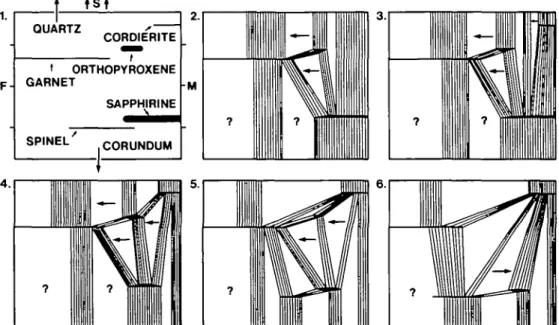
2 Gt - 2 Opx + Sa + Qz " (12) By the end of the prismatic sapphirine stage, the rocks had acquired much of the coarse-grained granulose texture visible today. Large (2-5-3 cm diameter) garnets (already
792 G. T. R. DROOP AND K. BUCHER-NURMINEN
showing signs of resorption) were embedded in a matrix of kyanite, prismatic sapphirine, prismatic orthopyroxene, biotite, quartz, K-feldspar and plagioclase. The stable matrix
sub-assemblage in Al2Si05-deficient areas was:
Gt + Qz + Sa + Opx + Biot + Ksp + Plag
The composite inclusion of Fig. 6a provides direct evidence for this sub-assemblage. The close association of prismatic orthopyroxene, prismatic sapphirine, garnet and sillimanite
(after kyanite) in Fig. 4a suggests that in Al2Si03-saturated areas (common only in TS100)
the stable sub-assemblage at this stage was:
Gt + Ky + Sa + Opx + Ksp + Plag + Qz
Modal calculations (Table 6, column 4) indicate that the sapphirine-granulites had already achieved Mg,Al-rich bulk compositions close to present values by the end of the prismatic sapphirine stage, and that fractional melting had ceased.
(4) Cordiertte stage
The large grain size of pyrope stage and prismatic sapphirine stage reaction products and the extent to which many of the reactions went to completion suggest that temperature was rising over this period. In subsequent stages, however, reaction products became progressively finer-grained (tending to form reaction rims, coronas, and ultimately symplectites) and many reactions failed to go to completion. These features imply a reduction in the scale of equilibrium, and require either falling temperature or a progressive 'drying-out' of the rocks or both.
F-QUARTZ CORDIERITE I ORTHOPYROXENE GARNET SPINEL SAPPHIRINE ?
-JU1
ifl
FIG. 15. Sequence of schematic.'opx-spinel' projections (as in Fig. 12) from AljSiO, (kyanite, 2; sillimanite, 3—6) summarizing the later part of the reaction history of the Bresciadega sapphirine-granulites. Migration directions of 3-phase triangles are only shown for reactions supported by textural evidence. 1. Chemographic relationships; 2. Prismatic sapphirine stage (late); 3. Cordierite stage (early); 4. Cordierite stage (late); 5. Symplectite stage (early);