Development of a Survey Technique for Larvae of the Grass Webworm
and Other Lepidopterous
Species in Turfgrass
1H. TASHIRO,> C. L. MURDOCH;' AND W. C. MITCHELL Department of Entomology, University of Hawaii, Honolulu, Hawaii 96822
Environ.EntomoJ.12: 1428-1432 (1983)
ABSTRACT Sampling techniques for larvae of the grass webworm, Herpetogramma /icarsisa/is (Walker) (Lepidoptera: Pyralidae) in turfgrass were studied. Sprinkling I liter of a 0.0015% aqueous solution of pyrethrins or 0.25% detergent into a I ,860-cm2 frame forced 61 and 55% of the larvae to the surface, respectively, compared with 4 liters of each irritant. The need for a greater volume of water than the commonly used technique of applying 4 liters/0.84 m2 was apparent. Continuous obser-vation was required during the 10 min after application of either irritant to assure an accurate count, since 29% of the surfaced larvae reentered the thatch within 5 min and 38 to 39% reentered within 10 min. The detergent forced >50% of the larve to surface within 2 min. compared with 4 min with pyrethrins. Liquid irritants surfaced ca. 3 times more larvae in 5 to 10 min than plywood set out overnight. Similar responses to the presence of minor populations of the lawn armyworm, the black cutworm, and the fiery skipper indicate that other turf-infesting lepidopterous larvae may be sampled with the same techniques.
The grass webworm, Herpelogramma licarsisalis (Walker), is considered the most important lepidopter-ous pest of turfgrass in Hawaii (Tashiro 1976), followed in order of importance by the lawn armyworm, Spodop-tera mauritia (Boisduval), the fiery skipper, Hylephila phyleus (Drury), and the black cutworm, Agrotis ipsi/on (Hufnagle). An accurate and rapid method of determin-ing larval populations in the turf is essential for studies on population dynamics and pest management, and for control studies.
One commonly employed procedure calls for the ap-plication of I gal (ca. 3.79 liters) of water containing either pyrethrins or a detergent over a square yard (ca. 0.8 m2) of turf with a sprinkling can. Larvae usually surface within 10 min (Anonymous 1981, Niemczyk 1981). Although this technique or slight modifications (Reinert 1976) have been in general use for some time, we are not aware of any research data from which this technique has evolved. Another technique used for sam-pling nocturnally feeding larvae in turfgrass has been to place plywood board (30.5 by 61 by 1.27 cm thick) on the turf during the evening before taking a reading (Mitchell and Murdoch 1974). Larvae that come to the surface to feed during the night remain at the surface, since the board excludes light. Larvae are easily counted the following morning by inverting the board.
We conducted various studies during February through June 1982 on 'Sunturf' bermuda, Cynodon magennissii Hurcombe, and 'Seashore' paspalum, Paspalum vagin-alum Sw., turfgrass plots at the Waimanalo Field Sta-tion, Oahu. Efforts were made to modify and improve the currently used sampling techniques.
IApprovedfor publicationby the Director,HawaiiInstitutefor TropicalAgricultureandHumanResources,asJournalSeriesNo.2738.
Receivedfor publicationI February1983; accepted27 April]983.
Mentionof a commercialor propietaryproductdoesnot constitutean endorsementby the Universityof Hawaii.
2VisitingEntomologist,Dept.of Entomology.Universityof Ha-waii.on sabbaticalleavefromCornellUniversity,NewYorkStateAg-riculturalExperimentStation.Geneva.NY14456.
3Dept.of Horticulture,Universityof Hawaii,Honolulu,HI96822.
Materials and Methods
Moderately thatched turfgrass plots were maintained at a height of I to 2 cm and irrigated when needed. No distinction was made between testing on bermuda or paspalum, since larvae responded similarly in either grass. Test sites were selected primarily for high larval popu-lations.
Comparison of Boards, Submergence, and Sprinkling Six plywood boards (30.5 by 61 by 1.3 cm thick) were placed randomly on the turf during the previous evening as one of seven treatments in a six-replication initial study. The next morning, the following six treat-ments were established in the vicinity of each board. Three steel cylinders (20.3 cm in diameter by 20.3 cm high) with a cutting edge on one end were sunk through the turf into the surface soil. Each of the three cylinders received 4 liters of one of three treatments: water only, 0.002% pyrethrin, and 0.25% liquid detergent. These and all subsequent concentrations are on a vol/vol basis. Pyrenone containing 6.00% pyrethrins, 60.00% piper-onyl butoxide, and 24.00% petroleum distillate (Fair-field American Corp.) was used in this and all subsequent tests. The detergent used for all tests was Joy, an anionic and non ionic surfactant plus ethyl alcohol (Procter and Gamble). Water containing these two materials is here-after referred to as "liquid irritants." Standing water was present for 10 min in all three treatments. Each of three 0.84-m' areas was sprinkled with 4 liters of one of three liquids: water only, 0.002% pyrethrins, and 0.25% detergent. We counted the surfaced grass web-worm larvae 10 min after treating. Larvae observed un-der each board were also recorded.
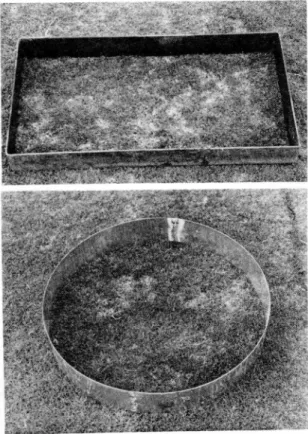
Since it required three settings of the 20.3-cm-diam-eter cylinders to obtain a 0.09-m' sample, use of these cylinders was not considered a highly practical sampling tool for webworms. A metal frame (30.5 by 61 by 7.6 cm high) fabricated from 3.2-mm-thick flat steel was 1,860 cm' (Fig. IA). All four sides of one edge were tapered to a cutting edge. This was a more practical 1428
October 1983
Table t. Relative efficiency of three techniques for surfacin~ ~rass webworm larvae in turfgrass with 4 liters per unit area"
in I liter of water. Five paired comparisons were made with a 5-min count for each sample.
·'Six replicutions per treatment.
"Means followed by the same leller not significantly different m the 5% level (Waller and Duncan's multiple range tcst).
'Surf3ce of lurf submerged under standing wmcr for 10 min. 24.83 22.03 14.4b 12.4be 3.2ed I.2d Od Me3n larvaell .860 cln~"
Irritant: o/cCOnen
Water only Detergent: 0.25'}t Pyrelhrin: 0.002'7<-None Pyrethrin: 0.002'7<-Delergenl: 0.25'11: Waler only
Rate of Larval Surfacing
During the previous study it appeared that the deter-gent forced larvae to the surface quicker than pyrethrins. Also, since the generally accepted practice is to count larvae surfacing within the first 10 min, it becomes im-portant to determine the rate of surfacing, because pe-riods less than 10 min would increase the efficiency of
Board vs. Liquid Irritant
With evidence early in these studies that the liquid irritants were more efficient in forcing larvae to surface than the boards, three different comparisons were made between the boards and liquids. In the first test, the boards (30.5 by 61 cm) were put out during the previous day. On the following morning the surfaced larvae under the boards were counted and removed, and immediately thereafter the steel frame (30.5 by 61 cm) was placed around the same area and sprinkled with 4 liters of water containing either 0.0015% pyrethrins or 0.25% deter-gent. Four comparisons were made with each irritant with a 5-min count of each sample.
A reciprocal of this study was made at another loca-tion. Larvae were forced to the surface with 0.007, 0.0015, 0.003, and 0.006% pyrethrins and with 0.125, 0.250, 0.500, and 1.0% detergent. Four liters of each was applied to each 1,860-cm' area within the frame, and larvae were counted during the first 5 min. Imme-diately thereafter, the boards were placed over the same 1,860-cm' areas for counting surfaced larvae the follow-ing mornfollow-ing.
With evidence that not all larvae surface with liquid irritants in 5 min, a third test was conducted with a 10-min count. Volume applied was the same as in the sec-ond test. With no evidence of concentration effects in test 2, only the 0.0015% pyrethrins and 0.25% detergcnt were applied. After the lO-min counts the same 1,860-cm' areas were covered with boards and surfaced larvae counted the following morning.
Technique Cylinder (20.3 em in di3mY Cylinder (20.3 em in di3m) Cylinder (20.3 em in diam)' Board (30.5 by 61 em) Sprinkle (91.4 by 91.4 em) Sprinkle (9 1.4 by 91.4 em) Sprinkle (91.4 by 91.4 em)
sampling frame due to its larger size, but required a length of 2-by-4 lumber to be placed across the frame and a heavy hammer to force the cutting edge through the thatch into the surface soil. Most subsequent studies employed the use of such a frame.
FIG.I. (A)Steel frame (30.5 by 61 by 7.6 cm) occupying 1,860 cm' and used for most sampling. (B) Sheet metal frame (48.7 cm in diameter) occupying 1,860 cm'.
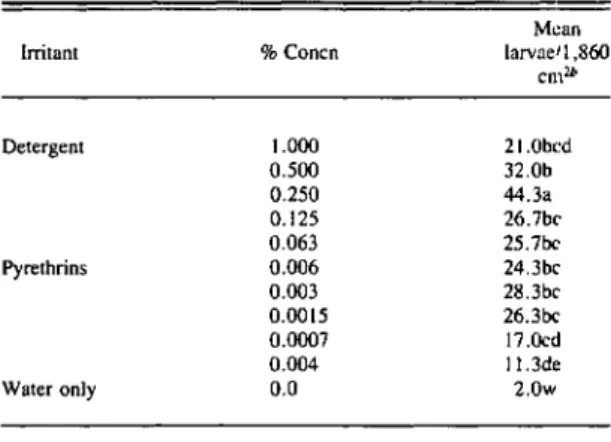
Four liters of water containing from 0.0004 to 0.006% concentration of pyrethrins (from 0.25 to 4.0 ml of Pyr-enone per 4 liters), and 0.063 to 1.000% concentration of detergent (from 2.5 to 40.0 ml of Joy per 4 liters) was sprinkled within the metal frame. The same volume of water only was applied as the untreated control. Each of II treatments was replicated three times. We counted all larvae surfacing during the first 5 min.
Concentrations of Irritant
Water Volume Requirement
Application of 4 liters/0.84 m' of turfgrass, the stan-dard technique, with either irritant appeared to be too small a volume for maximum surfacing in the initial test. Therefore, the use of 4 liters/l ,860 cm' was compared with I liter/l ,860 cm', which is roughly equivalent to I gal/yd'. To keep the dose of pyrethrins and detergent constant, a 0.0015% pyrethrins and 0.25% detergent concentration was present in 4 liters, and 0.006% py-rethrins and 1.0% detergent concentration was present
Table 2. Influence of irritant concentration in 4 liters of water per 1,860 em' on grass webworm larval surfacing in 5 min"
Table 3. Influence of volume of irritants per 1,860 em' of turf on webworm larval surfacing in 5 min"
"Five replications per treatment.
bMeans followed by the same letter are not significantly different at the 5% level (Waller and Duncan's multiple range test).
"Three replications per treatment.
·Means followed by the same leller are not significantly different at the 5% level (Waller and Duncan's multiple range test).
Miscellaneous Studies and Observations
10 min after application of irritant solutions to make counts. This may produce erroneous counts should sur-faced larvae reenter the thatch. A test was conducted to resolve this question. Four liters of 0.0015% pyrethrins or 0.25% detergent solutions was applied within each
1,860 cm2 frame setting. There were five settings for
each irritant. As each larva surfaced, its position was marked with a toothpick inserted into the thatch or soil. As a larva disappeared the representing toothpick was removed. Five and 10 min after application the numbers of larvae still remaining on the surface as represented by remaining toothpicks were counted.
Common liquid detergents, Ivory and Wisk, were compared with Joy at the same concentration of 0.25% in 4 liters/l,860 cm2• Two powders, All and Alconox
(for cleaning laboratory glass ware), were also tried at 1.5% concentration in 4 liters/l ,860 em'.
Essentially all of the sampling studies after the initial test were conducted by using the metal frame (30.5 by 61 by 7.6 cm) forced through the thatch and partially into the surface soil to retain most of the 4 liters of water applied. Limitations in this technique were the need for a heavy hammer and a length of 2-by-4 lumber to lay across the frame for hammering. This prompted a lim-ited observation in the use of a 48.7-cm-diameter cir-cular frame 7.6 cm high (also occupying an area of 1,860 cm') made from light sheet metal (Fig. I B). In addition to its lightness it had an additional advantage in occupying the smallest possible dimensions.
In addition to the extensive studies made on the grass webworm, a few larvae of three other lepidopterous pests of turfgrass were present-the lawn armyworm, the black cutworm, and fiery skipper. Their response to the var-ious sampling techniques was also noted.
Results and Discussion
Comparison of Boards, Submergence. and Sprinkling
Results of this test comparing overnight response to boards (30.5 by 61 cm), cylinders (20.3 cm in diameter) with standing water, and sprinkling 4 liters onto an
0.84-Mean larvae/l,860 cmlb 21.0bcd 32.0b 44.3a 26.7bc 25.7bc 24.3bc 28.3bc 26.3bc 17.Dcd Il.3de 2.0w 1.000 0.500 0.250 0.125 0.063 0.006 0.003 0.0015 0.0007 0.004 0.0 %Conen Liters of
Irritant (% Mean 1 Liter
irritantll.860 larvae/1,860 %of
em' concn) em'" 4 liters
4.0 Detergent (0.25) 27.4a 4.0 Pyrethrins (0.0015) 25.5a 1.0 Detergent (1.00) l4.6b 53 1.0 Pyrethrins (0.006) 15.5b 61 Pyrethrins Detergent Irritant Water only
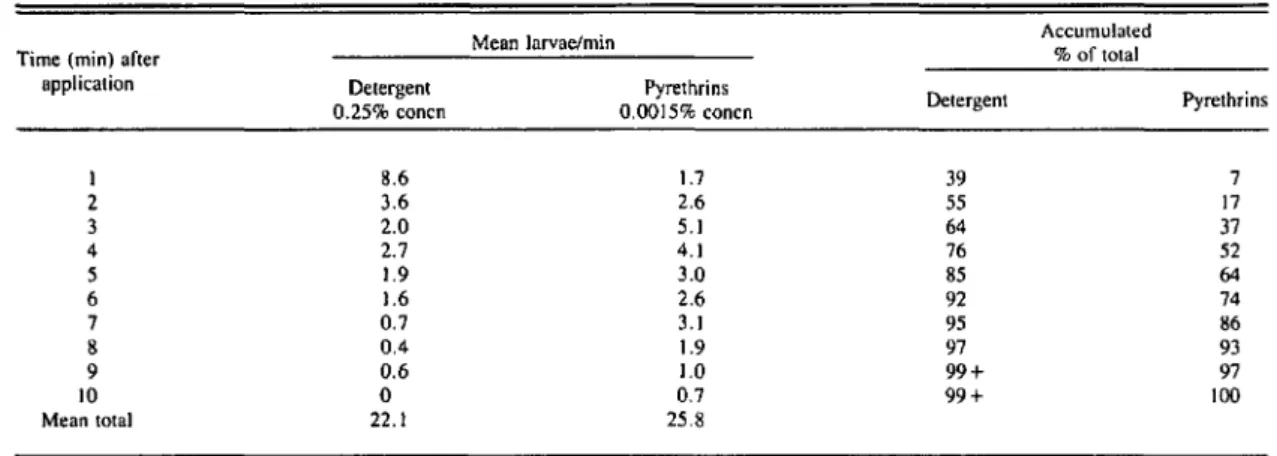
the sampling technique. A 4-liter amount of 0.0015% pyrethrin and 0.25% detergent was applied inside the 1,860-cm2 frame. Surfacing larvae were counted and
removed at I-min intervals for 10 min. Each of the two treatments was replicated seven times.
Fate of Surfaced Larvae
With indication in the standard procedures that larvae surface within 10 min, there may be a tendency to wait
Tabte 4. Comparison of liquid irritants and boards in sampling grllSs webworm larvat populations"
Test"
2 3
Sampling sequence Mean larvae/sample" %Of
total by
(initial-follow up) Board Irritant Total
initial Board---detergentd 8.3a 24.3c 32.6d 25 Board-pyrethrinsd 7.0a 15.3b 22.3c 31 Detergent-boardd 3.0a 26.7c 29.7c 90 Pyrethrins-boardd I.7a 15.5b 17.2b 92 Detergent-board' l.3a 15.3b 16.6b 93 Pyrethrins-board' 0.5a 20.Dc 20.5c 98
"Four replicatations per treatment per test. ·Sampling different populations in each test.
'Means in each test followed by the same leller are not significantly different at the 5% level (Waller and Duncan's multiple range test).
dFive-minute sampling period.
Table S. Effect of liquid Irritants on rate of grass webworm larval surfacing In turl"
Mean larvae/min Accumulated
Time (min) after %of total
application Detergent Pyrethrins
Detergent Pyrethrins 0.25% concn 0.0015% concn I 8.6 1.7 39 7 2 3.6 2.6 55 17 3 2.0 5.1 64 37 4 2.7 4.1 76 52 5 1.9 3.0 85 64 6 1.6 2.6 92 74 7 0.7 3.1 95 86 8 0.4 1.9 97 93 9 0.6 1.0 99+ 97 10 0 0.7 99+ 100 Mean total 22.1 25.8
"Seven replications per irritant per minute. All samples of I :860 em' within frame (30.5 by 61 em). and 4 liters per selling.
m' area are summarized (Table I) with data converted to larvae per 1,860 cm'. Complete submergence with standing water (10 min) was the most effective, with no difference between water alone and 0.25% detergent. A 0.0015% pyrethrins solution was less effective. The boards were intermediate in effectiveness. Treatments with 4 liters of water over a 0.84-cm' area were the least ef-fective, with water alone not forcing any larvae to the surface. Several definite opinions were formed as a re-sult of this test. Although the cylinders with standing water were the most effective whether an irritant was added or not, a 20.3-cm-diameter cylinder is not con-sidered a practical size for grass webworm larval sam-pling, since it would take three settings to occupy a 0.09-m' area. This test also convinced us that 0.84 m' of turf is too large an area for one person to observe over a period of time with accuracy. It also appeared that 4 liters of water over 0.84 m2 was insufficient to
adequately soak the turf with either irritant.
For a practical and efficient technique, it appeared that we should decrease the area to be observed from 0.84 m2to an area not to exceed 1,860 cm' and maintain
the water volume at 4 liters for complete saturation.
Table 6. Fate of grass webworm larvae forced to surface in turf with liquid irritants"
Concentration of Pyrenone and Detergent
The application of 0.0004, 0.0007, 0.0015, 0.003, and 0.006% pyrethrins showed that the two lowest centrations were less effective than the three higher con-centrations (Table 2). The 0.25% detergent was the most effective. The highest concentration of 1.0% provided the least response with evidence of slight temporary tox-icity. Surfacing larvae immediately became rigid and immobile but recovered within 5 to 10 min. The 0.0015% pyrethrins and 0.25% detergent solutions were stan-dardized for further testing.
Water Volume Requirements
When we were convinced that 4 liters of water per 0.84 m2 was an insufficient volume for complete
satu-ration of the turf, the effects of 4 liters/l ,860 cm2 were
compared with those of I liter/l ,860 cm'. Volumes of pyrethrins and detergent were quadrupled for the liter applications to maintain the same volume of active in-gredient at each site. The results (Table 3) show a need to have the larger volume of water whether pyrethrins or detergent is used. One liter of water per 1,860 cm2
forced up only 61 and 53% of the numbers fomed up with 4 liters of pyrethrins and detergent, respectively, per 1,860 cm2•
Detergent (0.25) First 5 26.4a
At 5 19.0b 29
At 10 16.2b 39
Pyrethrins (0.0015) First 5 52.6a
At 5 37.6b 29
At 10 33.0b 38
"Fi ve replications per treatment.
·Sampling different populations for each irritant. All samples of 1.860 em' within frame (30.5 by 61 em) and 4 liters per setting.
'Means for each irritant followed by the same leller are not signifi-cantly different at the 5% level (Waller and Duncan's multiple range test).
Irritant (% con en)· Counting period (in min) Mean larvae surfacing or remaining'" % Reentered
Boards vs. Liquid Irritants
Of the total population considered present in four areas of 1,860 cm2, the boards showed only 31 % efficiency
of pyrethrins and 25% efficiency of the detergent (Table 4). In a reciprocal test of forcing larvae with the liquid irritants first, then counting under the boards in the same area, it was apparent that the irritants did not force all the larvae to the surface. Pyrethrins forced 92% of the larvae to the surface, whereas the detergent forced 90% of the larvae to the surface during a 5-min count.
Even though pyrethrins and detergent solutions were highly effective when applied at 4liters/l ,860 cm2, there
were indications that not all the larvae were forced to the surface in 5 min. Therefore, the number of larvae
surfacing over a 10-min period was determined before covering the same areas with boards. Under these con-ditions, pyrethrins had a 98% efficiency and the deter-gent a 93% efficiency.
Rate and Duration of Larval Surfacing
Since it became evident that a period of about 10 min was required to force virtually the entire larval popula-tion to the surface, counts were made of surfacing larvae at I-min intervals for the entire IO-min period. Four liters of 0.25% solution of detergent per 1,860 em' of turf was more effective than the 0.0015% pyrethrins in the rapidity of forcing larvae to surface. Within 2 min, >50% of the total population present surfaced with the detergent, whereas it took up to 4 min for the same percentage to surface with pyrethrins (Table 5). The same relative differences held for surfacing between 90 and 95% of the total population.
Fate of Surfaced Larvae
Evidence in several studies pointed to the need for constant observation to obtain an accurate count of the total larval population since some disappeared from the surface. By marking every larva that surfaced during the first 5 min and then determining numbers still on the surface at 5 and 10 min after treating, it was determined that 29% of the surfaced larvae had reentered the thatch after 5 min and 38% after 10 min (Table 6) when 4 liters of 0.0015% pyrethrin per 1,860 em' was used. Reentry was nearly identical with 4 liters of 0.25% detergent per 1,860 em' with 29% reentry in 5 min and 38 to 39% in 10 min. Results of this experiment give ample evidence that observations must be continuous for the entire ex-amination period to obtain accurate counts.
Miscellaneous Studies and Observations
All three liquid detergents, Joy, Ivory, and Wisk, and the two powders, All and Alconox, used at the same concentrations of 0.25% for liquids and 1.5% for pow-ders, and same volume of 4litersll ,860 em', were equally effective in limited trials.
Because of the need to have a heavy hammer and a short length of 2-by-4 board to set the heavy steel frame (30.5 by 61 cm) deep enough through the hatch to retain nearly all the water added, sprinkling the 4 liters of
water into the frame without sealing to prevent water loss was a practical compromise. Even though there was seepage outside the frame with subsequent surfacing of larvae, the thorough saturation within the frame was as effective as retaining all the water. A circular, thin sheet metal frame of 48.7 em in diameter occupying 1,860 em' had the added advantage of occupying the smallest dimension in sampling 1,860 em' of turf.
We conclude from these tests that the most efficient features to employ for efficient sampling of lepidopter-ous larval populations in turfgrass should include the following features: to have an examination area of 1,860 em', preferably in a circular configuration; 4 liters of water containing either 0.0015% pyrethrins or 0.25% detergent should be sprinkled within the frame for even distribution; observations for surfacing larvae should be continuous during the first 5 min for a count of ca. 90% of the population present, or preferably for 10 min for a count of virtually 100% of the larvae present.
The few larvae present of the lawn armyworm, the fiery skipper, and the black cutworm responded identi-cally to the liquid irritants, as did the grass webworm. Therefore, we assume that these improved techniques are adaptable for use against most species of lepidop-terous larvae infesting turfgrass.
Acknowledgment
J. Y. Kuniyoshi and S. Higa of the Agricultural Engineering Department, University of Hawaii, fabricated the steel cylin-ders, the frames, and the circular frame mentioned above. We are grateful for these contributions to this study.
REFERENCES CITED
Anonymous. 1981. Guide to turfgrass pest control (to be used with Turfgrass Pests, Priced Publication 4053). Div. Agric. Sci. Univ. Calif. Leatl. 2209. 18 pp.
Mitchell, W. C., and C. L. Murdoch. 1974. Insecticides and their application frequency for control of turf insects in Hawaii. Down Earth 30: 17-23.
Niemczyk, H. D. 1981. Destructive turf insects. HDN Books, Wooster, Ohio. 48 pp.
Reinert, J. A. 1976. Control of sod webworms
(Herpeto-gramma spp. and Crambus spp.) on bermudagrass. J. Econ.
Entomol. 69: 669-672.
Tashiro, H. 1976. Biology of the grass webworm,
Herpero-gramma /icarsisa/is (Lepidoptera:Pyralidae) in Hawaii. Ann.