HAL Id: tel-00697756
https://tel.archives-ouvertes.fr/tel-00697756
Submitted on 16 May 2012HAL is a multi-disciplinary open access
archive for the deposit and dissemination of sci-entific research documents, whether they are pub-lished or not. The documents may come from teaching and research institutions in France or abroad, or from public or private research centers.
L’archive ouverte pluridisciplinaire HAL, est destinée au dépôt et à la diffusion de documents scientifiques de niveau recherche, publiés ou non, émanant des établissements d’enseignement et de recherche français ou étrangers, des laboratoires publics ou privés.
Gilbert Tekli
To cite this version:
Gilbert Tekli. XML manipulation by nonexpert users. Other [cs.OH]. Université Jean Monnet -Saint-Etienne, 2011. English. �NNT : 2011STET4013�. �tel-00697756�
Manipulation des Données XML par des
Utilisateurs Non-Experts
XML Manipulation by Non-Expert Users
Gilbert M. Tekli
Thèse de Doctorat en Informatique
Ph.D. Dissertation in Computer Science and Software EngineeringMembres du Jury (Examination Committee)
Rapporteurs (Reviewers):
Ahmed LBATH – U. J. Fourier, LIG, France
Nhan LE THANH – U. Nice Sophia-Antipolis, Laboratoire I3S, UMR 6070 CNRS, France
Examinateurs (Examiners):
Frederique LAFOREST – UJM, Télécom Saint-Etienne, France Florence SEDES, U. Paul Sabatier, IRIT - UMR 5505, France
Co-directeur de Thèse (Co-Supervisor): Jacques FAYOLLE – UJM / Télécom Saint-Etienne, France Co-directeur de Thèse (Co-Supervisor): Richard CHBEIR – U. Bourgogne, LE2I, France
A man's reach should exceed his grasp, or what's a heaven for? - Robert Browning
I dedicate this work first of all to our lord Jesus Christ in whom I found eternal salvation and without whom this work would have never come to be. I would also like to dedicate this
dissertation to mom and dad, to my brothers Antoun, Joe and Jimmy, and to my family (grandparents, aunts, uncles, cousins and future parents in-law) in Lebanon and Australia,
whose unconditional love and unwavering support were crucial in achieving this work. I dedicate this thesis as well to my fiancée Hanadi, my bestest of friends Lizzy, and my mentor Antoun Daou whom without their perseverance I would not have lasted. I bestow this work in
particular to my aunt Yvonne, cousins Layal, Toni and Carla, our guardians in heaven.
Where there is no guidance, a people falls, but in an abundance of counselors there is safety. - Proverbs 11:14
I also dedicate this work to my larger family, both in France and Lebanon, Dr. Chbeir and his family, to my dear friends Taline Boyajian, Toufiq abilameh, Linda Eid, Maroun Khoury,
Charbel Mousallem, Christian Nseir, Said Sfeir and Wajdi Dandach, as well as to all the members of the Jesus Sacred Heart Organization (JSHO), Shouf, Lebanon, for their
Acknowledgements
This dissertation would not have come to fruition without the support of many individuals and institutions, and it is with pleasure that I acknowledge their efforts and contributions.
First, I would like to express my gratitude to my professors and academic supervisors Dr. Richard Chbeir of the LE2I Laboratory UMR-CNRS, University of Dijon, and Dr. Jacques Fayolle of the LT2C laboratory, Telecom St Etienne whose successful teachings have made this dissertation possible.
I would like to express my greatest gratitude to Dr. Richard Chbeir, for his close supervision and constant presence during the past three years. I thank him for his patience, support, and generous guidance during the completion of my Doctorate.
Equally, I would like to thank my senior supervisor Dr. Jacques Fayolle, Co-director of Telecom St Etienne, for his guidance and valuable advice during the thesis.
I would also like to thank Dr. Nhan LE THANH, Professor in the I3S Laboratory, University Nice Sophia-Antipolis, France, as member of my examination committee, and Dr. Ahmed LBATH, Professor in the LIG, U. J. Fourier, as member of the examination committee.
My thesis was financially supported by the Satin team from Telecom St Etienne, through a three year doctoral fellowship, to whom I am grateful.
I would like to acknowledge the support of my colleagues in the Satin team and LE2I laboratory, mainly Christophe Gravier, Michael Ates, Jeremy Lardon, Abakar Mahamat Ahmat, Bechara Al Bouna, Elie Raad and Fekade Getahun, as well as the support of my friends, mainly Christiane, Ali and Wajih.
Lastly and most importantly, my deepest gratitude and love goes to our Lord Jesus Christ who filled me with strength, patience and wisdom to finish this work.
Table of Contents
Chapter 1: Introduction ... 11
1.1 Introduction ... 13
1.2 Motivating Scenarios ... 14
1.2.1 Scenario 1: Information Gathering (Data Filtering) ... 14
1.2.2 Scenario 2: News Gathering and Report Generation ... 14
1.2.3 Scenario 3: Sensitive Data Obfuscation ... 15
1.2.4 Scenario 4: Messenger Malicious Content Removal ... 15
1.2.5 Scenario 5: Collaborative Presentation Modification ... 16
1.3 Related Work ... 17
1.4 Proposal and Main Contributions ... 18
1.4.1 Language Platform ... 18
1.4.2 Compiler ... 19
1.4.3 Runtime Environment ... 19
1.4.4 Prototype and Evaluation ... 19
1.5 Thesis Organization ... 19
Chapter 2: Related Works ... 21
2.1.1 Preliminaries and Analysis Criteria ... 25
2.1.2 Manipulated Data ... 26
2.1.3 Manipulation Operations ... 26
2.1.4 Interaction/Visualization ... 26
2.1.5 Derivability ... 27
2.2 XML Query and Transformation Visual Languages ... 29
2.2.1 XML-GL ... 31
2.2.2 Xing (XML in graphics) ... 32
2.2.3 XQBE (XML Query by Example) ... 33
2.2.4 VXT: Visual XML Transformation Language ... 35
2.2.5 Discussion ... 37 2.3 XML-oriented Mashups ... 39 2.3.1 YahooPipes ... 40 2.3.2 IBM Damia ... 43 2.3.3 Discussion ... 45 2.4 XML Manipulation Techniques ... 46 2.4.1 XML Security ... 47
2.4.2 XML Adaptation ... 53
2.4.3 Discussion ... 56
2.5 Dataflows ... 58
2.5.1 DFL: a Dataflow language based on petri nets and nested relational calculus ... 58
2.5.2 The V language (Visual Dataflow language) ... 62
2.5.3 Taverna Workflows ... 63
2.5.4 Discussion ... 65
2.6 Discussion and Conclusion ... 66
Chapter 3: Background and Preliminaries ... 71
3.1 Introduction ... 74
3.2 Dataflows ... 74
3.2.1 Dataflow Execution Model ... 75
3.2.2 Early Dataflow Architectures ... 76
3.2.3 Early Dataflow Programming Languages ... 77
3.2.4 Recent Dataflow Programming Languages ... 79
3.3 Dataflow in a Nutshell ... 80
Chapter 4: XA2C Approach ... 83
4.1 Introduction ... 87
4.2 XA2C Overview ... 89
4.2.1 XA2C Properties ... 90
4.2.2 XA2C Architecture ... 91
4.3 XCDL Platform ... 92
4.3.1 Overview on Petri Nets and Visual Languages ... 93
4.3.2 XCDL Overview ... 96
4.3.3 I/O XCD-trees ... 98
4.3.4 XCDL Syntax and Semantics ... 103
4.3.5 XCDL Algebra Properties ... 115 4.3.6 Illustration ... 124 4.4 XA2C Compiler ... 126 4.4.1 Front-End ... 127 4.4.2 Middle-End ... 136 4.4.3 Back-End ... 138
4.5 XA2C Runtime Environment ... 141
4.6 Conclusion ... 155
Chapter 5: Prototype and Experiments ... 157
5.1 Introduction ... 161 5.2 XCDL Platform ... 161 5.2.1 Library ... 162 5.2.2 I/O XCD-trees ... 164 5.2.3 Composition editor ... 164 5.3 XCDL Compiler ... 166 5.4 Runtime Environment ... 167
5.5 Evaluation and Experiments ... 168
5.5.1 Evaluating XCDL, an XML-Oriented Visual Language ... 168
5.5.2 XCDL Evaluation Framework ... 168
5.5.3 XCDL Evaluation Case Study ... 171
5.5.4 Evaluation Results ... 176
5.5.5 Evaluating the Execution Step Discovery Algorithm ... 186
5.6 Conclusion ... 188
Chapter 6: Conclusion ... 191
6.1 Introduction ... 193
6.2 Contributions ... 193
6.2.1 The XA2C approach ... 194
6.2.2 The XCDL language ... 194
6.2.3 Prototype and Evaluation ... 195
6.3 Future Works ... 196 6.3.1 XCDL Extensibility ... 196 6.3.2 XCDL Derivability ... 197 6.3.3 Automated Composition ... 198 6.3.4 Technical enhancements ... 198 6.3.5 Better Assessment ... 198 References ... i Appendixes ... ii
List of Figures
Chapter 1: Introduction
Figure 1: Thesis Structure ... 20
Chapter 2: Related Works Figure 1: XML query visual languages ... 31
Figure 2: XML-GL query example ... 33
Figure 3: Xing, XML in graphics ... 34
Figure 4: Querying in XQBE ... 35
Figure 5: XML view as a treelist ... 36
Figure 6: XML view as a treemap ... 37
Figure 7: Creating a reply email template ... 38
Figure 8: YahooPipes snapshot ... 42
Figure 9: IBM Damia snapshot ... 45
Figure 10: UCONABC control process ... 50
Figure 11: DRM architecture ... 51
Figure 12: User queries defined with XPath expressions for the required filter and the corresponding NFA ... 55
Figure 13: Example of nested iterations ... 61
Figure 14: Iterative constructs in the V language ... 64
Figure 15: Taverna workflows diagram ... 66
Chapter 3: Background and Preliminaries Figure 1: Dataflow graph of a simple mathematic problem ... 75
Figure 2: Dataflow granularity curve from Sterling et al. ... 79
Chapter 4: XA2C approach Figure 1: XA2C approach ... 89
Figure 2: Architecture of the XA2C framework ... 92
Figure 3: Example of a CP-Net ... 94
Figure 4: Several sample functions defined in XCDL ... 96
Figure 5: Functional composition in XCDL ... 97
Figure 6: XCDL compositions ... 98
Figure 8: XCD-tree representing the XML document/DTD/XSD books ... 100
Figure 9: XCD-tree representing an XML fragment ... 101
Figure 10: XCDL overview ... 103
Figure 11: XCDL-GR components ... 103
Figure 12: Graphical representations of the XCDL core components (SD-function and Sequence) ... 108
Figure 13: Compositions in XCDL ... 110
Figure 14: Transformation functions ... 115
Figure 15: Illustration of scenario 1 in XCDL ... 125
Figure 16: XA2C compiler architecture ... 127
Figure 17: Front-End data types ... 128
Figure 18: SD-function data type ... 129
Figure 19: Filter SD-function ... 131
Figure 20: Composition diagram data type ... 132
Figure 21: Composition instance ... 133
Figure 22: Composition schema compliant with XCGN ... 137
Figure 23: Optimized composition ... 138
Figure 24: CPN1, an example of a petri net resulting from scenario 1 in XCDL ... 143
Figure 25: ES discovery algorithm ... 146
Figure 26: CPN1, an example of a petri net resulting from scenario 1 in XCDL ... 148
Chapter 5: Prototype and Experiments Figure 1: Prototype architecture ... 161
Figure 2: Library configuration forms ... 163
Figure 3: Insert SD-function graphical representation ... 164
Figure 4: Edit XCD-tree controllers ... 164
Figure 5 Composition editor ... 165
Figure 6: Detailed relational schemas of the internal data models ... 167
Figure 7: Evaluating the quality of language ... 169
Figure 8: Evaluating the quality of visualization ... 169
Figure 9: Evaluating the quality of interaction ... 170
Figure 10: Evaluating the quality of use ... 170
Figure 11: VPL evaluation model ... 171
Figure 12: Use case scenario 1 ... 172
Figure 13: Use case scenario 2 ... 173
Figure 14: Use case scenario 3 ... 173
Figure 16: Visualization attributes evaluation ... 177
Figure 17: Quality of visualization ... 178
Figure 18: Interaction attributes evaluation ... 179
Figure 19: Quality of interaction ... 180
Figure 20: Overall language usage attributes evaluation ... 181
Figure 21: Quality of use ... 183
Figure 22: Quality of language ... 184
Figure 23: Different composition scenarios ... 186
List of Tables
Chapter 2: Related Works
Table 1: Analysis criteria ... 28
Table 2: VXT transformation rules ... 37
Table 3: Analysis regarding XML query visual languages ... 39
Table 4: Operator modules which transform and filter data flowing through the pipes ... 43
Table 5: String modules for manipulating and combining textual values ... 44
Table 6: Damia presentation operators ... 45
Table 7: Damia building operators ... 46
Table 8: Mashup tools analysis ... 47
Table 9: Scope and data types of existing alteration/adaptation control techniques .... 57
Table 10: Analysis regarding XML adaptation and security techniques ... 58
Table 11: Visual formalism of the V language ... 63
Table 12: DFVPL analysis ... 67
Table 13: Analysis of XML manipulation approaches ... 69
Chapter 4: XA2C Approach Table 1: Incidence Matrix of CP-Net in Figure 3 ... 95
Table 2: Different types of XCD-tree-nodes ... 102
Table 3: XCDL algebra properties ... 115
Table 4: Functions used in scenario 1 ... 126
Table 5: Filter SD-function translation from XCGN to objects ... 131
Table 6: Composition translation from XCGN to objects ... 135
Table 7: PP matrix of CPN1 ... 144
Table 8: Incidence Matrix of CPN1 ... 149
Table 9: Incidence Matrix after the 1st iteration ... 150
Table 10: PP matrix after the 1st iteration ... 150
Table 11: Incidence Matrix after the 2nd iteration ... 151
Table 12: PP matrix after the 2nd iteration ... 151
Table 13: Incidence Matrix after the 3rd iteration ... 152
Table 14: PP matrix after the 3rd iteration ... 152
Table 15: Incidence Matrix after the 4th iteration ... 153
Table 17: Incidence Matrix after 5th iteration ... 154
Table 18: PP matrix after the 5th iteration ... 154
Chapter 5: Prototype and Experiments Table 1: Demographic distribution of the participants ... 172
Table 2: Efficiency evaluation of XCDL ... 182
Table 3: Open questions evaluation ... 185
INTRODUCTION
[1-112]
Table of Contents
1.1 Introduction ... 13
1.2 Motivating Scenarios ... 14
1.2.1 Scenario 1: Information Gathering (Data Filtering) ... 14
1.2.2 Scenario 2: News Gathering and Report Generation ... 14
1.2.3 Scenario 3: Sensitive Data Obfuscation ... 15
1.2.4 Scenario 4: Messenger Malicious Content Removal ... 15
1.2.5 Scenario 5: Collaborative Presentation Modification ... 16
1.3 Related Work ... 17
1.4 Proposal and Main Contributions ... 18
1.4.1 Language Platform ... 18
1.4.2 Compiler ... 19
1.4.3 Runtime Environment ... 19
1.4.4 Prototype and Evaluation ... 19
C h a p t e r 1 - I n t r o d u c t i o n
1.1 Introduction
Communication is the key element for human evolution in all its domains: social, medical, chemical, commercial, financial, etc. In the 21st century, computers are everywhere. They have invaded our lives and have become the main source of communication, whether they are used in:
Instant messaging (e.g., people chatting using instant messaging tools such as Gtalk, Msn, Yahoo messenger, Jabber, etc.)
Social networks (e.g., friends sharing information over Facebook, Flicker, Linkedin, etc.)
Scientific data management (e.g., colleagues sharing sensitive data such as medical, financial and scientific records, etc.)
Data protection (e.g., companies exchanging sensitive encrypted data).
XML (Extensible Markup Language), representing textual structured data, is nowadays the dominant data type of communications in the world of computer science whether these communications are text-based, audio-based, image-based or video-based.
What is XML?
XML, defined by the W3C (World Wide Web Consortium) stands for eXtensible Markup Language. Informally speaking, it is a human readable way of describing structured data. XML is a markup language for documents containing structured information. Structured information contains both data (textual) and meta-data (pictures, audio, etc.) A markup language is a mechanism to identify structures in a document. The XML specification defines a standard way to add markup to documents. XML is made up of tags enclosing text where each tag can have zero or multiple attributes and zero or multiple sub elements such as:
<XML version=”1.0”> <lib>
<book id=”1”>
<author>Charles Dickens</author> <title>A Christmas Carol</title> <pub_date> 17-12-1843</pub_date> </book> <book id=”2”> <author>James Joyce</author> <title>Ulysses</title> <pub_date> 2-2-1922</pub_date> </book> </lib>
XML has a similar structure to HTML, nonetheless it does not withhold any presentation information and its tags are not predefined. They are either defined by the user or from a user based-grammar. XML was standardized mainly for data configuration and transfer over the web as well as any other platform.
C h a p t e r 1 - I n t r o d u c t i o n
XML can be either, the carrier of the communicated data, which is the case of textual-based data, or its descriptor, which is the case of audio [85], image [42] and video-based [16] data. Thus, XML has become one of the essential elements in the communication process in and between all areas/fields. Its use goes beyond computer science. Therefore and as a consequence, there is a daily increasing need for manipulating (controlling, altering, filtering, modifying, adapting, obfuscating, etc.) XML-based data (e.g., XML documents or fragments) transferred between different types of users, applications and systems, from different areas (e.g., business, education, computer science, etc.) in different environments (e.g., desktops, laptops, portable devices, etc.). Nowadays, all users, experts and non-experts, need to manipulate their XML data. As the writer Marylin vos Savant had said:
“Email, instant messaging, and cell phones give us fabulous communication ability, but because we live and work in our own little worlds, that communication is totally
disorganized.”
To better motivate our research, consider the following 5 additional scenarios illustrating different XML data manipulation in different application domains.
1.2 Motivating Scenarios
Consider a media company running different departments locally and internationally (e.g., Reporting department, Publishing department, Communication department, etc.). Different manipulation/control scenarios are required either in a single department or between departments.
1.2.1 Scenario 1: Information Gathering (Data Filtering)
A reporter working in the IT (information and technology) department is writing an article on the guide books which have been published in the year 2001. The reporter wishes to acquire all the information available in the company’s library on guide books published in 2001.
To achieve this, one technique would be required:
(a) XML Filtering: Filter XML data based on XML value predicates („guide‟ and
„2001‟ in this case).
1.2.2 Scenario 2: News Gathering and Report Generation
A journalist working in the Reporting department is writing an article covering an event. The journalist wishes to acquire all information being transmitted by different media sources (television channels, radio channels, journals, etc.) in the form of RSS
C h a p t e r 1 - I n t r o d u c t i o n
feeds, filter out their content based on the topic (s)he is interested in, and then compare the resulted feeds. Based on the comparison results, a report covering relevant facts of the event will be generated.
To achieve this, several techniques would be required:
(a) XML Filtering: Filter XML data provided by several sources having the same
structure (RSS Schema) based on a specific topic
(b) XML Content Similarity: Compare the filtered XML data for content
similarities and retrieve significant data
(c) Automated XML generation: Generate an XML file reporting the filtered out
XML data.
1.2.3 Scenario 3: Sensitive Data Obfuscation
The Communication department posts information and news concerning its activities in form of RSS feeds over the internet. The company wants to keep sensitive parts of the information exclusive to its employees and partners. However, the information needs to be partially available worldwide over the internet. In other words, sensitive data in the RSS feeds are to be encrypted by the information provider (the communication department), decrypted by the corresponding readers (employees and partners), and obfuscated for the rest. The feeds should remain RSS standardized.
To achieve this, several techniques would be required:
(a) XML Granular Content Encryption and Signature:
Encrypt and sign part of the data content transmitted in an XML file without altering the structure. (e.g., <description>38SUJujdgxxvES decided to sign the contract on the Wx34zs5sdZD.</description>)
Decrypt the encrypted data by the corresponding users.
1.2.4 Scenario 4: Messenger Malicious Content Removal
The company runs a messenger service (e.g., Jabber messenger) on its intranet as a communication system between its employees. The messenger communicates via XML structured data. One of the employers wishes to control the communication between his employees by removing all swear words automatically, replacing them with a notification message and removing any sexual content.
To achieve this, several techniques would be required:
(a) XML Content Search: Detect the existence of malicious data in an XML data
C h a p t e r 1 - I n t r o d u c t i o n
(b) XML Content Adaptation: Based on the data type found, the malicious data
must be either replaced with a customized text message or the entire data content must be deleted.
1.2.5 Scenario 5: Collaborative Presentation Modification
The departments communicate using collaborative presentations based on XML [42]. The employer wishes to put together and analyze the structure and content of the SMIL documents so that he can ensure the presence of each department’s logo and inserts the company’s logo on all slides without overlapping. The SMIL documents provided from each department may have different structures.
To achieve this, several techniques would be required:
(a) XML Structural and Content Search: Search for sensitive data in the
structure and data content of XML data collected from different sources
(b) XML Content Modification: Ensures that each department‟s logo exists and
inserts the company‟s logo.
These scenarios present the following issues:
What are the main issues to be solved? 1. Data types
Data to be manipulated is XML-based 2. Manipulation operations
Different and separate techniques are required to fulfill the manipulation operations which can vary between (but is not limited to):
o XML data selection/projection, insertion/removal and modification (e.g., XML element retrieval, insertion, etc.)
o XML value selection/projection, insertion/removal and modification (e.g., XML textual value extraction, deletion, etc.)
o XML syntax and semantic filtering o XML data restructuring
o XML data protection (i.e., XML data obfuscation/omission). 3. User profiles
Users are not necessarily expert programmers (e.g., a journalist) and thus require intuitive interfaces
4. Platforms
Data is being communicated over different environments and platforms (e.g., internet, user machines and intranet).
Consequently, providing non-expert users with means to create and execute manipulation operations over XML data is becoming more and more crucial. In the literature, there has not been a unified solution addressing these matters
C h a p t e r 1 - I n t r o d u c t i o n
simultaneously. Nevertheless, several approaches exist addressing the “XML manipulation by non-expert users” subject from separate point of views.
1.3 Related Work
Four main categories are provided: (i) XML-oriented Visual languages, (ii) Mahsups, (iii) XML manipulation via security and adaptation techniques, and (vi) Dataflow visual languages.
1. XML-oriented Visual Languages:
These languages have been developed mainly for non-expert users, allowing them to visually query XML data. Several languages exist, such as XML-GL [22], Xing [40], XQBE[15] and VXT[88], providing users with means to visually create their selection/projection queries over XML-based data. While these languages target non-expert users, they require knowledge in data querying and are limited in their manipulation to XML data extraction and structural transformation and do not provide XML data modification (i.e., insertion/update etc.) and/or value manipulations.
2. Mashups
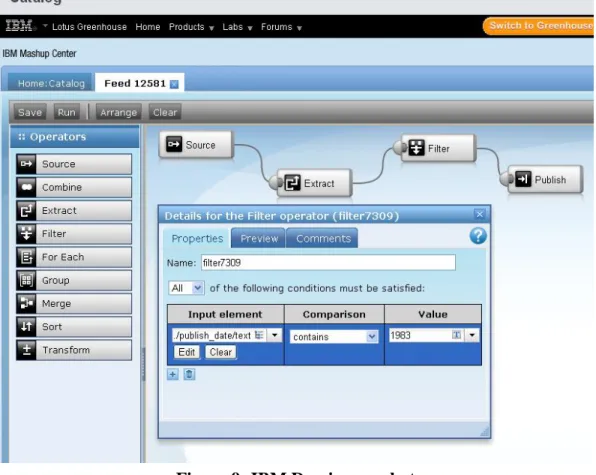
Mashup tools have been developed recently to manipulate web data by non-expert users. In this category, 2 tools in particular have been developed allowing the manipulation of XML data, YahooPipes [73] and IBM Damia [93]. These tools are based on the functional composition paradigm, considered to be the closest to the natural human thinking process, where the user creates his manipulation operation by simply linking different functions (modules) together. This is simpler than the query paradigm and does not require any level of expertise. Nevertheless, these tools are limited in their manipulations mainly to XML data/value extraction and transformation. In addition, they are dedicated for web applications. Thus, they have limited expressiveness and do not allow the manipulation of offline data (available on user machines).
3. XML manipulation techniques
These techniques are defined originally to provide different methods for adapting XML data to different platforms and systems, and to secure sensitive XML data by means of encryption, access control, etc. In this category, different techniques have been defined under the adaptation approach such as XML filtering [75], adaptation [71, 84] and information extraction [23, 27], and under the security approach such as XML access control [29], usage control [83], encryption and signature [58], firewalls [109], etc. These techniques defined the main manipulation operations (i.e., data
C h a p t e r 1 - I n t r o d u c t i o n
selection/projection, filtering, modification, etc.). Nevertheless, these techniques are defined each separately and require each a high level of expertise to implement it.
4. DataFlow Visual Programming Languages (DFVPL)
DataFlow Visual Programming Languages or DFVPLs are essentially developed for non-expert users, mainly scientists, allowing them to manipulate scientific data by means of visual compositions. They follow the Dataflow paradigm, mainly based on functional composition. Different DFVPLs have been defined such as DFL [53], V [10] and Taverna [80]. They provide a well-defined visual syntax allowing non-expert users to create their manipulation operations. Nonetheless and to the best of our knowledge, DFVPLs have not yet been adopted in XML data manipulations.
Since none of the existing approaches/techniques solves the issues (cf. page 16) addressed here, our research mainly aims at defining a derivable XML-oriented framework allowing non-expert users to write/draw and enforce XML manipulation operations based on functional composition. The functions can:
express any type of manipulations satisfying personal user requirements or security requirements
be provided in forms of local libraries (e.g., DLL files) or online services (e.g., web-services).
1.4 Proposal and Main Contributions
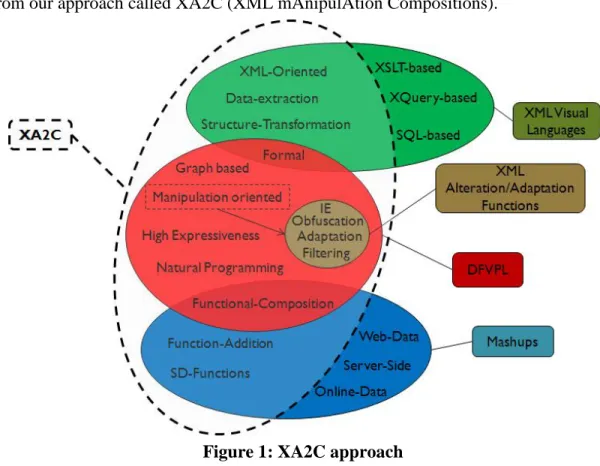
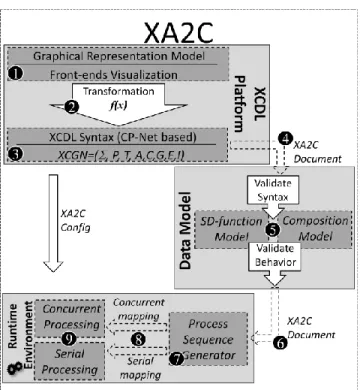
The framework, called XA2C (XML-oriented mAnipulAtion compositions), is defined as a modular architecture with 3 main modules: (i) the language platform, (ii) the compiler, and (iii) the runtime environment. A prototype, called X-Man, is developed and used to assess our approach. The XA2C approach was published in [97].
1.4.1 Language Platform
The language platform defines formally a DFVPL for manipulating XML-based data. The language, called XCDL (XML-oriented Composition Definition Language), is defined mainly as a visual functional composition language based on the Dataflow paradigm since it is the closest to the natural human thinking process [11, 60]. Its syntax and semantics are based, on one hand, on Colored Petri Nets (CP-Nets) [61, 79] which allow expressing complex compositions with true concurrency (combined serial and parallel executions), and, on the other hand, on OLT (Ordered Labeled Trees) allowing the formal representation of I/O XML-based data. As for the manipulation operation composition, it is denoted by mapping the output of a function to the input of another. The functions are identified in the language library as SD-functions
C h a p t e r 1 - I n t r o d u c t i o n
(System-Defined functions) from either offline libraries (i.e., DLL files) or online libraries (i.e., web services). The language platform was published in [95].
1.4.2 Compiler
The compiler is formally defined as a middleware between the language platform and the runtime environment. The compiler validates the compositions’ syntax, optimizes (e.g., remove passive transitions) and translates them from high-level petri nets (similar to high level programming languages) as defined by the XCDL syntax into XML-based petri nets (similar to machine code) executable in the Runtime Environment.
1.4.3 Runtime Environment
The Runtime Environment defines formally the execution environment for the resulting compositions translated from high-level petri nets into XML-based petri nets. The Runtime Environment contains 2 execution modes: (i) serial execution, executing one function at a time and (ii) concurrent execution, executing functions in parallel when all dependencies are resolved. The execution modes are generated from a execution step discovery algorithm defined based on the petri nets firing rule [79] and incidence matrix [79]. The algorithm generates from the XML-based petri net a serial and concurrent execution sequences which can be respectively executed on a single processor machine and a multi-processor machine depending on the machine type. The Runtime Environment was published in [96].
1.4.4 Prototype and Evaluation
To validate and evaluate our approach, we developed a prototype, called X-Man (XML mAnipulAtions) developed in visual studio. X-Man was tested in different case studies with a number of participants in order to evaluate XCDL and assess its usability/performance with regard to existing approaches such as YahooPipes [73] and IBM Damia [93]. In addition, we tested the execution step discovery algorithm of X-Man in different scenarios (i.e., serial, parallel and concurrent compositions).
1.5 Thesis Organization
The rest of the thesis is organized as shown in Figure 1. Chapter 2 defines the initial criterions related to XML manipulation by both experts and non-experts, and discusses existing approaches and techniques (i.e., XML visual languages, Mashups, XML manipulation techniques and DFVPLs). Since our approach is DFVPL-based, Chapter 3 provides some background regarding Dataflows. In Chapter 4, we detail the XA2C (XML mAnipulAtion composition framework) approach. Here, the XCDL
C h a p t e r 1 - I n t r o d u c t i o n
specifications and syntax are also defined along with the compiler and the runtime environment. In Chapter 5, we present our prototype (X-Man) as well as a VPL (visual programming language) evaluation framework that we designed. We also present here the set of case studies conducted to evaluate the XA2C approach. Finally, Chapter 6 concludes this study and provides some future research tracks.
RELATED WORKS
[1-112]
XML manipulations in multiple domains have been the focus of many researchers over the years. Whether adapting XML data to different platforms, filtering it for data management, encrypting it for protection purposes, signing and watermarking it for privacy reasons or modifying/transforming it for user requirement satisfaction, XML manipulation has become a wide phenomena due to the increasing use of XML. Nowadays, since XML has become one of the most essential data types used in computer communications, its widespread has crossed over the boundaries of computer science domains and reached other areas such as medical (e.g., medical record storage), mechanical (e.g., graphical map design), social (e.g., instant messaging), commercial (e.g., publicity communication), financial (e.g., online payment) and others. This has brought a new criterion into the XML manipulation research field, XML manipulation by non-experts. In this chapter, we study and analyze existent techniques for manipulating XML from a non-expert point of view while relating it to traditional manipulation techniques defined in the literature such as filtering, adaptation, data extraction, transformation, access control, encryption, etc. XML manipulation techniques by non-experts were categorized under 3 major titles: (i) XML-oriented visual languages dealing with XML data extraction and transformations, (ii) Mashups tackling mainly XML restructuring with value manipulations, and (iii) Dataflow visual programming languages targeting non-experts and providing them with means to visually manipulate scientific data. A full analysis was conducted which allowed existent approaches/techniques to be compared and resulted in an overview of the current requirements of this subject.
C h a p t e r 2 - R e l a t e d W o r k s
Table of Contents
2.1 Introduction ... 25 2.1.1 Preliminaries and Analysis criteria ... 26 2.1.2 Manipulated data ... 27 2.1.3 Manipulation operations ... 27 2.1.4 Interaction/visualization ... 27 2.1.5 Derivability ... 28 2.2 XML Query AND TRANSFORMATION Visual Languages ... 30 2.2.1 XML-GL ... 32 2.2.2 Xing (XML in graphics) ... 33 2.2.3 XQBE (XML Query by Example) ... 34 2.2.4 VXT: Visual XML Transformation Language ... 36 2.2.5 Discussion ... 38 2.3 XML-oriented Mashups ... 40 2.3.1 YahooPipes ... 41 2.3.2 IBM Damia ... 44 2.3.3 Discussion ... 46 2.4 XML manipulation techniques ... 47 2.4.1 XML Security ... 48 2.4.1.1 Access Control ... 49 2.4.1.2 Usage Control ... 49 2.4.1.3 DRM and E-DRM ... 51 2.4.1.4 XML Proxy Servers and Firewalls ... 52 2.4.1.5 XML Encryption and Signature ... 53 2.4.2 XML Adaptation ... 54 2.4.2.1 XML Filtering ... 54 2.4.2.2 XML Adaptation ... 56 2.4.2.3 Information Extraction (IE) ... 56 2.4.3 Discussion ... 57 2.5 Dataflows ... 59 2.5.1 DFL: a Dataflow language based on petri nets and nested relational calculus ... 59 2.5.2 The V language (Visual Dataflow language) ... 63 2.5.3 Taverna workflows ... 64 2.5.4 Discussion ... 66 2.6 Discussion and Conclusion ... 67
C h a p t e r 2 - R e l a t e d W o r k s
2.1 Introduction
The widespread of XML today has invaded the world of computers and is present now in most of its fields (i.e., internet, networks, information systems, software and operating systems). Furthermore XML has reached beyond the computer domain and is being used to communicate crucial data in different areas such as e-commerce, data communication, identification, information storage, instant messaging and others. Therefore, due to the extensive use of textual information transmitted in form of XML structured data, it is becoming essential to allow all kind of users to manipulate corresponding XML data based on specific user requirements. As an example, consider a journalist who works in a news company covering global events. The journalist wishes to acquire all information being transmitted by different media sources (television channels, radio channels, journals …) in the form of RSS feeds, filter out their content, based on the topic (s)he is interested in, and then compare the resulted feeds. Based on the comparison results, a report covering relevant facts of the event needs to be generated.
In this first simple scenario, several separate techniques are required to generate the manipulation operation required by the user such as XML filtering, string similarity comparison and automated XML generation. In a second scenario, consider a cardiologist who shares medical records of his patients with some of his colleagues and wishes to omit personal information concerning his patients (i.e., name, social security number, address, etc.). In this case, data omission is the manipulation required which can be done via data encryption, removal, substitution or others depending on the operations provided by the system and the requirements of the user (cardiologist in this case).
Based on these scenarios: (i) we need a framework for creating XML-oriented manipulation operations. It should contain all of the XML-oriented manipulation techniques. To the best of our knowledge, such a framework does not exist so far, and (ii) we need the framework to target non-expert users (e.g., scientists, businessmen, novice programmers, etc.).
As discussed in these scenarios, (i) manipulated data is XML-based (ii) separate and several manipulation techniques are required varying between simple data selection/projection, filtering, data restructuring and securing data (i.e., XML filtering, string similarity comparison, XML transformation and data obfuscation/omission, watermarking, etc.), (iii) targeted users are non-expert programmers (e.g., journalist, cardiologist), and (iv) data is circulating between different environments and platforms (e.g., internet, local machines and local networks).
C h a p t e r 2 - R e l a t e d W o r k s
Even though, these issues are progressing more and more, in the literature, there has not been a unified solution addressing these matters simultaneously. Nevertheless, several approaches exist addressing the “XML manipulation by non-expert users” subject from different perspectives such as:
(a) XML Querying Visual Languages developed mainly for non-expert users allowing them to visually query XML data
(b) Mashup tools developed recently for non-expert users to manipulate web data (c) XML security and adaptation techniques defined originally to provide
different techniques for adapting XML data to different platforms and systems, and to secure sensitive XML data by means of encryption, access control, etc. (d) DFVPLs (Dataflow Visual Programming Languages) essentially developed
for non-expert users, mainly scientists, allowing them to manipulate scientific data by means of visual compositions.
In this study, we discuss these techniques and approaches regarding “XML manipulation by non-expert users”. These approaches are analyzed based on different criterions regarding the subject at hand such as expressiveness, visualization, formalization, expertise and others. This paper summarizes their advantages and drawbacks with regard to the issues mentioned here.
The rest of this chapter is organized as follows. In Section 1, we give some preliminaries and analysis criteria. The second section presents different XML Querying Visual Languages. Section 3 discusses the Mashup approach with different XML-oriented Mashup tools. We present different XML security and adaptation techniques in Section 4. Section 5 discusses the Dataflow paradigm and describes different formalisms of DFVPL. And finally, we conclude and discuss the effect of these approaches on the “XML manipulation by non-expert and expert users” paradigm.
2.1.1 Preliminaries and Analysis Criteria
Being that the “XML manipulation by non-expert and expert users” subject has not been discussed in the literature previously, no analysis criterions have been identified so far concerning this matter. Therefore, we propose some analysis criteria allowing the evaluation of existing approaches, defined in Table 1, regarding the issues identified in the previous scenario. The evaluation criteria are grouped in 4 main analysis categories identified with regard to the 4 main perspectives underlined by “XML manipulation by non-expert users”: (i) manipulated data, (ii) manipulation operations, (iii) interaction/visualization and (iv) derivability. These criteria are discussed in the following section are detailed in Table 1.
C h a p t e r 2 - R e l a t e d W o r k s
2.1.2 Manipulated Data
The techniques/approaches need to be XML oriented, target online and offline data (since the data can be user-defined or web-based). Thus, the data manipulated should be XML-based whether it is located online or offline and the manipulated data is identified as an analysis category with the following criteria (cf. Table 1):
XML-based
Web-based
User-based
Target offline data (stand alone architecture)
Target online data (client server architecture) 2.1.3 Manipulation Operations
The expressiveness of a technique/approach is essential in order to define the manipulation operation that can be provided, whether it is used for security or adaptation purposes, such as XML data selection, projection, insertion and modification. Provided that XML is structured and text-based, it is imperative to check whether a technique/approach can manipulate textual values (XML textual values) as well as structural values (XML elements and attributes). Therefore, the manipulation operations are considered an analysis category which contains the following criterions but is not limited to: (cf. Table 1)
selection/filtering
projection/transformation
insertion/removal
modification/protection/obfuscation 2.1.4 Interaction/Visualization
On one hand, seeing that the manipulations need to be created by non-expert programmers, it is essential to denote if a technique/approach is defined with the aid of visual representations and thus can be used by non-expert users (e.g., a journalist and a Cardiologist),. On the other hand, it is also important to note if a technique/approach requires a user to be an expert and/or have some knowledge in programming. Allowing users to integrate their created manipulation operations and being able to reuse them is an essential criterion as well as determining if a technique/approach is based on the functional composition paradigm, as in manipulation operations are built by simply mapping different modules/functions together which is the closest paradigm to the human natural thinking process.
C h a p t e r 2 - R e l a t e d W o r k s
Thus human/machine interaction and system/data visualizations are defined as an analysis category and regroup the following criteria: (cf. Table 1)
Composition-based operations
Programming knowledge
Expertise
Reusability
Formalized/intuitive visual syntax
Expressiveness 2.1.5 Derivability
Since the data can be used on different platforms and environments, it is important to specify whether a technique/approach has been formally defined and can be re-implemented, and if it is defined as a language allowing the users to write their manipulation operations. Also, it is important to note the extensibility of a technique/approach, if it can be extended with new features/operations. As a result, the solutions need to be derivable and their architectures should be flexible and adaptable. Consequently, we identify derivability as an analysis category containing the following criterions: (cf. Table 1)
Formalized approach/technique
Formalized Language
Extensibility
The defined analysis criterions are detailed in Table 1. Table 1: Analysis criteria
Category Sub- category Criteria Description
Manipulated Data
Type
XML-specific Specifies whether a technique or an approach is oriented towards XML and deals with the particularities of XML structured data.
Web-based Determines if the data is web-based (e.g., HTML, RSS, etc.)
User-based Determines if the data is defined by the user (e.g., scientific data, graphs, etc.)
Location
Target offline data (stand alone)
Denotes that a technique/approach can manipulate offline data, from user computers.
Target online data
(client/server)
Determines if a technique/approach can manipulate data from the internet, not stored on the user machine.
C h a p t e r 2 - R e l a t e d W o r k s
Operations ing provide XML data selection/extraction Projection/tran
sformation
Indicates that the technique/approach can
provide XML data
restructuring/transformation. Insertion/remo
val
Denotes that a technique/approach allows for data removal or new data insertion. Modification
(obfuscation)
Denotes that a technique/approach allows for existing XML data to be updated/modified. The modification can be viewed as protection such as in the case of data obfuscation.
Content (textual)
Selection Indicates if a technique/approach can implement selection queries over textual data
Insertion/remo val
determines whether a technique/approach can implement insertion/deletion queries over textual data
Textual manipulations
Specifies whether a technique/approach can provide manipulations over XML textual values (e.g., update, obfuscation, signature, etc.). Interaction/ Visualization User Programming background
Designates that a technique/approach requires the user to have some knowledge in programming in order to be able to define the manipulation operations.
Expertise required
Designates that a technique/approach requires the user to be an expert in it in order to be able to define the manipulation operations.
System
Composition-based
Denotes that a technique/approach is based on simple composition which is the closest paradigm to the human thinking.
Query-based Designates that a technique/approach follows the query paradigm
Reusable Denotes that created manipulation operations can be reused by others.
Formal Visual syntax
Signifies that a technique/approach is defined as a formal visual language and its visual representation is well defined (visual representations are essential for non-expert users).
Expressiveness Defines the expressiveness power of a technique/approach to manipulate XML data.
C h a p t e r 2 - R e l a t e d W o r k s
Derivability
Formalism Specifies whether a technique/approach has been formally defined and can be implemented on different platforms.
Formal language
Indicates that a technique/approach is defined as formal language (formal languages can be implemented to provide the user with means to write their manipulation operations).
Extensibility Designates that the technique/approach can be extended with new features/operations.
The following sections will discuss different approaches and techniques related to “XML manipulation by non-expert programmers”. To the best of our knowledge, so far there has not been any unified approach resolving the issues discussed in this paper, therefore each technique/approach is presented from its own angle and point of view on the subject such as XML visual languages from the data extraction and restructuring by non-experts point of view, Mashups from the web data manipulation by non-experts point of view, XML security and adaptation techniques from the XML manipulation operations point of view and DFVPL from the data manipulation by non-experts point of view.
2.2 XML Query and Transformation Visual Languages
Since the standardization of XML and its widespread beyond the computer domain, researchers have been trying to provide XML-oriented visual languages allowing the querying of XML data since the existing textual languages (such as XQuery [104], XPath [103] and XSLT [66]) are complicated and require a high level of expertise. These visual languages are mainly extensions of existing approaches such as XML query languages and transformation languages. Their main contribution is to allow non-expert programmers to extract sensitive data from XML document and restructure the output document.
As detailed in the subsections, several languages have been developed over the years such as XML-GL [22], Xing [40], XQBE [15] and VXT [88]. On one hand, Xing and XML-GL were developed before XQuery was standardized and took the SQL querying approach by following the 3 main components of a regular query: selecting, filtering and restructuring the data. XQBE was developed after XQuery has been standardized and, therefore, is based on it. Its expressiveness is greater than previous approaches whereas it allows the creation of complex queries containing aggregation functions, ordering results and negation expressions. Nonetheless, its expressiveness is still limited to data extraction and query reconstruction in XQuery and does not
C h a p t e r 2 - R e l a t e d W o r k s
include textual data manipulation operations. VXT, on the other hand, was based on XSLT [102] which is mainly used for XML data restructuring without any textual data manipulation, nor data insertion nor modification.
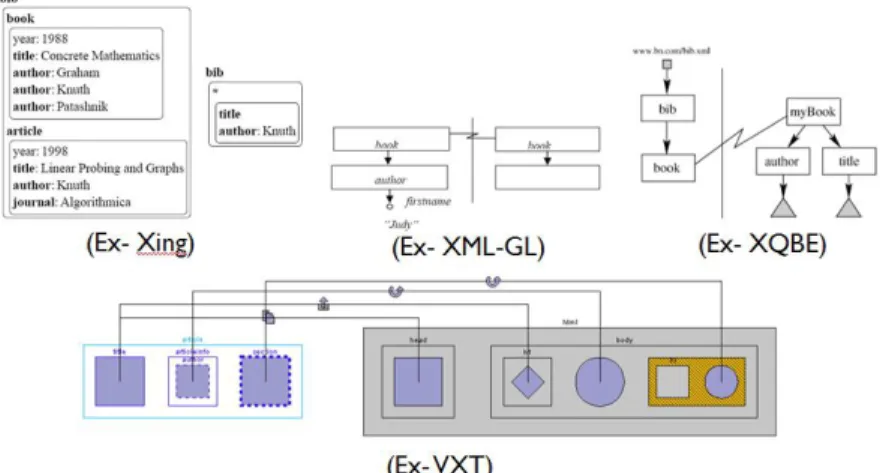
From the visual aspect, all of these approaches followed the same pattern. They divide the workspace to 2 main sections, left and right. The left section constitutes the source file with the extraction rules and the right section constitutes the result file. The query is defined by mapping the element to be extracted from the left section to the element to be constructed in the right section as shown in Figure 1.
Figure 1: XML query visual languages
The existing visual languages successfully bridged the gap between the complexities of XML data querying and non-expert programmers. However, they were limited only to data extraction, filtering and restructuring. Mainly they provided non-expert programmers with the ability to create XML structural transformations along with data extraction and filtering. They did not address the textual data manipulation issue and XML data insertion and modification (cf. Table 1). The main languages are discussed here below. The following query and XML document is used in the illustrations of the XML query visual languages.
Query 1:
Select all the books from books.xml that have been published in the year 1983 XML document books.xml:
<XML version=1.0> <lib>
<book>
<author>Charles Dickens</author> <title>A Christmas Carol</title> <pub_year>1983</pub_date>
</book> <book>
<author>James Joyce</author> <title>Ulysses</title>
C h a p t e r 2 - R e l a t e d W o r k s
<pub_year>1922</pub_date>
<description>An epic Greek myth.</description> </book>
</lib>
2.2.1 XML-GL
XML-GL [22] was defined by the World Wide Web consortium (W3C) as a graphical language for querying and restructuring an XML document. XML-GL represents XML documents as labeled graphs [21] and thus aims at being user friendly.
An XML-GL graph is defined formally as a connected, paired and directed graph defined by 2 sets N and A.
N is a set of nodes representing XML components (e.g., Elements and Attributes). These nodes are divided into 2 disjoint sets E and P. E is the set of XML Elements represented by labeled rectangles, with their tag names as labels. P is a set of properties defined by the sets At and C. At defines the set of
attribute nodes represented by solid circles and C is the set of content nodes represented by hollow circles.
A is a set of labeled arcs represented by directed arrows from n to n’, where n is the source node and n’ the destination node.
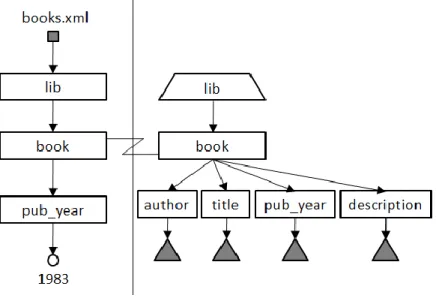
As shown in Figure 2, a query, in XML-GL, is represented by 2 XML-GL labeled graphs separated by a vertical line. The graph on the left side is the source graph and the one on the right is the destination graph. The 2 graphs are linked together by an explicit binding (the line linking a source node with a destination node). The source graph represents the selections to be made from the source XML file. As for the destination graph, it represents the output structure of the executed query. The binding maps the source elements being queried to the output structure being projected.
In Figure 2, we can see an example of query 1 over books.xml where the user wishes to extract all books published in 1983.
C h a p t e r 2 - R e l a t e d W o r k s
Figure 2: XML-GL query example
The XML-GL query paradigm is based on the “SELECT <attributes> FROM <tables> WHERE <conditions>” query from the SQL language, and thus is limited to data selections and projections.
XML-GL was one of the first graphical querying languages designed for XML documents. The main purpose was to provide users, mainly non-expert programmers, with the ability to restructure and extract sensitive data from XML files. Nonetheless, due to the limitations provided by the existing querying languages at the time, in this case SQL and in particular SQL selection queries, XML-GL‟s queries were very limited. Like most existing XML-oriented visual languages, XML-GL lacks the ability to manipulate string data, data insertion and update, and is limited to the expressiveness of the query language it is based on. And since it uses the querying paradigm, therefore, the task is rendered more difficult for non-expert programmers seeing that they are required to have some knowledge in querying data.
2.2.2 Xing (XML in graphics)
Xing was conceived as a visual querying and restructuring language for XML documents. Similar to XML-GL, Xing aims at extracting and restructuring XML data by using selections and projections. The main difference between Xing and XML-GL is the representation of the XML data by boxed patterns instead of graphs. As for the rest, it follows the same querying paradigm of XML-GL where a query is represented by 2 patterns, as depicted in Figure 3, one on the left for data selection, called the argument pattern, and one on the right for data reconstruction, called the result pattern. The argument and result patterns are linked together via a binding represented by an arrow directed from left to right.
C h a p t e r 2 - R e l a t e d W o r k s
(a) Example of a Xing expression
(b) Example of a query in Xing
Figure 3: Xing, XML in graphics
In Xing, an element is represented as a hybrid textual/graphic expression in a box with the element tag written above it (cf. Figure 3.a). Sub-elements and attributes are written within the borders of the parent element box. Sub-elements are differentiated from attributes by having their tag names written in bold as shown in Figure 3.a. Simple elements without any sub-elements are represented textually with their tag names in bold followed by their values in regular font separated by semi-colons. As for the order of elements, it is represented by their vertical positions.
A simple selection query is represented by a document pattern written/drawn with a Xing expression. As an example, we can see in Figure 3.b the query 1 written in Xing for extracting all books published in 1983.
Xing was defined formally as a visual representation for querying XML data by following the selection projection paradigm. It is defined conceptually based on the SQL selection querying paradigm. Even though it is called XML in graphics, nonetheless it is not based only on visual representations but on textual as well in tabular forms. Similar to XML-GL, its expressiveness is limited seeing that it is based on an existing language. In terms of XML data manipulation, it is only concerned with data extraction and restructuring, no textual manipulations, insertions nor modifications (e.g., updates) exist. Since Xing is based on the SQL paradigm, some knowledge in querying is required.
2.2.3 XQBE (XML Query by Example)
XQBE [15] is an XML-oriented graphical query language defining formally a visual syntax for querying XML data. The main objective of XQBE is being easy to use by non-expert programmers and directly mappable to XQuery. Due to the complexities of XQuery and the need for XQBE to be easy to use, the language was limited to simple querying.
As shown in Figure 4, XQBE is divided to 2 directed graphs, the source graph (on the left) and the construction graph (on the right) separated by a vertical line in the
C h a p t e r 2 - R e l a t e d W o r k s
middle. The source graph represents a pattern matching for the source XML file to be queried and transformed into the structure represented by the construction graph. Similar to XML-GL, XML elements are represented by rectangles labeled with the elements‟ tag name. The attributes are represented as black circles with their names drawn on the arc linking the element with its attributes. If an element contains PCDATA, the data is represented by an empty circle with the data value drawn underneath it. To represent the hierarchy between elements, directed arcs are used.
Figure 4: Querying in XQBE
The visual paradigm of XQBE was adopted so that the transformation may have a natural reading order from left to right. Correspondence between elements is represented by an explicit binding, as shown in Figure 4, between the source element and its corresponding node in the construction graph.
The core primitive transformations provided by the language are selection, iteration and projection which are denoted by the source graph, the binding edges and the construction graph respectively. The selection process is executed by evaluating the structure constraints shown in the source graph. The iteration takes place on the nodes of the source graph mapped to the construction graph. Projections are executed with respect to the constraints provided by the construction graph, which may remove or insert new nodes to the queried source node. Figure 4 illustrates query 1 in XQBE. The source graph defines the structure for matching all the book elements with an attribute year equal to 1983. The result is an XML fragment satisfying the structure of the construction graph with a root element lib, a child element book with its sub-elements author, title, pub_year and description.
XQBE is a formal visual querying language with a formally defined graphical user interface. Since XQBE is based on the syntax of XQuery, it therefore inherits its
C h a p t e r 2 - R e l a t e d W o r k s
limitations and complexities. On one hand, the manipulation is limited to selections and projections which is useful for data transformation and extraction and does not allow any data adaptation in terms of insertion and update or textual manipulations. On the other hand, it inherits the expressiveness of XQuery but limits its use due to visual constraints and can only be used for simple querying. And since it follows the query paradigm, therefore programming knowledge in querying is required for all users, experts and non-experts.
2.2.4 VXT: Visual XML Transformation Language
VXT is a visual language designed mainly to simplify XML transformations. XML transformations are normally done using the XSLT language which is the most expressive language for transforming XML files. Nonetheless, XSLT is a very complicated language and requires a certain level of expertise in order to use it. Therefore, Pietriga in [88], defined VXT as a visual language based on the XSLT language by providing some graphical elements formally defined and constituting a visual syntax which is translated into an XSLT syntax for rendering.
Figure 5: XML view as a treelist
VXT‟s main contribution was the adoption of treemaps [88] (cf. Figure 6) for XML data representation instead of tree lists (cf. Figure 5).
Pietriga [88] argued that tree lists require a large amount of space and become difficult to read as the XML document structure grows and becomes more complex. Therefore, VXT adopts treemap views which represent XML documents in a more compact space than tree list as shown in Figure 6. Nonetheless, treemaps require additional
C h a p t e r 2 - R e l a t e d W o r k s
computing when it comes to complex structures. A zoom function is required to view complex sub-elements.
Figure 6: XML view as a treemap
Similarly to Xing, VXT uses pattern matching based on treemaps to draw selections and projections. Based on a similar approach, VXT draws 2 patterns, a source pattern and a construction pattern (destination pattern similar to the source and destination graphs). But since VXT is based on XSLT, therefore, instead of binding nodes by a simple mapping, VXT introduces 3 transformation rules as show in
Table 2.
Table 2: VXT transformation rules
Operation Image Input Output
Copy of node (xsl:copy) Element Attribute Text Element Attribute Text Text extraction (xsl:value-of) Element Attribute Text Text Text Text Apply rules (xsl:apply-template) Element Attribute Text Unknown Unknown Unknown
The transformation rules are representations of transformation rules defined in XSLT and thus, are related to structure transformations such as copying a node, extracting textual values or applying a template to a fragment of XML. Figure 7 illustrates an example of creating a reply email template using the 3 rules provided by VXT. This transformation template copies the sender‟s and recipient values of the received email respectively to the recipient and sender elements of the reply email. The subject and textbody are transformed in the reply email based on predefined templates.
C h a p t e r 2 - R e l a t e d W o r k s
Figure 7: Creating a reply email template
To summarize, VXT tries to express selection projection queries similar to other XML visual languages but from a different perspective. VXT dropped the idea of building its visual syntax on a querying language and went towards a transformation language instead, so that it can be more expressive by introducing some transformation rules. VXT tackled the XML graphical representation issue and adopted the treemap view approach which optimizes the space required for viewing XML structures. Nevertheless and in terms of XML data manipulation, VXT remains limited to data extraction and transformation. No textual manipulations nor data insertion nor update are possible.
2.2.5 Discussion
After presenting the main XML visual languages (XML-GL, Xing, XQBE and VXT), an analysis based on the criteria defined in Table 1 is shown in Table 3.
Based on existing querying and transformation languages, several XML-oriented visual languages emerged and were formally defined. Their main goals were XML data extraction and structural transformations. However, these languages were very limited in their expressiveness mainly due to the graphical constraints and to the languages they are based on.
C h a p t e r 2 - R e l a t e d W o r k s
Table 3: Analysis regarding XML query visual languages
Category Sub-category Criteria XML-GL Xing XQBE VXT Manipulated Data Type
XML-specific Yes Yes Yes Yes
Web-based - - - -
User-based - - - -
Location
Target offline
data Yes Yes Yes Yes
Target online
data Yes Yes Yes Yes
Manipulation Operations
Structural
Selection/
filtering Yes Yes Yes Yes
Projection/
transformation Yes Yes Yes Yes
Insertion/ removal - - - - Modification (obfuscation) - - - - Content (textual) Selection - - - - Insertion/ removal - - - - Textual manipulations - - - - Interaction/ Visualization User Programming knowledge required
Yes Yes Yes Yes
Expertise
required Low Low Low Low
System
Composition-based - - - -
Query-based Yes Yes Yes Yes
Reusable - - - -
Formal Visual
syntax Yes Yes Yes Yes
Expressiveness Low Low Low Low
Derivability
Formalism Yes Yes Yes Yes
Formal
language Yes Yes Yes Yes
Extensibility - - Limited -
As shown in Table 3, the languages did not provide means for textual manipulation, data insertion nor data modification. Last but not least, even though the languages