ORIGINAL ARTICLE
Influence of dentin and enamel pretreatment with acidic sulfur
compounds on adhesive performance
Alexis Ioannidis&Bogna Stawarczyk&Beatrice Sener&
Thomas Attin&Patrick R. Schmidlin
Received: 25 August 2011 / Accepted: 24 October 2012 / Published online: 9 November 2012 # Springer-Verlag Berlin Heidelberg 2012
Abstract
Objective This study tested the potential hampering effects of acidic sulfur compounds (ASC) containing hydroxybenzene sulfonic acid, hydroxymethoxybenzene sulfonic acid, and sulfuric acid, prior to self-etch and etch-and-rinse bonding procedures on enamel and dentin. According to the manufac-turer, ASC should be applied after cavity preparation and prior to application of a primer in order to reduce the remaining biofilm in the preparation cavity. Despite promoted marketing, data on the investigated liquid are almost completely lacking. Material and methods One hundred and fifty-two extracted mandibular bovine incisors were embedded and polished to expose either enamel (E) or dentin (D). Then, specimens were randomly divided and conditioned as follows (n012/group): ASC and consecutive phosphoric acid application (E1/D1), ASC (E2/D2; E5/D5), phosphoric acid (E3/D3), and no con-ditioning (E4/D4; E6/D6). Groups were then treated with either Optibond FL® (etch-and-rinse; 1–4) or Clearfil SE Bond® (self-etch; 5–6). Hollow acrylic cylinders were bonded with a hybrid composite resin (Filtek Supreme XTE®) to the specimens, and the shear bond strength was measured (1 mm/ min). In addition, failure types were assessed. Descriptive statistics and statistical analyses were performed with one-way ANOVA followed by the Scheffé post hoc test.
Results For enamel, the highest shear bond strength values were obtained applying routine bonding procedures (23.5± 5.6 MPa for etch-and-rinse and 26.0±6.0 MPa for self-etch,
respectively). In contrast, dentin pretreatment with a combi-nation of ASC and phosphoric acid led to the highest shear bond values (22.8±4.1 MPa).
Conclusion This study shows that ASC prior to dental res-toration placement cannot be recommended for etch-and-rinse procedures on enamel but is appropriate for dentin without interfering with routine bonding procedures. Clinical relevance The application of acidic sulfur com-pounds prior to adhesive restoration placement should be restricted to dentin only as it may negatively influence shear bond strength on sound enamel.
Keywords Shear bond strength . Acidic sulfur compounds . Composite resin . Bonding
Introduction
Secondary caries is regarded as the most common reason for the failure and, therefore, replacement of dental restorations [1,2]. This may be caused by residual bacteria, which remain in the cavity after preparation [3,4]. During caries excavation, clinicians must make their decision as to whether the remain-ing dentin is still infected or not based on criteria such as the color and texture of the dentin [5,6]. Even in case of a quasi-complete removal of a dentinal lesion based on clinical judg-ment, bacteria can remain at the enamel–dentin junction, at the cavity walls, in the smear layer, or in the dentinal tubules on a histological level [4]. Data indicate that residual bacteria can find their way through the dentinal tubules and may reach the non-exposed pulp tissue [7]. The presence of persistent bacte-ria in dentin and their proximity to the pulp have been clearly associated with pulpal inflammation [8,9]. To reach remaining bacteria and ensure complete bacterial removal, it seems evi-dent that additional treatment of the cavity, supplementary to the physical removal of the carious dentin, could be advanta-geous before placing a restoration. An antimicrobial effect and
A. Ioannidis
:
B. Sener:
T. Attin:
P. R. Schmidlin (*) Clinic for Preventive Dentistry, Periodontology and Cariology, Center of Dental Medicine, University of Zurich,Plattenstrasse 11, 8032 Zurich, Switzerland
e-mail: [email protected] B. Stawarczyk
Department of Prosthodontics, Munich Dental School, Ludwig-Maximilians-University Munich,
a modification or dissolution of the smear layer are desired. The application of chlorhexidine or sodium hypochlorite to prepared dentin surfaces has been suggested for this purpose [10]; however, previous results have shown that these solu-tions are not capable of completely removing the smear layer present after cavity preparation [11,12]. Furthermore, these solutions may be less than ideal in combination with adhesive techniques because of their hampering effect on bond strength [13–15]. To ensure bacterial elimination in dentinal tubules, the smear layer must be removed by a strong chelator or an acid [11]. Treating dentin and enamel with acid or acid-containing liquids is widely used for routine bonding proce-dures. The use of 32 to 37 % phosphoric acid has been suggested to successfully etch caries-affected dentin so as to remove the intratubular deposits and obtain high bond strength and well-infiltrated demineralized dentin with ex-posed collagen network [16–18].
A concentrated aqueous mixture of acidic sulfur compounds (ASC) containing hydroxybenzene sulfonic acid, hydroxyme-thoxybenzene sulfonic acid, and sulfuric acid (HybenX®, EPIEN Medical; St. Paul, USA) was recently introduced and marketed as a“Plaque Biofilm Remover” for several indica-tions, including use prior to the placement of dental restorations. However, no studies on this topic are available yet. As this liquid contains acidic sulfur compounds, it can potentially be used as conditioner before restoration placement. Since studies have shown that a strong acid is required to adequately etch caries-affected dentin in order to produce high bond strengths and well-infiltrated demineralized dentin [16], the use of an ASC-containing liquid could potentially improve bonding qual-ity or, at least, not interfere with the bonding procedures.
Given this assumption, this in vitro study aimed to test the influence of ASC on the shear bond strength of enamel and dentin when used in combination with etch-and-rinse and self-etch procedures. The null hypothesis was that ap-plication of this product would not interfere with adhesion and that the mean shear bond strength values would be similar with those of routine bonding procedures.
Methods and materials
Specimen preparation
One hundred and fifty-two extracted mandibular bovine central incisors were cleaned, stored in deionized water, and embedded with the labial surface facing downwards in a self-curing acrylic resin (ScandiQuick, Scandia, Hagen, Germany) in cylindrical molds with a diameter of 25 mm. After polymerization of the resin, teeth were ground flat under water-cooling with SiC paper of P240 grit, followed by P400 grit to expose either the enamel or middle dentin. As shown in Table1, specimens were randomly allocated to
12 groups (n012/group). Eight specimens were used for electron microscopy examination.
Bonding procedures
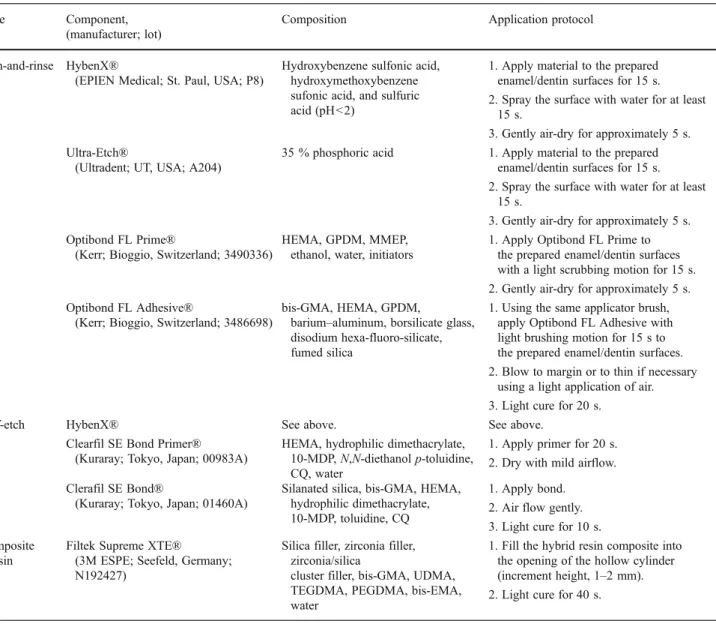
The conditioning and bonding materials used in this study are listed in Table2. As allocated to the groups in Table1, specimens were either not conditioned or treated with ASC and/or with phosphoric acid for 15 s each. Routine bonding procedures served as positive controls, with the groups E3/ D3 for the etch-and-rinse techniques and the groups E6/D6 for the self-etch techniques, respectively. The groups E4/D4 without a conditioning procedure served as a negative con-trol for the etch-and-rinse techniques. For the self-etch pro-cedures, there was no negative control group. After conditioning, specimens were sprayed with water after each step if required and then gently air-dried. Afterwards, bond-ing was accomplished usbond-ing step-by-step application of either a self-etching or an etch-and-rinse adhesive system according to the manufacturer’s instructions (Table2). Shear bond strength testing
After the conditioning and adhesive procedures, a transparent, hollow acrylic cylinder with an inner diameter of 2.9 mm and an outer diameter of 3.1 mm was pressed onto the exposed tooth surfaces of the specimen by means of a special bonding device as recently described in detail by Schmidlin et al. [19]. The opening of the cylinder was filled with a hybrid composite resin (Filtek Supreme XTE®; for details, see Table2) in two incre-ments of about 1–2 mm in height, which was light-cured for 40 s (Elipar Freelight 2®, 3M ESPE®; 970 mW/cm2). After-wards, specimens were carefully removed from the device. Thereafter, the specimens were stored in distilled water at 37 ° C for 1 week. The shear bond strength of the specimens was investigated using a universal testing machine (Zwick® Z010, Ulm, Germany). The specimens were positioned in the sample holder with the treated specimen surface parallel to the loading piston at a distance of 200μm. The loading piston had a chisel configuration, and the load was applied with a crosshead speed of 1 mm/min. Load at failure was recorded, and shear strength values were calculated according to the equationσ0F/A, where σ is the shear bond strength, F is the load at failure (in newton), and A represents the adhesive area (in square millimeter).
After debonding, the failure types were investigated with loupes at a ×3.3 magnification (Sandy Grendel® TP-740; Aar-burg, Switzerland). Failure types were classified as follows: (1) adhesive failure, when fractures were observed between the resin and the tooth; (2) cohesive failure in the composite, when fracture occurred within the resin composite; (3) cohesive fail-ure in the tooth, when fractfail-ure was seen in the tooth substrate; and (4) mixed failure, when fractures were judged as represent-ing adhesive and cohesive failure simultaneously.
Electron microscopy
To assess the surface morphology of the surfaces of the enamel and dentin specimens after the different conditioning modalities, eight specimens were prepared for scanning
electron microscopy (SEM) analysis. Enamel and dentin specimens were conditioned with ASC and/or phosphoric acid for 15 s each and sprayed with water for at least 15 s. When both ASC and phosphoric acid were used, the speci-mens were sprayed with water after each treatment step.
Table 1 Treatment groups and treatment steps
Group Enamel Dentin
Etch-and-rinse Self-etch Etch-and-rinse Self-etch
E1 E2 E3 E4 E5 E6 D1 D2 D3 D4 D5 D6
I Conditioner ASC + + − − + − + + − − + −
II Phosphoric acid + − + − − − + − + − − −
III Adhesive procedure Optibond FL® + + + + − − + + + + − −
Clearfil SE Bond® − − − − + + − − − − + +
Table 2 Composition and application steps of the products used in this study
Type Component,
(manufacturer; lot)
Composition Application protocol
Etch-and-rinse HybenX®
(EPIEN Medical; St. Paul, USA; P8)
Hydroxybenzene sulfonic acid, hydroxymethoxybenzene sufonic acid, and sulfuric acid (pH<2)
1. Apply material to the prepared enamel/dentin surfaces for 15 s. 2. Spray the surface with water for at least
15 s.
3. Gently air-dry for approximately 5 s. Ultra-Etch®
(Ultradent; UT, USA; A204)
35 % phosphoric acid 1. Apply material to the prepared enamel/dentin surfaces for 15 s. 2. Spray the surface with water for at least
15 s.
3. Gently air-dry for approximately 5 s. Optibond FL Prime®
(Kerr; Bioggio, Switzerland; 3490336)
HEMA, GPDM, MMEP, ethanol, water, initiators
1. Apply Optibond FL Prime to the prepared enamel/dentin surfaces with a light scrubbing motion for 15 s. 2. Gently air-dry for approximately 5 s. Optibond FL Adhesive®
(Kerr; Bioggio, Switzerland; 3486698)
bis-GMA, HEMA, GPDM,
barium–aluminum, borsilicate glass, disodium hexa-fluoro-silicate, fumed silica
1. Using the same applicator brush, apply Optibond FL Adhesive with light brushing motion for 15 s to the prepared enamel/dentin surfaces. 2. Blow to margin or to thin if necessary
using a light application of air. 3. Light cure for 20 s.
Self-etch HybenX® See above. See above.
Clearfil SE Bond Primer® (Kuraray; Tokyo, Japan; 00983A)
HEMA, hydrophilic dimethacrylate, 10-MDP, N,N-diethanol p-toluidine, CQ, water
1. Apply primer for 20 s. 2. Dry with mild airflow. Clerafil SE Bond®
(Kuraray; Tokyo, Japan; 01460A)
Silanated silica, bis-GMA, HEMA, hydrophilic dimethacrylate, 10-MDP, toluidine, CQ
1. Apply bond. 2. Air flow gently. 3. Light cure for 10 s. Composite
resin
Filtek Supreme XTE® (3M ESPE; Seefeld, Germany; N192427)
Silica filler, zirconia filler, zirconia/silica
cluster filler, bis-GMA, UDMA, TEGDMA, PEGDMA, bis-EMA, water
1. Fill the hybrid resin composite into the opening of the hollow cylinder (increment height, 1–2 mm). 2. Light cure for 40 s.
Unconditioned specimens served as the control. After the conditioning procedures, specimens were dried and mounted on aluminum stubs and sputter coated with gold, then exam-ined using a scanning electron microscope (CS4, Cam Scan, Waterbeach, UK) operating at 1,000 kV with a working distance of 8.2–12.6 mm. SEM pictures were captured at a magnification of ×10,000. As only one image of one specimen per conditioning modality was taken, the pictures have to be declared as a nonrepresentative visualization and simply give an idea of the different etching patterns.
Statistical methods
The shear bond strength data were coded and analyzed in PASW Statistics 18.0 (SPSS Inc., Chicago, IL, USA). The shear bond strength data were analyzed under the assumption of a normal distribution. Descriptive statistics such as the mean and standard deviation for each treatment group were comput-ed separately. One-way ANOVA together with the Scheffé post hoc test was applied in order to investigate the differences in the shear bond strength between the treatment groups for enamel and dentin separately. In addition, fracture modes were investigated, and the relative frequencies of the fracture modes were computed with 95 % Cl in each treatment group [20]. The results of the statistical analysis with p values <0.05 were considered to be statistically significant.
Results
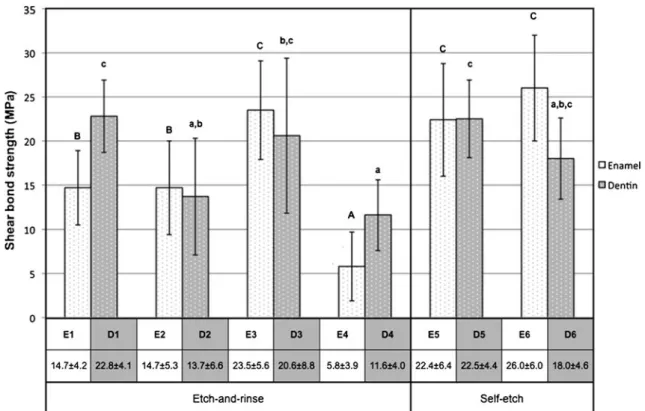
As the primary outcome parameter of the study, the mean shear bond strength values of the enamel and dentin speci-mens are presented in Fig.1. For enamel, the values ranged from 5.8±3.9 to 23.5±5.6 MPa for the etch-and-rinse proce-dures and from 22.4±6.4 to 26.0±6.0 MPa for the self-etch techniques. The highest shear bond strengths were obtained with routine bonding procedures (E3+E6), which served as the positive control. Group E4, which served as the negative control for etch-and-rinse techniques, showed the lowest val-ues. The one-way ANOVA revealed a significant hampering effect of ASC on adhesion with the etch-and-rinse techniques (E1–E2) compared to the control group (E3). In the self-etch groups (E5–E6), the use of ASC prior to the adhesive proce-dure negatively influenced the shear bond strength values, although the differences were not significant.
On dentin specimens, the shear bond strength values varied from 11.6±4.0 to 22.8±4.1 MPa for the etch-and-rinse techniques and from 18.0±4.6 to 22.5±4.4 MPa for the self-etch procedures. The highest shear bond strength values were achieved by using ASC prior to routine proce-dures (D1+D5). If the highest obtained values are compared to their corresponding positive control group (E3+E6), the differences tested by ANOVA were not significant, either for
the etch-and-rinse or for self-etch procedures. Thus, the use of ASC before routine bonding procedures did not signifi-cantly reduce the shear bond strength values in dentin but tended to increase the respective values (D1 +D5). The use of ASC as a sole dentin conditioner (D2) hampered the adhesive performance as compared to the routine etch-and-rinse conditioning procedure with phosphoric acid (D3) or the combination of ASC and phosphoric acid (D1).
The results of the fracture analysis are presented in Table3. For enamel, in all groups where conditioning procedures were used (E1−E3 and E5−E6), mixed failures were predominantly demonstrated. The percentages ranged from 67 % (34; 91) in group E3 to 100 % (73; 100) in group E1. The percentages of adhesive failures varied from 0 % (0; 27) in group E1 to 67 % (34; 91) in group E4. Group E4 served as the negative control without conditioning procedures. Cohesive failures in enamel occurred only in group E5 (8 %, 0; 39), whereas no cohesive failures in composite were detected. In dentin, mixed failures occurred frequently, which ranged from 42 % (15; 73) in group D1 to 83 % (51; 98) in group D2. Overall, the highest percentage of cohesive failures in teeth could be observed in the dentin specimens, which were treated with ASC and phosphoric acid (D1). In dentin, no cohesive failures in com-posite were observed.
The SEM images of the enamel and dentin surfaces are shown in Fig.2. The labeling of the images corresponds to the conditioning procedures of groups E1–E6 (enamel) and D1–D6 (dentin) as described in Table 1. The untreated specimen showed smear layer-coated surfaces with distinct polishing patterns on the dentin and enamel (corresponding to groups E4, E6 and D4, D6, respectively). On enamel, specimens revealed predominantly a type 2 etching pattern where the prism core material was preferentially left intact and the prism peripherals were removed (corresponding to groups E1, E2, E3, and E5) [21]. On dentin, etching with phosphoric acid alone (D3) or etching with ASC followed by etching with phosphoric acid (D1) led to dissolution of the smear layer and opening of the dentinal tubules. Pre-conditioning with ASC alone led to a partial dissolution of the smear layer and incomplete opening of the dentinal tubules (corresponding to groups D2 and D5).
Discussion
In the present study, different preconditioning patterns were evaluated in vitro to assess the effect of ASC as a condi-tioner when used in combination with routine etch-and-rinse and self-etch procedures. According to the manufacturer, ASC should be applied after cavity preparation and prior to the application of a primer [22]. They claim that, through its use, residual biofilm can be eliminated from the cavity and that the occurrence of bonding failures should be
reduced [22]. However, studies are not yet available to support either the first or the second claim. Despite promot-ed marketing, data on the investigatpromot-ed ASC-containing liq-uid are almost completely lacking. The only published study available is on the treatment of recurrent aphthous stomatitis [23]. The present investigation was the first test of the influence of this product on the shear bond strength of enamel and dentin when used in combination with an etch-and-rinse or a self-etch procedure, which would be a pre-requisite for application in adhesive dentistry. We hypothe-sized that the application of the ASC-containing liquid
before conditioning would not influence the bonding proce-dure in terms of altered shear bond strength values.
One hypothesis of this study was that, in the case of sufficient shear bond strength values achieved by etching with ASC alone, the tested product could be used as a therapeutic etchant for etch-and-rinse adhesives. However, on enamel, data from the etch-and-rinse techniques indicate that ASC can neither replace phosphoric acid as an etchant nor improve adhesive performance when used as an adjunct for the tested adhesive procedure. In contrast, with regard to the self-etch system tested in this investigation, our null hypothesis could
Fig. 1 Mean shear bond strength values ±standard deviation (mega-pascal) after the different conditioning and bonding procedures on enamel (E1–6) and dentin (D1–6). Different letters (A, B, C, D for
enamel specimens; a, b, c, d for dentin specimens) represent a signif-icant post hoc test between the levels of the test group factor
Table 3 Relative frequencies of fracture modes with 95 % confidence intervals of different treatment modalities in enamel and dentin (percentage; 95 % confidence interval according to Ciba-Geigy [20] in parenthesis)
Enamel Dentin Group Adhesive failure Cohesive failure in enamel Cohesive failure in composite
Mixed failure Group Adhesive failure Cohesive failure in dentin Cohesive failure in composite Mixed failure Etch- and-rinse E1 0 (0; 27) 0 (0; 27) 0 (0; 27) 100 (73; 100) D1 8 (0; 39) 50 (21; 79) 0 (0; 27) 42 (15; 73) E2 17 (2; 48) 0 (0; 27) 0 (0; 27) 83 (51; 98) D2 0 (0; 27) 17 (2; 48) 0 (0; 27) 83 (51; 98) E3 33 (9; 66) 0 (0; 27) 0 (0; 27) 67 (34; 91) D3 8 (0; 39) 25 (5; 58) 0 (0; 27) 67 (34; 91) E4 67 (34; 91) 0 (0; 27) 0 (0; 27) 33 (9; 66) D4 25 (5; 58) 0 (0; 27) 0 (0; 27) 75 (42; 95) Self-etch E5 17 (2; 48) 8 (0; 39) 0 (0; 27) 75 (42; 95) D5 0 (0; 27) 33 (9; 66) 0 (0; 27) 67 (34; 91) E6 17 (2; 48) 0 (0; 27) 0 (0; 27) 83 (51; 98) D6 0 (0; 27) 25 (5; 58) 0 (0; 27) 75 (42; 95)
not be violated. Previously recorded data showed that pre-etching with phosphoric acid increases the bond strength for self-etch techniques and can be considered a safe and clini-cally reliable approach [24]. However pre-etching with ASC did not significantly affect the bond strength measurements of the self-etch groups in our investigation.
In contrast to the enamel groups, our hypothesis was not rejected for dentin groups. Even better than expected, the highest shear bond strength values were achieved when ASC was used before routine bonding procedures with the etch-and-rinse adhesive. An explanation for the higher shear bond results could be based on the greater etching depth, which may be clarified by observing the SEM images. Whereas the use of ASC as a single etchant led to only partial dissolution of
the smear layer, a more accentuated dissolution pattern could be observed when a combination of ASC and phosphoric acid was used. These results are in agreement with other studies that showed the highest shear bond strength values with a total-etch technique [25, 26]. When applying self-etching adhesives, it was shown that additional or extended etching on sound dentin did not improve the tensile bond strength [27]. In addition, previous studies have indicated that there is no correlation between bond strength and the thickness of the bonding infiltrated smear layer [28, 29]. Other studies have shown, however, a negative effect on bond strength values when dentin was pretreated with phosphoric acid [30,31]. In their review, Scherrer et al. described an average shear bond strength of Optibond FL® to dentin of 23.1 ± 7.9 MPa
Fig. 2 SEM images after different conditioning modalities. The labeling of the images corresponds to the conditioning procedures of the groups E1–E6 (enamel, left) and D1–D6 (dentin, right) as described in Table1. E1 and D1 a combination of phosphoric acid and ASC; E2, E5 and D2, D5 ASC alone; E3 and D3 phosphoric acid; E4, E6 and D4, D6 untreated samples. Please note that these images are not representative, since only the image of one specimen per experimental group is shown
including eight publications [32]. Fifteen publications assessed Clearfil SE Bond® and a mean shear bond strength value of 23.2±7.1 MPa was reported [32]. These pooled values were slightly higher as compared to the findings of the present study with mean values of 20.6±8.8 and 18.0±4.6 MPa, respective-ly. These differences may be explained, in part, by different methodological and analytical approaches, e.g., specimen preparation, shear bond strength measurements, etc. In their review, Scherrer et al. included only studies which assessed the shear bond strength on human dentin, whereas bovine dentine in our investigation was used. Moreover, different media than those used in our treatment protocol, such as formalin, thymol, chloramine, sodium azide, or saline solutions, were used to store the extracted human teeth [32].
By analyzing the fracture types, the data show predomi-nantly mixed failures in enamel. Only group E5, when ASC was applied before the application of the self-etch adhesive, showed a few pure cohesive failures in enamel. Comparing the shear bond strength values and the fracture type analysis of the dentin groups, the amount of cohesive failures in dentin correlated with the shear bond strength results, which is in accordance with a review by Salz et al., who described a significant correlation between higher bond strength and the rate of cohesive failures [33]. In addition, they mentioned an increased incidence of cohesive failure in dentin during shear bond tests in recent years [33]. They assumed that this fact is an intrinsic side effect of shear bond testing and does not mean a high adhesive performance, which can withstand the shear bond strength [33]. Thus, the observed cohesive failures do not necessarily imply an improved adhesion.
In the present study, bovine teeth were used. Due to their size and disposability, they represent an ideal substrate for shear bond strength testing. Studies have shown no statistical-ly significant morphological differences between coronal den-tin of human permanent molars and bovine central incisors when comparing the number of tubules per square millimeter or their diameters [34]. There is some doubt whether conclu-sions made with studies on bovine teeth can be directly applied to human teeth and whether such data are valid in a clinical situation [35]. Another potentially influencing factor, which may hamper the overall clinical validity of this inves-tigation, was the fact that no pulpal pressure was applied. Further, it must be considered that the specimens used for this study were neither caries infected nor caries affected. This fact is important because tubule occlusion due to caries-affected dentin is referred to as the major factor for decreased bond strength in carious dentin as it hampers adequate tag formation [36]. Other authors have also reported lower bond strength with the self-etch and etch-and-rinse procedures to caries-affected dentin in comparison to sound dentin, even for groups with additional or extended acid etching [27]. Other inves-tigations have revealed good penetration of bonding agents in sound, artificially and naturally induced carious dentin with
different adhesive systems [37,38]. Another limiting factor was that no thermomechanical aging was performed in this study. Furthermore, an experimental group where ASC was applied after the self-etch adhesive was not included into this investigation. In our opinion, the use of ASC after self-etch adhesive offers no advantage and is not a clinical concept. However, future studies may look at this aspect as well. Over-all, adhesion testing is a highly technique-sensitive procedure [33]. Even minor variations in any of the numerous experi-mental steps can significantly influence the results [33]. Thus, for these reasons, it is important to acknowledge that the conditions of the present investigation differ from in vivo situations and that a general comparability with other studies is difficult. Nevertheless, as this was a comparative investiga-tion, the findings of this study allow at least the detection of treatment differences when using one substrate under standard-ized conditions.
Conclusions
Within the limitations of this in vitro screening investigation, it can be concluded that the application of ASC prior to dental restoration placement cannot be recommended for etch-and-rinse procedures in enamel. In contrast, ASC may be benefi-cial on dentin as a potential antibacterial adjunctive for routine bonding procedures, so the use of ASC can be recommended. However, we presume that the selective application of ASC on dentin could be challenging, especially in small cavities. In addition, the potential antimicrobial effect of ASC as a poten-tial biofilm remover is yet to be investigated in further studies.
Acknowledgments The authors would like to thank Albert Trott-mann and Felix Schmutz for their support. We are grateful to EPIEN Medical for their support with the materials.
Conflict of interest The authors declare no conflicts of interest.
References
1. York AK, Arthur JS (1993) Reasons for placement and replace-ment of dental restorations in the United States Navy Dental Corps. Oper Dent 18(5):203–208
2. Hamouda IM, Al-Khodary AM, El Shami FM (2010) Degree of conversion and antimicrobial activity of etch-and-rinse versus self-etching adhesives. J Adhes Dent 12(1):33–38
3. Mejare B, Mejare I, Edwardsson S (1979) Bacteria beneath com-posite restorations—a culturing and histobacteriological study. Acta Odontol Scand 37(5):267–275
4. Schmidlin OA, Zehnder M, Schmidlin PR (2003) Effectiveness of dentine bonding agents against cariogenic bacteria in vitro: a comparison of two methods. Oral Microbiol Immunol 18(3):140– 143
5. Lennon AM, Buchalla W, Rassner B, Becker K, Attin T (2006) Efficiency of 4 caries excavation methods compared. Oper Dent 31 (5):551–555
6. Kidd EA, Ricketts DN, Beighton D (1996) Criteria for caries removal at the enamel–dentine junction: a clinical and microbio-logical study. Br Dent J 180(8):287–291
7. Hoshino E, Ando N, Sato M, Kota K (1992) Bacterial invasion of non-exposed dental pulp. Int Endod J 25(1):2–5
8. Reeves R, Stanley HR (1966) The relationship of bacterial pene-tration and pulpal pathosis in carious teeth. Oral Surg Oral Med Oral Pathol 22(1):59–65
9. Martin FE, Nadkarni MA, Jacques NA, Hunter N (2002) Quanti-tative microbiological study of human carious dentine by culture and real-time PCR: association of anaerobes with histopathological changes in chronic pulpitis. J Clin Microbiol 40(5):1698–1704 10. Vahdaty A, Pitt Ford TR, Wilson RF (1993) Efficacy of
chlorhex-idine in disinfecting dentinal tubules in vitro. Endod Dent Trau-matol 9(6):243–248
11. Lottanti S, Gautschi H, Sener B, Zehnder M (2009) Effects of ethyl-enediaminetetraacetic, etidronic and peracetic acid irrigation on hu-man root dentine and the smear layer. Int Endod J 42(4):335–343 12. Zehnder M (2006) Root canal irrigants. J Endod 32(5):389–398 13. Osorio R, Ceballos L, Tay F, Cabrerizo-Vilchez MA, Toledano M
(2002) Effect of sodium hypochlorite on dentin bonding with a polyalkenoic acid-containing adhesive system. J Biomed Mater Res 60(2):316–324
14. Pilo R, Cardash HS, Oz-Ari B, Ben-Amar A (2001) Effect of preliminary treatment of the dentin surface on the shear bond strength of resin composite to dentin. Oper Dent 26(6):569–575 15. Taylor-Hardy TL, Leonard RH Jr, Mauriello SM, Swift EJ Jr
(2001) Effect of dental unit waterline biocides on enamel bond strengths. Gen Dent 49(4):421–425
16. Nakajima M, Sano H, Urabe I, Tagami J, Pashley DH (2000) Bond strengths of single-bottle dentin adhesives to caries-affected den-tin. Oper Dent 25(1):2–10
17. Nakajima M, Ogata M, Harada N, Tagami J, Pashley DH (2000) Bond strengths of self-etching primer adhesives to in vitro-demineralized dentin following mineralizing treatment. J Adhes Dent 2(1):29–38 18. Pashley DH, Tay FR, Breschi L, Tjaderhane L, Carvalho RM,
Carrilho M, Tezvergil-Mutluay A (2011) State of the art etch-and-rinse adhesives. Dent Mater 27(1):1–16
19. Schmidlin PR, Stawarczyk B, Wieland M, Attin T, Hammerle CH, Fischer J (2010) Effect of different surface pre-treatments and luting materials on shear bond strength to PEEK. Dent Mater 26 (6):553–559
20. Ciba-Geigy (1980) Wissenschaftliche Tabellen Geigy, vol 8. Teilband Statistik, Basel
21. Silverstone LM, Saxton CA, Dogon IL, Fejerskov O (1975) Variation in the pattern of acid etching of human dental enamel examined by scanning electron microscopy. Caries Res 9(5):373–387
22. HybenX (2012)http://dentaldesiccants.com/uploads/HybenX_use chart.pdf. Accessed 17 May 2012
23. Porter SR, Al-Johani K, Fedele S, Moles DR (2009) Randomised controlled trial of the efficacy of HybenX in the symptomatic treatment of recurrent aphthous stomatitis. Oral Dis 15(2):155–161 24. Taschner M, Nato F, Mazzoni A, Frankenberger R, Kramer N, Di Lenarda R, Petschelt A, Breschi L (2010) Role of preliminary etching for one-step self-etch adhesives. Eur J Oral Sci 118 (5):517–524
25. Aguilar-Mendoza JA, Rosales-Leal JI, Rodriguez-Valverde MA, Gonzalez-Lopez S, Cabrerizo-Vilchez MA (2008) Wettability and bonding of self-etching dental adhesives. Influence of the smear layer. Dent Mater 24(7):994–1000
26. Reis A, Grandi V, Carlotto L, Bortoli G, Patzlaff R, Rodrigues Accorinte Mde L, Dourado Loguercio A (2005) Effect of smear layer thickness and acidity of self-etching solutions on early and long-term bond strength to dentin. J Dent 33(7):549–559 27. Arrais CA, Giannini M, Nakajima M, Tagami J (2004) Effects of
additional and extended acid etching on bonding to caries-affected dentine. Eur J Oral Sci 112(5):458–464
28. Yoshiyama M, Carvalho R, Sano H, Horner J, Brewer PD, Pashley DH (1995) Interfacial morphology and strength of bonds made to superficial versus deep dentin. Am J Dent 8(6):297–302 29. Perdigao J, May KN Jr, Wilder AD Jr, Lopes M (2000) The effect
of depth of dentin demineralization on bond strengths and mor-phology of the hybrid layer. Oper Dent 25(3):186–194
30. Erhardt MC, Cavalcante LM, Pimenta LA (2004) Influence of phosphoric acid pretreatment on self-etching bond strengths. J Esthet Restor Dent 16(1):33–40, discussion 41
31. Ikeda M, Kurokawa H, Sunada N, Tamura Y, Takimoto M, Mur-ayama R, Ando S, Miyazaki M (2009) Influence of previous acid etching on dentin bond strength of self-etch adhesives. J Oral Sci 51(4):527–534
32. Scherrer SS, Cesar PF, Swain MV (2010) Direct comparison of the bond strength results of the different test methods: a critical liter-ature review. Dent Mater 26(2):e78–93
33. Salz U, Bock T (2010) Testing adhesion of direct restoratives to dental hard tissue—a review. J Adhes Dent 12(5):343–371 34. Schilke R, Lisson JA, Bauss O, Geurtsen W (2000) Comparison of
the number and diameter of dentinal tubules in human and bovine dentine by scanning electron microscopic investigation. Arch Oral Biol 45(5):355–361
35. Nakamichi I, Iwaku M, Fusayama T (1983) Bovine teeth as pos-sible substitutes in the adhesion test. J Dent Res 62(10):1076–1081 36. Schmidlin PR, Siebenmann J, Kocher P, Seemann R, Attin T, Bindl A (2008) Effects of de- and remineralization of dentin on bond strengths yielded by 1-, 3-, and 4-step adhesives. J Adhes Dent 10(2):119–126
37. Hahn P, Hellwig E (2004) An in vitro investigation of penetration depth of dentine bonding agents into carious dentine. J Oral Rehabil 31(11):1053–1060
38. Imazato S, Walls AW, Kuramoto A, Ebisu S (2002) Penetration of an antibacterial dentine-bonding system into demineralized human root dentine in vitro. Eur J Oral Sci 110(2):168–174