L
ASER
O
SCILLATORS FOR
A
PPLICATIONS IN
M
ETROLOGY AND THE
G
ENERATION OF
TH
Z
AND
XUV
R
ADIATION
A dissertation submitted to
U N I V E R S I T É D E N E U C H Â T E L
F A C U L T É D E S S C I E N C E S
for the degree of
D O C T O R O F S C I E N C E S
presented by
N
O R B E R TP
A U LM
O D S C H I N GMaster of Science in Photonics born on 17. December 1986
citizen of Germany
accepted on the recommendation of Prof. Dr. Thomas Südmeyer, Supervisor
Prof. Dr. Jens Limpert, Co-Examiner Dr. Valentin J. Wittwer, Co-Examiner
Das Erreichen eines Zieles beendet die Erfahrung.
I
Abstract
Ultrafast laser systems find application as versatile tool in industry and science. Ultrafast laser systems based on Ti:sapphire – the workhorse in ultrafast science – operate typically at kHz repetition rates and benefit from the available broad gain bandwidth for the direct generation of sub-100-fs pulse durations. However, thermal effects in the gain medium due to a high quantum defect limit their average power to several watt. Many applications would benefit to be driven at MHz repetition rates by simple and powerful laser systems. Ultrafast laser systems based Yb-doped gain materials have experienced an unprecedented scaling of the average power over the last decades. Nowadays, these systems reach the kilowatt level of average power while operating at MHz repetition rates. The tremendous progress was achieved by laser operation at a reduced quantum defect in combination with novel concepts utilizing optimized geometries of the laser gain medium for efficient heat extraction (fiber, slab, thin disk). In general, two basic design approaches for high-power ultrafast laser systems can be distinguished. Either they are based on a low-power master oscillator as seed source followed by multiple amplification stages, or they are directly based on high-power laser oscillators. However, the limited gain bandwidth of Yb-doped gain materials results typically in the generation of pulses with several hundred femtoseconds of duration. Additional nonlinear pulse compression becomes necessary in order to reach the required sub-100-fs pulse durations for many applications. This adds, on the one hand, complexity into the driving laser systems and can, on the other hand, degrade the temporal and spatial quality of the generated pulse train.
This thesis investigates the potential of ultrafast thin-disk laser (TDL) oscillators for laser operation directly in the sub-100-fs pulse duration regime at high average powers. The thin-disk geometry has already proven to be suitable to operate at the highest average power of any ultrafast laser oscillator technology. The development of powerful sub-100-fs TDL oscillators can ultimately overcome the need for amplification and nonlinear pulse compression. By that, these sources are highly attractive as simple single-stage driving laser systems for many applications, featuring
transform-limited soliton pulses at excellent beam quality without pre- or post-pulses and potential for further power-scaling.
The key ingredient of the presented sub-100-fs TDL oscillators is the combination of the Kerr lens mode-locking scheme with Yb-doped gain materials of broader gain bandwidth than Yb:YAG. Laser operation of a Kerr lens mode-locked (KLM) Yb:Lu2O3
TDL oscillator in the regime of strong intracavity self-phase modulation (SPM) enabled the generation of shorter pulse durations than directly supported by the corresponding gain bandwidth. The expansion of the optical spectrum up to three times beyond the gain bandwidth resulted in the generation of 35-fs pulses at 1.6 W of average power. In a modified laser configuration slightly longer pulse duration of 49 fs were generated at 4.5 W. Increased round-trip gain by folding the laser cavity a second time on the disk resulted in laser operation with 95-fs pulses at 21 W. These are the highest average powers so far achieved by a sub-50-fs and sub-100-fs laser oscillator, respectively. Compared to the results achieved prior to this thesis, the average power of sub-100-fs TDL oscillators has been increased by a factor of 4. By utilizing the very broad gain bandwidth of Yb:CALGO even shorter pulse durations of 30 fs are generated by the first KLM Yb:CALGO TDL oscillator. This is the shortest pulse duration so far achieved by a TDL oscillator and 40% shorter compared to the pulse durations of TDL oscillators achieved prior to this thesis. At that time, this pulse duration was equal to the shortest one achieved by Yb-based bulk oscillators. The presented results demonstrate that the thin-disk geometry is as well suitable for the generation of shortest pulse durations.
The suitability of laser operation in the strongly SPM-broadened regime for applications in metrology as optical frequency comb is investigated by detecting and stabilizing the carrier envelope offset frequency (fCEO). In the presented configuration
the KLM Yb:Lu2O3 TDL oscillator generated 50-fs pulses at 4.4 W of average power.
For fCEO detection in a standard f-to-2f interferometer, the short pulse duration enabled
the required coherent super continuum generation in a photonic crystal fiber without the need for adjacent nonlinear pulse compression. Only a minor fraction of the available average power was required for fCEO detection while the major part remained
available for application. In the presented experiment the fCEO was stabilized to an
external radio-frequency reference up to a bandwidth of 10 kHz by applying an active feedback to the current of the pump diode. A tight phase lock was achieved with a
residual in-loop integrated phase noise of 197 mrad (integrated from 1 Hz to 1 MHz). This is the shortest pulse duration and the highest average power of an Yb-based laser oscillator that has been so far fCEO stabilized without the need for additional
amplification or nonlinear pulse compression. Additionally, a preliminary study presents investigations for full frequency comb stabilization by parallel stabilization of the repetition rate (frep). Stabilization of the frep to an external radio-frequency
reference was enabled by mounting one folding cavity mirror onto a controlled piezoelectric transducer. Simultaneous stabilization of fCEO and frep was achieved in the
range of minutes. Cross-talking between both stabilization loops required to limit the
frep stabilization to a bandwidth of 35 Hz while the integrated residual fCEO phase noise
increased to 745 mrad.
Another application of the developed sub-100-fs KLM TDL oscillators as single-stage driving laser system is presented by driving directly the generation and detection of broadband THz radiation. In an initial configuration broadband THz radiation was generated via optical rectification in GaP utilizing the output of a KLM Yb:Lu2O3 TDL
oscillator operating with 50-fs pulses at 4 W of average power. The generated THz spectrum was centered around 3.4 THz and extended from below 1 THz to nearly 7 THz. A spectroscopic characterization of a GaP crystal enabled phase matching calculation which are in good agreement with the observed features in the THz spectrum. As benchmark for applications in linear THz time-domain spectroscopy the absorption spectrum of water vapor was measured with a sub-50-GHz resolution. A presented second study investigates in more detail the impact of the GaP crystal thickness and the driving pulse duration on the generated THz spectrum. Modification of the driving TDL oscillator enabled high-fidelity measurements at discrete pulse durations ranging from 50 fs to 220 fs. Based on the experimental results a procedure is presented allowing to estimate the THz spectrum via multiplicative factors in the frequency domain. Driving THz generation with 95-fs pulses at 20 W of average power enabled the generation of 0.3 mW of THz average power with a spectrum extending up to 5 THz.
Additionally, the first experimental realization of high harmonic generation (HHG) inside the cavity of a mode-locked TDL oscillator is presented. In this proof-of-principle experiment HHG is driven by launching a high-pressure xenon gas jet into the 12 µm radius intracavity focus of a SESAM mode-locked TDL oscillator. The laser
operated with a pulse duration of 255 fs at 64 MW of intracavity peak power and 320 W of intracavity average power. At an intracavity peak intensity of ∼2.8 × 10¹³
W∕cm2 up to the 17th harmonic (61 nm, 20 eV) has been detected. A generated photon
flux of 2.6 × 10⁸ photons/s was estimated for the 11th harmonic (94 nm, 13.2 eV).
Launching the gas jet into the laser cavity did not disturb the mode-locked operation and noise performance. Further improvement can be expected by utilizing the Kerr lens mode-locking scheme with laser operation in the strongly SPM-broadened regime to reach shorter pulse durations in combination with cavity optimization towards higher intracavity peak powers. The prior presented investigations of fCEO and frep
stabilization anticipate that full frequency comb stabilization is feasible. As such, TDL driven intra-oscillator HHG is a promising approach for the development of single-stage extreme ultraviolet frequency combs.
Keywords:
Mode-locked lasers; ultrafast lasers; ytterbium; Yb-doped gain materials; Kerr lens mode-locking; thin-disk laser oscillators; optical frequency combs; carrier envelope offset frequency; terahertz radiation; optical rectification; high-harmonic generation; extreme-ultraviolet frequency combs.
VII
Résumé
Les systèmes laser ultra brefs sont des outils versatiles ayant des applications dans l’industrie et la recherche scientifique. Ceux basés sue le Ti:sapphire fonctionnent généralement à des taux de répétition autour du kHz et bénéficient de la large bande spectrale d’amplification disponible pour la génération directe de durée d’impulsions inférieure à 100 fs. Cependant, les effets thermiques délétères dans le milieu amplificateur limitent leur puissance moyenne à quelques watts. De nombreuses d’applications bénéficieraient d’être pilotées à des taux de répétition de l’ordre du MHz en utilisant des systèmes laser simples et puissants. Les systèmes laser ultra brefs basés sur des milieux amplificateurs dopés aux ions ytterbium ont vu une augmentation drastique sans précédent de leur puissance moyenne au cours des dernières décennies. Ces immenses progrès ont été obtenus grâce au faible défaut quantique de ces milieux, combiné à des concepts novateurs utilisant des géométries de milieu amplificateur optimisées pour une extraction de chaleur efficace (fibres optiques, slab, disques minces). Ces systèmes sont habituellement basés sur des architectures présentant plusieurs étages d’amplification et atteignent aujourd’hui des puissances moyennes de l’ordre du kilowatt à des taux de répétition autour du MHz. Cependant, la bande spectrale d’amplification limitée des milieux amplificateurs dopés aux ions ytterbium entraine la génération d’impulsion ayant des durées de plusieurs centaines de femtosecondes. De plus, la post-compression nonlinéaire de ces impulsions devient nécessaire afin d’obtenir des durées d’impulsions inférieures à 100 fs requises par un grand nombre d’applications.
Les études présentées dans cette thèse portent sur le potentiel des oscillateurs lasers à base de disque mince (TDL) puissants et ultra brefs pour la génération d’impulsions de durée inférieure à 100 fs. La géométrie des disques minces a déjà prouvé qu’elle était adaptée à ces besoins en délivrant la plus grande puissance moyenne de toutes les technologies d’oscillateurs laser ultra brefs. À terme, le développement de puissants oscillateurs TDL délivrant des durées d’impulsions inférieures à 100 fs peut surmonter la nécessité d’amplifications et de post-compression nonlinaire additionnelles. De ce fait, en tant que système laser simple et
mono étage délivrant des impulsions solitoniques limitées par transformée de Fourier sans piédestal pré ou post impulsions avec une excellente qualité de faisceau et un potentiel d’augmentation de puissance, ces sources sont extrêmement attractives pour un grand nombre d’applications
L’ingrédient clé des oscillateurs TDL délivrant des impulsions inférieures à 100 fs présentés dans cette thèse réside dans le blocage de mode par effet Kerr combiné à l’utilisation de milieux amplificateurs dopés aux ions ytterbium présentant des bandes spectrale d’amplification plus large que l’Yb:YAG. Un oscillateur laser en de blocage de mode par effet Kerr (KLM) fonctionnant en régime de forte automodulation de phase intra-cavité basé sur l’Yb:Lu2O3 a permis la génération de durées d’impulsions
plus courte que celles supportées par la bande spectrale d’amplification correspondante. Ddifférentes configurations ont permis la génération d’impulsions d’une durée de 49 fs avec une puissance moyenne de 4.5 W d’une part et de 95 fs avec 21 W d’autre part. Ces performances représentent les plus importantes puissances moyennes obtenues jusqu’ici par des oscillateurs laser délivrant respectivement des impulsions de durée inférieure à 50 fs et 100 fs. Comparé aux résultats publiés avant cette thèse, la puissance moyenne des oscillateurs TDL a été multipliée par un facteur 4. En utilisant la bande spectrale d’amplification très large de l’Yb :CALGO, des impulsions de 30 fs ont été générées par le premier oscillateur TDL en régime de blocage de mode par effet Kerr basé sur ce milieu amplificateur. À ce jour, ce résultat représente à plus courte durée d’impulsions obtenue par un oscillateur TDL et est 40% plus courte que les durées d’impulsions générées par des oscillateurs TDL avant cette thèse.
La capacité des oscillateurs TDL développés à être utilisé dans des applications en métrologie comme peigne de fréquence optique est démontrée. Le décalage de la fréquence enveloppe-porteuse est détecté et stabilisé avec un asservissement tight de la phase. Une étude préliminaire étudie la stabilisation complète du peigne de fréquence grace à une stabilisation parallèle du taux de répétition.
Les sources laser développées ont également permis la génération de radiation THz de large bande spectrale, pour la première fois par un oscillateur TDL ultra bref. En utilisant le processus de rectification electro-optique in GaP, un spectre optique s’étendant jusqu’à 7 THz a été généré. La génération de THz avec des impulsions de 95 fs à 20 W de puissance moyenne a produit 0.3 mW de puissance moyenne THz avec
un spectre optique allant jusqu'à 5 THz. Le spectre d'absorption de la vapeur d'eau a été mesuré avec une résolution inférieure à 20 GHz comme référence pour les applications de spectroscopie linéaire dans le domaine temporel en THz. En outre, une procédure est présentée permettant d'estimer le spectre THz à l'aide de facteurs multiplicatifs dans le domaine de Fourier. Moreover, a procedure is presented allowing to estimate the THz spectrum via multiplicative factors in the frequency domain.
De plus, la première réalisation expérimentale de génération d'harmoniques d’ordres élevés à l'intérieur de la cavité d'un oscillateur TDL à blocage de mode par SESAM est présentée. Ce ouvre la voie à une nouvelle classe de sources de lumière dans l’extrême ultraviolet à un étage fonctionnant à des taux de répétition de l’ordre du MHz.
Mots clés :
Laser à blocage de mode; laser ultra brefs; ytterbium; matériaux amplificateurs dopes aux ions ytterbium; blocage de mode par effet Kerr; oscillateur laser à disque mince; peignes de fréquences optiques; décalage de la fréquence enveloppe-porteuse; radiation terahertz; rectification electro-optique; génération d'harmoniques d’ordres élevés; peignes de fréquences dans l’extrême ultraviolet.
XI
Table of Contents
ABSTRACT ...I RÉSUMÉ ... VII TABLE OF CONTENTS ... XI PUBLICATIONS ... XV JOURNAL PAPERS ...XVSELECTION OF CONFERENCE SUBMISSIONS ... XVI
CHAPTER 1INTRODUCTION ... 1
1.1 MOTIVATION AND OVERVIEW ... 1
1.2 GEOMETRIES FOR HIGH-POWER ULTRAFAST LASERS ... 4
1.3 THIN-DISK CONCEPT ... 5
1.4 SUMMARY OF INCLUDED PAPERS AND AUTHORS CONTRIBUTION ... 7
CHAPTER 2CUTTING-EDGE SUB-100-FS THIN-DISK LASER OSCILLATORS ... 13
2.1 GENERATION OF SUB-100-FS PULSE DURATIONS FROM THIN-DISK LASER OSCILLATORS... 13
2.1.1 Mode-locking of TDL oscillators via the Kerr effect ... 15
2.1.2 Yb-doped gain materials ... 18
2.2 GENERATION OF 35-FS PULSES FROM A KERR LENS MODE-LOCKED YB:LU2O3 THIN-DISK LASER ... 23
2.2.1 Introduction ... 23
2.2.2 Laser characterization in continuous-wave operation ... 26
2.2.3 Results of the laser experiments in mode-locked operation ... 28
2.2.4 Conclusion and outlook ... 32
2.3 SUB-100-FS KERR LENS MODE-LOCKED YB:LU2O3 THIN-DISK LASER OSCILLATOR OPERATING AT 21W AVERAGEPOWER ... 35
2.3.1 Introduction ... 35
2.3.2 Cavity design ... 38
2.3.3 Performance in mode-locked operation ... 41
2.3.4 Conclusion and outlook ... 45
2.4 KERR LENS MODE-LOCKED YB:CALGO THIN-DISK LASER ... 48
2.4.1 Introduction ... 48
2.4.2 Disk characterization in continuous-wave operation ... 51
2.4.3 Setup and performance in mode-locked operation ... 54
2.4.4 Advantage of the thin-disk pumping scheme ... 55
2.4.5 Conclusion and outlook ... 55
CHAPTER 3CARRIER ENVELOPE OFFSET FREQUENCY STABILIZED SUB-100-FS THIN-DISK
LASER OSCILLATOR ... 69
3.1 FREQUENCY COMBS ... 69
3.2 CARRIER-ENVELOPE OFFSET FREQUENCY STABILIZATION OF A THIN-DISK LASER OSCILLATOR OPERATING IN THE STRONGLY SELF-PHASE MODULATION BROADENED REGIME ... 74
3.2.1 Introduction ... 75
3.2.2 Thin-disk laser oscillator and experimental setup ... 76
3.2.3 Transfer functions... 78
3.2.4 CEO beat detection and stabilization ... 80
3.2.5 Conclusion and outlook ... 82
3.3 TOWARDS TDL-BASED FREQUENCY COMBS ... 86
CHAPTER 4THZ GENERATION DRIVEN BY SUB-100-FS THIN-DISK LASER OSCILLATORS91 4.1 POWERFUL YB-BASED LASERS FOR THZ GENERATION ... 91
4.2 BROADBAND TERAHERTZ PULSE GENERATION DRIVEN BY AN ULTRAFAST THIN-DISK LASER OSCILLATOR ... 95
4.2.1 Introduction ... 95
4.2.2 Broadband THz generation and detection ... 97
4.2.3 Spectroscopic characterization of GaP ... 100
4.2.4 THz spectroscopy of water vapor ... 102
4.2.5 Conclusion and outlook ... 103
4.3 OPTICAL RECTIFICATION OF ULTRAFAST YB-LASERS:PUSHING POWER AND BANDWIDTH OF THZ GENERATION IN GAP ... 108
4.3.1 Introduction ... 108
4.3.2 Experimental setup ... 110
4.3.3 Influence of pulse duration and crystal thickness on the THz spectrum ... 111
4.3.4 Estimation of the THz spectrum ... 113
4.3.5 Toward high THz powers ... 116
4.3.6 Conclusion ... 118
4.3.7 Appendix ... 119
CHAPTER 5THIN-DISK LASER DRIVEN INTRA-OSCILLATOR HIGH HARMONIC GENERATION ... 125
5.1 HIGH-HARMONIC GENERATION IN GAS JETS ... 125
5.2 EXTREME ULTRAVIOLET LIGHT SOURCE AT A MEGAHERTZ REPETITION RATE BASED ON HIGH -HARMONIC GENERATION INSIDE A MODE-LOCKED THIN-DISK LASER OSCILLATOR ... 131
5.2.1 Introduction ... 132
5.2.2 Experimental setup ... 134
5.2.3 Experimental results ... 135
5.2.4 Conclusion ... 138
CHAPTER 6CONCLUSION AND OUTLOOK ... 143
CURRICULUM VITAE ... 155
XV
Publications
Parts of this thesis are published in the following journal papers and conference proceedings.
Journal papers
1. J. Drs, N. Modsching, C. Paradis, C. Kränkel, V. J. Wittwer, O. Razskazovskaya, and T. Südmeyer, "Optical rectification of ultrafast Yb-lasers: Pushing power and bandwidth of THz generation in GaP," JOSA B submitted (2019).
2. N. Modsching, J. Drs, J. Fischer, C. Paradis, F. Labaye, M. Gaponenko, C. Kränkel, V. J. Wittwer, and T. Südmeyer, "Sub-100-fs Kerr lens mode-locked Yb:Lu2O3
thin-disk laser oscillator operating at 21 W average power," Opt. Express 27(11), 16111– 16120 (2019).
3. F. Labaye, M. Gaponenko, N. Modsching, B. Pierre, C. Paradis, S. Schilt, V. J. Wittwer, and T. Südmeyer, "XUV sources based on intra-oscillator high harmonic generation with thin-disk lasers: current status and prospects," IEEE J. Sel. Top. Quantum Electron. 25(4), 8800619(2019).
4. C. Paradis, J. Drs, N. Modsching, O. Razskazovskaya, F. Meyer, C. Kränkel, C. J. Saraceno, V. J. Wittwer, and T. Südmeyer, "Broadband terahertz pulse generation driven by an ultrafast thin-disk laser oscillator," Opt. Express 26(20), 26377–26384 (2018).
5. N. Modsching, C. Paradis, P. Brochard, N. Jornod, K. Gürel, C. Kränkel, S. Schilt, V. J. Wittwer, and T. Südmeyer, "Carrier-envelope offset frequency stabilization of a thin-disk laser oscillator operating in the strongly self-phase modulation broadened regime," Opt. Express 26(22), 28461-28467 (2018).
6. N. Modsching, C. Paradis, F. Labaye, M. Gaponenko, I. J. Graumann, A. Diebold, F. Emaury, V. J. Wittwer, and T. Südmeyer, "Kerr lens mode-locked Yb:CALGO thin-disk laser," Opt. Lett. 43(4), 879–882 (2018).
7. F. Labaye, M. Gaponenko, V. J. Wittwer, A. Diebold, C. Paradis, N. Modsching, L. Merceron, F. Emaury, I. J. Graumann, C. R. Phillips, C. J. Saraceno, C. Kränkel, U. Keller, and T. Südmeyer, "Extreme ultraviolet light source at a megahertz repetition rate based on high-harmonic generation inside a mode-locked thin-disk laser oscillator," Opt. Lett. 42(24), 5170–5173 (2017).
8. C. Paradis, N. Modsching, V. J. Wittwer, B. Deppe, C. Kränkel, and T. Südmeyer, "Generation of 35-fs pulses from a Kerr lens mode-locked Yb:Lu2O3 thin-disk
laser," Opt. Express 25(13), 14918–14925 (2017). (Editor´s pick)
Selection of conference contributions
1. N. Modsching, J. Drs, J. Fischer, C. Paradis, F. Labaye, M. Gaponenko, C. Kränkel, V. J. Wittwer, T. Südmeyer, “95-fs Yb:Lu2O3 Thin-Disk Laser Operating at 21 W
Average Power,” accepted for oral presentation at 2019 European Conference on
Lasers and Electro-Optics and European Quantum Electronics Conference, (Optical
Society of America, 2019), oral CA-5.1
2. J. Drs, N. Modsching, C. Paradis, C. Kränkel, V. J. Wittwer, O. Razskazovskaya and T. Südmeyer, “High-Power 0.33 mW Broadband THz Source Driven by an Ultrafast Yb-based Thin-Disk Laser Oscillator,” accepted for oral presentation at
2019 European Conference on Lasers and Electro-Optics and European Quantum Electronics Conference, (Optical Society of America, 2019), oral CC-6.6.
3. N. Modsching, J. Drs, J. Fischer, C. Paradis, F, Labaye, M. Gaponenko, C. Kränkel, V. J. Wittwer, and T. Südmeyer, “21 W average power sub-100-fs Yb:Lu2O3
thin-disk laser,” accepted for oral presentation at Conference on Lasers and Electro-Optics, San Jose, USA, Mai 13-18, 2019, oral SF3E.4.
4. J. Drs, N. Modsching, C. Paradis, C. Kränkel, V. J. Wittwer, O. Razskazovskaya and T. Südmeyer, “New horizons for high power broadband THz sources driven by ultrafast Yb-based thin-disk laser oscillators,” accepted for oral presentation at
Conference on Lasers and Electro-Optics, San Jose, USA, Mai 13-18, 2019, oral
STh3F.5.
5. C. Paradis, N. Modsching, O. Razskazovskaya, J. Drs, F. Meyer, C. Kränkel, C. J. Saraceno, V. J. Wittwer, and T. Südmeyer, “Thin-Disk Laser Oscillator Driving THz Generation Up To 6 THz,” presented at 2018 43rd International Conference on Infrared, Millimeter and Terahertz Waves (IRMMW THz-2018),
Nagoya, Japan, September 9-14, 2018, oral Tu-P1-1c-4.
6. M. Gaponenko, F. Labaye, P. Brochard, N. Modsching, K. Gürel, V. J. Wittwer, C. Paradis, C. Kränkel, S. Schilt, and T. Südmeyer, “CEO frequency stabilization of a thin-disk laser with intra-cavity high harmonic generation,” presented at the
8th EPS-QEOD Europhoton conference, Barcelona, Spain, September 2-7, 2018, oral
7. C. Paradis, N. Modsching, O. Razskazovskaya, J. Drs, F. Meyer, C. Kränkel, C. J. Saraceno, V. J. Wittwer, and T. Südmeyer, “50-fs thin-disk laser oscillator generating broadband THz pulses,” presented at the 8th EPS-QEOD Europhoton
conference, Barcelona, Spain, September 2-7, 2018, oral ThA1.1.
8. C. Kränkel, E. Castellano-Hernández, A. Uvarova, P. von Brunn, C. Paradis,
N. Modsching, V. J. Wittwer, T. Südmeyer, and A. M. Heuer, “Advanced
Materials for Multi-Wavelength, High Power and Short Pulse Solid State Lasers,” presented at OPTIQUE Toulouse 2018, Toulouse, France, July 3-6, 2018. (invited) 9. F. Labaye, M. Gaponenko, V. J. Wittwer, A. Diebold, C. Paradis, N. Modsching,
L. Merceron, F. Emaury, I. J. Graumann, C. R. Phillips, C. J. Saraceno, C. Kränkel, U. Keller, and T. Südmeyer, “Extreme Ultraviolet Light Source by High-Harmonic Generation Inside an Ultrafast Thin-Disk Laser,” in Advanced Photonics 2018
(BGPP, IPR, NP, NOMA, Sensors, Networks, SPPCom, SOF), OSA Technical Digest
(online) (Optical Society of America, 2018), paper NpTh1C.8.
10. N. Modsching, C. Paradis, M. Gaponenko, F. Labaye, V. J. Wittwer, and T. Südmeyer, “Towards few-cycle pulses from ultrafast thin disk lasers,” presented at 18th International Conference on Laser Optics (ICLO 2018), St. Petersburg, Russia, June 4-8, 2018. (invited)
11. C. Paradis, N. Modsching, M. Gaponenko, F. Labaye, V. J. Wittwer, and T. Südmeyer, "Frontiers in Ultrafast Thin-Disk Laser Oscillators," in Conference on
Lasers and Electro-Optics, OSA Technical Digest (online) (Optical Society of
America, 2018), paper SF2N.3. (invited)
12. N. Modsching, C. Paradis, P. Brochard, N. Jornod, K. Gürel, C. Kränkel, S. Schilt, V. J. Wittwer, and T. Südmeyer, "Frequency Comb Stabilization of a 50-fs Thin-Disk Laser Oscillator Operating in a Strongly SPM-broadened Regime," in
Conference on Lasers and Electro-Optics, OSA Technical Digest (online) (Optical
Society of America, 2018), paper SM4L.6.
13. C. Paradis, N. Modsching, O. Razskazovskaya, J. Drs, F. Meyer, C. J. Saraceno, C. Kränkel, V. J. Wittwer, and T. Südmeyer, “Broadband THz generation driven by a thin-disk laser oscillator,” presented at EOS Topical Meeting on Terahertz
Science & Technology (TST 2018), Berlin, Germany, Mai 6-9, 2018, poster #165.
14. N. Modsching, C. Paradis, P. Brochard, N. Jornod, K. Gürel, C. Kränkel, S. Schilt, V. J. Wittwer, and T. Südmeyer, "Frequency Comb Stabilization of a 4 W, 50-fs Thin-Disk Laser Oscillator," presented at 32nd European Frequency and Time Forum 2018, April 10-12, 2018, paper #7087. (best student paper award)
15. V. J. Wittwer, M. Hoffmann, C. Paradis, N. Modsching, M. Gaponenko, F. Labaye, T. Südmeyer, “Broadband IBS Coatings for sub-50-fs Pulse Generation from Ultrafast Thin-Disk Lasers,” presented at SPIE Photonics West 2018, LASE,
Conference 10511, San Francisco, California, United States, Jan. 27–Feb. 1, 2018,
poster 10511-82.
16. C. Paradis, N. Modsching, F. Labaye, M. Gaponenko, F. Emaury, A. Diebold, I. Graumann, B. Deppe, C. Kränkel, V. J. Wittwer, T. Südmeyer, “Kerr lens mode-locked thin-disk lasers delivering 30-fs pulses from Yb:CALGO and 35-fs pulses from Yb:Lu2O3,” presented at Ultrafast Optics (UFO) XI, Jackson Hole, Wyoming,
United States, October 8–13 , 2017, talk Tu7.2.
17. F. Labaye, M. Gaponenko, V. Wittwer, C. Paradis, N. Modsching, L. Merceron, A. Diebold, F. Emaury, I. Graumann, C. Phillips, C. J. Saraceno, C. Kränkel, U. Keller, T. Südmeyer, “Compact megahertz repetition rate coherent XUV light source based on HHG inside a modelocked thin-disk laser,” presented at Ultrafast
Optics (UFO) XI, Jackson Hole, Wyoming, United States, October 8–13, 2017, talk
Tu7.5. (upgraded as invited)
18. N. Modsching, C. Paradis, M. Gaponenko, F. Labaye, F. Emaury, A. Diebold, I. Graumann, B. Deppe, C. Kränkel, V. J. Wittwer, and T. Südmeyer, "Towards Few-Cycle Ultrafast Thin-Disk Lasers," in Laser Congress 2017 (ASSL, LAC), OSA Technical Digest (online) (Optical Society of America, 2017), paper JM5A.41. (awarded with “outstanding student poster presentation prize”)
19. F. Labaye, M. Gaponenko, V. J. Wittwer, C. Paradis, N. Modsching, L. Merceron, A. Diebold, F. Emaury, I. J. Graumann, C. R. Phillips, C. J. Saraceno, C. Kränkel, U. Keller, and T. Südmeyer, "SESAM-Modelocked Thin-Disk Laser (TDL) with Intracavity High-Harmonic Generation (HHG)," in Laser Congress 2017 (ASSL,
LAC), OSA Technical Digest (online) (Optical Society of America, 2017), paper
ATh5A.3.
20. M. Gaponenko, F. Labaye, V. J. Wittwer, C. Paradis, N. Modsching, L. Merceron, A. Diebold, F. Emaury, I. J. Graumann, C. R. Phillips, C. J. Saraceno, C. Kränkel, U. Keller, and T. Südmeyer, "High Harmonic Generation (HHG) inside a Modelocked Thin-Disk Laser," in Frontiers in Optics 2017, OSA Technical Digest (online) (Optical Society of America, 2017), paper FTh2B.1.
21. M. Gaponenko, F. Labaye, V. J. Wittwer, C. Paradis, N. Modsching, L. Merceron, A. Diebold, F. Emaury, I. J. Graumann, C. R. Phillips, C. J. Saraceno, C. Kränkel, U. Keller, and T. Südmeyer, "Compact megahertz coherent XUV generation by HHG inside an ultrafast thin-disk laser," in Nonlinear Optics, OSA Technical Digest (online) (Optical Society of America, 2017), paper NTh3A.1. (postdeadline
22. C. Paradis, N. Modsching, M. Gaponenko, F. Labaye, F. Emaury, A. Diebold, I. Graumann, B. Deppe, C. Kränkel, V. J. Wittwer, and T. Südmeyer, "Sub-50-fs Kerr Lens Mode-Locked Thin-Disk Lasers," in 2017 European Conference on Lasers
and Electro-Optics and European Quantum Electronics Conference, (Optical Society of
America, 2017), paper PD_1_4. (postdeadline paper)
23. N. Modsching, C. Paradis, V. J. Wittwer, B. Deppe, C. Kränkel, and T. Südmeyer, "64-fs Pulses from a Kerr-Lens Modelocked Yb:LuO Thin-Disk Laser," in 2017
European Conference on Lasers and Electro-Optics and European Quantum Electronics Conference, (Optical Society of America, 2017), paper CA_7_1.
24. C. Paradis, N. Modsching, V. J. Wittwer, B. Deppe, C. Kränkel, and T. Südmeyer, "128-fs Pulses from a Kerr-Lens Modelocked Yb:LuO Thin-Disk Laser," in
Conference on Lasers and Electro-Optics, OSA Technical Digest (online) (Optical
1
Chapter 1
Introduction
1.1 Motivation and overview
The development of novel laser sources over the last decades strongly impacted industry, science and our daily life. Smartphones, internet and even the bar-code scanners in the supermarket are examples of their manifold application. In science lasers have become cutting-edge tools leading to fundamental breakthroughs in physics, chemistry and biology. The Nobel prize in physics 2017 was awarded for the detection of gravitational waves, enabled by a large-scale laser interferometer [1]. Recently, the physics Nobel prize 2018 honored the invention of the chirped pulse amplification technique [2]. This technology marks a breakthrough in the development of powerful ultrafast laser systems and illustrates the high impact of ultrafast laser sources on science and technology.
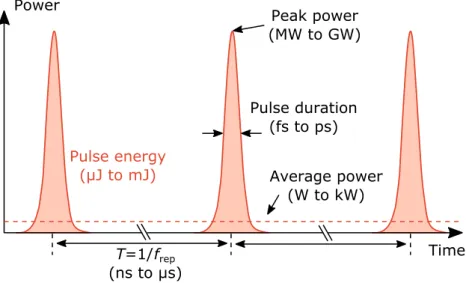
Ultrafast lasers generate optical pulses (Fig. 1), intensive flashes of light, at a certain repetition rate (frep) with pulse durations (τpulse) typically in the order of picoseconds
down to femtoseconds (10-12 s to 10-15 s). The compression of the pulse energy (Epulse)
in a short temporal duration results in the creation of a high peak power (Ppeak ~
Epulse / τpulse). As such, table-top laser systems operating at high repetition rates are
capable of generating up to several GW of peak power, a value comparable to the electrical power generated in nuclear power plants. Focused into a small spot diameter, extreme intensities can be reached that enable accessing and investigating the nonlinear optical properties of matter. Nonlinear optical effects like optical rectification or high harmonic generation enable the wavelength conversion of the
driving laser light from the low-energetic THz range up to the high-energetic extreme ultraviolet, respectively.
Fig. 1. Schematic of an optical pulse train generated by an ultrafast laser operating at high repetition rate. The compression of the pulse energy (area under the pulse envelope) in a short pulse duration results in the creation of a high peak power. The temporal spacing (T) between two successive pulses is the inverse of the repetition rate.
Driving nonlinear frequency conversion with even more extreme performance requires the continuous improvement of ultrafast lasers in following key parameters:
• Shorter pulse durations are beneficial for increasing the peak power. But more important, many nonlinear experiments rely on sub-100-fs pulse durations. In order to reach such short pulse durations, ultrafast lasers typically rely on gain materials with broad gain bandwidth or nonlinear pulse compression.
• Higher average powers result from the demand for higher pulse energy and laser operation at increased repetition rate (Pave = Epulse· frep)
o Higher pulse energies are required for the generation of higher peak
powers. They can be achieved by propagating the optical pulses through several amplifier stages or developing powerful laser oscillators. In case that the average power is the limiting factor higher pulse energies can be achieved by decreasing the repetition rate.
o Increased repetition rates can improve the signal-to-noise ratio, result in
reduced measurement times, and enable new types of nonlinear experiments. As such, targeted experiments require typically a faster recovery time than the temporal spacing between two consecutive pulses. Here, current research effort aims for increasing the repetition rate from several kHz up to the MHz and even the GHz range.
The main technological challenges for power-scaling arise from two factors. First, laser operation at high average power leads to an excessive heat load generated in the laser gain medium and applied to the cavity components. Second, high peak powers result in too much accumulation of nonlinearities during pulse propagation and can cause damage on the laser components. Overcoming those two limiting factors lead to different laser geometries and concepts for further average power and peak power scaling (section 1.2). One direction is based on the amplifier scheme using a low-power seed laser oscillator followed by several amplifier stages. The other direction is based on the development of high-power laser oscillators.
This thesis follows the approach of developing powerful thin-disk laser (TDL) oscillators that operate at MHz repetition rates (section 1.3). It aims for pushing the average power and minimal achievable pulse duration of high-power TDL oscillators in the sub-100-fs pulse duration regime. Prior to this work sub-100-fs TDL oscillators were limited to 5 W average power [3,4] and the minimal achieved pulse duration was 49 fs [5,6]. The combination of the Kerr lens mode-locking scheme and laser materials with broader gain bandwidth enabled the development of sub-100-fs TDL oscillators operating at 4 times higher average power and generating 40% shorter pulse durations than demonstrated before (chapter 2).
The potential of the developed sub-100-fs TDL oscillator for applications in metrology as powerful single-stage frequency comb is demonstrated by stabilizing its carrier-envelope offset frequency (chapter 3). Their suitability to perform nonlinear frequency conversions without additional nonlinear pulse compression is presented by the first THz generation and detection directly driven by the output of a thin-disk laser oscillator. Further scaling of the average power of the driving sub-100-fs TDL oscillator even enabled the generation of broadband THz radiation approaching the
mW-level of THz average power by optical rectification in gallium phosphide (chapter 4).
In a proof-of-principle experiment the extreme nonlinear process of high harmonic generation is driven directly inside the laser cavity of a TDL oscillator (chapter 5). While operating at longer pulse durations of 250 fs, this approach demonstrates the potential of the TDL oscillator technology as single-stage coherent extreme-ultraviolet light source operating at enhanced intracavity average powers and MHz repetition rates.
Finally, the experimental results will be concluded and an overview about future steps for further performance improvement of sub-100-fs Kerr lens mode-locked TDL oscillators and their applications is given (chapter 6).
1.2 Geometries for high-power ultrafast lasers
Heat load in the gain medium during laser operation challenges further scaling of the average power of ultrafast laser systems. The energy difference between pump and laser photon, referred to as quantum defect, is besides non-radiative decays the main heat load generating mechanism during laser operation. An excessive heat load generated in the gain medium or induced into other cavity components can change their optical and material properties. Effects like thermal lensing influence the beam quality and propagation. Induced mechanical stress can ultimately result in damage of the laser gain medium.
Fig. 1. Geometries of the gain medium enabling high-power laser operation. Efficient extraction of the generated heat load is achieved by optimizing the surface-to-volume ratio. Figure are courtesy of Martin Saraceno [7]
Fiber [8], slab [9] and thin disk [10] are different geometrical approaches of the gain medium (Fig. 1). They aim for optimizing the heat extraction by maximizing the surface-to-volume ratio. In the fiber geometry the laser beam is guided in a waveguide structure. Heat load is efficiently extracted in radial direction over the large surface.
The long interaction length in fibers is advantageous for a high gain. However, guiding of optical pulses with high peak power in small fiber-core diameters leads to a strong accumulation of nonlinearities. Temporal stretching techniques, like the chirped pulse amplification, have to be applied to the pulse in order to decrease its peak power and minimize the accumulation of nonlinearities. The fiber geometry finds therefore typically application in high-power amplifier systems. In the slab geometry the gain medium has the form of a thin bar, short in one direction and extended in the other two. The laser beam is propagated along the extended lengths of the slab. Efficient cooling is achieved by extracting the heat load over both larger surfaces. However, the directional cooling induces a thermal gradient in perpendicular direction. This results in the formation of an asymmetric thermal lens. Designing the laser cavity with an elliptical mode or passing the gain material in a zig-zag geometry can compensate partially the thermal lensing. The third approach is the thin-disk geometry. Here the gain medium has the shape of a disk with a thickness in the order of 100 μm. Laser operation with increased beam diameters on the gain medium reduces nonlinearities and makes this approach attractive for operation at high peak powers. As such, the thin-disk concept finds application in high-power laser oscillator and as well in multi-pass and regenerative amplifiers. This thesis applies the thin-disk concept for the development of powerful ultrafast laser oscillators.
1.3 Thin-disk concept
The thin disk is a power-scalable concept for high-power laser sources [10]. For a more detailed overview about the current status of thin-disk lasers the reader is referred to [11]. In the following, the basic concept of the thin-disk geometry will be recapitulated.
The disk features typically a thickness in the range of 100 μm to 300 μm with diameters in the cm-range and is mounted with its backside onto a heat sink [Fig. 2(a)]. Efficient heat extraction is achieved by cooling the backside of the disk with water in turbulent flow [Fig. 2(b)]. The large ratio between cooling surface to disk thickness results in a one-dimensional heat flow in propagation direction of the beam [Fig. 2(c)]. This suppresses thermal lensing and is suitable for laser operation at high average powers.
Fig. 2. (a) A thin disk contacted onto an industrial cooling finger (Trumpf GmbH). Mounting of the disk onto diamond enables efficient heat transport to the coolant. (b) Schematic of the cooling finger. Heat is extracted from the disk by turbulent water flow on the backside. (c) The large ratio between cooling surface to disk thickness features a one-dimensional (1D) heat flow. This suppresses thermal lensing and enables laser operation at high average powers. The disk is coated to be highly-reflective (HR) on the back side and anti-reflective (AR) on the front for pump and laser wavelength.
The backside of the disk is coated to be highly reflective (HR) and the front-side to be anti-reflective (AR) for the pump and laser wavelength [Fig. 2(c)]. The thin thickness limits the single-pass pump absorption and gain. Efficient pump absorption of more than 90% is achieved via a multi-pass pumping scheme allowing for more than 48 passes through the laser gain medium (Fig. 3). Higher cavity round-trip gain can be achieved in a similar manner by folding the laser cavity multiple times over the disk or by implementing several disks into the laser cavity.
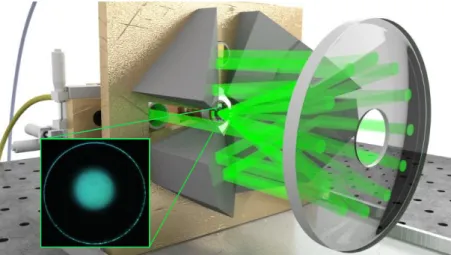
Fig. 3. Illustration on the multi-pass pumping scheme enabling efficient absorption of the pump light. In this image the pump is folded 24 times over the disk (after folding the pump light 12 times on the disk it is reflected back by an end mirror) resulting in 48 passes through the gain medium. The inset shows the pump spot on the disk after alignment of all passes. The illustration is courtesy of Martin Saraceno [7].
Geometrical power-scaling can be achieved by increasing the pump spot diameter on the disk (inset Fig. 3) in combination with an according increase of the laser beam diameter on it. Large beam diameters in the order of millimeters reduce the accumulation of nonlinearities in the disk due to a reduced peak intensity. This is beneficial for laser operation at high peak powers in pulsed laser operation. Nonlinearities can be instead adjusted by means of other cavity components which results in more freedom of the design parameters.
1.4 Summary of included papers and authors
contribution
This thesis concludes the achieved results in a cumulative collection of published papers. Each chapter contains an individual introduction that focusses on giving the reader a basic background about the discussed topic and summarizes the key results of the experimental investigation. Section 2.5 and section 3.3 contain additional experimental results that have not be included into the published papers.
Included papers have been published or are currently submitted to the corresponding journal. The originals are available on OSA Publishing (https://www.osapublishing.org/). Texts and figures contain identical content as published but have been replotted and formatted to match in appearance a corporate thesis style. All papers are reprinted with permission from the corresponding publishers. The copyright of the original publications is retained by the respective copyright holders.
The thesis was realized in the research group of Prof. Dr. Thomas Südmeyer. Each project was carried out in collaboration with other doctoral students, post-docs, senior scientists and external collaborators. The included papers are listed in their appearance in this thesis and the authors contribution to the published result is stated.
• Paper 1: C. Paradis, N. Modsching, V. J. Wittwer, B. Deppe, C. Kränkel, and T. Südmeyer, "Generation of 35-fs pulses from a Kerr lens mode-locked Yb:Lu2O3 thin-disk laser," Opt. Express 25(13), 14918–14925 (2017).
Contribution in discussions and the development of the script for the simulation of the Kerr lens mode-locking. Contribution in the experimental
optimization of the ultrafast TDL oscillator for shortest pulse duration and highest average power in the sub-100-fs pulse duration regime.
• Paper 2: N. Modsching, J. Drs, J. Fischer, C. Paradis, F. Labaye, M. Gaponenko, C. Kränkel, V. J. Wittwer, and T. Südmeyer, "Sub-100-fs Kerr lens mode-locked Yb:Lu2O3 thin-disk laser oscillator operating at 21 W average power," Opt.
Express 27(11), 16111–16120 (2019).
Project leader, development of the cavity design, setup of the TDL oscillator, full experimental characterization and optimization of the mode-locked laser performance.
• Paper 3: N. Modsching, C. Paradis, F. Labaye, M. Gaponenko, I. J. Graumann, A. Diebold, F. Emaury, V. J. Wittwer, and T. Südmeyer, "Kerr lens mode-locked Yb:CALGO thin-disk laser," Opt. Lett. 43(4), 879–882 (2018).
Project leader, development of the cavity design, setup of the TDL oscillator, full experimental characterization and optimization of the mode-locked laser performance.
• Paper 4: N. Modsching, C. Paradis, P. Brochard, N. Jornod, K. Gürel, C. Kränkel, S. Schilt, V. J. Wittwer, and T. Südmeyer, "Carrier-envelope offset frequency stabilization of a thin-disk laser oscillator operating in the strongly self-phase modulation broadened regime," Opt. Express 26(22), 28461 (2018).
Project leader, contribution in developing the driving laser system (paper 1), implementation of the stabilization electronics in the experimental setup, detection of the carrier-envelope offset frequency (fCEO)
with a provided f-to-2f interferometer, experimental characterization and stabilization of the fCEO, optimization of the active feedback loop.
• Paper 5: C. Paradis, J. Drs, N. Modsching, O. Razskazovskaya, F. Meyer, C. Kränkel, C. J. Saraceno, V. J. Wittwer, and T. Südmeyer, "Broadband terahertz pulse generation driven by an ultrafast thin-disk laser oscillator," Opt. Express 26(20), 26377–26384 (2018).
Contribution in developing the driving laser system (paper 1), participation in preliminary experimental investigations for THz generation,
participation in measurement campaigns and optimization of the experimental setup.
• Paper 6: J. Drs, N. Modsching, C. Paradis, C. Kränkel, V. J. Wittwer, O. Razskazovskaya, and T. Südmeyer, "Optical rectification of ultrafast Yb-lasers: Pushing power and bandwidth of THz generation in GaP," JOSA B
submitted (2019).
Experimental modification of the driving TDL oscillator to different pulse durations (paper 1), power-scaling of the TDL laser oscillator for achieving the high THz average power result (paper 2), participation in all THz measurement campaigns.
• Paper 7: F. Labaye, M. Gaponenko, V. J. Wittwer, A. Diebold, C. Paradis,
N. Modsching, L. Merceron, F. Emaury, I. J. Graumann, C. R. Phillips,
C. J. Saraceno, C. Kränkel, U. Keller, and T. Südmeyer, "Extreme ultraviolet light source at a megahertz repetition rate based on high-harmonic generation inside a mode-locked thin-disk laser oscillator," Opt. Lett. 42(24), 5170–5173 (2017).
Initial experimental investigation demonstrating the suitability of the used Yb:Lu2O3 disk for the generation of sub-300-fs pulses durations at high
average powers by SESAM mode-locking. Contribution in the discussion about cavity design.
References
1. R. Weiss, "Nobel Lecture: LIGO and the discovery of gravitational waves I," Rev. Mod. Phys.
90(4)(2018).
2. Royal Swedish Academy of Sciences, "Press release of the Nobel Prize in Physics 2018," www.nobelprize.org (October 2, 2018).
3. A. Diebold, F. Emaury, C. Schriber, M. Golling, C. J. Saraceno, T. Südmeyer, and U. Keller, "SESAM mode-locked Yb:CaGdAlO4 thin disk laser with 62 fs pulse generation," Opt. Lett. 38(19),
3842–3845 (2013).
4. C. J. Saraceno, O. H. Heckl, C. R. E. Baer, C. Schriber, M. Golling, K. Beil, C. Kränkel, T. Südmeyer, G. Huber, and U. Keller, "Sub-100 femtosecond pulses from a SESAM modelocked thin disk laser," Appl. Phys. B 106(3), 559–562 (2012).
5. C. Schriber, L. Merceron, A. Diebold, F. Emaury, M. Golling, K. Beil, C. Kränkel, C. J. Saraceno, T. Südmeyer, and U. Keller, "Pushing SESAM modelocked thin-disk lasers to shortest pulse durations," in Advanced Solid State Lasers (Optical Society of America, 2014), paper AF1A.4. 6. J. Zhang, J. Brons, M. Seidel, V. Pervak, V. Kalashnikov, Z. Wei, A. Apolonski, F. Krausz, and O.
Pronin, "49-fs Yb:YAG thin-disk oscillator with distributed Kerr-lens mode-locking," in European Quantum Electronics Conference (Optical Society of America, 2015), paper PD_A_1.
7. M. Saraceno, [email protected].
8. E. Snitzer, "Proposed Fiber Cavities for Optical Masers," J. Appl. Phys. 32(1), 36–39 (1961). 9. K. Du, P. Loosen, and R. Poprawe, "Optical amplifier arrangement for a solid state laser," U.S.
patent 6,654,163 (2003).
10. A. Giesen, H. Hügel, A. Voss, K. Wittig, U. Brauch, and H. Opower, "Scalable concept for diode-pumped high-power solid-state lasers," Appl. Phys. B Lasers Opt. 58(5), 365–372 (1994).
11. C. J. Saraceno, "Mode-locked thin-disk lasers and their potential application for high-power terahertz generation," J. Opt. 20(4), 044010 (2018).
13
Chapter 2
Cutting-edge sub-100-fs thin-disk
laser oscillators
This chapter presents the development of Kerr lens mode-locked (KLM) thin-disk laser (TDL) oscillators operating in the sub-100-fs pulse duration regime. Section 2.1 summarizes in an overview the achieved results in the framework of this thesis. Subsection 2.1.1 and 2.1.2 introduce the Kerr lens mode-locking technique and discuss the physical properties of the chosen Yb-doped gain materials, respectively. Section 2.2 to 2.4 present the developed KLM TDL oscillators. Section 2.5 discusses in more detail the experimental optimization for laser operation in the sub-100-fs pulse duration regime. Applications of the developed KLM TDL oscillators will be presented ongoing in chapter 3 and chapter 4.
2.1 Generation of sub-100-fs pulse durations from
thin-disk laser oscillators
In the framework of this thesis ultrafast TDL oscillators were developed with improved performance for laser operation the sub-100-fs pulse duration regime. Key ingredient was the combination of the Kerr lens mode-locking scheme for TDL oscillators [1] with the gain materials Yb:Lu2O3 [2] and Yb:CALGO [3]. This
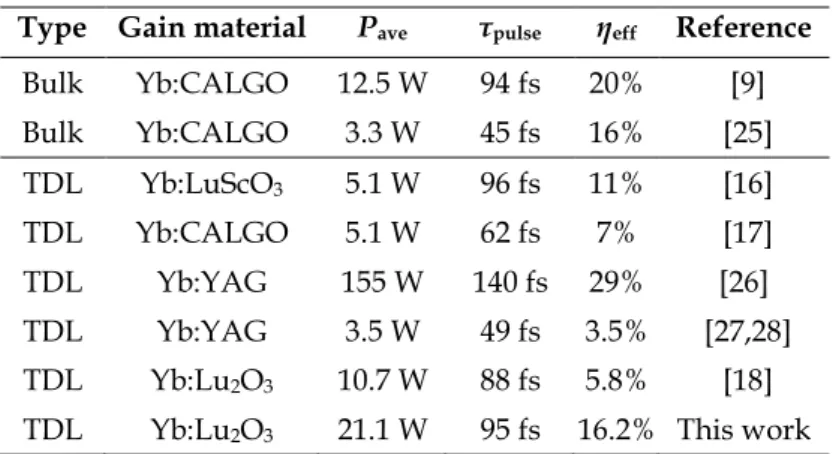
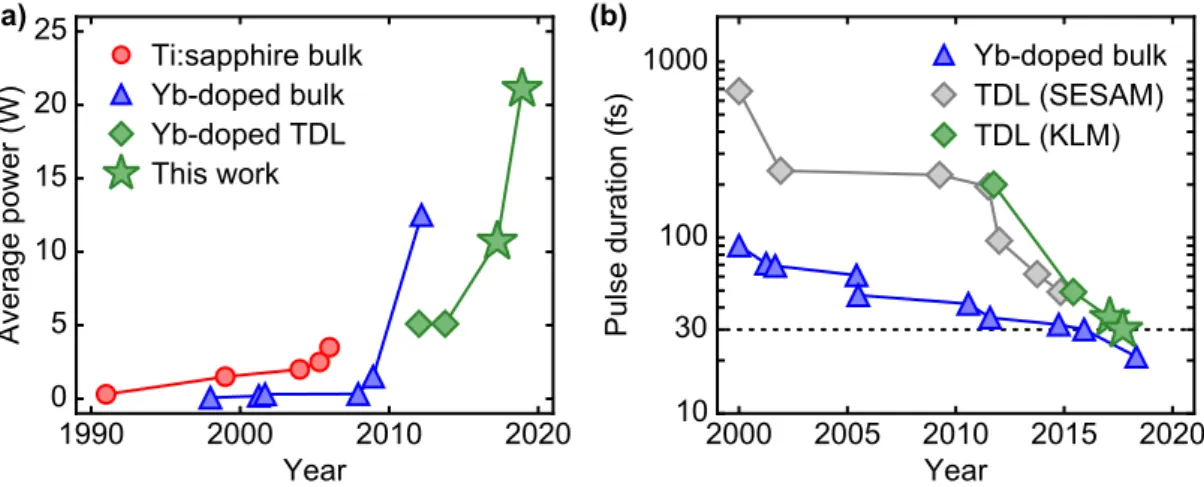
combination enabled the development of sub-100-fs TDL oscillators operating at a 4 times higher average power compared to previous results [Fig. 1(a)]. Additionally,
unprecedented pulse durations of ultrafast TDL oscillators have been achieved, 40% shorter compared to previous results [Fig. 1(b)]. This resulted in a change of paradigm showing that the thin-disk geometry can generate pulse durations from Yb-doped gain materials as short as the one achievable with Yb-doped bulk oscillators.
Fig. 1. (a) Progress in average power of sub-100-fs oscillators based on Ti:sapphire and Yb-doped gain materials for bulk and thin-disk laser (TDL) geometry. (b) Evolution of the shortest pulse duration generated by ultrafast Yb-doped bulk and TDL oscillators. Ultrafast TDL oscillators are distinguished into the applied mode-locking technique (SESAM: saturable absorber mirror; KLM: Kerr lens mode-locking). Presented results in this thesis are highlighted with a green star, references can be found in [4,5].
Subsection 2.1.1 introduces the Kerr lens mode-locking scheme of TDL oscillators and subsection 2.1.2 summarizes the physical key properties of the applied gain materials Yb:Lu2O3 and Yb:CALGO in comparison to Yb:YAG, the standard gain
material for nowadays TDL. Section 2.2 to 2.4 contain the experimental results of the developed Kerr lens mode-locked (KLM) TDL oscillators that are following concluded with their experimental results and key messages.
Section 2.2 presents the development of a KLM TDL oscillator based on the gain material Yb:Lu2O3. Different combinations of output-coupler transmission, introduced
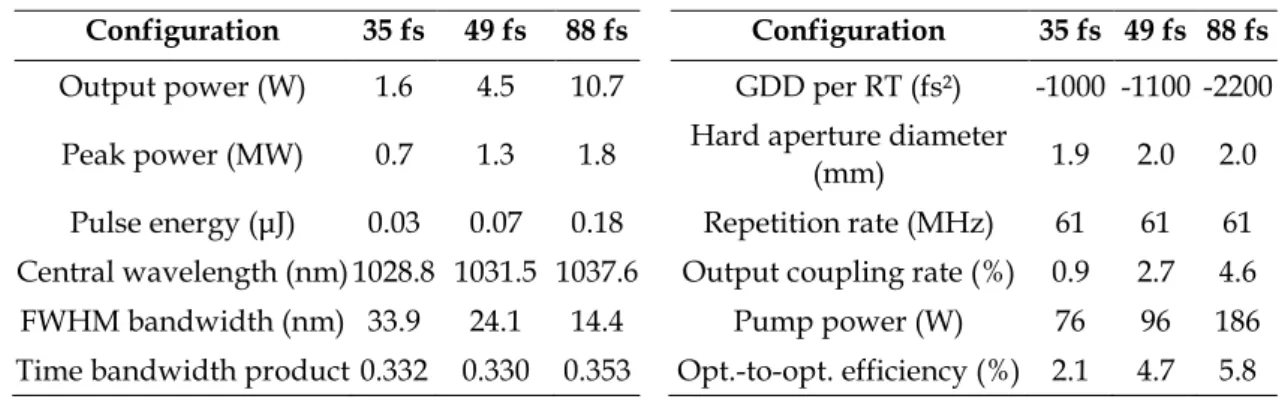
group delay dispersion and hard aperture diameter have been realized to study the impact of those laser parameter on the pulse duration and average power.
• Laser operation at 10.7 W of average power in 88-fs pulses, 4.5 W in 49-fs pulses, and 1.6 W in 35-fs pulses
• First demonstration of a sub-100-fs TDL oscillator operating at more than 10 W of average power
• At that time the shortest pulse duration generated by a TDL oscillator
• Demonstration that Yb:Lu2O3 is a promising gain material for power-scaling of
sub-100-fs TDL oscillators
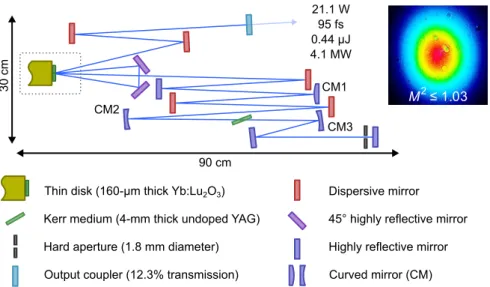
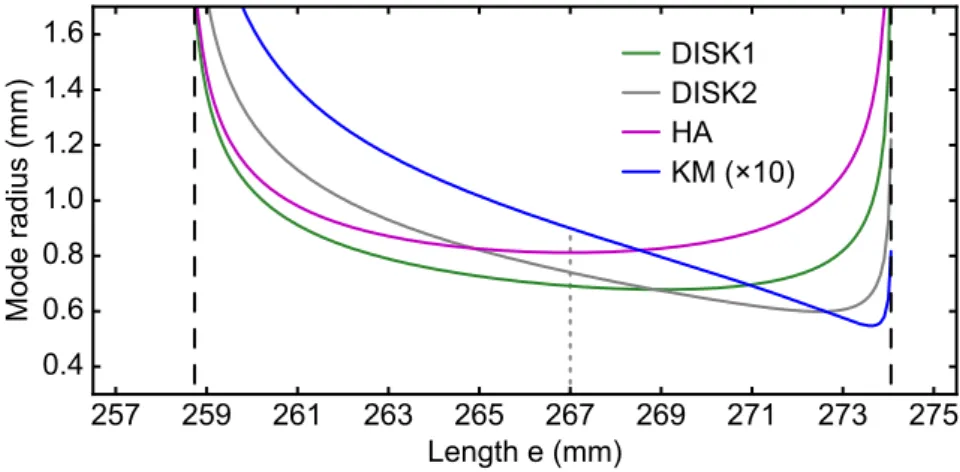
Section 2.3 presents the performance improvement of the KLM TDL oscillator developed in section 2.2. Based on the same Yb:Lu2O3 disk a modified cavity design
has been developed folding the laser cavity a second time on the disk. The impact of higher round-trip gain onto the laser performance in the sub-100-fs pulse duration regime was investigated.
• Laser operation at 21 W of average power in 95-fs pulses
• Highest average power demonstrated by a sub-100-fs oscillator
• Highest optical-to-optical efficiency achieved by a sub-100-fs TDL oscillator • Demonstration that TDL oscillators operating in the self-phase modulation
broadened regime can generate sub-100-fs pulses at high average powers with optical-to-optical efficiencies that are comparable to sub-100-fs Yb-based bulk oscillators
Section 2.4 presents the development of a KLM TDL oscillator based on the broadband gain material Yb:CALGO.
• First demonstration of a KLM Yb:CALGO TDL oscillator.
• Generation of 30-fs pulses which is the shortest pulse duration so far achieved by an ultrafast TDL oscillator
• Advantage of the thin-disk pumping scheme for the generation of even shorter pulse duration in comparison to standard end-pumped bulk oscillators.
Section 2.5 concludes this chapter by explaining in more detail the underlying experimental optimization for laser operation in the sub-100-fs pulse duration regime. The impact of various optimization parameters onto the laser performance is determined.
2.1.1 Mode-locking of TDL oscillators via the Kerr effect
Passive mode-locking enables the formation of a pulse inside a laser oscillator with durations in the femtosecond regime [6–8]. The fundamental principle of mode-locking has been intensively discussed in various text books [9–11]. In the thin-disk
geometry several mode-locking techniques have been applied, e.g. by saturable absorber mirrors (SESAMs) [12], Kerr lens mode-locking [13], nonlinear polarization rotation [14] and, more recently, non-linear mirror mode-locking [15]. Among those techniques the shortest pulse durations were generated via Kerr lens mode-locking as will be presented in this thesis.
The Kerr effect describes the change of the refractive index of a material (n) in the presence of light with high intensity (I). Its strength depends on the nonlinear material refractive index n2 and the intensity of the light as follows
𝑛(𝐼) = 𝑛 + 𝑛2𝐼.
In a transverse Gaussian profile, the highest intensity appears in the center of the laser beam. In case that n2 > 0 the Kerr effect creates a corresponding refractive index
profile with the maximum in the center. The increased refractive index retards the central laser beam components compared to the outer ones. This results in the formation of an intensity dependent focusing lens. The focal length of the so created Kerr lens (fKerr) can be approximated by
𝑓Kerr−1 = 8𝑛2𝑑KM
𝜋𝑤2 · 𝐼,
where dKM is the thickness of the Kerr medium (KM) and w the beam radius in the
KM [16].
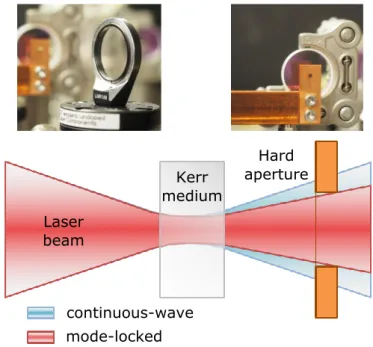
Mode-locking via the Kerr effect is based on the formation of a Kerr lens in a bulk material, referred to as Kerr medium [inset Fig. 2(left)]. The KM is usually an undoped YAG, sapphire or fused silica plate of several millimeter thickness. It is typically placed under Brewster´s angle into the cavity to avoid Fresnel reflection losses. In the standard Kerr lens mode-locking scheme of TDL oscillators the KM is placed in the vicinity of an intracavity focus that is created between two curved mirrors [13]. The Kerr lens can promote two types of passive loss modulation for the generation of ultrashort pulses. In case of “hard aperture mode-locking” the required loss modulation is achieved by placing a pinhole into the laser cavity [inset Fig. 2(right)]. The Kerr lens focusses the laser beam at the position of the hard aperture [Fig. 2(bottom)]. Reduced round-trip losses make the mode-locked operation more
favourable than the continuous-wave operation. In case of “soft aperture mode-locking” the Kerr lens improves in mode-locked operation the overlap of the laser beam with the pumped area in the gain material.
Fig. 2. (left) Kerr medium and (right) pinhole placed in front of a cavity end mirror for hard aperture mode-locking. (bottom) Schematic of the beam propagation in continuous-wave and in mode-locked operation. The Kerr lens in mode-locked operation reduces the losses by focusing the laser beam through the hard aperture.
Kerr lens mode-locking features a spectrally broadband passive loss modulation at high modulation depths. The nearly instantaneous response and relaxation is beneficial for the formation of ultrashort pulse durations. Without real absorption taking place, this technique is as well suitable for laser operation at high intracavity average powers and peak powers. However, the challenge for Kerr lens mode-locking relies in the cavity design. Usually a continuous-wave operation close to the edge of the stability zone is required [13].
Focussing of the pulse into the KM generates besides the Kerr lens also self-phase modulation (SPM). The amount of SPM created per cavity roundtrip (γSPM) along the
propagation length z can be estimated for a Gaussian beam by
𝛾SPM= 2π 𝜆 ∫ 𝑛2 2 𝜋 · 𝑤2(𝑧)· d𝑧, 𝐿 0
where λ is the wavelength [10]. SPM generates new frequency components for a corresponding up-chirp. The created amount of SPM in the KM is usually much larger than the one accumulated during free space propagation. For soliton pulse formation the SPM has to be accordingly compensated by negative group delay dispersion (GDD). The fundamental soliton equation relates the resulting pulse energy Epulse, to
the amount of total GDD, the SPM-coefficient γSPM, and the full width at half maximum
(FWHM) pulse duration τFWHM as follows:
𝐸pulse =2 · 1.76 · |GDD| |γSPM| · 𝜏FWHM
A large amount of SPM can result in the generation of frequency components beyond the gain bandwidth. This enables the generation of shorter pulse duration than actually supported by the gain material [17]. By operating in the strongly SPM-broadened regime a KLM Yb:YAG TDL oscillator generated pulses durations as short as 49 fs [18]. Section 2.2 presents the development of a KLM Yb:Lu2O3 TDL oscillator
operating in the same regime generating even a shorter pulse duration of 35 fs. In both cases enabled the large amount of SPM the expansion of the optical spectrum three times beyond the corresponding FWHM gain bandwidth.
2.1.2 Yb-doped gain materials
The development of novel gain materials and the continuous improvement of the crystal quality from existing ones is crucial for further progress of powerful ultrafast lasers. Besides the manifold of laser active ions (Cr3+, Er3+, Ti3+, Tm3+, Ho3+, Yb3+,…),
Yb-doped gain materials feature the most suitable properties for laser operation at high average power [19]. Main advantages are a reduced heat load due to the low quantum defect, high doping concentration up to 10% and optical pumping with diode laser systems that are commercially available at kW power levels. The choice of the Yb-doped host [19–23] (e.g. garnets like YAG or LuAG; sesquioxides like Lu2O3, Sc2O3
or LuScO3; tungstates like KYW, KGW or KLuW; vanadates like LuVO, YVO, GdVO;
CALGO or CALYO) is crucial for the thermo-mechanical and spectral properties of the gain material. An extensive overview about Yb-doped gain materials and their suitability for the development of sub-100-fs TDL oscillators is given in [21]. Most favourable properties of a gain material for application in the thin-disk configuration
are: High thermal conductivity, large gain cross-sections, broad spectral gain bandwidth, high doping concentrations, high crystal quality, homogenous crystal properties, reproducible manufacturing of large crystal diameters. However, the ideal gain material fulfilling all required properties does not exist yet and a trade-off has to be found.
In the framework of this thesis the gain materials Yb:Lu2O3 and Yb:CALGO have
been selected as most promising for the development of sub-100-fs TDL oscillators. Their gain cross-sections at an inversion level β of 0.3 are shown in Fig. 1 in comparison to Yb:YAG, the standard gain material of TDLs nowadays. Selected physical properties of the three gain materials are summarized in Tab. 1.
Fig. 3. Gain cross sections (inversion level β = 0.3) of the gain materials Yb:Lu2O3 and
Yb:CALGO (σ-polarization) are shown in comparison to Yb:YAG, the standard gain material of nowadays high-power TDL. The figure has been taken from [5] and modified.
The physical properties of Yb:Lu2O3 are promising for the development of
powerful sub-100-fs TDL oscillators (Tab. 1). Its thermal conductivity drops only slightly with increasing doping concentration [20]. In comparison to Yb:YAG this results in a 50% higher thermal conductivity at a doping concentration of 3 at.%. The 40% smaller gain cross section could thus be compensated with an increased doping concentration and a larger disk thickness. The 60% larger FWHM gain bandwidth at an inversion level of β = 0.3 is beneficial for the generation of sub-100-fs pulse durations. However, the extremely high melting temperature of 2500 °C makes the fabrication of single crystal Yb:Lu2O3 challenging [19]. Highest single crystal quality
was so far achieved by the heat-exchanger method [24]. The potential of single crystal Yb:Lu2O3 TDL oscillators was demonstrated with 670 W of average power in
multi-mode operation [25]. In multi-mode-locked operation 141 W of average power were achieved at a somewhat longer pulse duration of 738 fs [26]. Recently, the fabrication of ceramic Yb:Lu2O3 via the sintering method has become another promising approach
to fabricate Yb:Lu2O3 disks at lower temperatures [27]. Ceramic Yb:Lu2O3 TDL
oscillators achieved already 174 W of average power in multi-mode operation [28]. In mode-locked operation 3.7 W were demonstrated with 98-fs pulses [29].
The potential of KLM TDL oscillators based on crystalline Yb:Lu2O3 disks for
high-power laser operation in the sub-100-fs pulse duration regime is presented in section 2.2. Section 2.3 demonstrates laser operation of a sub-100-fs Yb:Lu2O3 KLM
TDL oscillators at 21 W of average power.
Tab. 1. Selected physical properties of the gain materials Yb:YAG, Yb:Lu2O3 and Yb:CALGO
(FWHM, full width at half maximum) [3,30,31].
Yb:YAG Yb:Lu2O3 Yb:CALGO
(c-cut)
Chemical formula Yb:Y3Al5O12 Yb:Lu2O3 Yb:CaGdAlO4
Melting point (undoped) 1930 °C 2500 °C < 1700 °C
Thermal conductivity (undoped) 9.8 W/m· K 12.2 W/m· K 11.4 W/m· K
Thermal conductivity (Yb-doped) 7.1 W/m· K
(3 at.%)
10.8 W/m· K (3 at.%)
6.3 W/m· K (2 at.%)
Gain properties at inversion level of β = 0.3 (values retrieved from Fig. 1)
Central wavelength 1030 nm 1033 nm 1042 nm
Gain cross section 5.5· 10-21 cm2 3.3· 10-21 cm2 1.5· 10-21 cm2
FWHM bandwidth 8 nm 13 nm > 60 nm
Bandwidth corresponding Fourier limited pulse duration
140 fs 90 fs < 20 fs
Yb:CALGO features the broadest gain bandwidth of Yb-doped gain materials that have been so far applied in the thin-disk configuration (Fig. 1). It supports theoretically the generation of sub-20-fs pulse durations (Tab. 1). However, the disordered crystalline structure results in a strongly reduced gain cross section and restricts the available single pass gain. Although the thermal conductivity drops for higher doping concentrations, it remains good compared to other broadband gain materials [21]. The strongest limitation in the development of more powerful ultrafast Yb:CALGO TDL oscillators is the available disk quality which still suffers from inhomogeneities [5,32]. In the thin-disk configuration already 190 W of average power were reported in
![Tab. 1. Selected physical properties of the gain materials Yb:YAG, Yb:Lu 2 O 3 and Yb:CALGO (FWHM, full width at half maximum) [3,30,31]](https://thumb-eu.123doks.com/thumbv2/123doknet/14809703.610679/46.892.129.729.496.822/selected-physical-properties-materials-calgo-fwhm-width-maximum.webp)
![Fig. 1. Progress of the average power of ultrafast solid-state laser oscillators operating in the sub-100-fs pulse duration regime (Ti:sapphire [5,13], doped bulk [6,13–15], Yb-doped thin-disk laser (TDL) [16–18])](https://thumb-eu.123doks.com/thumbv2/123doknet/14809703.610679/62.892.230.622.625.866/progress-average-ultrafast-oscillators-operating-duration-regime-sapphire.webp)