HAL Id: hal-02412851
https://hal.archives-ouvertes.fr/hal-02412851
Submitted on 15 Dec 2019HAL is a multi-disciplinary open access archive for the deposit and dissemination of sci-entific research documents, whether they are pub-lished or not. The documents may come from teaching and research institutions in France or abroad, or from public or private research centers.
L’archive ouverte pluridisciplinaire HAL, est destinée au dépôt et à la diffusion de documents scientifiques de niveau recherche, publiés ou non, émanant des établissements d’enseignement et de recherche français ou étrangers, des laboratoires publics ou privés.
Algorithms as a discovery process in frequentist
approach to prediction interval
Jannick Trunkenwald, Dominique Laval
To cite this version:
Jannick Trunkenwald, Dominique Laval. Algorithms as a discovery process in frequentist approach to prediction interval. Eleventh Congress of the European Society for Research in Mathematics Education (CERME11), Utrecht University, Feb 2019, Utrecht, Netherlands. �hal-02412851�
Algorithms as a discovery process in frequentist approach to
prediction interval
Jannick Trunkenwald and Dominique Laval
Université Diderot-Paris, France; [email protected] ; [email protected] This article deals with the contribution of algorithmic to introduce the frequentist approach to probability. Our attention is focused on teachers in training who have to perform a sampling simulation program in order to solve a probabilistic task. The mathematical work corresponding to this discovery process of the prediction interval is analysed in its semiotic, discursive, and instrumental dimensions, within each of involved fields (probabilities, descriptive statistics and algorithmic). Synergies and interactions between these various fields are taken into account. Methodological tools MWS (Kuzniak, 2011) and AWS (Laval, 2018) are used to lead this study.
Keywords: Algorithmic, Work Spaces,frequentist, probability, field
Introduction
In France, teaching of probability in upper school commences with a double approach: “combinatorial” and “frequentist”. This makes it possible to connect the abstract notion of probability to “real” world, as it is perceived through our senses. The approach of frequency derives from binomial distribution with a deductive reasoning based upon random variables. The approach of probability is based on sampling fluctuation with empirical observations of frequencies. We choose to analyse the introduction to sampling fluctuation that empirically establishes the prediction interval principle, which is the only formalized rule taught at 10th grade level. We make the choice to observe the work of teachers during a training course, by taking in account instrumental, semiotic and discursive dimensions. More particularly, this paper deals with existing interactions between fields such as probability and descriptive statistics, but also algorithmics during teacher’s work.
Frequentist approach to sampling fluctuation
The 10th grade program in French school system leads to the discovery of sampling fluctuation with the following property: Let p be the probability of success, and let n be the number of repeated
random experiments. Any frequency of success verifies
with at least a 95%
level of confidence.Nechache (2016) notices the absence in 10th grade of a probabilistic theoretical reference that would make it possible to approach this interval of fluctuation by deductive reasoning. The discovery process of this interval remains indeed at this stage, experimental and based on observation of samples which have the same size. Each frequency value corresponds to a sample obtained itself by repeating the considered random experiment. This is an empirical approach based on inductive reasoning. In addition, the “time cost” corresponding to the need of repeating the same experiment a large number of times entails a need for automation. And this idea is “facilitated” by using of computing which is based on a pseudo-random generator operation. Thus the “frequentist” approach requires consideration of three fields: probabilities, descriptive statistics and algorithmics.
A digital environment (“spreadsheet” or “programming software”) makes possible to reduce the time spent on repeating the random experiment. Specific skills are needed to digital field
(algorithmic, syntax of machine language, user interface…), and the lack of computing expertise could cause additional difficulties for students. It could also cause a meta-cognitive (or even cognitive) concern to teachers. Using digital field makes possible to automate an experimental protocol that requires the use of gestures, syntax, and specific modes of thinking. However, we can also question the specific contribution resulting from the use of a machine-implementable method, for a better comprehension of the frequentist approach (from a mathematical point of view). This question seems being even more important for teachers. Indeed, they are supposed to look closely at their practices. We can thus consider three main ways of exploiting a digital field to modelize the random experiment: - a spreadsheet; - the construction of “paper-and-pencil” algorithms and the actual implementation on the computer in order to test them; - the use of simulation algorithms or spreadsheet provided and already built. Each of these forms of use can be assimilated to an instrumentalization of computing or algorithmics artifacts to construct a “frequentist” approach in probabilistic or statistical fields.
We choose not to approach the spreadsheet case and to restrict the scope to algorithms. We believe that focusing on algorithms enables us to study the instrumental, semiotic and discursive dimensions which will be involved during mathematical and algorithmic work on sampling fluctuations. We thus seek to study the contribution of an algorithmic thought (Laval, 2018; Modeste, 2012) in the context of a mathematical work on probabilities and statistics. In particular, we think that writing the simulation algorithm corresponds to a higher stage of formalization for different involved statistical protocols, and that the role of “language” will take on particular importance in this sense.
Observations carried out in teacher training
Training on the simulation of sampling fluctuation at 10th grade level is conducted during an internship at the French High School in Algiers on May 2018. Five groups of three teachers (A, B, C, D, and E) have to solve the following problem: “What is the probability that the distance
between two points randomly chosen along a line segment S, is more than half the length of the segment S?”.
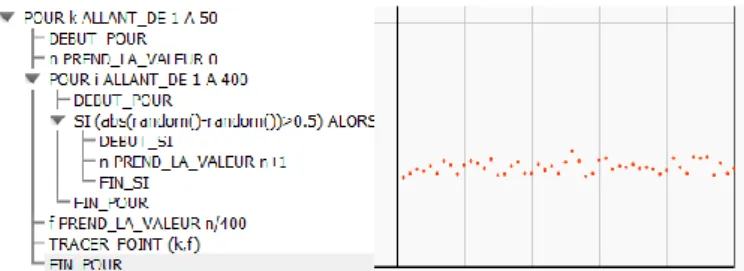
We build on existing work previously undertaken by Nechache (2016) and Trunkenwald (2018), to consider this task as being representative of institutional expectations for the “frequentist” approach. It is possible to explore sampling fluctuation with a real repetition of the random experiment (case of strings of twines cut with scissors), but considering this long process with randomization by a human being choice, our hypothesis is that teachers will use a numerical simulation operating with a pseudo-random generator (Alea()), which returns a random number between 0 and 1 simulating the position of a randomly selected point on the S-segment. The modelling work highlighting sampling fluctuation can find its formalized expression through a simulation algorithm. Indeed, the random experiment providing distance between two selected points can be simulated with |(Alea()-Alea())| as computing instruction which can be considered as a level 0 algorithm used for each simulation of the random experiment. Another level 1 algorithm can be constructed from the level 0 algorithm, by repeating the random experiment to obtain directly a simulated frequency of success (Figure 1).
Figure 1: Level 1 and level 2 algorithms written in pseudo-code.
Running several times level 1 algorithm generates a list of frequencies, which can be represented as a cloud diagram (scatter plot). For this purpose, a third step can be envisaged in digital field: the level 2 algorithm (Figure 1) automating the layout of the cloud. Then level 2 algorithm is constructed from level 0 algorithm, by repeating the simulated frequency of success to draw directly the cloud.
The working groups do not have access to any pre-existing files to accomplish their task. But the algorithms they will design can be adapted for a later activity based on a roll of three dice. The groups manage more or less easily, with the help of the trainer when it is necessary, realizing a numerical model for the simulation of a frequency calculation. Only one group (the E) uses the spreadsheet, and only one group (the C) manages to finalize level 2 algorithm. Indeed, the transition from level 1 to level 2 corresponds to a tricky stage, especially the algorithmic writing of a statistical protocol that would consist in exploiting (on “paper”) the results provided by level 1 algorithm. Our hypothesis is that it is an epistemological obstacle linked to the encapsulation of an algorithm in another (principle of a procedural subroutine), in order to automate the execution of the first one. Other difficulties at the interaction of statistical and algorithmic domains are identified during the training session. We present (Figure 2) an excerpt from the transcription of exchanges between the trainer and the group B, concerning the implementation in level 1 algorithm of a counter.
Figure 2: Excerpt of a 8’14’’record with group B
In this excerpt the counter with its initialization, conditioned incrementation, and final exploitation appears as a complex construction. Its drafting is integrated into three levels of the algorithm script, with consideration of other instructions. Trainees try to locate a specific position which does not really exist for the counter... We observe a confusion between “success counter” and “simulation step counter”. Step counter is a “natural” process in statistics that becomes a difficulty in algorithmics. Finally, a similar difficulty appears in a confusion between the instructions “result value” provided by the counter, and “incrementation” of intermediate values used for its calculation. We can also observe a difficulty between probability and statistics fields: S2 speaks of “favorable case” instead of “success achieved”.
In addition, transcripts of the session show difficulties related to the numerical modelling of the random experiment. Some difficulties appear in other groups, such as reluctance to use a pseudo-random generator, reference to the geometry field with consideration of lengths ratio as a probability, and lack of definition for abscissa. All these observations show us the importance of interactions between various fields, as probability and statistics, but also with algorithmics, when introducing the frequentist approach of the prediction interval. We believe that an analysis of the mathematical and algorithmic work in these various fields with their interactions, can help us to refine our understanding of some difficulties encountered by trainees.
The choice of theoretical framework and research question
Nilsson, Schindler, and Bakker (2017) presented a literature review of theoretical work apparent in Statistics Education Research (SER) over the past 11 years, encouraging educators and researchers to be explicit about their background theories and orienting: “in the reviewed articles there was no deeper theorization of computer assisted instruction in statistics. (…) In the 35 articles we found no theoretical attempts on a more specific level (…) such as guiding principles for designing tasks and sequencing tasks in a digital learning environment or frameworks for explaining and understanding the relationship between digital and analogue learning environments.”
Activities that involve a mathematical task associated with multiple domains can be analysed by considering that entities involved in the task appear under different semiotic, instrumental, and discursive representations. Some researchers have developed frameworks to conduct studies of these activities according to the type of studied representations. Duval (1993) named “registers” the representations organized in semiotic systems. Processes of handling and conversions are located inside and between these registers, and this description is also supplemented by the idea of “instruments” in the mathematical activity of students. Rabardel theorical framework (1995) focused on this “instrumental approach”, and described the use of digital technologies to teach and learn mathematics in different contexts. Such a framework consisting of “objects” from mathematical fields with relationships between them, and different expressions or associated mental images, had already been addressed earlier by Douady (1986). However, some researchers have emphasized the inseparable development of instrument-related knowledge and mathematical knowledge, all in an instrumental genesis. An implementation of these issues for analysing articulation between the algorithmic and mathematical fields is presented in a didactic engineering of Laval (2018) based on the Work Spaces framework. And we wish to see taken into account the
induced relations by instrumental and mathematical signs. Then we hypothesise that coordinating the activity in several fields could provide answers in this sense.
Indeed, in algorithmics the activity is located into an instrument for solving the mathematical task, with a specific system of signs for computer science. On the other hand, in mathematics the activity consists on solving the task from a mathematical point of view and using signs making it possible to understand and justify. Next, we have to choose an appropriate theorical framework that can give meaning to the learner’s work during an activity involving several fields with their interactions, considering the semiotic, instrumental, and discursive dimensions specific to each field. We assume that articulations between Spaces of Specific Mathematical Work (MWSs) (Kuzniak & Richard, 2014) and Spaces of Algorithmic Work (AWS) (Laval, 2018), will allow to study the different geneses of the representamen and processes, from the point of view of the learners’ MWSs and AWS, but also to approach the interactions between the probability/statistics and algorithmics. We briefly present this theoretical framework in the following section. Then the research question of this article is how this framework can analyse a learner’s work involving computer programming in a frequentist approach to the prediction interval. French programs also emphasize a potential contribution of algorithmic work to the understanding of mathematical concepts, which raises the question of interactions between domains in learners’ activity (Lagrange & Laval, 2019; Laval, 2018).
The working spaces MWSs AWS – First analyses
The methodological tools MWSs (Kuzniak, Tanguay, & Elia, 2016) and AWSs (Laval, 2018) help us to decompose intellectual perceptions at stake, during activity in mathematics and algorithmics fields. Three instrumental, semiotic, and discursive dimensions are considered, each generating a dynamic relationship between an epistemological plane and a cognitive plane (Figure 3).
Figure 3: Case of Algorithmic Space Work (Laval, 2018)
Technological (artifact), semiotic (representamen), and theoretical (referential) tools of epistemological plane can then be exploited using appropriate schemes. In this case, we respectively refer to instrumental, semiotic, and discursive genesis, which respectively produce constructs, visualizations, and proofs in the cognitive plane. The activation of two geneses can lead to a circulation between dimensions that carry them, which could sometimes be assimilated to the idea of modelling (Laval, 2018). We call “projection” of MWSs (or AWS) the restriction to a specific
field of what we analyse in the Workspace. We write projections of the MWS on probability and statistic fields, as respectively MWSProb and MWSStat. In order to avoid visual overload, we present
diagrams of these projections with a view from above. Points and bolded lines represent the different discursive (D), instrumental (I), and semiotic (S) geneses, as well as circulations in planes located between these geneses’ axes.
The main interaction between MWS and AWS is related to the use of a pseudo-random generator. This artifact is first instrumentalized within AWS to build a simulation of the random experiment. The link between this construction and the associated formulation causes an I-D circulation and leads to a discursive genesis enriching the AWS referential. With reference to Laval (2015), algorithmic design work presents a triple instrumental, semiotic, and discursive dimension within AWS. We link this discursive dimension with the idea of “language”. Indeed, level 0, 1, and 2 algorithms are formalized writes of experimental protocols. Algorithmic expressions in “natural” language, with their three encapsulated structures, then constitute an explicit formulation of the procedure to be followed in the statistical field to carry out a “frequentist approach” to the prediction interval. This explanation may be associated with the idea of proof. This consideration brings us back to discursive genesis which, according to Laval (2015), is confirmed when the program is able to run (at the first level of paradigm corresponding to an intuitive view of the algorithm).
It should be noted that this AWS discursive dimension tends to fade from “semiotico-instrumental” plan, when working with a spreadsheet tool, whose syntactic aspects are more related to nature of artifacts (even if discursive dimension is still activated from cognitive plane to mobilize tools of AWS referential). A complex construction with a spreadsheet can also reduce “intellectual visualization” of a phenomenon and thus semiotic dimension, to be limited to instrumental dimension. Finally, AWS loses all activity when the algorithm implemented in a digital environment is provided to learners to be executed and used without any modification work expected in its own structure. The algorithm is then reduced to an artifact ready to be instrumentalised in MWS projection on another field.
Simulation programs and dynamic tables are very active in the instrumental dimension of MWSs outside AWS. The “simulation programs” are instrumentalized as tools to build a statistical observation, within MWSstat (and within MWSprob if this construction shows properties resulting from chance).
Case of algorithms written in “pseudo-code” of levels 0, 1, and 2
The level 2 algorithm aims to resume the experimental protocol of drawing a cloud diagram. We expect that trainees automate the cloud diagram of frequencies by improving level 1 algorithm which gives the simulation of a frequency. Then implementation of level 2 algorithm makes it possible to observe different clouds, and to conjecture the property of prediction interval. Figures 4, 5 and 6 present the exploded diagram (top view of MWSs and AWS) corresponding to designs and executions of each algorithm level. More specifically as regards interactions between probability and statistics, a more detailed description is presented in Trunkenwald (2018) for the chosen task.
Figure 4: AWS, MWSProb, and MWSStat for level 0 algorithm (conception and exploitation).
At level 0, the algorithm is designed in an instrumental genesis of the random generator artefact in AWS, simulating a distance between two randomly selected points along the segment. This numerical modelization generates a discursive validation of the random experiment simulation, through a discursive genesis in AWS. This level 0 algorithm is then used as a technological tool in MWSStat through an instrumental genesis in MWSStat (activating the discursive dimension by
mobilizing frequency, and the semiotic dimension by mobilizing a type of data management). An experimental protocol for calculating a frequency is then constructed by running the level 0 algorithm many times (Figure 4).
Figure 5: AWS, MWSProb, and MWSStat for level 1 algorithm (conception and exploitation).
At level 1 (Figure 5), the frequency simulation protocol is totally automated. This algorithmic work generates a complete circulation in AWS. And the level 1 algorithm (new frequency simulation algorithm) is then used as a technological tool in MWSstat through an instrumental genesis
(activating the discursive dimension by mobilizing cartesian coordinate system). This protocol builds a frequency cloud diagram protocol by running the level 1 algorithm many times. This work generates a semiotic genesis in MWSStat by visualizing the sample fluctuations. Supported by this
new semiotic link between frequency and probability, this semiotic genesis in MWSStat leads to a
semiotic genesis in MWSprob (“intellectual visualization” of fluctuations of chance).
Figure 6: AWS, MWSProb, and MWSStat for level 2 algorithm (conception and exploitation)
At level 2 (Figures 6 and 7), the cloud drawing protocol is totally automated. This algorithmic work generates again a complete circulation in AWS. And this level 2 algorithm (new cloud drawing algorithm) is then used as a technological tool in MWSstat through an instrumental genesis. This
construction of a new protocol leads a complete circulation in MWSStat to build a conjecture of the
prediction interval formula by inductive reasoning. This work generates a discursive genesis in MWSStat with this new understanding of the interval meaning, in light of sample fluctuations.
Supported by this new discursive link between frequency and probability, discursive genesis in MWSStat leads to a discursive genesis in MWSprob (understanding of the prediction interval formula
meaning, in light of the frequentist approach of probability).
Figure 7: Level 2 algorithm implemented on Algobox
Conclusion
The three described phases allow us a construction by successive encapsulations of the simulation algorithm. These algorithmic steps also resonate with the experimental statistical protocol phases. And this semantic congruence finds its expression in a certain aspect of algorithmic work: the organization of in-blocks “subroutines” procedures.
The MWSS tool highlights interactions between the three considered domains: the level 0 algorithm
designed in an interaction between the instrumental dimension of MWS and AWS. Then level 0 algorithm is executed in order to construct a new experimental protocol. The level 0 algorithm is then considered as a technological tool through an instrumental genesis in MWSStat. Then level 0
algorithm, taken as theoretical tool in a discursive genesis of AWS, finalizes a new algorithmic object aiming to automate this new experimental protocol: the level 1 algorithm. Two new identical cycles of interactions between MWSStat and AWS can successively generate the level 2 algorithm,
which could establish a conjecture to frame the fluctuations. Then, this conjecture makes it possible to visualize in a semiotic genesis of MWSProb the prediction interval, in order to activate the
discursive dimension of MWSProb to enrich the repository of the prediction interval property.
In addition, to highlight this dialectic of evolving interaction cycles between the three involved domains, our analysis can be used to design a prototype for teacher training session, or an activity for students, that avoid confronting learners with the simultaneous difficulties of different domains. Such a prototype can also be used as a remediation tool.
References
Douady, R. (1986). Jeux de cadres et dialectique outil-objet. Recherches en didactique des Mathématiques, 7(2), 5–31.
Duval, R. (1993). Registres de représentation sémiotique et fonctionnement cognitif de la pensée. Annales de didactique et de sciences cognitives, 5(1), 37
–
65.Kuzniak, A., Tanguay, D., & Elia, I. (2016). Mathematical Working Spaces in schooling: an introduction. ZDM, 48(6), 721–737.
Lagrange, J. B. & Laval D. (2019). Connected working spaces: The case of computer programming in mathematics education. Paper presented at the Eleventh Congress of the European Society for Research in Mathematics Education (CERME-11). Utrecht, The Netherlands.
dans différents domaines mathématiques. Thèse de doctorat. Université Paris-Diderot.
Modeste, S. (2012). Enseigner l’algorithme pour quoi? Quelles nouvelles questions pour les mathématiques? Quels apports pour l'apprentissage de la preuve? Thèse de doctorat. Université de Grenoble, France.
Nechache, A. (2016). La validation dans l’enseignement des probabilités au secondaire. Thèse de doctorat. Université Paris-Diderot, Paris, France.
Nilsson, P., Schindler, M., & Bakker, A. (2017). The nature and use of theories in statistics education. In D. Ben-Zvi, K. Makar, & J. Garfield (Eds.), International handbook of research in statistics education (pp. 359–386). Cham: Springer.
Rabardel, P. (1995). Les hommes et les technologies : Approche cognitive des instruments contemporains. Paris : Armand Colin.
Trunkenwald, J. (2018). L’Espace de Travail Mathématique : Une respiration pour analyser la fluctuation d’une simulation d’échantillonnage. Mathematical Working Space, Proceedings Sixth MWS Symposium. Valparaiso, Chili. New submission ETM 6.