HAL Id: hal-02320145
https://hal.archives-ouvertes.fr/hal-02320145
Submitted on 18 Oct 2019
HAL is a multi-disciplinary open access
archive for the deposit and dissemination of
sci-entific research documents, whether they are
pub-lished or not. The documents may come from
teaching and research institutions in France or
abroad, or from public or private research centers.
L’archive ouverte pluridisciplinaire HAL, est
destinée au dépôt et à la diffusion de documents
scientifiques de niveau recherche, publiés ou non,
émanant des établissements d’enseignement et de
recherche français ou étrangers, des laboratoires
publics ou privés.
a theoretical and methodological framework
Valérie Saint-Dizier de Almeida, Emmanuèle Auriac-Slusarczyk, Jean-Marc
Colletta, Antonietta Specogna, Jean-Pascal Simon, Gabriela Fiema,
Christophe Luxembourger
To cite this version:
Valérie Saint-Dizier de Almeida, Emmanuèle Auriac-Slusarczyk, Jean-Marc Colletta, Antonietta
Specogna, Jean-Pascal Simon, et al.. Studying activities that take place in speech interactions: a
theoretical and methodological framework. International Journal of Qualitative Studies in
Educa-tion, Taylor & Francis (Routledge), 2016, 29 (5), pp.686-713. �10.1080/09518398.2016.1145277�.
�hal-02320145�
HAL Id: hal-02320145
https://hal.archives-ouvertes.fr/hal-02320145
Submitted on 18 Oct 2019
HAL is a multi-disciplinary open access
archive for the deposit and dissemination of
sci-entific research documents, whether they are
pub-lished or not. The documents may come from
teaching and research institutions in France or
abroad, or from public or private research centers.
L’archive ouverte pluridisciplinaire HAL, est
destinée au dépôt et à la diffusion de documents
scientifiques de niveau recherche, publiés ou non,
émanant des établissements d’enseignement et de
recherche français ou étrangers, des laboratoires
publics ou privés.
a theoretical and methodological framework
Emmanuèle Auriac-Slusarczyk, Valérie Saint-Dizier de Almeida, Jean-Marc
Colletta, Emmanuelle Auriac-Slusarczyk, Antonietta Specogna, Jean-Pascal
Simon, Gabriela Fiema, Christophe Luxembourger
To cite this version:
Emmanuèle Auriac-Slusarczyk, Valérie Saint-Dizier de Almeida, Jean-Marc Colletta, Emmanuelle
Auriac-Slusarczyk, Antonietta Specogna, et al.. Studying activities that take place in speech
inter-actions: a theoretical and methodological framework. International Journal of Qualitative Studies in
Education, Taylor & Francis (Routledge), 2016, 29 (5), pp.686-713. �10.1080/09518398.2016.1145277
�. �hal-02320145�
Full Terms & Conditions of access and use can be found at
http://www.tandfonline.com/action/journalInformation?journalCode=tqse20
Download by: [90.40.136.180] Date: 21 February 2016, At: 10:41
International Journal of Qualitative Studies in Education
ISSN: 0951-8398 (Print) 1366-5898 (Online) Journal homepage: http://www.tandfonline.com/loi/tqse20
Studying activities that take place in speech
interactions: a theoretical and methodological
framework
Valérie Saint-Dizier de Almeida, Jean-Marc Colletta, Emmanuelle
Auriac-Slusarczyk, Antonietta Specogna, Jean-Pascal Simon, Gabriela Fiema &
Christophe Luxembourger
To cite this article: Valérie Saint-Dizier de Almeida, Jean-Marc Colletta, Emmanuelle Auriac-Slusarczyk, Antonietta Specogna, Jean-Pascal Simon, Gabriela Fiema & Christophe Luxembourger (2016): Studying activities that take place in speech interactions: a theoretical and methodological framework, International Journal of Qualitative Studies in Education, DOI: 10.1080/09518398.2016.1145277
To link to this article: http://dx.doi.org/10.1080/09518398.2016.1145277
Published online: 19 Feb 2016.
Submit your article to this journal
Article views: 2
View related articles
theoretical and methodological framework
Valérie Saint-Dizier de Almeidaa, Jean-Marc Collettab, Emmanuelle Auriac-Slusarczykc,
Antonietta Specognaa, Jean-Pascal Simonb, Gabriela Fiemac and Christophe Luxembourgera
alaboratoire InterPsy, université de lorraine, nancy, france; blaboratoire lidilem, université de Grenoble, Grenoble, france; claboratoire acté, clermont université, clermont-ferrand, france
Introduction
Our aim is to propose a framework to study the collective activities that take form in speech interactions (class work, business meetings, focus groups, etc.). The purpose of this framework is to describe this type of activity in all its complexity and from different viewpoints. The description is based solely on the study of a transcription of utterances produced during the activity. It is meant to provide a conceptual and methodological frame that will allow the activity to be considered from different angles. This pre-liminary work helps provide answers to questions such as: How and to what extent do individual utter-ances contribute to a collective construction? How are the speech productions interconnected? Which productions constitute premises for others and which are deductions from preceding interventions? How are the productions distributed among the interactants? How is the collective activity structured according to the speech productions? How does collective reasoning take shape?
The answers to these questions are of interest in the educational sciences where they may help achieve a fuller understanding of the acquisition processes taking place in collaborative contexts. Some researchers following Vygotsky have shown experimentally that interactions play a part in the acquisition process (Doise, Mugny, & Perret-Clermont, 1975; Schubauer-Leoni, Bell, & Grossen,
1989). Others have opted to focus on the behaviours produced in situations of interaction in order
ABSTRACT
The paper proposes a theoretical and methodological framework based on a pluralistic, concerted approach to the study of activities that take place in and through speech interactions. The framework has a general scope, applying to any collective activity taking form through language interactions. It contributes to a fuller understanding of the dynamics of activity and the emergence of the phenomena observed. The framework fits a constructivist and interactionist paradigm. It allows an approach to different dimensions of the activity: communicational, functional, discursive and interlocutory. The theories, models, concepts and methods chosen to address each of the dimensions are presented. From the study of a collaborative philosophical inquiry produced in the first year of a French primary school, we illustrate the use of the framework and show how it can be enriched according to the nature of the activity studied and researchers’ aims.
ARTICLE HISTORY received 15 december 2013 accepted 29 July 2015 KEYWORDS collective activity; communication; discourse analysis; reasoning; collaborative philosophical inquiry
CONTACT valérie Saint-dizier de
to study where the interactions emerge (e.g. Marro-Clément, Trognon, & Perret-Clermont, 1999). However, the analysis often addresses only one or two dimensions of the activity (its cognitive dimension and/or its interlocutory dimension). Our aim here is to propose a methodology that allows several dimensions of the activity to be addressed. We expect that increasing the number of angles of approach to the activity will give us a clearer picture of all that is happening. To illus-trate our approach, we have chosen a collaborative activity in a school classroom setting. This accordingly provides researchers in education with a discourse canvas close to usual classroom concerns: group work, teacher interactions, etc.
The dimensions considered here were chosen on a scientific basis. The overall approach to the activity is underpinned by the work of the Geneva group, for which all activities possess a functional structure (roulet, Auchlin, Moeschler, rubbattel, & Schelling, 1985) that closely depends on the nature of the transaction (Kostulski & Trognon, 1998), and by that of Flament (1965), which shows that collec-tive activities that occur through discourse generate communication networks that tell us about the dynamics of the group activity. Lastly, a local study of the activity, focusing on linguistic phenomena such as repeats and shifts in meaning, identifies the distributed and/or co-constructed cognitive pro-cesses. This local investigation is based on the work of Trognon (1999), which shows that language interactions form the matrix for the communicability of cognitions.
The activity is addressed within a constructivist paradigm: a paradigm instigated by Mead (1934), developed in particular by the exponents of ethnomethodology and theorised, for example, by Suchman (1987) through situated action theory. In this paradigm, the performance of an action will depend on available cognitive resources, but above all on social and physical circumstances (Suchman,
1987) presented by the world as constructed here and now in and through actions already performed. This paradigmatic stance gives rise to an interactionist approach to behaviour: understanding the dynamics of actions implies inquiry into the world under construction and so into previously performed actions. Understanding the dynamics of the activity will thus involve identifying the relations linking the actions.
Our investigation was based on a pluralistic, interdisciplinary, concerted study on the same single experience. The aim was to use the study of the language communications produced in their context to record the activity deployed, viewed from different angles. Our theoretical and methodological framework combined several disciplinary fields: developmental psychology, social psychology and linguistics. The theories, models, concepts and methods that compose our framework are designed to address different dimensions of an activity performed in and through language interactions. Thus, the focus of our work is this activity and its underlying processes.
Because the actions we are concerned with are materialised through the performance of language behaviour, we also need to draw on theories that explain the workings and dynamics of communica-tion in our paradigmatic framework. This theoretical grounding is essential, firstly, because the specific rules governing communications impact, constrain and participate in the performance of the activity, and secondly because the analysis of the communication was to conduct calls upon methods that are underpinned by this theory.
The theory of communication we subscribe to is considered to be:
• Actional: we envision utterances not as phrases but as acts (Austin, 1970).
• Gestaltist: the communication cannot be reduced to the sum of alternating acts. The communica-tion possesses an organisacommunica-tion, an architecture that is shaped and revealed as language produccommunica-tion proceeds (roulet et al., 1985).
• Dialogical: what is produced at a given time is an object, an event that will make sense through subsequent collective interpretation and exploitation (Trognon & Brassac, 1992).
With this framework, the analyses we propose compared, for example, with the analysis of content and lexical analysis enable us to retain the interactional dimension of the spoken exchanges and so bring to light the dialogical processes and co-constructions (Saint-Dizier de Almeida & Trognon, 2000).
In this theoretical and paradigmatic framework, and from whatever angle the activity is viewed (communicational, functional, discursive and interlocutory), the language behaviours are addressed through a sequential study of speech. This sequential study involves considering every language behaviour as a component of interactive sequences that are related to other components. The theories and methods selected for the construction of our framework thus read this interactionist dimension of the activity. The framework has a general scope insofar as it has been shown that the models and methods specific to each dimension can be applied to all collective language interactions: Flament (1965) for communication networks (communicational dimension), Trognon and Brassac (1992) through interlocutory logic (interlocutory dimension), François (1990, 1993) for concepts and linguistic methods (discursive dimension) and roulet et al. (1985) for functional discourse architecture (functional dimension).
In this paper, we illustrate the use of our framework from the analysis of a collaborative philosoph-ical inquiry (CPI). We show from this illustration that our framework, which is of general scope, can be extended according to the nature of the activity studied and researchers’ aims: in our instance, to take into account the nature of the activity (activity produced in a classroom) and to meet one of our objectives (identify thought movements shown to characterise CPI) (Cappeau & Auriac-slusarczyk, 2013; Daniel & Auriac, 2011), we added the concept of “conversational loop” (CL) adapted for the study of classroom interactions (Specogna, 2013); to describe thought movements, we used the concepts and methods developed by Fiema (2014) to study the cognitive dimension of activities in CPI.
First, we present our theoretical and methodological framework, which is designed to be generic and must be applicable whatever the collective activity to be studied. In the Methods section, we first describe the activity used (a CPI) to exemplify our framework, and second how the data we use were collected and transcribed. We also state what additions were made to the framework. Thirdly, we present
Figure 1. depiction of the investigation process.
notes: the cognitive dimension is not part of our generic framework, but we opted to include it to show that the results obtained in the other dimensions are necessary to describe the cognitive dimension.
the results, which although are based on the data collected, reach beyond the simple CPI. Lastly, we discuss the results obtained, which demonstrate the advantages of a pluralistic approach.
Framework
Our aim was to describe a complex activity involving numerous actors that takes place in and through a collective speech activity in a dialogical discussion format as described and analysed by specialists in communicative interaction (Bange, 1992; roulet, 1999).
For our study, we give emphasis to an interactionalistic, dialogical approach, where all productions are appraised with reference to the context in which they appear, and to their sequential pattern. Our postulate is that the identification of reasoning generated during an activity involving several speakers is possible only by studying the activity in all its dynamic complexity, and by considering it from different viewpoints. The method we propose thus begins with observable effects enriched by their interactional context, and aims to investigate different facets of the activity, as shown in Figure 1.
The activity was investigated from different viewpoints and in different perspectives (Figure 1). It was approached at a global level, centred on its communicational and functional dimension. Our approach to the communicational dimension consisted in studying the distribution of speaking turns (STs) and identifying the type of network deployed. Investigating the functional dimension involved identifying the key phases and sequences of the discussion and their articulation. This first approach provided a glimpse of the overall activity. It also supplied information to contextualise phenomena studied on the basis of a more local approach to discourse. At a more local level, the productions were approached in their discursive dimension as semiotic tools, or more precisely as “acted speech events”, to which we could linguistically assign a pragmatic aim, a thematic content and semantic properties. The produc-tions were also studied in their interlocutory dimension. The study, which uses a dialogical approach to discourse, focused on conversational chains, and aimed to identify the resources exploited by the protagonists, and discern to what extent the discourse was co-constructed. The study of the produc-tions, supported by these two forms of investigation (discursive and interlocutory), made it possible to record the cognitive dimension of the activity. Emphasis was placed on the reasoning that takes shape in the discussion, with its semantic colour and its interlocutory properties. Our investigation set out to record the thought movements that could be deduced from an analysis of speech interactions. Communicational dimension: communication network
This study identified in particular the type of communication network deployed. This consisted in study-ing how the speech productions were distributed over the class. This study made it possible to describe the participative setting characteristic of this type of interaction. The participative setting designates the
interlocutory roles actualised during an interaction (…): who was the speaker at time t during the interaction, and who was the interlocutor? Who became the speaker at time t1? Did all the participants actively participate in the exchanges? Did any parallel interactions occur? (Colletta, 2004, 27 our translation)
This investigation was underpinned by the formalisations and schemes used in the 1950s and 1960s in social psychology for the study of communication networks: for a synthesis, see Flament (1965). Functional dimension of the activity: articulation of phases and sequences
The study of the functional dimension of the activity consisted in identifying the phases and sequences that reflected the process of resolution in its chronological dimension. This investigation was based on the thesis whereby communication possesses an organisation, an architecture that is shaped by ongoing speech productions (Kostulski & Trognon, 1998; Trognon & Saint-Dizier, 1999), and this archi-tecture contains, in particular, operating components: it accounts for the different time points during the process of resolution and their articulation (De Almeida & Saint-Dizier De Almeida, 1998; Trognon,
Saint-Dizier de Almeida, & Grossen, 1999). These macrostructures take shape discursively as a succession of components connected linearly or hierarchically to others. To describe this architecture, we need a terminology that will take into account units at different levels. Based, in particular, on the Geneva school model (roulet et al., 1985), which additionally provides the means to represent this type of structure spatially, and the work of Kerbrat-Orecchioni (Kerbrat-Orecchioni, 1990), we used the following rank units. We list them starting with the largest.
• Interaction. This denotes the discussion as a whole. It starts at the first utterance and ends at the last one.
• Phase. This unit can comprise one or several subunits (e.g. intervention, exchange and sequence: these will be defined later on) connected by a high degree of operational coherence. For exam-ple, a discussion between two pupils wanting to solve a problem in primary school might form the following succession of phases: an opening phase, a phase in which the facts of the problem are appropriated, a phase in which proposals for solving the problem are made, a phase for the transcription of the results and a closing phase (Trognon et al., 1999).
• Sequence. This unit comprises several subunits (intervention and exchange) “connected by a high degree of semantic and/or pragmatic coherence” (Kerbrat-Orecchioni, 1990, 218, our translation). Taking the previous example, the transcription phase can comprise several sequences: one to designate the pupil who is going to do the transcription, another during which the content to be written down is dictated, another to resolve a referential ambiguity, etc. The sequences are noted relative to the phase in which they occur.
• Exchange. This is the smallest unit of dialogue (it implies at least two speakers). “The constituents of the exchange are interventions linked by illocutionary relations” (Moeschler, 1985, 191, our translation). For example, one pupil asks another if he/she agrees to write the transcription; the other consents.
• Intervention. This is the largest monologic unit (produced by a single speaker). In the above exam-ple, the pupil asks the other if he/she agrees. His/her intervention may be composed of one single speech act. For example, an intervention defending his/her position will be composed of at least two distinct speech acts, one expressing his/her position, the other offering an argument. Discursive dimension: pragmatic, thematic and semantic values of verbalisations
To characterise the speech events transcribed as regards their thematic content and their semantic properties, we refer essentially to François (1993) for an approach to oral expression, focusing on its interactive construction, and its often unfinished aspect, while still revealing the dynamics of thought, stance and intersubjectivity that traverse the dialogue. The utility of this approach is that it draws the analyst’s attention to differences in wording, and to the effect of these differences on the child’s dis-course, as we will see through some of our examples.
A theory of argumentation is additionally necessary to identify and analyse the utterances that express an argumentative stance. Here, our frame of reference was that of Golder (1996), who lays emphasis on a psycholinguistic and pragmatic approach to argumentation, highlighting language operations oriented towards their effects: advancing a thesis or discursive position, supporting it by producing one or more arguments by an operation of “justification” and integrating the points of view of others or that of the defendant (Plantin, 1990) by the dialogical operation of “negotiation”.
In this approach, support is the crucial operation: there is no argumentation without justification of a thesis by at least one argument. However, in children, as noted long ago by Piaget (1923), justification does not always proceed from reasoning. In a study of the explanations produced by children aged 6–11 years justifying a stance (Colletta, 2004), we identified three prototypical forms: (i) an explanation that involves reasoning, identifiable from the presence of networks of logical and argumentative con-nectors, (ii) an explanation based on hearsay or personal experience, recognisable by the non-generic
character of the information and the presence of introductive formulae such as “What I see is …”, “For example, …” and (iii) an explanation that expresses common knowledge, and relies on stereotypes. Interlocutory dimension: conversational chains
The aim was to study how and to what extent individual utterances contributed to a collective con-struction. This was done by identifying how the productions were interconnected. Did some constitute premises for others? Or were they deductions from preceding interventions? Our analysis consisted in identifying the components underlying the production of an utterance: we identified the resources used by a speaker, and determined whether they took into account and built on preceding utterances, and if so how. This study of a corpus relies on a pragmatic and dialogical approach to speech productions. The analysis is based (i) on interlocutory analysis (Saint-Dizier de Almeida & Agnoletti, 2010; Spigolon & Specogna, 2000; Trognon & Batt, 2003; Trognon & Brassac, 1992; Trognon & Kostulski, 1996) and (ii) hierarchical analysis of speech exchange (roulet et al., 1985). In interlocutory logic, i.e. in a dialogical version of speech act theory, whatever the type of initiating act proffered, satisfaction depends on the interlocutors and not on the correspondence between what is said and a state of the world. Thus, “the interlocutor of the second phase of the interaction realises the conditions for the satisfaction of an assertive act if and only if he appropriates that satisfaction, i.e. holds the propositional content true” (Trognon, 1993, p. 100). The truth of the initiating act is assumed “by default”, i.e. until proved false. Hence, the meaning belongs neither to the speaker nor to the auditor: it is a product that emerges jointly from both, i.e. from their relation.
Interlocutory analysis and hierarchical analysis of conversation show how utterances are structured, and how they contribute to the collective construction, by explicitating the conversational chain of utterances and their linkages. More explicitly, the analysis consists in relating an act produced to the act that responds to it in order to determine whether or not the responding speaker satisfies, in all or in part, the initial utterance.
Methods Data
To exemplify our framework, we used a CPI1 produced during a session held with young pupils (6–7 years;
see below). CPI2 is a school activity in which a teacher holds a class discussion on an issue relevant to
the human condition, where the adult encourages the pupils to conceptualise at their level. The teacher generally acts as a moderator so that a field of collective reasoning opens among the pupils. The humanistic orientation of the CPI leads the pupils to address themes that have no single solution, and indeed allow for possible divergence (moral, ethical or cultural). Typical questions dealt with might be: Is life lent or given? What is the use of sharing? What is a friend? What does being free mean? Should we always tell the truth?, etc. In this class, the pupils were asked to debate orally in response to a question they themselves had defined in a previous class. The question was: “What use is sharing?” In CPI, the protagonists proffer possibilities, advance hypotheses, present arguments, explicitate, illustrate and form abstractions. One major process in play is bringing participants into adversarial debate, and seeing how they “get out” of this situation.
State of research on CPI
Most of the research on CPI has studied the impact of this type of discussion on critical thinking, and on the skills assumed to be required for this type of activity, such as decentring, argumentation, con-ceptualisation, abstraction and creativity (Auriac-Peyronnet & Daniel, 2002; Daniel, 2005; Tozzi, 2007; Auriac-Slusarczyk & Daniel, 2009; Auriac, 2007). CPI has also been shown to have a positive impact on certain cognitive and academic capacities that are less directly involved: ability to learn and to reason (Higgins, Hall, Baumfield, & Moseley, 2005; Mortier, 2005; Topping & Trickey, 2007), performance in
mathematics and reading and overall educational attainment (Higgins et al., 2005). Socially, it has been observed that CPI leads pupils to cooperate more (Williams, 1993), and to develop moral values such as honesty and respect for others (Australian MCEETYA programme, 2008). The practice of CPI may strengthen pupils’ critical faculties (Auriac-Slusarczyk, Adami, & Daniel, 2011).
In recent years, research has shifted its focus away from testing towards an analysis of the produc-tions obtained through CPI. Through case studies, researchers have sought to explicitate the process by which reflexivity develops (Tozzi, 2007), and more generally to characterise the thought movements that are specific to the philosophical nature of the discussions held (Cappeau & Auriac-slusarczyk, 2013; Daniel & Auriac, 2011).
This type of conversational context is conducive to the emergence of thought movements and reasoning patterns characteristic of CPI. Surprising though this may seem, the age of the pupils is not an important consideration from our point of view. Pupils can make use of the CPI to deploy their reasoning irrespective of their level of educational attainment.
The CPI used
The CPI was taken from a corpus of several CPIs collected in the region of nantes (France) in 2010 from children in primary school (aged 7–11 years) and junior secondary school (age 12–15 years) who had already practiced CPIs for at least 4 months, i.e. who were able to produce collective reasoning. This collection was part of a programme designed to extend work carried out in education science (Auguet,
2003; Caillier, 2001; Connac, 2002, 2004; Tozzi, 2007; Usclat, 2008) and in linguistics (rispail, 2007), which set out to study this reasoning from verbal material, instead of solely from the aims of pedagogical practice (Daniel, 1997; Lalanne, 2002; Lipman, 1995) or from the argumentative dimension contained a priori in such practice (Tozzi, 2007).
In our study, the CPI used was not selected for any reason other than because it happened to be the first one to be transcribed when the research group’s interdisciplinary work was started. It was produced during a first year in a French primary school by a class of 23 pupils (14 girls and 9 boys). The fact that these children were young and, unlike older pupils, unskilled in certain reasoning options (e.g. deductive logic, knowledge support or cognitive decentring) did not hinder the study of the reasoning process. On the contrary, the apparent simplicity of the exchanges was belied by the analysis we performed (see results), which thus empirically validated this choice of young pupils. A study of CPI with older or better trained pupils would doubtlessly have revealed different logical chains.
The teacher who animated the CPI had undergone training in the principles of regulation of a CPI. This training was in two phases. In the first phase, the traditional supports of Lipman (1995) used to elicit philosophical issues from the pupils themselves were presented. In the second phase, recommendations for managing discussions in the CPI were produced, such as favouring curiosity, looking more closely at conceptually loaded words, reword if possible, making sure not to thwart discussion, giving free rein to STs, making three mini-recaps during the discussion, and not being judgemental. In practice, the teacher, upstream of each CPI, set in place a session devoted to the production by the pupils of several philosophical questions (generally at least one per pupil) using children’s books as a support and to trigger questioning. At the end of the session, a question was chosen democratically by the class (e.g. Why are there poor people? What is a leader for? Why do people quarrel? Is it good to make fun?). The question chosen then served to launch a session devoted to the CPI, the subject of our investigation. During the school year concerned, the teacher conducted 24 CPIs. The CPI studied was the 23rd.
During the discussion, the children were seated in a circle, each in front of their table. The teacher was inside the circle with the pupils.
Transcription and annotation of data
The analyst had to process pre-recorded speech data. This work involves two tasks, namely: transcrip-tion and annotatranscrip-tion.
The transcription of the corpus collected for this study was orthographic, as shown by the examples given below, and intended to describe interactive speech, with its specific patterns of enunciation (false starts, repeats and rewording and hesitations), its pauses and its silences and overlapping of utterances from different speakers. For this purpose, we adapted the transcription conventions proposed by our Belgian colleagues in the VALIBEL team (http://valibel.fltr.ucl.ac.be/).
The annotation of the utterances of the teacher and the pupils was based on a unit well known to pragmaticians: the speech act. Why did we opt for this unit rather than the sentence or the utterance?
All the specialists of spoken French agree that the written sentence has no equivalent in the spoken language, except when a text is read out, when the speaker will endeavour to use prosody to express the written punctuation and phrasal segmentation. It would be more accurate to say that an oral message is structured by utterances, although this term has been contested, some preferring “clause”, “period” or “proposition” (Adam, 1999; Berrendonner, 1990). But why speech act rather than ST or intervention (roulet et al., 1985), a unit that is much easier to identify than the speech act?
The reason for our choice stems from the specific features of CPI. First, in CPI, like in other categories of oral dialogue, the teacher’s speech is often pluri-intentional and polyphonic: in the same ST, the teacher can validate a pupil’s response, ask the whole class a question and admonish another pupil, thereby executing several acts and activating several exchanges. Second, CPI elic-its argumentative speech, which is based on the articulation of several assertive acts (a minima, following Golder, 1996, the statement of a thesis and the statement of at least one argument in support of that thesis). For both these reasons, the annotation of the teacher’s and the pupils’ speech in CPI must first of all be an annotation by act.
Our categorisation of the speech acts in the corpus is based on the typology of Searle (1982). This typology provides a characterisation of the illocutory act produced via each language behaviour (asser-tive, direc(asser-tive, commissive, expressive and declaration). It was refined for the study of directive acts so as to distinguish “requests to speak” from “requests to do”. This step, by which we determine the illocutory functions, then allows interlocutory analyses to be undertaken, which take into account sequential phenomena characteristic of dialogue, whereby an assertion can open up an exchange between two speakers (A asserts something, to which B prepares to respond), or conversely close it (e.g. when the responding assertion of B supplies the information awaited by A). This step also enables us to study the linguistic dimension of the discourse (whether the assertive act expresses an idea, an argument, an illustration, etc.).
Hence, our typology is also supported by conversational analysis and Geneva school pragmatics (Colletta, 2013; Kerbrat-Orecchioni, 1990; roulet et al., 1985).
We add that certain dimensions of the activity will lead us to use other units of analysis, which we will describe when relevant.
Study of data: enrichment of the framework Communicational dimension
The corpus was produced in a classroom: this led us to use the concept of the “CL” as developed by Specogna (2013) for the study of classroom interactions. A CL is a sequence produced by two speakers that forms part of a polylogue. A CL comprises several STs. An ST starts when a speaker speaks, and ends when a second speaker speaks in turn (Kerbrat-Orecchioni, 1990). A CL opens when a speaker addresses a particular interlocutor, and closes when the interaction switches to speakers other than those involved in the CL. CLs are conversational structures that appear fairly regularly in school activities (Specogna, 2013). The aim was to construct a representation of each CPI indicating who was speaking and when, the length of each CL, and by whom it was started.
Cognitive dimension
Our approach to reasoning requires a conceptual parenthesis. Like Lipman, we are interested in reasonableness. For Lipman, the term reasonableness3 supersedes that of reasoning (Lipman, 1995,
2005). The main concern for Lipman, and for those following him, was to emphasise the dynam-ics of reasoning, i.e. the activity at the core of reasoning, rather than the result. reasonableness denotes the process at work that links reasoning to argumentation, in the sense that the process tends towards truth (Lipman, 2005). It is this tension, this thought movement, that is important, as in François (1980). For the latter, argumentation is based on a heterogeneous approach where the linking up of ideas reveals the tension of real/true, which psychologists specialised in reasoning have already described (Oléron, 1977).
For reasoning to be brought into play, neither a strong interest in the subject concerned nor a smooth flow of dialogue is sufficient (François, 1980). There can be a confrontation on a shared theme supported by a discourse or by experience, but the interlocutors may remain parallel and never meet. A qualitative degree of linking in the exchanges is necessary. repeats, rewording and additions to a thematic series of aspects or viewpoints are a minimal condition without which no philosophical argument is possible. The interlocutor’s discourse must be integrated in the speaker’s.
All discourse is bounded – in particular through the constraints of the institutional setting and the context of interaction (Vion, 1992) – in referential fields: we talk of or about something. Words can be used (i) purely referentially, (ii) as a shared referent, (iii) to illustrate an idea or (iv) as a conceptual basis for reasoning. The shift in use of a word through these different levels – pure referent, shared referent, idea and concept – proceeds through successive stages. This conceptual framework was tested on 19 CPIs (Fiema, 2014).
At this point, it is apposite to define some of the terms we use to describe the thought movements and reasoning that occur during CPI – these definitions are from Fiema (2014).
• A referent is the representation of an experience, something in the world that is referred to by a linguistic sign. A given referent can refer to different representations. These representations will be brought together during the interlocution.
• A shared referent arises from explicit sharing (repeat or synonym), which sets, over a certain number of STs, the referential basis for the collectively produced discourse.
• An idea is an attempt to carry the discussion forward starting from a shared referent. The ideas that are produced will form the material from which the referent will give rise to a concept.
• A stage is materialised through an idea that influences how the reasoning is collectively con-structed. The idea is taken up several times in the discussion and validated or invalidated by the interlocutors.
• A concept is the result of the collective construction of the meaning of a shared referent through the production of ideas.
• An instance of collective reasoning is a conclusive piece of reasoning that delimits a conceptual field considered as having reached a sufficient degree of completion. It is characterised by a shared attempt to advance the definition of the shared referent through the interplay of ideas, and to tend towards truth. Thus, the speech acts that occur, in addition to their informative purpose, serve to validate or to invalidate, to support or to challenge.
Collective reasoning is constructed around a concept; it exploits ideas forming a chain of discursive entities that are extensions of the starting referent. It comprises argumentation and abstract reasoning. It is characterised by lexical shifts, repeated lexical items and new lexical items. It is a collective discur-sive construction that corresponds to a process that can translate “highs” and “lows” in the reasoning. A “high” is when reasoning is in action, and brings out ideas and conceptualisation. A “low” is when the philosophical reasoning comes to an end.
The aim was thus to describe, understand and record the collective constructs that appear in a CPI. To delimit these instances of collective reasoning, we use the term step: a step is a discursive period of ranging length during which a specific referent is collectively produced, explored and enriched. Interlocutory logic (Trognon, 1999) is used to describe these collective thought movements.
Results
Our results are presented in turn for each dimension studied: communicational, functional, discursive, interlocutory and finally cognitive, although these are all interdependent.
Communicational dimension: communication network
In the representation, we use to describe the communication network, each member of the class forms a node (Flament, 1965), which we represent by a circle; each is labelled with the member’s name. The exchanges (CL) among the members are materialised by lines connecting the nodes involved.
The point where a CL started is marked by an arrow.
The place of each CL in the overall exchange is indicated by the ST number opening the CL, and that closing it. This indication allows (i) the statement of the number of interventions comprising each CL and (ii) the positioning of the CLs in the overall discussion. Here is an example:
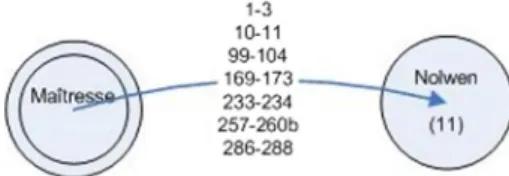
In Figure 2, the two participants involved are the teacher and nolwen. The line joining the two nodes materialises the exchange between them. Between the two nodes, we have listed the CLs in which the
Figure 2. depiction of exchanges between two interlocutors (from Specogna, 2013). note: teacher (“maîtresse”) and students.
Figure 3. distribution of Sts in the discussion studied (from Specogna, 2013).
two interlocutors have participated. The arrow pointing towards nolwen means that all seven CLs were started by an intervention of the teacher directed to nolwen. In nolwen’s node is shown the number of interventions she has produced: here 11 interventions. For each CL, we also state the number of the interventions that opened it, and the number of the interventions that closed it. This indication records the length of each CL. For example, “1-3” means that the CL comprised three interventions.
Figure 3 depicts the distribution of the communications observed in the CPI.
In all, 19 pupils out of 23 participated in the discussion. We can see (Figure 1) that 7 pupils were particularly active in the discussion (they participated in more than 4 CLs), and 12 pupils participated less. The direction of the CLs shows that the teacher initiated all but three of them: Anaëlle and Lou (153–154), and Aïdan responding to Maël 13 (14–15), eliciting a response from nathanaël (16).
The teacher thus formed the node of the communication network through which practically all the exchanges passed. We thus have a centralised network, as shown in Figure 1. The type of network obtained for the discussion studied shows us that the status of the participants (teacher/pupil) con-strains the participative framework. In this context, and in the management of turn-taking, the teacher’s role is to allot STs, and the pupils’ role is to ask for them and take them when the teacher permits. When a pupil takes a ST, there ensues a teacher–pupil exchange (a CL) of ranging length.
Functional dimension: articulation of phases and sequences
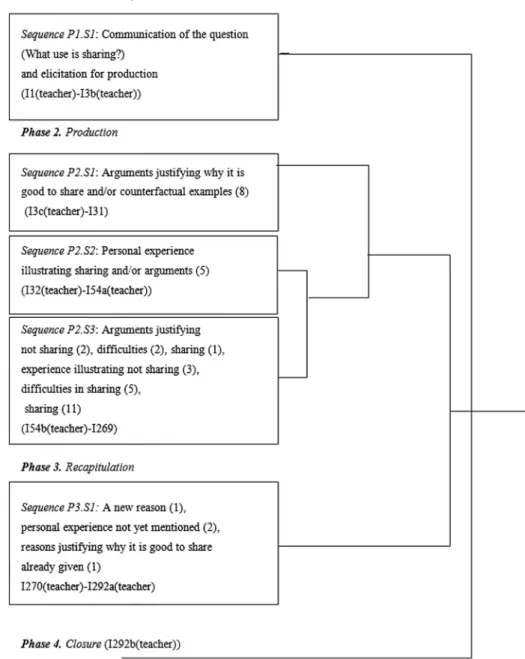
The analysis revealed different operating phases. One comprised several sequences (phase 2 in Figure 4). The different phases and sequences, and their articulation, are set out in Figure 4.
We can see that each of the phases was started by the teacher in an intervention addressed to the class. The address of the intervention was generally marked by the use of the personal pronoun “you”.
The interaction (Figure 4) comprised four phases: P1 formulation of the task, P2 production, P3 reca-pitulation and P4 closure. These phases reflect a conventional organisation of task resolution (Kostulski & Trognon, 1998; Trognon et al., 1999). Phase 2, which is more complex, comprised three sequences corresponding to a progression in the production (P2.S1, P2.S2 and P2.S3); these last conditioned the recapitulation phase (P3) as shown by the hierarchical structure.
This scheme also tells us about the process of collective thought deployed. We can see that P2.S1 offered some answers to the questions asked in P1; P2.S2 and P2.S3 essentially reported personal expe-rience that could give rise to argumentative productions. More precisely, the examples in P2.S2 illustrate sharing; the examples produced in P.2.S3 illustrate sharing, non-sharing and difficulties in sharing. Discursive dimension: pragmatic, thematic and semantic values of speech events
We then looked at the content of these STs, beginning with their performative dimension: What did the participants “do” when they spoke? What speech acts did they perform? As indeed we might expect, given the type of conversation we are concerned with here (CPI) (bearing in mind that it took place in a first-year primary school class), most of the pupils’ utterances were not argumentative. Many STs, unless they were merely factual answers to a question from the teacher, reported personal experience and so were narrative. The analysis of the corpus reveals a complete continuum from the anecdote, a pure account of an event with no commentary, to a stance supported by reasoning, taken up or not by the teacher or another pupil. Below are some examples showing the types of participation in the discussion we could find.
Anecdote
Several versions of the question (usefulness of sharing, whether or not we should share, whether or not we want to share, etc.) generated simple reported examples of sharing episodes with no commentary. In some cases, the pupil’s utterances were simply validated by the teacher, who then solicited another pupil. In other cases, the teacher questioned the class starting from an event, but this questioning failed
to detach the pupil from the event. The following excerpt illustrates this attachment to anecdote or event, with the teacher’s “and so?” signalling an unsuccessful attempt to bring the discussion back to the initial point (should we or should we not share?):
Figure 4. articulation of phases and sequences.
notes: the number of cls produced in each of the sequences is stated in brackets. We also state the number of the intervention by which a phase or a sequence started, and the number of the intervention that closed it. When these interventions were produced by the teacher, this is stated in brackets. for example, I270 (teacher) was the 270th intervention, and was produced by the teacher. “I54b(teacher)-I292(teacher)” means that the phase was stated by the teacher in intervention I54, and was closed by the teacher in the 292nd intervention of the interaction.
Problematised narration
When a link was made between relating an event and the question targeted in the exchange, it was often the teacher who prompted the pupil on the subject (but what did you get out of sharing […]
that’s the question) and enunciated this link (so the point was it made you happy):
We note that in this excerpt, at ST 253, the pupil had already tried to make a link between having shared something and the idea that this makes someone happy (it’s quite nice ‘cos like that // after we talk
and we talk // and:: // well we’re happy). A further degree of abstraction and generalisation would have
meant drawing out a maxim: “sharing with other people makes you happy”, but we can see that the teacher did not wish to go any further, and stayed anchored to the event (so the point was it made you
happy). In other, less frequent, cases, the link between recalling an event and the aim of the discussion
was made clearly explicit by the pupil, as in ST 233 below:
From the recall of an event, the pupil took a stance (it’s better to lend things) and argues (‘cos like that
we […] play // it’s more fun), and explicitated the move from narration to argumentation using the
connector “so”, which marks here the transition between two worlds: that of experience and that of thought. But the transition often occurred in the opposite direction, with argumentation supported by testimony.
91. Titouan: sometimes when it was my cousin // like // like he doesn’t much want to share with his cousins
92. Teacher: and so?
93. Titouan: like // uh uh // after uh he uh my cousin he went with him // but he wanted // uh my brother uh // to go for the trampoline
253. Lou: well:: it was it’s quite nice ‘cos like that // after we talk and we talk // and:: // well we’re happy and uh //{mumble} she lent it me ‘cos // like one day uh //{mumble} I went and stayed at her house // and then uh how // she did lend me a game // and {inaudible} they changed the bed // uh I slept right on the mattress // so // after XXX slept // in her bed // so after around uh dunno what time // uh // I was in the bed // and XXX got on in on the mattress
254. Teacher: but what did you get out of sharing, Lou, that’s the question xxx 255. Lou: well {inaudible}
256. Teacher: so I can see you shared lots of things but:: // what was the point of it all? 257. Lou: it was nice // and uh when uh we when I got home // I was I was happy 258. Teacher: you were happy // right so the point was it made you happy
229. Gaëlle: when I went to nolwen’s birthday party // um, we took photos, and we filmed and // like she’d lent me her camera so we could:: // so we could [do/take] things with it
230. Teacher: and you were pleased she lent you her camera 231. Gaëlle: {nods}
232. Teacher: and nolwen why did you lend her your camera, why didn’t you keep it just for yourself? 233. Nolwen: ‘cos // um, it was new and I wanted to show it // and then uh /// I wanted and then I lent it to her // ‘cos // it was better // to lend it ‘cos if not uh // if not {inaudible} don’t know what to do so uh // I lent it and with my camera it was fun // so it’s better to lend things ‘cos like that we
Argumentation supported by testimony
Argumentation with support from the utterer’s own experience was a recurrent pattern in the pupils’ discourse:
Often, the pupil took support from a classmate’s utterances and marked an agreement (or disagree-ment) with the point of view adopted. We then had an echo or “diaphonic” response (roulet et al., 1985), illustrating the dialogical dimension of the exchanges:
Argumentation supported by doxa
Another recurrent figure was argumentation supported by discourse or opinion. We find an excellent example in the excerpt below:
At ST 101, to support his point of view (it’s better to share), the pupil advanced two arguments (it’s more polite, you get more friends) that were neither drawn from personal experience (which he did not relate here) nor used in reasoning.
Table 1. rewording of problem f1 in the course of the discussion.
Speech event Wording Operator Category I2: nolwen: what use is sharing f1 what use is usefulness I4: lou: it’s good to share # ‘cos how # like that well a boy’s::
sis-ter:: well he / # she’s got the she’s got half the pack of paper and the other half of the pack of paper # and:: […]
f2 it’s good to axiological modality
I10: nolwen: you’ve got to share ‘cos # after uh the others they’re our friendsand we’re friends # for example uh # some bring:: # things to school toys # and then the other […]
f3 you’ve got to deontic modality
I32: teacher: what you mean is that you’re saying all of you that it’s good to share uh you share all the time # all the time you’re saying oh I share I’m really glad to share
f4 all the time aspectual modality
I43: Marie: sometimes uh # it’s good to share ‘cos # some uh like mm # they want uh # to dress up and then uh # I don’t mind sharing
f5 I don’t mind volitional modality
I66: teacher: no not always # and why then # why is it not
good to share sometimes f2’ is it not good axiological modality I73: awen: in fact you can share ‘cos it’s x x # and then
some-times when you don’t really want to # or else when you want to you can share sometimes share or not
f3’ you can deontic modality
197. Maëlle: it’s good to share ‘cos in fact // with my friend // in fact // uh I lent her some caram uh I gave her some carambars // but she wasn’t in so well I gave ‘em to // to her daddy
135. Soizic: I agree with Nolwen and Marie // ‘cos sharing // you share // too when you // I // brought // some sweets to school // I had I shared them
136. Teacher: and so?
137. Soizic: and then uh // {inaudible} // we played together and then we sh // we shared everything
98. Teacher: and do you think it’s better to:: share your things or to keep them all for yourself 99. Titouan: that it’s better to share
100. Teacher: why Erwan
101. Titouan: ‘cos uh // uh // like that it’s more polite and then uh // there’s the others who want to be // friends with us all the time
Argumentation supported by reasoning
Less often, we saw argumentation supported by reasoning, but given the children’s young age, we often found attempts at or fragments of reasoning rather than conclusive reasoning. These attempts sometimes ended in:
• Tautology (reworded here by the teacher):
• Circular reasoning, based on an opposition as in the excerpt below, where the pupil opposed “sharing = polite” and “not sharing = not polite”:
• Reasoning by contrast, as in the excerpt below, where a pupil used a temporal contrast “to start with / after”:
The next part of the excerpt is instructive and shows that the teacher, faced with this tentative reflexivity, was able to bring the pupil to complete or carry on their reasoning:
The teacher first had the pupil extend her reasoning (ST 110 and 112), and then explicitated the underly-ing relations (“if not …” in ST 114, “when …” in ST 116) in an effort to support and dialogically construct
a reasoned discourse which was still difficult for the pupil to manage alone.
271. Soizic: it’s good {to share} // and:: // also // it makes you learn 272. Teacher: it makes you learn?
273. Soizic: yes
274. Teacher: to learn what 275. Soizic: to share
276. Teacher: sharing makes you learn to share 277. Soizic: {nods} // it m it makes you learn to share
215. Soizic: it’s good to share // ‘cos if not you // you’re not // your not being polite // when [you] share // it’s good // but when you don’t share it’s bad // when you share // you can share // you
// you:: you’re nice // and you’re being polite // but when you don’t share // you’re not nice and you’re not being polite
109. Aïdan: how // uh well // it’s good to // it’s good to share ‘cos // sometimes like people // to start with they want // uh sometimes // in fact and like people they don’t want to share to start with // and
then uh when they haven’t been sharing enough // and like after like they share with other people
110. Teacher: when they / haven’t been sharing enough, but how do they go from:: // from when
they don’t share to when they do share why do they suddenly start sharing Enzo
111. Aïdan: um:: // ‘cos:: // there’s people who think uh:: after uh that it’s good to share 112. Teacher: why
113. Aïdan: ‘cos:: you can make friends 114. Teacher: if not they’re left on their own 115. Aïdan: yes
116. Teacher: when you don’t share 117. Aïdan: mm
Lastly, in some pupils, we found an instance of conclusive, fully logical reasoning, as in the last excerpt below:
Here, the pupil expressed her disagreement with a classmate’s point of view using concession (“right”) and counter-argument (“but”).
Anecdotes taken up or not by the teacher, points of view more or less successfully argued by the pupils, utterances supported to varying degrees by the teacher: all these speech events were both the support for and the product of the reflexivity in play during the discussion. They also gave rise to shifts in meaning that are highly relevant to the identification of instances of collective reasoning.
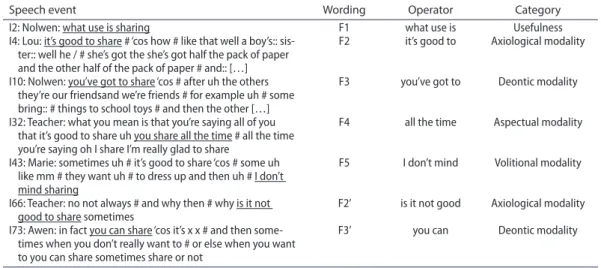
In the present case, the initial question of the discussion: “what use is sharing?” constantly evolved with successive STs by the teacher and the pupils. Every time the problem was reworded, a new modal-ity was launched: axiological, deontic, aspectual or volitional. Historically, the concept of modalmodal-ity was introduced in linguistics to take into account, inter alia, possible variations or patterns in the way an utterance is presented or enunciated: a fact can be presented by an utterer as certain or probable, possible or necessary, wanted or unwanted, positive or negative, etc.4 Table 1 presents the four main
types of rewording that we could identify from the transcription of the participants’ words, together with the indication of ST and the speech event during which they occurred.
As the teacher and the pupils conversed, we thus went from the usefulness of sharing (initial wording F1 to the issue of whether it is good (F2) or not (F2’), if you should share (F3) or if you can share (F3’), in what conditions (F4) and with what volition (F5).
Below are some examples of these shifts.
We can see the first one right at the start of the discussion, as illustrated in the following excerpt:
This rewording of the question introduced a change in the point of view which switched from the utilitarian value: “the use of sharing is …” to a value expressed in moral terms: “it’s good / bad to share”.
At ST 54, we saw the teacher rewording the question in quite a fundamental way:
261. Nolwen: I didn’t agree with Soizic // well ‘cos how // uh it’s better it’s good to share right // but there’s no use // it’s uh // you’re polite but sometimes you don’t want to share // and you’re polite all the same so you do [some/the] things uh // to be polite
262. Teacher: right so for you sharing means not being polite // […]
2. Nolwen: what use is sharing
3. Teacher: it’s a question you’ve chosen // you must have things to say [three pupils raise their hands]
4. Teacher: Cassandra
5. Lou: it’s good to share ‘cos ‘cos how // like that well a boy’s:: sister:: well he / # she’s got the she’s got half the pack of paper and the other half of the pack of paper # and:: when they’ve got a box uh for both of them with felt tips and crayons
6. Teacher: so why is it good to share then
54. Teacher: right // but it’s good when:: so I’m going to give you an example I at the gate the other day // there was uh // there was a birthday in the school and so it was in some class I don’t know which, but // there was a little boy who had two sweets and his grandma told him now give one to your sister you share, you’ve got two now you share // and the little boy said no no no // they’re my sweets they’re:: // they’re for me // doesn’t that ever happen to you to be like that do you always
Here, the teacher took up the pupils’ way of reasoning: “I’m going to give you an example”, but she used this strategy to bring in a counter-example to cause the pupils to think about non-sharing situations. However, this intervention was not sufficient, and had to be reiterated:
A little further on, the teacher reworded her question after an intervention by a pupil who proposed a new sharing situation without clearly considering a non-sharing situation:
Some 20 STs were needed to install this polarity sought by the teacher, but the pupils found it difficult to enter into this dual perspective.
These shifts in meaning were all possible traces of thought movements and reasoning that could emerge as the discussion proceeded, and which will be identified in the section titled ‘cognitive dimen-sion’. But their chaining, and the alternation of acts that were more obviously narrative or by contrast strongly argumentative, helped first to signal transition, steps and key moments in the discussion taken into account by the overall analysis of the activity.
Figure 5. Hierarchical articulation of cls.
Table 2. occurrence of functions of teacher’s responding interventions during P2.S1.
Make intelligible Guide, assist, explore Total Contribution:
clarify the discourse
Contribution:
ratification further infor-request: for mation request: To prompt exploration request: directing to-wards a new register Contribution: submission deduction 2 0 1 1 0 0 4
64. Teacher: so // you’re all telling me that it’s good to share, but do you do it afterwards
73. Awen: in fact you can share ‘cos it’s x x # and then sometimes when you don’t really want to # or else when you want to you can share {inaudible} share or not
74. Teacher: sometimes you share or you don’t it depends // and why do you not share sometimes
Interlocutory dimension: conversational chains
The analysis of the pupils’ speech events led us to fully dissociate the sequence P2.S1, from the sequences P2.S2 and P2.S3.
Sequence P2.S1
During this sequence, the pupils produced interventions that provided information that directly answered the question given. The use of sharing was: “making friends”, “not fighting”, “to have everything, nearly everything”, etc. The answers were additionally illustrated using counterfactual examples (e.g. “it’s good to share ‘cos ‘cos how // like that well a boy’s:: sister:: well he / # she’s got the she’s got half the pack of paper and the other half of the pack of paper # and:: when they’ve got a box uh for both of them with felt tips and crayons”). These counterfactual examples were marked in the discourse by pronouns and indefinite articles (you, a sister and a brother, someone else, etc.).
The pupils entered an argumentative process where the aim was to find arguments that justified the proposition that it is good to share.
This process took the following form: • Proposition (it’s good to share)
• Because: Argument (argument response to “what use is sharing”)
• Illustration (using a counterfactual example placed either before or after the argument).
We could also see that an argument proffered at a particular time point in a sequence, whatever its status, was often taken up again by other pupils and explored, explicitated, expanded or used as a premise. For example, during this period, one argument was: (it’s good to share because) “you can make uh friends”. In the subsequent CLs, this argument was reused: (it’s good to share because …)
• “… after the others uh they’re our friends and we’re friends …” (rewording and explicitation of the initial argument)
• “… after we make lots of friends …” (completion of the rewording of the initial argument) • “… they won’t fight, they’ll be able to get on with doing what they want …” (an implication having
the initial argument as premise).
Figure 6. linear articulation among cls.
Table 3. occurrence of functions of teacher’s responding interventions during P2.S2 and P2.S3.
Make intelligible Guide, assist, explore Total Contribution:
clarify the discourse
Contribution:
ratification further infor-request: for mation request: to prompt exploration request: directing to-wards a new register Contribution: submission deduction 18 21 7 26 4 13 89
Hence, the pupils listened to their classmates, integrated their arguments and succeeded in using them as components to be reworded, completed, explored or exploited as a premise.
This results in hierarchical relations among CLs (Figure 5). The ascending structure reveals that what was produced at a particular time formed a premise for subsequent productions. This shows that the dynamics of the collective activity during this phase depended in large part on what had first been produced and how it had been dealt with.
During this period, the teacher intervened essentially to allot STs. We note that four responding interactions were addressed to pupils in particular. The function of these elicitations is given in Table 2.
The argumentative activity required to answer the question asked was exerted by the pupils. Sequences P2.S2 and P2.S3
The pupils generally started their interventions by recalling factual instances that exemplified shar-ing situations of varyshar-ing difficulty (out of the 29 CLs produced, 24 began with a factual example,
Figure 7. Instances of collective reasoning in chronological order.
Table 4. occurrence of referents, ideas, concepts, stages and collective reasoning.
Localisation Thematic content Philosophical aspects
referent Ideas Concepts Stages Collective reasoning
Phase 1 1
Phase 2 I3-I31 1 8 1 2 1
Phases 2 and 3I32-I74 1 7 2 2 2 Phases 2 and 3I74–I269 1 18 1 1 1 Phase 3 I275–I291 – – – – –
Phase 4 I192 – – – – –
and only 5 with an argument). The way in which the CL was initiated tended to show that generally they no longer placed their utterances in an argumentative sequence intended to justify the thesis whereby it is good to share, but more often in a narrative sequence, where they sought to relate their sharing experience.
The productions were less constrained by CLs that had just been produced – even if the examples related could activate memories of situations in the others – resulting in intersequence relations that were most often linear (Figure 6).
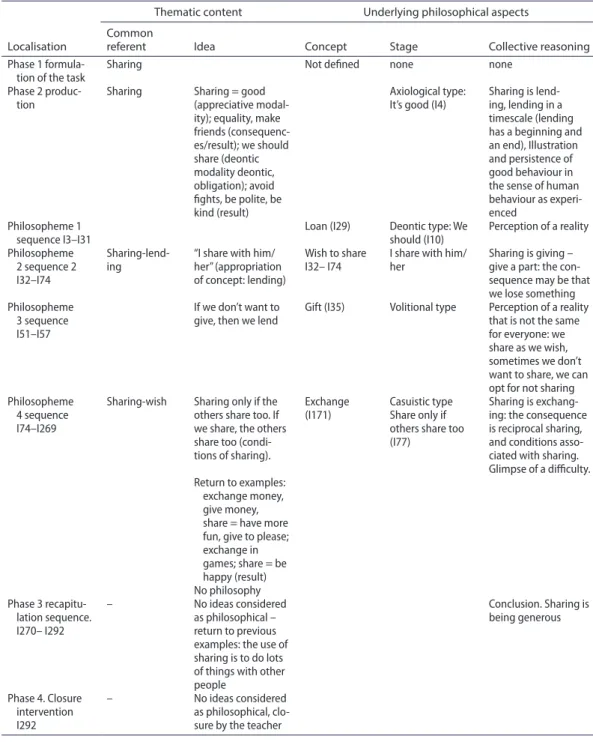
Table 5. content of referents, ideas, concepts, stages and collective reasoning.
Localisation
Thematic content Underlying philosophical aspects Common
referent Idea Concept Stage Collective reasoning Phase 1
formula-tion of the task Sharing not defined none none Phase 2
produc-tion Sharing Sharing = good (appreciative modal-ity); equality, make friends (consequenc-es/result); we should share (deontic modality deontic, obligation); avoid fights, be polite, be kind (result) axiological type:
It’s good (I4) Sharing is lend-ing, lending in a timescale (lending has a beginning and an end), Illustration and persistence of good behaviour in the sense of human behaviour as experi-enced
Philosopheme 1
sequence I3–I31 loan (I29) deontic type: We should (I10) Perception of a reality Philosopheme
2 sequence 2 I32–I74
Sharing-lend-ing “I share with him/her” (appropriation of concept: lending)
Wish to share
I32– I74 I share with him/her Sharing is giving – give a part: the con-sequence may be that we lose something Philosopheme
3 sequence I51–I57
If we don’t want to
give, then we lend Gift (I35) volitional type Perception of a reality that is not the same for everyone: we share as we wish, sometimes we don’t want to share, we can opt for not sharing Philosopheme
4 sequence I74–I269
Sharing-wish Sharing only if the others share too. If we share, the others share too (condi-tions of sharing).
exchange
(I171) casuistic type Share only if others share too (I77)
Sharing is exchang-ing: the consequence is reciprocal sharing, and conditions asso-ciated with sharing. Glimpse of a difficulty. return to examples:
exchange money, give money, share = have more fun, give to please; exchange in games; share = be happy (result) no philosophy Phase 3 recapitu-lation sequence. I270– I292 – no ideas considered as philosophical – return to previous examples: the use of sharing is to do lots of things with other people conclusion. Sharing is being generous Phase 4. closure intervention I292 – no ideas considered as philosophical, clo-sure by the teacher
The CLs thus most generally occupied the same position in the phase structure; they formed responses to the initial question as interpreted by the pupils, here: “report factual examples of sharing in which you took part”. Whatever the case, we note that arguments were produced even when a CL was launched by an example. Generally, these arguments were elicited by responding interventions made by the teacher when she invited the pupils to draw lessons and general rules from the experience they had just recounted. These elicitations given in Table 3 were intended to guide, assist and explore. The responding interventions, which were prompts – a prompt being a subordinate intervention whose subject is the interlocutor’s discourse (Blanchet & Gotman, 2005) – were much more often present than in phase 1, and significantly so.
Cognitive dimension
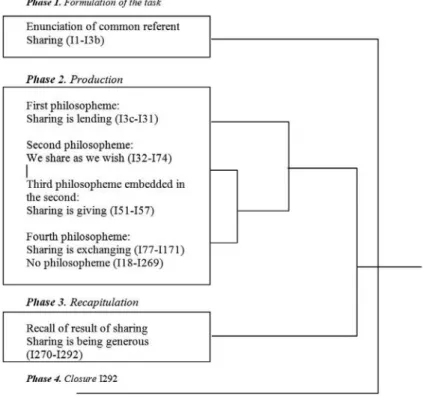
Figure 7 shows where the instances of collective reasoning are located.
In Table 4, we set out the materials (referents, ideas, concepts and stages) that contributed to and helped the emergence of collective reasoning and its occurrence. The content of these materials is detailed in Table 5.
The common referent, announced in phase 1, was not processed in the same way by all the interlocutors: this processing formed the next production phase. Here, a conceptual analysis caused us to divide one of the instances of collective reasoning into two conceptual sequences (I32–I74, distinct from I51–I57). Deduced from the thematic orientation, which enabled us to delimit the progression of the referential type, the interpretation of the underlying philosophical aspects produced four instances of collective reasoning extracted from the corpus: sharing is (i) lending, (ii) giving, (iii) exchanging, in the production phase, and (iv) being generous, which emerged in the operational phase of recapitulation.
During the production phase, the pupils managed to conceptualise first that sharing is a morally good action, which they illustrated with counterfactual examples: a certain reality was gradually per-ceived to be in play (we lend). A first instance of collective reasoning thus emerged: “sharing is lending”. The pupils, by exploring the theme of the loan, then transformed an unequivocal, moralising reality by an experience of diversity. In this process, only certain ideas led on to an exploration of sharing as a gift. But it was a prior movement, conceptualising the wish to share, that allowed the complete devel-opment of the collective reasoning: sharing is giving. It was access to the concept of gift that then made the situation complex and difficult, where the conditions, reciprocity and consequences complexified the initial doxa. Also, we saw the casuistic passage from one stated case to another, which essentially enabled the pupils to work out a philosophical reflexivity by exploiting the concept of exchange. The philosophical reasoning was constructed through successive stages where different conceptual fields were explored: loan (I29), gift (I35) and exchange (I171). The movement from the field of the gift (sec-ond instance of collective reasoning) led the pupils to escape from the single doxa introduced in the early speech events concerning the loan, which was trapped in its axiology (it’s good) or deontology (we should), preventing any possibility for the exploration of the first instance of collective reasoning. The construction of the third instance of collective reasoning was marked by “if … we”, “Sharing is exchanging”. It was composed essentially of examples; the usefulness of these could be debatable, as the reasoning was making no further philosophical progress, unless these examples can be considered as embodying new ideas. At this stage in the discussion, the pupils were actually replaying their earlier ideas on the diversity of personally experienced situations of happy exchange: to please, play, be happy, get something, have more fun, etc. The last instance of collective reasoning, “Sharing is being generous”, then emerged in the operating phase of recapitulation, as a sum or possible axiological adjustment (repositioning on the doxa, it’s good). The fact that the discussion ended rapidly, moving on to the closure phase, prevents us seeing whether the pupils would have taken their reasoning further. In the operating phase of production, the pupils’ argumentation led them through four conceptual stages (loan/wish/gift/exchange), clarified or sometimes supported by situations in their daily lives, which they thus went on to examine.