HAL Id: hal-00954437
https://hal.inria.fr/hal-00954437
Submitted on 4 Mar 2014
HAL is a multi-disciplinary open access
archive for the deposit and dissemination of
sci-entific research documents, whether they are
pub-lished or not. The documents may come from
teaching and research institutions in France or
L’archive ouverte pluridisciplinaire HAL, est
destinée au dépôt et à la diffusion de documents
scientifiques de niveau recherche, publiés ou non,
émanant des établissements d’enseignement et de
recherche français ou étrangers, des laboratoires
A numerical scheme for the early steps of
nucleation-aggregation Models
Harvey Thomas Banks, Marie Doumic, Carola Kruse
To cite this version:
Harvey Thomas Banks, Marie Doumic, Carola Kruse. A numerical scheme for the early steps of
nucleation-aggregation Models. Journal of Mathematical Biology, Springer Verlag (Germany), 2017,
74 (1-2), pp.259-287. �10.1007/s00285-016-1026-0�. �hal-00954437�
Efficient Numerical Schemes for
Nucleation-Aggregation Models: Early Steps
H.T. Banks
∗M. Doumic
†C. Kruse
‡March 4, 2014
Abstract
In the formation of large clusters out of small particles, the initializing step is called the nucleation, and consists in the spontaneous reaction of agents which aggregate into small and stable polymers called nucleus. After this early step, the polymers are involved into a bunch of reactions such as polymerization, fragmentation and coalescence. Since there may be several orders of magnitude between the size of a particle and the size of an aggregate, building efficient numerical schemes to capture accurately the kinetics of the reaction is a delicate step of key importance. In this article, we propose a conservative scheme, based on finite volume methods on an adaptive grid, which is able to render out the early steps of the reaction as well as the later chain reactions.
Keywords: polymerization, aggregation-fragmentation models, finite
vol-ume schemes, adaptive grid.
Introduction
In the formation of large clusters out of small particles, the initializing step is called the nucleation, and consists in the spontaneous reaction of agents which aggregate into small and stable polymers called nucleus. After this early
∗Center for Research in Scientific Computation [Raleigh] (CRSC), North Carolina State
University; [email protected]
†INRIA Rocquencourt; Laboratoire Jacques-Louis Lions (LJLL), Universit Pierre et Marie
Curie (UPMC) - Paris VI; [email protected]
‡INRIA Rocquencourt; Laboratoire Jacques-Louis Lions (LJLL), Universit Pierre et Marie
step, the polymers are involved into a wide range of possible reactions, such as polymerization, fragmentation and coalescence. These reactions vary from one species to the other, and even from one application field (microtubule or protein polymerization in general) to the other (phase condensation or crystallization). To model such nucleation and polymerization processes, deterministic mod-els consist in huge systems of ordinary differential equations, where there may be several orders of magnitude between the size of a single agent and the size of an aggregate. In these systems, the concentration of polymers made-up of i
monomers, i ∈ N, is described by a time-dependent variable ci(t). Its kinetics is
given by a first-order differential equation, coupled with the equations of
possi-bly all the other species. Among such models, we can quote the Bekker-D¨oring
system [4], discrete growth-fragmentation models [16] or discrete coagulation-fragmentation models [14].
Continuous coagulation-fragmentation have then been developed, and proved to be the (weak) limit of the discrete models when an appropriate rescaling is
carried out [4, 14, 7, 19]. In such models, the discrete concentration ci(t) is
replaced by a continuous concentration of polymers at time t of size x c(t, x),
whereas the concentration of monomers c1(t) is treated separetely. The limit
is taken for a vanishing parameter ε := iM1 where iM is the average size of a
polymer. The concentration of polymers c(t, x) is then the solution of a one-dimensional nonlinear first-order integro-partio diffential equation on a space [0, T ] × [x0, xM] with 0 ≤ x0< xM ≤ ∞, and coupled with the equation
satis-fied by the concentration of monomers c1(t).
In these asymptotic results however, the integro-PDE satisfied by c(t, x)
requires a boundary condition at x = x0≥ 0 for the problem to be well-posed.
Such a boundary condition is formally derived for different models in [4, 7, 19]. Complete proofs (in a weak formulation) are also provided in [4, 7], but with some extra assumptions either on the parameters (the polymerization rate needs to vanish toward zero, so that no boundary condition is necessary anymore) or on x0 (x0>0 is required). Unfortunately, these restrictive cases are often not
physically relevant: x0 > 0 would mean a very large minimal size of stable
polymers, since it has to be in the same order of magnitude as the average size
iM ≫ 1 by assumption, and if we assume a vanishing polymerization rate in 0
then spontaneous formation of polymers from monomers is impossible.
In [19] we proposed a general model to take into account both these large scale phenomena, modeled by a PDE approximation, and the nucleation step, which becomes a boundary condition for the smallest polymers. This boundary condition was formally derived but not theoretically proved, since it fails to satisfy these restrictive assumptions which were used in the previous studies [4, 7]. We also showed on some specific examples the accuracy of this new model.
However, it remains to determine how it is possible to capture numerically the specificity of the nucleation step, because its scale is of infinitesimal size compared to the scale where continuous models are valid. This early step is of key importance because it influences the overall dynamics: as shown below, it decides of the so-called lag time, which is the time needed for the polymerization chain reaction to ignite when initially the solution only contains monomers.
As concerns numerical schemes for coagulation-fragmentation models, many successfull studies have already been carried out, for the continuous equations (see e.g. [3, 12] for Lifshitz-Slyozov including even a space variable, and [1, 11, 10, 9, 8, 13]) as well as for the discrete one [21, 6]. Our purpose here is not to elaborate on these studies, but rather to focus on the treatment of the nucleation step, which, to the best of our knowledge, has not yet been treated when combined with large chain reactions.
In a first section, we will recall the general model proposed in [19], both in its original ODE version and its approximation by an integro-PDE system. We then write a simplified version of this system, which is the basis of this article: since our point is the treatment of the nucleation step, for the sake of clarity we neglect all the reactions which are of secondary importance while this early step dominates. In a second section, we detail our numerical strategy: the choice of an adapted grid, and convenient finite volume schemes. In a third section we detail which problems we chose to test our methods - one of them having the main advantage to possess an analytical solution, which allows quantitative error estimates. We then detail our numerical results. Finally, we discuss our results and how to adapt our method to more general situations where secondary pathways need to be considered.
1
Model
1.1
Framework Model and Aim of the Article
In this preliminary section, we recall the general ODE model that we aim to simulate. This model has been designed to be as general as possible so that any type of reaction is represented. In all the rest of the article, we will call monomer the single particle (or dust or atom or molecule) which is the unit agent at the
basis of the aggregation chain reactions. Its concentration is denoted c1(t),
whereas a concentration of polymers of size i (assumed here, for the sake of
simplicity, to belong to a unique species) is denoted ci(t). We consider the
following reactions.
into an active conformer, whose concentration is denoted c∗ 1. c1 k+ I ⇋ k− I c∗1
• Nucleation step. There exist a wide variety of nucleation types - homo-geneous or heterohomo-geneous, progressive or not. Here we chose the type of reactions proposed by Oosawa and co-authors [17] in the case of many protein polymerization processes. A nucleus here denotes the smallest stable size of polymers: smaller ones are highly unstable and too
tran-sitory to be observed. We call i0 the size of the nucleus, whose
concen-tration is ci0. Instead of modelling a sequential addition (represented by
c1 → c2 → c3 → · · · → ci0), the nucleus formation may be equivalently
represented by an i0 order kinetic reaction, i.e. i0c∗1 → ci0. The nucleus
size i0, of unknown value, can be equal to 1, 2, 3 or even more.
c∗1+ · · · + c∗ 1 | {z } i0 kN on ⇋ kN of f ci0
• Chain reaction of polymerization. Polymers of size i quickly polymerize into polymers of size i + 1 by addition of a monomer at a reaction rate ki
on, and may also depolymerize with a rate kidep.
ci+ c1 ki on ⇋ ki+1dep ci+1
• Coalescence and fragmentation. Polymers can coalesce with one another or break into two smaller polymers. We neglect the breakage into 3 or more pieces, which is generally much more hazardeous, as well as higher order coalescence of 3 or more polymers for the same reason. We denote ki,jcol the coagulation rate of two polymers of respective size i and j, and ki,jof f the fragmentation rate of a polymer of size i giving rise to smaller polymers of size j and i − j, with 2 ≤ j ≤ i0.
ci+ cj ki,jcol ⇋ ki+j,i of f ci+j We define Kof fj = j−2 ∑ i=2
ki,jof f. This represents the total rate with which a polymer of size j can break to give smaller polymers. By symmetry we have that ki,jof f= kj−i,jof f and kcoli,j = kj,icol.
• Degradation and monomer addition. Each polymer, conformer or monomer
may degrade with a degradation rate ki
m, k1∗m and km1 respectively, and
With these assumptions, the ordinary differential model is given by the sum of the laws of mass action for each of these reactions, namely
dc1 dt = −k + Ic1+ k−Ic∗1− k1mc1+ λ(t), (1) dc∗1 dt = k + I c1− kI−c ∗ 1− i0konN (c∗1)i0+ i0kNof fci0− km1∗c∗1 − c∗1 ∑ i≥i0 koni ci+ ∞ ∑ j=i0 kjdepcj+ 2 i0−1 ∑ i=2 ∞ ∑ j=i0 i kof fi,j cj, (2) dci0 dt = k N on(c∗1)i0− kNof fci0− koni0 ci0c∗1+ k i0+1 dep ci0+1− ki0mci0 + 2 ∞ ∑ j=i0+2 kof fi0,jcj− Kof fi0 ci0− ∑ j≥i0 kcoli0,jci0cj, (3) dci dt = c ∗
1(ki−1on ci−1− kionci) − (kdepi ci− ki+1depci+1) − kimci
+ 2 ∞ ∑ j=i+2 kof fi,j cj− Kof fi ci+ 1 2 ∑ i0≤j≤i−2
kj,i−jcol cjci−j −
∑
j≥i0
ki,jcolcicj.
(4)
When the early steps of nucleation and conformation are absent, this is a classi-cal system of coagulation-fragmentation reactions, which turns to be the
Becker-D¨oring system if we do not consider either fragmentation and coalescence but
only polymerization and depolymerization. This system has a positivity prop-erty, and satisfies a mass balance equation under the form
d dt ( c1(t) + c∗1(t) + ∞ ∑ i0 ici(t) ) = λ(t) − k1 mc1(t) − k1∗mc∗1(t) − ∞ ∑ i0 ikimci(t). (5)
Main objective of the article.
Our aim is to simulate this system with a fast and accurate numerical scheme. Efficiency is necessary since intensive simulations may be necessary, for instance, to estimate parameters from experimental measures, inverse problem methods and parameter identification algorithms generally require an important number of simulations. It is also required if we embed this model into a more complex one: for instance if we need a space variable [2, 12], or if we want to model the distribution of polymers in a proliferating cell population [20].
The main difficulty is that we expect i to take values up to 106or even more
(for instance in the case of Becker-D¨oring equation, part of the mass goes to
infinity in the super-critical case [18]). This makes an explicit scheme where
each diffential equation for ci is solved time-consuming. That is one of the
reasons for the interest in a continuous approximation of ci as was carried out
1.2
Continuous Approximation and Numerical Strategy
The continuous version of this model, formally derived in [19], is the following. The notation for c1and c∗1is unchanged, c(t, x) represents the concentration of
polymers of size x ≥ x0≥ 0 at time t, and the parameter functions are defined
similarly. The continuous variable x replaces the discrete one i. Assumptions that coefficients must satisfy are detailed in [19, Supplementary Data 1].
dc1 dt = −k + Ic1+ k − I c ∗ 1− km1c1, (6) dc∗ 1 dt = k + I c1− k − Ic ∗ 1− i0kNon(c∗1)i0+1koni0 kN of f+ k i0 onc∗1 − k1∗mc∗1− c∗1 ∞ ∫ x0 kon(x) c(t, x)dx + ∞ ∫ x0 kdep(x)c(t, x)dx, (7) ∂c(t, x) ∂t = −c ∗ 1 ∂ ∂x ( kon(x)c(t, x))+ ∂ ∂x(kdep(x)c(t, x) ) + 2 ∞ ∫ x kof f(x, y) c(y)dy − Kof f(x)c(t, x) − km(x)c(t, x) +1 2 x ∫ x0
kcol(y, x − y)c(t, y)c(t, x − y)dy − ∞
∫
x0
kcol(x, y)c(t, x) c(t, y)dy, x≥ x0,
(8) kon(x0)c(t, x0) = kon(x0) konN (c∗ 1)i0 kof fN + kon(x0)c1 . (9)
As soon as the average polymer size iM is large, this system is expected to
be a good approximation of System (1)–(4). A second-order approximation for the polymerizing-depolymerizing terms has been proposed by S. Haris and J.-F. Collet in [5], and is expected to be second-order accurate as shown by the
formal calculation carried out in [4] with respect to ε = 1
iM. The problem is
that if i0 ≪ iM, what is most often the case, there is a priori no reason for
this approximation (and even the second order one) to be accurate, since the main assumption, which is the large size of i, fails to be satisfied. Our numerical strategy is thus the following.
Let us set ε the typical precision that we want to achieve.
• For sizes i ≤ N0= 1 + ⌊1ε⌋, we solve the original ODE system described
by (1)–(4) by an accurate scheme of the desired order.
• For sizes larger to N0, we solve the PDE given by (8) by an
approximation of the polymerised mass
∞
∫
N0
xc(t, x)dx. For this step, it is also possible to take advantage of existing schemes, such as developed in [1, 11, 10, 9, 8, 3, 12] for instance.
• We define c1 by its equation and c∗1 by the mass conservation relation.
This corresponds to solving a mixed ODE and PDE system, that we write below in the simplified case we will now focus on.
In order to keep the physical meaning and orders of magnitude, let us note that we did not carry out any dimensionless writing of the equation. This leads to large values of x in Equation (8) and to not small values for our space step ∆x ≥ 1. The expected precision is not linked to a small ∆x but rather
to a small ratio ∆xx , assumed to be in the order of ε. In this case, our PDE
approximation is perfectly valid under the same kind of assumptions as in the
previous studies [4, 7, 19], for instance if we assume kon(x) = Kon(εx) with
a function Kon ∈ C1b independent of ε. This also means that the larger x, the
more we neglect small variations of the coefficients. This is at least correct while nucleation and small polymers dominate the reactions.
1.3
Simplified Model
Since our will here is to study the nucleation step and how we can build adapted numerical schemes, for the sake of simplicity we describe our method on a simpli-fied case, meant to be combined with existing numerical schemes for coagulation-fragmentation or Lifshitz-Slyozov-Wagner equation.
We study the case when fragmentation, coalescence, depolymerization and death are not present, and we apply the previously described strategy. The ODE system is then the following.
dc1 dt = −k + I c1+ kI−c∗1, (10) dc∗1 dt = k + Ic1− kI−c∗1− i0kNon(c∗1)i0+ i0kof fN ci0− c∗1 ∑ i≥i0 koni ci, (11) dci0 dt = k N on(c∗1)i0− kof fN ci0− ki0onci0c∗1, (12) dci dt = c ∗ 1(ki−1on ci−1− kionci), (13)
and the mass conservation - which may replace either Equation (10) or (11), becomes d dt ( c1(t) + c∗1(t) + ∞ ∑ i0 ici(t) ) = 0. (14)
2
Numerical Scheme
The domain size in the order of up to a million (shown in experiments as a max-imal size for protein polymers, but still larger for other applications like cluster formation) is a challenge in the computations. Our simplified model starts with an initial concentration of only monomers. After the nucleation step, the poly-mers bind one monomer at a time. After the usually relevant observation times, smaller polymers are thus found at a higher concentration than larger polymers. A uniform grid, which ideally should not contain a large amount of elements for still being computationally fast, does not capture these peaks at the left-hand side of the polymer distribution efficiently.
As explained in Section 1.2, we approximate (13) by solving the ODE system
as long as i ≤ N0 and by a PDE for x ≥ N0. The system of equations is then
given as dc1 dt = −k + Ic1+ k − I c ∗ 1, (15) dc∗1 dt = k + I c1− k−Ic∗1− i0konN (c∗1)i0+ i0kNof fci0 −c∗1 (N0 ∑ i0 kionci+ ∞ ∫ N0 kon(x)c(t, x)dx ) , (16) dci0 dt = k N on(c∗1)i0− kof fN ci0− ki0onci0c∗1, (17) dci dt = c ∗ 1(koni−1ci−1− koni ci), i≤ N0, (18) ∂c ∂t = −c ∗ 1∂x(kon(x)c(x, t)), x > N0. (19) with c(t = 0, x) = cin(x), c(t, x = N0) = cN0(t) (20)
and the mass conservation equation becomes d dt ( c1(t) + c∗1(t) + N0 ∑ i0 ici+ ∞ ∫ N0 xc(t, x)dx ) = 0. (21)
We will now discuss different kinds of finite volume approximations for the PDE.
2.1
Finite Volume Approximation
We use a finite volume scheme to approximate Equation (19). Let the mesh be defined by N0= x1/2< x3/2 < ... < xN −1/2 = imax with Ii = [xi−1/2, xi+1/2]
and hi = xi+1/2− xi−1/2, not necessarily uniform. We define the cell average on the interval Ii as Qki := 1 hi ∫ xi+1/2 xi−1/2 c(x, tk) dx = 1 hi ∫ Ii c(x, tk) dx. (22)
The integral form of (19) on the interval [tk, tk+1] is given by
d dt
∫
Ii
c(x, t) dx = fi−1/2(c, c∗1, t) − fi+1/2(c, c∗1, t) (23)
with fi−1/2(c, c∗1, t) = c∗1(t)kon(xi−1/2)c(xi−1/2, t). By integration, we obtain
the time stepping scheme Qk+1i = Qk i − ∆t hi (Fk i+1/2− Fi−1/2k ) (24) with Fi−1/2k ≈ 1 ∆t ∫ tk+1 tk fi−1/2(c, c∗1, t) dt (25)
being an approximation to the average flux on the interval [tk, tk+1].
Choos-ing Fk
i−1/2= c∗1(tk)koni−1/2Qki−1 with k i−1/2
on := kon(xi−1/2), we have the simple
upwind method
Qk+1i = Qki −
∆t hi
c∗,k1 (koni+1/2Qik− ki−1/2on Qki−1). (26)
This scheme is of first order. To increase the accuracy of the numerical simula-tions, we add a second order correction term and employ a Flux Limiter method on a non-uniform mesh [15, Chapter 6.17.1]. We have
Qk+1i = Qk i − ∆t hi c∗,k1 (ki+1/2 on Qki − koni−1/2Qki−1) − ∆t hi ( ˜Fi+1/2k − ˜Fi−1/2k ), (27) where we approximate the correction term by
˜ Fi−1/2k = c ∗,k 1 2 ( hi−1− c ∗,k 1 k i−1/2 on ∆t ) ki−1/2on ( Qki − Qki−1 1 2(hi−1+ hi) ) Φ(λki−1) (28) with λki−1= { Qk i−1−Qki−2 Qk i−Qki−1 , Q k i ̸= Qki−1 0, else . (29) For Φ(λk
i) = 1, we obtain the Lax-Wendroff (LW) method which is a classical
present in the solution.
As second choice we use the the Van Leer (VL) Limiter given by
Φ(λ) = |λ| + λ 1 + |λ| = { 0, λ <0 2|λ| 1+|λ|, λ >0 (30) Last, we will use a combination of Beam-Warming and Lax-Wendroff (BWLW) defined through Φ(λ) = 0, λ≤ 0 λ, 0 ≤ λ ≤ 1 1, 1 ≤ λ. (31)
2.2
Implementation of Boundary conditions
To advance the overall algorithm by one time step, we first compute ci0(tk+1)
and solve the finite ODE system ck+1i for i = 1, .., N0. The computation of Qn+11
in (24) requires the flux Fk
−1/2 which is outside the defined problem domain.
One approach would be to employ a special formula for the first cell and to compute the flux (25) by numerical integration. This is in our case not possible as c∗,k+11 is necessary, but still unknown (we will discuss the exact algorithm in section 2.3). As alternative, we use a ghost cell approach as defined in [15].
The main idea is to make use of the solution of the ODE at time tn. As we
i0 i0 i0 i0 i 0 c ci 0 ci 0 N0 N0 N0 cN0 cN0 cN0 +1 +2 x−3/2 x−1/2 x1/2 x3/2 x5/2 x7/2 Q Q−1 Q0 Q1 2 Q3 +1 +2 ... ... imax ... ... −1 −2 −2 −1
Figure 1: Mesh interpretation for ghost cell approach
have a hyperbolic equation, all information is transported along the streamlines
through the domain. We define x−1/2 := N0− 1, x1/2 = N0 and define the
linear function
g(x) = cN0−1+ (x − N0+ 1) (cN0− cN0−1) (32)
for x ∈ [N0− 1, N0]. We then define
Qk0:=
∫ x1/2 x−1/2
g(x) dx (33)
2.3
The algorithm
To obtain c∗,k1 , we need to compute the total polymerized mass Mk. In case
of our ODE-PDE approximation, the total polymerized mass is given by Mk =
Mk
ode+ Mpdek with
Modek = N0 ∑ i=i0 icki, Mpdek = ∫ ∞ N0 xc(x, tk) dx.
Let now xi be the midpoint of Ii, i.e. xi = 12(xi−1/2+ xi+1/2). As in [12], we
use the approximation Mpde(tk) = N ∑ i=1 ∫ Ii xc(x, tk) dx ≈ N ∑ i=1 xi ∫ Ii c(x, tk) dx = N ∑ i=1 xihiQki.
The computational algorithm is thus given by 1. Given c∗
1(tk), compute ci0(tk+1).
2. Given ci0(tk), solve the finite ODE system for ck+1i , i = 1, .., N0.
3. Given ck
N0−1, ckN0, compute a ghost cell average Qk0. (Analogously for Qk−1,
Qk
−2 in case of the flux limiter methods).
4. Solve the PDE using one of the methods defined in section 2.1 and obtain c(xi, tk+1) for i = N0, .., N
5. Compute M (tk+1) and update c∗1(tk+1) with the mass balance equation
(21), i.e. c∗
1(tk+1) = Modek+1+ M k+1
pde − c1(tk+1).
Remark 1. Time discretization.
In our numerical implementation, the ODE systen (36) for i ≤ N0is solved with
the forward Euler method. This scheme is explicit and of first order. To make use of the full higher order convergence that the Lax-Wendroff as well as Flux Limiter methods provide, it is necessary to also employ a second order scheme in time. The difficulty herein lays in the algorithm given above. A classical Runge-Kutta scheme can not be used, as it requires in step 2 the evaluation of
c∗1(tk+1) which is still unknown. A remedy is provided by the Adams-Bashforth
multi-step method, as it depends only on previous time steps. In our discussion below, we will keep however the backward Euler method. The CFL condition dictates a rather small time step for stability, such that the measured error is mainly spatial and convergence rates become clearly visible.
Remark 2. Properties of our scheme.
By replacing (35) with c∗
1= M − c1= Mode+ Mpde− c1, our scheme is
the upwind scheme, we also have a positive method. On the uniform mesh, the Lax-Wendroff method as defined in (27) is consistent and of second order [15, Chapter 9].
3
Numerical Experiments
3.1
Description of numerical examples
3.1.1 Example 1
As a first example, we neglect the conformation step and choose c∗
1 = a ∈ R,
use a constant polymerization rate kon ∈ R and set kof f = 0. The equations
(10)-(13) then become c∗1= a (34) dci0 dt = k N on(c∗1)i0− konci0c∗1, (35) dci dt = c ∗ 1kon(ci−1− ci), (36) ci(0) = 0, i= i0, ...
A solution in closed form is found to this simplified model.
Lemma 1. For c∗ 1= a ∈ R, kon∈ R and kof f = 0, we have ci0= − kN onai0−1 kon e−konat+k N onai0−1 kon , (37)
For i > i0, the polymer distribution is given by
ci+1= ci− (kona)i−i0
kNonai0
(i + 1 − i0)!
ti+1−i0e−konat. (38) Having the exact solution provides the possibility to determine a discretiza-tion error for the distribudiscretiza-tion c of our method. However, we chose here to use a representative parameter set, for which the simulation of (38) becomes nu-merically unstable. When comparing the discretization error in the following section, we will therefore use a numerically computed distribution, obtained by (34), (37) and an explicit very accurate scheme for (36).
The inverse problem uses the total polymerized mass in the cost function, as this is measured in the experiments. In the following, we derive explicit solutions
add up equations (35) and (36) and use the telescoping sum dP dt = dci0 dt + ∑ i>i0 dci dt = kN on(c∗1)i0− konci0c∗1+ ∑ i>i0 c∗1kon(ci−1− ci) = kNon(c∗1)i0. With P (0) = 0, we get P(t) = ∫ t 0 konN(c∗1)i0dt= konNai0t. (39)
Similarly, we get for the first moment (or total polymerized mass) M =∑i≥i0ici
by multiplying equations (35) and (36) by i and summing over i dM dt = i0 dci0 dt + ∑ i>i0 kdci dt = i0konN(c∗1)i0− i0konci0c∗1+ ∑ i>i0
c∗1kon((i − 1)ci−1− ci+ ci−1)
= i0konN(c∗1)i0+ P c∗1kon. Since M (0) = 0, we get M(t) = ∫ t 0 i0kNon(c∗1)i0+ konc∗1P ds= i0kNonai0t+ konkNonai0+1 2 t 2. (40) 3.1.2 Example 2
In a second example, we again allow a conformation step and choose the
poly-merization function ki
on to be linear in i, i.e.
koni = kon(1)+ ik(2)on
for some constants kon(1), kon(2) ∈ R. With this choice for koni , the setting is a
variation of the typical nucleation-aggregation model that we investigate. dc1 dt = −k + Ic1+ k−Ic∗1, (41) dc∗1 dt = k + I c1− k−Ic ∗ 1− i0kNon(c∗1)i0+ i0kof fN ci0− c∗1 ∑ i≥i0 koni ci, (42) dci0 dt = k N on(c∗1)i0− kNof fci0− koni0 ci0c∗1, (43) dci dt = c ∗ 1(koni−1ci−1− koni ci). (44)
A solution in closed form cannot be found, but we derive an aggregated version of the model. We follow [19, Supplementary Data 1] and obtain in an analogous way as above dP dt = k N on(c∗1)i0− kNof fci0 (45) and dM dt = c ∗ 1k(1)onP+ c∗1kon(2)M+ i0kNon(c∗1)i0− i0kNof fci0. (46)
Equations (41)-(43) and (45)-(46) form a (finite) system of ODEs which are eas-ily solved at a high precision using an explicit scheme. This numerical solution is then used in section 3.2 to compute an error for the numerical approximation.
3.2
Numerical Results
We now present numerical results to the finite volume schemes applied to the two examples of the previous section. We make two choices for the mesh required in the discretization of the PDE. First, we use a simple uniform mesh defined as
xi= N0+ i · h, i = 0, .., N
with h = imax−N0N . Second, we use a progressive mesh that is defined such that
a ratio between the spatial step size and the corresponding mesh element is kept constant, i.e. ∆xixi = q < 1. It follows the formula
xi= 1
1 − qxi−1. (47)
Remark 3. The progressive mesh is a quasi uniform mesh in the sense that
∆xi−1
∆xi = 1 − q = 1 + O(h). With this property, it can be shown that the upwind
and Lax-Wendroff methods are consistent on the progressive mesh.
Based on the parameter estimation problem, where the cost-function uses the total polymerized mass M for the minimization process, we compute the relative L2([0, T ])-discretization error e
M as
eM =
∥Mh− M ∥
L2([0,T )]
∥M ∥L2([0,T )]
with Mhbeing the solution of the discretized problem. It has to be emphasized
here, that the exact solution M corresponds to the infinite ODE setting, i.e.
M =∑i≥i0ici. We thus compare the numerical solution Mh (discretized by
the ODE-PDE scheme) to the ODE solution. The obtained error is therefore always influenced by the quality of the continuous (PDE) approximation of the
ODE system.
In case of example 1, we also compute a relative L2 error for the distribution c
at the final time tN as
ec(tN) = (∑ i≥i0(˜ci(tN) − ch(x = i, tN))2 )1/2 (∑ i≥i0˜ci(tN)2 )1/2 . (48)
The approximation to the exact solution c is obtained, as described above,
by solving (34), (37) and (36) with ∆tmax = 1e − 3. The integer steps of
ch(x = i, tN) are obtained by linear interpolation between two grid points xk.
Again, we compare the solution of the ODE-PDE scheme to the (numerical) ODE solution. The observed error does not obey any convergence results known from literature for an approximation of a PDE, however it will give a hint about the convergence of our scheme.
To measure the computational efficiency of the schemes, we also include the computation times of each method. These are measured using the Matlab tic-toc command on an Intel Core i7 processor.
3.3
Example 1
We start investigating a uniform mesh for the PDE with N elements and com-pare the flux limiter methods. The parameters are chosen as
c0= 285 · 10−6,
konN = 5.5079 · 103,
kon= 2.1691 · 106,
imax= 3.2907 · 105,
i0= 3.
These parameters are derived from a previous paper [19], where similar values were found as best-fit parameters to the polymerization problem and thus rep-resent some typical values. We choose the maximal time step size ∆t=1e-3. The smallest time step size is determined by the CFL condition (and thus unknown a priori). Consequently, we have a fine time stepping and expect to see (for a rather coarse spatial mesh) mainly a spatial error. We compute the simulations
up to T = 40h. The discretization error eM is found in Table 1 together with
the corresponding convergence rates which are computed in the usual way as λki =
log(eM(Nk)/eM(Nk−1))
log(Nk/Nk−1) indicating the slope of the error curves in Figure 2.
Table 1: Ex.1: Error eM and convergence rates λi for the uniform mesh with
∆tmax=1e-3 and N0= 100.
N Upw. λ1 LW λ2 VL λ3 BWLW λ4 10 1.7063 1.2790 1.1047 1.2803 20 0.8531 1.00 0.4753 1.43 0.4384 1.33 0.5379 1.25 40 0.4265 1.00 0.1348 1.82 0.1688 1.38 0.2246 1.26 80 0.2132 1.00 0.0312 2.11 0.0638 1.40 0.0933 1.27 160 0.1065 1.00 0.0077 2.01 0.0238 1.42 0.0385 1.28 320 0.0532 1.00 0.0019 2.04 0.0088 1.43 0.0157 1.29 640 0.0265 1.00 0.0004 2.15 0.0032 1.45 0.0064 1.30 1280 0.0132 1.01 0.0001 2.62 0.0012 1.47 0.0026 1.32 2560 0.0065 1.01 0.0000 0.52 0.0004 1.54 0.0010 1.35 5120 0.0032 1.03 0.0001 -0.44 0.0001 1.77 0.0004 1.43
are presented in Table 2 and the polymer distributions are given in Figure 4.
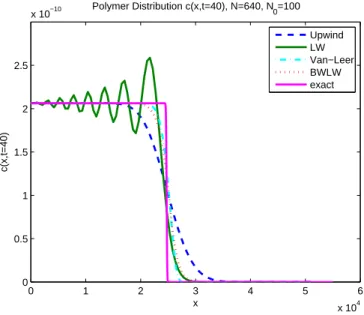
The simple upwind method converges with a rate of 1, while the Lax-Wendroff method with a rate of 2. The Flux-Limiter methods are between 1 and 2with Van-Leer Limiter showing a somewhat better convergence. The uniform mesh does not take the high concentration of smaller polymer sizes into account, but gives each spatial interval equal importance. The exact
poly-mer distribution ci to example 1 contains a sharp front. It is thus expected
and confirmed in Figure 4 that this feature will not be captured properly. The upwind method on a uniform grid smooths out the sharp front. While the Lax-Wendroff method converges the fastest for M , it leads to big oscillations for the
distribution ci. The flux limiter methods avoid oscillations and approximate the
sharp front better than the upwind method method. On the other hand, they
have a slightly bigger error eM than Lax-Wendroff.
The first experiment for the progressive mesh keeps the ratio q fixed and changes
N0. The error does not change significantly. Due to the constant inflow of
conformers and as seen in Figure 3, the distribution ci is constant for smaller
polymer sizes. Any of the four proposed discretization methods approximates a
constant accurately. The number of N0is thus, for this particular example, not
important. In the following simulations, we set N0= 100.
The second experiment for the progressive mesh focuses on the convergence of the error in q (or in the corresponding number of elements N ). All meth-ods converge satisfactorily (Table 4 and 5 and Figure 3). In terms of the error
Table 2: Ex.1: Error eM for the uniform mesh and computation time cti, ∆tmax=1e-3, N0= 100 N Upw. ct1 LW ct2 VL ct3 BWLW ct4 10 1.7063 1.58 1.2790 2.93 1.1047 3.50 1.2803 3.69 20 0.8531 1.60 0.4753 3.04 0.4384 3.85 0.5379 3.77 40 0.4265 1.62 0.1348 3.11 0.1688 4.80 0.2246 4.01 80 0.2132 1.74 0.0312 3.23 0.0638 4.21 0.0933 4.29 160 0.1065 2.03 0.0077 3.70 0.0238 4.59 0.0385 4.53 320 0.0532 2.21 0.0019 4.21 0.0088 4.87 0.0157 5.34 640 0.0265 2.73 0.0004 5.02 0.0032 6.18 0.0064 6.72 1280 0.0132 3.92 0.0001 7.37 0.0012 9.00 0.0026 9.85 2560 0.0065 7.74 0.0000 15.04 0.0004 17.91 0.0010 19.99 5120 0.0032 12.74 0.0001 25.54 0.0001 29.79 0.0004 32.75
Table 3: Ex.1: Error eM for the progressive mesh with ∆tmax= 10−3
q N0 N BWLW Upwind LW VL 0.10 10 97 0.0554 0.00549 0.0126 0.0199 0.10 100 77 0.0554 0.00549 0.0127 0.0199 0.10 1000 55 0.0553 0.00549 0.0127 0.0199 0.01 10 1009 0.0049 0.00005 0.0003 0.0008 0.01 100 803 0.0049 0.00003 0.0003 0.0008 0.01 1000 577 0.0049 0.00002 0.0003 0.0008
eM, the Lax-Wendroff method is best but again exhibits oscillations in the
dis-tribution c. In Figure 6, we present the relative error erel(t) = |M
h(t)−M (t)| |M | .
At the beginning, all methods have a big relative error. The model uses an instantaneous inflow of conformers which could be compared to a Dirac-delta
function. Since all methods start with solving (36) up to i = N0, this peak is
the same for all cases. For t ≥ 1, the relative error is about constant and thus
the approximation Mh is found in a fan-shaped environment around M . It is
clearly shown that Lax-Wendroff gives the best approximation to M , while the upwind method the worst.
Comparing the two meshes, the error using the progressive mesh is smaller than for the uniform mesh.
Conclusively, a choice for practical simulations would be a flux limiter method
to avoid the oscillations in the approximation of ci in combination with a
Table 4: Ex.1: Error eM and convergence rates λifor the progressive mesh with ∆tmax= 10−3 and N0= 100 q N Upwind λ1 LW λ2 VL λ3 BWLW λ4 1/2 12 0.4995 0.2525 0.2780 0.3329 1/4 29 0.1665 1.2451 0.0416 2.04 0.0614 1.71 0.0830 1.57 1/8 61 0.0713 1.1409 0.0089 2.08 0.0182 1.63 0.0277 1.48 1/16 126 0.0332 1.0536 0.0020 2.04 0.0060 1.53 0.0102 1.38 1/32 255 0.0160 1.0357 0.0004 2.17 0.0020 1.53 0.0039 1.36 1/64 513 0.0078 1.0266 0.0001 2.91 0.0007 1.56 0.0015 1.37 1/128 1029 0.0038 1.0312 0.0000 0.34 0.0002 1.76 0.0005 1.44 1/256 2062 0.0018 1.0413 0.0001 -0.86 0.0000 3.00 0.0002 1.75
Table 5: Ex.1: Error eM and computation time cti for the progressive mesh
with ∆tmax= 10−3 and N0= 100
q N Upwind ct1 LW ct2 VL ct3 BWLW ct4 1/2 12 0.4995 1.49 0.2525 2.78 0.2780 3.47 0.3329 3.61 1/4 29 0.1665 1.5157 0.0416 2.90 0.0614 3.50 0.0830 3.68 1/8 61 0.0713 1.8885 0.0089 3.12 0.0182 3.76 0.0277 3.86 1/16 126 0.0332 2.4272 0.0020 4.27 0.0060 5.24 0.0102 5.52 1/32 255 0.0160 1.9706 0.0004 3.64 0.0020 5.05 0.0039 5.99 1/64 513 0.0078 2.4639 0.0001 4.50 0.0007 5.64 0.0015 6.14 1/128 1029 0.0038 3.5800 0.0000 6.82 0.0002 8.48 0.0005 9.51 1/256 2062 0.0018 11.8933 0.0001 22.70 0.0000 27.55 0.0002 31.11
Table 6: Ex.1: Error ec and convergence rates λi for the uniform mesh with
∆tmax= 10−3 and N0= 100
N Upwind λ1 LW λ2 VL λ3 BWLW λ4
80 3.11e-01 2.35e-01 2.52e-01 2.59e-01
160 2.58e-01 0.27 1.94e-01 0.27 1.89e-01 0.42 1.98e-01 0.39
320 2.14e-01 0.27 1.62e-01 0.26 1.41e-01 0.42 1.52e-01 0.38
640 1.78e-01 0.27 1.33e-01 0.28 1.04e-01 0.43 1.16e-01 0.39
1280 1.47e-01 0.27 1.08e-01 0.31 7.55e-02 0.47 8.71e-02 0.41
2560 1.21e-01 0.28 8.50e-02 0.34 5.24e-02 0.53 6.36e-02 0.45
Figure 2: Example 1: Convergence plots for error eM (uniform mesh) 101 102 103 104 10−5 10−4 10−3 10−2 10−1 100 101
Convergence Plot in loglog−scale (uniform mesh), N0=100
number of elements N error e M Upwind Lax−Wendroff Van−Leer Lax−Wendroff/Beam−Warming
Figure 3: Example 1: Convergence plots for error eM (progressive mesh)
101 102 103 104 10−5 10−4 10−3 10−2 10−1 100
Convergence Plot in loglog−scale (progressive mesh), N0=100
number of elements N error e M Upwind Lax−Wendroff Van−Leer Lax−Wendroff/Beam−Warming
Figure 4: Example 1: Polymer Distribution (uniform mesh) 0 1 2 3 4 5 6 x 10⁴ 0 0.5 1 1.5 2 2.5 x 10⁻¹⁰ x c(x,t=40) Polymer Distribution c(x,t=40), N=640, N 0=100 Upwind LW Van−Leer BWLW exact
Figure 5: Example 1: Polymer Distribution (progressive mesh)
0 1 2 3 4 5 6 x 10⁴ 0 0.5 1 1.5 2 2.5 x 10⁻¹⁰ x c(x,t=40) Polymer Distribution c(x,t=40), q=1/64, N 0=100 Upwind LW Van−Leer BWLW exact
Figure 6: Example 1: Development of error erel in time (progressive mesh) for q=1/32, N0= 100 and ∆tmax= 10−3 0 5 10 15 20 25 30 35 40 0 0.01 0.02 0.03 0.04 0.05 0.06 0.07 0.08 0.09 t error e rel
Development of relative error in time
upwind LW VL BWLW
Table 7: Ex.1: Error ec and convergence rates λifor the progressive mesh with
∆tmax= 10−3 and N0= 100 q N Upwind λ1 LW λ2 VL λ3 BWLW λ4 1/8 61 0.2521 0.1931 0.2113 0.2153 1/16 126 0.2039 0.2927 0.1500 0.35 0.1520 0.45 0.1586 0.42 1/32 255 0.1670 0.2831 0.1204 0.31 0.1093 0.47 0.1176 0.42 1/64 513 0.1371 0.2821 0.0965 0.32 0.0775 0.49 0.0865 0.44 1/128 1029 0.1121 0.2890 0.0758 0.35 0.0528 0.55 0.0620 0.48 1/256 2062 0.0910 0.3010 0.0582 0.38 0.0329 0.68 0.0421 0.56 1/512 4128 0.0727 0.3227 0.0434 0.42 0.0170 0.95 0.0255 0.72
3.4
Example 2
In the second numerical example, we approximate (41)-(44) using (15)-(19).
The polymerization function is chosen as ki
on = kon1 + ikon2 for the ODE, and as
kon(x) = kon1 + xk2on in the continuous case. We take the following parameters
c0= 285 · 10−6, kI+= 5.7428 · 10−1, kI−= 1 · 10−2, kNon= 5.5079 · 103, k1on= 8.2766103, k2on= 6.5916 · 103, imax= 3.2907 · 105, i0= 3.
The simulated curve for the total polymerized mass has a typical shape for the polymerization-aggregation model. After having a lag-phase at the beginning where the conforming step takes place, it grows steeply (polymerization) and damps out in the end when all monomers are bound to a polymer.
We again discuss the convergence of the different suggested schemes in terms of the total polymerized mass M . This example does not provide an exact solu-tion. We solve the (finite) system of ODEs (41)-(43) and (45)-(46) numerically,
which gives a good approximation ˜M to the exact solution. The approximation
error is then computed as eM˜ =
∥ ˜M − Mh∥ L2([0,T ]
∥ ˜M∥L2([0,T ]
(49)
We define a maximum time step size to solve the ODE system for ˜M, while the
minimum time step size is determined through the CFL condition. In the
follow-ing numerical computations, we use ∆tmax= 10−4. For the uniform mesh, we
distinguish two different N0. The errors eM˜ vs. the convergence rates as well as
computation times for the four different methods using the uniform mesh with
N0= 100 and N0= 500 are given in Tables 8 - 11. For the progressive mesh, the
errors eM˜ and convergence rate are given in Tables 12 - 16. We distinguish
be-tween ∆tmax= 0.5·10−3and ∆tmax= 10−3, as well as N0= 100 and N0= 500.
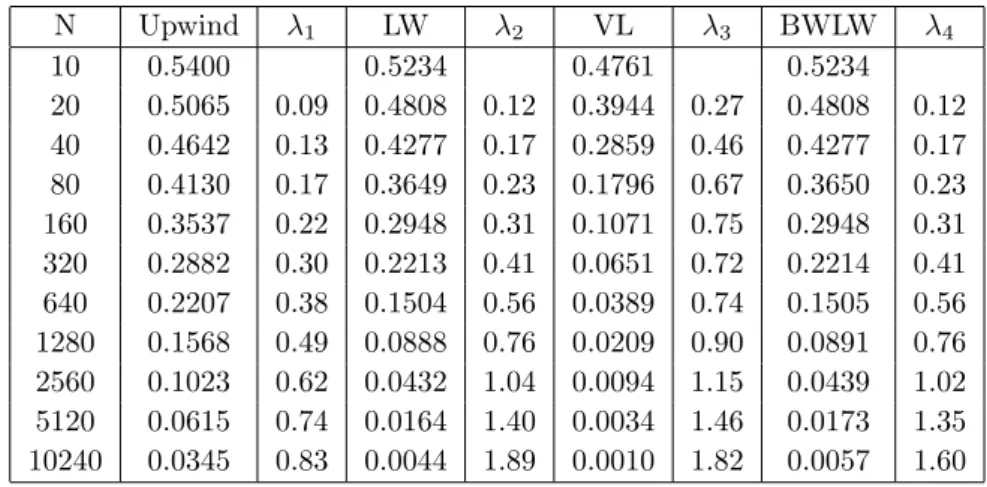
For the uniform mesh and N0 = 100 and N0 = 500, the numerical method
has not reached the asymptotic range yet for N , as the convergence rates are still changing. A convergence rate of 1 for the upwind method and 2 for the
Table 8: Ex.2: Error eM˜ and convergence rates λi for the uniform mesh with ∆tmax= 10−3 and N0= 100 N Upwind λ1 LW λ2 VL λ3 BWLW λ4 10 0.5400 0.5234 0.4761 0.5234 20 0.5065 0.09 0.4808 0.12 0.3944 0.27 0.4808 0.12 40 0.4642 0.13 0.4277 0.17 0.2859 0.46 0.4277 0.17 80 0.4130 0.17 0.3649 0.23 0.1796 0.67 0.3650 0.23 160 0.3537 0.22 0.2948 0.31 0.1071 0.75 0.2948 0.31 320 0.2882 0.30 0.2213 0.41 0.0651 0.72 0.2214 0.41 640 0.2207 0.38 0.1504 0.56 0.0389 0.74 0.1505 0.56 1280 0.1568 0.49 0.0888 0.76 0.0209 0.90 0.0891 0.76 2560 0.1023 0.62 0.0432 1.04 0.0094 1.15 0.0439 1.02 5120 0.0615 0.74 0.0164 1.40 0.0034 1.46 0.0173 1.35 10240 0.0345 0.83 0.0044 1.89 0.0010 1.82 0.0057 1.60
LW method are likely. We stop the computations at this point and do not further investigate on the convergence rates, as the computation times in com-bination with the size of the error have already reached an impractical size for
our application. It is to be noted that the error eM˜ is smaller for N0 = 500
throughout all methods and mesh sizes. This confirms the theory; the longer we use the actual ODE model for smaller polymers, the better is the approximation.
In case of the progressive mesh, the numerical scheme ceases to converge at a certain mesh size. To explain this, we first lowered the maximum time step size, to exclude that the error is caused by the temporal approximation. Having a smaller time step however gives an error in about the same ballpark as before. We conclude that the stagnating error is not caused by the temporal approxima-tion. Recall that the PDE is only an approximation to the infinite ODE system,
but the error eM˜ is computed with respect to the (numerical) ODE solution.
Increasing N0 to 500 shows a smaller error and the stagnated error is smaller
than in the case of N0= 100. We thus conclude that we obtained a converged
solution for the chosen N0 for which the error to the ODE model can only be
diminished by choosing a bigger N0 or a better continuous approximation to
the ODE system (e.g. second order PDE).
The goal of this study is to find an efficient scheme for the nucleation step in terms of accuracy and computation time. Fixing an acceptable
computa-tion time of 1.5s, say, and interpreting ˜M as good approximation to the exact
Table 9: Ex.2: Error eM˜ and computation time cti for the uniform mesh with ∆tmax= 10−3 and N0= 100 N Upwind ct1 LW ct2 VL ct3 BWLW ct4 10 0.5400 0.61 0.5234 0.90 0.4761 1.14 0.5234 1.19 20 0.5065 0.62 0.4808 0.90 0.3944 1.16 0.4808 1.22 40 0.4642 0.62 0.4277 0.93 0.2859 1.18 0.4277 1.23 80 0.4130 0.66 0.3649 1.08 0.1796 1.24 0.3650 1.30 160 0.3537 0.76 0.2948 1.44 0.1071 1.63 0.2948 1.71 320 0.2882 0.89 0.2213 1.78 0.0651 2.06 0.2214 1.76 640 0.2207 1.10 0.1504 1.82 0.0389 2.42 0.1505 2.63 1280 0.1568 2.13 0.0888 4.11 0.0209 5.44 0.0891 5.48 2560 0.1023 8.10 0.0432 16.21 0.0094 21.10 0.0439 21.34 5120 0.0615 24.07 0.0164 50.11 0.0034 62.94 0.0173 73.25 10240 0.0345 104.97 0.0044 198.91 0.0010 234.69 0.0057 267.99
Table 10: Ex.2: Error eM˜ and convergence rates λi for the uniform mesh with
∆tmax= 10−3 and N0= 500 N Upwind λ1 LW λ2 VL λ3 BWLW λ4 10 0.3900 0.3698 0.3178 0.3697 20 0.3489 0.16 0.3188 0.21 0.2367 0.42 0.3188 0.21 40 0.2992 0.22 0.2586 0.30 0.1515 0.64 0.2586 0.30 80 0.2428 0.30 0.1931 0.42 0.0853 0.83 0.1932 0.42 160 0.1839 0.40 0.1288 0.58 0.0440 0.95 0.1288 0.58 320 0.1283 0.52 0.0736 0.81 0.0205 1.10 0.0736 0.81 640 0.0820 0.65 0.0344 1.10 0.0083 1.32 0.0344 1.10 1280 0.0484 0.76 0.0127 1.44 0.0028 1.55 0.0128 1.42 2560 0.0268 0.85 0.0037 1.76 0.0009 1.71 0.0043 1.58 5120 0.0142 0.92 0.0009 2.09 0.0003 1.66 0.0014 1.61
Table 11: Ex.2: Error eM˜ and computation times cti for the uniform mesh with ∆tmax= 10−3 and N0= 500 N Upwind ct1 LW ct2 VL ct3 BWLW ct4 10 0.3900 0.77 0.3698 1.09 0.3178 1.31 0.3697 1.35 20 0.3489 0.78 0.3188 1.07 0.2367 1.34 0.3188 1.42 40 0.2992 0.79 0.2586 1.13 0.1515 1.37 0.2586 1.43 80 0.2428 0.81 0.1931 1.16 0.0853 1.44 0.1932 1.49 160 0.1839 0.88 0.1288 1.29 0.0440 1.55 0.1288 1.62 320 0.1283 0.94 0.0736 1.43 0.0205 2.02 0.0736 1.90 640 0.0820 1.33 0.0344 1.96 0.0083 2.49 0.0344 2.62 1280 0.0484 2.64 0.0127 4.53 0.0028 6.08 0.0128 7.45 2560 0.0268 9.15 0.0037 17.39 0.0009 20.89 0.0043 22.81 5120 0.0142 27.48 0.0009 52.64 0.0003 64.11 0.0014 72.69
Table 12: Ex.2: Error eM˜ and convergence rates λi for the progressive mesh
with ∆tmax= 10−3 and N0= 100
q N Upwind λ1 LW λ2 VL λ3 BWLW λ4 1/2 12 0.2857 0.2018 0.1253 0.1990 1/4 29 0.1480 0.75 0.0475 1.64 0.0159 2.34 0.0488 1.59 1/8 61 0.0726 0.96 0.0102 2.07 0.0023 2.58 0.0114 1.95 1/16 126 0.0354 0.99 0.0018 2.38 0.0002 3.24 0.0027 1.99 1/32 255 0.0172 1.02 0.0003 2.54 0.0004 -0.73 0.0005 2.48 1/64 513 0.0083 1.04 0.0007 -1.11 0.0007 -0.82 0.0004 0.12 1/128 1029 0.0039 1.09 0.0008 -0.21 0.0009 -0.39 0.0008 -0.83 1/256 2062 0.0017 1.19 0.0008 -0.05 0.0010 -0.28 0.0008 -0.05
Table 13: Ex.2: Error eM˜ and computational times ctifor the progressive mesh
with ∆tmax= 10−3 and N0= 100
q N Upwind ct1 LW ct2 VL ct3 BWLW ct4 1/2 12 0.2857 0.63 0.2018 0.93 0.1253 1.21 0.1990 1.19 1/4 29 0.1480 0.62 0.0475 0.93 0.0159 1.19 0.0488 1.23 1/8 61 0.0726 0.64 0.0102 0.96 0.0023 1.22 0.0114 1.29 1/16 126 0.0354 0.71 0.0018 1.10 0.0002 1.38 0.0027 1.42 1/32 255 0.0172 0.76 0.0003 1.25 0.0004 1.51 0.0005 1.60 1/64 513 0.0083 0.97 0.0007 1.74 0.0007 1.91 0.0004 2.00 1/128 1029 0.0039 1.16 0.0008 2.14 0.0009 2.82 0.0008 3.11 1/256 2062 0.0017 2.41 0.0008 3.71 0.0010 4.66 0.0008 4.99
Table 14: Ex.2: Error eM˜ and convergence rates λi for the progressive mesh
with ∆tmax= 0.5 · 10−3 and N0= 100
q N Upwind λ1 LW λ2 VL λ3 BWLW λ4 1/2 12 0.2857 0.2017 0.1252 0.1990 1/4 29 0.1480 0.75 0.0474 1.64 0.0157 2.35 0.0487 1.59 1/8 61 0.0726 0.96 0.0100 2.09 0.0022 2.67 0.0113 1.96 1/16 126 0.0354 0.99 0.0016 2.49 0.0001 4.41 0.0026 2.04 1/32 255 0.0172 1.02 0.0004 1.96 0.0005 -2.53 0.0003 2.98 1/64 513 0.0083 1.04 0.0008 -1.01 0.0008 -0.67 0.0006 -0.86 1/128 1029 0.0039 1.09 0.0010 -0.18 0.0011 -0.33 0.0010 -0.71 1/256 2062 0.0017 1.19 0.0010 -0.04 0.0012 -0.24 0.0010 -0.04
allowed upper temporal bound, the Upwind method achieves a minimal error
of 4 · 10−3, while LW and VL fall below an error of 3 · 10−4. Best performs
the VL method with an error of 0.02% in 1.38s. A similar outcome is observed
for N0 = 500. Again, the VL methods obtains the smallest error of 0.03% in
1.47s, which is about 8x smaller than the corresponding Upwind error. Since no limiter functions have to be computed, the LW method is faster for roughly the same small error. However, due to possible oscillations, the VL method is preferable.
Conclusion
This article proposes a method to deal numerically with both small sizes, pre-dominant during early reaction phases for instance, and with very large aggre-gates. It is based on a mixed ODE-PDE approach, which keeps the original ODE system for small sizes and uses an approximate PDE, on a progressive
Table 15: Ex.2: Error eM˜ and convergence rates λi for the progressive mesh
with ∆tmax= 10−3 and N0= 500
q N Upwind λ1 LW λ2 VL λ3 BWLW λ4 1/2 10 0.2022 0.1429 0.0901 0.1406 1/4 23 0.0992 0.85 0.0329 1.76 0.0119 2.43 0.0334 1.73 1/8 49 0.0474 0.98 0.0074 1.98 0.0018 2.50 0.0078 1.92 1/16 101 0.0228 1.01 0.0017 2.05 0.0003 2.45 0.0019 1.97 1/32 205 0.0110 1.03 0.0004 2.17 0.0001 1.32 0.0005 1.99 1/64 412 0.0053 1.06 0.0001 1.37 0.0001 -0.09 0.0001 1.61 1/128 827 0.0024 1.12 0.0002 -0.16 0.0001 -0.15 0.0001 0.21 1/256 1657 0.0010 1.26 0.0002 -0.09 0.0002 -0.14 0.0001 -0.18
Table 16: Ex.2: Error eM˜ and computational times ctifor the progressive mesh
with ∆tmax= 10−3 and N0= 500
q N Upwind ct1 LW ct2 VL ct3 BWLW ct4 1/2 10 0.2022 0.82 0.1429 1.18 0.0901 1.42 0.1406 1.41 1/4 23 0.0992 0.81 0.0329 1.11 0.0119 1.38 0.0334 1.43 1/8 49 0.0474 0.81 0.0074 1.13 0.0018 1.43 0.0078 1.50 1/16 101 0.0228 0.88 0.0017 1.22 0.0003 1.47 0.0019 1.52 1/32 205 0.0110 0.88 0.0004 1.33 0.0001 1.67 0.0005 1.76 1/64 412 0.0053 1.06 0.0001 1.58 0.0001 2.00 0.0001 2.12 1/128 827 0.0024 1.34 0.0002 2.00 0.0001 2.62 0.0001 2.79 1/256 1657 0.0010 1.78 0.0002 3.41 0.0002 4.13 0.0001 4.23
Figure 7: Example 2: Convergence plots of error eM˜ (uniform mesh), ∆tmax= 10−3 and N 0= 100 101 102 103 104 105 10−4 10−3 10−2 10−1 100
Convergence Plot in loglog−scale (uniform mesh), N
0=100 number of elements N error Upwind Lax−Wendroff Van−Leer Lax−Wendroff/Beam−Warming
Figure 8: Example 2: Convergence plots of error eM˜ (uniform mesh), ∆tmax=
10−3 and N 0= 500 101 102 103 104 10−4 10−3 10−2 10−1 100
Convergence Plot in loglog−scale (uniform mesh), N
0=500 number of elements N error Upwind Lax−Wendroff Van−Leer Lax−Wendroff/Beam−Warming
Figure 9: Example 2: Convergence plots of error eM˜ (progressive mesh), ∆tmax= 10−3 and N0= 100 101 102 103 104 10−4 10−3 10−2 10−1 100
Convergence Plot in loglog−scale, N
0=100 number of elements N error Upwind Lax−Wendroff Van−Leer Lax−Wendroff/Beam−Warming
Figure 10: Example 2: Convergence plots of error eM˜ (progressive mesh),
∆tmax= 10−3 and N0= 500 101 102 103 104 10−4 10−3 10−2 10−1 100
Convergence Plot in loglog−scale, N
0=500 number of elements N error Upwind Lax−Wendroff Van−Leer Lax−Wendroff/Beam−Warming
Figure 11: Example 2: Distribution of polymers at t = 12 0 100 200 300 400 500 0 0.2 0.4 0.6 0.8 1 1.2 1.4 1.6x 10 −9 x c(x,t=12) Polymer Distribution c(x,t=12), q=1/32, N 0=100 Upwind LW Van−Leer BWLW
grid, for larger sizes. Tested on simplified cases for which explicit solutions are available, the method revealed to be accurate, especially when using a flux limiter method in combination with a progressive mesh.
For the PDE part, we used finite volume methods which were accurate for the simplified case we were investigating. The methods presented in this paper neglect the possibility of depolymerization. However, they could be applied equally, by defining the flux limiter method according to [15, Chapter 9.5]
Fi−1/2= ki−1/2on Qi−1+ ki−1/2dep Qi+ ˜Fi−1/2 (50)
where ˜Fi−1/2 is defined in [15, Chapter 9.3.1, (9.19)].
To adapt it to more general equations or to capture long-time asymptotic behaviors, containing for instance fragmentation or coagulation terms, any other method could be used as soon as it proved efficient to deal with the continuous equation considered on a non-uniform mesh. For instance, the very recent and accurate method developed by T. Goudon, F. Lagouti`ere and L.M. Tine in [12] for the Lifshitz-Slyozov equation, even if derived on uniform meshes, can be adapted on a non-uniform mesh, and others like [10] are already written on non-uniform grids.
References
1. J.-P. Bourgade and F. Filbet. Convergence of a finite volume scheme for coagulation-fragmentation equations. Math. Comp., 77(262):851–882, 2008.
2. J. A. Caizo, L. Desvillettes, and K. Fellner. Regularity and mass con-servation for discrete coagulation-fragmentation equations with diffu-sion. Annales de lInstitut Henri Poincare. Annales: Analyse Non Lin-eaire/Nonlinear Analysis, 27(2):639–654, 2010.
3. J. A. Carrillo and T. Goudon. A numerical study on large-time asymp-totics of the Lifshitz-Slyozov system. J. Sci. Comput., 20(1):69–113, 2004. 4. J.-F. Collet, T. Goudon, F. Poupaud, and A. Vasseur. The Becker– D¨oring system and its Lifshitz–Slyozov limit. SIAM J. on Appl. Math., 62(5):1488–1500, 2002.
5. J.F. Collet and S. Hariz. A modified version of the lifshitz-slyozov model. Applied Mathematics Letters, 12:81–95, 1999.
6. P Deuflhard, W Huisinga, T Jahnke, and M Wulkow. Adaptive discrete galerkin methods applied to the chemical master equation. Technology, 30(6):2990–3011, 2008.
7. M. Doumic, T. Goudon, and T. Lepoutre. Scaling Limit of a Discrete Prion Dynamics Model. Comm. in Math. Sc., 7(4):839–865, 2009. 8. F. Filbet and P. Lauren¸cot. Numerical approximation of the
Lifshitz-Slyozov-Wagner equation. SIAM J. Numer. Anal., 41(2):563–588 (elec-tronic), 2003.
9. F. Filbet and P. Lauren¸cot. Mass-conserving solutions and
non-conservative approximation to the Smoluchowski coagulation equation. Arch. Math. (Basel), 83(6):558–567, 2004.
10. F. Filbet and P. Lauren¸cot. Numerical simulation of the Smoluchowski co-agulation equation. SIAM J. Sci. Comput., 25(6):2004–2028 (electronic), 2004.
11. Francis Filbet. An asymptotically stable scheme for diffusive coagulation-fragmentation models. Commun. Math. Sci., 6(2):257–280, 2008. 12. T. Goudon, F. Lagouti`ere, and L.M. Tine. The lifschitz-slyozov equation
with space-diffusion of monomers. Kinetic and Related Models, 5(2):325– 355, 06 2012.
13. J. Kumar, M. Peglow, G. Warnecke, S. Heinrich, and L. Mrl. Improved ac-curacy and convergence of discretized population balance for aggregation: The cell average technique. Chemical Engineering Science, 61(10):3327 – 3342, 2006.
14. Lauren¸cot, P., and S. Mischler. From the discrete to the continuous coagulation-fragmentation equations. Proc. Roy. Soc. Edinburgh Sect. A, 132(5):1219–1248, 2002.
15. Randall J. LeVeque. Finite volume methods for hyperbolic problems. bridge Texts in Applied Mathematics. Cambridge University Press, Cam-bridge, 2002.
16. J. Masel, V.A.A. Jansen, and M.A. Nowak. Quantifying the kinetic pa-rameters of prion replication. Biophysical Chemistry, 77(2-3):139 – 152, 1999.
17. F. Oosawa and S. Asakura. Thermodynamics of the polymerization of protein. Academic Press, 1975.
18. Oliver Penrose. Metastable states for the becker-dring cluster equations. Communications in Mathematical Physics, 124(4):515–541, 1989. 19. S. Prigent, A. Ballesta, F. Charles, N. Lenuzza, P. Gabriel, L.M. Tine,
H. Rezaei, and M. Doumic. An efficient kinetic model for assemblies of amyloid fibrils and its application to polyglutamine aggregation. PLoS ONE, 7(11):e43273, 11 2012.
20. Suzanne S. Sindi and Tricia R. Serio. Prion dynamics and the quest for the genetic determinant in protein-only inheritance. Current Opinion in Microbiology, 12(6):623–630, 2009.
21. M. Wulkow. The simulation of molecular weight distributions in polyre-action kinetics by discrete galerkin methods. Macromol. Theory Simul., 5:396–416, 1996.