VIII. ATOMIC BEAM RESEARCH
Prof. J. R. Zacharias S. J. Buchsbaum K. H. Powers Prof. J. G. Yates R. T. Daly, Jr. C. L. Schwartz Dr. V. Jaccarino D. S. Edmonds, Jr. H. H. Stroke
Dr. J. G. King R. D. Haun, Jr. R. Weiss
J. H. Holloway
A. CESIUM CLOCK
During the last quarter the cesium beam apparatus which has been under construction to provide a primary frequency standard for the Atomic Beam laboratory has been in successful operation. Much useful information has been obtained showing that such a
10 system can be expected to provide a long term stability approaching 1 part in 1010
133
The system uses the field insensitive resonance line of Cs , occurring at approxi-mately 9192. 63197 Mc/sec, as the frequency standard. By exploiting the molecular beam techniques developed for measurements on scarce isotopes, which involve the use of a narrow beam and sensitive detector, an apparatus has been designed to give a good signal-to-noise ratio using only one microgram of cesium per day. The expected line-width was about 200 cps, making possible a stability of 1 part in 1010 by splitting the linewidth to +1 per cent.
For those not familiar with the principles involved, the following brief description is provided.
There are a number of magnetic resonance lines associated with a cesium (or other) atom, resulting from transitions between two quantum states. There exists a pair of states for which the energy is independent (to the first order) of the external magnetic field, so that the associated frequency is similarly field insensitive. (There is, how-ever, a small term proportional to the square of the field.) The resonance is excited by applying a magnetic field at the appropriate frequency, the width of the resonance curve being inversely proportional to the time the atom spends in the field. With a beam of atoms a long path without collision can be obtained with a high density of atoms, because of the ordered nature of their paths. The transition in question is associated with a reversal in the magnetic moment of the atom. If the beam of atoms is passed through a transverse inhomogeneous magnetic field, a deflection is produced in a direc-tion determined by the sign of the magnetic moment. If a pair of such fields is placed on either side of the rf field (A and B magnets), a distinction can be made between atoms which have made the transition (or "flopped") and the others, by observing whether the two deflections have added or cancelled. A detector placed to measure the number of atoms on one or the other of the two paths will record a resonance curve as the frequency is varied. If the rf field is applied uniformly over a given length, a single peak is obtained. If two separated fields are used as in Ramsey's method, a typical interference pattern is obtained whose spacing depends on the velocity of the atom. If a
(VIII. ATOMIC BEAM RESEARCH) A MAGNET ELECTRON MULTIPLIER
9
---. .JI I.+300V
S ATOMS--- --- il NHOT WIRE l\ LL-I
IONIZER GROUNDED +300V SHIELD IONS/ 300VPLATES GROUND +3KV PAIR OF DEFLECTOR PLATES COLLEC/ POTENTIAL POTENTIAL VARIABLE COLLECTOR
(10 MEG TO
GROUND)
(C)
Fig. VIII-1
(a) Schematic diagram of apparatus. The apparatus actually operates in a vertical position with the top plate up. (b) Cross sectional view of deflecting magnets. (c) Schematic view of detector system. This assembly goes in the space at the top of the can in (a).
range of velocities is used, only the central peak is reinforced; the side peaks tend to average out. The use of a surface ionization detector (hot wire) serves to change neutral atoms into charged ions which may be detected electrically. With an electron multiplier as amplifier, the arrival of individual atoms can be recorded.
The general arrangement of the beam apparatus is indicated in the simplified form of Fig. VIII-1. The apparatus is housed in a stainless steel can 6 feet long and 10 inches in diameter into which it is lowered vertically. All connections are brought out through the top plate.
The oven produces two narrow beams of cesium atoms, each of initial cross section 0. 020 inch by 3/8 inch with a total divergence in angle of less than 10. Details of the oven construction and performance are given in the following section, but with a total emission of 10- 6 gm of cesium per day (5 • 1011 atoms/sec) it was expected to provide
107 atoms/sec reaching the detector, of which one-eighth can provide the desired transi-tion.
The A and
magnetic field.
a field strength
B magnets, which are identical, produce a transverse inhomogeneous
With an Alnico core, and circular section pole pieces (Fig. VIII-l(a)),
of 6000 gauss and a gradient of more than 10, 000 gauss/cm is obtained
I
POSITION OF BEAMS
(VIII. ATOMIC BEAM RESEARCH)
in a gap of 1/8 inch. The present magnet length is 10 inches, which produces a deflec-tion of 0. 025 radian on atoms of the most probable velocity. This is excessive; the magnet length will be reduced in the future to 3 1/2 inches and the gap increased to 1/4 inch. Magnetizing coils are incorporated so that the magnets can be set to the desired strength. The rf field system is designed to use the Ramsey method of separated fields. For each beam, two rectangular cavities each a half wavelength long and spaced 66 cm apart, produce a transverse rf field (parallel to the A and B fields), using the transverse component of the TE0 1 field pattern. The cavities are fed symmetrically with a
wave-guide feed. To get a symmetrical resonance curve it is essential that the phase of the fields in the two cavities should be the same. This is obtained by providing a second waveguide running between the cavities which is loosely coupled to the cavities by the slots through which the cesium beam passes. If a probe is inserted at its middle point, a null signal is obtained if the phase and amplitude in the cavities are identical. The phase adjustment is made by a tuning screw in each cavity. This measurement can be
checked during normal operation, but in general an initial adjustment is adequate. The steady field in the rf region is made up of the earth's field and the leakage field from the A and B magnets, with provision for some control by small coils near the cavities. It has been found that the maximum field is below 1 gauss. In the final form some magnetic screening will be provided to reduce the contribution of the earth's field, and the desired field will be provided by a suitable coil system.
The detector is a 0. 040-inch tungsten ribbon. Cesium atoms falling on this are ionized and are then pulled off and deflected electrostatically to one or the other of two electron multipliers, each having a gain of about 3 x 10⁶
The apparatus is evacuated by a 2 1/2-inch oil diffusion pump; with liquid air traps a pressure of 5 • 10 mm is regularly maintained.
A considerable amount of apparatus, which is described briefly below, has been constructed for use with the beam tube.
The most important item is the signal source at 9192 Mc/sec. This is produced in a silicon crystal tripler driven by an S-band cavity oscillator (1). The oscillator, with a cavity with a
Q
of about 50, 000 and a triode amplifier, has proved to have a short term stability better than 1 part in 109. For convenience in the experimental operation of the beam tube, the long term frequency stability has been improved by fitting a thermostat to the cavity of the oscillator. The thermostat uses a temperature sensitive resistance wound over the whole cylindrical surface of the cavity. This is connected in a sensitive bridge circuit that provides a continuous control of the power supplied to a heater winding outside the cavity, giving rapid and precise control of temperature. Changes of the thermostat setting provide a convenient means of frequency adjustment; they also provide a convenient method of producing a frequency changing linearly with time.(VIII. ATOMIC BEAM RESEARCH)
the oscillator over a predetermined range by switching the oscillator cavity heating
power between two levels. In addition, provision is made for the time of the occurrence
of the resonance curve (or any other event, such as a frequency marker from a crystal
standard) in the sweep to control automatically the frequency limit desired so that it
continues to cover the required range.
The frequency of the S-band oscillator can be compared with the laboratory crystal
standard, using the beat frequency between the S-band signal (3064 Mc/sec) and the 17th
harmonic of 180 Mc/sec (3060 Mc/sec) derived from a 5 Mc/sec crystal. An audio
fre-quency discriminator (with its peaks located at 1000 and 1500 cps) has proved very
convenient for recording small frequency variations.
If a small amount of frequency
modulation at about 30 cps is applied to the S-band oscillator, the beam current has a
30 cps component which is proportional to the derivative of the resonance curve. When
this is applied to a phase sensitive detector, an output having the characteristic of a
frequency discriminator is obtained with a zero value at the resonant frequency.
A Sanborn two-channel recorder has been used for recording the data and has proved
of great value in a number of different types of measurement.
As soon as the apparatus was assembled with magnets of the quoted specifications,
resonance curves of the Ramsey pattern were obtained.
Detailed measurements are
much too numerous to quote but the important conclusions are as follows.
Resonance curves of the Ramsey pattern with good signal-to-noise ratios were
obtained (Fig. VIII-2).
The oscillator proved to have more than adequate short-term
stability for the purpose, and can produce more than enough power at 9192 Mc/sec. The
oscillator was successfully locked to the beam frequency, by using the beam output as
an error signal for frequency control. With a very simple control system, a peak
fre-quency deviation of +1 part 109 was reached and the mean over longer periods would be
much smaller.
Probably of greatest importance is the fact that the whole apparatus worked very
much according to plan. The oven has run for two extended periods, one of 6 weeks,
3 CErE-; TM 32 A_/ SEC
Fig. VIII-2
Fig. VIII-3
(VIII. ATOMIC BEAM RESEARCH)
and in each instance the run was ended because the apparatus had to be opened to allow
other unrelated changes to be made.
The main feature requiring modification was that the linewidth obtained, of 300 cps,
corresponds to using atoms of twice the most probable velocity. If the magnet strength
was reduced to allow the use of lower velocity atoms, the background of "unflopped"
atoms, already high, was further increased because of certain features of the geometry
of the apparatus.
For a number of reasons, a more effective arrangement is a layout
in which the oven is offset to one side of the axis and the detector is offset to the other.
This gives a loss of half the available atoms but can give a much lower background. An
experiment with an excessive amount of displacement to suit the large magnet deflections
available gave the expected results, shown in Fig. VIII-3. This curve is an example of
the discriminator type of characteristic obtained by applying a small amount of frequency
modulation to the oscillator. A linewidth of 200 cps with negligible background and very
good signal-to-noise ratio was obtained. The total available signal can be increased by
using the optimum deflection angle.
The large number of peaks was expected from the
narrow velocity range used in this experiment. Information available from the present
tests provides the essential information for the engineering design of molecular beam
tubes of various sorts. The tube construction is simple and has proved very
satis-factory. For the immediate future, the beam apparatus will be set up to provide a
fre-quency standard by direct reference to the cesium resonance line with an accuracy of a
single observation of about 1 in 109.
As soon as any greater precision is required, the
necessary circuits for locking the oscillator continuously will be provided.
J. R. Zacharias, J. G. Yates
References
1. Quarterly Progress Report, Research Laboratory of Electronics, M.I.T., Jan. 15,
1954.
B.
WELL-COLLIMATED ATOMIC BEAM OVENS
To make possible the development of atomic beam clocks which would run for long
periods of time without maintenance, it was necessary to develop atomic beam sources
(ovens) that would conserve as much material as possible without reducing, significantly,
the usable number of atoms. This report describes the construction and test of such
ovens.
The number of atoms per second that will leave an oven canal and reach a distant
detector which subtends an infinitesimal solid angle located on the axis of the slit is
dependent only on the cross sectional area of the slit and on the pressure inside the oven.
(In this discussion, the slit is assumed to be some sort of a closed cylindrical surface;
(VIII. ATOMIC BEAM RESEARCH)
this does not restrict the argument.) On the other hand, the total number of atoms per second that leave the slit is determined by the solid angle which one end of the slit sub-tends as seen from the other end. This is so because most of the atoms entering the long canal will hit the walls on the oven end of the slit, and the smaller this solid angle, the greater the probability that atoms which hit the walls of the slit will go back into the oven instead of going out the far end of the slit.
Thus, to save material one is led to the use of a cylindrical slit whose length is large relative to its diameter. However, an upper limit is placed on the length by the condi-tion that the length be short compared with the mean free path for atoms in the oven exit canal. If this condition is not fulfilled, then atoms will collide with each other and the point at which such collisions are most probable will serve as a new source - so that the entire length of the slit will not be contributing to the material savings. Since the forward intensity is proportional to a positive power of the pressure in the oven and since one is usually interested in obtaining as great a forward intensity as possible, one obviously wants to operate the oven at as high a pressure as possible. But the mean free path is inversely proportional to the pressure. Therefore, one is forced to make the slit as short as possible. This in turn requires the slit diameter to be very small. To obtain usable forward intensities one must use a large number of such slits with their axes parallel and with as thin boundary walls as possible.
The oven slits now in use were constructed by rolling 0. 001 inch thick nickel foil between two interlocking bronze rolls. The width of sheet having the best rolling properties was found to be 0. 5 inch. This implies a canal length of 0. 5 inch. The length of the sheet is completely arbitrary. The resulting sheet (nicknamed "crinkly sheet") looks very much like miniature corrugated iron. The corrugations are about 0. 002 inch deep and about 0. 007 inch from peak to peak. The sheet can be cut to the desired length with a pair of kitchen scissors. By alternately stacking these "crinkly sheets" and
sheets of flat 0. 001-inch nickel foil, one can obtain canal assemblies of arbitrary dimensions.
For the small clock, the dimensions of the slit assembly are 0. 025 inch by 1.0 inch, and the length of each slit is 0. 5 inch.
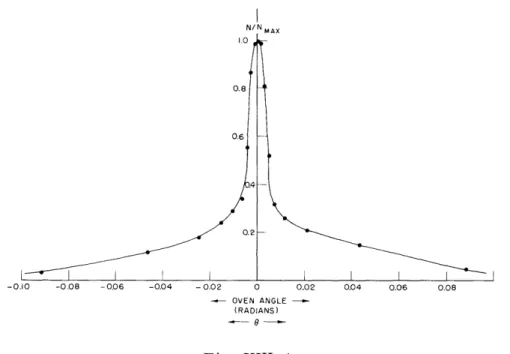
In the tests analyzing the directivity of this oven, a charge of cesium carbonate and potassium was placed in the oven. The beam of cesium atoms obtained on heating the oven was detected using a surface ionization detector (hot wire). The oven temperature was measured with an iron-constantan thermocouple bolted on the outside of the oven. The surface ionization detector was a heated tungsten wire, 0. 005 inch in diameter, located 12 inches from the oven slit. The useful length of the hot wire was about two inches. The oven was mounted so that it could be turned about a vertical axis parallel to the long dimension (one inch) of the slit assembly and perpendicular to the axes of the slits. The angle through which the oven was turned was read from a micrometer
0.8 0.6 0.2 -0.10 -0.08 -0.06 -0.04 -0.02 -..
1--I
N MAX 0 0.02 0.04 0.06 0.08 OVEN ANGLE (RADIANS) 9-Fig. VIII-4
Plot of beam intensity N vs. oven angle (0).
the intensity in the forward direction.
The
The value of N
maxwas 1. 1 x 10⁷ atoms/sec
N/N MAX
N is plotted in units of Nmax'
oven temperature was 341 K. hitting the hot wire.
-U.IU -U.Uj -oU.U -U.U4 - .UU 0 0.02 0.04 0.06 0.08 0.10
-OVEN ANGLE
--(RADIANS)
-- 8
Fig. VIII-5
Plot of beam intensity N vs. oven angle
(6).
the intensity in the forward direction. The
The value of Nma
max
xwas 1. 9
x
109 atoms/sec
N is plotted in units of N oven temperature was 4170K. hitting the hot wire.
(VIII. ATOMIC BEAM RESEARCH)
screw which actuated the turning lever. The number of cesium atoms which hit the hot wire in a second was measured as a function of oven temperature and angle. Two of the curves which were obtained are Fig. VIII-4 and Fig. VIII-5. In both of these curves, the ordinate of the curve has been normalized to unity at an angle of zero radian. Since a linear assembly of slits was used and the detector was also linear, one should interpret these curves as the measurement of angular spread in one direction only. Since each slit is approximately circular in cross section, the curve of angular spread for one slit would be approximately the figure of revolution obtained by rotating Figs. VIII-4 and VIII-5 about the 0 = 0 axis. From these figures we see that, in so far as one dimension is concerned, the amount of material within the half intensity angle is about 10 per cent of the total amount of material at a temperature of 341 K. However, from Fig. VIII-5, the amount of material in the central peak is only about 5 per cent of the total for a temperature of 417 0K. The material savings in the other direction will depend on the angle which the long dimension of the detector subtends at the source. With Fig. VIII-4 as a guide, we see that if this angle is 0.010 radian, about 10 per cent of the beam in that direction will be useful at a temperature of 341 K. In the experiments described above, the detector subtended an angle of approximately 0. 2 radian so that very little material was wasted in this direction.
The major conclusions of the experiments that have been completed are:
1. A definite material saving results from the use of collimated slits. The curves obtained show this when compared with the cosine distribution for N/Nmax vs. 0 which would be obtained for an infinitely short slit or when compared with the curves given by Davis (1). At low temperatures (see below) this material saving seems to be roughly that expected on the basis of considerations of solid angle alone.
2. The source is equivalent to an assembly of about 300 canals each giving about 105 atoms/sec at 341 0K and 107 atoms/sec at 417 0K - all going into the solid angle within the cone 6 = 0. 010 radian. The width at half intensity for a single canal is about 0. 010 radian for both temperatures. The proportion of atoms going outside the cone 6 = 0. 010 radian is a function of temperature.
3. The material saving is a function of temperature. The higher the temperature, the greater the ratio of total material leaving the oven to "forward intensity." (That is, the "wings" of the curves in Figs. VIII-4 and VIII-5 become larger as the temperature is increased.) This temperature dependence is probably due to scattering in the slit (1).
J. R. Zacharias, R. D. Haun, Jr.
References
1. L. Davis, Technical Report No. 88, Research Laboratory of Electronics, M.I.T., Dec. 1, 1948, pp. 10-15.
(VIII. ATOMIC BEAM RESEARCH)
C. HYPERFINE STRUCTURE ANOMALIES IN CESIUM RADIOISOTOPES
The ratios of the nuclear g values of the four cesium isotopes - Cs 1 3 3 (stable), and
134 135 137 6
Cs 3 4 , Cs , and Cs (radioactive with half lives of 2.3, 3 x 10 , and 37 years,
respectively) - have been measured by the atomic beam method, by observing the doublet
transitions AF = 0, m = -1 - -2 in the odd-even isotopes, and m = -3/2 - m = -5/2 in the odd-odd isotope in fields of 8300 to 9500 gauss. The results are:
g135 - 1.05817 + 0.00006 g133 g137 - 1. 04004 + 0. 00005 g1 3 5 g137137- = 1. 10047 + 0. 00008 9133 g134 - 1.01447 + 0. 0003 9133
When these results are compared with those obtained from the ratios of the Av's (1) by means of the Fermi formula (2),
8 2 21+ 1
Av
3
I
o
(0)
I
derived on the assumption that the nuclear magnetic moment is a point dipole, it is found (3) that there is a discrepancy a. The experimental values are
A(135-133)
= +0. 034 + 0. 006 per centA(137-135) = -0. 022 + 0. 005 per cent A(137-133) = +0. 006 + 0. 008 per cent
A(134-133) = +0. 17 + 0. 03 per cent
When these values are compared with the results of a detailed treatment of the hfs inter-action according to reference 3, in which a departure from a nuclear point dipole theory is considered, one finds, on the basis of a strict independent particle model with quenched intrinsic magnetic moments, agreement with experiment for the three isotopes
133 134 135 137
Cs 133, Cs , and Cs 3 5 . Cs has an hfs anomaly which has a sign opposite to the
135
one predicted with respect to Cs , as well as one smaller by a factor of 10 with respect
133 137
to Cs . This result may be related to the fact that Cs is a magic nucleus with a closed shell of 82 neutrons. A detailed description of the experiment and theory will be presented in a separate report.
(VIII. ATOMIC BEAM RESEARCH)
References
1. Quarterly Progress Report, Research Laboratory of Electronics, M.I.T., July 15,
1954.
2.
E. Fermi, Z. Physik 60, 320 (1930).
3.
A. Bohr and V. F. Weisskopf, Phys. Rev. 77, 94 (1950).
D.
NUCLEAR MAGNETIC OCTUPOLE MOMENTS OF THE
STABLE GALLIUM ISOTOPES
The three zero-field hyperfine structure intervals of the metastable
P3/2 state of
Ga
6 9and Ga
7 1have been remeasured (1) to higher precision to establish the existence
of a nuclear magnetic octupole moment.
The atomic beam magnetic resonance method was employed; the transitions were
induced by the Ramsey technique (2) of separated oscillating fields. One oscillating field
was phase-modulated at 93 cps with respect to the other so that the oscillating fields
were alternately in phase and 180* out of phase. The alternately in-phase and
out-of-phase Ramsey patterns produced were electronically subtracted by a synchronous
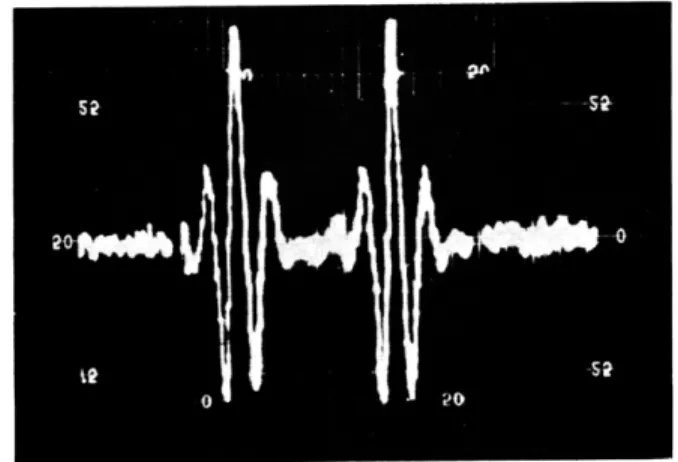
detector and displayed on an oscilloscope (see Fig. VIII-6).
The intervals were measured in several external fields ranging from 0. 2 gauss to
1 gauss, extrapolated to zero field, and corrected (3) for the perturbing effects of the
Fig. VIII-6
Typical oscilloscope photograph showing the quadratic Zeeman splitting of
the (F = 2, m
F= 0) -
(1, 0) and (2, 1) -
(1, 1) transitions in an external
mag-netic field of 0. 4 gauss. The Ramsey technique (2) of separated oscillating
fields was used. The two blank portions of the trace calibrate the picture
(VIII. ATOMIC BEAM RESEARCH)
Table I
Measured and Corrected HFS Intervals of the
2 6 9 and Ga71
Metastable P 3/ State of Ga and Ga
Ga
6 9(Mc/sec)
Ga71 (Mc/sec)Measured 128.27730 319.06706 634.90183 128.27650 319.06373 634.90597
0.00020
0.00020 0.00020 203.04340 445. 46960 766.69580Corrected
0.00030 0.000500.00060
203.04133 445.46566 766.70181 0.00020 0. 00020 0. 00020 0.000400. 00060
0.00080 neighboring 2 1/2 groundfiguration (see Table I). The magnetic dipole,
state as well as the admixture of (4s) (4p) (5s) electronic
con-electric quadrupole, and magnetic octupole interaction
constants (4), a, b, and c, are calculated from the corrected intervals to be:
Ga
6 9 Ga Ga 7 1 190. 794280 + 0. 000150 Me/sec 62. 522470 + 0. 000300 Mc/sec 84 + 6 cps 242. 433950 + 0. 000200 Mc/sec 39. 399040 + 0. 000400 Mc/sec 115 + 7 cpswhere the uncertainty is the root-sum-square of the uncertainties in each of the terms of the equations that yield the interaction constants in terms of the intervals.
The data cannot be explained by the mechanism of off-diagonal terms in the inter-action matrix giving rise to octupole-like (I'J) 3
terms, since (ab)69/(ab)7 1 and (b69)2/
71)2
69
71
(b ) are greater than unity, and c /c71 is less than unity. To within the quoted uncer-tainty a 69/a 7 1 = c69/c 7
Schwartz has evaluated the nuclear octupole moment,
0,
and finds 069 = (0. 107 + 0.02) 10- 24 nuclear magneton cm20
= u. 14-o - u. U) X iu nuclear magneton cm
Here, as in the corrected intervals, the quoted uncertainty includes the experimental error and the uncertainty in theoretical evaluation.
R. T. Daly, Jr., J. H. Holloway -- F -F -F -F -- F -F 71 -24
(VIII. ATOMIC BEAM RESEARCH)
References and Footnotes 1. P. Kusch and G. E. Becker, Phys. Rev. 73, 584 (1948).
2. N. F. Ramsey and H. B. Silsbee, Phys. Rev. 84, 506 (1951).
3. We are indebted to C. L. Schwartz for the calculation of the interval corrections. 4. For the interaction Hamiltonian, as well as an explicit definition of the constants a,
b, and c, see V. Jaccarino et al., Phys. Rev. 94, 1798 (1954). For gallium, the definition of b given should be taken with opposite sign.
E. HYPERFINE STRUCTURE OF HALOGENS
V. Jaccarino and the author have remeasured the hyperfine structure of the stable bromine isotopes to higher precision and have found an octupole interaction that is well outside the experimental uncertainties. Further experimental work must be done before the final results are published.
The hyperfine structure of the long-lived radioactive isotope 1129 is to be investi-gated. Since a large octupole interaction was found in the hfs of 1127 previously studied
at this laboratory, there is considerable interest in the proposed experiment. Apparatus for handling the small sample available and for improving the signal-to-noise ratio is being designed.