An Analysis of Patch Plausibility and Correctness
for Generate-And-Validate Patch Generation
Systems
by
Zichao Qi
Submitted to the Department of Electrical Engineering and Computer
Science
in partial fulfillment of the requirements for the degree of
Master of Science
at the
MASSACHUSETTS INSTITUTE OF TECHNOLOGY
September 2015
@
Massachusetts Institute of Technology 2015. All rights reserved.
Signature redacted
Author...
...-Department of Electrical Engineering and Computer Science
August 28, 2015
Signature redacted
C ertified by ... ... ...
Martin C.Rinard
Professor of Computer Science
Thesis Supervisor
Accepted by ...
Signature redacted...
/
6.I(J
Leslie A. Kolodziejski
Professor of Electrical Engineering
Chair, Department Committee on Graduate Students
MASSACHUSETS INSITUTE OF TE CHNOLOGY
NOV 0
22015
An Analysis of Patch Plausibility and Correctness for
Generate-And-Validate Patch Generation Systems
by
Zichao
Qi
Submitted to the Department of Electrical Engineering and Computer Science on August 28, 2015, in partial fulfillment of the
requirements for the degree of Master of Science
Abstract
We analyze reported patches for three existing generate-and-validate patch generation systems (GenProg, RSRepair, and AE). The basic principle behind generate-and-validate systems is to accept only plausible patches that produce correct outputs for all inputs in the test suite used to validate the patches.
Because of errors in the patch evaluation infrastructure, the majority of the re-ported patches are not plausible - they do not produce correct outputs even for the inputs in the validation test suite. The overwhelming majority of the reported patches are not correct and are equivalent to a single modification that simply deletes func-tionality. Observed negative effects include the introduction of security vulnerabilities and the elimination of desirable standard functionality.
We also present Kali, a generate-and-validate patch generation system that only deletes functionality. Working with a simpler and more effectively focused search space, Kali generates at least as many correct patches as prior GenProg, RSRepair, and AE systems. Kali also generates at least as many patches that produce correct outputs for the inputs in the validation test suite as the three prior systems.
We also discuss the patches produced by ClearView, a generate-and-validate bi-nary hot patching system that leverages learned invariants to produce patches that enable systems to survive otherwise fatal defects and security attacks. Our analysis indicates that ClearView successfully patches 9 of the 10 security vulnerabilities used to evaluate the system. At least 4 of these patches are correct.
Thesis Supervisor: Martin C.Rinard Title: Professor of Computer Science
Acknowledgments
I would like to thank my advisor, Martin Rinard, for his inspiration and enthusiasm.
This research was performed in collaboration with Fan Long and Sara Achour. I would like to thank them for their insightful discussions and help with the patch evaluation.
I would also like to thank members of the PAC CSAIL group, especially Stelious
Sidiroglou, Sasa Misailovic, and Eric Lahtinen for their helpful advice. Finally I would like to thank my parents for their unconditional love and support.
Contents
1 Introduction
1.1 Plausibility Analysis and Weak Proxies
1.2 Correctness Analysis . . . .
1.3 Stronger Test Suites . . . .
1.4 Functionality Deletion . . . .
1.5 Original GenProg . . . .
1.6 Revisiting Hypotheses and Explanations
1.7 Realistic Patch Generation Expectations
1.8 K ali . . . .
1.9 Research Result Availability . . . .
1.10 Contributions . . . .
2 Overview of Analyzed Systems
3 Plausibility Analysis
4 Correctness Analysis
5 GenProg Reexecutions
6 Semantic Patch Analysis
6.1 W eak Test Suites . . . .
6.2 Impact of Functionality Deletion Patches . . . .
7 Original GenProg Patches
13 . . . . . 14 15 15 16 . . . . . 17 18 20 . . . . . 21 . . . . . 23 . . . . . 23 25 27 31 35 37 38 38 41
8 Kali 45
8.1 Kali Evaluation Methodology ... 47
8.2 Experimental Results . . . . 49 8.3 D iscussion . . . . 52 9 ClearView 53 10 Threats To Validity 57 11 Related Work 59 12 Conclusion 67 A Correct Patches 69
A.1 GenProg and AE ... . 69
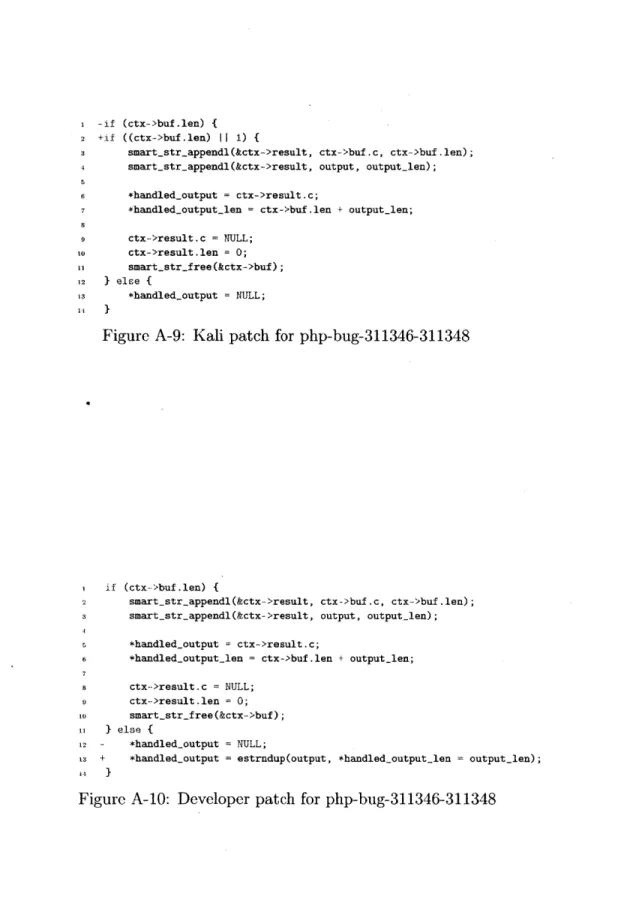
List of Figures
8-1 Experimental Results . . . .
A-I GenProg patch for python-bug-69783-69784 A-2 Developer patch for python-bug-69783-69784 A-3 GenProg patch for php-bug-309892-309910
A-4 Developer patch for php-bug-309892-309910
A-5 AE patch for php-bug-309111-309159 . . . . A-6 Developer patch for php-bug-309111-309159 A-7 Kali patch for python-bug-69783-69784 . . . A-8 Kali patch for php-bug-309892-309910 . . . A-9 Kali patch for php-bug-311346-311348 . . . A-10 Developer patch for php-bug-311346-311348
48 . . . . 70 . . . . 7 1 . . . . 72 . . . . 73 . . . . 74 . . . . 75 . . . . 76 . . . . 77 . . . . 7 8 . . . . 78
Chapter 1
Introduction
Automatic patch generation holds out the promise of correcting defects in production software systems without the time and expense required for human developers to understand, triage, and correct these defects. The prominent generate-and-validate approach starts with a test suite of inputs, at least one of which exposes a defect in the software. The patch generation system applies program modifications to generate a space of candidate patches, then searches the generated patch space to find plausible
patches - i.e., patches that produce correct outputs for all inputs in the test suite. In this paper we start by considering the GenProg 126], RSRepair
1481,
and AE [591 systems.The reported results for these systems are impressive: GenProg is reported to fix
55 of 105 considered bugs [261, RSRepair is reported to fix all 24 of 24 considered bugs
(these bugs are a subset of the 55 bugs that GenProg is reported to fix) [481, and AE is reported to fix 54 of the same 105 considered bugs [591.1 If these results are accurate, these systems represent a significant step forward in our ability to automatically eliminate defects in large software systems.
'Our analysis of the conunit logs and applications indicates that 36 of these bugs correspond to deliberate functionality changes, not actual bugs. That is, for 36 of these bugs, there is no actual bug to fix. To simplify the presentation, however, we refer to all of the 105 bugs as defects.
1.1
Plausibility Analysis and Weak Proxies
Motivated to better understand the capabilities and potential of these systems, we performed an analysis of the patches that these systems produce. Enabled by the availability of the generated patches and the relevant patch generation and valida-tion infrastructure [7, 5, 3, 8, 1], our analysis was driven by the following research questions:
RQ1: Do the reported GenProg, RSRepair, and AE patches produce
correct outputs for the inputs in the test suite used to validate the patch?
The basic principle behind generate-and-validate systems is to only accept
plau-sible patches that produce correct outputs for all inputs in the test suite used to
validate the patches. Despite this principle, our analysis shows that because of errors in the patch validation infrastructure, many of the reported patches are, in fact, not plausible - they do not produce correct outputs even for the inputs in the test suite used to validate the patch.
For 37 of the 55 defects that GenProg is reported to repair [261, none of the reported patches produce correct outputs for the inputs in the test suite. For 14 of the 24 defects that RSRepair is reported to repair [48], none of the reported patches that we analyze produce correct outputs for the inputs in the test suite. And for 27 of the 54 defects reported in the AE result tar file [1, none of the reported patches produces correct outputs.
Further investigation indicates that weak proxies are the source of the error. A weak proxy is an acceptance test that does not check that the patched program produces correct output. It instead checks for a weaker property that may (or may not) indicate correct execution. Specifically, some of the acceptance tests check only if the patched program produces an exit code of 0. If so, they accept the patch (whether the output is correct or not).
Because of weak proxies, all of these systems violate the underlying basic principle of generate-and-validate patch generation. The result is that the majority of the
patches accepted by these systems do not generate correct outputs even for the inputs in the validation test suite. See Section 3.
1.2
Correctness Analysis
Despite multiple publications that analyze the reported patches and the methods used to generate them [26, 48, 59, 41, 23, 32, 49, 211, we were able to find no systematic patch correctness analysis. We therefore analyzed the remaining plausible patches to determine if they eliminated the defect or not.
RQ2: Are any of the reported GenProg, RSRepair, and AE patches
correct?
The overwhelming majority of the patches are not correct. Specifically, GenProg
produced a correct patch for only 2 of the 105 considered defects.2 Similarly, RSRepair produced a correct patch for only 2 of the 24 considered defects. AE produced a correct patch for only 3 of the 105 considered defects. For each of the incorrect patches, we have a test case that exposes the defect in the patch [501. Because of weak proxies, many of these test cases were already present in the existing test suites. For the remaining plausible but incorrect patches, we developed new test cases that exposed the defects. See Section 4.
1.3
Stronger Test Suites
One hypothesis is that stronger test suites with additional inputs that provide better coverage would enable these systems to generate more correct patches:
RQ3: Do stronger test suites enable GenProg to produce more correct
patches?
To investigate this question, we reran all of the GenProg runs that generated incor-rect patches. We used corincor-rected test scripts and enhanced test suites that contained
2
We note that the paper discusses only two patches: one of the correct patches for one of these two defects and a patch that is obtained with the aid of user annotations 1261.
defect-exposing test cases for all of these patches. These reexecutions produced no patches at all. We next discuss two potential explanations for this result.
Search Space: A necessary prerequisite for the success of any search-based patch generation algorithm is a search space that contains successful patches. One potential explanation is that the GenProg, RSRepair, and AE search spaces do not contain correct patches for these defects. This explanation is consistent with recent results from the staged program repair (SPR) project, whose search space contains correct patches for 20 of the 105 defects in the GenProg benchmark set
134,
351. Only 3 ofthese correct patches are within the GenProg search space.
Random Genetic Search: Another potential explanation is that these systems
do not use a search algorithm that can explore the search space efficiently enough. GenProg's genetic search algorithm uses the number of passed test cases as the fitness function. For most of the defects in the benchmark set, there is only one negative test case (so even the unpatched program passes all but one of the test cases). With this fitness function, the difference between the fitness of the unpatched code and the fitness of a plausible patch that passes all test cases is only one. There is therefore no smooth gradient for the genetic search to traverse to find a solution. In this situation, genetic search can easily devolve into random search. Indeed, RSRepair (which uses random search) is reported to find patches more quickly and with less trials than GenProg 148]. See Section 5.
1.4
Functionality Deletion
As we analyzed patch correctness, it became clear that (despite some surface syntactic complexity), the overwhelming majority of the plausible patches were semantically
quite simple. Specifically, they were equivalent to a single functionality deletion
modification, either the deletion of a single line or block of code or the insertion of a single return or exit statement.
RQ4: How many of the plausible reported GenProg, RSRepair, and AE patches are equivalent to a single functionality deletion
modifica-tion?,
Our analysis indicates that 104 of the 110 plausible GenProg patches, 37 of the 44 plausible RSRepair patches, and 22 of the 27 plausible AE patches are equivalent to a single modification that deletes functionality.
Our analysis also indicates that (in contrast to previously reported results [311) the plausible patches had significant negative effects, including the introduction of new integer and buffer overflow security vulnerabilities and the elimination of standard desriable functionality. These negative effects highlight some of the risks associated with the combination of functionality deletion and generate-and-validate patch gen-eration. See Section 6.
Despite their potential for negative effects, functionality deletion patches can be useful in helping developers locate and better understand defects. For obtaining func-tionality deletion patches for this purpose, we advocate using a system that focuses solely on functionality deletion (as opposed to a system that aspires to create correct patches). Such an approach has at least two advantages. First, it is substantially simpler than approaches that attempt to generate more complex repairs. The search space can therefore be smaller, simpler, and searched more efficiently. Second, focus-ing solely on functionality deletion can produce simpler, more transparent patches for developers who want to use the patches to help them locate and better understand defects.
1.5
Original GenProg
Our analysis of the original GenProg system [60, 221 yields similar results. Out
of 11 defects evaluated in the two papers, the generated patches for 9 defects are incorrect (in some cases because of the use of weak proxies, in other cases because of weak test suites). The patches for 9 of the 11 defects simply delete functionality (removing statements, adding return statements, or adding exit statements). The
only two defects for which the original GenProg system generates correct patches are small motivating examples (less than 30 lines of code). See Section 7.
1.6
Revisiting Hypotheses and Explanations
At this point there is a substantial number of papers that present hypotheses and explanations related to phenomena associated with the GenProg, RSRepair, and AE automated patch generation systems. We next revisit some of these hypotheses and explanations in light of the results presented in this paper.
Simple vs. Complex Patches: Previous papers have considered (but not
satisfac-torily answered) the following question: "why is GenProg typically able to produce simple patches for bugs when humans used complex patches?" [59, 261. The results in this paper provide additional insight into this question: the simple GenProg patches are not correct - they either fail to produce correct outputs even for the inputs in the validation test suite, or they simply remove lightly tested functionality. Humans used complex patches because complex patches. are required to eliminate the defect. This fact highlights how test suites that may be suitable for human developers may not be suitable for automated patch generation systems that operate with less context.
Targeted Defect Classes: In an essay in ICSE 2014, Monperrus focuses on the
importance of "target defect classes," i.e., the set of defects for which the technique is designed to work [411. He notes that the GenProg research does not explicitly address the question, but observes "hints that GenProg works best for manipulating defensive code against memory errors (in particular segmentation faults and buffer overruns)" [411. Our results indicate that the defect class for which GenProg works best is defects that can be repaired -with a single modification that deletes function-ality. And while some of the patches do manipulate defensive code, observed effects include the deletion of critical checks and the introduction of new segmentation faults and buffer overruns.
Human Patch Acceptability: A paper investigating the developer maintainability
the GenProg patches "can be maintained with equal accuracy and less effort than the code produced by human-written patches" [231. In retrospect, this potentially surprising result may become more plausible when one considers that the majority of the GenProg patches are equivalent to a single functionality deletion modification.
The evaluation focused on asking human developers a variety of questions de-signed to be relevant to maintainability tasks [231. There is no indication if any of the developers thought that the patches were incorrect. The motivation for the pa-per, referencing GenProg patches (among others), states "while these patches may be functionally correct, little effort has been taken to date to evaluate the understand-ability of the resulting code". We note that the referenced patches are not functionally correct, and question the relevance of a human evaluation of patch understandability that does not expose the obvious incorrectness of the patches.
Time and Effort: The GenProg, RSRepair, and AE research projects devoted
sig-nificant time and effort to evaluating variants of the basic GenProg patch generation mechanisms [26, 21, 32, 48, 59]. The results presented in this paper show that (at least for the considered benchmark defects) all of the time and effort invested in devel-oping, evaluating, analyzing, and evolving these mechanisms only produced complex systems whose patches are no better than those generated by the much simpler Kali patch generation mechanism (which simply deletes functionality).
Community Perception: It is our understanding that the broader software
engi-neering community may understand (incorrectly) that the GenProg patches actually fix the defects. Example quotes that reflect this understanding include "We selected GenProg for the reason that it is almost the only state-of-the-art automated repair tool having the ability of fixing real-world, large-scale C faulty programs" [491 and "in an evaluation of GenProg, a state-of-the-art repair approach guided by genetic programming, this approach repaired 55 out of 105 defects" [38]. We believe that this understanding should be revisited in light of the results presented in this paper.
1.7
Realistic Patch Generation Expectations
Given this backdrop, what can one realistically expect from automatic patch gener-ation systems moving forward? Currently available evidence indicates that improve-ments will require both 1) the use of richer search spaces with more correct patches and 2) the use of more effective search algorithms that can search the space more efficiently.
Perhaps most importantly, our results highlight important differences between machine-generated and human-generated patches. Even the plausible GenProg, AE, and RSRepair patches are overwhelming incorrect and simply remove functionality. The human-generated patches for the same defects, in contrast, are typically correct and usually modify or introduce new program logic. This result indicates that infor-mation other than simply passing a validation test suite is (at least with current test suites) important for producing correct patches.
Automatic Code Transfer: One way to obtain correct code is to obtain it from
another application. Working with an input that exposes a potential security vulnera-bility, CodePhage searches an application database to automatically locate and trans-fer code that eliminates the vulnerability [56, 55]. CodePhage successfully repaired
10 defects in 7 recipient applications via code transfer from 5 donor applications.
Learning From Successful Patches: Another way to obtain additional
informa-tion is to learn from successful human patches. Prophet [331 analyzes a large database of revision changes extracted from open source project repositories to automatically learn features of successful patches. It then uses these features to recognize and prioritize correct patches within a larger space of candidate patches. On the Gen-Prog benchmark set, Prophet generates correct patches for 14 defects (12 more than GenProg and 11 more than AE).
Learned Invariants: Successful executions are yet another source of useful
infor-mation. Learning data structure consistency specifications from successful executions
can enable successful data structure repair
1141.
ClearView [47] observes successfulexecutions. ClearView automatically generates successful patches that eliminate se-curity vulnerabilities in 9 of 10 evaluated defects [471.
Targeted Patch Generation: Another source of information is to identify a specific
set of defects and apply techniques that target that set of defects. Researchers have successfully targeted out of bounds accesses [53, 10, 421, null pointer dereferences [36,
181, divide by zero errors [361, memory leaks [44, 251, infinite loops [11, 29, 371,
and integer and buffer overflows [571. For the defects in scope, a targeted technique tends to generate patches with better quality than a search-based technique. For
example, RCV
[361,
a recovery tool for divide-by-zero and null-dereference defects,successfully enables applications to recover from the majority of the systematically collected 18 CVE defects so that they exhibit identical behavior as the developer-patched application.
Specifications: Specifications, when available, can enable patch generation systems to produce patches that are guaranteed to be correct. AutoFix-E produces semanti-cally sound candidate bug patches with the aid of a design-by-contract programming language (Eiffel) [581. CodeHint uses partial specifications to automatically synthe-size code fragments with the specified behavior [241. Data structure repair techniques detect the inconsistency between a data structure state and a set of specified model constraints and enforce the violated constraints to repair the data structure state [151.
Realistic Expectations: By combining more productive search spaces and search
algorithms with the exploitation of additional information other than generating cor-rect outputs on a validation test suite, we expect future systems to be able to generate successful patches for defects that can be fixed with small changes (via search-based
techniques) and defects that follow specific patterns (via targeted techniques).
1.8
Kali
Inspired by the observation that the patches for the vast majority of the defects that GenProg, RSRepair, and AE were able to address consisted (semantically) of a single functionality deletion modification, we implemented a new system, the Kali automatic
patch generation system, that focuses only on removing functionality. Kali generates patches that either 1) delete a single line or block of code, 2) replace an if condition with true or false (forcing the then or else branch to always execute), or 3) insert a single return statement into a function body. Kali accepts a patch if it generates correct outputs on all inputs in the validation test suite. Our hypothesis was that
by focusing directly on functionality removal, we would be able to obtain a simpler
system that was at least as effective in practice.
RQ5: How effective is Kali in comparison with existing
generate-and-validate patch generation systems?
Our results show that Kali is more effective than GenProg, RSRepair, and AE. Specifically, Kali finds correct patches for at least as many defects (3 for Kali vs. 3 for AE and 2 for GenProg and RSRepair) and plausible patches for at least as many defects (27 for Kali vs. 18 for GenProg, 10 for RSRepair, and 27 for AE). And Kali works with a simpler and more focused search space.
Efficiency and Automatic Operation: An efficient search space is important for
automatic operation. An examination of the GenProg patch generation infrastructure indicates that GenProg (and presumably RSRepair and AE) require the developer to specify the source code file to attempt to patch [61. This requirement significantly reduces the size of the patch search space, but also. prevents these prior systems from operating automatically without developer involvement. Kali, in contrast, is efficient enough to operate fully automatically without requiring the developer to specify a target source code file to attempt to patch.
RQ6: Can Kali provide useful information about software defects?
Although Kali is more effective than GenProg, RSRepair, and AE at finding cor-rect patches, it is not so much more effective that we would advocate using it for this purpose (any more than we would advocate using any of these previous systems to find correct patches). But Kali's plausible patches can still be useful. The Kali patches often precisely pinpoint the exact line or lines of code to change. And they almost always provide insight into the defective functionality, the cause of the defect, and how to correct the defect.
1.9
Research Result Availability
We were able to perform the research in this paper because the reported GenProg, RSRepair, and AE patches (along with the GenProg patch generation and evaluation infrastructure) were available online [7, 3, 5, 1, 81. This paper therefore supports a move to greater transparency and availability of reported experimental results and systems. The Kali and ClearView patches, new test cases, and the plausibility, cor-rectness, and functionality deletion analyses are all available 1501. Kali is available on
request for the purpose of checking the results presented in this paper.
The PAR system is another prominent generate-and-validate automatic patch generation system [28]. We do not include PAR in this study because (despite re-peated requests to the authors of the PAR paper), we were unable to obtain the PAR patches.
1.10
Contributions
This paper makes the following contributions:
* Plausibility Analysis: It shows that the majority of the reported GenProg,
RSRepair, and AE patches, contrary to the basic principle of generate-and-validate patch generation, do not produce correct outputs even for the inputs in the test suite used to validate the patches.
* Weak Proxies: It identifies weak proxies, acceptance tests that do not check
that the patched application produces the correct output, as the cause of the reported implausible patches.
o Correctness Analysis: It shows that the overwhelming majority of the re-ported patches are not correct and that these incorrect patches can have signif-icant negative effects including the introduction of new security vulnerabilities and the elimination of desirable standard functionality.
* Stronger Test Suites Don't Help: It shows that stronger test suites do not help GenProg produce correct patches - they simply eliminate the ability of GenProg to produce any patches at all.
" Semantic Patch Analysis: It reports, for the first time, that the
overwhelm-ing majority of the plausible GenProg, RSRepair, and AE patches are semanti-cally equivalent to a single modification that simply deletes functionality from the application.
" Kali: It presents a novel automatic patch generation system, Kali, that works
only with simple patches that delete functionality.
" Kali Results: It presents results that show that Kali outperforms GenProg,
RSRepair, and AE. With a simpler search space and no identification of a target source code file to patch, Kali generates at least as many correct patches and at least as many plausible patches as these prior systems. Even though the majority of these patches are not correct, they successfully target the defective functionality, can help pinpoint the defective code, and often provide insight into important defect characteristics.
Chapter 2
Overview of Analyzed Systems
GenProg: GcnProg combines three basic modifications, specifically delete, insert,
and replace, into larger patches, then uses genetic programming to search the resulting patch space. We work with the GenProg system used to perform a "systematic study of automated program repair" that "includes two orders of magnitude more" source code, test cases, and defects than previous studies 1261. As of the submission date of this paper, the relevant GenProg paper is referenced on the GenProg web site as the recommended starting point for researchers interested in learning more about
GenProg
141.
The GenProg patch evaluation infrastructure works with the followingkinds of components
17,
5, 31:9 Test Cases: Individual tests that exercise functionality in the patched appli-cation. Examples include php scripts (which arc then evaluated by a patched version of php), bash scripts that invoke patched versions of the libtiff tools on specific images, and perl scripts that generate HTTP requests (which are then processed by a patched version of lighttpd).
* Test Scripts: Scripts that run the application on a set of test cases and report
either success (if the application passes all of the test cases) or failure (if the application does not pass at least one test case).
9 Test Harnesses: Scripts or programs that evaluate candidate patches by
run-ning the relevant test script or scripts on the patched application, then reporting the results (success or failure) back to GenProg.
It is our understanding that the test cases and test scripts were adopted from the existing software development efforts for each of the benchmark GenProg applications and implemented by the developers of these projects for the purpose of testing code written by human developers working on these applications. The test harnesses were implemented by the GenProg developers as part of the GenProg project.
A downloadable virtual machine [7], all of the patches reported in the relevant
GenProg paper (these include patches from 10 GenProg executions for each defect) [51, source code for each application, test cases, test scripts, and the GenProg test harness for each application
131
are all publicly available. Together, these components make it possible to apply each patch and run the test scripts or even the patched version of each application on the provided test cases. It is also possible to run GenProg itself.RSRepair: The goal of the RSRepair project was to compare the effectiveness of
genetic programming with random search [481. To this end, the RSRepair system built on the GenProg system, using the same testing and patch evaluation infrastructure but changing the search algorithm from genetic search to random search. RSRepair was evaluated on 24 of the 55 defects that GenProg was reported to repair [48, 261. The reported patches are publicly available [8]. For each defect, the RSRepair paper reports patches from 100 runs. We analyze the first 5 patches from these 100 runs.
AE: AE is an extension to GenProg that uses a patch equivalence analysis to avoid
repeated testing of patches that are syntactically different but equivalent (according to an approximate patch equivalence test) [591. AE focuses on patches that only perform one edit and exhaustively enumerates all such patches. The AE experiments were "designed for direct comparison with previous GenProg results" [59, 261 and evaluate AE on the same set of 105 defects. The paper reports one patch per repaired defect, with the patches publicly available [1]. AE is based on GenProg and we were able to leverage the developer test scripts available in the GenProg distribution to compile and execute the reported AE patches.
Chapter 3
Plausibility Analysis
The basic principle behind the GenProg, RSRepair, and AE systems is to generate patches that produce correct results for all of the inputs in the test suite used to validate the patches. We investigate the following research question:
RQ1: Do the reported GenProg, RSRepair, and AE patches produce
correct results for the inputs in the test suite used to validate the patch?
To investigate this question, we downloaded the reported patches and validation
test suites
17,
5, 3, 8, 11. We then applied the patches, recompiled the patchedapplications, ran the patched applications on the inputs in the validation test suites, and compared the outputs with the correct outputs. Our results show that the answer to RQ1 is that the majority of the reported GenProg, RSRepair, and AE patches do not produce correct outputs for the inputs in the validation test suite:
* GenProg: Of the reported 414 GenProg patches, only 110 are plausible - the remaining 304 generate incorrect results for at least one input in the test suite used to validate the patch. This leaves 18 defects with at least one plausible patch.
* RSRepair: Of the analyzed 120 AE patches, only 44 are plausible - the remaining 76 generate incorrect results for at least one input in the test suite used to validate the patch. This leaves 10 defects with at least one plausible patch.
* AE: Of the reported 54 AE patches, only 27 are plausible -- the remaining 27 generate incorrect results for at least one input in the test suite. This leaves 27 defects with at least one plausible patch.
Test Harness Issues: The GenProg 2012 paper reports that GenProg found
suc-cessful patches for 28 of 44 defects in php [261. The results tarball contains a total of 196 patches for these 28 defects. Only 29 of these patches (for 5 of the 44 de-fects, specifically defects 307931-307934, 309892-309910,
php-bug-309986-310009, php-bug-310011-310050, and php-bug-310673-310681) are plausible.
GenProg accepts the remaining 167 patches because of integration issues between the GenProg test harness and the developer test script.
For php, the developer test script is also written in php. The GenProg test harness executes this developer test script using the version of php with the current GenProg patch under evaluation applied, not the standard version of php. The current patch under evaluation can therefore influence the behavior of the developer test script (and not just the behavior of the test cases).
The GenProg test harness does not check that the php patches cause the developer test scripts to produce the correct result. It instead checks only that the higher order
8 bits of the exit code from the developer test script are 0. This can happen if 1) the
test script itself crashes with a segmentation fault (because of an error in the patched version of php that the test case exercises), 2) the current patch under evaluation causes the test script (which is written in php) to exit with exit code 0 even though one of the test cases fails, or 3) all of the test cases pass. Of the 167 accepted patches,
138 are implausible - only 29 pass all of the test cases.
We next present relevant test infrastructure code. The GenProg test harness is written in C. The following lines determine if the test harness accepts a patch. Line
8564 runs the test case and shifts off the lower 8 bits of the exit code. Line 8566
accepts the patch if the remaining upper 8 bits of the exit code are zero.
php-run-test.c:8564 int res = system(buffer) >> 8
php-run-test.c:8565
Here buf f er contains the following shell command:
./sapi/cli/php ../php-helper.php -p ./sapi/cli/php -q <php test file>
where ./sapi/cli/php is the patched version of the php interpreter. This patched
version is used both to run the php test file for the test case and the php-helper .php
script that runs the test case.
Test Script Issues: The GenProg libtiff test scripts do not check that the test cases produce the correct output. They instead use a weak proxy that checks only that the exercised libtiff tools return exit code 0 (it is our understanding that the libtiff developers, not the GenProg developers, developed these test scripts [9j). The test scripts may therefore accept patches that do not produce the correct output. There is a libtiff test script for each test case; 73 of the 78 libtiff test scripts check only the exit code. This issue causes GenProg to accept 137 implausible libtiff patches (out of a total of 155 libtiff patches). libtiff and php together account for 322 of the total 414 patches that the GenProg paper reports [261.
One of the gmp test scripts does not check that all of the output components are correct (despite this issue, both gnip patches are plausible).
AE: The reported AE patches exhibit plausibility problems that are consistent with
the use of weak proxies in the GenProg testing infrastructure. Specifically, only 5 of the 17 reported libtiff patches and 7 of the reported 22 php patches are plausible.
RSRepair: RSRepair uses the same testing infrastructure as GenProg [481.
Pre-sumably because of weak proxy problems inherited from the GenProg testing infras-tructure, the reported RSRepair patches exhibit similar plausibility problems. Only
5 of the 75 RSRepair libtiff patches are plausible. All of these 5 patches repair the
same defect, specifically libtiff-bug-d13be72c-ccadf48a. The RSRepair paper reports patches for only 1 php defect, specifically php-bug-309892-309910, the 1 php defect for which all three systems are able to generate a correct patch.
ManyBugs: It is our understanding that the developers of the GenProg benchmark
suite are aware of the test infrastructure errors and are working to correct them. As of the submission date of this paper, the php test harness uses the patched version of php
to run the test cases (the segmentation fault error described above has been corrected) and the libtiff test scripts check only for exit code 0, not for correct output [30]. The result is accepted patches that produce incorrect outputs for inputs in the validation test suite.
Chapter 4
Correctness Analysis
We analyze each plausible patch in context to determine if it correctly repairs the defect.
RQ2: Are any of the reported GenProg, RSRepair, and AE patches correct?
Patch Correctness Results: Our analysis indicates that only 5 of the 414 GenProg patches (3 for python-bug-69783-69784 and 2 for php-bug-309892-309910) are correct. This leaves GenProg with correct patches for 2 out of 105 defects. Only 4 of the 120 RSRepair patches (2 for python-bug-69783-69784 and 2 for php-bug-309892-309910)
are correct. This leaves RSRepair with correct patches for 2 out of 24 defects. Only
3 of the 54 AE patches (1 for php-bug-309111-309159, 1 for php-bug-309892-309910,
and 1 for python-bug-69783-69784) are correct. This leaves AE with correct patches for 3 out of 54 defects.
For each plausible but incorrect patch that GenProg or AE generate, and each plausible but incorrect RSRepair patch that we analyze, we developed a new test case that exposes the defect in the incorrect patch
1501.
Patch Correctness Clarity: We acknowledge that, in general, determining whether a specific patch corrects a specific defect can be difficult (or in some cases not even well defined). We emphasize that this is not the case for the patches and defects that we consider here. The correct behavior for all of the defects is clear, as is patch correctness and incorrectness.
Developer Patch Comparison: For each defect, the GenProg benchmark suite
identifies a corrected version of the application that does not have the defect. In most cases the corrected version is a later version produced by a developer writing an explicit developer patch to repair the error. In other cases the corrected version
simply applies a deliberate functionality change - there was no defect in the original
version of the application. In yet other cases the identified correct version is an earlier version of the application. In these cases, it is possible to derive an implicit developer patch that reverts the application back to the earlier version.
Our analysis indicates that the developer patches are, in general, consistent with our correctness analysis. Specifically, 1) if our analysis indicates that the reported GenProg, RSRepair, or AE patch is correct, then the patch has the same semantics as the developer patch, 2) if our analysis indicates that the reported GenProg, RSRepair, or AE patch is not correct, then the patch has different semantics than the developer patch, and 3) if we developed a new test case to invalidate generated plausible but incorrect patches for a defect, the corresponding developer patched version of the application produces correct output for the new input.
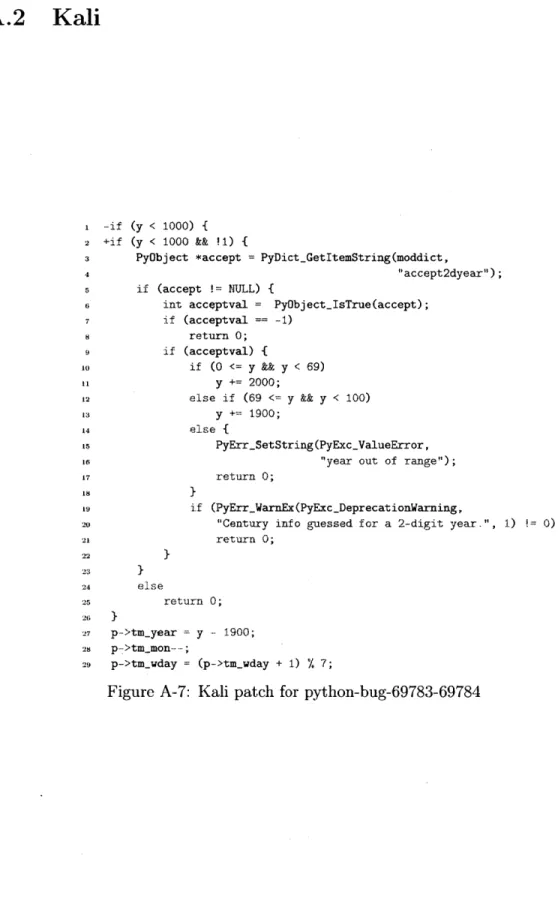
python.-bug-69783-69784: Figure A-1 (see Appendix A.1) presents the GenProg patch for python-bug-69783-69784. Figure A-2 presents the developer patch. Both of the patches remove an if statement (lines 1-25 in Figure 2, lines 1-52 in Figure
A-1). Because GenProg generates preprocessed code, the GenProg patch is larger than
but semantically equivalent to the developer patch. AE and RSRepair also generate
correct patches that are semantically equivalent to this GenProg patch. Note that
python-bug-69783-69784 is in fact not a bug. It instead corresponds to a deliberate functionality change. The relevant code (correctly) implemented python support for
two-year dates. This functionality was deliberately removed by the developer in
revision 69784.
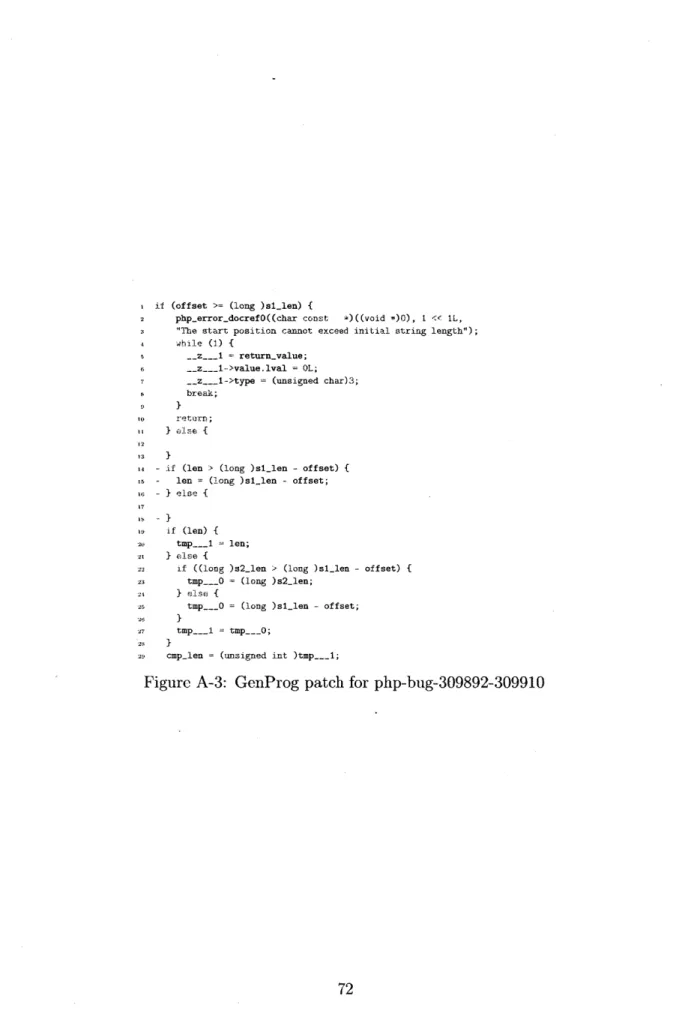
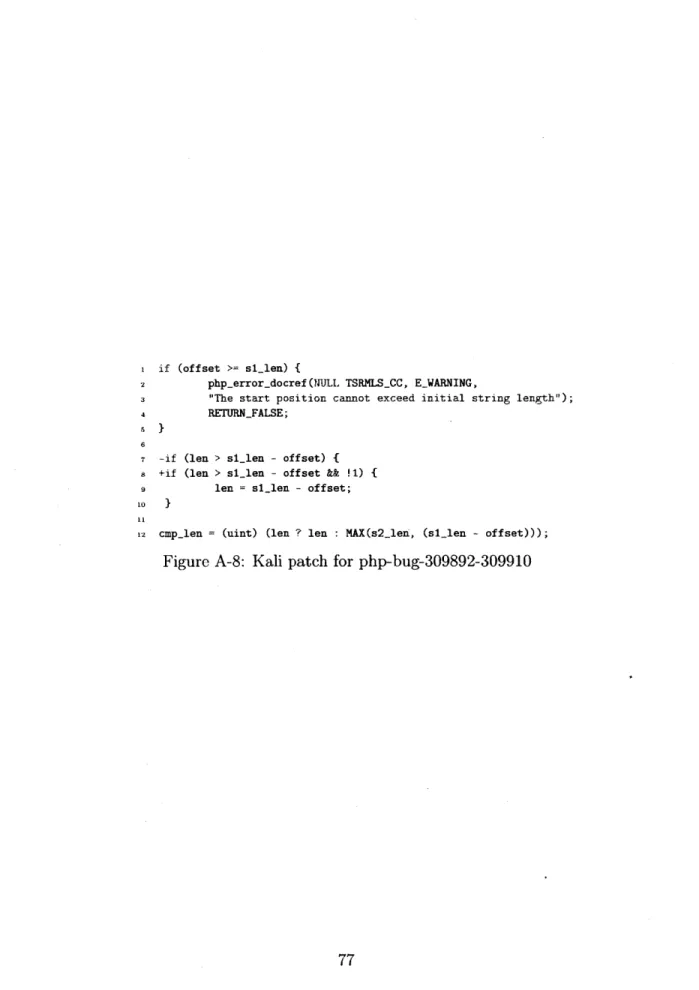
php-bug-309892-309910: Figure A-3 (see Appendix A.1) presents the GenProg
patch for php-bug-309892-309910. Figure A-4 presents the developer patch. Both
of the patches remove an obsolete check implemented by the deleted if statement (lines 14-18 in Figure A-3 and lines 7-9 in Figure A-4). AE and RSRepair generate
semantically equivalent patches.
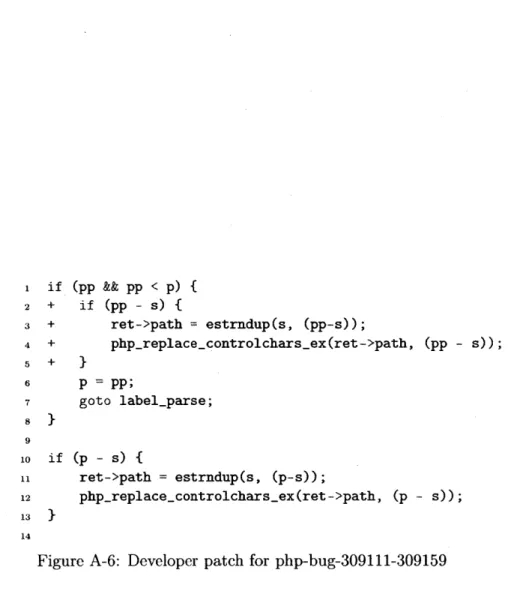
php-bug-309111-309159: Figure A-5 (see Appendix A.1) presents the AE patch for php-bug-309111-309159. Figure A-6 presents the developer patch.
php-309111-309159 is an url parsing defect - the PHP function parseurl() may incorrectly parse urls that contain question marks. The AE patch (with _ _genprog_ mutant equal to 25) copies the if statement (lines 23-29 of Figure A-5) to the location after the assignment p = pp. Therefore p is equal to pp when the copied block executes. In this context, the copied block is semantically equivalent to the block that the developer patch adds before the assignment statement. In the AE patch, the code involving _ _genprog_mutant works with the AE test infrastructure to compile mul-tiple generated patches into the same file for later dynamic selection by the AE test
Chapter 5
GenProg Reexecutions
We next consider the following research question:
RQ3: Do stronger test suites enable GenProg to produce more correct
patches?
To determine whether GenProg [261 is able to generate correct patches if we correct the issues in the patch evaluation infrastructure and provide GenProg with stronger test suites, we perform the following GenProg reexecutions:
Corrected Patch Evaluation Infrastructure: We first corrected the GenProg
patch evaluation infrastructure issues (see Section 3). Specifically, we modified the
php test harness to ensure that the harness correctly runs the test script and correctly
reports the results back to GenProg. We strengthened the 73 libtiff test scripts to, as appropriate, compare various metadata components and/or the generated image output with the correct output. We modified the gmp test scripts to check all output components.
Augmented Test Suites: We augmented the GenProg test suites to include the new test cases (see Section 4) that expose the defects in the plausible but incorrect GenProg patches.
GenProg Reexecution: For each combination of defect and random seed for which GenProg generated an incorrect patch, we reexecuted GenProg with that same combination. These reexecutions used the corrected patch evaluation infrastructure and the augmented test suites.
Results: These reexecutions produced 13 new patches (for defects
libtiff-bug-5b02179-3dfb33b and lighttpd-bug-2661-2662). Our analysis indicates that the new
patches that GenProg generated for these two defects are plausible but incorrect. We therefore developed two new test cases that exposed the defects in these new incorrect patches. We included these new test cases in the test suites and reexecuted GenProg again. With these test suites, the GenProg reexecutions produced no patches at all. The new test cases are available [501.
Chapter 6
Semantic Patch Analysis
For each plausible patch, we manually analyzed the patch in context to determine if it is semantically equivalent to either 1) the deletion of a single statement or block of code, or 2) the insertion of a single return or exit statement. This analysis enables us to answer the following research question:
RQ4: Are the reported GenProg, RSRepair, and AE patches
equiva-lent to a single modification that simply deletes functionality?
Our analysis indicates that the overwhelming majority of the reported plausible patches are equivalent to a single functionality deletion modification. Specifically, 104 of the 110 plausible GenProg patches, 37 of the plausible 44 RSRepair patches, and 22 of the plausible 27 AE patches are equivalent to a single deletion or return insertion modification. Note that even though AE contains analyses that attempt to determine if two patches are equivalent, the analyses are based on relatively shallow criteria (syntactic equality, dead code elimination, and equivalent sequences of independent instructions) that do not necessarily recognize the functionality deletion equivalence of syntactically complex sequences of instructions. Indeed, the AE paper, despite its focus on semantic patch equivalence, provides no indication that the overwhelming majority of the reported patches are semantically equivalent to a single functionality deletion modification 159].
6.1
Weak Test Suites
During our analysis, we obtained a deeper understanding of why so many plausible patches simply delete functionality. A common scenario is that one of the test cases exercises a defect in functionality that is otherwise unexercised. The patch simply deletes functionality that the test case exercises. This deletion then impairs or even completely removes the functionality.
These results highlight the fact that weak test suites - i.e., test suites that provide
relatively limited coverage - may be appropriate for human developers (who operate
with a broader understanding of the application and are motivated to produce correct patches) but (in the absence of additional techniques designed to enhance their ability to produce correct patches) not for automatic patch generation systems that aspire to produce correct patches.
6.2
Impact of Functionality Deletion Patches
Our analysis of the patches also indicated that (in contrast to previously reported results [31J) the combination of test suites with limited coverage and support for functionality deletion can promote the generation of patches with negative effects such as the introduction of security vulnerabilities and the elimination of standard functionality. Check Elimination: Several defects are caused by incorrectly coded checks. The test suite contains a test case that causes the check to fire incorrectly, but there is no test case that relies on the check to fire correctly. The generated patches simply remove the check. The consequences vary depending on the nature of the check. For example:
* Integer Overflow: libtiff-bug-0860361d-1ba75257 incorrectly implements an
integer overflow check. The generated patches remove the check, in effect rein-troducing a security vulnerability from a previous version of libtiff
* Buffer Overflow: Defect fbc-bug-5458-5459 corresponds to an overly
conser-vative check that prevents a buffer overflow. The generated patches remove the check, enabling the buffer overflow.
Standard Feature Elimination: Defects php-bug-307931-307934, gzip-bug-3fe0ca-39a362, lighttpd-bug-1913-1914, lighttpd-bug-2330-2331 correspond to incorrectly handled cases in standard functionality. The test suite contains a test case that exposes the incorrectly handled case, but no test case that exercises the standard functionality. The patches impair or remove the functionality, leaving the program unable to process standard use cases (such as decompressing non-zero files or initial-izing associative array elements to integer values).
Undefined Accesses: Patches often remove initialization code. While the resulting undefined accesses may happen to return values that enable the patch to pass the
test cases, the patches can be fragile - different environments can produce values
that cause the patch to fail (e.g., the AE patch for fbc-bug-5458-5459).
Deallocation Elimination: The patches for wireshark-bug-37112-37111 and php-bug-310011-310050 eliminate memory management errors by removing relevant mem-ory deallocations. While this typically introduces a memmem-ory leak, it can also enhance survival by postponing the failure until the program runs out of memory (which may never happen). We note that human developers often work around difficult memory management defects by similarly removing deallocations.
Survival Enhancement: One potential benefit of even incorrect patches is that they
may enhance the survival of the application even if they do not produce completely correct execution. This was the goal of several previous systems (which often produce correct execution even though that was not the goal) [53, 10, 42, 11, 29, 36, 44, 18, 471. Defect lighttpd-bug-1794-1795 terminates the program if it encounters an unknown configuration file setting. The generated patches enhance survival by removing the check and enabling lighttpd to boot even with such configuration files. We note that removing the check is similar to the standard practice of disabling assertions in production use.
Relatively Minor Defects: We note that some of the defects can be viewed as
relatively minor. For example, python-bug-69223-69224 causes the unpatched version
of python to produce a SelectError message instead of a ValueError message - i.e.,
the correct behavior is to produce an error message, the defect is that python produces the wrong error message. Three of the wireshark defects (wireshark-bug-37172-37171, wireshark-bug-37172-37173, wireshark-bug-37284-37285) were caused by a developer checking in a version of wireshark with a debug macro flag set. The relevant defect is that these versions generate debugging information to the screen and to a log file. The correct behavior omits this debugging information.
Chapter
7
Original GenProg Patches
We also analyzed the reported patches from the original GenProg system [60, 221. Out of the 11 defects evaluated in the two papers, the corresponding patches for 9 defects are plausible but incorrect. 9 of the 11 patches simply eliminate functionality
(by removing statements or adding a return or exit statements). We next discuss the
reported patch for each application in turn.
* uniq: The patch is semantically equivalent to removing the statement *buf++
= c at uniq.c:74. The effect is that the patched application will ignore the user input file and operate as if the file were empty. Because of the use of a weak proxy, this patch is not plausible. The test scripts check the exit code of the program, not whether the output is correct.
* look-u: The patch is semantically equivalent to removing the condition argv[1] == "-" from the while loop at look.c:63. The effect is that look will treat the first command line argument (-d, -f, -t) as the name of the input file. Unless a file with such a name exists, look will then immediately exit without processing the intended input file.
9 look-s: The patch is semantically equivalent to replacing the statement mid
(top+bot)/2 at look.c:87 with exit(O). The effect is that look will always exit immediately without printing any output (if the input file exists, if not, look will print an error message before it exits).
The patch is plausible because the use of a weak test suite - the correct output for the positive and negative test cases is always no output. If the correct output for any of the test cases had been non-empty, this patch would have been implausible.
" units: The units program asks the user to input a sequence of pairs of units (for
example, the pair meter and feet) and prints out the conversion factor between the two units in the pair. The patch is semantically equivalent to adding initO after units.c:279. The unpatched version of the program does not check for an overflow of the user input buffer. A long user input will therefore overflow the buffer.
The GenProg patch does not eliminate the buffer overflow. It instead clears the unit table whenever the program reads an unrecognized unit (whether the unit overflows the user input buffer or not). Any subsequent attempt to look up the conversion for any pair of units will fail. It is also possible for the buffer overflow to crash the patched program.
" deroff: When deroff reads a backslash construct (for example, \L), it should
read the next character (for example, ") as a delimiter. It should then skip any text until it reaches another occurrence of the delimiter or the end of the line. The patch is semantically equivalent to removing the statement bdelim=c (au-tomatically generated as part of a macro expansion) at deroff.c:524. The effect
is that the patched program does not process the delimiter correctly - when it
encounters a delimiter, it skips all of the remaining text on the line, including any text after the next occurrence of the delimiter.
" nullhttpd: The patch is semantically equivalent to removing the call to str-cmp(..., "POST") httpdcomb.c:4092-4099. The effect is that all POST
re-quests generate an HTML bad request error reply.
* indent: The patch is semantically equivalent to adding a return after
of C comments that are not C++ comments." Our experiments with the patched version indicate that the patched version correctly handles at least some C com-ments that are not C++ comcom-ments (we never observed a C comment that it handled incorrectly). In many cases, however, the patched version simply exits after reading a { character, truncating the input file after the {.
" flex: The patch is semantically equivalent to removing the call to strcpy() at
flexcomb.c:13784. This call transfers the token (stored in yytext) into the variable nmdef. Removing the call to strcpyo causes flex to incorrectly operate with an uninitialied nmdef. This variable holds one of the parsed tokens to process. The effect is that flex fails to parse the input file and incorrectly produces error messages that indicate that flex encountered an unrecognized rule.
* atris: The commments in the atris source code indicate that it is graphical tetris game. atris has the ability to load in user options stored in the .atrisrc in the user's home directory. A call to sprintf() at atrixcomb.c:5879 initializes the string buffer that specifies the filename of this .atrisrc file. If the home directory is longer than 2048 characters this sprintf( call will overflow the buffer. The patch is semantically equivalent to removing the call to sprintf() at
atrixcomb.c:5879. The result is that the program passes an uninitialized file-name to the procedure that reads the .atrisrc file.
The remaining 2 programs, for which GenProg generates correct patches, are used as motivating examples in the ICSE 2009 and GECCO 2009 papers [60, 221. These two programs contain less than 30 lines of code.
We note that many of the test scripts use weak proxies. Specifically, all uniq, look-u, and look-s test cases do not compare the output of the patched program to the correct output. They instead check only that the patched program produces the correct exit code. Similarly, the deroff and indent negative test case test scripts only check the exit code.
Chapter 8
Kali
The basic idea behind Kali is to search a simple patch space that consists solely of patches that remove functionality. There are two potential goals: 1) if the correct patch simply removes functionality, find the patch, 2) if the correct patch does not simply remove functionality, generate a patch that modifies the functionality con-taining the defect. For an existing statement, Kali deploys the following kinds of patches:
" Redirect Branch: If the existing statement is a branch statement, set the
condition to true or false. The effect is that the then or else branch always executes.
" Insert Return: Insert a return before the existing statement. If the function
returns a pointer, the inserted return statement returns NULL. If the function returns an integer, Kali generates two patches: one that returns 0 and another that returns -1.
" Remove Statement: Remove the existing statement. If the statement is a
compound statement, Kali will remove all substatements inside it as well.
Statement Ordering: Each Kali patch targets a statement. Kali uses instrumented
executions to collect information and order the executed statements as follows. Given a statement s and a test case i, r(s, i) is the recorded execution counter that identifies
particular, if the statement s is not executed at all when the application runs with the test case i, then r(s, i) = 0. Neg is the set of negative test cases (for which the
unpatched application produces incorrect output) and Pos is the set of positive test cases (for which the unpatched application produces correct output). Kali computes three scores a(s), b(s), c(s) for each statement s:
a(s) = {i
I
r(s,i)$
0, i E Neg}I
b(s) =
I
{iI
r(s,i) = 0, i E Pos}I
c(s) = EiENegr(s, i)
A statement si has higher priority than a statement S2 if prior(si, S2) = 1, where
prior is defined as:
1 a(si) > a(s2)
1 a(si)
=
a(s2), b(si) > b(s2)prior(si, s2) = a(si) = a(s2), b(si) = b(s2),
1
c(si) > c(s2)
0 otherwise
Intuitively, Kali prioritizes statements 1) that are executed with more negative test cases, 2) that are executed with less positive test cases, and 3) that are executed later during the executions with negative test cases. The Kali search space includes the top 500 ranked statements regardless of the file in which they appear.
Search: Kali deterministically searches the patch space in tiers: first all patches that change an if condition, then all patches that insert a return, then all patches that remove a statement. Within each tier, Kali applies the patch to the statements in the priority or-der identified above. It accepts a patch if the patch produces correct outputs for all of the inputs in the validation test suite.