Publisher’s version / Version de l'éditeur:
SAE International Journal of Materials and Manufacturing, 3, 1, pp. 484-492,
2010-12-04
READ THESE TERMS AND CONDITIONS CAREFULLY BEFORE USING THIS WEBSITE.
https://nrc-publications.canada.ca/eng/copyright
Vous avez des questions? Nous pouvons vous aider. Pour communiquer directement avec un auteur, consultez la première page de la revue dans laquelle son article a été publié afin de trouver ses coordonnées. Si vous n’arrivez pas à les repérer, communiquez avec nous à [email protected].
Questions? Contact the NRC Publications Archive team at
[email protected]. If you wish to email the authors directly, please see the first page of the publication for their contact information.
This publication could be one of several versions: author’s original, accepted manuscript or the publisher’s version. / La version de cette publication peut être l’une des suivantes : la version prépublication de l’auteur, la version acceptée du manuscrit ou la version de l’éditeur.
For the publisher’s version, please access the DOI link below./ Pour consulter la version de l’éditeur, utilisez le lien DOI ci-dessous.
https://doi.org/10.4271/2010-01-0748
Access and use of this website and the material on it are subject to the Terms and Conditions set forth at
Reduction of hot tears : Alloy and casting process optimization using
neutron diffraction
Bichler, L.; D’Elia, F.; Ravindran, C.; Sediako, D.
https://publications-cnrc.canada.ca/fra/droits
L’accès à ce site Web et l’utilisation de son contenu sont assujettis aux conditions présentées dans le site LISEZ CES CONDITIONS ATTENTIVEMENT AVANT D’UTILISER CE SITE WEB.
NRC Publications Record / Notice d'Archives des publications de CNRC:
https://nrc-publications.canada.ca/eng/view/object/?id=4eeea194-d180-4151-a0eb-f0bc31278477 https://publications-cnrc.canada.ca/fra/voir/objet/?id=4eeea194-d180-4151-a0eb-f0bc31278477
ABSTRACT
The continued need of vehicle weight reduction provides impetus for research into the development of novel automotive casting alloys and their processing technologies. Where possible, ferrous components are being replaced by aluminum (Al) and magnesium (Mg) alloy counterparts. This transition, however, requires a systematic optimization of the alloys and their manufacturing processes to enable production of defect-free castings. In this context, prevention of hot tears remains a challenge for Al and Mg alloy thin-wall castings. Hot tears form in semi-solid alloy subjected to localized tensile stress. Classical methods of stress measurement present numerous experimental limitations. In this research, neutron diffraction (ND) was used as a novel tool to obtain stress maps of castings and to quantify the effect of two processes used to eliminate hot tears in permanent mold castings: 1) increasing of the mold temperature during casting of Mg alloys, and 2) grain refinement of Al alloys.
In case of the AZ91D Mg alloy, the ND results indicate that increasing the mold temperature effectively decreased the level of tensile strain in a casting region with a geometric stress concentration, thereby preventing nucleation of hot tears. In the case of the B206 Al alloy, hot tearing was alleviated by the addition of 0.05 wt% Ti-B grain refiner and the ND mapping revealed a decrease in the stress level along with enhanced stress uniformity across the casting.
INTRODUCTION
Manufacturing processes such as casting, forming, heat treatment, machining and joining add value to alloys and extend their range of application [1]. In the case of magnesium (Mg) and aluminum (Al) alloys, the automotive and electronics industries require parts with superior mechanical properties and favorable process economy. These requirements continue to drive fundamental and applied research into processing and optimization of these alloys. Specifically, the effect of the manufacturing process on the microstructure and the mechanical performance, wear resistance and dimensional stability of the cast products are subject to extensive research.
In the case of Mg and Al components, casting is one of the primary manufacturing routes. During the solidification of a casting, temperature distribution and homogeneity must be carefully controlled to ensure continuous and appropriate feeding of liquid metal to solidifying parts of the casting. When uniform solidification is absent, high thermal gradients may induce thermo-mechanical and residual stresses. Thermal stresses result from non-uniform temperature distribution during solidification (resulting in shrinkage) and thermal contraction of a casting subsequent to solidification. Mechanical stresses develop when a casting solidifies within a rigid mold, which limits its solidification shrinkage and thermal contraction. Cracks resulting from ensuing material are typically referred to as hot tears. Once a hot tear forms, the casting must be scrapped [2].
Reduction of Hot Tears: Alloy and Casting Process
Optimization Using Neutron Diffraction
2010-01-0748
Published
04/12/2010
L. Bichler, F. D'Elia and C. Ravindran
Centre for Near-net-shape Processing of Materials, Ryerson University, Toronto, Canada
D. Sediako
Canadian Neutron Beam Centre - NRC Chalk River, Canada
© 2010 NRC Canada
SAE Int. J. Mater. Manuf. | Volume 3 | Issue 1 484
The hot tearing susceptibility of an alloy depends on various factors. For example, the level of solute concentration significantly affects hot tearing tendency. An example of a λ-curve (indicating the length of a hot tear as a function of solute concentration) for Al-Mg alloy is presented in Figure 1, along with the Al-Mg phase diagram.
Figure 1. (a) Al-Mg phase diagram, (b) Al-Mg alloy λ-curve [3].
The initial increase in the crack length (i.e., severity of hot tearing) with increasing solute concentration (from zero to approximately 1 wt% Mg) is related to the widening of the solidification range. The maximum hot tearing susceptibility coincides with the maximum solidification range of the alloy. Subsequent increase of solute concentration typically results in the formation of eutectic microconstituents, which extend interdendritic feeding at late stages of solidification and decrease the alloy's hot tearing susceptibility.
Attempts to quantify the hot tearing susceptibility of alloys have achieved only limited success. For example, in order to determine the stress and strain conditions in the alloy during solidification, load cells, LVDT's and push-rods were installed in molds. However, these intrusive probes altered the natural casting solidification profile, thus making the final results questionable. Similarly, theoretical criterion functions based on solidification theories were developed, along with computer models; however, validation of these theoretical criterion functions and computer models was successful only
for simple casting geometries and a few alloys (e.g., iron plate castings). To this date, there is no universal formula relating the development of alloy strength to hot tearing [4]. Extensive research has been carried out on the effect of grain refinement on hot tearing [5, 6, 7, 8]. Past studies determined that grain refinement has a beneficial effect on reducing hot tearing and that two mechanisms are responsible. The first mechanism is related to the grain structure. Specifically, a fine globular grain structure allows grain sliding during high temperature deformation, thereby alleviating evolving strains [5, 6]. The second mechanism is related to the permeability of liquid through interdendritic regions. In an alloy with heavily branched dendrites, liquid metal flow must be accommodated via narrow interdendritic regions, while in an alloy with equiaxed grains, liquid metal easily flows via larger intergranular regions [7, 8]. Despite the commonly known beneficial effect of grain refinement on reduction of hot tears, no literature is available with quantitative data relating grain refinement to hot tearing.
In this research, neutron diffraction (ND) was used to measure residual stresses (ex-situ) in castings with distinct levels of hot tearing. Thus, the research quantified the impact of increasing mold temperature in Mg alloy casting on hot tearing, as well as the impact of grain refinement on hot tearing of Al alloys.
EXPERIMENTAL PROCEDURE
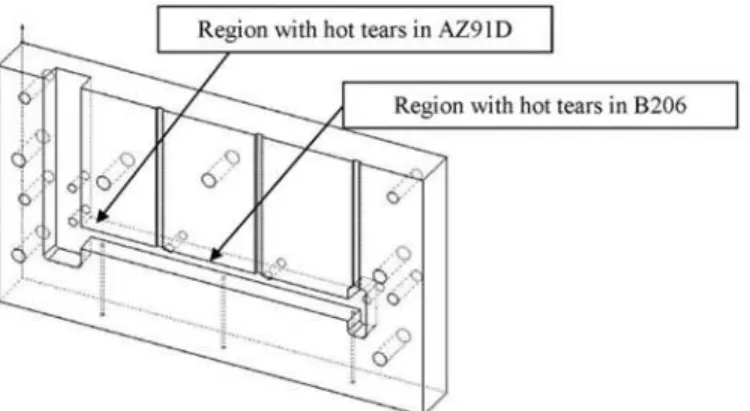
AZ91D and B206 alloy castings were produced via the permanent mold casting (PMC) process. The casting cavity consisted of a downsprue and a 260 mm long horizontal bar with an end restraint, as shown in Figure 2. All hot tears in the AZ91D castings were observed near the 90° corner at the junction of the downsprue and the horizontal bar. For magnesium alloy experiments, the severity of hot tearing was manipulated by adjusting the mold temperature between 140 °C and 380 °C. By increasing the mold temperature, the solidification rate decreased, allowing time for interdendritic feeding and homogeneous temperature distribution. As a result, hot tearing decreased with increasing mold temperature, as expected. The pouring temperature was held constant at 720 °C.
For B206 aluminum alloy experiments, hot tears were observed in the midsection of the horizontal bar. The severity of hot tearing in B206 was manipulated by adding selected amounts (0.02 and 0.05 wt%) of titanium using an Al-5Ti-1B master alloy in cut-rod form. The alloys were poured at 710 °C with a constant mold temperature of 380 °C.
Figure 2. Custom-designed permanent mold. The magnesium alloys used in this research were obtained as 10kg ingots from Meridian Technologies, Inc. In the case of the B206 aluminum alloy, ingots were obtained from Alcan Inc. The actual alloy compositions as obtained from an emission spectrometer are presented in Table 1 and 2, respectively. All castings were made with virgin ingot material (i.e., no recycled alloy was used).
Table 1. Composition of AZ91D alloy (wt%).
Table 2. Composition of B206 alloy (wt%).
In order to determine the process parameters corresponding to the onset of hot tearing, a series of trial-and-error experiments were performed. The objective was to manipulate the pouring and mold temperatures to produce castings with distinct degrees of hot tearing. This systematic manipulation of the process temperatures enabled visual determination of the onset conditions for hot tearing in each alloy.
Neutron diffraction strain mapping was performed at the Canadian Neutron Beam Centre in Chalk River, Canada. Neutron diffraction closely parallels X-ray diffraction in methodology and analytical assessment. Neutrons interact with nuclei of atoms, which constitute a small fraction of the atom, enabling penetration depths nearly a thousand times greater than in the case of X-rays (for the wavelength range of 0.7 < λ < 4 Å) [9]. In addition, ND can be carried out in controlled environments (e.g., furnaces or sample containers) thus yielding accurate information about the properties of the material.
When a material is subjected to a tensile load, the lattice spacing of its crystal structure, d, increases in the tensile loading direction with respect to its stress-free value, do. The lattice spacing can be accurately measured experimentally
using Bragg's law. Similarly, the lattice spacing decreases for compressive loads. Thus, the strain, ε, experienced by the material can be expressed using the peak-shift method as:
(1)
The experiments were carried out with a monochromatic beam of neutrons (λ = 2.371 Å), and a first-order diffraction (n = 1) analysis was performed. In the case of AZ91D Mg alloy, the (hkil) planes of interest were the prismatic , basal (0002) and pyramidal and planes. For B206 Al alloy, the (hkl) planes of interest were the close-packed (111) and the (200) plane. For both alloys, a reference stress-free sample was obtained from the downsprue of respective castings. The downsprue was free to contract (under very low cooling), and thus contained minimal residual stress. Further, by machining the stress-free sample to 3 × 3 × 20 mm size, remaining residual stresses were relieved.
Strain measurements were performed on two castings for AZ91D: one casting made at 210 °C mold temperature (i.e., a casting with a hot tear) and one casting made at 250 °C mold temperature (i.e., casting without a hot tear). Strain measurements for B206 were performed on three castings: one casting made with an unrefined alloy, one casting made with 0.02 wt% Ti addition and one casting made with 0.05 wt % Ti addition. The location of the linescan where lattice strain measurements were obtained is indicated in Figure 3. The linescan was 4 mm below the top edge of the horizontal bar.
Figure 3. Linescan location (drawing not to scale).
SAE Int. J. Mater. Manuf. | Volume 3 | Issue 1 486
RESULTS AND DISCUSSION
AZ91D ALLOY
In the case of the AZ91D magnesium alloy, the onset of hot tearing was observed at a mold temperature between 210 °C and 250 °C at the pouring temperature of 720 °C, as shown in Figure 4. A casting made at 210 °C had a hairline hot tear at the 90° corner (selected area). This hot tear became clearly visible during metallographic analysis, as illustrated in Figure 4c.
(a). 210 °C mold temperature
(b). 250 °C mold temperature
The ND strain measurements support the presence of hot tears in the AZ91D samples. Residual strain plots revealed unique development of strain magnitude and strain variance with respect to the onset of hot tearing (Figure 5). Tensile εx
developed in the critical region (i.e., between the horizontal bar and the downsprue) of the casting with a hot tear. Tensile strain was expected, since the thermal contractions of the horizontal bar and the downsprue were restricted by the steel mold. However, it was readily observed that hot tear formation enabled a significant strain relaxation in the critical region. For example, this relaxation may be observed in Figure 5a near the x = 0 mm location (sharp corner). As illustrated in Figure 4c, significant shrinkage porosity formed along with the hot tear (located in the vicinity of the main and secondary cracks), indicating plastic damage of the material. In the casting without a hot tear (Figure 5b), the strain was more homogeneous across the critical region, thereby indicating lower stress concentration effect of the 90° sharp corner.
(a). 210 °C mold temperature casting.
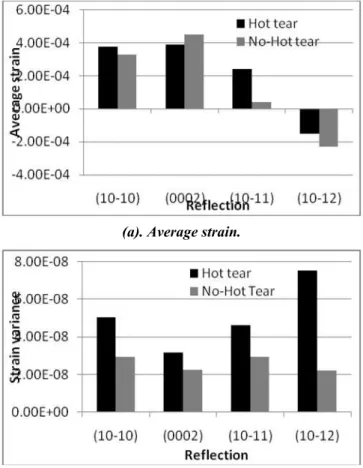
(b). 250 °C mold temperature casting. Figure 5. Strain profiles for basal plane reflection. The average strain values for the entire linescan were calculated for each casting (with and without a hot tear) and are presented in Figure 6. It can be observed, that different crystallographic planes responded differently during the onset
of hot tearing. In general, however, as the mold temperature increased, the average tensile strain decreased (i.e., became more compressive). It was observed that the magnitude of strain variance also significantly decreased, as illustrated in Figure 6b. Thus, the ND results reveal that as hot tears were eliminated by the increase of the mold temperature, the alloy deformation in the critical region became more homogeneous and tensile strain in the material decreased. Therefore, preheating the mold temperature lessened the impact of stress concentration at the 90° corner and decreased the susceptibility for hot tearing.
(a). Average strain.
(b). Average strain variance.
Figure 6. Average strain and variance results for AZ91D castings.
B206 ALLOY
The effect of grain refiner on hot tearing of B206 alloys is illustrated in Figure 7. The results suggest that Ti-B grain refiner had a significant impact on hot tearing severity of B206. Initially, a severe hot tear formed in unrefined alloy (indicated by arrow in Figure 7 a) in the mid section of the horizontal bar. With the addition of 0.02 wt% Ti, only a small hot tear developed near the casting surface, as shown magnified in the top left corner of Figure 7 b. Further addition of Ti eliminated hot tears on the casting surface.
SAE Int. J. Mater. Manuf. | Volume 3 | Issue 1 488
(a). Unrefined
(b). 0.02 wt% Ti
(c). 0.05 wt% Ti
Figure 7. Effect of grain refiner on hot tearing in B206 alloy.
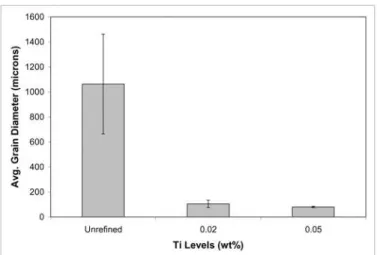
Grain size measurements for the B206 alloy were performed using the linear intercept method. The results are presented in Figure 8. As can be observed, addition of Ti-B grain refiner significantly reduced the grain size: 0.02 wt% Ti addition resulted in ∼10x reduction in grain size from 1070 µm to 100 µm. Additional Ti reduced the grain size by ∼50 µm, as shown in Figure 8. These results are in agreement with literature, as a decrease in hot tearing severity typically occurs in conjunction with a reduction in grain size.
Figure 8. Grain size measurements for B206 alloy with various Ti concentrations. Error bars represent plus and
minus one standard deviation.
The micrographs in Figure 9 illustrate the grain structure of the B206 alloys. The unrefined B206 alloy had a very coarse and dendritic grain structure (Figure 9a). This grain structure supports observations in Figure 7a, since the unrefined alloy's dendrites were not able to move relative to one another under loading during solidification, and therefore material fracture readily initiated. On the contrary, the finer and more equiaxed grain structure which resulted from Ti-B addition, improved the alloy's ductility at elevated temperatures, resulting in enhanced hot tear resistance.
(a). Unrefined
(b). 0.02 wt% Ti
(c). 0.05 wt% Ti
Figure 9. Grain structure of B206 alloy with various levels of Ti (Magnification: 100×).
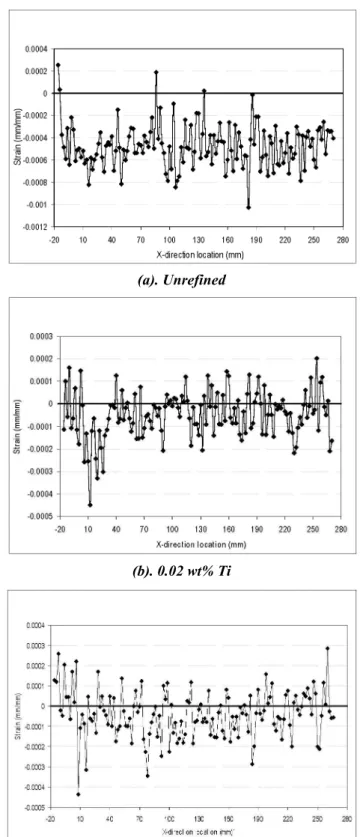
Figure 10 provides plots of residual strain in the x-direction (εx) for the B206 unrefined alloy and 0.02 and 0.05 wt%
Ti-containing B206 alloys. For the unrefined alloy, compressive strain was observed. This suggested that the horizontal bar was free to shrink once a hot tear formed near the solidus temperature. The free (unrestrained) contraction of the bar enabled development of compressive strains.
In the case of the refined alloys, however, a mix of tensile and compressive strains was observed. A significant relaxation of strain to a compressive state was visible for both refined alloys. The location of this relaxation was equivalent to the location of the 90° junction between the downsprue and horizontal bar in the permanent mold (i.e. sharp corner). Further, analysis of the strain profiles illustrates that the discontinuity in strain magnitude was greater for the 0.02 wt % Ti condition. This was likely due to the small hot tear that
was present on the 0.02 wt% Ti alloy's surface. In the case of the 0.05 wt% Ti condition, the relaxation in strain magnitude was not significant enough to form a hot tear.
(a). Unrefined
(b). 0.02 wt% Ti
(c). 0.05 wt% Ti
Figure 10. Strain profiles for B206 castings [(111) reflection].
SAE Int. J. Mater. Manuf. | Volume 3 | Issue 1 490
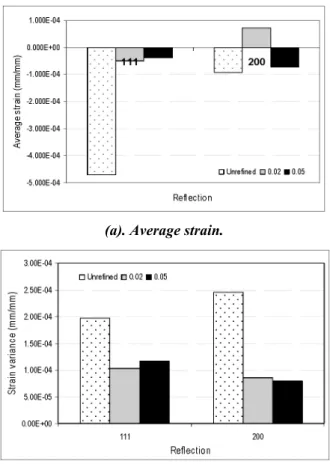
The average strain and strain variance are presented in Figure 11 for the (111) and (200) reflections. The average strain was significantly reduced with grain refiner additions for the (111) reflection. This was expected, as the grain refined microstructure likely enabled uniform feeding of liquid metal during casting solidification, which compensated the axial contraction of the horizontal bar and alleviated developing strains. In the case of the (200) reflection, mixed strain values were observed for the casting conditions. The strain for the (200) reflection was less sensitive to the effect of grain refinement, as observed in Figure 11a (only a small change in strain magnitude was observed). The average strain variance shown in Figure 11b suggests that grain refiner enhanced strain homogeneity, for both (111) and (200) reflections.
(a). Average strain.
(b). Average strain variance.
Figure 11. Average strain and strain variance for B206 alloy castings.
CONCLUSIONS
Neutron diffraction experiments provided quantitative data for analysis of methods to alleviate hot tearing in magnesium and aluminum alloys.
The results of the experiments with AZ91D alloys reveal that increasing the mold temperature is capable of eliminating hot tears from castings. The increase of mold temperature
promoted a homogeneous temperature distribution in the solidifying casting, resulting in a homogeneous strain distribution and reduction of stress concentrations in the casting.
This study suggests that grain refinement is a practical method to reduce hot tearing severity. The fundamental mechanisms of Ti-B grain refiner's influence on hot tearing in B206 were as follows.
• Hot tears were virtually eliminated in B206 with addition of
Ti-B grain refiner.
• Grain refinement resulted in a significant decrease in grain
size. Examination of the B206 grain structure showed a transformation from a dendritic morphology to globular grains.
• Neutron diffraction revealed that the total residual strain
measurements were in agreement with the hot tearing severity of B206. It was observed that, average residual strain was significantly less for the grain refined castings. Further, the strain homogeneity was improved with grain refiner additions. As a result, the grain refined castings were less prone to hot tear formation.
REFERENCES
1. Gharghouri, M., “Neutron Diffraction Techniques for
Alloy Characterization and Development,” Materials Science Forum. 519-521: 1379-1384, 2006.
2. Eskin, D. G., Suyitno, Katgerman, L., “Mechanical
properties in the semi-solid state and hot tearing of aluminum alloys,” Progress in Materials Science. 49: 629-711, 2004.
3. Avedesian, M. and Baker, H., Magnesium and Magnesium
Alloys, ASM International, Materials Park, OH, ISBN 0-87170-657-1, 1999.
4. Sigworth, G.K., “Hot tearing of metals,” AFS
Transactions. 104: 1053-1062, 1996.
5. Metz, S.A. and Flemings, M.C., “A Fundamental Study of
Hot Tearing,” AFS Transactions. 78: 453-460, 1970.
6. Eskin, D.G., Suyitno, Mooney, J.F. and Katgerman, L.,
“Contraction of Aluminum Alloys During and After Solidification,” Metallurgical and Materials Transactions A. 35A: 1325-1335, 2004.
7. Braccini, M. Suéry, M. and Stucky, M., “Influence of
Grain Refinement on Hot-Cracking in Aluminum-Copper Alloys,” Fonderie Fondeur d'aujourd'hui. 208: 12-23, 2001.
8. Eskin, D.G. and Katgerman, L., “Effect of Structure on
Hot Tearing Properties of Aluminum Alloys,” Trans Tech Publications, Switzerland. 2007.
9. Prask, H. J. and Brand, P.C. “Neutron Diffraction
Residual Stress Measurement at NIST,” Materials Science Forum. 210-213: 155-162, 1996.
CONTACT INFORMATION
Dimitry Sediako
Canadian Neutron Beam Centre - National Research Council of Canada
Chalk River Laboratories Chalk River, ON K0J1J0 [email protected] Phone: 613-584-8811 Ext.44614
ACKNOWLEDGMENTS
The authors would like to acknowledge the financial support of the Natural Sciences and Engineering Research Council (NSERC) of Canada. The authors would also like to thank Mr. I. Kosi of Meridian Technologies for the provision of materials and Mr. A. Machin of Ryerson University for technical assistance. They are thankful to staff of Canadian Neutron Beam Centre for assistance with neutron experiments.
SAE Int. J. Mater. Manuf. | Volume 3 | Issue 1 492