HAL Id: halshs-00188299
https://halshs.archives-ouvertes.fr/halshs-00188299
Submitted on 16 Nov 2007HAL is a multi-disciplinary open access
archive for the deposit and dissemination of sci-entific research documents, whether they are pub-lished or not. The documents may come from teaching and research institutions in France or
L’archive ouverte pluridisciplinaire HAL, est destinée au dépôt et à la diffusion de documents scientifiques de niveau recherche, publiés ou non, émanant des établissements d’enseignement et de recherche français ou étrangers, des laboratoires
Work organization and preferences dynamics
Victor Hiller
To cite this version:
Documents de Travail du
Centre d’Economie de la Sorbonne
Maison des Sciences Économiques, 106-112 boulevard de L'Hôpital, 75647 Paris Cedex 13
Work organization and preferences dynamics
Victor HILLER
Work organization and preferences dynamics
Victor HILLER
∗First Draft: May 2006
this version: August 2007
∗Panthéon Sorbonne Economie, University of Paris I, 106-112 Boulevard de l’Hôpital 75013 Paris, France. <[email protected]>
Abstract
We present a model with intergenerational transmission of preferences providing a joint explanation of preference evolution and of work organization changes in a society. We focus on the preference for autonomy, defined as an individual’s degree of initiative and the value they attach to self direction. We show that the economy has several steady states with different levels of worker autonomy and of the degree of coercion in the work place. The Industrial Revolution and the recent return of flexible forms of organization enable us to illustrate the existence of organizational path dependency. Indeed, the current technological shocks, impacting on the long-run distribution of preferences, modify the future possibilities of adoption of new organizational forms.
Résumé
Nous proposons d’expliquer conjointement l’évolution des préférences des travailleurs et les changements dans l’organisation du travail. Pour cela, nous présentons un modèle dans lequel le degré de préférence pour l’autonomie des agents est hétérogène et se transmet d’une génération à l’autre. Nous montrons l’existence de plusieurs états stationnaires caractérisés par des niveaux différents d’autonomie chez le travailleurs et de discipline dans l’organisation du travail. Les exemples historiques de la Révolution Industrielle et de l’apparition récente de nouvelles formes d’organisation nous fournissent l’illustration de la propriété de dépendance à l’histoire dans la trajectoire organisationnelle d’un pays. En effet, un choc technologique donné, en transformant sur le long terme la structure des préférences, modifiera les possibil-ités future d’adoption d’une nouvelle forme d’organisation.
JEL Codes: L16, L23, Z10.
Keywords: Cultural Transmission, Work Organization, Industrial Revolution, Histori-cal Path Dependency.
1
Introduction
The Industrial Revolution is associated with the rise of the Factory. However, the Factory cannot be limited to a technological improvement allowing a reduction of production costs by taking advantage of economies of scale and the fall of transport costs. It is also char-acterized by a transformation in the relationship between employers, workers and the work process. Marx (1976)[1867] considers the transition from traditional forms of production (workshop, handcraft...) to the Factory as a loss of workers’ control over the content, in-tensity and rhythm of their work.1 This point of view is now held by many economists and
economic historians.2 Yet the Factory’s supremacy is contested, as dramatic changes in the
organization of work occurred at the end of the twentieth century. As distinct from earlier transformations, recent developments are characterized by a trend toward more autonomy for the workers. Although this trend, initiated in Japan during the 1970’s, seems to con-cern most of the industrialized world, the speed and depth of changes vary widely across countries.
Starting from these observed developments, two opposed traditional explanations emerge. On the one hand, a cultural explanation (Dore (1973), Lincoln & Kalleberg (1990)) suggests that the organizational choice derives from the country’s own cultural factors. However, this view fails to explain the successful implementation of the Japanese style of management into other countries. Moreover, it considers the culture as a static factor without taking into account the impact of the industrial structure on the national culture. On the other hand, a strict technological explanation highlights, for a given technological level, the existence of a one best way in organizational choices (Kenney & Florida (1993), Kochan et al. (1997)). However, this approach, by rejecting the influence of national specificities, does not explain why new organizations can appear at different times and places. The present paper intends to provide a new understanding of organizational evolution by putting together the cultural with the economic and technological analysis. Indeed, we argue that transformations of the workplace induce changes in worker preferences, while the opportunities to adopt a new organization depend on these preferences.
In an overlapping generations model, we focus on the preference for autonomy. Workers can be of two types : autonomous or non-autonomous. The utility of an autonomous agent is assumed to be positively related to the degree of freedom in his work place.3 Conversely, a
non-autonomous agent will be unaffected by the degree of control and the absence of freedom. Thus, the autonomous workers make a greater effort in a relatively free form of organization than in a more coercive form. As a consequence, the profitability of each organization depends on the proportion of autonomous agents in the population. This relation between work context and incentives to provide effort has been highlighted by Bowles (1998) and Bowles et al. (2001). They argue that some preferences are incentives-enhancing i.e. they enable the employer to elicit workers’ effort at lower cost. Moreover, the incentives-enhancing preferences differ according to the work context, the level in the hierarchy and the level of
1On this lost of control Marx (1976)[1867] writes : “In handcraft [...] the workman makes use of a tool, in the Factory the machine makes use of him”. (p.422).
2See Berg (1985) for a survey on the economic historians’ views about the passage to the Factory. 3This degree of freedom depends on the level of transfer of decision making and responsibility to the
responsibility. Empirical evidence on the existence of such preferences is provided by a growing number of studies. They emphasize the impact of preferences or personality traits on labor market outcomes such as the wage or labor market participation (see Jackson (2006), Nyhus & Pons (2005), Osborne (2005) and a survey in Bowles (1998)).
Here, we consider endogenous preferences. The mechanism of preferences formation is in line with Bisin & Verdier (2001). Children’s preferences depend on two levels of socialization: first vertical, then oblique. The vertical socialization corresponds to a direct parental effort in terms of education. The parents exhibit a paternalistic altruism (Bisin and Verdier), which incites them to transmit their own preferences. A costly transmission effort determines the probability of directly transmitting these preferences. The transmission effort increases with the adequacy between the expected form of work organization and the behavior correspond-ing to preference type. For instance, autonomous parents may have less incentive to transmit their preferences if the dominant form of organization is coercive. The oblique socialization occurs when the vertical one fails. It corresponds to a matching between the child and a role
model 4, randomly chosen in the population, who transmits his own preferences to the child.
Firms have to choose between two archetypal forms of organization : the Workshop and the Factory organizations (Clark (1994)). The Workshop is more decentralized and leaves more responsibilities, more possibilities of involvement in the decision making process to the worker. The Factory is characterized by more precise and repetitive tasks associated with the labor division and a stricter work discipline. Due to the effect of work context on the incentives to provide effort, the optimal choice of organization depends on the workers’ preferences. Moreover, through the mechanism of preference transmission, the parental choice of socialization depends on the firms’ choice of organization. Thus, we obtain a co-determination of the distribution of preferences (i.e. proportion of each worker type) and the industrial structure (i.e. proportion of each organizational form) in the economy. This co-determination may generate multiple equilibria. They differ by the proportion of autonomous and are characterized either by the domination of the Workshop, by the domination of the Factory or by a mixed population of firms. This property implies that two countries having close initial conditions can follow different trajectories and converge to different long-run situations.
In this framework, we propose a reappraisal of the above-mentioned changes in work organization and assess the possibility of organizational path dependency. The adoption of a more flexible and decentralized form of production during recent decades corresponds, in the model, to a return to the Workshop organization. It was made possible by some technological innovations (Caroli & van Reenen (2001), Lindbeck & Snower (2000), Milgrom & Roberts (1990), Mokyr (2001)) having affected the whole developed world. However, the model predicts that the effects of this shock depend on the structure of preferences in the economy where it occurs. Indeed, the decentralized form of organization is more adapted to the autonomous behavior. Thus, the profitability of the adoption of this organization is positively related to the proportion of autonomous workers. Now, this proportion depends on the previous shocks. Taking the Japanese example, we argue that the late industrialization of Japan has induced a less extensive spread of the Factory and therefore a lower decline in autonomy than in other developed countries. Because of this later industrialization,
the Japanese structure of preferences made the adoption of the new organization easier. Thus, our approach may provide part of an explanation for the international differences in organizational trajectories without referring to strict cultural explanations. However, it recognizes the importance of the workers’ preferences in organizational changes (importance highlighted by Lindbeck & Snower (1996) and (2000) in a static framework.5)
The last part of our analysis consists in the extension of the basic model. First, we show that our dynamics can exhibit self-fulfilling beliefs, inducing multiple perfect foresight paths. These features give a role to ideologies. They could shape both the organizational form and the distribution of preferences in the long run by providing agents with an image of what should be the state of a future society. Then, we propose a more realistic description of the recent changes toward a more decentralized form of organization, modelling the role of autonomy in the process of learning and innovation.
This article is organized as follows. Section 2 introduces the model and illustrates it by the example of the Industrial Revolution. Section 3 focuses on the potential discrepancies concerning the organizational trajectories and the property of path-dependency. Section 4 analyzes the impact of ideologies on both industrial and cultural structures and the conse-quences of taking into account the opportunities of learning and innovations. Finally, Section 5 concludes.
2
The Model
We consider two populations, the first constituted of infinitely-lived agents, namely firms, the second constituted of short-lived agents, namely workers. Both populations of agents are distributed according to a continuum with a measure normalized to one. Workers are risk neutral and live two periods. During childhood they acquire their personality, during adulthood they are randomly matched with a firm, work and receive a wage.
The population of workers is split into two types of individuals, differing in their degree of autonomy. The autonomous individuals (giving a high value to autonomy) will be indexed by ¯a and the non-autonomous (giving a low value to autonomy) will be indexed by a. The proportion of autonomous workers at a date t is denoted qt.
Firms are risk neutral and maximize the profit function πj = ˜e−cj where ˜e is the expected
level of worker’s effort and cj the organizing cost of production. They can choose between
two forms of work organization.6 These alternative organizations differ by the level of control
of the employers on the employees and by the level of autonomy of the employees in their work. Following the description of the Industrial Revolution provided by some economic historians (such as Berg (1985) or Clark (1994)), these two archetypal forms of organization are named the Workshop and the Factory. The Workshop is more decentralized, leaves more freedom to workers who are less controlled; the Factory is characterized by some more precise and repetitive tasks due to the division of labor and a more strict work discipline.7
5Under the realistic assumption that more skilled workers are more autonomous (Scott (1981)), the model
conforms also with the studies on the skill-biased organizational change (Caroli & van Reenen (2001)).
6We suppose for simplicity that the form of organization is the only available choice variable of the firm. 7Clark (1994) writes: “One reason that the Industrial Revolution was greeted with hostility by many was its
Each date t is divided into two sub-periods 1 and 2 . In period 1 workers choose their effort level regarding the organization implemented by the firm and their degree of autonomy. In period 2 firms make their choice of organization for the next date in order to maximize their expected profit and workers choose the level of education which they invest in their children’s socialization.
The following of this section examines the short-run equilibrium defined as the effort choices of workers, the choices of organization of firms and the socialization choices of parents at a date t.
2.1
Short-run equilibrium
2.1.1 Choice of effortWorkers make their effort choices given the organizational context (chosen by the firms at the previous date). The set of workers’ effort levels is assumed to be discrete : e =
{¯e, e} with ¯e > e. Moreover, neither this effort level nor the workers’ type is observable by
the employer. In consequence, workers earn the same wage whatever their effort level. This wage is assumed to be exogenous and equal to wF for the Factory organization and wW for
the Workshop organization.8 The employers supervise the work process and try to detect
the shirkers (workers choosing the low effort level). When a shirker is detected, he is directly dismissed and is not paid.9. The probability of shirkers’ detection is denoted ¯s and s in
respectively the Factory and Workshop with ¯s > s > 0. Indeed, the Factory allows a better
supervision than an organization giving more freedom and autonomy to workers. Finally, the choice of ¯e provokes a disutility to workers. D denotes the high effort disutility of
an autonomous worker in the Factory organization context. d represents the high effort disutility of an a-worker whatever the organization type. We assume that D > d > 0, thus in a coercive context (the Factory organization) the effort of autonomous workers is very painful.
The matrix of expected gain for each worker type, given the organizational form, are:
W F ¯ e wW wF − D e (1 − s)wW (1 − ¯s)wF W F ¯ e wW − d wF − d e (1 − s)wW (1 − ¯s)wF a-worker a-worker
Note that the choice of the low effort level does not induce disutility whatever the type of worker and the organizational form. Hence, for the autonomous it is not the work context
association with a revolutionary change in the way work life was organized [...] Workers in [the] Workshops controlled their own hours, work pace and conduct. They took breaks when they wanted and socialized at work as they wished [...] The second and later change was the imposition on these concentrated workers of “factory discipline”. With factory discipline the employer dictated when workers worked, their conduct on the job, and that they steadily attend to their assigned task”.
8This difference between the wages paid inside the Factory and inside the Workshop can be explained by
differences of labor productivity associated with the different organizations.
9Pollard (1963) notes that “dismissal and the threat of dismissal, were in fact the main deterrent instru-ments of enforcing discipline in the factories”. It will be the only instrument in our model. However, the
which is painful but high effort choice in this context. We make the following assumptions on the payoff structure :
D > ¯swF > d > swW (1)
Lemma 1 Assume condition (1) holds :
− in the Workshop organization, ¯a-workers always choose the level of effort ¯e and a-workers always choose the level of effort e
− in the Factory organization, ¯a-workers always choose the level of effort e and a-workers always choose the level of effort ¯e
Inside the Factory, the level of effort disutility discourages autonomous workers from choosing the high effort level despite the higher detection risk linked with better control. Conversely, when ¯a-workers enjoy more freedom in the work place (as in the Workshop organization) they will choose the highest effort level. Concerning the a-workers, their effort disutility is unaffected by the degree of discipline. Their effort choice will only depend on the detection probability when they choose to shirk and then on the degree of supervision in the work place.
Thus, autonomy is an incentive-enhancing preference (Bowles et al. (2001)) in a Work-shop organization but it is an incentive-weakening preference in a Factory organization.10
2.1.2 Choice of organization
Due to the time of implementation of a production process, the form of organization imple-mented at the date t must be decided at date t − 1. The effort level and the type of workers are assumed to be unobservable. By Lemma 1, the benefits of one organization will depend on the proportion of each worker type. Then, to make their organizational choices, firms have to form expectations, at date t − 1, on the proportion of autonomous workers of date
t. These expectations are based on qt−1, the current observation. It is assumed that firms
cannot perfectly observe this proportion. They receive only local and partial information on the workforce’s state of mind. Consequently, firms base their choices only on a biased signal on qt−1. For simplicity, this signal is assumed to be uniformly distributed among the firms
around the true value of qt−1. Under these assumptions, the expected value of qt, denoted
qs
t, is qts= qt−1+ ε with ε uniformly distributed on the interval [−˜ε, ˜ε].11
At each date t, the problem of the firms is the choice of organization for the date t + 1 such that12
Max
j={W,F }E(π) = Maxj={W,F }[q s
te(¯a, j) + (1 − qts)e(a, j) − cj] (2)
10Pollard (1963) stresses that, according to Factory managers at the beginning of industrialization, a
proportion of workers was considerably dissatisfied because of the absence of autonomy in work organization. Moreover, this dissatisfaction seems often to induce irregular attendance or shirking. In our framework, this type of individual is ¯a-worker.
11The model’s results remain the same if the heterogeneity refers to production costs.
12To make things simple and without consequences on our results we assume that the costs of organization
with e(¯a, j) (respectively e(a, j)) the effort level of an autonomous worker (respectively non autonomous worker) inside an organization j. Given the results of Lemma 1, the expected profit of a firm under each organization type is :
πW = qts¯e + (1 − qst)e − cW
πF = qste + (1 − qst)¯e − cF (3)
Further we will assume that :
cW − cF < ¯e − e (4)
The proportion of firms choosing the Workshop organization at date t is noted pt(respectively
(1 − pt) for the Factory).
Lemma 2 Given a proportion qt of autonomous workers at date t, the proportion pt+1 of
firms choosing the Workshop organization for the date t + 1 is : pt+1 = 0 if qt< ˜q − ˜ε 1 2 − ˜ q 2˜ε + qt 2˜ε if qt∈ [˜q − ˜ε, ˜q + ˜ε] 1 if qt> ˜q + ˜ε (5) With ˜q = cW−cF
2(¯e−e) + 12. Condition (3) ensures that ˜q is between 0 and 1.
Proof πW ≥ πF if qts ≥ ˜q. Then if a firm perceives a proportion of autonomous workers
higher than the threshold ˜q it will choose the Workshop. The proportion of firms having a
signal qs t higher than ˜q is : pt+1= P (qts ≥ ˜q) = P (ε ≥ ˜q − qt) = Z ε˜ ˜ q−qt f (ε)dε = ε − ˜˜ q + qt 2˜ε
The result of Lemma 2 directly follows. ¤
The population of firms is totally homogeneous only for a relatively low level of imperfect information (˜ε low) and for a relatively homogeneous workers population. If qt ∈ [˜q − ˜ε, ˜q + ˜ε],
the population of firms is heterogenous. 2.1.3 Transmission of preferences
The individual preferences are acquired during childhood by a process of socialization. First a process of vertical (parental) socialization occurs. In line with Bisin & Verdier (2001), we assume that parents have a paternalistic form of altruism for their children. They make their educational choices in order to maximize the well-being of their children, but this well-being is evaluated according to their preferences. This assumption implies that parents always try to socialize their children to their own preferences. We will note τi the educational effort
made by a parent i, with i ∈ {¯a, a} the parental preferences. With probability τi the vertical
socialization is successful and the child will adopt his parent’s preferences. With probability 1−τithe vertical socialization fails and a process of oblique socialization begins. This oblique
socialization consists in the adoption, by the children, of another adult’s preferences, this
role model being randomly chosen among the population. Therefore, if vertical socialization
fails, a child, whatever his parent’s type, will be ¯a with probability qtand a with probability
We can deduce from this socialization process the probability that a child of a parent with preferences i is socialized to preferences j for each i and j . We will note Pij this transition
probability:
P¯a¯a
t = τt¯a+ (1 − τta¯)qt Pt¯aa = (1 − τt¯a) (1 − qt)
Ptaa = τta+ (1 − τta) (1 − qt) Pta¯a= (1 − τta)qt (6)
2.1.4 Parental socialization choice
As we have seen, the parents make their educational choices in order to maximize their children’s utility, estimated in accordance with their own preferences (the payoff matrix corresponding to their type). Formally, the parental problem of socialization at date t can be written as follows: Max τ it Pii t (τti, qt)V ii t+1+ Ptij(τti, qt)V ij t+1− C(τti) (7)
where Vt+1ij is the utility of a parent with preferences i if his child is of type j . It is the utility of an individual behaving at the date t+1 according to the preferences j but evaluated according to the preferences i. C(τi
t) is the socialization cost which we assume to be :
C(τi t) =
(τi t)2
2k . The first order conditions yield:13
τ¯a
t = k(1 − qt)∆Vt+1¯a and τta= kqt∆Vt+1a (8)
where ∆Vi
t+1 = Vt+1ii − Vt+1ij . by definition ∆Vt+1i is never negative. Indeed, the optimal
action of an agent of type j induces utility for an agent of type i lower or equal to the one his own optimal action would have induced, thus Vii
t+1 ≥ Vt+1ij . ∆Vt+1i is the loss of utility
suffered by an agent of type i if he behaves like an agent of type j instead of optimally. Besides, this value depends on the work organization at the date t+1 and therefore on the expectations concerning the organization. Note ∆Vi(W ) (respectively ∆Vi(F )) this value
for an agent of type i expecting that his child will work inside the Workshop (respectively Factory) organization.
If the organization is the Workshop, the ¯a-workers will choose the level of effort ¯e and the a-workers will choose the level of effort e. V¯aa(W ) is the payoff for a worker behaving like
an a-worker (choosing the level of effort e) evaluated with the payoff matrix for an ¯a-worker. Then we have V¯aa(W ) = (1−s)w
W. In the same way, the following values for ∆Viregarding
the expected organization are deduced: ∆Va¯(W ) = sw
W ∆Va(W ) = d − swW
∆Va¯(F ) = D − ¯sw
F ∆Va(F ) = ¯swF − d (9)
Finally, workers know the decision rule of the firm and then know the proportion pt+1 of
firms choosing the Workshop, then : ∆Vi
t+1 = pt+1∆Vi(W ) + (1 − pt+1)∆Vi(F ) (10)
13Note that k must be low enough such that C(τi) be sufficiently convex so that the solution of the socialization problem is τi< 1.
Note that vertical and oblique transmissions are substitutes. The probability of transmission of autonomy by oblique socialization is positively related to the proportion of autonomous workers. The higher this proportion is, the weaker are the incentives for autonomous parents to transmit their preferences directly and the higher are these incentives for non-autonomous parents.14
The short-run equilibrium: firm’s choice (organization type) and workers’ choice (work and education effort level for each worker type)15, has been characterized. Those choices
completely depend on the proportion of autonomous workers. So, the dynamics of the economy are completely described by the dynamics of qt.
2.2
Dynamics of autonomy
We deduce from the transition probabilities given by (6) the dynamics of qt :
qt+1= qtPt¯a¯a+ (1 − qt)Pta¯a = qt+ qt(1 − qt)[τta¯− τ a
t] (11)
The dynamics relationship qt+1 = f (qt) is derived by substitution of the optimal level of
socialization effort (8), the values of ∆Vi
t+1 (9) and (10) and the value of pt+1 (5) into
expression (11): f (qt) = fF(q t) ≡ qt+ qt(1 − qt)k[D − ¯swF − qt(D − d)] if qt< ˜q − ˜ε fm(q t) if qt ∈ [˜q − ˜ε, ˜q + ˜ε] fW(q t) ≡ qt+ qt(1 − qt)k[swW − dqt] if qt > ˜q + ˜ε (12) where fm(qt) ≡ qt+ qt(1 − qt)kR(qt) and R(qt) = qt(D − 2d)(1 2 − ˜ q 2˜ε + qt 2˜ε) + [¯swF + swW − D]( 1 2 − ˜ q 2˜ε + qt 2˜ε) −qt(D − d) + D − ¯swF
The dynamics of qt can be split in three parts. For values of qt< ˜q − ˜ε all firms choose the
Factory, ∆ Vi
t+1 = ∆Vi(F ) for all agents and qt+1 = fF(qt). If qt> ˜q + ˜e all firms choose the
Workshop, ∆ Vi
t+1 = ∆Vi(W ) for all agents and qt+1= fW(qt). Finally for ˜q − ˜ε ≤ qt≤ ˜q + ˜ε
a proportion pt+1 of firms choose the Workshop, ∆Vt+1i = pt+1∆Vi(W ) + (1 − pt+1)∆Vi(F )
and qt+1= fm(qt).
The following Lemma examines the general properties of the trajectories fF(q t) and
fW(q t).
Lemma 3 Both trajectories qt+1 = fW(qt) and qt+1 = fF(qt) have three stationary states:
0, 1 and ˆqj = ∆Va¯(j)
∆Va(j)+∆V¯a(j) with j = {W, F }. Moreover, {0, 1} are unstable and for a low
enough k, ˆqj is globally stable for both trajectories.
14This property is named cultural substitution by Bisin & Verdier (2001) 15We note respectively ea¯
t and eat the work effort level of ¯a-workers and a-workers and τt¯a and τta the education effort level of ¯a-workers and a-workers.
Proof See Appendix ¤ By Lemma 3 the interior steady states values of qt corresponding to each trajectory
qt+1 = fW(qt) and qt+1 = fF(qt) are ˆqW = swdW and ˆqF = D−¯D−dswF. Observe that ˆqW > ˆqF
when
D < d(¯swF − swW) d − swW
(13) (13) holds under the sufficient condition that the loss of utility for an autonomous parent (respectively for a non-autonomous parents) induced by having a child with different pref-erences increases in the proportion of Workshop (respectively the proportion of Factory).16
Let us look at the general properties of the whole dynamics qt+1 = f (qt).
Lemma 4 Assume (1) holds. For a small enough k, f (qt) is continuous and strictly
in-creasing on between 0 and 1. Moreover, {0, 1} are unstable equilibria of qt+1 = f (qt) for all
parameter configurations.
Proof See Appendix ¤
Taking the historical example of the Industrial Revolution, the following section studies the long-run behavior of the economy (preference distribution and industrial structure at the steady state) regarding different configurations of parameters.
2.3
The Industrial Revolution: rise of the Factory and decline in
the autonomy
This section describes the consequences of a technological shock affecting the relative cost of each form of organization on the dynamics. These consequences are illustrated by the example of Industrial Revolution.
2.3.1 Pre-industrial situation
Clark (1994) focuses on the work conditions before the Industrial Revolution in Britain. He argues that most workers were employed in Workshops, controlled their pace, timing and conduct at work. The owner of the Workshop often rented out his material to workers without exercising any control or discipline. Clark notes that: “workers worked when they wished
during [the Workshop opened] hours [...] workers did not have to produce any minimum output per week”.
For a sufficiently low cost of Workshop organization (cW), the dynamics of qt exhibit a
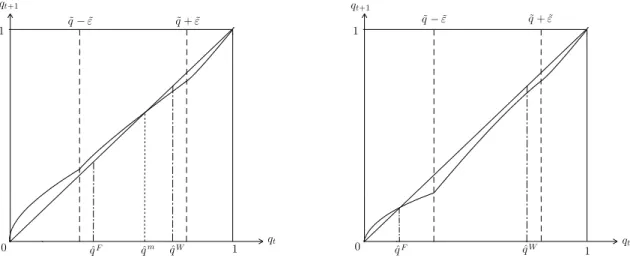
unique steady state corresponding to the situation described by Clark. It is the case in the configuration, illustrated by Figure 1, where ˜q − ˜ε < ˆqF and ˜q + ˜ε < ˆqW.
Proposition 1 describes the properties of the dynamics in this configuration of parameters and under the additional assumption (14)17
D < 2d (14)
16Indeed, ∂∆Vt+1i
∂pt+1 = ∆V
i(W ) − ∆Vi(F ) and (13) holds if ∆V¯a(W )∆Va(F ) > ∆Va¯(F )∆Va(W ).
17This technical assumption means that the disutility of autonomous workers inside the Factory is not too
large relative to the disutility of non autonomous worker. It is not necessary to obtain our results. However it allows us to specify the dynamics in all parameter configurations.
0 1
qt
qt+1
q˜− ε˜ qˆF q˜ + ε˜ qˆW 1
Fig. 1. Dynamics of the worker’s distribution of preferences when ˜q − ˜ε < ˆqF < ˜q + ˜ε < ˆqW
Proposition 1 Assume (1), (13) and (14) hold. If ˜q − ˜ε < ˆqF < ˜q + ˜ε < ˆqW: {0, 1} are
unstable steady states and for all q0 ∈]0, 1[, qt converges toward ˆqW.
Proof See Appendix ¤
By Proposition 1, for all initial proportions of autonomous workers, the economy will converge toward ˆqW characterized by a relatively high level of autonomy and the choice of
the Workshop organization by all the firms. This result comes from the interplay of the organizational choices and the incentives of parents to educate their children. For low values of qt(qt< ˜q − ˜ε), all firms choose the Factory organization. Despite this, autonomous agents
transmit their preferences more than non-autonomous because of the cultural substitution. Then the proportion of autonomous workers rises. This increase of qt induces an increase
of pt (the proportion of Workshops) which, in turn, implies a rise of incentives to transmit
autonomy. As qt increases and the autonomous workers become the majority, this positive
incentives effect dominates the negative effect of cultural substitution. Finally, qt converges
to the stable value ˆqW.
The equilibrium ˆqW corresponds to the pre-Industrial Revolution situation as described
by Clark. The next part examines how technological changes, at the origin of the Industrial Revolution, may destabilize this equilibrium.
2.3.2 The Industrial revolution
The steam machine has been the emblematic innovation of the first Industrial Revolution. It allowed employer to supply many workers with energy under the same roof. Then it lead
to the division of labor and the birth of the Factory. Mokyr (2001) insists on another deter-minant of transition toward the Factory: the decrease in costs of the centralized production (essentially the transport costs) relatively to the costs of the decentralized production (es-sentially the information diffusion costs). Indeed, the improvement of the means of transport enabled the firm to access a larger market and a cheaper input supply. Such changes have the door to mass-production and to a new organizational form able to sustain this huge increase of production.18
The technical changes at the origin of the Industrial Revolution are represented, in the model, by a decrease in the costs of Factory organization relative to Workshop organization (rise of cW − cF). It implies a rise of ˜q and then a shift toward the right of the interval
[˜q − ˜ε, ˜q + ˜ε]. Starting from the situation of Figure 1 consider a shock provoking an increase
of ˜q such that the bound ˜q + ˜ε overtakes ˆqW.
Proposition 2 Assume (1), (13) and (14) hold. If ˜q − ˜ε < ˆqF < ˆqW < ˜q + ˜ε: {0, 1} are
unstable steady states and for all q0 ∈] 0, 1 [, qt converges toward ˆqm.
Proof See Appendix ¤
Figure 2 (Cf. section 3.1) illustrates the results of Proposition 2. The trajectories outside the interval [˜q − ˜ε, ˜q + ˜ε] (qt+1= fF(qt) for qt< ˜q − ˜ε and qt+1 = fW(qt) for qt> ˜q + ˜ε) remain
unchanged. But the trajectory qt+1= fm(qt), which holds between the bounds ˜q − ˜ε and ˜q + ˜ε
is modified. Indeed, the shock induces a cost advantage to the Factory. Given a proportion of autonomous workers ˆqW, due to this cost advantage, a proportion (1 − p
t) = 12+2˜q˜ε−qˆ
W
2˜ε of
firms shifts from the Workshop to the Factory organization. This appearance of a coercive form of production decreases the parental incentives to transmit autonomy and thus decreases the proportion of autonomous workers for the next date (qt+1 = fm(ˆqW) < ˆqW by Proposition
2). This decline in the proportion of autonomous workers strengthens the advantage of the Factory. Finally, the proportion of autonomous workers and the proportion of Workshops will progressively decrease to reach respectively ˆqm and ˆpm = 1
2 − ˜ q 2˜ε+ ˆ qm 2˜ε.19
Note that the model does not predict an unconditional organizational change after a technological shock in favor of the Factory. Such a shock must be large enough to make ˜
q + ˜ε higher than ˆqW. Then, the initial proportion of autonomous workers (ˆqW) determines
whether a given technological shock will provoke a spread of the Factory. Berg (1985) highlights this dependence on the adoption of the Factory for the structure of preferences.20
The impact of Factory discipline on workers’ behavior or preferences is more difficult to assess. Taira (1978) notes that an industrial revolution simultaneous to the rise of the Factory system induces a potential transformation of “traditional man into industrial man,
as he sheds the traditional outlook and works habits and acquires new personal qualities that
18See Chandler (1978) and Taira (1978) for historical study of transformations linked with the Industrial
Revolution respectively in the United States and in Japan.
19The result, according to which the Industrial Revolution introduced a new form of production
orga-nization without inducing a disappearance of the traditional orgaorga-nization (Workshop, handcraft...) seems empirically relevant (see Berg (1985) and Taira (1978) for the English and Japanese examples).
20He argues that : “the choice of economic structures were partly dependent on the social values of domestic workers and artisans. The strength of such values reverberated in the resistance of the factories and to mechanization, ultimately determining the location of much factory-based industry”.
enable him to manoeuvre rationally in the class structure of an industrial society”. The
impact of job conditions on personality is also highlighted in empirical studies on individual data. Indeed, there is a cumulative body of evidence that people who do self-directed work highly value self-direction, both for themselves and for their children (Kohn & Schooler (1978) and (1981); Miller et al. (1979) and (1985)). At an aggregated level, all these findings imply that the rise of the Factory should be followed by the fall of autonomy. In the model, the preferences of workers do not change during the work life shaped by work conditions. The decrease of autonomy comes from the relative advantage acquired by non autonomous behaviors in the process of preference transmission because of the appearance of the Factory.
3
Path dependency and organizational differentiation
The previous section dealt with the impact of cost shocks on the long run distribution of preferences via the move of the threshold ˜q. Now, this section focuses on the long run
impact of a change in the variables that influence workers’ utility (for instance a wage shock). Finally, we model a combination of these two types of shock and introduce the possibility of path dependency in organizational trajectories.
3.1
Incentives effect of wages and supervision
Consider the consequences of an asymmetric evolution of wages between the two organiza-tions.21 Assume that the wage associated with the Factory organization (w
F) increases while
the wage associated with the Workshop organization (wW) remains stable. The equilibria ˆqF
and ˆqm are decreasing with respect to w
F.22 Indeed, a rise of wF allows for a higher increase
in the expected reward for a non-shirker (equal to wF) than for a shirker (equal to (1− ¯s)wF).
By Lemma 1, if the organizational form is the Factory, autonomous workers choose the high level of effort (¯e) and non-autonomous workers the low level. Then, an increase in wF has
a larger positive influence on the expected utility of a non-autonomous worker than on the expected utility of an autonomous worker. That induces a fall of the relative incentive to transmit autonomy. So, the long run proportion of autonomous workers decreases.
The following figures represent the change in the dynamics induced by the rise of wF.23
Start from the equilibrium ˆqm (left figure). If the decrease of ˆqF is large enough such that
ˆ
qF < ˜q − ˜ε, it will generate a shift toward the equilibrium ˆqF.
21On the asymmetric evolution of American wages between Workshop and Factory see Atack et al. (2004)
on the period 1850-1880 and Goldin & Katz (1996) for data on the beginning of the twentieth century.
22qˆmis decreasing with respect to w
F because R00(q) < 0 and ∂R(q)∂wF = ¯s(pt+1− 1) < 0.
23Note that the increase of labor productivity at the origin of the increase of w
F can induce an increase in the relative profit of the Factory organization and thus an increase of ˜q. We choose not to take into account
0 1 qt qt+1 qˆW 1 q˜− ε˜ qˆF qˆm q˜ + ε˜
Fig. 2. Dynamics of qt when ˜q − ˜ε < ˆqF < ˆqW < ˜q + ˜ε
0 1 qt qt+1 q˜ + ε˜ q˜− ε˜ qˆF 1 qˆW
Fig. 3. Dynamics of qtwhen ˆqF < ˜q − ˜ε < ˆqW < ˜q + ˜ε Proposition 3 Assume (1), (13) and (14) hold. If ˆqF < ˜q − ˜ε < ˆqW < ˜q + ˜ε: {0, 1} are
unstable steady states and for all q0 ∈] 0, 1 [, qt converges toward ˆqF.
Proof See Appendix ¤
Consider ˆqm as the initial situation. As a result of the shock, the proportion of
au-tonomous workers will progressively decrease to reach ˆqF. At the same time, the proportion
of Factories within the firms’ population increases and reaches one in the long run. An increase of ¯s induces the same effects as the increase of wF.
Notice that these changes do not arise from an intrinsic advantage in the efficiency of Factory organization. Here, it is the transformation of the preferences structure (i.e. the decline in the autonomy) which induces the higher profitability of the Factory. Thus, the key factor at the origin of the disappearance of the Workshop organization is the decline in incentives to transmit autonomy.
Moreover, the fall of qtimplies a decrease of the proportion of shirkers inside the Factory.
This result complies with the standard incentive theory: the average level of effort inside the Factory rises with the wages and the supervision level. However, the mechanism at play is different here. This increase does not come from a rise of incentives to provide effort. It is allowed by the rise of incentives to transmit the non-autonomous behavior.
3.2
Organizational path dependency
Section 3.3.2. emphasizes the consequences of a technological shock (shock on the relative cost of each organization) on the dynamics of qt. These consequences depend in a crucial way
on the current distribution of preferences. The previous section showed that a shock affecting the workers’ utility (such as a change in wages or in the level of supervision) modifies the incentives to transmit autonomy. Thus, it has an impact on the steady state reached by the economy. Now, we consider the consequences of the combination of these two types of shock. Starting from Figure 3, let us assume a cost shock in favor of Workshop organization (fall of cW − cF). It implies a decrease of ˜q (the level of imperfect information ˜ε remaining
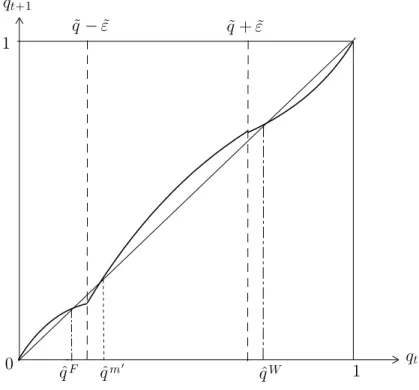
Proposition 4 Assume (1), (13) and (14) hold. If ˆqF < ˜q − ˜ε < ˜q + ˜ε < ˆqW are unstable
steady states and ˆqF and ˆqW are stable steady states such that:
− for all q0 ∈]0, ˆqm 0 [, qt converges to ˆqF − for all q0 ∈ [ˆqm 0 , 1], qt converges to ˆqW where ˆqm 0
solves the equation R(q) = 0.
Proof See Appendix ¤
The results of the proposition are illustrated in the following figure.
0 1 qt qt+1 qˆm0 1 q˜− ε˜ qˆF qˆW q˜ + ε˜
Fig. 4. Dynamics of qt when ˆqF < ˜q − ˜ε < ˜q + ˜ε < ˆqW
In this case the long-run equilibrium reached by the economy depends on the initial distribution of preferences (q0). This initial distribution is the proportion of autonomous
workers before the shock. It depends on the nature and the timing of the previous shocks. Consider again the shock described in Figure 3. The increase of wF induces a transition
from ˆqm to ˆqF. Then, at date T a second shock occurs which corresponds to a fall of c W− cF
(Figure 4). The long run equilibrium will depend on the timing of these two consecutive shocks. Indeed, assume that the second shock is relatively close to the first one, that is to say
qT is still higher than ˆqm
0
. In this case, the economy will converge toward ˆqW. Conversely,
if the shock takes place later, such that qT < ˆqm
0
, the economy will pursue its convergence toward ˆqF.
The Figure 5 describes the population dynamics of two economies ((a) and (b)) impacted by the same shocks but at a different date. For the simulation, parameters are chosen such that before the first shock, ˆqW = 0.7, ˆqF = 0.4, ˆqm ' 0.64, ˜q = 0.55 and ˜ε = 0.2. This
configuration of parameters corresponds to the situation of Figure 2 where the only steady state is ˆqm. Both economies are initially in ˆqm. w
F increases by 10 % (shock 1), first, in
economy (a) at date t = 2 and then in economy (b) at date t = 4. After this shock, the new value of ˆqF is 0.2. Then, at date t = 6, within the two economies, the relative cost of
Workshop (cW − cF) decreases (shock 2) and ˜q equals to 0.45.24
2 4 6 8 time 0.2 0.3 0.4 0.5 0.6 0.7 0.8 q
(a) Shock 1 (t = 2) and Shock 2 (t = 6)
2 4 6 8 time 0.2 0.3 0.4 0.5 0.6 0.7 0.8 q
(b) Shock 1 (t = 4) and Shock 2 (t = 6) Fig. 5. Evolution of the proportion of autonomous workers (Shock 1: increase of the Factory wages, Shock
2: decrease of the relative cost of Workshop)
Because the first shocks are two-periods lagged, it induces a striking divergence in terms of both the long-run level of autonomy and the organizational form. This comes from the fact that the earlier the shock, the larger the decrease of autonomy. Besides, an important decrease of autonomy makes the adoption of Workshop organization non-profitable even after the fall of cW − cF. Thus, via the impact of organizational choices on preferences
distribution, the trajectory of an economy is path dependent. The timing of the evolution of a productive system determines the possibilities of the adoption of an alternative system. In the following discussion, we will see how these properties can help us to understand the different organizational development in Japan and the U.S. during the twentieth century.
3.3
Discussion
Both in Japan and the U.S. the spread of the Factory system followed the Industrial Rev-olution. Piore & Sabel (1984) highlight, for the U.S., this phenomenon of disappearance of the Workshop organization to the benefit of mass-production and the Factory organization. Nevertheless, during the second part of the twentieth century, Japan broke away from this trend and adopted a more flexible form of production. Several authors argue that a techno-logical shock in favor of a more flexible and decentralized form of organization could be at the origin of this shift. For instance, Milgrom & Roberts (1990) insist on the impact of the development of computer science and robotics, Mokyr (2001) focuses on the decrease of in-formation costs, Lindbeck & Snower (2000) summarize evidence on cost advantages acquired by a less centralized form of organization. This shock has induced the appearance of new
24The values of parameters are chosen to satisfy the conditions (1), (4), (13) and (14). Moreover, the
wages payed inside the Workshop and the Factory are assumed to be the same (wW = wF) before the first shock.
management style and organizational forms, such as the lean production principles (Womak
et al. (1991)), in Japan. It impacted the whole developed world and is represented in our
framework by a decrease in ˜q (through the reduction of cW − cF). The question is, why has
such a shock induced a deeper and earlier change of organizational form in Japan than in the U.S.?
Complying with the analysis presented in the previous section, the later industrialization of Japan could be at the origin of these national divergences. Chandler (1969) stresses the earlier and faster spread of mass-production in the U.S. than in Japan. This spread came with an increase in the division of labor, in labor productivity and in wages. In the model, these changes are represented by the first shock (increase of wF or/and increase of ¯s). The
model predicts that the later industrialization of Japan combined with the technological shock in favor of more decentralized forms of production will induce not only divergences in the production pattern but also in the proportion of autonomous workers (Figure 5).
Consequently, the conservation of a sufficient cultural heterogeneity due to a later indus-trialization allowed for the rise of a new and more flexible organizational form in Japan.25
This historical path dependency provides one explanation for the international differences in organizational trajectories without having recourse to strict cultural explanations (Dore (1973), Lincoln & Kalleberg (1990)).
4
Extensions
In this section two assumptions are modified. First, the firms do not make their organiza-tional choices for the date t at the end of date t−1 but at the beginning of date t. Thus, this choice is a function of qt. Consequently, the socialization decision of parents for the date t
depends on the expectation on the proportion of autonomous workers for the date t+1. This expectation is denoted qa
t+1. The second assumption to be modified concerns the
imperfec-tion of informaimperfec-tion. In the following, at date t, firms perfectly observe the proporimperfec-tion qt of
autonomous workers.26 Under these new assumptions, this section gives a role to ideology in
the switch from one equilibrium to another. In the second part, we propose a new modelling of the relative cost of organization (cW− cF) taking into account the possibilities of learning
and innovation.
4.1
Self-fulfilling beliefs and the role of ideology
Under the new assumptions, the optimal effort choices of workers are not modified (Lemma 1 still holds). The optimal organizational choice of the firm is the Workshop if qt < ˜q and
the Factory if qt ≥ ˜q. Finally, the optimal socialization choice of parents is:
τa¯ t = k(1 − qt)∆Vt+1a¯ = ½ k(1 − qt)sw if qt+1a > ˜q k(1 − qt)(D − ¯sw) if qat+1≤ ˜q (15)
25Veblen (1934) was the first to apply to Japan the idea that the timing of a nation’s industrialization
impacts on the nature of its subsequent growth and institutional structure.
26This assumption, which prevents the possibility of co-existence of the two organizations at the same
τta= kqt∆Vt+1a =
½
kqt(d − sw) if qt+1a > ˜q
kqt(¯sw − d) if qt+1a ≤ ˜q
(16) The dynamics of the economy become qt+1= f (qt, qt+1a ), where
f (qt, qt+1a ) = ½ fF(q t) ≡ qt+ qt(1 − qt)k[D − ¯sw − qt(D − d)] if qt+1a ≤ ˜q fW(q t) ≡ qt+ qt(1 − qt)k[sw − dqt] if qat+1> ˜q (17) The trajectory of the economy is totally determined by the sequence of qt and qt+1a .
Among these trajectories we will only focus on the perfect foresight paths. A perfect foresight path is defined as a sequence of qt satisfying equation (17) and as qt+1a = qt+1 for all t.
The dynamics of qt, given by the equation qt+1 = f (qt, qt+1), completely describe the
evolution of our economy under the assumption of perfect foresight. These dynamics are composed of two trajectories, qt+1 = fF(qt) if the agents expect that all firms will choose the
Factory organization (qa
t+1≤ ˜q) and qt+1 = fW(qt) if the agents expect that qt+1a > ˜q. By the
assumption of perfect foresight paths, the agents’ expectations are self-fulfilling. qa
t+1 ≤ ˜q
implies that qt+1 ≤ ˜q and the firms will effectively choose the Factory organization. The
properties of the two trajectories are described in Lemma 3.
The main difference regarding the previous sections is the presence of an indeterminacy area. We define {¯qW, ¯qF} ∈ [0, 1]2 as the values of q which solve respectively ˜q = fF(q) and
˜
q = fW(q). The following results hold
Proposition 5 If ¯qF < q
t< ¯qW, two values of qt+1 corresponding to a perfect foresight path
exist.
Proof See Appendix ¤
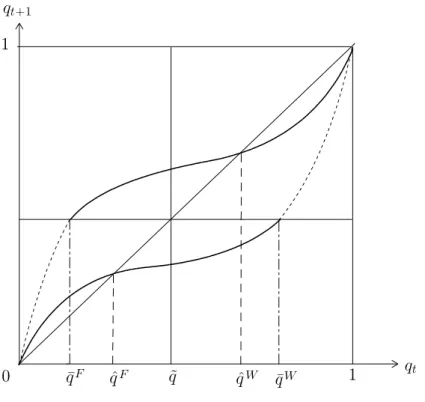
Figure 6 describes the dynamics in the configuration where ¯qF < ˆqF < ˜q < ˆqW < ¯qW
(The perfect foresight paths are represented by the solid line).
If qt+1 > ˜q (respectively qt+1 ≤ ˜q) the only perfect foresight path corresponds to the
trajectory fW(q
t) (respectively fF(qt)). As the two equilibria ˆqW and ˆqF are stable, if q0 > ˜q
all the firms initially choose the Workshop and, if the expectations remain the same (workers continue to believe that the Workshop will be the future form of organization) the economy converges toward ˆqW. However, the equilibria ˆqW and ˆqF are both in the indetermination
area [¯qF, ¯qW].
If the economy is on equilibrium ˆqW (respectively ˆqF), the expectation that the firms
will choose the Factory (respectively the Workshop) organization is self-fulfilling. Thus if parents focus their expectations on the Factory (respectively the Workshop) qt will join
ˆ
qF (respectively ˆqW). Hence, ˆqW and ˆqF are steady states but are unstable according to
expectations. Consequently, the long-run organization and distribution of preferences would be affected by a change in agents’ anticipations.
Bisin & Verdier (2000) insist on the role of ideologies in the coordination of beliefs. Indeed an ideology, providing to agents an image of what should be the state of a future society, allows them to coordinate their behavior, based on one anticipation. Obviously, to provoke a switch from one equilibrium to another, the ideology has to be self-fulfilling. It is the case of the belief of industrialization if the economy is in ˆqW. In this case, if a sufficiently large
0 1 qt qt+1 1 q¯F qˆF q˜ qˆW q¯W
Fig. 6. Dynamics of qt when ¯qF < ˆqF < ˜q < ˆqW < ¯qW.
expect that the behavior of non autonomous workers will be relatively less rewarded. The preference for autonomy will be less transmitted and the proportion qt+1 will be effectively
lower than ˜q.
Luke (1983), in a study concerning Soviet Russia, argues that the Russian industrial-ization has required the transformation of the cultural values of the work force. He insists on the culture-transforming role of Marxist ideology in the development of a modern work ethic, based on disciplined labor.27 Our framework allows us to consider the possibility of a
transition toward another form of organization allowed by ideology.
4.2
Learning and innovation
Up to now, the two organizations differed by the incentives they provide to the workers and an exogenous cost parameter. This section introduces another difference: the level of workers’ involvement in the process of learning and innovation. It allows us to take into account the role of autonomy in the innovative process. For this, we modify the model, introducing the following assumptions
i The innovations of a date t allow a decrease of production costs for the following period,
27One of the roles given by Lenin to the communist party cadres was to spread within the Russian people
discipline as both a value and a necessity to reach a new society. Their mission was “to teach people how to work” and to lead the struggle against “carelessness, untidiness, unpunctuality, nervous haste, the inclination to substitute discussion for action” (Lenin (1964)[1918] and Lenin (1965)[1919]).
ii these improvements are spread in the whole economy but are specific to an organiza-tional form,
iii the process of learning and innovation can only take place in the Workshop organiza-tion,
iv only autonomous workers are able to propose improvements in the production process. Though iii, the process of learning and innovation can only take place in an organization characterized by a sufficiently flexible form of organization. Indeed, a high level of workers’ involvement, multitasking or decentralization of authority may facilitate this process. This assumption is supported by the findings of Laursen & Foss (2003), who emphasize the positive effect of organization decentralization on innovative performances. Assumption iv means that a sufficient level of autonomy is required to benefit from learning possibilities and to be able to propose innovations.
Under these four assumptions we can express the cost of the Workshop organization at date t as a function of the proportion of autonomous workers at date t − 1. It is denoted
CW(qt−1, ν) = cW − l(qt−1, ν) with ν a technological factor and l the function describing the
learning efficiency. We assume l(0, ν) = 0 and
∂l(qt−1, ν) ∂qt−1 > 0, ∂l(qt−1, ν) ∂ν > 0, ∂2l(q t−1, ν) ∂(qt−1)2 < 0 and ∂ 2l(q t−1, ν) ∂qt−1∂ν > 0
The optimal effort choice of workers is not modified (Lemma 1 still holds). The threshold ˜q
is now a function of the previous proportion of autonomous workers ˜ q(qt−1, ν) = cW − cF − l(qt−1, ν) 2(¯e − e) + 1 2 (18)
Here, a technological change can take two different forms. First, it can directly affect the relative cost of production (change in (cW − cF)). Secondly, it can modify the efficiency
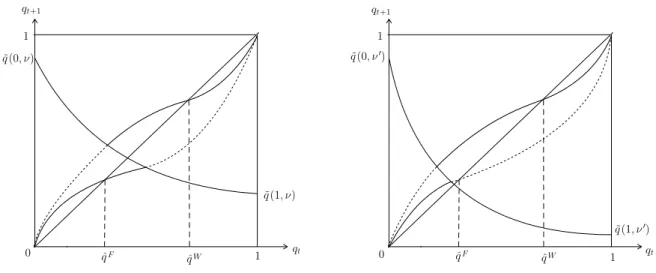
of learning (change of ν). The Figure 7. describes the consequences of an increase in the technological factor from ν to ν0.
For all proportions of autonomous workers, an improvement of the learning process im-plies a decrease of the costs of Workshop organization. Let us start from the equilibrium ˆqF.
As illustrated in Figure 7, if this improvement is large enough, it is sufficient to destabilize the equilibrium ˆqF and to provoke the convergence toward ˆqW.
This modelling gives a better description of the return to a more flexible form of or-ganization during the last decades. Indeed, many innovations associated with the rise of new organizational forms give higher importance to continuous learning and to the worker’s autonomy in the innovative process. For instance, Lindbeck & Snower (2000) insist on the role of the intertask learning. It arises when a worker can use the information and skills acquired at one task to improve his performance and to propose innovations concerning other tasks. This form of learning, allowed by the introduction of robotic and flexible machine tools, may be easier and more spontaneous for autonomous workers. The profitability of the implementation of Information Technologies also rises with the level of workers’ reactivity and adaptability. These technological changes, increasing the role of autonomy in the im-provement of the production process, may induce a shift toward a new situation, according more importance to autonomy.
0 1 qt qt+1 q ˆF 1 q˜(1, ν) q˜(0, ν) qˆW 0 1 qt qt+1 qˆF 1 q˜(0, ν0) qˆW q˜(1, ν0)
Fig. 7. Change in the dynamics of qt following an increase of ν
5
Conclusion
The introduction of an heterogeneity in the workers’ preferences enables us to show how the work organization and the preferences distribution could be co-determined. On the one hand, the proportion of autonomous workers impacts on the relative profitability of different organizational forms and thus on the form chosen by the firms. On the other hand, the work organization determines the reward of autonomy and thus parents’ incentives to transmit this trait. Hence, economic factors, such as the technological level, will determine the long run organizational and cultural structure of a society. For instance, the fall of transport costs and the innovations wave induced by the Industrial Revolution implied both the spread of the Factory and a decrease in autonomy among the workers. Other factors, such as the level of wages or the level of supervision in the Factory, impact on the incentives for parents to transmit autonomy. The combination of both shocks on organizational costs and on wages may induce the phenomenon of path dependency. In particular, the delay in industrialization or in technological change can allow for an easier adoption of organizational innovations. Indeed, in a country where technological progress has not induce the domination of one organizational form, the heterogeneity in preferences of the workers remains relatively high. It is this cultural diversity which make profitable the adoption of new forms of organizations.
Appendix
Proof of Lemma 3.It is easy to see that 0, 1 and ˆqj are solutions of the equation fj(q
t) = qt with j ∈ {W, F }.
We note that dfj(q
t)/dqt|qt=0 = 1 + k∆V¯a(j)>1 and dfj(qt)/dqt|qt=1 = 1 + k∆Va(j) > 1
therefore (0,1) are locally unstable. Moreover, the functions fj(q
t), describing evolution of
qt on the trajectory (j), are continuous and increasing if k is low enough. This implies that
the unique interior solution ˆqj for each trajectory (j) is globally stable.
Proof of Lemma 4.
We check the continuity of f : lim x→˜q−˜εf F(x) = fm(˜q − ˜ε) and lim x→˜q+˜εf W(x) = fm(˜q + ˜ε) By Lemma 3 fF(q
t) and fW(qt) are increasing. Moreover, we have fm(q) = q + q(1 −
q)kR(q), then :
∂fm(q)
∂q = 1 + k(1 − 2q)R(q) + kq(1 − q)R
0(q)
which is positive for low enough k . Then, for low enough k , f (qt) is increasing between 0
and 1.
It is easy to see that 0 and 1 are equilibria of the dynamics qt+1 = f (qt). We check
whether these equilibria are stable :
− if ˜q − ˜ε > 0 : f (0) = fF(0) and, by Lemma 3, 0 is unstable;
− if ˜q − ˜ε ≤ 0 : f (0) = fm(0) and dfm(q)/dq| q=0 = 1+kR(0) = 1+k(D − ¯swF) ¡1 2 + ˜ q 2˜ε ¢ + swW ¡1 2 − ˜ q 2˜ε ¢
> 1 for low enough k ;
− if ˜q + ˜ε < 1 : f (1) = fW(1) and, by Lemma 3, 1 is unstable;
− if ˜q + ˜ε ≥ 1 : f (1) = fm(1) and df (x)/dx| x=1 = 1 − kR(1) = 1 + k(d − swW) ¡1−˜q ˜ ε ¢ + (¯swF − swW) ¡q+˜˜ ε−1 2˜ε ¢
> 1 for low enough k .
Then 0 and 1 are always unstable equilibria of qt+1 = f (qt).
Proof of Proposition 1.
Let us look at the equilibria on the set I =]0, ˜q − ˜ε[∪]˜q + ˜ε, 1[= I1∪ I2. We know that fF
holds on I1 and fW holds on I2. By Lemma 3, If ˜q − ˜ε < ˆqF and ˜q + ˜ε < ˆqW : ˆqW is the
unique steady states of qt+1 = f (qt) on I .
On the interval J = [˜q − ˜ε, ˜q + ˜ε], fm holds. The equation fm(q) = q − q(1 − q)R(q) = q
has for solution 0, 1 and the solutions of the equation R(q) = 0. Moreover, R00(q) = D−2d
˜
ε
then the condition D < 2d ensures the global concavity of R(q). ˜q − ˜ε < ˆqF implies that
R(˜q − ˜ε) > 0 and ˜q + ˜ε < ˆqW implies that R(˜q + ˜ε) > 0. Then, by global concavity of R(q),
the equation R(q) = 0 has no solution.
The results directly follow from the continuity and the increase of f (q) proved in Lemma 4.