December 1987 LIDS-P-1732
A DIAGNOSTICS ALGORITHM
FOR IMPACT PRINTER ACTUATOR
Sheldon X.C. Lou
Laboratory for Information and Decision Systems
Massachusetts Institute of Technology
Cambridge, Massachusetts, U.S.A., 02139
Sherman S. Wang
IBM Research Lab
5600 Cottle Road
1
Introduction
In this paper a new machinery diagnostics algorithm (Failure Projection Technique) has been applied to the failure mode (or, more precisely, pa-rameter change) identification of moving coil actuators of an impact printer system.
The parameters of a printer actuator and the related mechanism con-sist of mass, coil recon-sistance, inductance, spring constants to magnetic flux and current through coil. In practice, it is impossible to monitor all the parameters during the testing processes due to the large amount of sensors required. Furthermore, some parameters are very difficult to measure.
The approach proposed in this paper is based on a system failure de-tection and identification method called Failure Projection Method [1],[2]. It measures only few parameters during some period of time. Based on those observations, it not only detects the possible failures but also identi-fies them. Furthermore, the process is in real time. That is, it detects and identifies parameter changes as soon as they have appeared with no time delay. In this specific application, it observes the current flowing through the coil at discrete time intervals and based on these observations it de-termines which parameters have deviated, if there have been any. More specifically, it forms some vectors based on these observations, projects these vectors onto some subspace, and then investigates the directions of these projections. according to their directions and the amplitudes as well, it can determine the failure categories.
In the next section we will briefly introduce the basic idea about the Failure Projection Method. In Section 3 we describe the use of this method to our printer actuator diagnosis and finally in Section 4 we present some simulation results.
2
Failure Projection Method (FPM)
To introduce the basic idea of the FPM, let us consider a discrete time and time invariant system
x(k + 1) = Ax(k) + Bu(k) (1)
y(k) = Cx(k) (2)
Let us first consider the simpler case where B=O. Thus the system equations can be written as
x(k + 1) = Ax(k) (3)
y(k) = Cx(k)k = 0,1, .... (4) where x(k)ER", y(k)eRm, CeRmXn and ARR"X".
Define the extended observation vector of length p to be
y(k) y(k + 1)
yp
1)
=
pk0,1, ...
(5)
y(k + p-l) Obviously C CA yp(k) = . x(k) (6) CAP-1 Let s=mp. Then p(k)eRs. DefineC
CA
CP= . 8xn (7)
CAP-`
and the observation space (of length p) Zp to be
zp = R(Cp) (8)
where R(Cp) is the range of Cp. Define the detection space (of length p) Gp to be the orthogonal complement of Zp, i.e.
Zp Gp,=R (9)
Zp I Gp (10)
A parameter failure is one that causes parameter changes, e.g. changes in A and/or C. An additive failure is one that creates additive components
in (3) and/or in (4). Consider the projection of the extended observation vector yp(k) on the detection space Gp, PGyp(k). It is not difficult to see that either of these failures will generally result in a nonzero projection PGyp(k). By identifying the direction of the projection in Gp, we not only detect the occurrence of failures but also identify their causes.
The important generalization of this result to systems with parameter uncertainties and noise can be found in [1] and [2] and will be omitted in this paper.
3
Application to printer diagnosis
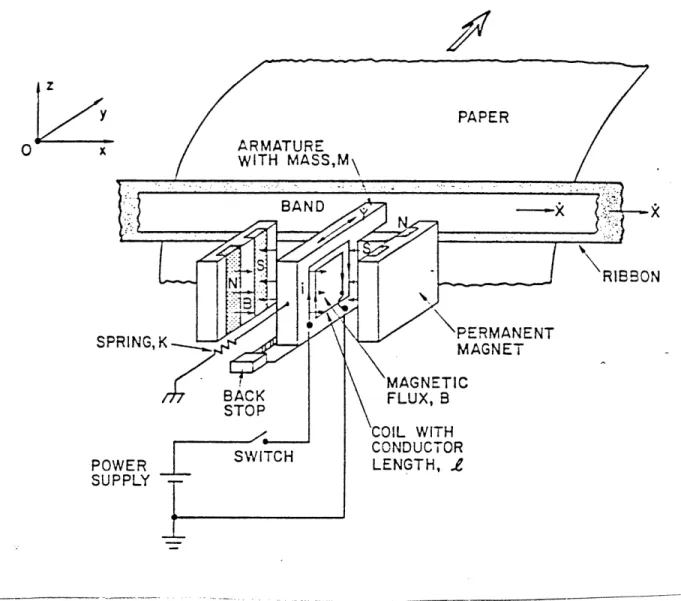
The printer actuator system is shown in 1 [3]. It consists of a permanent magnet, an armature coil, a electromag net, paper, and the backstop. After the switch is closed, a current, i, flows through the coil. The current is determined by the following equation:
V = iR + L di/dt + Bl dx/dt (11) and the motion of the armature is determined by the equation (if we ignore the force applied to the armature by the paper):
md2x/dt2 = Bli - Kx (12)
where V is the voltage applied to the actuator, R is the resistance, L is the inductance, t is the time, B is the magnetic flux generated by the permanent magnets, 1 is the length of each conductor in the coil, x is the armature displacement, m is the mass of the armature and K is the spring constant. The force generated by the electrical and magnetic interaction will cause the actuator to strike a moving print character band and will transfer the ink on the ribbon to the paper. The current is shut off shortly before the impact, and the rebound energy and the spring force will cause the armature to return to the backstop. If we define xl = i, x2 = x and X3 = dx/dt, then Eq. (11) and (12) can be rewritten in matrix form:
x1 -R/L 0 -B1/L xl 1/L
X2 0 0 0 1 x2 + V (13)
x3 Bl/m -K/m 0 x 3
PAPER
x ARMATURE
WITH MASS,M\
SPRING, fK UM,2m4 tXLMAGNET
MAGNETIC BACK B FLUX, B STOP COIL WITH CONDUCTOR POWER LENGTH, S SUPPLY
Figure : Printer Actuator
If we only observe current i, the observation equation can be written as
y = x1 (14)
Combining (13) and (14) we have
x = Ax + Bu (15) y = Cx (16) where -RIL 0 -B1/L A = 0 0 1 (17) Bl/m -K/m 0 and C= [ 0 0] (18)
Discretizing (15) and (16) for some small time interval d we have
x(k + 1) = Ax(k) + Bu(k) (19)
y(k) = Cx(k) (20)
where A=I+Ad and B=Bd. Since here we have a driven term, the formu-lation will be different from the basic equations given in Section 2. Let us define the extended observation vector y(k) as before and let p=4. We have yp(k) = Cpx(k) + Bpup(k) (21) where
yp(k) = [y'(k) y'(k + 1) ... y'(k + 4)]' (22) up(K) = [u'(k) ... u'(k + 3)]' (23)
CA
CP = 4 (24)
and 0 0 0 0 CB 0 0 0 Bp= CAB CB 0 0 (25) CA2B CAB CB 0 CA3B CA2B CAB CB
As in Section 2, the observation space Zp is defined as the range space of C and the detection space G the orthogonal complement of Zp. In this case, the Zp is a 3-D subspace of a 5-D space and G is a 2-D subspace. Therefore, the results of this approach can be easily visualized as we will see in the next section. Since we have an additional driven term in Eq. (19), we have to make some revisions. Define Yp(k) = yp(k) -Bup(k). Then under normal conditions, as before, the projection of Yp onto G will be zero. If there has been some parameter change, then the projection generally will not be zero and its direction in G will be used to identify which parameter has been changed. This can been seen from the numerical results presented in the next section.
4
Numerical results
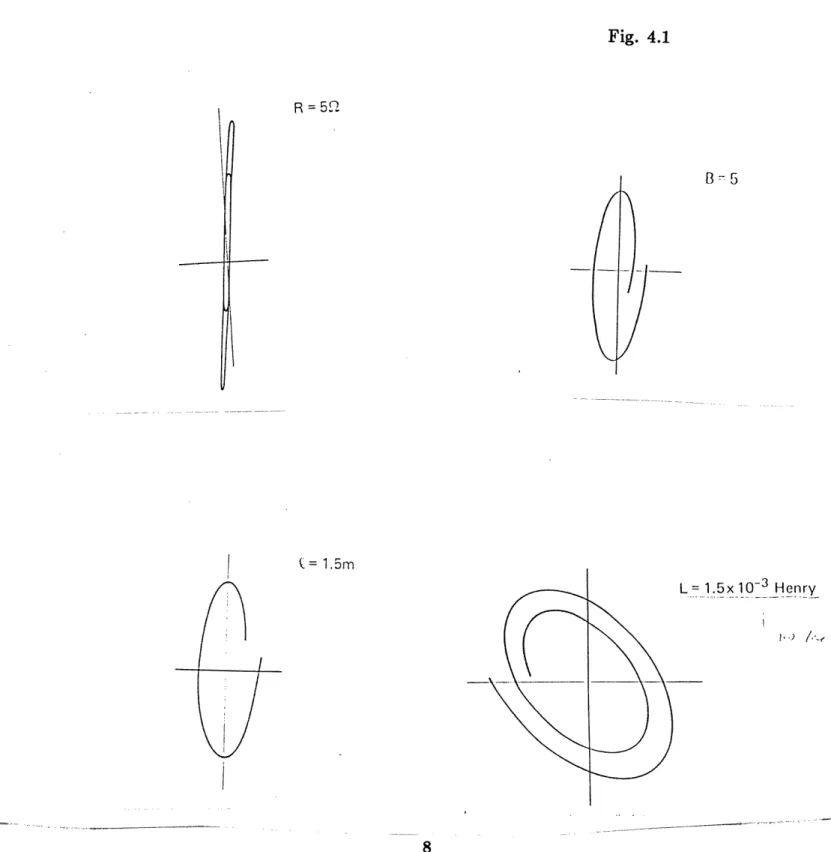
In this example we use the following parameters: R = 11.98 Ohm, L = 0.0028 Henry, M = 0.4x10⁻³ Kg, B = 10.81 Welber, K = 50.02 Newton/m and I = 2.27 meter. Also let d = 5x10- 6 s. Consider a duration of 400x 10-6 second. Using these parameters to compute (15) to (21) and form the subspace Zp and Gp according to (8) and (10). Then we compute the projections of yp (k) on Gp (it is a two-dimensional subspace in this example) for time k = 0, 1,... and for different parameter changes. The results are shown in Fig. 4.1.
Fig. 4.1 R = 5 B:5 = 1.5m L= 1.5x10- 3 Henry L ____~~~~~~~~~~~~~~~~~1~
As seen from Fig.4.1, As long as there is no failure (or parameter change), the projections formed by the observations of the current through the coil remains zero. If there is a parameter change, then the projec-tion will not be zero and its 'center', length and direcprojec-tion varies according to different parameters. Therefore an algorithm such as the one used in computer vision literature can be used to determine the failures.
5
Conclusion
In this paper the Failure Projection Method is used to determine and iden-tify the parameter changes in a printer actuator. The numerical results showed that this approach is very simple and effective. Further work can be in several directions. If the system characteristics, unlike in this exam-ple, are not perfectly known, then the minimax approach described in [2] should be taken. Other possible combinations of p (in this example p=4) and C (in this example C=[1 0 0]) should be considered in order to obtain better identification, i.e. better separation of observations for different pa-rameter changes. If there is noise, the detection and estimation processes should be taken to provide satisfactory results.
REFERENCES
1. S.X.C.Lou, A.Willsky and G. Verghese, Optimally Robust Redun-dency Relations for Failure Detection in Uncertain Systems, Auto-matica, 1986.
2. S.X.C.Lou, A. Willsky and G. Verghese, Failure Detection with Un-certain Models, Proceeding of the American Control Conference, San Francisco, March, 1983.
3. M. S. Jayantha, Feedback Control of Impact Dynamics of Moming Coil Actuator, IBM Research Report, RJ11823, April 9, 1986.