HAL Id: hal-03059672
https://hal.archives-ouvertes.fr/hal-03059672
Submitted on 12 Dec 2020
HAL is a multi-disciplinary open access
archive for the deposit and dissemination of
sci-entific research documents, whether they are
pub-lished or not. The documents may come from
teaching and research institutions in France or
abroad, or from public or private research centers.
L’archive ouverte pluridisciplinaire HAL, est
destinée au dépôt et à la diffusion de documents
scientifiques de niveau recherche, publiés ou non,
émanant des établissements d’enseignement et de
recherche français ou étrangers, des laboratoires
publics ou privés.
Great Efficiency of Nucleosides as Organizing Tools
Sonja Merkaš, Souhaila Bouatra, Régis Rein, Ivo Piantanida, Mladen Žinić,
Nathalie Solladie
To cite this version:
Sonja Merkaš, Souhaila Bouatra, Régis Rein, Ivo Piantanida, Mladen Žinić, et al.. Great Efficiency
of Nucleosides as Organizing Tools. Croatica Chemica Acta - izd. tromjesečno Hrvatsko kemijsko
društvo, Croatian Chemical Society, 2017, 90 (4), �10.5562/cca3247�. �hal-03059672�
This work is licensed under a Creative Commons Attribution 4.0 International License.
Great Efficiency of Nucleosides as Organizing Tools
Sonja Merkaš,1,2 Souhaila Bouatra,1 Régis Rein,1 Ivo Piantanida,2 Mladen Žinić,2 Nathalie Solladié1,*1 CNRS, 205 route de Narbonne, 31077 Toulouse, France; Université de Toulouse, UPS, INPT, 31077 Toulouse, France 2 Laboratory of Supramolecular and Nucleoside Chemistry, Ruđer Bošković Institute, Bijenička c. 54, HR-10000 Zagreb, Croatia
* Corresponding author’s e-mail address: [email protected]
RECEIVED: November 23, 2017 REVISED: February 20, 2018 ACCEPTED: March 26, 2018
THIS PAPER IS DEDICATED TO PROF.MLADEN ŽINIĆ ON THE OCCASION OF HIS 70TH BIRTHDAY
Abstract: Bis-porphyrins with flexible linkers such as uridine or 2’-deoxyuridin pre-organize in a face-to-face conformation and form stable sandwich complexes with bidentate base such as DABCO. The gain in stability can be even greater when a dinucleotide linker is used. Such pre-organization increases the association constant by one to two orders of magnitude when compared to the one of DABCO with a reference porphyrin. Comparison with rigid tweezers shows a better efficiency of nucleosidic dimers. The choice of rigid spacers is not the only way to pre-organize bis-porphyrins, and well-chosen nucleosidic linkers offer an interesting option for the synthesis of such devices.
Keywords: porphyrins, tweezers, nucleosides, molecular recognition.
INTRODUCTION
LABORATION of non-covalent multiporphyrinic assemblies represents an important challenge in relation to the mimicry of bacterial photosynthesis[1] and
the design of functional molecular materials.[2] Axial
coordination to the central metal ions of porphyrins by suitable ligands is an effective and widespread strategy for the assembly of non-covalently bound multi-component systems. Zn(II) derivatives[3–4] have been extensively used
for this purpose and can be found in the literature. For the last few years, we have focused on cofacial bis-porphyrin tweezers by host/guest interactions and in-vestigated the possibility to obtain self-coordinated molec-ular systems with predictable spectral and redox characteristics. We reported a few years ago the synthesis of a bis-porphyrinic tweezers bearing a tris-anthracenic spacers.[5] Specifically, a tris-anthracene spacer was chosen
in order to facilitate a cofacial orientation of the chromo-phores while allowing free rotation around the acetylene axis, thus adjusting the cavity to a large variety of guests. Indeed, this adjustable tweezers is able to complex both small and large bidentate bases, as well as photoactive guests such as bipyridyl-porphyrins.[6]
However, synthesis of rigid tweezers can be long and tedious, especially for the preparation of rigid linkers which may bring solubility and stability problems. As part of our research on arborescent multi-porphyrins with nucleosidic linkers, we noticed that nucleosides seem to generate blocked conformers bringing the porphyrins in a face-to-face orientation.[7] We thus focus on the study of three
bis-porphyrins bearing either uridine or 2’-deoxyuridine derivatives as spacers.[8] They differ by the positions where
the chromophores are attached, either on the ribose or on the nucleic base. We also report the binding studies of these three bis-porphyrinic nucleosides with a bidentate base, DABCO. In two out of three cases, the nucleoside seems to confer sufficient preorganization to the dimers to enhance the association constants, documenting the fact that rigid dimers are not necessary for preorganization, and opening up new routes to the faster synthesis of flexible tweezers capable of complexing guests with a high association constant.
Furthermore, we recently highlighted that the gain in stability and the enhancement of the association constants for the complexation of bidentate base such as DABCO can be even greater when a dinucleotide linker is used. Such pre-organization increases the association
596 S. MERKAS et al.: Great Efficiency of Nucleosides …
Croat. Chem. Acta 2017, 90(4), 595-602 DOI: 10.5562/cca3247
constants by one to two orders of magnitude when compared to the association constants of the same bidentate ligands with a reference Zn(II) porphyrin.
RESULTS AND DISCUSSION
Bis-Porphyrinic Tweezers with a Simple
Nucleosidic Linker
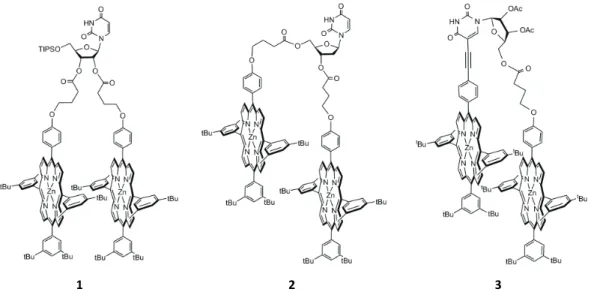
As part of our studies concerning complexation of bidentate Lewis bases by bis-porphyrinic tweezers, we synthesized a few years ago three new bis-porphyrins bearing a flexible nucleosidic linker (1, 2 and 3 in Figure 1).
These dimers differ by the attachment positions of the two porphyrins. For bis-porphyrinic dimers 1 and 2, both
porphyrins are attached to the ribose, in the O-2’ and O-3’ positions of uridine for dimer 1 and in the O-3’ and O-5’
positions of 2’-deoxyuridine for dimer 2.[11] For dimer 2 and
3, the anchoring position of one Zn(II) porphyrin at the O-3’
position of the sugar moiety is conserved, while the second chromophore is attached either at the O-5’ position of the 2’-deoxyuridine for dimer 2 or at the C-5 position of the
nucleic base for dimer 3.
The synthesis of dimers 1, 2 and 3 has already been
described.[8,9] The ability of tweezers 1, 2 and 3 to
accom-modate guests of various size was investigated through binding studies carried out in dichloromethane with DABCO or 4,4’-bipyridine as bidentate bases. The complexations were monitored by UV-visible spectrophotometric titration of a solution of tweezers in CH2Cl2 ([1] = 2.7 × 10⁻⁵ M, [2] =
3.0 × 10⁻⁵ M, [3] = 2.4 × 10⁻⁵ M), which resulted as expected
in a significant red-shift of the Soret and Q bands in the por-phyrin (Figure 2).[10]
The association constants for the formation of the complexes were calculated from UV-visible spectroscopic data. A value of 2.5 × 10⁴ M–1 was found for tweezers 1,
which is similar to the association constant of DABCO with a reference Zn(II) porphyrin 5,10,15,20-tetra-di-tert-butyl-phenyl-porphyrin A4 (2.5 × 10⁴ M–1), thus indicating as
expected that no well-defined pre-organized conformation exists for bis-porphyrin 1. However, much higher binding
constants were found for the formation of host/guest complexes between tweezers 2 and 3 and DABCO. Values
of 6.3 × 10⁵ M–1 and 2.0 × 10⁶ M–1 were found. These
association constants are increased by 1.5 or 2 orders of magnitude as compared to the association constants of the same bidentate ligand with the above cited reference Zn(II)
1 2 3
Figure 1. Three new bis-porphyrins bearing a flexible nucleosidic linker and differing by the attachment positions of the two porphyrins. 480 500 520 540 560 580 600 620 640 660 680 0,0 0,2 0,4 0,6 0,8 1,0 Abs or banc e λ (nm)
Figure 2. UV-Vis spectroscopic titration of dimer 2 with DABCO in CH2Cl2 at rt. Spectral changes of 2 on addition of
DABCO at rt: [2] = 3.10–5 M, concentration ratio [DABCO] / [2] =
DOI: 10.5562/cca3247 Croat. Chem. Acta 2017, 90(4), 595–602 porphyrin. This enhanced stability of the complex may be
ascribed to a pre-organization of the bis-porphyrinic tweezers 2 and 3 forming a cavity and provides convincing
evidence that the bidentate base is inserted into the cavity of both dimers via host/guest interactions. Such results were expected for tweezers 3 since it is known that the
anti-conformation is blocked for uridine in the presence of bulky substituents on the nucleic base, providing more favorable conditions for the second porphyrin to come in a face-to-face orientation. However, no explanation could be found to explain such a high complexing capability of tweezers 2.
The adjustment of the cavity to bidentate guests of various size was investigated for tweezers 2 and 3 through
binding studies realized in dichloromethane between these dimers and 4,4’-bipyridine. The complexations were monitored by UV-visible spectrophotometric titration of a solution of tweezers in CH2Cl2 ([2] = 2.9 × 10⁻⁵ M, [3] =
2.2 × 10⁻⁵ M), which resulted as expected in a significant
red-shift of the Soret and Q bands in the porphyrin.[10] The
association constants for the formation of the complexes were calculated from UV-visible spectroscopic data. Values of 1.3 × 10⁵ M–1 and 3.2 × 10⁵ M–1 were found for tweezers
2 and 3 respectively. These binding constants are increased
by 1 or 1.5 order of magnitude as compared to the association constants of the same bidentate ligand with a reference Zn(II) porphyrin 5,10,15,20-tetra-di-tert-butyl-phenyl-porphyrin A4 (7.9 × 10³ M–1), indicating an enhanced
stability of the complex, which may be ascribed to a pre-organization of the bis-porphyrinic tweezers 2 and 3
forming a cavity. These results document the insertion of the bidentate base into the cavity of the dimers via host/guest interactions, and clearly demonstrate the adjustment of the cavity to the size of the complexed guest.
Rigid Cofacial Bis-Porphyrinic Tweezers
To rationalize the pre-organization of these flexible dimers and their capability to behave as tweezers to complex bi-dentate guests, it is interesting to compare the obtained re-sults with those of a rigid cofacial bis-porphyrinic tweezers
4 we synthesized.[5] More specifically, this rigid dimer was
designed in order to force the cofacial orientation of the porphyrins to create a cavity between the two chromo-phores, thus making them capable of hosting bidentate guests of appropriate size. Poly-anthracenes were chosen as rigid spacer for the construction of this tweezers. The tris-anthracenic spacer used in 4 forces a cofacial
orienta-tion of the chromophores while allowing a free rotaorienta-tion around the acetylenic axis, thus adjusting the cavity size to accommodate a large variety of guests (Figure 3).
The ability of 4 to accommodate various guests was
investigated through binding studies carried out in di-chloromethane with two bidentate bases of different
lengths and pKa values, namely DABCO and 4,4’-bipyridine.[5] In particular, the complexations were
moni-tored by a UV-visible spectrophotometric titration in CH2Cl2. The association constants (Ka) between tweezers 4
and both bases were calculated from the UV-visible spec-troscopic data and values of 3.9 × 10⁵ M–1 and 4.0 × 10⁴ M–1
were found for DABCO and 4,4’-bipyridine respectively. These association constants are increased by one order of magnitude, when compared to the association constant for the binding of the same bidentate ligands with a reference Zn(II) porphyrin 5,10,15,20-tetra-di-tert-butyl-phenyl-por-phyrin A4 (2.5 × 10⁴ M–1 forDABCO and 4.0 × 10³ M–1 for
4,4’-bipyridine), in spite of the difference in sizes of the guests involved in this recognition process (2.7 Å and 7.1 Å respectively) and of the cavity of dimer 4 in its extended
conformation (ca. 15 Å). The enhanced stability of the com-plex is ascribed to the pre-organization of the bis-porphy-rinic tweezers 4. These results provide convincing evidence
of the adjustability of the host’s cavity size to fit the guest to be accommodated.
Rigid or Flexible Bis-Porphyrinic
Tweezers?
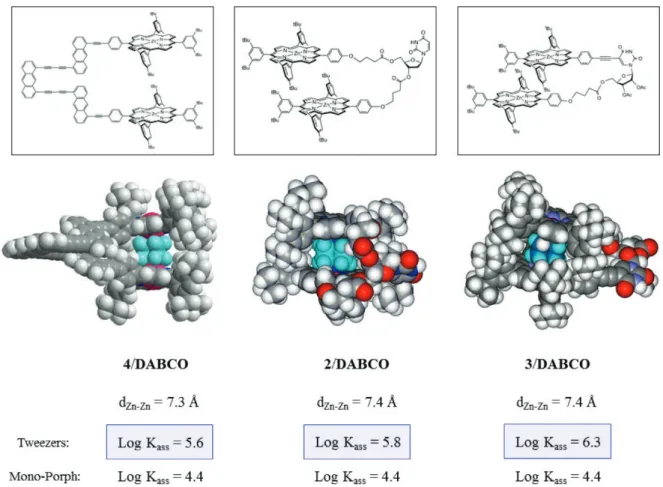
Molecular modeling studies of 4, 2 and 3 and their 1/1
complexes with DABCO were carried out by geometry optimizations using molecular mechanics with the ESFF force field and are represented in Figure 4. In the absence of guest, the center to center distance between the two Zn(II) porphyrins are 15 Å, 6.7 Å and 10.4 Å respectively for dimers 4, 2 and 3. The insertion of DABCO into the cavity
results in a distortion of the molecule, which adopts a conformation with a center to center distance between the chromophores of ∼7.4 Å. However, as mentioned above, one to two orders of magnitude are gained in the association constant documenting the fact that the cavity is
4
Figure 3. Rigid cofacial bis-porphrynic tweezers with tris-anthracenic spacer 4.
598 S. MERKAS et al.: Great Efficiency of Nucleosides …
Croat. Chem. Acta 2017, 90(4), 595-602 DOI: 10.5562/cca3247
flexible enough to adapt to the complexed guest without gaining too much tension energy likely to distabilize the complex. The cavity of dimers 4 and 3 is reduced by 7.6 Å
and 3 Å respectively when forming the complexes, while the cavity of tweezers 3 expands by 0.7 Å upon
complexation of DABCO.
Dinucleotide: Particularly High
Association Constant for the Formation
of a Sandwich Type Molecular Complex
We recently synthesized bis-porphyrinic dimer 5 based on
a di-nulceosidic linker (Figure 5) and studied its complexation capabilities by UV-Vis spectroscopy. The gain in stability for the formation of sandwich type host-guest complex with DABCO can be even greater when a dinucleotide linker is used. Such pre-organization increases the association constants by one to two orders of magnitude when compared to the association constants of the same bidentate ligands with a reference Zn(II) porphyrin. Comparison of these results with those obtained for rigid tweezers 4 shows a better efficiency of the flexible
nucleosidic dimers.
The ability of di-nucleotide 5 to accommodate guests
was investigated through binding studies carried out in dichloromethane with DABCO as bidentate base. As reported in some of our previous publications,[12] it was
assumed that the di-nucleosidic bis-porphyrin could be pre-organized and thus facilitate the coordination of this rigid bifunctional ligand. The synthesized molecular system is amenable to preorganization, because its architecture is based on combination of rigid and flexible linkers. The architecture of multi-porphyrinic systems is important because the covalent connectivity between the interacting centers commands the geometry of resulting assembly and the relative orientation of chromophores dictates the strength of the interaction with ligands. As already noted, the geometry of porphyrins in supramolecular assembly is crucial in design of artificial light-harvesting complexes.[11–29]
Data obtained by UV-visible titrations were analyzed by using the values of the absorbance at fixed wavelengths, which method is exclusively valid for the complexes with stoichiometry 1/1, and by simultaneous fitting of the whole series of spectra collected at 1 nm intervals using the software SPECFIT.[30–34]
Figure 4. Molecular modeling of dimers 4, 2 and 3 and their 1/1 complexes: 4/DABCO, 2/ DABCO, 3/DABCO. The center to
center distance between the two porphyrins is ∼ 7.4 Å in all dimers. Geometry optimizations have been done by molecular mechanics with the ESFF force field using the computer program Spartan.
DOI: 10.5562/cca3247 Croat. Chem. Acta 2017, 90(4), 595–602 After examining the complexation of the simple porphyrin with DABCO, we studied the binding of the same base to dimer 5, the bis-porphyrinic tweezer appended to
an appropriate position of the flexible uridinic scaffold by the rigid acetylene group. The titration of the dimer with DABCO was measured by using the coordination shift of the Soret absorption as well as the Q-bands. The Soret band absorption was measured at the concentration of 1.04 × 10⁻⁶ M which corresponds to an absorbance of 0.95
at 422 nm. The titration was performed in two parts to be analyzed in terms of two-state equilibria. The first part of the titration was processed until 2 equivalents of DABCO were added per porphyrin. The complete titration that involved an addition of DABCO until 6000 equivalents per porphyrin was performed separately, Figure 6.
The clean isosbesticity of spectra obtained in the first part of the titration demonstrates that the only colored 5
Figure 5. Rigid cofacial bis-porphrynic tweezers with tris-anthracenic spacer 5. 400 410 420 430 440 450 0,0 0,2 0,4 0,6 0,8 1,0 1,2 427 nm 422 nm Abs or banc e λ, nm 400 420 440 0,0 0,2 0,4 0,6 0,8 1,0 1,2 427 nm432 nm 422 nm Abs or banc e λ, nm
Figure 6. UV-visible titration of bis-porphyrinic tweezer 5 with DABCO in CH2Cl2 at rt. On the left hand side first part of the
titration and on the right the complete titration.
Figure 7. Representation of the proposed equilibria involved in the binding of DABCO to bis-porphyrinic tweezer 5. For clarity reasons tert-butyls on meso-phenyls are omitted.
600 S. MERKAS et al.: Great Efficiency of Nucleosides …
Croat. Chem. Acta 2017, 90(4), 595-602 DOI: 10.5562/cca3247
species present in solution are free dimer 5 and one type of
its complex with DABCO. The observed spectral changes are quite similar to those obtained in the titration of the monomer. However, there are some minor spectral changes, i.e. smaller red shift of the Soret peak, from 422 to 427 nm, as well as intensified and sharpened form of the titration spectrum. A shift in the Soret band of 5 nm is exactly two times smaller than the shift obtained for the 1/1 monomer/DABCO complex. Accordingly, it was reasonable to anticipate formation of the intramolecular 1/1 sandwich complex. On addition of more DABCO, intensity of the absorption band at 427 nm decreased, and a new absorption band appeared at 432 nm. As observed in the titration spectrum of the monomer, the Soret absorption at 432 nm is typical for the simple 1/1 porphyrin/DABCO complex. On the basis of the changes in absorption spectra, the possible two consecutive two-state equilibria with corresponding stepwise constants in the binding of DABCO to bis-porphyrinic tweezer 5 are shown
in Figure 7.
The first method for calculation of the binding constant by using titration data at selected wavelengths was applied only to the first part of the titration characterized by sharp isosbestic point. This analysis could
be performed because the complexation by 1/1 binding model was envisaged in the first equilibrium. The binding constant for the 1/1 dimer/DABCO complex was found to be 7.4 × 10⁶ M–1 (log K11 = 6.9). The formation of this type
of a complex was verified by analysis of the whole set of spectra which correspond to the first part of the titration by using SPECFIT. The analysis resulted with only one possible 1/1 complex with corresponding binding constant log K11 = 6.42 ± 0.03. It is interesting to note that calculated
log K11 for 1/1 dimer/DABCO complex is more than one
order of magnitude higher than log K11 for 1/1
monomer/DABCO complex. Taken together, these results strongly support formation of 1/1 dimer/DABCO sandwich complex through the chelate effect. The whole spectra obtained by the complete titration was analyzed in terms of three possible colored species: free dimer 5, 1/1
sandwich complex, and 1/2 open complex (Figure 7). Fitting of the titration data revealed that 1/1 and 1/2 binding models for dimer/DABCO are only possible, Figure 8.
Fitting to 1/1 binding isotherm yielded the stoichiometric binding constant log K11= 6.65 ± 0.08, while
the fit to 1/2 binding model provided log K12= 3.21 ± 0.10.
The calculated log K11 is almost identical to log K11 value
obtained in the analysis of the first part of the titration.
0,0 2,0x10-34,0x10-36,0x10-38,0x10-31,0x10-21,2x10-21,4x10-21,6x10-21,8x10⁻² 0,30 0,35 0,40 0,45 0,50 0,55 0,60 0,65 0,70 0,75 0,80 0,85 0,90 0,95 1,00 1,05 1,10 Abs 432 nm c(DABCO), mol dm-3 0,0 2,0x10-34,0x10-36,0x10-38,0x10-31,0x10-21,2x10-21,4x10-21,6x10-21,8x10⁻² 0,1 0,2 0,3 0,4 0,5 0,6 0,7 0,8 0,9 1,0 Abs 422 nm c(DABCO), mol dm-3 0,0 2,0x10-34,0x10-36,0x10-38,0x10-31,0x10-21,2x10-21,4x10-21,6x10-21,8x10⁻² 0,55 0,60 0,65 0,70 0,75 0,80 0,85 0,90 0,95 1,00 1,05 1,10 Abs 427 nm c(DABCO), mol dm-3
Figure 8. UV-visible titration data (change in absorbance at three wavelengths, 422, 427 and 432 nm) for the binding of
DOI: 10.5562/cca3247 Croat. Chem. Acta 2017, 90(4), 595–602 Moreover, calculated log K12 value is three orders of
magnitude lower than log K11 value. Therefore, dissociation
of the more stable chelated 1/1 complex is followed by coordination of second DABCO and by that formation of the 1/2 complex in which two DABCO molecules are coordinated to two porphyrins of the dimer. Both, 1/1 and 1/2 complexes involved in these consecutive two-state equilibria are in agreement with the species represented in Figure 7.
Similar formation of sandwich complexes was evidenced by Sanders, Hunter, Anderson and co-workers.[35–41] These studies show that sandwich complex
formation is in concert with the parallel orientation of two porphyrin macrocycles. In this respect, the shifts in titration spectra are caused by proximity of the porphyrins and in this line increased interporphyrinic electronic interaction. The Soret band of the free dimer 5 has fwhm 15 nm, and
the Soret band of the dimer/DABCO sandwich complex 11 nm. It is believed that this narrowing indicate a significant increase in the center-to-center distance between the two porphyrins, due to the insertion of DABCO into the bis-porphyrinic cavity. This hypothesis is in great agreement with the half width at half maximum of 13 nm for the 1/2 dimer DABCO open complex. The outer coordination of DABCO allows a shorter center-to-center distance between the porphyrins.
These results thus document the fact that the choice of rigid spacers is not the only way to pre-organize bis-porphyrins, and that some well-chosen nucleosidic linkers offer an interesting option for the synthesis of such devices. Furthermore, the chirality and enantio-purity of the nucleosidic linkers paves the way toward the selective complexation of enantio-pure bidentate guests and the resolution of racemates.
SUMMARY
We report herein that flexible linkers such as uridine or 2’-deoxyuridine generate blocked conformers bringing the two porphyrins in a face-to-face position. Bis-porphyrins with flexible linkers such as uridine or 2’-deoxyuridin pre-organize in a face-to-face conformation and form stable sandwich complexes with bidentate base such as DABCO. The gain in stability can be even greater when a dinucleotide linker is used. Such pre-organization increases the association constants by one to two orders of magnitude when compared to the association constants of the same bidentate ligands with a reference Zn(II) porphyrin. Comparison of these results with those obtained for rigid tweezers 4 shows a better efficiency of the flexible
nucleosidic dimers. We thus document the fact that the choice of rigid spacers is not the only way to pre-organize bis-porphyrins, and that some well-chosen nucleosidic
linkers offer an interesting option for the synthesis of such devices. Furthermore, achiral bis-porphyrinic tweezers have already been used for supramolecular chirogenesis. The bulkiness of chiral ligands plays an important role in supramolecular chirality induction by controlling con-formational changes in achiral hosts via steric repulsion, with larger ligands inducing more intense CD signals.[42] For
these reasons, we believe that the chirality and enantio-purity of the nucleosidic linkers of our tweezers could pave the way toward the selective complexation of enantio-pure bidentate guests and the resolution of racemates. Acknowledgment. This work was supported by the CNRS and the French Ministry of Research. We also thank the French Government for a grant to Sonja Merkas for her PhD.
REFERENCES
[1] a) O. Shoji, S. Okada, A. Satake, Y. Kobuke, J. Am.
Chem. Soc. 2005, 127, 2201; b) R. Takahashi, Y.
Kobuke, J. Am. Chem. Soc. 2003, 125, 2372; c) Y.
Kuroda, K. Sugou, K. Sasaki, J. Am. Chem. Soc. 2000,
122, 7833; d) R. A. Haycock, A. Yartsev, U. Michelsen, V. Sundström, C. A. Hunter, Angew. Chem. Int. Ed.
2000, 39, 3616; e) T. Hayashi, H. Ogoshi, Chem. Soc.
Rev. 1997, 26, 355.
[2] a) H. L. Anderson, Chem. Commun. 1999, 0, 2323; b)
C. M. Drain, J. T. Hupp, K. S. Suslick, M. R. Wasielewski, X. Chen, J. Porphyrins Phthalocyanines
2002, 6, 243.
[3] a) Y. Kuramochi, A. S. D. Sandanayaka, A. Satake, Y. Araki, K. Ogawa, O. Ito, Y. Kobuke, Chem. Eur. J.
2009, 15, 2317; b) Y. Kuramochi, Y. Kawakami, A.
Satake, Inorg. Chem. 2017, 56, 11008.
[4] a) C. Roche, Q. Luo, G. Gil-Ramirez, H. W. Jiang, D. R. Kohn, Y. Xiong, A. L. Thompson, H. L. Anderson, J.
Org. Chem. 2017, 82, 7446; b) M. Rickhaus, J. A.
Vargas, L. Tejerina, I. Grubner, M. Jirasek, T. D. W. Claridge, H. L. Anderson, J. Am. Chem. Soc. 2017,
139, 16502; c) S. Brittle, T. H. Richardson, A. D. F. Dunbar, S. Turega, C. A. Hunter, J. Phys. Chem. B.
2008, 112, 11278; d) C. A. Hunter, C. M. R. Low, M. J.
Packer, S. E. Spey, J. G. Vinter, M. O. Vysotsky, C. Zonta, Angew. Chem. Int. Ed. Engl. 2001, 40, 2678; e)
K. Ogawa, Y. Kobuke, Angew. Chem . Int. Ed. Engl.
2000, 39, 4070.
[5] R. Rein, M. Gross, N. Solladié, Chem. Commun. 2004,
0, 1992.
[6] L. Flamigni, A. M. Talarico, B. Ventura, R. Rein, N. Solladié, Chemistry A Eur. J. 2006, 12, 701.
[7] L. Flamigni, A. M. Talarico, B. Ventura, G. Marconi, C. Sooambar, N. Solladié, Eur. J. Inorg. Chem. 2004,
602 S. MERKAS et al.: Great Efficiency of Nucleosides …
Croat. Chem. Acta 2017, 90(4), 595-602 DOI: 10.5562/cca3247
[8] N. Solladié, S. Bouatra, S. Merkas, R. Rein, R. Roeser,
J. Porphyrins Phtalocyanines 2005, 9, 779.
[9] N. Solladié, F. Aziat, S. Bouatra, R. Rein, J. Porphyrins
Phtalocyanines 2008, 12, 1250.
[10] a) C. A. Hunter, L. D: Sarson, Angew. Chem. Int. Ed.
Engl. 1994, 33, 2313; b) X. Chi, A. Guerin, J. R. A.
Haycock, C. A. Hunter, L. D. Sarson, J. Chem. Soc.
Chem. Commun. 1995, 2567; c) C. A. Hunter, R. K.
Hyde, Angew. Chem. Int. Ed. Engl. 1996, 35, 1936; d)
C. A. Hunter, R. J. Shannon, J. Chem. Soc. Chem.
Commun. 1996, 11, 1361; e) C. C. Mak, N. Bampos, J.
M. K. Sanders, Angew. Chem. Int. Ed. Engl. 1998, 37,
3020; f) N. Armaroli, F. Diederich, L. Echegoyen, T. Habicher, L. Flamigni, G. Marconi, J.-F. Nierengarten,
New J. Chem. 1999, 23, 77.
[11] S. Fukuzumi, K. Saito, K. Ohkubo, V. Troiani, H. Qiu, S. Gadde, F. D'Souza, N. Solladié, Phys. Chem. Chem.
Phys. 2011, 13, 17019.
[12] J. J. Piet, P. N. Taylor, H. L. Anderson, A. Osuka, J. M. Warman, J. Am. Chem. Soc. 2000, 122, 1749.
[13] A. Satake, Y. Kobuke, Tetrahedron 2005, 61, 13. [14] M. Choi, T. Yamazaki, I. Yamazaki, T. Aida, Angew.
Chem. Int. Ed. 2004, 43, 150.
[15] K. Tomizaki, L. Yu, L. Wei, D. F. Bocian, J. S. Lindsey,
J. Org. Chem. 2003, 68, 8199.
[16] I. W. Hwang, T. Kamada, T. K. Ahn, D. M. Ko, T. Nakamura, A. Tsuda, A. Osuka, D. Kim, J. Am. Chem.
Soc. 2004, 126, 16187.
[17] C. C.Mak, N. Bampos, S. L. Darling, M. Montalti, L. Prodi, J. K. M. Sanders, J. Org. Chem. 2001, 66, 4476.
[18] R. A. Haycock, A. Yartsev, U. Michelsen, V. Sundström, C. A. Hunter, Angew. Chem. Int. Ed.
2000, 39, 3616.
[19] J. Bretar, J.-P. Gieselbrecht, M. Gross, N. Solladié,
Chem. Commun. 2001, 733.
[20] R. Rein, M. Gross, N. Solladié, Chem. Commun. 2004, 1992.
[21] L. Flamigni, A. M. Talarico, B. Ventura, R. Rein, N. Solladié, Chem. Eur. J. 2006, 12, 701.
[22] C. Ikeda, Y. Tanaka, T. Fujihara, Y, Ishii, T. Ushiyama, K. Yamamoto, N. Yoshioka, H. Inoue, Inorg. Chem.
2001, 40, 3395.
[23] C. Ikeda, A. Satake, Y. Kobuke, Org. Lett. 2003, 5, 4935.
[24] K. Kameyama, A. Satake, Y. Kobuke, Tetrahedon Lett.
2004, 45, 7617.
[25] M. Schmittel, R. S. K. Kishore, Org. Lett. 2004, 6, 1923.
[26] T. S. Balaban, R. Goddard, M. Linke-Schaetzel, J.-M. Lehn, J. Am. Chem. Soc. 2003, 125, 4233.
[27] E. Iengo, E. Zangrando, E. Alessio, Eur. J. Inorg. Chem.
2003, 13, 2371.
[28] E. Iengo, E. Zangrando, E. Alessio, J.-C. Chambron, V. Heitz, L. Flamigni, J.-P. Sauvage, Chem. Eur. J. 2003,
9, 5879.
[29] K. Sugou, K. Sasaki, K. Kitajima, T. Iwaki, Y. Kuroda, J.
Am. Chem. Soc. 2002, 124, 1182.
[30] SPECFIT; Global Least Squares fitting by Factor Analysis and Marquart Minimization.
[31] H. Gampp, M. Maeder, C. J. Meyer, A. D. Zuberbühler, Talanta 1986, 33, 943.
[32] H. Gampp, M. Maeder, C. J. Meyer, A. D. Zuberbühler, Talanta 1985, 32, 95.
[33] C. C. Mak, N. Bampos, J. K. M. Sanders, Angew.
Chem. Int. Ed. 1998, 37, 3020.
[34] P. Ballester, A. Costa, A. M. Castilla, P. M. Deyà, A. Frontera, R. M. Gomila, C. A. Hunter, Chem. Eur. J.
2005, 11, 2196.
[35] C. A. Hunter, M. N. Meah, J. K. M. Sanders, J. Am.
Chem. Soc. 1990, 112, 5773.
[36] H. L. Anderson, C. A. Hunter, M. N. Meah, J. K. M. Sanders, J. Am. Chem. Soc. 1990, 112, 5780.
[37] H. J. Kim, N. Bampos, J. K. M. Sanders, J. Am. Chem.
Soc. 1999, 121, 8120.
[38] C. A. Hunter, R. Tregonning, Tetrahedron 2002, 58, 691.
[39] C .C. Mak, D. Pomeranc, M. Montelti, L. Prodi, J. K. M. Sanders, Chem. Commun. 1999, 1083.
[40] G. S. Wilson, H. L. Anderson, Chem. Commun. 1999, 16, 1539.
[41] L. Baldini, P. Ballester, A. Casnati, R. M. Gomila, C. A. Hunter, F. Sansone, R. Ungaro, J. Am. Chem. Soc.
2003, 125, 14181.
[42] a) V. V. Borovkov, Symmetry 2014, 6, 256; b) V. V. Borovkov, J. M. Lintuluoto, Y. Inoue, Org. Lett. 2000,
2, 1565; c) X. Huang, B. Borhan, B. H. Rickman, K. Nakanishi, N. Berova, Chem. Eur. J. 2000, 6, 216.