The Journal of Heredity 73: 413-420. 1982.
Argenteum (Arg) mutant of Pisum
Genetic control and breeding behavior
G. A. Marx
ABSTRACT: Pea plants bearing the dominant gene argenteum (/Arg) have gray-green, sil-very foliage that contrasts sharply with the green of normal (arg) plants. The mutant pheno-type results from extensive air spaces beneath the leaf epidermis. Arg segregates in a Mendeiian manner and Is linked with PI and other markers on chromosome 6. The pheno-type, however, is not completely stable. Instability is marked by variegation—irregular patches of green tissue—and by distorted segregation ratios. Distorted ratios result from a higher than expected number of green offspring, the excess being attributable to plants that mimic those produced by Mendeiian segregation but originating in a non-Mendelian manner. The marker, PI, aids in distinguishing such green plants, designated "arg", from normal arg/arg segregants. Green "arg" plants also may descend directly from Arg/Arg plants. Arg/Arg plants that are variegated In the reproductive region produce more "arg" offspring than those that are variegated In the vegetative region only, or those that are not variegated (visually) at all. Once the Arg phenotype is converted to "arg" the latter is in-herited as monogenic recessive. Phenotypic Instability could not be satisfactorily ex-plained by any of the mechanisms Investigated, including nuclear/cytoplasm interaction and modifier gene action. An hypothesis Invoking high mutability would require simulta-neous or sequential mutation at both Argalleles of Arg/Arg plants. Moreover, since "arg" plants can be induced to develop a near-mutant phenotype upon exposure to high growth temperature, this Implies that "arg" Is not a back mutation to arg. Thus, the distinction be-tween tissue specific gene action and gene change Is still unclear.
The author is professor in the Department of Seed and Vegetable Sciences, New York State Agricultural Experiment Station, Cornell University, Geneva, NY 14456. Thanks are due to L. G. Cniger, Plant Breeding Supervisor for the Del Monte Corp., San Leandro, CA, for providing the original seed of the Argenteum mu-tant The valuable counsel of Charlotte S. Pratt during the course of this study ii gratefully acknowledged. © 1982, American Genetic Association.
T H E A R G E N T E U M (Arg) mutant of the
gar-den pea {Pisum sativum L.), first isolated by L. G. Cruger, has distinctive phenotypic and histological features4 as well as an unusual breeding behavior9. Mutant plants have a conspicuous gray-green, silvery cast that is evident from the early seedling stage until senescence. There are no other obvious dif-ferences between mutant and normal plants, and the fecundity of both phenotypes appears equal. Hoch et al.4 ascribed the mutant phe-notype to the presence of extensive air spaces underlying the epidermal layers of the leaflets. The epidermis of Arg plants is weakly at-tached, allowing it to be peeled in large sheets from the adaxial and abaxial ieaf surfaces with little or no tearing of the subjacent cell layers. The mutant therefore may play a useful role in certain physiological studies, such as those involving stomatal behavior5, where a single intact layer of cells is desired.
Sporadically, Arg plants become variegat-ed, exhibiting a highly irregular mix of mutant (gray-green) and normal (green) tissue.
Variegation, in turn, evidently is associated with anomalous breeding behavior. Although examples of variegation abound3-6, the specific type of variegation in the Arg mutant is un-common and its nature is still enigmatic. Pearson12 discussed several examples of phe-notypic instability in plants and considered various mechanisms that might account for such behavior.
Evidence presented here shows that the argenteum phenotype is transmitted in a Mendeiian manner. The phenotypic instability • that characterizes this mutant, as well as the results of attempts to probe the nature of the phenomenon, are described.
Materials and Methods
Experimental plants were cultivated in the field, greenhouse, and in growth chambers, [n the field, seed were planted about 7 cm apart in rows and the plants were supported by wire trellises, permitting the plants to be examined and scored on an individual basis. Mature, dry
seed was harvested, identified, and handled on a single-plant basis.
In the greenhouse, plants were grown indi-vidually in 1-quart plastic pots filled with Cornell Mix1; they were watered, fertilized, and trained according to procedures that as-sured good growth. Some plant populations also were grown in flats (63 plants per flat) containing builders' or quartz sand after which some individual plants were transplanted to pots and grown to maturity. Greenhouse controls were set to achieve temperatures of 20°C day/15°C night. Natural daylength was supplemented to 16 hours by light from VHO fluorescent tubes and 200 watt incandescent bulbs.
In exploratory experiments conducted to test the influence of growth environment on phenotypic stability, greenhouse conditions were used to provide near-optimal growth environment while growth cabinets were used to provide conditions approaching the upper and lower limits for satisfactory growth. Two growth cabinets were maintained at 10°C constant and two at 30°C constant. One of the two cabinets at each temperature regime was set to provide high (ca. 95 percent) and the other low (ca. 50 percent) relative humidity. Constant light was provided in each cabinet by fluorescent tubes and incandescent bulbs, giving a photosynthetic photon flux density of ca. 200 E m "2 s~' as measured by a LI-COR Quantum meter. Two different lines were exposed simultaneously to these conditions. An Fj homozygous for Arg and PI and pre-sumed to be stable for mutant expression was planted in 10 greenhouse flats, two flats for each environment. Plants were examined for frequency and degree of variegation and for overall phenotypic expression. The second line, an F5, descended from a single Pl/Pl F4 plant exhibited a normal (green) phenotype but with moderate flecking. Seed were planted in 1-quart plastic pots filled with 1-quartz sand, three seed per pot and six pots per environmental regime. The plants were fertilized about every 10 days with soluble fertilizer.
Results and Discussion
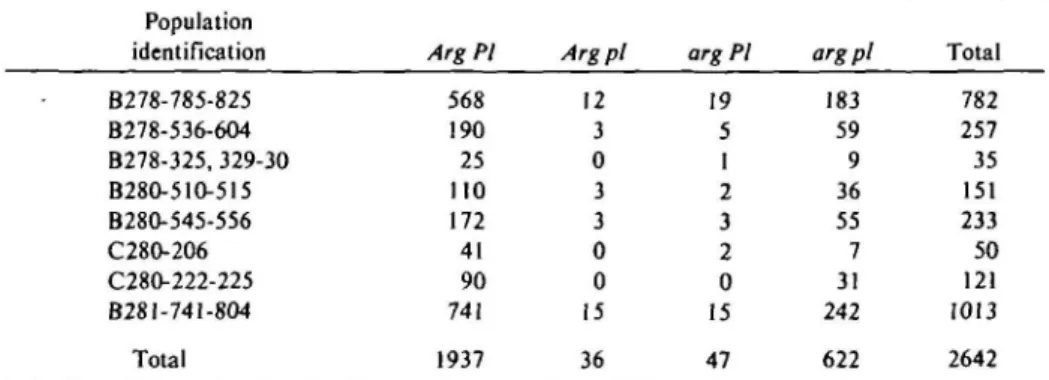
Generally, F| plants from reciprocal crosses between normal green (nonmutant) and gray-green plants were gray-green (mutant). The F2 populations typically consisted of two discrete classes (Figure 1), with segregation ratios conforming to that expected for mono-genic control (Table I). Table I also reveals a close linkage (3-4 percent) between Arg and PI, a dominant marker located on chromo-some 6. The seed of PI plants have a jet black hilum, whereas the hila of normal (pl/pl) seed are unpigmented14. Since PI affects the
ma-FIGURE 1 Gray-green (Argj-) and normal green {arg/arg) seedlings in a segregating population.
ternal tissue of the seedcoat, hilum color seg-regates on a plant-to-plant basis. Other markers on chromosome 6 have been shown to be linked with Arg'0. In the course of
gath-ering these routine early Findings—indicating that the argenteum phenotype is coded by a single dominant nuclear gene residing on
chromosome 6—evidence of exceptional breeding behavior began to accumulate.
Some Arg progenies contained plants with variegated foliage, i.e., leaflets and stipules with irregular patches or sectors of nonmutant (normal green) tissue on otherwise mutant plants. The amount and distribution of such
Table I. Joint segregation of Arg and PI in F2 populations from 8 coupling phase crosses*
Population identification B278-785-825 B278-536-6O4 B278-325, 329-30 B28O-51O-515 B28O-545-556 C28O-2O6 C28O-222-225 B281-741-804 Total Arg PI 568 190 25 110 172 41 90 741 1937 Arg pi 12 3 0 3 3 0 0 15 36 arg PI 19 5 I 2 3 2 0 15 47 arg pi 183 59 9 36 55 7 31 242 622 Total 782 257 35 151 233 50 121 1013 2642 • With one exception all chi-squares for single-gene segregation were nonsignificant at P >» 0.05 (PI-pl segre-gation in population C28O-2O6 was significant at P =» 0.05 but not at P m 0.01). All contingency chi-squares for
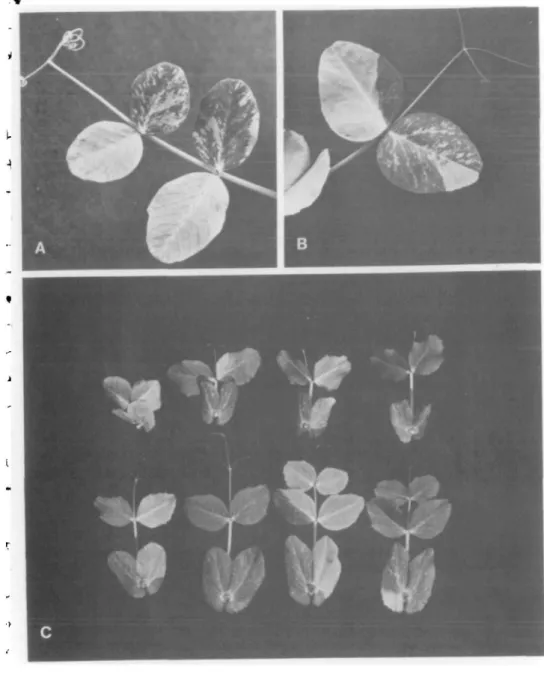
FIGURE 2 A and B show leaves of different variegated Arg plants illustrating absence of fixed pattern. C—eight leaves were removed in order of maturity from the same variegated Arg plant, with the first formed leaf at top left and last formed leaf at bottom right. Note intervening green (or nearly green) leaves between leaves exhibiting mutant tissue.
patches varied widely from plant to plant and from leaf to leaf on a given plant (Figure 2). The number of variegated Arg plants in any given progeny also varied greatly, from none to all. Variegation has been observed in diverse growth environments, in nonsegregating as well as segregating populations, and in every generation examined from Fi through Fg (Table II). Green tissue sometimes extended into and included part or all of the pod-bearing region of mutant plants. Occasionally, there was a wholesale conversion of mutant to non-mutant tissue in the early seedling stage so that all the tissue above the first few nodes was green. This irregular, seemingly random, patchwork of mutant and nonmutant tissue
resembles many types of chlorophyll varie-gation6 except that in this case there is no chlorotic tissue, and it is the mutant phenotype rather than the normal that exhibits the var-iegation.
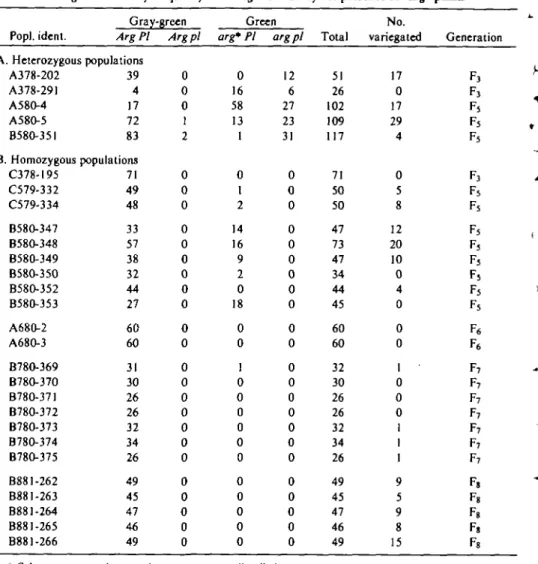
Mutant plants were, with rare exceptions, readily distinguishable from normal green plants, even if the former were highly varie-gated. Whereas most heterozygous gray-green r plants (Arg/arg) produced progenies in which the number of gray-green and green progeny fit Mendelian expectation, some populations had significantly more green plants than ex-pected (Table II, pops. A378-291, A580-4, A58O-5). Since all the green plants in such progenies were phenotypically alike, their
origin could not be determined on the basis of phenotype alone. But, by monitoring the marker gene (PI) in populations segregating simultaneously for PI and Arg, it was possible to ascertain (except for rare crossover plants) whether a particular nonmutant (green) plant owed its phenotype to normal Mendelian segregation at the Arg locus, or to some ex-traneous cause. The symbol "arg" hereafter is applied to green plants that mimic true arg segregants but whose origin was presumed to be non-Mendelian or spurious. Like genuine arg segregants, "arg" plants consistently bred true for the green phenotype.
In some instances "arg" plants also ap-peared in the Fi generation of crosses between gray-green and green plants. The initial crosses involving the original mutant line from Cruger provided the most extreme example of this. Among 31 Fi plants grown, 16 were gray-green and 15 were green, a result from which it was incorrectly surmised that the original line was heterozygous (Arg/arg) when in fact later evidence showed it to be'homozy-gous dominant. In instances where the mutant parent of crosses was indeed heterozygous (Arg/arg), the "arg" plants in the F| genera-tion could be distinguished from the true Mendelian segregants by means of the marker gene, PI, just as in the F2 populations (Table III).
Occasionally, the leaves of "arg" plants displayed somewhat more flecking than usual. Recking (whitish marbling of the leaves) is common even in normal (arg/arg) peas; it varies from line to line and is controlled by the dominant gene FI13, which is closely linked
with PI on chromosome 67. The flecking as-sociated with FI has been attributed to pockets of air space beneath the epidermal layers of leaflets and stipules2. Possibly, the phenotype caused by Arg is a magnified expression of that caused by FI; Arg and FI therefore may be allcles of the same locus. Allelism tests are in progress but the task is not straightforward. The Arg phenotype masks both the FI and/7 phenotypes, and the unpredictable occurrence of "arg" segregants confuses matters fur-ther.
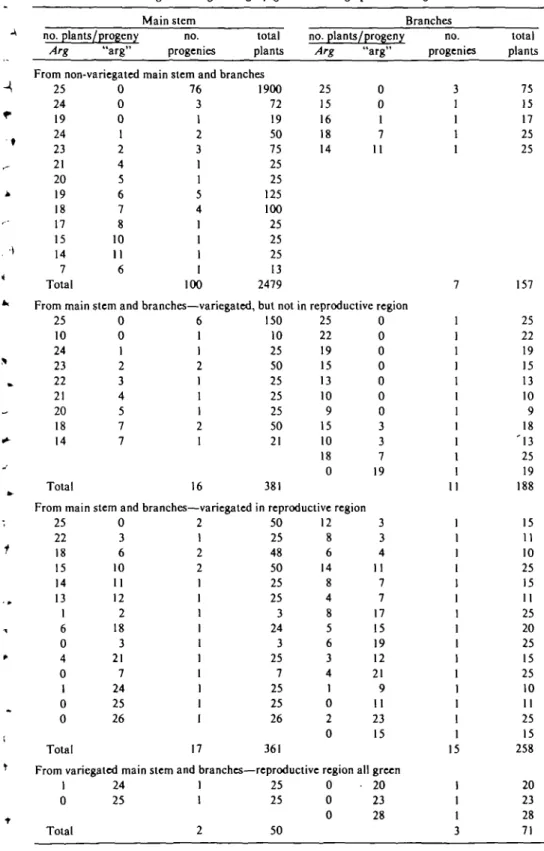
The two manifestations of phenotypic in-stability in Arg populations, viz., variegation on the one hand and anomalous breeding be-havior characterized by the presence of "arg" plants on the other, appear to be causally connected. This is best shown in populations descending from mutant plants homozygous for Arg inasmuch as ArgJArg plants may be the immediate progenitors of green plants (Tables II and IV). Progenies derived from nonvariegated mutant plants generally pro-duced far fewer "arg" plants than did those from variegated plants (Table IV). Also, seed
collected from mutant plants in which the main stem was nonvariegated produced progeny with fewer "arg" plants than seed collected from variegated branches of the same plant (data not shown). Furthermore, the number of green progeny produced by a homozygous Arg plant appeared to be condi-tional upon the extent to which its reproduc-tive portion was invaded by variegated tissue (Table IV); more "arg" plants occurred in progenies derived from variegated plants in which the variegation extended into the re-productive portion of the plant than those in which no such encroachment was noted. Mu-tant plants in which the entire reproductive region was converted to green typically pro-duced progeny that were either all "arg" or nearly so. These relationships were not without exception, however. At one extreme, some variegated plants produced progeny all of which were gray-green. Conversely, about 6 percent of the progeny of mutant plants clas-sified as nonvariegated were "arg". These exceptions may trace in part to the fact that the distribution of green tissue on variegated mutant plants was subjectively determined. Plants were assigned into the broad categories shown in Table IV on the basis of visual ex-amination only.
If green tissue must indeed invade the re-productive portion of a mutant plant in order for that plant to produce green plants in its progeny, then presumably the variegated tis-sue that does not involve the reproductive portion could become isolated and hence not contribute to the production of "arg" plants. Such isolation might result, for example, from the sorting out of causal determinants in a manner akin to the sorting out of chloroplasts in plants exhibiting chlorophyll variegation. However, the reproductive region of a mutant plant may contain so few cells of one tissue type or the other that the differences cannot be detected. Tissue that might appear to be homogeneous or effectively isolated from the reproductive region might in fact be composed of two cell types. Nor was it uncommon for patches of green tissue on variegated mutant plants to be separated by several intervening leaves that were entirely gray-green (Figure 2). Therefore, several architectural features of peas, viz., distichous leaf arrangement, trilacunar nodal anatomy, and the presence of marginal leaf meristems", would allow for unpredictable distributions of mutant and nonmutant tissue. Changes are possible at any one of several meristematic sites.
The strong correlative evidence notwith-standing, variegation may not be a precondi-tion for the producprecondi-tion of "arg" plants, but instead may be an independent manifestation of phenotypic instability. Even if variegation
is a precondition, it is possible that variegation per se rather than variegation in the repro-ductive region determines the production and frequency of "arg" plants in the ensuing gen-eration. Whatever its mode of origin,
phe-notypic instability of the character appears to be unidirectional, i.e., from gray-green to green. The phenotypes associated with Arg and "arg" are transmitted through pollen and egg alike.
Table II. Distribution of phenotypes in different generations in populations heterosygous (A) and bomozygous (B) for Arg and PI, each population being derived from single plants in the previous generation. Populations were selected to illustrate phenotypic stability and instability, instability
being evidenced by frequency of variegation and by the presence of "arg" plants
Popl. ident. Gray Arg PI A. Heterozygous populations A378-202 A378-291 A580-4 A580-5 B58O-35I B. Homozygous C378-195 C579-332 C579-334 B58O-347 B58O-348 B580-349 B580-350 B58O-352 B580-353 A68O-2 A68O-3 B78O-369 B78O-37O , B78O-371 B78O-372 B78O-373 B78O-374 B78O-375 B881-262 B881-263 B881-264 B881-265 B881-266 39 4 17 72 83 populations 71 49 48 33 57 38 32 44 27 60 60 31 30 26 26 32 34 26 49 45 47 46 49 -green Arg pi 0 0 0 1 2 0 0 0 0 0 0 0 0 0 0 0 0 0 0 0 0 0 0 0 0 0 0 0 Green arg* PI 0 16 58 13 1 0 1 2 14 16 9 2 0 18 0 0 1 0 0 0 0 0 0 0 0 0 0 0 arg pi 12 6 27 23 31 0 0 0 0 0 0 0 0 0 0 0 0 0 0 0 0 0 0 0 0 0 0 0 Total 51 26 102 109 117 71 50 50 47 73 47 34 44 45 60 60 32 30 26 26 32 34 26 49 45 47 46 49 No. variegated 17 0 17 29 4 0 5 8 12 20 10 0 4 0 0 0 1 0 0 0 1 1 1 9 5 9 8 15 Generation F j FJ F5 Fs Fs F j Fs Fs Fs F3 Fs Fs Fs Fs F6 F6 F7 F7 F7 F7 F7 F7 F7 F, F8 Fs Fs 1 Column may contain normal arg segregants or "arg" plants
Table III. Distribution of phenotypes in Fi plants derived from 37 reciprocal crosses between normal green (arg/arg) plants with colorless hila (pl/pt) and various gray-green (Arg/-PI/-) Fj
segregants from a previous cross Phenotype of
female parent Gray-green (Arg/-)
Black hila (PI/-) Normal green Colorless hila (pl/pl) Total No. crosses 15 22 Gray-green Arg PI 28 43 71 foliage Arg pi 0 1 1 Green foliage arg* PI 8 11 19 arg pi 17 57 74 Total 53 112 165 • Column may contain normal arg segregants or "arg" plants, the latter being of spurious origin
Environmental influence on mutant
expression
Growth environment (mainly temperature) had a marked effect on the phenotypic
ex-pression of mutant plants. The leaves of Arg plants grown at high (ca. 30°C) temperature were strongly crinkled or buckled especially at low relative humidity; crinkling also
oc-Table IV. Distribution of phenotypes in Fg progenies derived from individual Fj plants that were homozygou* dominant for Arg and PI. F5 plants were scored for presence OT absence of variegation;
variegated individuals were divided into categories based on location of involvement. Fg plants designated Arg were gray-green and "arg" plants were green
Main stem no. plants/progeny no.
Arg "arg" progenies
total plants From non-variegated main stem and branches
25 24 19 24 23 21 20 19 18 17 15 14 7 Total 0 0 0 1 2 4 5 6 7 8 10 11 6 76 3 1 2 3 1 1 5 4 1 1 1 I 100 1900 72 19 50 75 25 25 125 100 25 25 25 13 2479 From main stem and branches—variegated, but not
25 10 24 23 22 21 20 18 14 Total 0 0 1 2 3 4 5 7 7 6 1 1 2 1 1 1 2 1 16 150 10 25 50 25 25 25 50 21 381 no. plants/progen) Arg 25 15 16 18 14 "arg" 0 0 1 7 11 Branches no. progenies 3 1 1 1 1 7 n reproductive region 25 22 19 15 13 10 9 15 10 18 0 0 0 0 0 0 0 0 3 3 7 19
From main stem and branches—variegated in reproductive region 25 22 18 15 14 13 1 6 0 4 0 1 0 0 Total 0 3 6 10 11 12 2 18 3 21 7 24 25 26 2 1 2 2 1 17 50 25 48 50 25 25 3 24 3 25 7 25 25 26 361 12 8 6 14 8 4 8 5 6 3 4 1 0 2 0 From variegated main stem and branches—reproductive region
1 0 Total 24 25 1 1 2 25 25 50 0 0 0 3 3 4 11 7 7 17 15 19 12 21 9 11 23 15 all green 20 23 28 1 1 1 1 1 1 1 1 1 1 1 1 1 15 1 1 1 3 total plants 75 15 17 25 25 157 25 22 19 15 13 10 9 18 ' 1 3 25 19 188 15 11 10 25 15 11 25 20 25 15 25 10 11 25 15 258 20 23 28 71
curred under greenhouse conditions but to a less striking degree. In some leaves the buck-ling was so pronounced that epidermal bridges spanned the undulations in the lamina. Little or no buckling of the lamina occurred in the green, nonmutant sectors of variegated Arg plants, nor in the leaves of normal green (arg) control plants. This suggests that the dynamics of cell expansion in mutant tissue is different from that in normal (arg) tissue but that "arg" tissue is similar to arg in this respect.
At the low (10°C) growth temperature the characteristic silvery gray-green cast of mu-tant plants was much less pronounced (more green in hue) than at the high and normal temperature regimes. Crinkling was absent in plants grown at low temperature.
Plants of a selected "arg" line were exposed to the same range of conditions as above in an attempt to induce or restore the mutant phe-notype. Although phenotypically nonmutant (green), the "arg" line was regarded as pos-sibly genotypically mutant (Arg) because it was a product of non-Mendelian inheritance and because it was rather strongly flecked as well as homozygous for PI. Whereas no phe-notypic changes were evident under the nor-mal and low temperature regimes, plants ex-posed to high temperature and high relative humidity assumed in large part the charac-teristic gray-green cast of the mutant pheno-type (Figure 3). These results were verified in repeat experiments. The treatment had no noticeable effect on control plants (arg, Fl).
Inferences concerning the basis of
phenotypic instability
Although this investigation has not yielded an explanation for the variegation and erratic breeding behavior of the Arg mutant, some partial insights may be drawn from the fol-lowing considerations and observations.
Variegation in relation to fertility. The
original Arg line obtained from Cruger showed reduced seed set. Changes in chro-mosome structure constitute a potential cause of reduced fertility and such changes are known to be associated with certain kinds of variegation8. Although fertility itself was not examined in detail, numerous fully fertile Arg lines were selected in the course of these studies. If a relationship between fertility and variegation in Arg plants does exist, then it was not apparent in the comparatively large number of lines observed thus far. The regular behavior of the marker gene, PI, may be a further indication that the occurrence of var-iegation may be independent of fertility.
Heterozygosity. Although the incidence of variegation was observed to be higher in cer-tain populations known to be heterozygous at
the Arg locus (Arg/arg), no consistent pattern has emerged to implicate heterozygosity as a cause or a triggering mechanism leading to instability. Phenotypic instability has been observed in homozygous Arg inbred lines that earlier were believed to be stable.
Mutability of Arg. Certain types of varie-gation have been ascribed to highly mutable1 or unstable genes12. Since variegation has been observed to occur in lines homozygous for Arg, and since "arg" plants may descend directly from such lines, to infer that variegation in the Arg mutant is the product of an inordinately high rate of mutation is to suppose that both alleles mutate simultaneously or sequentially from the dominant to the recessive state during the ontogeny of a given individual plant. Moreover, as the temperature experiments showed, it was possible to restore, partially at least, the mutant phenotype in certain green plants suspected on the basis of genetic evi-dence to possess Arg.
Nuclear/extra-nuclear interaction. An at-tempt was made to determine if stable mutant phenotypic expression depended on an inter-action between the nuclear gene, Arg, and one or more extra-nuclear elements. The first step in this approach consisted of selecting a number of different arg/arg pl/pl (green) seg-regants from populations in which both Arg and PI segregated according to Mendelian expectation and in which variegation was ab-sent. Such plants were considered to be normal ("+") with respect to whatever extra-nuclear factor(s) might be operating. These were used as one parent in a series of reciprocal crosses with selected green plants, dominant, for marker PI, derived from populations showing disturbed segregation patterns. Plants of this type were regarded as candidates that lacked some required extra-nuclear element(s) for stability of Arg expression. Crosses between these two types of green plant, one arg pi ("+") the other "arg" PI ("—"), were de-signed to determine if complementation be-tween nuclear factors and some putative extra-nuclear factors would result in a resto-ration of the mutant phenotype in the F|. The Fi 's of 57 such crosses, a total of 233 plants, were observed. None showed typical Arg ex-pression. Some plants, however, did appear to be more highly flecked than normal, but not beyond the limits of plants that are recessive for arg (arg/arg) but dominant for Fl. Most of the above plants were carried into the F4 generation as separate entries without recov-ering a clear mutant phenotype. Meanwhile, the marker locus showed no deviation from the expected segregation pattern.
Modifier action. To test whether modifier genes might influence phenotypic stability, plants of a F5 Arg/Arg Pl/Pl line stable for
FIGURE 3 Plants from the same "arg" line grown under optimal conditions in greenhouse (left) and under high temperature (30°C) conditions in growth chamber. Note that the mutant (gray-green) phenotype was nearly restored at 30°C.
Arg expression were crossed reciprocally with plants from an unstable line. Parent plants in the stable line were selected from among 50 plants homozygous for Arg and PI and show-ing no evidence of variegation. Parent plants in the unstable line were selected from among variegated gray-green plants in an F5 that showed the following phenotypic distribution: Arg PI—17; Arg pi—0; "arg" /V—58; arg pi—27.
Thus the unstable line was heterozygous for Arg and for PI. Whereas the marker gene segregated according to expectation (75 Pl.Yl pi), the Arg segregation (17 gray-green:85 green) was markedly disturbed. In addition, all 17 of the /irgy-plants were variegated. Among four plants in this line used as parents, two were all green and two were initially gray-green but later turned mostly green as a result of considerable variegation. Hence, the
latter two crosses may be symbolized as Arg/ Arg Pl/Pl X Arg/- PI/-.
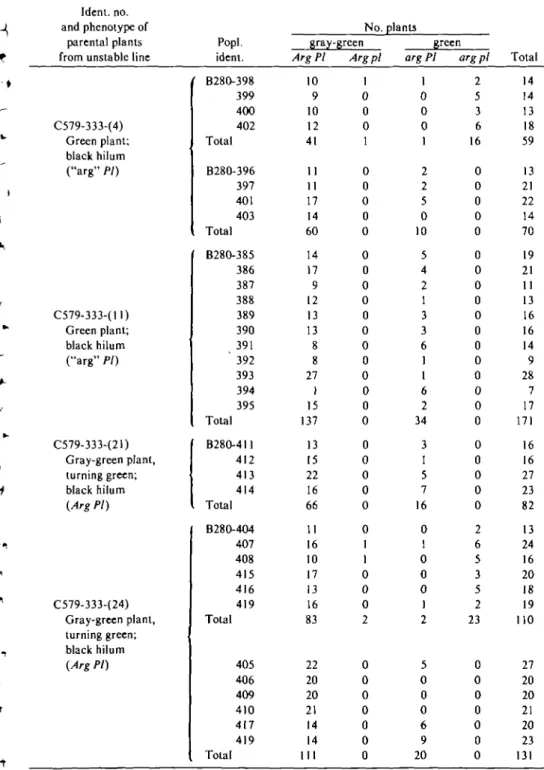
All 35 of the Fi plants from these crosses were mutant (gray-green) without any sign of variegation at any time in their ontogeny; all were PI/-. Among 623 F2 plants descended from the 35 F, 's, 498 were Arg (gray-green), only one of which was variegated. Based on the results of the F2 segregation (Table V), two of the four parental plants—C579-333-(l 1) and C579-333-(21)—were homozygous for PI, whereas the other two—C579-333-(4) and C579-333-(24)—were heterozygous. Even in the F25s derived from the parents homozygous for PI, nearly one-fourth (34 of 171, and 16 of 82) of the plants were normal green. Apart from the single variegated F2 plant, the com-bined F2 population displayed only two distinct phenotypes: gray-green and green. Still, the seed of 83 of the green plants had black hila
(PI). Progenies from these crosses were carried into the F5 and F6 generations and were used to show the relationships between variegation and the incidence of "arg" plants summarized in Table IV.
A further series of crosses was made among F4 plants of the populations just considered. They were made to rule out the unlikely
pos-sibility that many of the "arg" plants in the above progenies were actually arg plants tracing to an F2 crossover event. In one set of crosses gray-green plants proven to be homo-zygous dominant for both Arg and PI were crossed with green plants (i.e., "arg") homo-zygous for the dominant marker PI. Impor-tantly, the latter also derived from progenies
Table V. Distribution of phenotypes in the Fj from crosses between gray-green plants homoiygoug for Arg and PI ("stable" line) and "arg" plants or Arg plants in which the reproductive portion was
green (unstable line)
-\ f -• t i *< •f it 1 ( i •i Ident. no. and phenotype of parental plants from unstable line
C579-333-(4) Green plant; black hilum ("arg" PI) C579-333-(!l) Green plant; black hilum ("arg" PI) C579-333-(21) Gray-green plant. turning green; black hilum (Arg PI) C579-333-(24) Gray-green plant, turning green; black hilum (Arg PI) Popl. ident. B280-398 399 400 402 Total B280-396 397 401 403 Total B28O-385 386 387 388 389 390 391 ' 392 393 394 395 Total B280-411 412 413 414 Total B280-4O4 407 408 415 416 419 Total 405 406 409 410 417 419 Total No. gray-green Arg PI 10 9 10 12 41 11 11 17 14 60 14 17 9 12 13 13 8 8 27 1 15 137 13 15 22 16 66 11 16 10 17 13 16 83 22 20 20 21 14 14 111 Arg pi 1 0 0 0 1 0 0 0 0 0 0 0 0 0 0 0 0 0 0 0 0 0 0 0 0 0 0 0 1 1 0 0 0 2 0 0 0 0 0 0 0 plants green arg PI 1 0 0 0 1 2 2 5 0 10 5 4 2 1 3 3 6 1 1 6 2 34 3 1 5 7 16 0 1 0 0 0 1 2 5 0 0 0 6 9 20 arg pi 2 5 3 6 16 0 0 0 0 0 0 0 0 0 0 0 0 0 0 0 0 0 0 0 0 0 0 2 6 5 3 5 2 23 0 0 0 0 0 0 0 Total 14 14 13 18 59 13 21 22 14 70 19 21 11 13 16 16 14 9 28 7 17 171 16 16 27 23 82 13 24 16 20 18 19 110 27 20 20 21 20 23 131 * Column may contain either arg segregants or "arg" plants
that had previously been shown to be Arg/Arg PI/PI. Another set of crosses was made be-tween different "arg" plants within the group (i.e., "arg" PI X "arg" PI). All 95 F, plants from the latter crosses were green. Twenty-seven of these Fi's were tested in F2 (21 plants per F2 population, 419 plants in all), and all were green (data not shown).
All 72 Fi plants derived from the (Arg PI X "arg" PI) reciprocal crosses were gray-green, but many were variegated. Among the 64 F2 populations deriving therefrom, all but three consisted of gray-green and green plants in ratios approximating 3:1. Two of the excep-tional F2 populations contained green plants exclusively. The third contained gray-green plants exclusively but this population consisted of only 14 plants whereas all other F2*s con-sisted of 21 plants each. The combined phe-notypic distribution resembled monogenic segregation (931 gray-green: 406 green) but with an excess of "arg" plants (xo.i) = 20.5). It would appear from these and other results that once a plant becomes green, no matter how it originates, "greenness" is inherited as a recessive to gray-green.
Although the crosses considered in this section did not identify specific modifier genes that control phenotypic stability, the obser-vations overall suggest that some lines are more stable than others, due perhaps to some ill-defined differences in background geno-type.
Evidence obtained in the preceding section provides useful detail concerning the manner in which the phenotypic alteration is trans-mitted.
The F2 phenotypic distribution in Table V reveals that the number of "arg" plants in some F2 populations (those homozygous for PI) roughly equaled the number of arg seg-regants found in populations segregating in Mendelian manner for both Arg and PI. Since, once formed, "arg" behaves as a monogenic recessive factor (Table V), the time that "arg" becomes introduced into the pedigree is key to succeeding events. F2's derived from crosses involving C579-333-(21) and C579-333-(24) are particularly informative in this regard. Since both plants were gray-green in the seedling stage, clearly each inherited at least one dominant Arg allele. Both, however, be-came mostly green prior to being used as parents in crosses. The F2 distribution showed C579-333-(21) evidently to be homozygous for PI (and presumably for Arg as well) whereas C579-333-(24) was heterozygous for PI. From this it follows that both Arg alleles in the former plant and the single Arg allele in the latter had became transmuted to "arg" prior to gametogenesis. As a result, both plants contributed only "arg" gametes, and these,
when paired with the Arg PI gametes from the other parent, produced the observed segrega-tion for gray-green and green phenotypes in F2, some (the "arg") associated with PI and some (arg segregants) with pi. The frequency of "arg" plants introduced apparently depends on the degree to which a given Arg source plant is converted to green tissue and pre-sumably thereby to "arg" gametes. The con-version may be partial or complete. Thus, virtually any phenotype distribution is possi-ble, including those that fit a 3:1.
This mostly descriptive account leaves un-answered the very questions inspired by the observations themselves. At the core of the matter is the abrupt, unpredictable alteration of the mutant phenotype and the capacity to transmit the change to the offspring.
Differential growth patterns that set up stresses and strains among cells or tissues are commonly cited as the basis for the formation of subepidermal air spaces3. The findings of Hoch et al.4 suggested that the middle lamella between epidermal and palisade cells in leaves of Arg may be weaker than the middle lam-ellae of nonmutant plants. Hara3 noted that the middle lamella is sufficiently plastic to be separated by growth strains and that this leads to the formation of subepidermal air blisters. The striking crinkling of the leaves of Arg plants grown at high temperature may be ev-idence of even more exaggerated differential growth. The magnitude of the crinkling might imply that the stresses and strains among cells are not confined to the epidermal and subja-cent layers, but also may involve differential growth among the mesophyll cells them-selves.
Phenotypic instability might well be
ex-pected if Arg acts by altering the gross rela-tionship between derivatives of the L-l (epi-dermal) and L-II and L-III layers, since the balance between and among leaf cells and cell type is subject to modification by a variety of internal and external factors. What is not ex-pected, however, is that the changes in the Arg phenotype are capable of being transmitted sexually, at least in the manner described in this report. Particularly unclear is whether the sudden, seemingly random and often massive conversion from gray-green to green tissue reflects a permanent genie change at the DN A level that eventually enters the germ line, or instead, reflects a tissue-specific change in gene action. There is some evidence of both. The phenotypic similarity between "arg" and arg plants together with certain aspects of breeding behavior suggest that Arg may back mutate to arg. Yet, the temperature experi-ments imply that "argv and arg are not equivalent, suggesting in turn that "arg" represents a change in gene action only.
Another possibility is that "arg" represents a back mutation to a new mutational state. Alternatively, if Arg is an allele of Fl, then "arg" may be a manifestation of Fl, the latter having back mutated from a more dominant form, e.g., Fl Arg. In the temperature exper-iments, however, the phenotype of Fl plants remained unaltered.
None of the instability phenomena dis-cussed by Pearson12 or others appears to match in every essential detail the phenome-non described here. Further investigations, especially those conducted at the cell and tis-sue level of organization, are needed. It is hoped that the present study provides suffi-cient background to inspire such studies.
References
1. BOODLEY, J. W.and R . S H E L D R A K E , JR.Cornell peat-lite mixes for commercial plant growing. Cornell Inf. Bull. 43. New York State College of Agriculture and Life Sciences, Ithaca, NY.
1977.
2. FEDETOV. V. S. Multiple allelomorphs of the character "grey spotting" on the foliage of peas. Bull. Appl. Bot. Gen. PL Breed. Series II 9 2 7 5 -286. (In Russian with English Summary). 1935. 3. H A R A , N . Study of the variegated leaves, with
special reference to those caused by air spaces. Jap. J.Bol. 16:86-101. 1957.
4. H O C H , H. C , C. P R A T T , and G. A. M A R X .
Epi-dermal air spaces: basis for the phenotypic ex-pression of the argenteum mutant of Pisum. Am. J. Botany 67:905-911. 1980.
5. J E W E R , P. C , L. D. I N C O L L , and J. S H A W .
Sto-matal responses of Argemeum—a mutant of Pisum sativum L. with readily detachable leaf epidermis. Planta 155:146-153. 1982.
6. KIRK, J. T. O. and R. A. E. T I L N E Y - B A S S E T T . The Plastids. W. H. Freeman, San Francisco.
1967.
7. L A M P R E C H T , H. The variation of linkage and the course of crossingover. Agri Hortique Genet. 6:
10-48. 1948.
8. LEWIS, E. B. The phenomenon of position effect. Ado. Genet. 3:73-115. 1950.
9. M A R X , G. A. Argenteum: a mutant under nuclear and extra nuclear control. Pisum Newsl. 10:3-4-37.
1978.
10. . The linkage relations of a newly isolated nana mutant. Pisum. Newsl. 13:35-37. 1981. 11. P A T E , J. S. In Crop Physiology: Some Case
Histories. L. T. Evans, Ed. Cambridge University Press, p. 191-224. 1974.
12. PEARSON, O. H. Unstable gene systems in vege-table crops and implications for selection. Hort-Science 3:271-274. 1968.
13. TEDIN, H. and O. TEDIN. Contributions to the genetics of Pisum. IV. Leaf axil colour and grey spotting on the leaves. Hereditas 7:102-108.
1925.
14. WHITE, O. E. Studies of inheritance in Pisum. II. The present state of knowledge of heredity and variation in peas. Proc. Am. Phil Soc. 56:487-588. 1917.