© The Author 2011. Published by Oxford University Press on behalf of The Gerontological Society of America.
All rights reserved. For permissions, please e-mail: [email protected]. 411
Received July 13, 2010; Accepted February 6, 2011 Decision Editor: Elizabeth Stine-Morrow, PhD
R
ECENT approaches to subjective well-being (SWB)advocate the use of experience-sampling and diary assessments that capture affect in real-time rather than only retrospectively in terms of a trait (Hoppmann & Riediger, 2009; Röcke, Li, & Smith, 2009). Importantly, past research points to discrepancies between momentary and retrospective ratings over short periods such as min-utes or weeks in young adults. This study extends past re-search by examining the correspondence between older adults’ current evaluations of SWB and their retrospective evaluations over one year.
Correspondence Between Retrospective and Momentary Affect in Young Adulthood
Retrospective assessments are often based on semantic knowledge about average past affect but are also influenced by the worst and final moments. In contrast, current affect ratings typically involve the retrieval of distinct and recent episodes (Fredrickson & Kahneman, 1993; Robinson & Clore, 2002). Retrospective and momentary affect ratings thus capture different components of a person’s SWB, pos-sibly leading to divergent reports.
Indeed, the average of momentary reports only moder-ately correlates with retrospective ratings across several domains (Carver & Scheier, 1994; Klumb & Baltes, 1999;
Stone, Broderick, Shiffman, & Schwartz, 2004). For ex-ample, Hedges, Jandorf, and Stone (1985) compared four momentary reports with end-of-day ratings in middle-aged and older adults over fourteen days and found that individ-uals retrospectively overestimate positive affect (PA) and
negative affect (NA; Parkinson, Briner, Reynolds, & Tot-terdell, 1995; Thomas & Diener, 1990).
Which features of well-being over time most strongly in-fluence the summative memory for past well-being? Find-ings from young adults are mixed with some studies pointing to peak affect (Hedges et al., 1985) and others to average and recent affect (Fredrickson & Kahneman, 1993; Parkinson et al., 1995). In addition, valence differences have been re-ported. Thomas and Diener (1990) found correlations be-tween actual and recalled affect intensity to be smaller for NA than for PA. Furthermore, Parkinson and colleagues (1995) report that peak momentary affect influenced retro-spective daily affect ratings independently of average mo-mentary affect for PA but not for NA.
Discordance Between Retrospective and Momentary Affect in Older Adults
Interestingly, most past research focuses on young or mid-dle-aged adults and on short time periods from seconds to a few weeks. This study aimed to examine if the respective findings generalize to older adults. Several studies suggest close correspondences between current and recalled affect in older adults for the following reasons: Older adults may be less prone to time frame–related priming effects when rating emotional stimuli (Ready, Robinson, & Weinberger, 2006; see also Lachman, Röcke, Rosnick, & Ryff, 2008). In ad-dition, age-related declines in episodic memory may make older adults less prone to the effects of single events on judgments of retrospective affect. There may also be va-lence differences in that older adults have a greater memory
Correspondence Between Retrospective and Momentary
Ratings of Positive and Negative Affect in Old Age:
Findings From a One-Year Measurement Burst Design
Christina Röcke,
1Christiane A. Hoppmann,
2and Petra L. Klumb
31International Normal Aging and Plasticity Imaging Center, University of Zurich, Switzerland. 2Department of Psychology, University of British Columbia, Vancouver, Canada.
3Department of Psychology, University of Fribourg, Switzerland.
Objectives and Method. Using 5 measurement bursts spanning 1 year, this study examined correspondences between
retrospective end-of-year ratings and momentary ratings of positive affect (PA) and negative affect (NA) in 53 older adult participants from the Berlin Aging Study.
Results. Average momentary assessments were moderately positively correlated with retrospective ratings of PA and NA.
Hierarchical regression analyses further indicate that mean momentary PA best predicted retrospective PA over and above peak or recent momentary PA, whereas no such pattern emerged for NA. No evidence for age differences in these patterns was found.
Discussion. Our discussion focuses on the implications of affective memory biases for examining affective
experi-ences as they occur in peoples’ daily lives and points to implications concerning methods and theory development.
advantage for positive over negative information (Mather & Carstensen, 2005) and a reduced memory advantage for neg-ative over neutral material than young adults (Grühn, Smith, & Baltes, 2005). Consistent with these findings Ready, Weinberger, and Jones (2007) found older adults to overesti-mate PA retrospectively more than younger adults, whereas the reverse was true for retrospective versus current NA. The Present Study
We use affective experience-sampling data from five sam-pling periods across twelve months in combination with end-of-year retrospective ratings from very old adults to examine the correspondence between reports of momentary affect over time (i.e., average, peak, and recent) and retro-spective recollection of affect. Based on evidence about older adults’ decreased proneness to time frame–related priming effects and a greater correspondence between well-being reports across different time intervals, we expected a moderate to strong relative correspondence between retrospective and momentary PA and NA. In line with documented age differ-ences in emotional memory, we hypothesized that older adults would be motivated to focus on salient past positive experi-ences resulting in retrospective affect being most strongly linked to peak PA over and above average momentary PA. In contrast, peak or recent NA was expected to be less related to retrospective NA than the average of the momentary NA. Method
Participants and Procedure
Eighty-three adults (M = 80.62 years; 72–97 years) partici-pated in an intensive measurement burst study (Nesselroade, 1991) after the third assessment occasion of the Berlin Aging Study (Baltes & Mayer, 1999). The sample was positively selected as compared with the overall Berlin Aging Study sample regarding cognition, vision, and hearing (+0.8–1.2 SD; Klumb & Baltes, 1999). We focused on 53 adults (Mage =
80.17 years, SD = 4.16, 72.80–91.54 years) who completed at least three of the five measurement bursts and the retrospec-tive assessment (35.8% women; 41.5% married; 43.4% wid-owed; 90.6% living at home; moderate subjective health: range 1–5, M = 2.87, SD = 0.98) Drop-outs (n = 30) were slightly older than the 53 participants (M = 81.97 years, SD = 6.44 vs. M = 80.17 years, SD = 4.16; t(81) = 1.55, p < 0.01, but the two groups did not differ regarding gender, marital or residential status, and subjective health.
The study included five measurement bursts scheduled two months apart. Each burst consisted of six days of expe-rience sampling, including random signals five times per day on a portable beeper to report one’s current affect (ie, up to 30 possible assessments per burst). Daily beeps were at least 15 min apart (M = 150 min) and occurred during the average waking time. Individuals completed a mean of 4.77 bursts (SD = 0.51) and provided an average of 26.98
expe-rience-sampling diaries (SD = 4.26) across bursts. At the end of the year, participants recalled their affect for the past twelve months.
Measures
Participants rated their momentary PA (happy, interested, active, relaxed) and NA (depressed, bored, lonely, irritable) on a scale from 0 (not at all) to 4 (very much). Momentary PA and NA scores were computed as the average across the respective items. Average momentary affect represents the mean of all momentary affect ratings across bursts. Two indi-cators of peak affect were peak burst affect (ie, highest aver-age burst PA/NA compared with remaining bursts) and peak daily affect (ie, maximum daily PA/NA across bursts). Two indicators of recent affect were recent burst affect (ie, mean PA/NA in the last burst prior to the retrospective rating) and recent peak day (ie, peak daily PA/NA in the last burst).
Retrospective PA and NA was obtained at the end of the twelve-months study period with the same affect adjectives based on the question “How often did you experience each of the following emotions during the past year?” (0 = never to 6 = almost always). The response scale differed from the momentary assessment in range (1–4 vs. 1–6) and format (intensity vs. frequency), so we focus on relative rather than absolute associations between momentary and retrospective affect (see Supplementary Table A1 in the online Appendix for descriptives and zero-order correlations).
Results and Discussion
Intraindividual Variability and Change in PA and NA We first examined intraindividual variability and change within and across bursts using multilevel modeling ( Rauden-bush & Bryk, 2002). Intraclass correlations from unconditional three-level models indicate that for PA, 34%, 19%, and 47% of the variance originated at the level of day, burst, and person, respectively. For NA, 50%, 20%, and 30% of the variance orig-inated at the level of day, burst, and person, respectively. Tau coefficients and their respective standard errors for PA and NA as obtained using the program Hierarchical Linear Modeling (HLM) indicated that all variance components were highly significant: PA Level 1 = .169, SE = 0.18, p < .001; PA Level 2 t = .427, SE = 0.091, p < .001; NA Level 1 t = .042, SE = 0.005, p < .001; NA Level 2 t = .064, SE = 0.014, p < .001.
We then examined trajectories of PA and NA in condi-tional three-level models (ie, day level, burst level, person level). At Level 1, affect for person j on day i was modeled as a function of the average affect across all days in a burst (b0jk), the slope of day (b1jk; ie, average day-to-day change),
and a random effect (rijk): sijk(daily affect) = b0jk + b1jk(day
in study) + rijk. At Level 2, affect for person j in burst k was
modeled as a function of the average affect across bursts (g00k), the slope of burst (g01k; ie, average burst-to-burst
+ g01k(burst number) + u0jk. At Level 3, we modeled
be-tween-person differences in the average daily and burst af-fect as well as in day-to-day and burst-to-burst afaf-fect change (g00k = d000 + v00k; g01k = d010 + v01k).
Participants reported high levels of PA (b = 2.79, SE = 0.11, p < 0.01) and low levels of NA (b = 0.38, SE = 0.05, p < 0.01; Supplementary Figure A1). Both PA (b = −0.01, SE = 0.01, n.s.) and NA (b = −0.01, SE = 0.01, p < .01) showed little change (decrease) from day-to-day within a burst. PA decreased slightly from burst to burst (b = −0.12, SE = 0.02, p < 0.01), likely reflecting reactivity and adapta-tion to the repeated assessments.
PA decreased slightly from burst to burst (b ; -0.12, SE = 0.02, p<0.01), likely reflecting reactivity and adaption to the repeated assessments. Given that Burst 1 PA was significantly higher than the momentary PA across the re-maining bursts, we have rerun all analyses both with and without Burst 1 PA information. The pattern of findings was almost identical so that we only report results from the analyses including all available burst data. In contrast, in-dividuals reported stable burst-to-burst NA (b = −0.02, SE < 0.01, n.s.). There were significant interindividual differ-ences in intercepts and slopes. Individuals thus experienced sizeable short-term (day-to-day) and long term (burst-to-burst) within-person variations in affect speaking to the plasticity of the affect system into late life (Röcke et al., 2009) but also little systematic change over twelve months, supporting the notion of maintenance of well-being in later life.
Correspondence Between Momentary and Retrospective Affect Ratings
Zero-order correlations.—Relative associations between retrospective and momentary affect ranged from r = 0.49 to .63 for valence-homogeneous comparisons (momentary vs. retrospective PA) and from r = −0.29 to r = −0.53 for valence-heterogeneous comparisons (eg, momentary PA vs. retrospective NA; Supplementary Table A1). Consistent with our hypothesis, all indicators of momentary PA and NA were moderately positively related to the retrospective scores in the valence-homogeneous comparisons, indicating that indi-viduals reporting high retrospective affect also reported high momentary affect. The degree of this correspondence was comparable to studies using younger samples (Thomas & Diener, 1990; Wirtz, Kruger, Scollon, & Diener, 2003). Hence, older adults are fairly accurate in recalling their past affect.
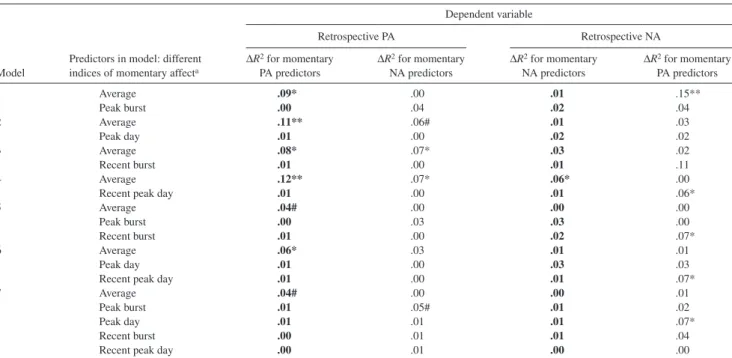
Specific momentary affect characteristics.—In a next step, we examined which of the momentary affect indices best predicted retrospective reports beyond the other indi-ces. The different indices were highly correlated within each affect domain, with correlation coefficients ranging from r = 0.57 to .97 (Supplementary Table A1). We conducted seven multiple hierarchical regressions for each affect domain in which retrospective affect was the dependent variable and different momentary affect scores served as predictors, Table 1. Results of Hierarchical Regression Analyses Showing Unique Predictive Effects (DR2) of Different Momentary Affect Indicators for
Individual Differences in Retrospective Affect
Model
Predictors in model: different indices of momentary affecta
Dependent variable Retrospective PA Retrospective NA DR2 for momentary PA predictors DR2 for momentary NA predictors DR2 for momentary NA predictors DR2 for momentary PA predictors 1 Average .09* .00 .01 .15** Peak burst .00 .04 .02 .04 2 Average .11** .06# .01 .03 Peak day .01 .00 .02 .02 3 Average .08* .07* .03 .02 Recent burst .01 .00 .01 .11 4 Average .12** .07* .06* .00
Recent peak day .01 .00 .01 .06*
5 Average .04# .00 .00 .00
Peak burst .00 .03 .03 .00
Recent burst .01 .00 .02 .07*
6 Average .06* .03 .01 .01
Peak day .01 .00 .03 .03
Recent peak day .01 .00 .01 .07*
7 Average .04# .00 .00 .01
Peak burst .01 .05# .01 .02
Peak day .01 .01 .01 .07*
Recent burst .00 .01 .01 .04
Recent peak day .00 .01 .00 .00
Notes: Within-affect domain associations are in bold. Across-domain associations are in normal font. Recent burst = mean affect score for the last burst an indi-vidual participated in. Recent peak day = peak daily affect score during the last burst an indiindi-vidual participated in. NA = negative affect; PA = positive affect.
a Numbers represent DR2 due to adding a given variable after controlling for all other variables derived from separate hierarchical regression analyses.
varying their entry order to obtain R2-change coefficients
representing the unique predictive role of each index above the others (Table 1). The first four models compared average momentary affect with one of the four remaining indices of peak and recent affect. Models 5 and 6 included all three indices of momentary affect as predictors (average, peak, and recent), once using burst-level and once using day-level peak and recent affect indicators. In Model 7, all momentary affect indices were consecutively entered as predictors.
Overall, unique predictive effects ranged from 1% to 15% of individual difference variance accounted for. Re-sults for valence-homogeneous analyses for PA indicated that average momentary affect across all momentary as-sessments was the strongest unique predictor. Neither peak nor recent momentary PA contributed a reliable unique proportion of explained variance. Overall, no individual momentary affect index stood out for within-domain corre-spondence of NA. The pattern of results was much less con-sistent for the valence-heterogeneous analyses. These findings are in contrast to our hypotheses that peak PA would be the strongest or at least a unique predictor for re-called PA and that average NA would have a prominent role in shaping individual differences in recalled NA in older adults. The observed differences may reflect differential recall strategies that operate within affect domains: Whereas individuals tend to aim at feeling good in general, making an averaging strategy a useful approach for estimates of past PA, it may be functional to remember specific negative epi-sodes (both peak and recent) to try to avoid the various spe-cific contexts that elicited these states in the future, leading to a lack of a single specific momentary predictor of retro-spective NA. We note that in our small sample, variance in momentary NA was much lower (but significant) than in PA (.07 vs. .49) and NA was reported at very low levels consis-tent with the idea that older adults maximize the positive and minimize the negative. Hence, the different aspects of momentary NA may not have been suited to differentially relate to retrospective NA. Future studies may want to focus on a sample undergoing major life events expected to lead to stronger intraindividual and interindividual variation in NA in order to more closely examine the dynamics and sub-jective reconstruction of affect in times of challenge.
Age differences.—In a final step, we also explored differ-ences in the correspondence between momentary and retro-spective affect as a function of age in our older adult sample to examine whether some of the hypothesized effects would be particularly evident for the oldest old. We added the re-spective age interactions to the final step of Models 5 and 6 from Table 1 (after centering all predictor variables), which included all three major indicators of momentary affect (mean, peak, and recent) on a day level and a burst level, respectively (see Supplementary Tables A2 in the online Appendix for the complete results). The only significant age interaction emerged for the prediction of retrospective NA
with peak day PA, indicating that for the oldest old adults, there was a particularly strong inverse relationship between peak day PA and retrospective evaluations of NA compared with the younger old adults.
Conclusion
Using data from 53 older adults who participated in five intensive measurement bursts across one year, we show that the affect system is remarkably robust until very old age. We replicate and extend previous findings from younger samples by showing that there is great relative correspondence between very old adults’ recalled and momentary affect over time (av-erage, peak, and recent). Despite postulated recall and fore-casting biases in young adults (Wilson & Gilbert, 2005), very old adults fare quite well in recollecting their past affect. For PA, average rather than peak momentary affect best predicted recalled affect, whereas no individual momentary affect index uniquely predicted recalled NA. Future research should focus on the mechanisms and functional implications of individual differences in the degree of correspondence (Lachman et al., 2008) between retrospective and real-time ratings.
Funding
Preparation for this manuscript was supported by a Research Fellowship awarded by the German Research Foundation (DFG) to C. A. Hoppmann. The Berlin Aging Study (BASE) was financially supported by two German Federal Departments: the Department of Research and Technology (13 TA 011: 1988–1991) and the Department of Family and Senior Citizens (1991–1998) as well as by the Max Planck Society. The Beeper study was financially supported by the German Research Foundation (grant Ba 902/8-1 to Margret M. Baltes).
Supplementary Material
Supplementary material can be found at: http://psychsocgerontology. oxfordjournals.org/
Acknowledgments
We would like to thank our student assistants for their help with data collection in the Beeper Study. We would also like to thank Derek Isaacowitz for comments on an earlier version of this manuscript. Correspondence
Correspondence should be addressed to Christina Röcke, PhD, Interna-tional Normal Aging and Plasticity Imaging Center, University of Zurich, Su-matrastrasse 30, 8006 Zurich, Switzerland. E-mail: [email protected]. References
Baltes, P. B. & Mayer, K. U. (Eds.), (1999). The Berlin Aging Study: Aging
from 70 to 100. New York, NY: Cambridge University Press. Carver, S. C., & Scheier, M. F. (1994). Situational coping and coping
dis-positions in a stressful transaction. Journal of Personality and Social
Psychology, 66, 184–195.
Fredrickson, B. L., & Kahneman, D. (1993). Duration neglect in retrospec-tive evaluations of affecretrospec-tive episodes. Journal of Personality and
So-cial Psychology, 65, 45–55.
Grühn, D., Smith, J., & Baltes, P. B. (2005). No aging bias favoring memory for positive material: Evidence from a heterogeneity-homogeneity list paradigm using emotionally toned words. Psychology and Aging, 20, 579–588.
Hedges, S. M., Jandorf, L., & Stone, A. A. (1985). Meaning of daily mood as-sessments. Journal of Personality and Social Psychology, 48, 428–434. Hoppmann, C. A., & Riediger, M. (2009). Ambulatory assessment in
lifes-pan psychology: An overview of current status and new trends.
Euro-pean Psychologist, 14, 98–108.
Klumb, P. L., & Baltes, M. M. (1999). Validity of retrospective time-use reports in old age. Applied Cognitive Psychology, 13, 527–539. Lachman, M. E., Röcke, C., Rosnick, C. B., & Ryff, C. D. (2008). Realism
and illusion in Americans’ temporal views of their life satisfaction: Age differences in reconstructing the past and anticipating the future.
Psychological Science, 19, 889–897.
Mather, M., & Carstensen, L. L. (2005). Aging and motivated cognition: The positivity effect in attention and memory. Trends in Cognitive
Sciences, 9, 496–502.
Nesselroade, J. R. (1991). The warp and the woof of the developmental fabric. In R. M. Downs, L. S. Liben, & D. S. Palermo (Eds.), Visions
of aesthetics, the environment, and development: The legacy of Joachim F. Wohlwill (pp. 213–240). Hillsdale, NJ: Lawrence Erlbaum. Parkinson, B., Briner, R. B., Reynolds, S., & Totterdell, P. (1995). Time frames for mood: Relations between momentary and generalized rat-ings of affect. Personality and Social Psychology Bulletin, 21, 331–339. Raudenbush, S. W., & Bryk, A. S. (2002). Hierarchical linear models:
Ap-plications and data analysis methods (2nd ed.). Thousand Oaks, CA: Sage Publications.
Ready, R. E., Robinson, M. D., & Weinberger, M. (2006). Age differences in the organization of emotion knowledge: Effects involving valence and time frame. Psychology and Aging, 21, 726–736.
Ready, R. E., Weinberger, M. I., & Jones, K. M. (2007). How happy have you felt lately? Two diary studies of emotion recall in older and younger adults. Cognition and Emotion, 21, 728–757.
Robinson, M. D., & Clore, G. L. (2002). Episodic and semantic knowledge in emotional self-report: Evidence for two judgment processes.
Jour-nal of PersoJour-nality and Social Psychology, 83, 198–215.
Röcke, C., Li, S. C., & Smith, J. (2009). Intraindividual variability in pos-itive and negative affect over 45 days: Do older adults fluctuate less than young adults? Psychology and Aging, 24, 863–878.
Stone, A. A., Broderick, J. E., Shiffman, S. S., & Schwartz, J. E. (2004). Understanding recall of weekly pain from a momentary assessment perspective: Absolute agreement, between- and within-person con-sistency, and judged change in weekly pain. Pain, 107, 61–69. Thomas, D. L., & Diener, E. (1990). Memory accuracy in the recall of
emotions. Journal of Personality and Social Psychology, 59, 291– 297.
Wilson, T. D., & Gilbert, D. T. (2005). Affective forecasting: Knowing what to want. Current Directions in Psychological Science, 14, 131–134. Wirtz, D., Kruger, J., Scollon, C. N., & Diener, E. (2003). What to do on
spring break? The role of predicted, on-line, and remembered experi-ence in future choice. Psychological Sciexperi-ence, 14, 520–524.