Viet Nam 1995-2015
Analysis of the Governance
Portfolio of the Swiss
Agency for Development
and Cooperation
ADB Asian Development Bank
ASEAN Association of Southeast Asian Nations
CB-SPAR Cao Bang – Support to Public Administration Reform
CEM Committee on Ethnic Minorities
CDF Community Development Fund / Commune Development Fund
CFM Community Financial Management
CHF Swiss Frank
CM Community Management
CPRGS Comprehensive Poverty Reduction and Growth Strategy
DARD Department of Agriculture and Rural Development
DOHA Department of Home Affairs
DOLISA Department of Labour, Invalids and Social Affairs
DOPI Department of Planning and Investment
DUDP Dong Hoi Urban Development Project
DWC Centre for Development of Women and Children
ETSP Extension Training Support Project
GTZ German Technical Cooperation
HUDP Hue Urban Development Project
M&E Monitoring and Evaluation
MARD Ministry of Agriculture and Rural Development MESMARD Monitoring and Evaluation Support for MARD MoET Ministry of Education and Training
MoF Ministry of Finance
MoHA Ministry of Home Affairs
MoJ Ministry of Justice
MPI Ministry of Planning and Investment
MRS Mekong Region Strategy
MTR Mid-Term Review
NLAA National Legal Aid Agency
NRD New Regional Development
NUDP Nam Dinh Urban Development Project
ONA Office of the National Assembly
OSS One Stop Shop
OECD Organisation of Economic Cooperation and Development
PAPI Provincial Administration Performance Index
PAR Public Administration Reform
PARMP Public Administration Reform Master Program
PC People’s Committee
PMU Project Management Unit
PPC People’s Provincial Council
PSARD Public Services – Agriculture and Rural Development RB Results-based
SDC Swiss Agency for Development and Cooperation
SEDP Socio-Economic Development Plan
TA Technical Assistance
UNDP United Nations Development Programme
VND Vietnamese Dong
1. INTRODUCTION 5
2. EXECUTIVE SUMMARY 6
3. OVERVIEW OF THE SDC GOVERNANCE PORTFOLIO 9
3.1. National Context 9
3.1.1. Economic and Social Development 9
3.1.2. The Political Economy 10
3.1.3. National Policy and Planning Context 10
3.1.4. Donor Presence in Vietnam 12
3.1.5. Measuring Governance at the Macro-level 13
3.2. Programming Context 14
3.2.1. From Cooperation Programmes to Regional Strategy 14
3.2.2. Portfolio Development 15
3.2.3. Choice of interventions 17
3.3. Portfolio Overview 18
3.3.1. Thematic Areas 18
3.3.2. Programmes Overview and Expenditures 19
4. KEY RESULTS AND IMPACTS 21
4.1. Academic Capacity Building 21
4.2. Local Governance and Service Delivery 23
4.2.1. Urban Development 24
4.2.2. One Stop Shop Replication 26
4.2.3. Participatory Planning and Local Development Funds 28
4.2.4. Service Provision in Agriculture and Rural Development 32
4.2.5. Reforming Local Government Institutions 33
4.3. National Reform Programmes and Monitoring 35
4.3.1. Public Administration Reform - Master Plan 35
4.3.2. Support to Governance Reforms Under the One UN Plan 37
4.3.3. Results-based Planning at Ministry Level 37
4.3.4. Evidence-based Policy-making – PAPI 39
4.4. Access to Justice 40
4.4.1. National Legal Aid Agency 40
4.4.2. Prevention of Domestic Violence 41
4.5. Democratic Representation 42 4.6. Cross-cutting Issues 43 4.6.1. Gender Equality 43 4.6.2. Human Rights 45 4.6.1. Environmental Issues 45 4.7. Portfolio Scorecard 46
4.8. Partners and Beneficiaries Matrix 48
5. ACHIEVEMENTS AND MAIN LESSONS LEARNT 50
5.1. Project Context 50
5.1.1. Identification of Issues and Opportunities 50
5.1.2. Preparation, Participation and Perseverance 52
5.2. Project Implementation 53
5.2.1. National Implementation Partners 53
5.2.2. Management and Modalities 54
6. CONCLUSIONS 55
6.1. Summary of Portfolio Outcomes 55
6.1.1. No Improvement in systemic governance, but some successful
changes at local level 55
6.1.2. Improvements in People’s Lives 56
6.1.3. What Worked 56
6.1.4. What Didn’t Work 57
6.1.5. The SDC Legacy 58
7. APPENDIX A - PROJECT STORY SHEETS 59
7.1. Local Governance and Service Delivery 59
7.1.1. Hue and Dong Hoi Urban Development Projects 59
7.1.2. Nam Dinh Urban Development Project 61
7.1.3. Once Stop Shop Replication 63
7.1.4. Cao Bang Public Administration Reform (SPAR-CB) 65 7.1.5. Public Service – Agriculture and Rural Development (PSARD) 67
7.1.6. Community Management Project 70
7.2. Academic Capacity Building 72
7.2.1. Management Development Programme 72
7.3. National Planning and Monitoring 73
7.3.1. Public Administration Reform - Master Programme 73
7.3.2. Support to Governance Reforms in Vietnam Under the “One UN Plan” 75
7.3.3. Monitoring and Evaluation – MESMARD 76
7.3.4. Public Administration Performance Index – PAPI 78 7.3.5. Pro-poor Policy Monitoring and Analysis in Vietnam 80
7.4. Access to Justice 81
7.4.1. National Legal Aid Agency Support 81
7.4.2. Prevention of Domestic Violence 83
7.5. Democratic Representation 84
7.5.1. Support to People’s Elected Bodies 84
8. APPENDICES B – REFERENCES 86
8.1. List of Governance Projects by Thematic Area 86
8.2. Scorecard on Sustainability, Impact and Replicability 87
8.3. Portfolio Partners and Beneficiaries 92
8.4. Project Map 100
8.5. List of Documents Consulted 101
8.6. List of Persons Consulted 108
01
The Swiss Agency for Development Cooperation (SDC) has been active in Vietnam for more than 25 years. Vietnam became a middle-income country in 2010 and therefore bilateral cooperation between SDC and the Government of Vietnam will come to an end in 2016. SDC will, however, continue to be active, with a sizeable number of programs that address challenges at the global or Mekong region level, such as climate change, water and food security and include Vietnam components. Furthermore, bilateral economic development cooperation will continue through the State Secretariat for Economic Affairs, SECO.To mark the end of bilateral development cooperation, the SDC wishes to present the story of Swiss engagement in Vietnam in the form of a retrospective analysis of the Governance sector and the agriculture and forestry sector over the past 20 years.
To this end, in July 2015 the SDC commissioned an independent team of specialists to write an analysis of the governance portfolio. The present report covers the governance portfolio from 1995-2015. A second team was commissioned in November 2015 to write an analysis of the agriculture and forestry sector. This report will be available separately in May 2016.
The review team wishes to pay special thanks to the staff of the Swiss Development Cooperation in Hanoi for their invaluable assistance and knowledge: Mr. Samuel Wälty, SDC Country Director, Mr. Dao Minh Chau, senior programme officer, Ms. Nguyen Hai Ha, programme assistant, and Ms. Hoang My Lan, senior programme officer.
Our sincere thanks also go to the many government officials from central ministries, provincial and district governments, commune leaders, Party officials, commune officials and leaders and members of communities in Cao Bang, Nam Dinh, Quang Binh, Hoa Binh and Thai Nguyen provinces. A complete list of persons consulted, who gave their valuable time and shared their experiences, is found in Annex 7.3
Team composition:
• Mr. Jacob Gammelgaard, team leader, Rule of Law Partners, Ltd., Copenhagen, Denmark • Mr. Nguyen Hung Quang, governance specialist, managing partner, Nguyen Hung
Quang and Associates, Hanoi, Vietnam
• Mr. Nguyen Tien Lap, governance specialist, senior partner, Nguyen Hung Quang and Associates, Hanoi, Vietnam
The assignment was carried out in the period from September 2015 to February 2016. The team worked in Vietnam in September and again in November 2015 to collect data and to conduct interviews in several of the project localities.
The Swiss Agency for Development and Cooperation (SDC) was a development partner of Vietnam from the early years of the famous renovation policy announced at the Party Congress in 1986. The first governance project was launched in 1993; the last bilateral projects will come to an end in 2016.
In some areas, SDC went with the current and joined other donors in supporting national programmes. However, in most areas, SDC struck out on its own to build up projects and expertise in cooperation with local governments and, as the country gradually opened up, with local communities.
The present report is an analysis of the SDC governance portfolio during the 20 years from 1995 to 2015.
PORTFOLIO OVERVIEW
The SDC governance portfolio covers fifteen projects. The projects can be divided into the following thematic groups:
1. Local Governance and Service Delivery (6 projects) 2. Academic Capacity Building (1 project)
3. National Reform Programmes and Monitoring (5 projects) 4. Access to Justice (2 projects)
5. Democratic Representation (1 project)
The largest group of six projects focused on strengthening local governance and consumed two-thirds of the governance envelope. All projects were based on cooperation with provincial authorities and local communities. The projects addressed issues on institutional reform, local planning, environmental management, public service delivery, community management and community development funds for livelihood improvement.
The second thematic area was a project for building academic capacity and business management skills in partnership with four leading universities in Vietnam.
The third group, on National Reform Programmes and Monitoring, contained five projects. Two projects in collaboration with UNDP supported the Public Administration Reform Programme (PAR) and the implementation of the Provincial Administrative Performance Index (PAPI). A third project supported the Ministry of Agriculture and Rural Development to develop a national system for results-based (RB) monitoring for the agricultural sector. Two other projects supported the implementation of the One UN Plan in Vietnam and Pro-poor Monitoring and Policy Analysis.
02
The fourth thematic area on access to justice contained a basket-funding project in support of the National Legal Aid Agency to strengthen its outreach and the quality of services to citizens in need of legal assistance. The second project on prevention of domestic violence grouped together three smaller projects in support of NGOs and UN interventions.
The fifth thematic area was a UNDP-led project to develop parliamentary good practices and the professional capacity of elected deputies to the National Assembly.
KEY RESULTS AND IMPACTS
Local governance and service delivery
This group represents SDC main and unique contribution to the development of Vietnam with results and expertise that were developed over two decades. The main outcome is a contribution to democratising local development that has improved freedom of choice and livelihoods for a large number of participating households and communities. The best results are well suited for replication across the country.
National Reform Programmes and monitoring
SDC’s support for the Public Administration Reform Master Programme was an early project and lasted for a single phase, after which SDC withdrew along with other donors. The review finds that the PAR project had limited impact and it has since been largely abandoned by the donors. Two other projects on PAPI and the collaboration with MARD are innovative and have shown considerable success in systematic acquisition of data for policy-making and building technical skills of the partner institutions. The MESMARD project in particular carries best practices in participatory project preparation and implementation. A sizeable project supported the implementation of the One UN Plan in Vietnam. SDC earmarked funding to resume support of two UNDP-led project; PAR Master Programme and Elected People’s Representatives.
The project on Academic Capacity Building was a pioneering effort to bring international outlook and skills to an isolated and backward university environment in economics and business management. The project had lasting impact on improving the quality and methodology of teaching and research at the universities and in opening Vietnamese universities to international cooperation.
Two projects under Access to Justice and Democratic Representation were discontinued by the SDC after a single phase of engagement. The review finds that the projects had limited impact and that the decision to pull out was sound and based on a strategic choice of concentrating on SDC’s own projects on local governance. SDC subsequently resumed support to the latter project under the One UN Plan. In addition, the support for the prevention of domestic violence, which contained three smaller projects, the most important of which supported local NGOs and civil society networking.
MAIN LESSONS LEARNT
SDC got its priorities right on local governance
The SDC has pursued the idea of community self-management throughout the 20 years of programmes, while closing projects in other areas with less potential for results.
SDC has become a lead donor on local self management
SDC has kept its focus and resources on community management, and is today a lead donor in the field in Vietnam with a lasting legacy and singular contribution.
SDC is good at learning from experience
SDC is a small, open-minded organisation that is willing to adapt and to change its approach in the light of experience and independent evaluations. SDC is good at receiving critique and good at acting upon the implications.
SDC has maintained its professional integrity
SDC has managed to stay a small and flexible organisation open to learning from experience. By the same token, SDC has avoided becoming beholden to vested bureaucratic interests that would otherwise have promoted unsound projects and kept alive programmes that were better cut short.
SDC used participatory project formulation with excellent results
SDC has applied a participatory approach to project formulation and problem solving. The results have often been excellent and promoted lasting outcomes and strong ownership. SDC has maintained a continuous dialogue with local government as a precondition for programme successes.
SDC has engaged with a large number of national and local government agencies over the past 20 years. These agencies have been the main partners in project formulation and implementation and their collaboration has been indispensable for the achievements and viability of the project.
Understanding local decision-making
SDC has been good at understanding and adapting to the complicated approval procedures in a hierarchical administrative system. Local governments have little autonomy and are dependent upon top-level decisions and permissions. Here, SDC and its local partners were able to maintain an open dialogue that facilitated solutions to projects.
CONCLUSIONS
The legacy of the SDC governance portfolio in Vietnam is the participatory community development process. The SDC programmes leave behind profound knowledge and experience in promoting self-management and empowerment of local communities. Few, if any, of the other donors that have supported Vietnam over the years have a comparable expertise.
The projects have developed a pool of national expertise and know-how, supportive local governments, successful demonstration projects, guidelines and incipient national regulation. The SDC experience in participatory community management is readily replicable throughout the country.
In a wider sense, the SDC governance portfolio has supported the development of democracy from a Vietnamese perspective, which denotes people’s participation and voice in the national development project. Thus, the SDC governance portfolio has provided a space for people’s voice in local affairs and matched it with more freedom of choice through improved livelihoods.
3.1. NATIONAL CONTEXT
3.1.1. Economic and Social Development
The story of Vietnam’s economic growth and poverty reduction is well known and often told. GDP has grown at the rate of 5-8% per year, which enabled Vietnam to reach lower middle-income status in 2010. Growth was largely led by foreign direct investment and opening up to foreign trade spurred on by government-led reforms. Poverty rates fell consistently over the entire period from 58% in 1993 to 13% today1, although with considerable regional
and ethnic difference. The success nevertheless masks rising inequality, macroeconomic imbalances, rising government debts and low-factor productivity gains.
The greatest driver of change in Vietnam was the WTO accession process, which took place over a decade and was concluded in 2006. Two secondary drivers of change were the accession to ASEAN in 1995 and the conclusion of the Bilateral Trade agreement with the United States in 2001.
The impact of WTO accession had wide implications throughout Vietnamese society and in political and government institutions. Legislation has been introduced in many areas of business, investment, arbitration, litigation, fiscal affairs and public finance, and has impacted on public administration, the judicial system, the business environment, academic curricula and the growth of the legal community.
Outlooks and mind settings were affected: Vietnamese government officials and other professionals joined in international negotiations. International standards of accountability were imposed in meeting the criteria of WTO accession. The country sought membership and participation in international fora. Businesses gained knowledge of international markets while universities opened programmes on international trade and business law and the elite sought higher education and business contacts abroad.
WTO membership created pressures for adaptation of the legal and judicial system to perform according to international standards, especially the demands of independent adjudication of disputes and effective enforcement of judgements.
Economic growth and open borders for trade have also given rise to organised crime, international smuggling and money laundering. In the latter area, Vietnam is on an international watch list for inefficient compliance with its obligations.
OVERVIEW OF THE SDC
GOVERNANCE PORTFOLIO
03
An important factor in the political economy of Vietnam continues to be the struggle for Party survival and the preservation of the position of the ruling elites in the state apparatus and state-owned economic sector. The Party seeks to build its continued power on the basic concepts of a Chinese-inspired model of rising living standards, access to consumption and global lifestyle in exchange for political loyalty and stability. The Party/State control over the big state economic sector remains strong and is encapsulated in the slogan of “market-based economy with socialist characteristics”.
3.1.2. The Political Economy
The pace of social change is rapid within business, market development, higher education, consumer patterns, media diffusion, internet usage and a host of other areas.
Vietnam has become part of a globalised economy, which has brought many side-effects; better human qualifications, new ideas in business and culture, political perspectives, social exchange and intellectual diversity. Vietnam has become a member of international organisations and inter-state agreements and is now a player in multilateral fora (e.g. UN Security Council). Vietnam has opened up markets and expanded trade agreements with EU, USA, ASEAN Economic Community, and Asian partners of the Trans Pacific Trade Agreement. The political structures, however, have hardly changed. Power remains heavily skewered towards the executive and under Party direction. The National Assembly is formally the supreme organ of state power, but in practice it is subordinate to the Politburo on key issues of national policy, national security and the division of political and economic power.
A strong nexus of Party officials, high-ranking government officials, state-owned companies, big businesses and patronage relations appear to control a large share of national assets. The private business sector remains mostly small and household based, while designated “strategic” industries, such as oil extraction, mining and aviation, are under the control of the Prime Minister, which points to a strong concentration of economic and political power. There is little public leadership by the Party and no strong public presence by its members; the Party remains internally oriented, opaque and shields its influence from all outsiders, foreigners in particular. Party congresses remain influential, certainly as a forum for power brokerage, but are widely viewed with cynicism. The Party seems to have little vision for the development of the country, but is rather bent on maintaining the status quo.
Internet and social media continue to grow at fast rate. With more than 25 million Facebook accounts, Vietnamese are prolific users of the internet. The content of public reporting is widening and the media have become an important source of social criticism and debate. Blogging is widespread and a target for police surveillance against political dissidents. Censorship is widely enforced and internet censorship is tightly regulated, but often unevenly enforced in practice. The government owns all printed media and maintains a tight licensing control over all publications.
3.1.3. National Policy and Planning Context
The period from 1996 to 2015 witnessed an unprecedented social and economic development in Vietnam coinciding with a large build up of donor-supported programmes. Under the official slogan of “global economic integration” the country gradually opened up its economy and, more slowly, its governance system, motivated by the strategic need for economic growth.
The cooperation between the government and the donor community resulted in the emergence of large-scale social and economic planning. National development plans cover several sectors: socio-economic development, public administration, judicial reform strategy, poverty reduction, sustainable development strategy and the National Strategy for Gender Equality.
The main socio-economic national plans include:
• Socio-Economic Development Strategy (2001-2010; 2011-2020) • Comprehensive Poverty Reduction and Growth Strategy (2002) • The Sustainable Development Strategy (2011-20)
The international donor community2 was attracted to Vietnam’s high growth rates and what
seemed to be an effective system of government capable of formulating national development targets. The Government of Vietnam is imbued with a spirit of social engineering, which matches the donor predilection for top-down and government-driven development plans. The donor community favours big plans for the purpose of alignment, perceived development efficiency and for political justification in home constituencies. A good match was made and the donor community remained well represented in Vietnam throughout the period.
Vietnam governance reforms over the past 20 years are numerous and cover a wide field of plans and programmes. The key reforms include:
• Public Administration Reform Master Programme.
• Legislative Reform Programme based on Politburo Resolution No. 48. • Judicial Reform Strategy based on Politburo Resolutions Nos. 8 and 49.
• Anti-corruption Committee under the Prime Minister’s Office, but since 2013 transferred to the resuscitated Central Party Committee on Internal Affairs.
• Numerous law reforms, including a Law on Organisation of the National Assembly, a Law on the Organisation of Local Government, a Law on Election of Deputies to the National Assembly and People’s Councils, an Ordinance on Grass Roots Democracy, a Law on the Promulgation of Normative Legal Documents, a Law on State Compensation and Liability and a Law on the State Budget.
• The Amended Constitution of 2013, including a new chapter on Civil and Human Rights. • Media regulation, a draft Law on Associations and a draft Law on Access to Information.
3.1.4. Donor Presence in Vietnam
International donors have maintained a prominent presence in Vietnam through most of the 20-year period covered by this analysis. The early presence of donors was strongly influenced by political sensitivities of the government, but from the mid-90’s onwards an increasing number of donor agencies, both bilateral and multilateral, have established programmes and cooperation agreements. SDC established its first country programme in Vietnam in 1995.
2. The donor community includes: bilaterals: AFC, AusAID, Belgian BTC, CIDA, Danida, DfID, GTZ, Irish Aid, JICA, KOICA, NORAD, NOVIB, SDC, SIDA, USAID; multilaterals: Asian Development Bank, European Union, UN agencies, World Bank; international NGOs: Save the Children, CARE International, OXFAM, etc. Vietnam also has bilateral relations with China, Russia and other members of the former Soviet bloc, some of which are current bilateral donors or cooperation partners.
Fig. 1: Total ODA disbursements to Vietnam 1990-2014: Largest bilateral donors
Source: OECD (2016), “Detailed aid statistics: ODA Official development assistance: disbursements”, OECD International Development Statistics (database). DOI: http://dx.doi.org/10.1787/data-00069-en.
The graph lists the largest bilateral donors in Vietnam. Switzerland is represented in 13th place of bilateral donors, with a sizeable ODA contribution, although smaller than the like-minded group of donors with which SDC has cooperated through much of the period. As a smaller player in the main group of western donors, SDC has sought ways to leverage its influence through cooperation with other donors in basket-funded projects, in particular with UNDP. Thus, SDC has built its profile in local governance projects of its own, while joining up with other donors for increased influence and dialogue at the level of central government.
3.1.5. Measuring Governance at the Macro-level
The World Governance Indicators3 for Vietnam shows little or no improvement. In the period 1995 to 2015, the only significant gain is in government effectiveness and rule of law, where improvement leapt in 2013, coinciding with the promulgation of the new Constitution. The World Governance indicators compiled by the World Bank are aggregate indicators for six dimensions of governance: 1) Voice and Accountability, 2) Government Effectiveness, 3) Rule of Law, 4) Political Stability, 5) Regulatory Quality and 6) Control of Corruption.
Care should be taken in relating perception indicators directly to donor-funded programmes. The relation is tenuous and direct attribution is not possible. Governance indicators compiled at the aggregate level may not be able to capture policy initiatives or interventions in specific areas of targeted programme activities. Thus, reform programmes may conceivably obtain
3. Source: World Bank: Worldwide Governance Indicators, Country Data Report for Vietnam, 1996-2014; www.govindicators.org. Mill. USD 16,000 14,000 12,000 10,000 8,000 6,000 4,000 2,000 -Japan Franc e German y Austr alia Korea Denmar k Unit ed K ingdom Unit ed S tates Sweden Nether lands
Canada Belgium Switz
erland 14,762
2,679
success in localised or targeted areas, for example in local government, which are not reflected in the overall ratings. Governance reforms usually take time to produce results for the overall system of governance in a given country.
Nevertheless, the governance indicators seem to reflect a lack of confidence in government reforms and their ability to achieve their stated objectives.
The overall trend indicates technocratic and administrative improvement in government effectiveness, which improved steadily from 1995 to 2004 and then declined or stagnated for the period up to 2013, after which it rebounded. The indicator for rule of law show a similar trend although the improvement is less pronounced.
The demand part of governance – citizens’ voice and accountability– remains low and without improvement, as does control of corruption, which has in fact declined marginally. Vietnam’s WGI score on voice and accountability remains among the lowest in the world; approximately 90% of all countries score better over the past 20 years. Regulatory quality remains stagnant and political stability has declined noticeably.
The Government of Vietnam has taken several significant steps to control corruption. Thus, the Law on Anti-Corruption was passed in 2005 and a National Anti-Corruption Strategy was adopted in 2009. However, Transparency International’s Corruption Perception Index scores for the period 2007 to 2015 show only marginal improvement, with an average score of 2.9 (with 0 being “highly corrupt” and 10 being “very clean”)4.
The Human Development Index (HDI) is compiled each year by the UNDP. The index is based on four key indicators5. Vietnam has shown a remarkable increase over the period and is now
ranked in the group of countries with medium human development, at 116th place out 187 countries. The computed value is 0.666 in 2015 as compared to 0.463 in 1980, an improvement of 44 %. Some regional HDIs are as follows: Cambodia 143; Laos: 141; Vietnam 116; Thailand 93; China 90; Malaysia 62; Hong Kong 12 and Singapore 11.6
3.2. PROGRAMMING CONTEXT
3.2.1. From Cooperation Programmes to Regional Strategy
The SDC programmes in Vietnam were predicated on two consecutive regional Cooperation Programmes, which were replaced by a regional strategy in 2007 covering Vietnam, Laos, Cambodia and Myanmar. The regional strategy was renewed in 2012 up to the end of 2017.
• Cooperation Programme in the Mekong Region I (1995-2000) • Cooperation Programme in the Mekong Region II (2002-06) • Mekong Region Strategy I (2007-11)
• Mekong Region Strategy II (2013-17)
4. Transparency International, http://www.transparency.org/, and U4 Expert Answers: Overview of corruption and anti-corruption in Vietnam, Transparency International, Christian Michelsen Institute and Anti-Corruption Resource Centre, no year.
5. Life expectancy at birth, expected years of schooling, mean years of schooling, and GNI per capita. 6. Source:http://hdr.undp.org/sites/default/files/hdr_2015_statistical_annex.pdf
Governance systems and reforms are very specific to a country and very hard to transfer or replicate across borders. Governance policies are national in character for obvious reasons and one government cannot and will not adjust its national targets and expenditures in deference to or in consultation with another state.
These constraints are openly recognised in the MRS 2013-17, which notes that “the SDC Mekong program (…) remained, in essence, three separate country programs.”7 The current
MRS therefore reverts to separate country programs, which can be completed by regional programmatic interventions. 15% of the MRS II funds are set aside for regional programs, the remainder being distributed to country-specific programs.
The main strategic orientations can be discerned in the Mekong Regions Strategy II, which sets out three strategic directions for SDC interventions:
1) “Partnering with other donors is the only way that would allow SDC to leverage large reforms;
2) “In a top-down organised country like Vietnam, capacity building for and providing resources directly to the local levels in an effective way to support decentralisation; 3) “Real participation and full transparency are key factors of successful mobilisation of
people at grassroots level.”8
As the report will show, this is exactly what SDC did.
3.2.2. Portfolio Development
The development of the governance portfolio shows the growing sophistication and complexity of the projects. Three factors were important in shaping the portfolio: the ability to seize real opportunities as they arose, the application of sound development practice and a willingness to heed lessons learnt from projects as they became evident.
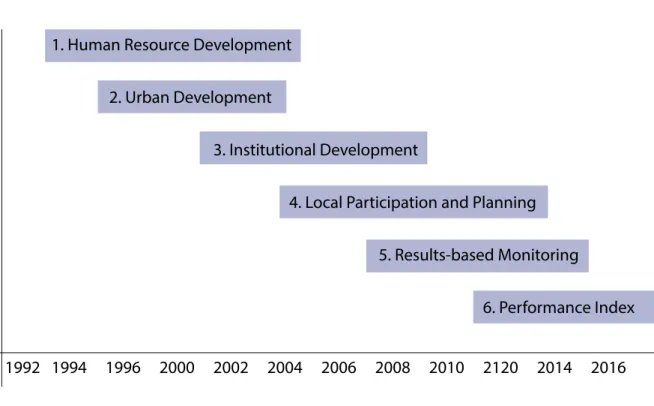
The governance portfolio contains five distinct stages9 that make up an intervention
progression described below.
1. Support to human resource development (1992-2007)
The initial phase of SDC interventions was based on the assumption that the transition to a market-based economy would not be achieved without the existence of national human resource base in economics and business administration. The main project of this phase was the Management Development Programme that aimed to build academic and research capacity with four partner universities in Vietnam10. The programme lasted from 1992 to
2007. The urban development projects in Hue, Dong Hoi and Nam Dinh also had components for building the capacity of local government officials in areas such as management, organisational development and urban planning.
7. Mekong Region Cooperation Strategy 2013-17, p. 14 8. MRP II, page 15
9. The term “stage” implies a logical progression that guides the development of a programme in the long-term. In reality, this is rarely the case. Most projects develop in an incremental fashion based on experience and opportunities. The word is used here to indicate a retrospective view of programme development.
10. National Economics University at Hanoi, University of Technology in Hanoi, the Economics College at the National University in HCMC, and College of Engineering at the National University in HCMC
11. Managing for Trade and Development Results: Case Study of Vietnam, OECD, 2012. 2. Urban development (1996 - 2006)
The projects contained components on urban planning, municipal administration reform, community participation and infrastructure development. The projects were remarkable for focusing on urban poverty issues at a very early stage. Main programmes were the Dong Hoi, Nam Dinh and Hue Urban Development projects. The period of implementation was from 1996 to 2006. In hindsight, these projects provided the basis for the more advanced community development programmes that SDC developed later.
3. Support for institutional planning and capacity development (from 2002-2008)
The third stage of SDC interventions focused on building the capacity of central government agencies to formulate coherent national plans and to implement and sustain them through capacity building and regulation. The projects are a step up the value-added chain of reforms and aim to strengthen the sustainability of institutional reform agendas. The main project was support to the Public Administration Reform Master Programme, which was the first attempt to bring together a national reform programme into a single framework and to join development partners behind such an effort. SDC’s support for the programme lasted from 2002 to 2006. Another programme was the support to People’s Elected Bodies, which sought to professionalise deputies of the National Assembly and to strengthen the legislative process. SDC supported this programme from 2003 to 2008. SDC supported governance reforms under the One UN Plan in two phases from 2008-2010 and again from 2012-14.
4.Support for local planning and monitoring of development investments (2004 - 2016)
A fourth stage, or arm, of SDC’s governance portfolio was to support local government and communities to participate in monitoring and planning of local investments for poverty alleviation. These projects are the core of the SDC’s governance portfolio and represent by far the largest monetary investment. The first such project was the One Stop Shop pilot initiated in 2004, which remains one of the major successes of SDC. Larger programmes are the Public Service Provision Improvement Programme in Agriculture and Rural Development (PSARD) and the Community Management Programme, both of which continue until 2015-16. The programmes have pioneered methods of local participation in planning and community development.
5.Support to results-based monitoring and policy formulation (from 2006 - 2016)
The last level of SDC governance interventions consist of two projects aimed at introducing result-based monitoring in central level government agencies and to promote evidence-based policy formulation. The projects are technically demanding and represent an advanced level of institutional development11. Monitoring and Evaluation for Poverty Reduction (MESMARD)
is a technical cooperation with the Ministry of Agriculture and Rural Development launched in 2006 and running to 2015. Support for the Provincial Governance and Public Administration Index (PAPI) began in 2011 and will end in 2016. A small project contribution is the Pro-poor Policy Monitoring and Analysis in Vietnam launched in 2014.
The five stages of the SDC governance programmes can be illustrated as below. For reasons of clarity, the last stage has been divided into two: Results-based Monitoring and Performance Index.
Fig. 2: Sequence of SDC Governance Projects 1992-2016
1. Human Resource Development
2. Urban Development
3. Institutional Development
4. Local Participation and Planning
5. Results-based Monitoring 6. Performance Index 1992 1994 1996 2000 2002 2004 2006 2008 2010 2120 2014 2016 The graphic representation above illustrates how the governance content of the governance portfolio developed over time and took on technically and politically more challenging issues. The sequence reflects the increasing possibilities of governance programming in Vietnam and shows how the SDC governance portfolio developed in step with evolving international theory and the experience of governance programming. As such, it is a testimony to the ability of SDC to widen their field of technical cooperation and identify new opportunities and partners.
The progression should not be over-interpreted. A project on urban development is not in itself more simple or less challenging than establishing a sector-wide, result-based monitoring system. Nor should reforming university teaching methodology be viewed as any easier than introducing participatory planning at community level.
3.2.3. Choice of interventions
The period from 1995 to 2015 was a high point of peace-time development in Vietnam in which more reforms were undertaken than at any other comparable point in modern history. Government agendas and strategies were developed for most areas of governance reforms, as indicated in section 3.1.3 above. Faced with such a proliferation of opportunities, any donor would face options and strategic choices for how to best spend their limited development budgets. In this context, the question became one of making reasonable choices based on “comparative advantages” and available resources. For SDC, such choices were developed and largely expressed in the two Mekong Region Strategies.
SDC chose to remain outside some major areas of governance reform. Thus, judicial reform and law-making are absent from the portfolio. Public expenditure management and related subjects, e.i anti-corruption, public procurement and state audit, were never part of SDC focus areas. Support to civil society, as it slowly became an area accessible to donor intervention, was likewise not a priority. It must be mentioned that several projects related to or integrated parts
of the above issues. Likewise, the political section of the Swiss embassy did take on elements of justice reform, e.g. prison reform and issues relating to civil society and human rights.
The SDC governance portfolio, as it developed over time, developed a strong focus on local governance coupled with efforts to bring local results to the central, political level for additional impact. There is little to suggest that SDC missed opportunities to promote their main agenda by staying outside areas such as judicial and legislative reform. The one area where additional leverage might have been obtained might have been a greater emphasis on civil society development. However, wherever possible, SDC appears to have opted for integrating CSOs into project implementation thus building their capacity and at the same time making a policy “statement” in favour of CSO involvement in Vietnam’s development process.
3.3. PORTFOLIO OVERVIEW
3.3.1. Thematic Areas
For the purpose of analysis, the SDC Governance portfolio is divided into five thematic areas based on their main objectives, as follows:
Governance Portfolio Projects by Thematic Areas
Academic Capacity Building
Management Development Programme Local Governance and Service Delivery
Hue and Dong Hoi Urban Development Project Nam Dinh Urban Development Project
One Stop Shop
Cao Bang Support to Public Administration Reform
Public Service Delivery – Agriculture and Rural Development Programme Community Management Project
National Reform Programmes and Monitoring PAR Master Programme
Support to Governance Reforms in Vietnam under the “One UN Plan” Monitoring and Evaluation for Poverty Reduction
Provincial Governance and Public Administration Index Pro-poor Policy Monitoring and Analysis in Vietnam Access to Justice
National Legal Aid Agency Prevention of Domestic Violence Democratic Representation People’s Elected Bodies
3.3.2. Programmes Overview and Expenditures
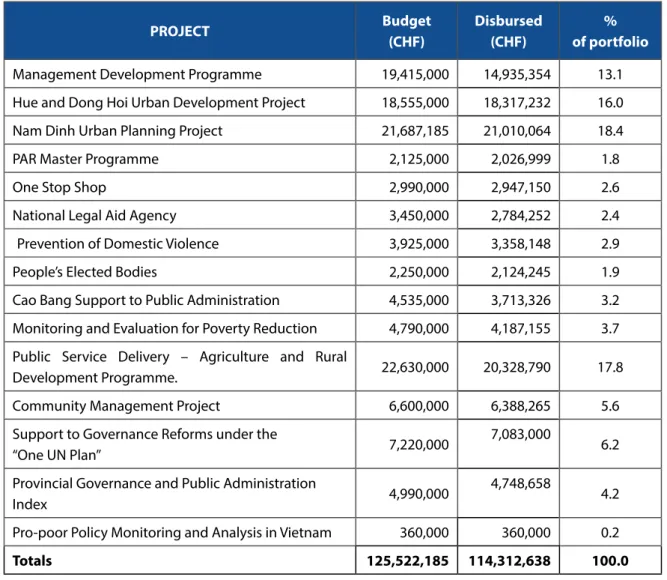
The present report covers the following 15 projects in the period from 1996-2016 (sorted by year launched):
Fig. 3: Governance projects overview - chronological list
The governance portfolio accounts for approximately 50% of the SDC country programmes, the remaining half being allocated chiefly to agriculture and forestry sectors. The disbursement rate against budget was 91%, which indicates a high standard of programming and budgeting. The table indicates the total budget/disbursement for each thematic area and the number of projects included. PROJECT Budget (CHF) Disbursed (CHF) % of portfolio Management Development Programme 19,415,000 14,935,354 13.1 Hue and Dong Hoi Urban Development Project 18,555,000 18,317,232 16.0 Nam Dinh Urban Planning Project 21,687,185 21,010,064 18.4
PAR Master Programme 2,125,000 2,026,999 1.8
One Stop Shop 2,990,000 2,947,150 2.6
National Legal Aid Agency 3,450,000 2,784,252 2.4
Prevention of Domestic Violence 3,925,000 3,358,148 2.9
People’s Elected Bodies 2,250,000 2,124,245 1.9
Cao Bang Support to Public Administration 4,535,000 3,713,326 3.2 Monitoring and Evaluation for Poverty Reduction 4,790,000 4,187,155 3.7 Public Service Delivery – Agriculture and Rural
Development Programme. 22,630,000 20,328,790 17.8
Community Management Project 6,600,000 6,388,265 5.6 Support to Governance Reforms under the
“One UN Plan” 7,220,000
7,083,000
6.2 Provincial Governance and Public Administration
Index 4,990,000
4,748,658
4.2 Pro-poor Policy Monitoring and Analysis in Vietnam 360,000 360,000 0.2
Fig. 4:Thematic Areas –Budget and No. of Projects
*) Figures lump together both budget and some disbursements figures to show the approximate costs of projects.
The area of local governance and service delivery takes up a more than 63 % of the portfolio budget. Together with the Academic Capacity Building, 76.7% of the portfolio was allocated to these two thematic areas. By comparison, national-level projects account for 20.4 % of the envelope of which 4.2% are allocated to provincial level monitoring (PAPI).
Fig.5: Allocation of Funds by Type of Project
Portfolio expenditures for local government and community level projects is 91 m. CHF or 80 % of the total. Central level projects accounted for the remaining 20% of portfolio disbursements.
More than 95% of the portfolio was disbursed on projects with a duration of more than 5 years, while 54 % of portfolio disbursements were allocated to projects of more than 10 years duration.
The allocation of funds also shows that SDC largely went its own way in selecting its interventions and in designing its programmes. SDC spent most of its resources and energies on developing its own projects and building its own partnerships at provincial and community level.
In SDC strategy, central level basket funds served to leverage influence and provide access to policy dialogue fora. Hence, a direct comparison by volume alone is not entirely appropriate.
Thematic Area No. of
projects
Disbursed
(CHF) %
1 - Academic Capacity Building 1 14,935,354 13.1
2 - Local Governance and Service Delivery 6 72,704,827 63.6 3 - National Reform Programmes and Monitoring 5 18,405,812 16.1
4 - Access to Justice 2 6,142,400 5.4
5 - Democratic Representation 1 2,124,245 1.9
Total 15 114,312,638 100.00
PROJECT Budget (CHF) % No. of
projects
Local level projects 90,998,329 79.6 8
Central level projects 23,314,309 20.4 7
Total 100 15
Basket funded projects 22,074,304 19.3 7
More than one phase 104,295,483 91.2 11
More than 5 years duration 108,881,243 95.2 12
19% of funds were spent on donor baskets. As the analysis will show, these projects were short-lived as compared to the local governance projects.
The data shows how SDC stayed with its partners. Thus 91% of projects had more than one phase, and 54% of the portfolio disbursements went into projects of more than 10 years duration.
Sticking with projects is not always a good thing – donors may continue to fund under performing projects for political imperatives rather than for reasons based on development efficiency. However, the analysis will show that SDC set the right priorities and stuck with the right partners. A number of projects were discontinued and others were substantially reformulated. Even though some long-term projects can best be described as learning processes, they obtained results in their own right. Most important, SDC has shown itself to be skilful in experimenting with ideas and approaches and in focusing on those areas were valuable results could be obtained.
4.1. ACADEMIC CAPACITY BUILDING
The Management Development Programme was the first and one of the largest projects of the SDC governance portfolio, beginning in 1993 and lasting for almost 15 years until 2007. The project’s main objective was to build academic qualifications and to develop business management teaching and research at four of the best-performing universities in Vietnam. The project ran over three phases beginning with diploma courses and Masters degrees in business management. Later, the project expanded into a doctoral thesis programme and a faculty development programme. Projects were also initiated to support development of a research network.
At the time the project was launched in 1993, the academic environment in Vietnam was intellectually and culturally isolated, heavily dominated by orthodox Marxist economic theory and under political control from Party structures and police surveillance. Exposure to international academic thinking and research was very limited and indeed; knowledge and application of foreign academic thinking was regarded with apprehension and not a small amount of suspicion. Moreover, the lack of knowledge on how to manage business in a market economy was a serious hindrance for the transition process from a central planning economy to a market-oriented economy in the country.
Four of the leading universities in Vietnam were selected as partners in the project. The project catered to a cohort of highly motivated postgraduate students with potential for high academic achievements. Through cooperation with the Asia Institute of Technology, it brought good knowledge of educational management to the partner universities. SDC was able to develop and expand the project to relevant new areas, in particular the introduction of the PhD programme in phases two and three. The completion rates for students in the diploma, Masters and PhD programmes were high, which testified to the rigorous selection of students in the project.
Against this background, the project was timely and relevant and made full use of opportunities and conditions available. The objectives of the programme were largely met, with the exception of the quality of the business executive training and the expectation that a distinct research network among participants in the programme could be established. The project received high credit in external reviews and from participants and beneficiaries throughout its lifetime and even today remains recognised within academic circles.
The project was seen as a model for other universities by partners, and there has since been a proliferation of MBA degrees offered by Vietnamese universities and foreign universities operating in Vietnam. At the time, several other international assistance programmes
supported Masters programmes and offered MBAs abroad. Among these, the Management Development project stands out as one of the first and largest.12
The project included a Business Executive Programme aimed at building the capacity of business leaders. This must be viewed as a failure, as witnessed by the distribution of participants: In the period 1993-2002, a total of 507 participants took part in 25 courses: of these, 140 were government officials, 130 were from universities, 185 from state-owned companies, and only 54 from private companies.13 In effect, private business showed little or
no demand for the courses. The project did try to remedy this in phase three, but apparently with limited success.
University education has undergone significant innovation and modernisation over the past two decades. However, Vietnamese universities continue to suffer from severe constraints. The private market for academic degrees has expanded but remains generally of low quality and a drain on state resources. Academic freedom, curricula and research remain limited and under political control. The extent of direct foreign cooperation is still limited, and international lectures and teaching exchange programmes remain very limited and subject to external control through ministries and the security apparatus.
Beneficiaries:
The available project documentation shows the following number of beneficiaries: • + 200 MBA graduates
• + 35 PhD degrees awarded
• Diploma courses attended by + 200 students • Faculty and students at four universities
• Participants in courses offered under programme
The number of beneficiaries cannot be ascertained. However, the number of students that have benefitted from classes, improved curricula and other academic support since the beginning of the project period could be in the range of 15 – 25,000 persons.
Conclusions:
The project had considerable impact through knowledge transfer and the subsequent careers of project beneficiaries within university structures. The project succeeded in disseminating the application of teaching and research methodology and in the establishment of MBA programmes at partner universities and elsewhere. The project had a lasting impact on promoting international academic accreditation of the participating faculties, introducing modern education management, promoting quality assurance programmes, curriculum development and international exchange programmes.
4.2. LOCAL GOVERNANCE AND SERVICE DELIVERY
Local governance and service delivery is by far the largest thematic area of the governance portfolio, taking up more than two-thirds of the funds invested in the period from 1996 to 2016.
12. Sweden, France, Belgium and USA (Fulbright) supported some of the major academic programmes.
13. Swiss – AIT – Vietnam Management Development Programme: Joint Evaluation Report (1993-2000); p. 18, Hanoi, April 2000.
The projects included in this section are:
1. Hue and Dong Hoi Urban Development Project 2. Nam Dinh Urban Development Project
3. One Stop Shops
4. Cao Bang Support to Public Administration Reform
5. Public Service Delivery – Agriculture and Rural Development Programme 6. Community Management Project
The SDC case for improving local governance is threefold. First, good policies and administration at local level will improve public service delivery by making them more responsive to and accountable for local needs. Second, the real inclusion of the population in planning and prioritising local investments will result in effective allocation of scarce resources. Thirdly, a population that has influence over resources and policies is better able to improve its living conditions.
Ideally, these three factors are mutually reinforcing, although their interaction is complex and dependent on political structures, bureaucratic mindsets, and the presence of officials and community leaders who are able and willing to champion local reforms.
The programme environment in Vietnam is challenging. The administrative and political structures in Vietnam are strongly hierarchical and compounded by parallel Party structures in all state bodies and administrative units. The main purpose of the governance system is to maintain hierarchical political control and Party coherence, not to foster administrative efficiency and public accountability.
Local government decisions are bound by the need to seek consensus and to obtain permissions from higher levels of local government. All official counterparts rely on a top-down system of decision-making for even minor matters affecting project implementation. The system is not transparent and only to some degree rule-bound.
To further complicate matters, each ministry maintains departments at provincial levels with substantial influence over policy-making and implementation. The Ministries of Finance, of Planning and Investment, of Justice, of Agriculture and Rural Development, of Home Affairs, of Public Security all have provincial departments with which the SDC projects had to coordinate and from whom various permissions had to be obtained to implement the projects.
It is a measure of the success of SDC projects to have engaged successfully with local governments and to have expanded the bottom-up approach of its projects to include local communities in direct management of project decisions and in community planning. This would not have been possible without lengthy project preparation, continuous consultation with partners and a robust knowledge of local conditions based on years of experience and building the profile of SDC as a trustworthy partner.
4.2.1. Urban Development
In the period from 1996-2007, the SDC ran two urban development projects: Hue and Dong Hoi Urban Development Project and Nam Dinh Urban Development Project.
Provincial capital cities in the mid-90s existed in very poor conditions. Looking back, it is striking just how poor the country was: statistics from Dong Hoi in the mid-90s showed a GDP per capita of about 75-125 USD. According to project documentation, public water distribution reached only 16% of the population and more than 30% of the population had no access to sanitation. Solid waste collection amounted to a mere 12% of waste generated by the city.
SDC’s urban development projects built on a good policy and legislative background: the Decree on Grass Root Democracy (1995) was a policy milestone in the delegation of powers to local governments, which was further strengthened by the Decree on Communal Level Democracy (1998). This legislation gave local governments a degree of autonomy over development plans and budgets that enabled direct cooperation between foreign donors and provinces.
The SDC Urban Development programme was formulated as an outcome of the Dong Hoi and Nam Dinh Public Administration Reform Pilot Projects (1997-2000). The key objective was to enhance the role of medium-sized cities in Vietnam’s development. Urbanisation was seen as an engine of economic development and the programmes sought to promote more even economic growth by focusing on urban centres in the provinces.
Beneficiaries:
The number of beneficiaries of the urban development projects cannot be ascertained. However, given the scope and diversity of the project activities, a useful proxy measurement is the population of the three cities Dong Hoi, Hue and Nam Dinh totalling 160,000, 350,000 and 352,000 respectively. Hence, it is estimated that a between 500,000 to 850,000 persons may have been in contact with and benefitted from the projects.
Conclusions
SDC urban development projects were pioneers within the field of planning and local governance. As a result, some project show mixed results and frequent adaptations of objectives and components during project life times.
The evolution of the SDC urban development program in Vietnam is a good illustration of learning by doing. Phase 1(1997-2000) of the program focused on capacity building for public officials in municipal management and included local planning, strategy development, institutional reorganisation and training. Review reports show that this phase did not work well and that local government ownership was a key hindrance to obtaining the expected results.
The main lessons for SDC were that in a poor city, institutional and organisation reform should be matched with support for development of basic infrastructure. Therefore, infrastructure development for waste management and flood prevention was added in the second phase (2000-2003). The scope of the projects was shifted towards urban governance and included components on decentralisation of planning and budgeting, citizens’ participation and new public management. Two successful pilots – One Stop Shops and Community Management –were later developed into separate successful projects.
The experience from this program taught SDC that in the political context of a transitional country like Vietnam, impact on governance reform cannot be obtained only at local level. This insight contributed to forming SDC’s two-pronged strategy – work at local level under bilateral projects while teaming up with like-minded partners to work at the national level (e.g. PAR and parliamentary reform). National-level programmes carried opportunities for advocacy, policy dialogue and institutionalisation of successful local pilots (e.g. OSS) in national or sector programmes.
However, the two-pronged strategy also had its limitations, in particular with respect to the lack of response by local governments to national public administration reform programmes. Thus, Phase 3 of this program was over-ambitious and misjudged the ability and willingness of local governments to promote PAR reforms. As a consequence, many planned results in Phase 3 were only partly achieved or stalled.
Waste management
An important component of all three urban development projects focused on waste management, sanitation, landfills and protection against flooding. The projects also included activities for restructuring local agencies responsible for waste management and support to development of city-wide strategies for environmental protection.
There are many examples of positive feedback from provincial authorities on the waste management components. Notably interviews conducted more than 10 years after the completion of the projects all bring out various lasting benefits of these components. The benefits include physical improvements in the urban environment and people’s daily lives, the impact of urban plans for waste management and a change in people’s attitude towards environmental protection.
See below, section 4.6.1, for further discussion of the impact of environmental protection components in the urban development programmes.
4.2.2. One Stop Shop Replication
The earliest national regulation on One Stop Shops was the prime ministerial decree No. 38 from 1994. One Stop Shops were subsequently expanded by the prime ministerial Decision 181 of September 2003 with the objective of establishing operational One Stop Shops in all districts by end 2004 and in all communes by end 2005.
Two national development programmes, PAR and the Comprehensive Poverty Reduction and Growth Strategy, adopted One Stop Shops as part of their strategies in 2002, which gave further political direction to provincial governments.
The SDC support to One Stop Shops made an early start in Dong Hoi Urban Development Programme in 1999. Under DUDP, the establishment of OSS was extended to several districts in Quang Binh province.
“SDC’s studies on pollution and remedies for pollution from the landfills near the city at that time still retain their value. Later, the French government continued to support the city with a waste treatment plant.”
In 2002, SDC supported the Ministry of Home Affairs to elaborate a national evaluation of OSS and to develop recommendations for national replication. This evaluation formed the basis for the Prime Minister’s Decision 181 in 2003 on nationwide replication of OSS. In May 2003, One Stop Shops were established and functioning in approximately 25% of all districts in Vietnam (160 out of a total of 661 districts).14
SDC’s project for One Stop Shop
Replication was launched in 2003, based on the success of the cooperation with MoHA and the release of PM Decision 181. The programme ran for three years until 2006. Under the programme, SDC has supported OSS establishment in 103 districts in nine provinces.15
Most One Stop Shops include some or all of the following: 1) notarisation and authentication services, 2) business licensing, 3) land administration, 4) selected social services, 5) construction permits, and 6) household registration.
Review reports and interviews consistently names the OSS as a good and sustainable result.
Factors contributing to the success of the project include:
• The project was aligned with successful government policy and regulation.
• The project was built on solid project experience from previous SDC projects on OSS pilots in Dong Hoi and urban development projects.
• The project was implemented and financed through direct agreement between SDC, the provincial People’s Committee and local authorities at district levels.
• The project developed a standard model and costing for a standard One Stop Shop, which is good practice and a sound basis for planning and replication of the model. • A two-pronged strategy allowed SDC to pilot a new instrument/ideas at the local level
and then bring the result to the national level for institutionalisation and replication. • SDC supported the replication process with the central level agencies.
The quality and level of service provided by One Stop Shops at present is not known to the review team. The quality of service is bound to vary from locality to locality depending on the
“Most impressive activity of the administrative reform in Dong Hoi is the One Stop Shop. This model is developing day by day. Up to now, many OSS are computerised and makes convenience for people.”
NGO leader, project participant, Dong Hoi interview, October 2015.
14. Quoted in District OSS Assessment in Quang Binh Province, February 2004, p. 7.
16. District OSS Assessment in Quang Binh Province, February 2004, p. 4.
17. Final Project report on OSS Replication at district level in nine provinces in Vietnam; Urban Rural Solutions JSC, Jan 2005, p. 2. Figures quoted from MoHA.
18. Ministry of Home Affairs, 2015 Year End Report and Orientation 2016.
motivation of the local OSS leaders and staff and the level of support from local governments. This point was brought out clearly in the SDC project review from 2004, which stated that “the OSS organisation and structure effectiveness seems to be highly linked with the OSS manager’s functions.”16
Beneficiaries:
The OSS project was implemented in nine provinces. The population count for these provinces is 11,500,000 persons. No figures are available on the number of persons using the services of the One-stop Shops. For the purpose of this survey it is assumed that 10 – 20% of the population may have recourse to the One-stop Shops at some point. The number of beneficiaries is found to be in the range of 1 – 2,000,000 persons. In addition, the project was successful in supporting national regulation for the establishment of One-stop Shops across the country.
Conclusions
The OSS project shows a clear line of impact from national policy to outcomes at provincial and district level. The SDC project was well conceived, timely and had clear demonstrable effects that promoted the subsequent replication of the OSS model in other provinces. Nationwide, the OSS has achieved impressive numbers for replication. As early as December 2003, the expansion of OSS had reached 54 cities and provinces, and included 483 out of 654 districts. However, commune-level One Stop Shops were established in only 695 out of 10,707 communes, or 6.5%.17
By 2015, the Ministry of Home Affairs reports,18 10,958 communes had established One Stop
Shops out of a total 11,164 communes (equivalent to 98,15%). A total of 704 districts had established One Stop Shops out of 713 districts (equivalent to 98,7%), and 1,114 provincial specialised departments and agencies participated out of 1,204 (equivalent to 92,5%).
4.2.3. Participatory Planning and Local Development Funds
This thematic group contained three projects. All three projects supported local infrastructure development and participatory planning processes. Two first projects collaborated with communes, while the third project worked directly in relation to community groups.
• Cao Bang Support for Public Administration Reform,
• Public Service Delivery
– Agriculture and Rural Development Programme.
The communes are the first level administrative unit in the Vietnamese administrative system. The counterparts in the CB-SPAR and PSARD projects were districts and commune officials. Funds for the Commune Development Funds were transferred by direct agreements between the SDC and the local authorities.
The Community Development Funds were managed directly by the local communities without a corresponding state administrative structure. Hence, funds were managed by the project itself and accessible directly by the project communities through an application procedure. A. Participatory commune-level planning
Participatory planning of local Socio-Economic Development Plans (SEDP) and commune management of small-scale infrastructure was a key objective of two projects:1) Cao Bang Support for Public Administration Reform, and 2) Public Service Delivery – Agriculture and Rural Development Programme.
The projects focused on the participation of communes, villages and households in the annual identification and prioritisation of local SEDP plans, which in turn formed part of the district and provincial implementation of the national SEDP target programme.
The Commune Development Funds have five main purposes:
• To provide limited funding for the implementation of SEDP activities at the commune level. • To improve the financial management capacity of commune staff.
• To promote community ownership of investment, and thereby to demonstrate that communities are capable of managing investment budgets.
• To generate feedback to local authorities on community needs. • To increase transparency of communal investment budgets.
The participatory approach to Social-Economic Development Plans was designed to increase bottom-up demand for allocations and transparent investment planning. Thus, the Community Management Project facilitates the participation of communities in the participatory commune SEDPs under the higher level SEDPs of the districts and the province. The local plan follows a planning cycle initiated by the district government upon decision from the provincial authorities. The local SEDP establishes target spending and priorities decided by the local communities. In the best cases, the communes themselves take charge of managing the planned activities and investments. This has benefits in the form of increased transparency, improved accountability of local authorities, lower construction costs and, more intangible, empowerment of local communities and attitudes of local government officials. Over time, the local governance projects were able to expand from local authorities to include individual households, what in Vietnamese political parlance is known as the “grassroots”. The term is somewhat derogatory and reflects the steep distance between government and subjects in the Vietnamese political system. Thus, early urban development projects in Hue, Dong Hoi and Nam Dinh worked with district governments and piloted forms of commune participation in decision making and project management. In the full expansion of this principle, the PSARD and the Community Management Project were able to extend participation from communes to communities and households.
The projects had noticeable impact on people’s confidence and ability in using the planning process to influence administrative decisions and making their opinions heard.