Land Use in LCA (Subject Editor: Llorenç Milà i Canals)
Assessment of Land Use Impacts on the Natural Environment
Part 1: An Analytical Framework for Pure Land Occupation and Land Use Change
Thomas Koellner* and Roland W. Scholz
Swiss Federal Institute of Technology, Department of Environmental Sciences, Natural and Social Science Interface (ETH-NSSI), ETH-Zentrum CHN, 8092 Zurich, Switzerland
* Corresponding author ([email protected])
Part 1: An analytical framework for pure land occupation and land use change Part 2: Generic characterization factors for local species diversity in Central Europe
Preamble. This series of two papers is based on a PhD thesis (Koellner 2003) and develops a method on how to assess land use impacts on
biodiversity in the framework of LCA. Part 1 further expands the analytical framework of the thesis for pure land occupation and land use change.
Part 2 rests on a much richer database compared to the thesis in order to quantify generic characterization factors for local species' richness.
Recommendations and Perspectives. One main problem to
ad-dress is the development of reliable generic characterization fac-tors, which express the ecosystem damage potential of specific land use types. The characterization factors should be devel-oped on an empirical basis, which allow decision makers to get access to knowledge from environmental sciences in a very con-densed form. In order to support decisions on distinct land use projects, methods should be developed, which allow accomplish-ing a generic assessment with site-dependent assessments.
Keywords: Characterization factor; damage function; ecosys-tem; impact; land use; LCA; restoration time
DOI: http://dx.doi.org/10.1065/lca2006.12.292.1 Abstract
Goal, Scope and Background. In the framework of LCA, land
use is broadly accepted as an impact category. However, the methodology for the assessment of damages on the natural en-vironment was and still is the subject of discussion. The main objective of this paper is to contribute to that discussion by providing a consistent methodological framework for the as-sessment of land occupation and transformation.
Methods. We clarify the context of LCA relevant land use
deci-sions. Based on that, we develop a formal model with damage functions and generic characterization factors for quantifying damages on ecosystems from land occupation and land trans-formation. The characterization factor for land occupation and land use change is labeled Ecosystem Damage Potential (EDP). We analytically address the substitutability of area and time occupied in order to produce a constant output.
Results. Based on the proposed method, it is possible to
calcu-late the damages from complex series of land transformation, land occupation, and land restoration. A main feature of the method is that land transformation is assessed based on a fac-tual or virfac-tual, restoration time. This means that the damage of land transformation is largest for land use types which are diffi-cult to restore and need extremely long to develop (e.g. thou-sand of years and more for primary forest and peatbog). In ad-dition, we could show that area and time of occupation are not substitutable. The more severe the damage potential of a spe-cific land use type is, the better it is to minimize the area and maximize the duration of occupation.
Discussion. An approach for the assessment of pure land
occu-pation and land use change was developed in this paper, which is not geographically referenced. Developing geographically-ref-erenced land use inventories and impact assessment methods can increase their accuracy. The information cost to provide geographically referenced data on land use for practical LCA applications, however, would increase enormously.
Conclusions. An impact assessment method for land use with
generic characterization factors improves the basis for decision-making in industry and other organizations. It can best be ap-plied to marginal land use decisions; that is, to decisions in which the consequences are so small that the quality or quantity of environmental parameters of a region is not noticeably altered.
Introduction
The Earth's land areas are dominated by human usage. In Europe, as in other industrialized regions, a large propor-tion of the area is used for forestry, agriculture, cities and infrastructure. Only a rather small remaining proportion is occupied by natural ecosystems, which are not in use at all. Irreversible consequences of such intensive land use include soil degradation and erosion, shifts in ground water avail-ability, loss of biodiversity, and load with nutrients and ecotoxical chemicals. For that reason, land use is taken into account in LCA and represents an impact category (Heijungs et al. 1997, Udo de Haes et al. 1999). The impact category
land use groups together all intentional activities necessary
to make land usable as a resource in economic sectors such as agriculture, forestry, and the building industry.
The development of the assessment methodology for land use in LCA has been the subject of lively debate (Finnveden 1996, Heijungs et al. 1997, Pennington et al. 2004). Gener-ally, four areas of protection are proposed: Protection of
human health, natural environment, natural resources and man-made environment (Udo de Haes et al. 1999). For the
area, natural environment following impacts were proposed for an assessment: Impacts on life support functions and ecosystems services (Blonk et al. 1997, Koellner 2003, Lindei-jer 2000a, Udo de Haes et al. 1999), impacts on naturalness
of areas, including the time necessary for regeneration after different types of use (Brentrup et al. 2002, Frischknecht et al. 1996, pp. 44, Giegrich and Sturm 1996), and impacts on biodiversity (Goedkoop et al. 1998, Heijungs et al. 1997, pp. 28, Koellner 2000, Koellner 2003, Lindeijer 2000a, Müller-Wenk 1998, Udo de Haes et al. 1999, Udo de Haes 2006). In order to quantify land use in the LCA framework, land occupation and land transformation are considered basic land use activities (Koellner 2003, Lindeijer 2000a, Lindeijer 2000b, Lindeijer et al. 2002, Lindeijer et al. 2001). Two methodological problems still remain unresolved. The first problem is how to calculate the total damage from a series of land use activities, including a complex series of transfor-mation and occupation. The second problem is substitut-ability of the space and time in land use impact assessment. Currently, in impact assessment methods for land use, a re-duction of occupation time can be compensated with an in-crease of occupied area, because the total intervention is calculated by multiplying both. The question is, however, what way the damage should depend on the relation of area and time occupied. The goal of the paper is to provide a methodological framework for the impact assessment of land use and to address the two mentioned problems.
1 The Decision Problem to Frame the Assessment
Method for Land Use Impacts in LCA
In order to propose an assessment method, it is necessary to know the decision problem for which it will be used (Werner & Scholz, 2002). In general, it is possible to distinguish two types of land use decisions. First, information about a spe-cific case of land use is available and the site where this case takes place is known. For example, when alternative loca-tions for an industrial plant or alternative routes for a high-way exist, and the decision must be made for one of the alternatives. An environmental assessment of the land use activity associated with the case can be made site-specific with an Environmental Impact Assessment (EIA). Second, the other type of decision is made considering the environ-mental impact of a land use type without being able to take into account the specific site of its use. In the food industry, for example, a general decision can be made in favor of raw materials from organic agriculture and against conventional farming. In such instances, the environmental assessment of the land use activities cannot be site-specific, but must, rather, be generic. However, it may be useful to distinguish differ-ent regions in the latter assessmdiffer-ent.
In LCA, the second type of land use decision is more rel-evant. If we assess the environmental impact of a product or process, the specific site where a land unit has been used is generally not known in LCA. Information costs would rise considerably if the exact location of every land use in a product's life cycle would have to be registered. Therefore, in LCA, a more generic assessment of the environmental impact of different types of land use is applied. When available, case-and site-specific information, can improve the assessment. In general, from a LCA view, we can distinguish between land transformation, land occupation and land restoration with corresponding periods Ttrans, Tocc, and Tres. Land
occu-pation means the continuous cover of land with one type to get a specific outcome, whereas land transformation is the change from one land use type to another (Koellner 2003, Lindeijer 2000a, Lindeijer 2000b, Lindeijer et al. 2002, Lindeijer et al. 2001). A special type of transformation is the restoration of areas after the use phase, which might be managed or spontaneous without human activities. From a decision perspective, the case of pure land occupa-tion is of specific interest. This is due to the lack of informa-tion on the transformainforma-tion phase, which can originate from diverse histories. Further, the restoration of occupied land is a future event and, thus, there is no secured knowledge about this phase. We will thus first deal with the simple case of
pure land occupation and then deal with the more complex
case of land use change.
All basic land use activities result in either damage to or benefits for ecosystem quality. Land transformation creates a change in ecosystem quality and land occupation delays changes to its quality. The damage potential of land occupa-tion refers to the use of an area of land, which demonstrates a constant quality over time. This damage potential increases as the ecological quality of the occupied land decreases.
2 Results: Method to Assess Land Use Impacts in LCA
2.1 Calculation of ecosystem damages for pure land
occupation
For pure land occupation, the total ecosystem damage Docc is depending on the area occupied, the duration of occupa-tion and the damaging potential for ecosystem quality of a specific land use type. The damaging potential of a specific land use type is called EDPocc (Koellner, 2003). EDPocc is the characterization function and expresses the ecosystem damage for a specific land use type. In this paper, we as-sume simplifying a constant damage over the occupation period. In general, the function EDPocc depends on t
(quan-tified in years) and an area variable a (quan(quan-tified in square meters). As in a first step, we comprise the geographic coor-dinates to a one-dimensional area variable a. We have to define the variable a in a way that standard calculus of inte-gration becomes possible. This can be done, e.g. by defining unit areas, e.g. squares of the size of 1 square meter and then numbering all unit areas from 0 to a1.
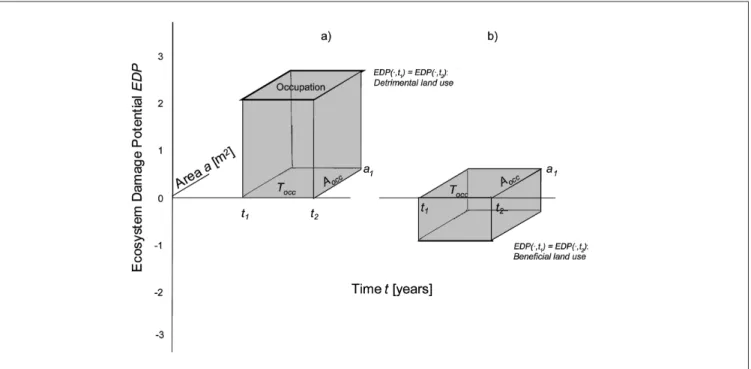
For land occupation, the characterization factor EDPocc is assumed to be independent of the specificarea coordinates a and time t (indicated by its parallelism to the 'x,z-surface' in
Fig. 1a and 1b). Formally, this is written as
EDPocc = EDP(a,t) for all a ∈ [0,a1] and t ∈ [t1, t2] (1)
The potential damage (Docc) of a specific land occupation is calculated as the integral of the damage function yocc over time t and area a.
(2)
Where, in this formula, EDP(·,t1) is the Ecosystem Damage
all possible values for a (indicated by the ·). Since we assume no degradation or improvement of the area's ecosystem qual-ity, EDP(·,t1) is equal to the Ecosystem Damage Potential at
the end of the occupation at t2, i.e. EDP(·,t2). Aocc is the size of the area of occupation, which is measured in square meters.
T1 is the initial time of occupation, t2 the closure time of
oc-cupation and Tocc the duration of occupation. This means that the amount of total damage Docc is the intervention (area multiplied by the period of time during which the land is used) multiplied by the dimensionless characterization factor
EDP(·,t1). The unit of Docc is thus square meters multiplied by
years. This simple calculation of impacts of land occupation was already proposed by the SETAC working group on Im-pact Assessment in 1996 (see Lindeijer 2000b). In contrast to other proposals, we introduce the possibility of beneficial im-pacts on the environment due to land use. The value EDP(·,t1) is positive in the case of weak detrimental land use (see Fig. 1a) and negative in the case of beneficial land use (see Fig. 1b). Examples for such land use types beneficial for ecosystem quality might be ecologically managed forests or species rich meadows. They still are productive with respect to usable biomass, but can be very beneficial in terms of bio-diversity at the same time. The transition between beneficial land use and detrimental land use depends on the chosen reference. We suggest the current regional status in order to assess whether a specific land use type is worse or better compared to the regional average land use mix.
2.2 Calculation of ecosystem damages for land use change
In the case of land use change, two different approaches have been introduced (e.g. Lindeijer et al. 2001). (i) The 'net' transformation impact, which means amount of negative or positive changes of ecosystem quality over time. This is sim-ply the difference of the damage characterization function
at the end of the transformation phase EDP(.,t
1) and the
beginning EDP(.,t
0). (ii) The impact of land use during the
transformation phase can be considered in a differential manner while the changing ecosystem quality during the transformation phase is added up and integrated. Thus, a transformation process which attains a high damage very soon after t0 receives a more negative evaluation than a
pro-cess which starts smoothly and attains high negative pacts just before regular land occupation. An area can im-prove from low to moderate ecosystem quality over time (i.e. positive transformation impact), but the area still dem-onstrates an ecosystem quality somewhere between bad and moderate (i.e. negative occupation impact).
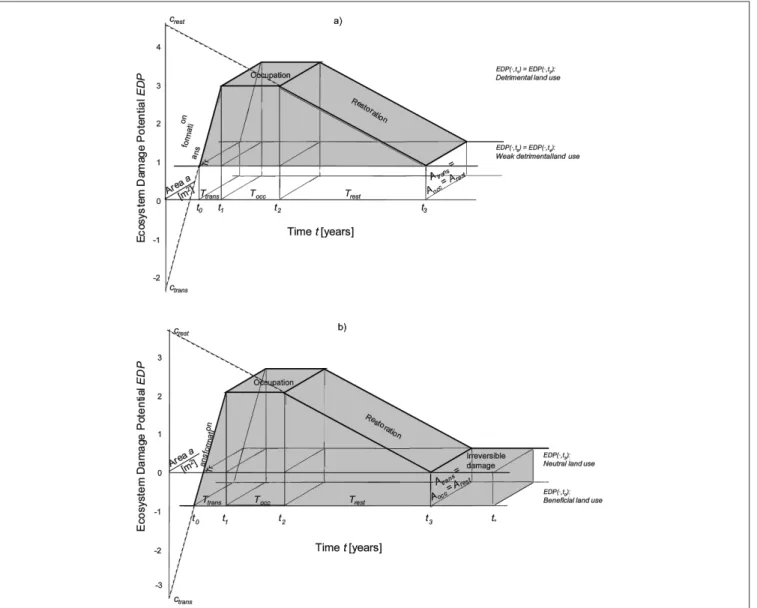
In the simplest case, the damage function EDP for transfor-mation and restoration are linear functions. We show only the formula for the transformation function, as we assume only different slopes for land transformation and land restoration. As in the former simplified calculations, we assume that the damage potential EDP is independent from the area vari-able a (again indicated by its parallelism to the 'x,z-surface' in Fig. 2). The linear damage function is written as:
EDP(a,t) = ctrans + m · t for all a ∈ [0,a1] and t ∈ [t0, t1] (3)
Where EDP(·,t0) is the damage potential at the beginning of the transformation phase (i.e. t0) and EDP(.,t
1) is the
dam-age potential at the beginning of the occupation phase t1 for any value of a, ctrans is the y-intercept (i.e. the bottom
cross-ing of the dashed lines with the y-axis in Fig. 2b) and m is the slope of the damage function. Ttrans denotes the duration
of transformation.
The potential damage for land transformation (Dtrans) equals
the size of the shaded wedge over the [t0,t1] × [0,a1] area. If
Fig. 1: For land occupation, the total damage (represented by the grey volume) is calculated with the ecosystem damage potential EDP, time of occupa-tion Tocc and area of occupation Aocc. a) For detrimental land use types, the damage is positive and b) for beneficial land use types, it is negative (equals benefit). The transition from damages to benefits very much depends on the chosen reference
we take the integral of the EDP-function over the base area, the white cube below the shaded wedge has to be subtracted (see Fig. 2a). This is generally written as
(4)
The damage Dtrans from transformation is then calculated as
(for the complete deduction of the left summand integral see the appendix)
(5)
Simultaneously for Drest it is
(6)
Fig. 2: Land use activities as sequences of transformation (trans), occupation (occ) and restoration (rest). The upper surface of the grey volume in the graph is the damage function y. For land occupation, it is only depending on the level of the ecosystem damage potential EDP. For land transformation, it depends in addition on the transformation and restoration time. In both cases, however, the area of land use activity does not influence the damage function. The grey volume itself represents the total damage of a land use activity and is the integral over area A and duration T of each land use activity. a) Completely reversible land transformation with weak, detrimental land use type before transformation and a detrimental one during occupation. b) The sequence of land use starts with a beneficial land use type, followed by a detrimental one during occupation, and, after a restoration phase derived from a neutral land use type. Because the original beneficial level cannot be reached again, irreversible damage is achieved
2.3 Sequence of land transformation, occupation and restoration
The equations (2) and (4) form the basis upon which to cal-culate the damage/benefits of a sequence of land transfor-mation, occupation and restoration in a modular mode (see Fig. 2 a and b). Equation (4) can be used to calculate dam-ages from both transformation and restoration. If we con-sider a certain type of land use, the total damage Dtotal
re-sulting from land use is the sum of all individual damages from transformation Dtrans, occupation Docc, restoration Drest, and of the baseline Dbase i.e.:
Dtotal = Dtrans + Docc + Drest + Dbase (7) The total damage is represented by the volume in Fig. 2a. This means that the situation before transformation at t0 is taken as a baseline for calculating the damage of a sequence of land use. Note that the occupation damage now is not calculated with the neutral land use type with EDP(a,t0)=0, but taking the damage potential of the initial land use type as a reference. If the neutral land use type is chosen as the baseline, Dbase has to be added, which is represented by the white base in Fig. 2a. The neutral land use type must be taken anyway as a baseline, in case the land use type before transformation is not known. Fig. 2b shows a case where the initial land use type at t0 is beneficial for ecosystem quality and this stage is never reached again. The total damage is calculated as the sum of all three phases given in equation [7] and, in addition, as infinite damage due to the irreversible damage component. According to Lindeijer (2000b), this damage component is quantified by the delta change of potential damages (∆Dtrans) between two points in time (t0 and t3) resulting from a
trans-formation and is calculated as
∆Dtrans = [EDP(·,t3) – EDP(·,t0] · Atrans (8)
where positive results indicate deterioration and negative re-sults demonstrate improvements in ecosystem quality. The same applies for potential benefits, which occur when occupied land or land after transformation shows high ecosystem quality. This proposed method allows an assessment in the damage of complex sequences of land use (e.g. rotation systems in agriculture, where use of a field might periodically alternate between being in an intensive state or in an extensive one for recovery).
2.4 Substitutability of area of occupation and time of occupation
Our approach provides also an analytical solution to the issue of equivalence of area and time in LCA of land use. Let us consider two combinations (i and j) of size of area and time of occupation for one and the same type of land use (e.g. corn growing). The damage function is assumed to be independent of time and area. According to equation [2], area of occupation and time of occupation are substitut-able. Reduction of occupation time can be compensated by increase in the area of occupation in order to have a con-stant functional output C. Thus, in general, there are many combinations of amounts of area and time:
Aocc i · Tocc i = Aocc j· Tocc j = C (9)
For the sake of simplicity, we assume that EDP(a,t1) =
EDP(a,t2) = 1, EDP(a,t0) = EDP(a,t3) = 0 and Ttrans = 0, for
both types of land use. This means that the transformation is infinitely fast, therefore Dtrans = 0. If the damages of two
different combinations (i and j) are equal, then the ratio of the total damages Dtotal i / Dtotal j should be 1. We can infer
from [2], [8], and [9] that Aocc = Arest:
(10)
Thus,
(11) Even in this simple case, the substitutability of area and time of occupation is a rather intricate relationship. The equa-tion reveals that restoraequa-tion time can get a significant im-pact on substitutability consideration, because D1/D2 is not
1, but depends on the restoration time Trans, occupation time Tocc and Aocc area of occupation. Only for short restoration times, the ratio becomes 1, i.e.
.
For a restoration time of 1 year, for example, for Aocc i = 10, Tocc i = 10, Aocc j = 5, Tocc j = 20 and therefore C = 100, the value for the ratio is 1.02. This means that the area of occu-pation and the time of occuoccu-pation are fully substitutable for practical applications. For the same values, but a restora-tion time of 1000 years, the calculated ratio is 1.96. The more intensive land use is and the longer the restoration time, the higher is the advantage of increasing the occupa-tion time and reducing the area of occupaoccupa-tion in order to minimize damage Dtotal. To illustrate this, imagine two types of built-up land. One type with removed soil, solid base-ment and, therefore, long restoration times. Consider the other as light construction without basement, easy to re-move and short restoration time, because soils are not heavily disturbed. In order to get a constant output of area times time (C), it would make sense for the first case to maximize occupation time and to minimize occupation area. In the second case it is less clear, because removing the building is easy, restoration time is short and damage low. Therefore, one could consider changing the location during occupation time, which means to increase the area affected and reduc-ing the average occupation time. In this case it is less impor-tant to maximize occupation time and minimize occupation area. Based on cost consideration, we would come to a simi-lar conclusion for both exempsimi-lary cases.
2.5 Transformation times
In order to calculate the damage of land use transforma-tion, it is necessary to have information about the time, which is needed for transforming one land use type into another one. In general, high-intensity land use types are very quickly reproduced. In contrast, near-to-natural land cover types need a long time for restoration. The restoration is regarded as a special type of transformation and refers to transfor-mation towards a favorable land use type either with or without human intervention.
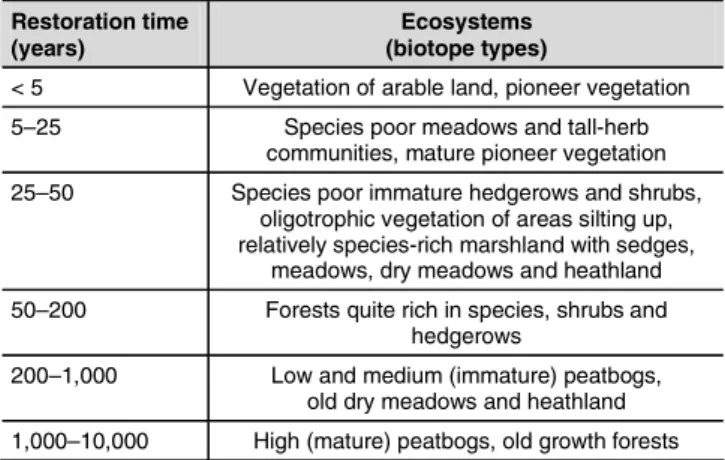
Bastian and Schreiber (1999, p. 298) assessed the restoration time for a number of different ecosystem types based on a literature review (Table 1). Restoration times differ consider-ably for investigated ecosystem types. For example, pioneer vegetation is quite easily restored compared to peatbog. Based on the data given in Table 1, we estimated the resto-ration time of different types of intensities of land use (Table 2). It should be clear that the estimates are some-what arbitrary and only a rough first approach. Depending on the initial/final quality of the land use type, the climate, and many other factors, restoration times may vary quite considerably. Some ecosystem types, however, might never be restored again either.
3 Discussion
If characterization factors for the specific land use types and region are known, a calculation of damages is straightfor-ward. In order to quantify damages from land occupation, the only data needed are the land use types, the time of oc-cupation, and area of occupation. More complex is the cal-culation of damages from land transformation. According to Lindeijer (2001) and Milà i Canals et al. (2006), the trans-formation impact is distinguished from the occupation im-pact. In the case of land use activities with a defined end of use phase (e.g. mining), the total potential damage of the occupation impact of the transformation should be calcu-lated as the sum of the potential damage of the transforma-tion at the beginning, of the occupatransforma-tion phase in the middle and of the restoration at the end (see Fig. 2). It is the integral over time and area and is calculated according to the basic equations (2) and (4). Please note, for this calculation, that the restoration times are of central importance. Calculated damages increase with increasing restoration times, i.e. du-ration between end of occupation and the point in time where a land cover type has developed with the same damage po-tential as the initial one. This must not imply that exactly the same ecosystem type is restored, but one of equal qual-ity and value. To explain this further we use an example. Imagine a piece of primary forest is logged, which is ex-tremely difficult to restore, but after a couple of thousand of years an ecosystem of similar quality could have developed. This long restoration time and correspondingly high dam-age of the restoration phase would express the damdam-age of logging this forest. Even though in this case the transforma-tion damage in sensu Lindeijer is zero according to equatransforma-tion [8], because EDP before transformation and EDP after res-toration are equal. Milà i Canals et al. (2006) do not follow this argumentation and denote also the integral over time and area as the transformation impact. An open question is where to set the baseline for calculating the transformation damage. In principle, the neutral land use (land use with no effect in the region with EDP = 0) or the land use before transformation can be used as baselines (EDP at t0). If an LCIA approach stresses dynamics of damages over time, the land use before transformation can be used as baselines (EDP
Restoration time (years)
Ecosystems (biotope types)
< 5 Vegetation of arable land, pioneer vegetation
5–25 Species poor meadows and tall-herb
communities, mature pioneer vegetation
25–50 Species poor immature hedgerows and shrubs,
oligotrophic vegetation of areas silting up, relatively species-rich marshland with sedges,
meadows, dry meadows and heathland
50–200 Forests quite rich in species, shrubs and
hedgerows
200–1,000 Low and medium (immature) peatbogs,
old dry meadows and heathland
1,000–10,000 High (mature) peatbogs, old growth forests
To final →
From initial ↓ Agri_hi Agri_li Artificial_hi Artificial_li Forest_hi Forest_li Non-use
Agri_hi – 10 <1 2 25 50 500 Agri_li <1 – <1 2 25 50 500 Artificial_hi 5 10 – 2 25 50 500 Artificial_li 2 5 <1 – 25 50 500 Forest_hi 1 2 <1 2 – 25 – Forest_li 1 2 <1 2 10 – – Non-use <1 <1 <1 2 10 25 –
Agri_hi: conventional arable, integrated arable, organic arable, fibre/energy crops, intensive meadow Agri_li: less intensive meadow, organic meadow, organic orchard, natural grassland
Artificial_hi: built up land, continuous urban, discontinuous urban, sport facilities, industrial area – part with vegetation Artificial_li: green urban, rural settlement, rail embankments
Forest_hi: forest plantations
Forest_li: semi-natural broad-leafed forest (either moist or arid) Non-use: heathland, hedgerows, peatbog
Table 2: Estimated time in years which is necessary to transform an initial land intensity into a final land intensity Table 1: Restoration time (age) of ecosystem types (translated according
at t0). If absolute damages are more important in the
spe-cific LCIA approach, the neutral land use should instead be taken as baseline.
To calculate the occupation impact, Milà i Canals et al. (2006) propose a dynamic reference situation, whereas we propose a static reference situation in this paper. The cur-rent regional status of ecosystem quality is such a static ref-erence situation, which allows one to assess whether a spe-cific land use type is worse or better compared to the regional average land use mix. The impact assessment could even then include a regional component describing how much a region would be affected by a certain land use process (see Koellner 2003 for more information on local and regional impact assessment). In this sense, it can be future oriented like the dynamic reference situation proposed by Milà i Ca-nals et al., but perhaps more straightforward to assess. The main open question is how to deal with irreversible changes and, thus, transformation damage unequal to zero (Lindeijer 2001). If land cannot be restored, the total dam-age for the occupation aspect would be infinite in principle, because the original ecosystem quality is not achieved again. To solve this methodological problem for practical applica-tions in LCA, a virtual but very long restoration phase can be assumed. The damage of the transformation aspect of a land transformation is measured as the delta between EDP before transformation and after the restoration. For practi-cal applications, we suppose, in many cases, that the dam-age of the transformation impact is correlated with the res-toration time. However, more empirical investigations are required to test this hypothesis.
Above, we demonstrated a simple approach for the assess-ment of pure land occupation and land use change, which is not geographically referenced. This is simply because we assume, in many LCA applications the exact location of land use is not known. Of course inventories and impact assess-ment, which are geographically dependent, would be much more accurate and have been proposed (Milà i Canals et al. 2006). For calculating the damage functions, the same prin-ciples as developed above would apply. The difference is that the damage functions depend on the geographic coor-dinates (above, the two spatial dimensions were collapsed into the area variable) and the time variable. Then, also as-pects of spatial arrangement of the used areas can be inte-grated, and fragmentation effects and edge effects can be assessed (Koellner 2003, pp. 42).
4 Conclusion
An impact assessment method for land use with generic char-acterization factors (EDP) improves the basis for decision-making in industry and other organizations. It can best be applied to marginal land use decisions; that is to decisions in which the consequences are so small that the quality or quan-tity of environmental parameters of a region is not noticeably altered. However, many of these marginal decisions on a mi-cro level can have a substantial impact on the environment. We focused on this type of application, because LCA is a tool for supporting decisions on a micro level. In order to support decisions on a macro level (e.g. policy decisions restricting intensive agriculture) a non-marginal approach is advisable
and the method developed here must be completed with a regional assessment. In order to support decisions on dis-tinct land use projects, a generic assessment should be ac-complished with site-dependent assessment methods.
Acknowledgement. We would like to thank Ruedi Müller-Wenk for valuable discussions and comments on earlier versions of this paper and two reviewers for their important feedback.
References
Bastian O, Schreiber K-F (eds) (1999): Analyse und ökologische Bewertung der Landschaft. Spektrum Akademischer Verlag, Heidelberg, Berlin Blonk H, Lindeijer E, Broers J (1997): Towards a methodology for taking physical
degradation of ecosystems into account in LCA. Int J LCA 2, 91–98 Brentrup F, Küsters J, Lammel J, Kuhlmann H (2002): Life Cycle Impact
Assessment of Land Use Based on the Hemeroby Concept. Int J LCA 7, 339–348
Finnveden G (1996): 'Resources' and related impact categories. In: Udo de Haes H (ed), Towards a Methodology for Life Cycle Impact Assessment. Society of Environmental Chemistry and Toxicology (SETAC), Brussels Frischknecht R, Hofstetter P, Knoepfel I, Dones R, Zollinger E (1996): Ökoin-ventare für Energiesysteme. Grundlagen für den ökologischen Vergleich von Energiesystemen und den Einbezug von Energiesystemen in Öko-bilanzen für die Schweiz. Band 1–3. Gruppe Energie-Stoffe-Umwelt (ESU-ETHZ), Sektion Ganzheitliche Systemanalyse (Paul Scherrer Institut), Zurich, Villigen/ Würenlingen
Giegrich J, Sturm K (1996): Operationalisierung der Wirkungskategorie Naturraumbeanspruchung. Institut für Energie und Umwelt (IFEU), Heidelberg
Goedkoop M, Hofstetter P, Müller-Wenk R, Spriensma R (1998): The Eco-Indicator 98 explained. Int J LCA 3, 352–360
Heijungs R, Guinée J, Huppes G (1997): Impact Categories for Natural Resources and Land Use. Centre of Environmental Science (CML), Leiden Koellner T (2000): Species-pool effect potentials (SPEP) as a yardstick to
evaluate land use impacts on biodiversity. J Cl Prod 8, 293–311 Koellner T (2003): Land Use in Product Life Cycles and Ecosystem Quality.
Peter Lang, Bern, Frankfurt a. M., New York
Koellner T, Scholz RW (2006) The assessment of land use impacts on the natural environment. Part 2: Generic characterization factors for local species diversity in Central Europe. Int J LCA, OnlineFirst <DOI: http:// dx.doi.org/10.1065/lca2006.12.292.2>
Lindeijer E (2000a): Biodiversity and life support impacts of land use in LCA. J Cl Prod 8, 313–319
Lindeijer E. (2000b): Review of land use impact methodologies. J Clean Prod 8, 273–281
Lindeijer E, Müller-Wenk R, Steen B (eds) (2002): Resources and land use. In: Udo de Haes HA, Jolliet O, Finnveden G, Goedkoop M, Hauschild M, Hertwich E, Hofstetter P, Klöpffer W (eds), Life-cycle impact assess-ment: Striving towards best practice. SETAC Press, Pensacola, FL, USA Lindeijer E, Steen B, Müller-Wenk R (2001): Impact Assessment of Resources and Land Use. SETAC, WIA2, Taskforce on resources and land, Brus-sels, pp 32
Milà i Canals L, Bauer C, Depestele J, Dubreuil A, Freiermuth Knuchel R, Gaillard G, Michelsen O, Müller-Wenk R, Rydgren B (2007): Key Ele-ments in a Framework for Land Use Impact Assessment Within LCA. Int J LCA 12 (1) 5–15
Müller-Wenk R (1998): Land Use – The Main Threat to Species. How to Include Land Use in LCA. Institute for Economy and the Environment (IWÖ), University St. Gallen, St. Gallen
Pennington DW, Potting J, Finnveden G, Lindeijer E, Jolliet O, Rydberg T, Rebitzer G (2004): Life cycle assessment Part 2: Current impact assess-ment practice. Environ Int 30 (5) 721–739
Udo de Haes H, Jolliet O, Finnveden G, Hausschild M, Krewitt W, Müller-Wenk R (1999): Best available practice regarding impact categories and category indicators in Life Cycle Impact Assessment. Background docu-ment for the second working group on Life Cycle Impact Assessdocu-ment of SETAC-Europe (WIA-2) Part A. Int J LCA 4, 66–74
Udo de Haes HA (2006): How to approach land use in LCIA or, how to avoid the Cinderella effect? Comments on 'Key Elements in a Framework for Land Use Impact Assessment Within LCA'. Int J LCA 11, 219–221
Received: September 1st, 2005 Accepted: December 10th, 2006 OnlineFirst: December 11th, 2006
Appendix
In this appendix, we show the deduction of equation [5], which is used to calculate the damage Dtrans from transfor-mation. The general integral given in equation [4] is our start-ing point. We then calculate the left summand integral as
With the slope parameter
results:
Inserting the intercept
and with t1 – t0 = Ttrans results
(12)
We could simply have derived this final result by looking at the geometrical shape of the grey wedge in Fig. 2. The value of that mathematical solution is that also nonlinear damage functions, for which we cannot find a solution by eyeballing, can be treated in the same way.
Assessment of Land Use Impacts on the Natural Environment
Part 2: Generic Characterization Factors for Local Species Diversity in Central Europe
Thomas Koellner* and Roland W. Scholz
Swiss Federal Institute of Technology, Department of Environmental Sciences, Natural and Social Science Interface (ETH-NSSI), ETH-Zentrum HAD, 8092 Zurich, Switzerland
* Corresponding author ([email protected])
DOI: http://dx.doi.org/10.1065/lca2006.12.292.2 Abstract
Goal, Scope and Background. Land use is an economic activity that generates large benefits for human society. One side effect, however, is that it has caused many environmental problems throughout history and still does today. Biodiversity, in particular, has been negatively in-fluenced by intensive agriculture, forestry and the increase in urban areas and infrastructure. Integrated assessment such as Life Cycle As-sessment (LCA), thus, incorporate impacts on biodiversity. The main objective of this paper is to develop generic characterization factors for land use types using empirical information on species diversity from Central Europe, which can be used in the assessment method devel-oped in the first part of this series of paper.
Methods. Based on an extensive meta-analysis, with information about species diversity on 5581 sample plots, we calculated characterization factors for 53 land use types and six intensity classes. The typology is based on the CORINE Plus classification. We took information on the standardized α -diversity of plants, moss and mollusks into account. In addition, threatened plants were considered. Linear and nonlinear mod-els were used for the calculation of damage potentials (EDPS). In our
approach, we use the current mean species number in the region as a reference, because this determines whether specific land use types hold more or less species diversity per area. The damage potential calculated here is endpoint oriented. The corresponding characterization factors EDPS can be used in the Life Cycle Impact Assessment as weighting
factors for different types of land occupation and land use change as described in Part 1 of this paper series.
Discussion. Land use has severe impacts on the environment. The eco-system damage potential EDPS is based on assessment of impacts of
land use on species diversity. We clearly base EDPS factors on
α-diver-sity, which correlates with the local aspect of species diversity of land use types. Based on an extensive meta-analysis of biologists' field re-search, we were able to include data on the diversity of plant species, threatened plant species, moss and mollusks in the EDPS. The
integra-tion of other animal species groups (e.g. insects, birds, mammals, am-phibians) with their specific habitat preferences could change the char-acterization factors values specific for each land use type. Those mobile species groups support ecosystem functions, because they provide func-tional links between habitats in the landscape.
Conclusions. The use of generic characterization factors in Life Cycle Impact Assessment of land use, which we have developed, can improve the basis for decision-making in industry and other organizations. It can best be applied for marginal land use decisions. However, if the goal and scope of an LCA requires it this generic assessment can be complemented with a site-dependent assessment.
Recommendations and Perspectives. We recommend utilizing the devel-oped characterization factors for land use in Central Europe and as a refer-ence methodology for other regions. In order to assess the impacts of land use in other regions it would be necessary to sample empirical data on species diversity and to develop region specific characterization fac-tors on a worldwide basis in LCA. This is because species diversity and the impact of land use on it can very much differ from region to region. Keywords: Generic assessment; impacts; land use; LCA; species diversity