Anne-Nelly Perret-Clermont (*), Stéphanie Breux (*), Sara Greco Morasso (**) and Céline Miserez-Caperos(*), University of Neuchâtel (Switzerland)
Children and knowledge-oriented argumentation
Some notes for future research.
1In the study of argumentation skills in children, a mainline perspective has consisted in comparing children's performances to adults' fully achieved argumentation (e.g., Golder, 1993, 1996; Kuhn, 1991; Kuhn & Udell, 2003; Piaget, 1926). Interesting results have pointed to the complex step by step development of children's capacities that allows them gradually to take into account points of view different from their own; then to coordinate them; and finally to use language in order to progressively manage discursive argumentations with explicit standpoints and back ups.
Yet, there is a sense of dissatisfaction when approaching such theories of "initial deficit" in children. Parents know how competent arguers their children can be in "case of need" (i.e., when the kids really want to reach their goals). Some educators marvel at the sophistication of young pupils' discourse when enthusiastically involved in some intriguing issue (Pontecorvo & Arcidiacono, 2010; Pontecorvo & Sterponi, 2006). As we see, being an adult does not necessarily lead to performing formally good argumentations: implicitly or explicitly, discourse expresses not only facts, thoughts and feelings, but also roles and social positions and their contexts (Bernstein, 1973); argumentations address specific audiences and this contributes to the shaping of the argumentative schemes (Grize, 1982). If audience and context are so important (Rigotti & Rocci, 2006), what lessons can be learned by studying children's argumentative discourse, taking into account the interpersonal relationships and the social context in which they make their point and defend it? Would it be the case that, similar to what was found in developmental cognitive psychology for children's reasoning (Light & Perret-Clermont, 1989; Schwarz, Perret-Clermont, Trognon, & Marro Clément, 2008), classical studies of children's argumentation would tend to underestimate the role of the interpersonal and social context as a matrix affording and supporting its elaboration?
Observing children's argumentation in a research setting
In her doctoral dissertation (in preparation), Céline Miserez-Caperos explores these questions in two formal situations designed to observe children's argumentation out of the classroom but in school: a neo-Piagetian activity based on the test of conservation of quantities of liquid (Piaget & Szeminska, 1941), and "the tricked dice" activity (Miserez-Caperos & Perret-Clermont, in preparation) in which subjects have to identify which is the (supposedly) "tricked dice" among a set of five. These tasks are inspired by classic psychological tests of children's reasoning, redesigned here with the goal of not having isolated children facing an adult tester anymore but peers discussing together. The starting hypothesis is that offering children the opportunity to get involved in peer interactions around those tasks would get them involved in less asymmetrical conversations than in face-to-face interactions with an adult. This would make it easier for them to enter into real argumentative discourse and would diminish the risk that would instead go into efforts to try and guess the correct answer, which they suppose the adult expects (Arcidiacono & Perret-Clermont, 2010; Sinclaire-Harding, Miserez, Arcidiacono, & Perret-Clermont, 2013).
One hundred and sixty-three children, 4 to 7 years old, in Swiss and English schools, took part in the first activity in groups of 2 or 3. The adult starts by telling them the story of the soft toy animals that are on the table. This staging of the task relies on previous research that has shown that a proper narrative helps children make sense of the Piagetian question of conservation of quantities (Donaldson, 1978; Light, 1986; Light, Corsuch, & Newmann, 1987). The adult lends her voice to the giraffe to create a context for the task. The giraffe explains that her friends (the other animals) are (*) Université de Neuchâtel, Switzerland.
(**) Università della Svizzera Italiana, Lugano, Switzerland.
1With thanks to the Swiss National Science Foundation for its support with the contract n° PDFMP1-123102/1 and the doctoral school Argupolis I (coordinated by Prof. Eddo Rigotti) and Argupolis II (coordinated by Prof. Andrea Rocci). Argupolis was born out of the CVS project (also coordinated by Prof. E. Rigotti):
http://www2.unine.ch/ipe/recherche/argumentum.
gathered here for her birthday and have eaten the chocolate cake prepared by her mother. Now, says the giraffe, it is time to drink some juice because the guests are very thirsty. She then gives the following instruction to the children: "We all want to have juice. We all have to have as much to drink: no one should drink more, no one should drink less". The giraffe then gives two equal glasses (A and A' of similar shape and size) to the children: one for the bear and one for the monkey and asks them to pour equal quantities of juice. When this is done, and the children have agreed on the fairness of the share, the adult gives the children glass C, which is wider and lower than the A glasses, and the children now have to solve the difficult task of finding a solution in order to give the same amount to drink to the giraffe and convince each other that the solution found is fair.
Ninety-three children, 5 to 7 and 9 to 11 years old, in Swiss schools, have taken part in the second activity with the "tricked die". The adult meets with two or three children at a time and tells them the following narrative: "So, we have 5 die, a blue, a red, a yellow, a green and a black one. When we were in another school to play with children, they told us that one of these die is tricked. Do you know what ‘tricked’ means? We need to find which is tricked". The discussion then starts, and the children explore different strategies to identify the tricked dice.
The video recordings of these discussions were then transcribed and analyzed by Céline Miserez-Caperos using van Eemeren's ideal model of a critical discussion (van Eemeren, Grootendorst, & Snoeck Henkemans, 1996) in an effort to identify how the issue is discussed, the standpoints taken by the children and the arguments they use. She has also tried to reconstruct the argument schemes and structures of the children (van Eemeren, Grootendorst, & Snoeck-Henkemans, 2002; van Eemeren, Houtlosser, & Snoeck-Henkemans, 2007). The results are very interesting and tend to contradict the "deficit model": here the argumentations of the children are rich, multiple and at times even complex. It is striking to observe that children do take standpoints but also that they tend to abandon them easily in favor of other opinions - and they do so even several times during the same discussion. In these conversations, changing one's mind does not mean being inconsistent: actually, the children have understood that they must back up their statements to defend them; but it also seems clear to them that they are invited to reflect on the situation, and this requires exploring different points of view and testing them out. In the argumentations found in this corpus, it seems that children's propositions are not so much claims to be defended; they are rather "work hypotheses" to be checked (Greco Morasso, Miserez-Caperos, & Perret-Clermont, submitted). This could be a general characteristic of knowledge-oriented argumentation and not only a property of children's productions. Further research should investigate if not only children, but also adults, have moving standpoints when they are engaged in knowledge-oriented argumentation.
In the "tricked dice" activity, Céline Miserez-Caperos has observed that children develop different strategies to test the die and, in parallel, are led into rich argumentative discussions in which they develop their standpoints, contradict those of their peers and as a consequence have to justify their statements. In these discussions, it is interesting to note that beyond the main issue that had been set by the adult, they often introduce new issues. A closer look at these new issues, that at first glance seem off the subject in the adult's eyes, reveals that these issues are in fact issues and sub-argumentations that help the children make sense of the problem set by the adult (Miserez-Caperos, Breux, & Perret-Clermont, 2013; Miserez-Caperos & Perret-Clermont, in preparation). This observation reminds us of a tendency of adults to discard children's opinions and objects of concern as irrelevant when they are not those that they expect - no surprise then that they build theories about children's unsophisticated thinking and argumentation. It is clear that it is not easy for an adult to decenter enough to catch the perspective of young interlocutors who tend not to make their discourse and thinking too clear because they cannot even imagine that adults might not share their premises. Further research could investigate to what extent such processes are also at work in argumentative discussions among adults.
In the above-mentioned activities, the adult had been trained to interact with children according to Piaget's clinical method (Piaget, 1926), whose goal is to offer subjects opportunities to display their thinking. Piaget had suggested that observing children's arguments would inform on their reasoning. Hence, the psychologist engages in a conversation with the children and tries to enter into their perspective(s). It is an open, non-directive interview. The adult is supposed to demonstrate explicitly that different answers are acceptable; and to test the authenticity of children's answers by making adapted counter-suggestions supposed to induce either a change of opinion if the child is not really
convinced by the standpoint he advanced, or a backed up defense of his opinion if he is. The interviewer is also supposed to use children's words as much as possible in order to show cognitive empathy and to make mutual understanding easier. Piaget did a lot to promote this respectful attitude into psychological investigation. The fact of engaging in real conversations with children and displaying true interest in children's answers usually motivates if the discussion deals with puzzling situations. Piaget tried to make them feel comfortable and happy to reveal their reasoning behind their statements. One of Piaget's fundamental theoretical premises is the hypothesis that children go through different forms of rationality depending on their developmental stage. The child's "ratio" is not the adult's. It is a "ratio" in development. It undergoes transformations because the child learns to adjust to reality and to meta-reflect on his actions and thoughts.
In these clinical interviews, it was a major surprise to discover that, despite the intention of letting the children "display" their thinking and argumentation, the adults keep interfering all the time in the children's discourse: it is co-produced and not just "displayed". A closer analysis of the conversations shows that the psychologists, having their own goals in mind (i.e., to discover the child's mind and argumentation), set up a very specific type of interaction with a specific discourse genre which we named "psyguese" because it resembles, in some aspects, motherese and teacherese, already described in the literature (Greco Morasso, Miserez-Caperos, & Perret-Clermont, submitted). In "psyguese", psychologists avoid giving their own opinions and center on children, asking them to give their opinion, to make explicit their standpoints, clarify what they have said, and respond to counter-suggestions that often induces them into doubts. Via language, gaze and bodily expressions, psychologists encourage the children, require answers, and praise them for what they say. Children feel invited to think aloud, but at the same time they search for an understanding of the meaning of this unusual setting and explore ways to meet the expectations. Their answers are not "displays" of thoughts that would have existed before the encounter. Obviously the children are not developing their thinking alone. They are active co-constructers of a common discourse with the adult and their peers. Engaging in argumentative activities is a cognitive but also a social experience: cognitive because children are invited to think and invent strategies to deal with the issue and discuss the validity of their solutions; social because they have to manage the conflicts that emerge as well as uneasiness, doubts and affects.
Formal settings, argumentation, and role expectations
Often, psychological research tends to neglect the role of the institutional context in which it takes place. On the contrary, our hypothesis is that this context plays a fundamental part. It sets the frame of the social positioning of the interactants, their role expectations, the goals of the joint activity and the discourse genres. In the studies that we have described so far, three institutions (academia, schools and families) are involved: psychologists are entitled by parents (via a written consent) and school authorities (via an official permission) to meet children in school (but out of the classroom) in order to contribute to fundamental research but also to better understand children's discourse and reasoning in the hope that this could one day contribute to help children, teachers, schools and parents in their endeavors. The agenda is set by the psychologists and explained to the parents, teachers and school authorities with reference to the scientific state of the art and to the research contract that finances the study.
Usually, the agenda is left to the psychologists, and the other institutions remain an implicit part of the context. But we have had an interesting case in which the children's behavior on a conservation task was quite surprising and really difficult to understand. The students seemed slightly scared but still very cooperative. Yet, they were giving strange answers to the adults' questions, and the whole discourse seemed like nonsense. It took a long time before discovering that parents and teachers had (wrongly) understood the scope of the study and invested the presence of psychologists in the school as an opportunity (they thought) to demonstrate that the school and students were more talented than expected by their stereotyped reputation. In order to achieve this goal, parents and teachers had collaborated in drilling the children so that they would give what they expected to be the proper answers to what they had imagined the test was about! As a result, the children were part of another discourse than the one set by the researchers, who then, of course, could not make sense of what was going on (Muller Mirza, Baucal, Perret-Clermont, & Marro Clément, 2003). But the reverse also can be true: the researchers know what kind of conversation they want to instill, and what is the issue, but the children may have a hard time understanding these intentions and may then experience conflicting social positions and role expectations within the situation. "This is not exclusive to children
or to psychologists, researchers or schools". Our hypothesis is that such processes can also be found in the interactions in other formal settings (courts, hospitals, professional-client relationships, etc.). In her doctoral dissertation (in preparation), Stéphanie Breux conducts a fine-grained analysis of the conversations in order to understand the difficulties encountered by students when they try to endorse the role of arguers because they are requested to do so in an activity set up by a researcher or a teacher. Observations reveal that it is not easy to be simultaneously in the role of a child (respectful of the adults, ready to believe what they say, expecting to have to learn from them) and at the same time to be in the role of an interlocutor (who takes stands, defends one's opinion and resists counter-suggestions), and still also in the role of a kind partner to his or her peers (sharing juice in a spirit of fairness, cooperative, respectful of taking turns and ready to take into account different points of view). The task is not only that of elaborating a proper cognitive argumentation in order to solve a problem and check that the solution is reasonable, it is also a complex multidimensional social game that requires managing faces, rules of politeness, gender identities, and other agendas for self and others. In such circumstances, statements made are part of an inner dialogue of the "dialogical self" (Hermans, 2001; Ligorio & César, 2013) and also part of the several layers of the on-going explicit and implicit conversation(s).
It is not self-evident either that, in these situations, children have a standpoint or are entitled to defend it. After all, they are in school to learn; adults are considered as knowing all sorts of things better than kids - especially those things that are discussed in school settings. In ordinary situations, when adults ask children to justify their statements, it is usually an indirect sign of disagreement or error. As a result, in these research or classroom settings, children can then have difficulties in understanding that they are invited into an open argumentative discussion. They expect explanations and not argumentations.
Stéphanie Breux has also paid particular attention to reprises in these data, and also in classrooms at infant schools. Reprises (i.e., when one of the partners of the conversation repeats elements said before by someone else) are a process well known to linguists (e.g., Bahktine, 1984; Bernicot, Salazar Orvig, & Veneziano, 2006; Vion & Mittner, 1986). Children use them to insert themselves into a dialog and to co-construct shared understanding and joint discourse by appropriating some elements and contributing them back into the conversation (Salazar Orvig, 2000). Breux observes that adults in these situations induce (or even request) children to make reprises by giving them instructions on what to say in various circumstances, for instance by saying such things as: "you don't agree? Then you should say: ‘I disagree because I think that…’ ". But adults also happen to ask students to give their own personal point of view and at the same time to make reprises - as a result the children experience a double bind situation. In particular, she observes that in the Piagetian clinical interviews, the beginning is almost always a moment of tension: by trying to decipher the adult's expectations and those of their peers, the children try to understand what kind of social game they are asked to enter and usually they try to respond to these expectations. But at the same time, they usually also try to find their place, mark it by their own moves, develop their understanding of the issue and express it (Breux & Perret-Clermont, 2013; Breux & Perret-Clermont, in press). In some cases, the effort to comply takes the lead and a "social thinking" is observed. In other cases, the effort to make one's point heard and not lose track of some "personal thought" renders them almost deaf to other perspectives. Of course, there also cases in which the child is seen moving back and forth from social to personal thoughts, trying to adjust them to one another, and this probably ensures that the person's cognitive development takes a socialized and not "autistic" form. Yet, this balance is often fragile: in some formal circumstances the need to conform represses the impetus of the people to express their agency and, if this lasts, it might become difficult for them to "come back" to the role of an active protagonist of an argumentation.
Implicit in children in informal settings
Classical research in argumentation theory has been mostly concerned with fully fledged argumentations produced by expert adults in formal settings: legal, political, medical, commercial, and scholarly communications (e.g., van Eemeren, 2010, p.143; see also the collections of papers in van Eemeren 2009, van Eemeren and Garssen, 2013). Yet, when studying children, the researcher is meeting children whose minds are in development and whose argumentations (or proto-argumentations) are under construction. We have discussed above our observations that children's argumentations can be sophisticated. Our hypothesis is that children's failure in some argumentative tests or classroom argumentative tasks is often not due to young children's minds not having the
capacity to participate in an argumentative discussion but to a matter of implicitness: children don't make their premises explicit (and adults often don't either - but adults, especially in formal contexts, have experience of what to expect as implicit in other adults' discourse. This is new to children and novices.). The mind is born from interactions that challenge the person's presence and thinking; it expands nurtured by conversations. It is deeply wrought by argumentation. From this perspective, it is very interesting to decipher the implicitness of children's argumentations.
The Argumentum Model of Topics (AMT), developed by Rigotti (2006, 2008) and Rigotti & Greco Morasso (2006, 2009, 2010), opens new perspectives to do so. As an instrument for analyzing the inferential configuration of arguments, this model goes in depth into the consideration of the inferential mechanism of each argumentative move advanced in the context of a discussion. It offers a way to elicit premises that the arguers rely upon, distinguishing between premises of a procedural (formal) nature from material premises assumed from the cultural and contextual backgrounds of the persons involved in a discussion. Because, in argumentative discussions, premises often remain implicit, the AMT counts as a heuristic tool which can be used in order to focus on what is left implicit and yet must be assumed in order to correctly interpret an argument. Notably, it is often the deepest cultural premises – those anchored to one’s interpretative framing of the situation – that remain implicit – precisely because they are “taken for granted” by the speakers.
We will show how the AMT might be used in relation to the implicitness in children’s argumentation by means of an example collected by S. Greco Morasso from a six-year-old child whom we will call G. In September 2013, G visited the Enrico Toti submarine, preserved as a museum ship at the Museo Nazionale della Scienza e della Tecnologia “Leonardo da Vinci” in Milan. Visitors were given a guided tour; among other things, they were informed that the Toti was laid down in 1967, thus after the Second World War, which is important to our discussion. A few days after this visit, while speaking to his mother, who had not been to the museum, G went back to talking about the Toti and appeared puzzled by what he had heard. He commented: “But the lady [at the guided tour] said that the Toti had to go around and control enemies. But what enemies – if the war was over?”
This question appears as a request for a supplementary explanation, supposedly needed after the child reflected on what “the lady” had said. At the same time, it also carries some criticism about what she said, based on the assumption that one should expect enemies during an armed conflict but not after it is finished. On the face of it, this could be even an accusation of inconsistency, though a very mild one in terms of style, as it is a small child speaking here, raising his voice against the authority of “the lady”. On second thought, the term accusation is maybe too strong here; most probably the child is looking for a solution for the inappropriate use of the term “enemies”, as he finds it weird – not to say impossible – that an inconsistency should come from a knowledgeable lady in charge of a guided tour at a museum. Something else must be behind this apparent contradiction, reasons the child; and right he is, because that was the time of the Cold War.
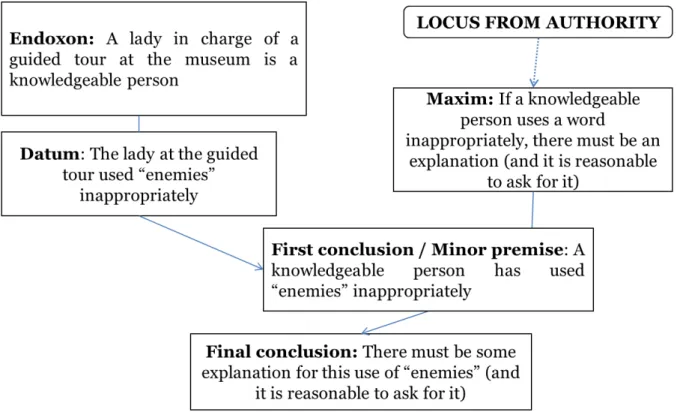
Following this interpretation, we will now use the AMT to analyze the child’s mostly implicit argumentation. Two steps must be considered, which are represented in figures 1 and 2, respectively.
Figure 1: AMT representation of the child’s argumentation, step 1
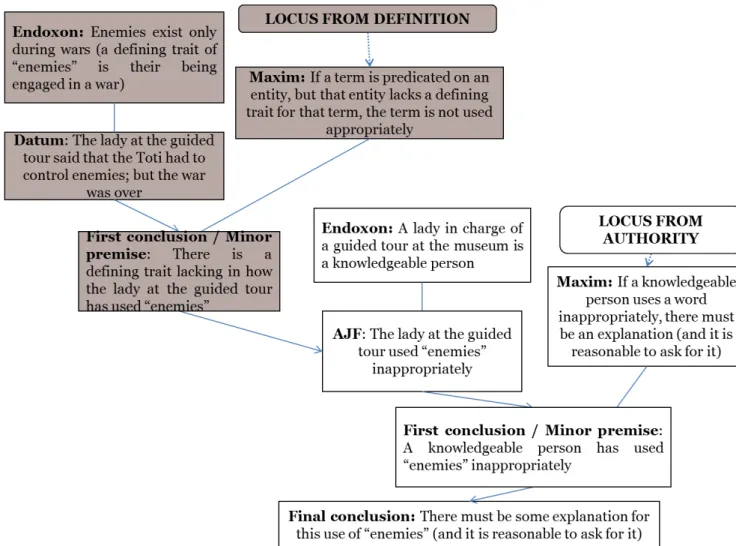
The first step (figure 1) is based on a problem of definition, regarding the connection between how a term (enemies in this case) is used and the entity on which it is predicated. The AMT representation in Figure 1 is a quasi-Y structure (Rigotti 2006) based on a combination of two syllogistic procedures. On the right side of the diagram procedural premises based on the inferential mechanism of the locus from definition bring us to the final conclusion that “the lady at the guided tour has not used ‘enemies’” appropriately. While the major premise – called a maxim – is an abstract inferential connection, the minor premise in this syllogism requires some extra-logical backing. In fact, how do we know that “There is a defining trait lacking in how the lady at the guided tour has used enemies”? The answer to this question is extra-logical; we need to share a definition of “enemy”; and we need factual knowledge (information) about what the lady has actually said. This type of “material” premises is supplied in the left part of figure 1 in the form of an endoxon – a general opinion – and a factual piece of information (datum). Taken together, these two material premises are activated in a syllogism that brings us to the desired first conclusion, which is then connected to the procedural syllogism.
The second step in our child’s reasoning (figure 2) focuses on the reason why G asks for an explanation. We believe this is based on argumentation from authority, as the child reasons that a knowledgeable person such as a museum lady cannot use inappropriate terms randomly; so she must have had some reason to speak of “enemies” (figure 2). This is interesting, we believe, at least for two reasons. First, by a textual clue, namely the use of the word “enemies”, G is brought close to understanding that the political situation of the time was not as peaceful as one could expect. This is made possible exclusively thanks to inference (and, in particular, reasoning from definition). Second, the material premises in this reasoning (the endoxon in particular) are relative to the lady’s authority; notably, via the AMT reconstruction, one can elicit a child’s views on adults as sources of reliable knowledge.
Figure 2: AMT representation of the child’s argumentation, step 2
These two steps of G’s reasoning are actually interrelated, as the conclusion of the first step (figure 1) is used as a datum (or, to put it in more precise terms, an Argumentatively Justified Fact – AJF) in the second step (figure 2). Figure 3 shows this intertwining graphically.
Figure 3: Intertwining between the two steps in figures 1 and 2
An invitation to further research
We believe that the hypotheses discussed here, inspired by theories of argumentation, and in particular by E. Rigotti's work, open new perspectives for psychological and educational research in children and adults in formal and informal settings.
In particular, there is a need to reconsider children as true interlocutors (and not only as "half baked" thinkers who have to mimic adults in order to grow). And this could lead to a redefinition of the social position and the role of school students. There is a need to better understand the social, relational and emotional conditions that allow and support argumentation in children and reconsider the usual school situations in which children's argumentative skills are traditionally taught and assessed. Seldom, for instance, do children feel entitled to support their standpoint in an asymmetrical relationship with a teacher (or a researcher); or even in a peer interaction with a friend, if they wish to be "kind". Research does indicate ways to advance pedagogical design for the development of argumentation skills (Kuhn, 2005, 2014; Schwarz, 2009, 2014). Our effort is to contribute to further understanding of the socio-cognitive and conversational processes involved.
Scientific knowledge is the fruit of still on-going, centuries long argumentative discussions about reality and the ways in which it is experienced and modeled. If society wants to transmit such knowledge to children, than school instruction has to offer students possibilities to enter sufficiently into these discussions to understand what is at stake. In other words, children should be invited into "reprises" of scientific statements but not in a passive submissive way. In order to learn to be scientists or at least to understand this discussion about reality, in order to be able one day to contribute to it or to use it adequately in the controversial problems that they will meet professionally and in everyday life, they need to experience its argumentative nature. Participating in critical discussions requires a legitimacy to participate and proper skills to address simultaneously its cognitive, affective, social, cultural and
technical components. In a complex society, with different institutions interacting around the same issues, there are conflicting demands in terms of roles, communication modes, (un)shared implicitness, etc. Education for such a society is a very complex endeavor. It does not end with infancy but lasts for life. Teachers left alone in their classrooms cannot answer these demands without the help of research.
We feel there is a need to reconsider the growing mind as argumentative and to reconsider achieved adult argumentation as the result of a "genesis" of intellectual and relational skills under proper respectful social and institutional conditions. It is also interesting to look at the major institutions of a democratic society in order to assure that they will not dismiss this argumentative dimension, in order to prevent them from becoming "frozen" or "fossilized" into complex bureaucratic systems with procedures that have lost their argumentative role. Schools, in particular, have an important role in the education of citizens whose minds can be either frozen after being furnished with an excessive load of fossilized information or instead been instrumented with resources to participate actively in the challenges presently met by humanity on Earth.
References
Arcidiacono, F., & Perret-Clermont, A.-N. (2010). The co-construction of conversational moves in the context of piagetian interview: the case of the test of conservation of quantities of liquid.
Rassegna di Psicologia, 27(2), 117-137.
Bakhtine, M. (1984). Esthétique de la création verbale. Paris: Gallimard.
Bernicot, J., Salazar Orvig, A., & Veneziano, E. (2006). Les reprises: dialogue, formes, fonctions et ontogenèse. La Linguistique, 42(2), 29-50.
Bernstein B. (Ed.) (1973). Class, Codes, and Control: Applied Studies towards a Sociology of
Language, vol II. London: Routledge & Kegan Paul.
Breux, S., & Perret-Clermont, A.-N. (2013). Self and other in Piagetian interviews. In B. Ligorio (Chair),
Interactions supporting interplays between dialogical learning and dialogical self. Symposium
conducted at the 15th Biennal EARLI Conference for Research on Learning and Instruction “Responsible Teaching and Sustainable Learning”, Münich, Germany, 27-31 August 2013. Breux, S., & Perret-Clermont, A.-N. (in press). Etre élève et exprimer une pensée propre : un
paradoxe ? In Enseignement du français : les apports de la recherche en linguistique. Bruxelles: P.I.E. Peter Lang.
Donaldson, M. (1978). Children's minds. New-York: W.W. Norton.
Eemeren, F. H. van. (2009, ed.). Examining argumentation in context. Fifteen studies on strategic
manoeuvring. Amsterdam/Philadelphia: John Benjamins.
Eemeren, F. H. van., & Garssen, B. (2012, eds.). Exploring argumentative contexts. Amsterdam/Philadelphia: John Benjamins.
Eemeren, F. H. van. (2010). Strategic maneuvering in argumentative discourse. Amsterdam: John Benjamins Publishing Company.
Eemeren, F. H. van, Grootendorst, R., & Snoeck Henkemans, A. F. (1996). Fundamentals of
argumentation theory. A handbook of historical background and contemporary developments.
Mahwah: Erlbaum.
Eemeren, F. H. van, Grootendorst, R., & Snoeck Henkemans, A. F. (2002). Argumentation: Analysis,
evaluation, presentation. Mahwah (NJ)/London: Erlbaum.
Eemeren, F. H. van, Houtlosser, P., & Snoeck Henkemans, A. F. (2007). Argumentative indicators in
discourse. A pragma-dialectical study. New York: Springer.
Golder, C. (1993). Savez-vous argumenter à la mode... à la mode des petits? Enfance, 46(4), 359-376.
Golder, C. (1996). Le développement des discours argumentatifs. Lausanne et Paris: Delachaux & Niestlé.
Greco Morasso, S., Miserez-Caperos, C., & Perret-Clermont, A.-N. (submitted). L'argumentation à visée cognitive chez les enfants. Une étude exploratoire sur les dynamiques argumentatives et psychosociales. In N. Muller Mirza & C. Buty (Eds.), Argumentation dans les contextes de
l’éducation.
Grize, J.-B. (1982). De la logique à l'argumentation. Genève: Droz.
Hermans, H. J. M. (2001). The dialogical Self: toward a theory of personal and cultural positioning.
Culture & Psychology, 7(3), 243 -281.
Kuhn, D. (1991). The Skills of Argument. Cambridge: Cambridge University Press. Kuhn, D. (2005). Education for Thinking. Cambridge: Harvard University Press.
Kuhn, D., Hemberger, L., & Khait, V. (2014). Argue with me: Argument as a path to developing
students’ thinking and writing. New York, Wessex Press.
Kuhn, D., & Udell, W. (2003). The development of argument skills. Child Development, 74(5), 1245-1260.
Light, P. (1986). Context, conservation and conversation. In P. L. M. Richard (Ed.), Children of social
worlds. Development in a social context (pp. 170-190). Cambridge: Polity Press.
Light, P., Gorsuch, C., & Newmann, J. (1987). Why do you ask? Context and communication in the conservation task. European Journal of Psychology of Education, 2, 73-82.
Light, P., & Perret-Clermont, A.-N. (1989). Social context effects in learning and testing. In A. Gellatly, D. Rogers & J.-A. Sloboda (Eds.), Cognition and social worlds (pp. 99-112). Oxford: Oxford University Press.
Ligorio, M. B., & César, M. (Eds.). (2013). Interplays between dialogical learning and dialogical self. Charlotte: Information Age Publishing.
Miserez-Caperos, C., Breux, S., & Perret-Clermont, A.-N. (2013). Children’s cognitive argumentations:
the construction of argumentative sub-discussions. Paper presented at the Communication au
16th european conference on developmental psychology, Lausanne, Switzerland, 3-7 September 2013.
Miserez-Caperos, C., & Perret-Clermont, A.-N. (in preparation). Pourquoi la tâche des dés est-elle si fascinante. Cahiers de psychologie et éducation.
Muller Mirza, N., Baucal, A., Perret-Clermont, A.-N., & Marro Clément, P., (2003). Nice designed experiment goes to the local community. Cahiers de Psychologie (Université de Neuchâtel) 38: 17-28.
Piaget, J. (1926). La représentation du monde chez l'enfant. Introduction (6th ed.). Paris: Presses Universitaires de France.
Piaget, J., & Szeminska, A. (1941). La genèse du nombre chez l'enfant. Neuchâtel: Delachaux et Niestlé.
Pontecorvo, C. & Arcidiacono, F. (2010). Development of reasoning through arguing in young children.
Cultural-Historical Psychology(4), 19-29.
Pontecorvo, C., & Sterponi, L. (2006). Learning to argue and reason through discourse in educational settings. In G. Wells & G. Claxton (Eds.), Learning for Life in the 21st Century (pp. 127-140). Oxford: Blackwell.
Rigotti, E. (2006). Relevance of Context-bound loci to Topical Potential in the Argumentation Stage.
Argumentation, 20, 519-540.
Rigotti, E. (2008). Locus a causa finali. In Word meaning in argumentative dialogue. Homage to Sorin
Stati, ed. G. Gobber et al. L’analisi linguistica e letteraria, 16(2), 559-576
Rigotti, E., & Greco Morasso, S. (2006). Topics: the argument generator. Argumentum eLearning module, www.argumentum.ch [restricted access].
Rigotti, E., & Greco Morasso, S. (2009). Argumentation as an object of interest and as a social and cultural resource. In N. Muller Mirza & A.-N. Perret-Clermont (Eds.), Argumentation and
Rigotti, E., & Greco Morasso, S. (2010). Comparing the argumentum model of topics to other contemporary approaches to argument schemes: the procedural and material components.
Argumentation, 24, 489-512. doi:10.1007/s10503-010-9190-7
Rigotti, E., & Rocci, A. (2006). Towards a definition of communication context. Foundations of interdisciplinary approach to communication. Studies in Communication Sciences, 6(2), 155-180.
Salazar Orvig, A. (2000). La reprise aux sources de la construction discursive. Langages, 140, 68-91. Schwarz, B. B. (2009). Argumentation and learning. In N. Müller Mirza & A.-N. Perret-Clermont (Eds.),
Argumentation and education. Theoretical Foundations and Practices (pp. 91-126). New York:
Springer.
Schwarz, B. B. (2014). Revisiting educational dialogues in their complexity: tracing their goals,
deployment and productivity. Paper presented at Thematic days on knowledge-oriented
argumentation. Doctoral school Arguolis, University of Neuchâtel, 22-24 January 2014.
Schwarz, B. B., Perret-Clermont, A.-N., Trognon, A. & Marro Clément, P. (2008). Emergent learning in successive activities: learning in interaction in a laboratory context. Pragmatics and cognition,
16(1), 57-87.
Sinclaire-Harding, L., Miserez, C., Arcidiacono, F., & Perret-Clermont, A.-N. (2013). Argumentation in the piagetian clinical interview: a step further in dialogism. In B. Ligorio & M. César (Eds.), The
interplays between dialogical learning and dialogical self (pp. 53-82). Charlotte: Information Age
Publisher.
Vion, R. & Mittner, M. (1986). Activité de reprise et gestion des interactions en communication exolingue. Langages, 84, 25-42.