HAL Id: hal-00157870
https://hal.archives-ouvertes.fr/hal-00157870
Submitted on 4 May 2020
HAL is a multi-disciplinary open access
archive for the deposit and dissemination of
sci-entific research documents, whether they are
pub-lished or not. The documents may come from
teaching and research institutions in France or
abroad, or from public or private research centers.
L’archive ouverte pluridisciplinaire HAL, est
destinée au dépôt et à la diffusion de documents
scientifiques de niveau recherche, publiés ou non,
émanant des établissements d’enseignement et de
recherche français ou étrangers, des laboratoires
publics ou privés.
A search for electron scale structures across the
magnetopause.
P. Canu, Pierrette Décréau, S. Escoffier, N. Cornilleau-Werhlin, D. Fontaine,
M. Dunlop, Jean-Gabriel Trotignon, Jean-Louis Rauch, T. Carozzi
To cite this version:
P. Canu, Pierrette Décréau, S. Escoffier, N. Cornilleau-Werhlin, D. Fontaine, et al.. A search for
electron scale structures across the magnetopause.. Proceedings Cluster and Double Star Symposium
– 5th Anniversary of Cluster in Space. ESA SP-598, Sep 2005, Noordwijk, Netherlands. �hal-00157870�
A SEARCH FOR ELECTRON SCALE STRUCTURES CLOSE TO THE
MAGNETOPAUSE
P. Canu1, P. Décréau2, S. Escoffier1, N. Cornilleau-Wehrlin1, D. Fontaine1, M. Dunlop3, J. G. Trotignon2, J. L. Rauch2 and T. Carozzi4
(1)CETP/CNRS/UVSQ, 10-12 Av de l’Europe 78140 Vélizy, France. [email protected] (2)LPCE/CNRS and Université d’Orléans, 3 Av de la Recherche Scientifique, 45100 Orléans, France
(3)Rutherford Appleton Laboratory, Didcot, Oxon, OX11 0QX, UK (4) University of Sussex, UK
ABSTRACT
Intense and localized burst of electrostatic emissions have been observed by the Whisper instrument on Cluster at frequency close to the electron plasma frequency, in the magnetopause boundary layer. The good time resolution of Whisper when in burst mode telemetry as well as the combination of the observations performed by the four Cluster spacecraft at short separation distance (~100 km) have allowed to determine in one case the dimension of these structure, typically a few tens of kilometers, close to the electron scale. We browse Whisper data in search for such events and present here some examples of their observations. We present the main characteristics of the spectra and power profile of the emissions.
1. INTRODUCTION
The Cluster mission is designed for studying in 3D the small scale structures of the Earth magnetosphere [7]. Based on four identical spacecraft, with 11 instruments on board each, they have been launched by pair in summer 2000. The Whisper instruments [6] on board each of the Cluster spacecraft monitor the plasma waves in the various regions of the magnetosphere such as the cusp, entry layer, magnetosheath, magnetopause, plasmasheet and its boundary layer, or plasmapause. Plasma emissions, electromagnetic or electrostatic, are very good tracers of the phenomena occurring in space plasma. Although most of these signatures have already been observed by past missions, the good sensitivity, time and frequency resolution of Whisper, combined with the vantage of the four viewpoints, allow new insight into the plasma mechanisms at their origin, locally or remotely.
The magnetopause is the archetypal astrophysical boundary between a large scale magnetic field and a streaming plasma, here the solar wind. Complex structures [8] like layers and mechanisms like magnetic reconnection are expected in this region, involving coupled processes from the MHD scale down to the electron kinetics (a few km), the later one being poorly known. While Cluster is not fully instrumented to
precisely characterized the plasma on very short scale, the field instruments can have time resolution which allows to identify some structures with dimension close to the electron scale. The EFW experiment on Cluster has already discovered, very close to the magnetopause, a thin layer, about 20 km wide [2] and its associated wave and turbulence [1,14]. This discovery is in agreement with the relevant numerical simulations. With its good frequency and time resolution, the Whisper instrument can also observe very short time scale events. We present below some examples of the discovery close to the magnetopause, on the magnetospheric side, of intense and localized burst of electrostatic emissions at frequency near the plasma frequency. These events are not observed in the same location as those reported by [2], but their typical size, as derived from the four points measurements, is also of a few tens of kilometres, i.e. close to the electron scale.
2. INSTRUMENT
Whisper is a dual instrument, part of the Wave Experiment Consortium (WEC, see [12]) providing first a survey of the electric component of the waves in the frequency range 2-80 kHz and second a relaxation sounder which triggers with an emitter the characteristic resonances of the surrounding plasma from which the local electron density is derived [6]. The detection of the electric signal relies on sphere antennae located on symmetric radial booms of 88 meter length tip to tip, which are parts of the Electric Field and Wave experiment [9]. The natural spectra used here are obtained from the waveform which is Fast Fourier transformed on board. The resulting spectra, with a frequency resolution of 160 or 320 Hz, depending on the operating mode, are then down linked with a time resolution ranging usually between 0.6 to 2 seconds, depending on the bit rate. In addition, the wave power, integrated over the full Whisper range of 2-80 kHz is also down linked at a rate which also depends on the telemetry mode, but is always better than the time resolution of contiguous spectra. For wave spectra dominated by a single strong emission, this provides a higher time resolution of its dynamic. In the burst mode
_________________________________________________________________
Proceedings Cluster and Double Star Symposium – 5th Anniversary of Cluster in Space,
considered in the observations presented in this paper, this rate is one averaged power every 13 milliseconds.
3. OBSERVATIONS
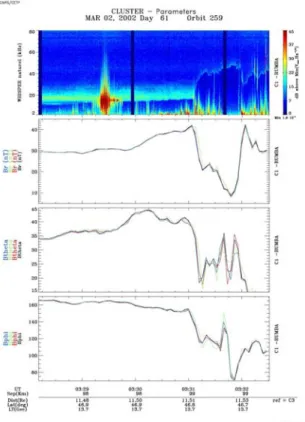
The Whisper dynamic spectrograms for C1 and the magnetic field magnitude and direction in GSE over plotted for the four spacecraft, provided by the FGM experiment [3], are displayed on Fig. 1. These data were collected when the Cluster were located at a distance of about 11.5 Rt, 13.7 local time and a latitude of 47° (GSE). The separation distance between the spacecraft, in a tetrahedron configuration, was about 100 km. The electric field amplitude of the wave in the 2-80 kHz range is measured over a 4.5 minutes period by the instrument on March 2, 2002, when the Cluster quartet
was in the magnetosphere, approaching the
magnetopause. At that time, the spacecraft were in a burst mode telemetry, and time resolution for Whisper was 0.62 s. The narrow band line with frequency above 40 kHz, seen after 03:31 is the plasma frequency (Fp) observed in the magnetosheath.
Fig 1. Whisper dynamic spectrogram for C1 and
magnetic field in GSE for the four spacecraft. The plasma frequency jump at 03:31 and magnetic field drop and rotation corresponds to the magnetopause crossing. A strong burst of electrostatic emissions at Fp is observed at 03:29:30 on the magnetosphere side.
This plasma frequency is also clearly identified in the magnetosphere, by the cut-off of the continuum radiation at about 18 kHz. The magnetopause is observed as a large frequency jump of Fp at about 03:31 UT and
changes in magnitude and direction of B. Prior to the magnetopause crossing, on the magnetosphere side, intense and localised bursts of broad band emissions, centred around the local Fp, are detected at ~ 03:29:30 UT. There is no significant deviation of the magnetic field at this time, except the beginning of a small rise of its magnitude, which culminates at the magnetopause crossing. This is a known signature in the Low Latitude Boundary Layer [10]. Very small differences can be seen between the B field detected by each spacecraft, but the current derived from the curl B computations was barely noticeable.
Fig. 2. Details of the electrostatic structure shown in
Fig-1. Duration is about 10s for each spacecraft. The plasma frequency is about 18 kHz. The amplitude modulation corresponds to a strong polarisation of the emissions along the local magnetic field
Fig. 2 is an expanded view of these emissions as seen by the four spacecraft, with duration of about 10 s each. The strong modulation of the amplitude of the spectra with time is evident. There is about one order of magnitude difference between the lowest and highest electric field amplitude of the emissions. During the event, the mean electric field increases smoothly as time elapses, reaches a maximum at its centre and decreases almost symmetrically. The boundary close to the magnetopause ends with strong, impulsive narrow band emissions at the Fp.
A further analysis indicates that this strong signal modulation is due to high polarization, with the
maximum amplitude almost aligned with the local magnetic field. There is no measurement of the magnetic components of the emissions for this frequency range on-board Cluster, but the strong and fast varying amplitude of the emissions, as well as the differences seen between spacecraft indicates that they are not propagating and hence are electrostatic. This would suggest Langmuir emissions, but this is not supported by the smooth and broadband shape of the spectra, very different from the narrowband, highly instable emissions more typical of Langmuir waves or upper hybrid emission. The fact that the most intense emissions are observed in the middle of the event suggests that the spacecraft encountered a small structure highly localized in space.
Peace electrons data [11], (not shown here) do not display any significant change in the distribution function during the bursts of emissions. Prior to the observations of the warm (100 eV) omnidirectional electrons of the magnetosheath at 3:31:10 UT, lower fluxes of bidirectional field aligned electrons of the same energy were observed, probably leaking from the magnetosheath and mirroring at low altitude back to the spacecraft, which is a characteristic feature of the low latitude boundary layer, observed here at high magnetic latitude (35°). These leaking magnetosheath electrons were mixed with field aligned higher energy (~ 1 keV) electrons of magnetospheric origin and vanishing fluxes close to the wave bursts location.
Although multiple field aligned electrons beams can be identified by the Peace instruments in the vicinity of the magnetopause, no clear correlations has been identified between these emissions and the electrons distribution function. A small and brief drop in the 100 eV electron flux is observed at the same time, but a correlation is difficult to confirm because of the modulation of the flux of these leaking electrons. The only other clear signature correlated to the electrostatic structure seen by Whisper is a strong electromagnetic emissions observed by Staff and EFW in the frequency range 40- 500 Hz (Staff-SC up to 180 Hz only, see [5]) which is reported by [13].
4. STRUCTURE DIMENSION
By taking into account the respective spatial position and velocities of each spacecraft and assuming a rigid body with a cylindrical or a layer shape and a constant
velocity, we can derive its main geometrical
characteristics from the difference in the timing for entry and exit as seen from the wave amplitude. This shows that the structure is drifting with a velocity, taken perpendicularly to the cylinder axis or surface layer, of about 31 km/s with a size along the velocity direction of 36 km. The size along the other direction can not be derived precisely but is above the spacecraft separation distance (~100 km). The direction of the velocity is almost perpendicular to the magnetic field (107°)
5. MULTIPLE CROSSINGS
We have performed a preliminary search of similar events in other magnetopause crossings, in order to discriminate between transient phenomena and a structure commonly associated with the magnetopause. This survey shows that such structures are present probably in more than half of the crossings, although this value is not very accurate since it requires a burst mode bit rate in order to characterize events of a few seconds duration. Magnetopause crossings in this mode are seldom. Structures observed at large spacecraft separation show little correlation suggesting that their size perpendicular to spacecraft path is less than a few hundreds of kilometres, or/and is strongly varying in space and time.
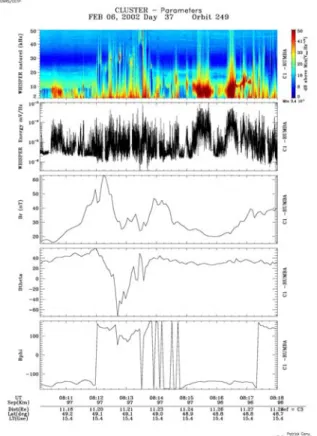
Fig. 3. presents an example obtained during multiple magnetopause crossing, which illustrates the connection between the structure reported above and its close association with the magnetopause. The panels display from top to bottom, Whisper dynamic spectra for C1, the
Fig. 3. Multiple crossings of the magnetopause. From
top to bottom, Whisper spectrogram and integrated power (2-80 kHz) and Br, Bθ, Bφ in GSE
total electric power in the Whisper frequency range (2-80 kHz) and the 3 components of the magnetic field.
In this example, the spacecraft separation is also about ~ 100 km in a tetrahedron formation. The constellation is close to the magnetopause which is crossed multiple
times, at ~ 08:12 (out bound), 08:13:30 (in bound) and 08:17:20 (out bound) as evidenced by the electron density gradient derived from the line at Fp observed by Whisper and the B field direction reversal observed by FGM. A structure similar to the one displayed on Fig.2. is observed each time, close to the boundary, inbound and outbound, on the magnetospheric side. The wave energy is comparable in these structures, and sometime higher, than the wave energy encountered during magnetopause crossing. Fig. 4 is an expanded view of the first event. The slightly decreasing central frequency corresponds to a small electron density decrease, also observed by the Peace instrument. This crossing corresponds to the one investigated by [2] where a thin electron layer was identified at the magnetopause, close to the separatrix, from the electric field experiment (EFW). However, the structure observed by Whisper, with its characteristic broadband spin modulated spectra is not correlated with the one reported by [2]. The later one, is observed at 08:11:57.5, very close to the density ramp, whereas the Whisper bursts are detected more deeply in the boundary layer, about one minute earlier.
Fig. 4. Whisper spectrograms for C1, C2, C3, C4 close
to the magnetopause (~08:12). The electrostatic structure is observed beginning at 08:10:30
Fig. 5 is an expanded view of the third structure, observed prior to the last magnetopause crossing from the magnetosphere to the magnetosheath. As for the event displayed in Fig.2, strong Langmuir emissions are observed at the boundary of the structure. Fig. 6 is an
over plot of consecutive spectra, with a time separation of ~0.43 s, displaying amplitude versus frequency. Spin modulation amplitude shows a variation of almost 2 order of magnitude. However, as reported for Fig. 2, the spectral shape is broadband, with a central frequency close to the local Fp. It does not correspond to a known wave mode or instability and strongly differs from the standard strong, often impulsive, and narrow bandwidth Fp emissions, encountered in the vicinity of the magnetopause, often triggered by field aligned electron beams or currents, as the ones observed by C1,C2,C4 at ~ 08:16:40, at the structure exit, displayed on Fig. 7.
Fig. 5. Whisper spectrograms for C1, C2, C3, C4 close
to the last magnetopause crossing (~08:17:20). The electrostatic structure is observed beginning at 08:16:15
Fig. 8 is a more expanded view in time and frequency of the same structure. The top 2 panels are dynamic spectra from C1 & C3. The bottom panels are time series, for the 4 spacecraft, of the integrated electric field power in the range 2-80 kHz, which is dominated here by the structure. While the individual time resolution for spectra for this Burst mode is ~0.43 s, the time resolution for integrated power is 13 ms and provide then a precise monitoring of the power variations. Fig. 8 shows that the mean power, while spin modulated, increases smoothly and peaks at the center of the structure before decreasing almost symmetrically. A more detailed view on Fig. 9, spanning a spacecraft spin of ~ 4s, with individual frequency spectra (top) and time series of wave energy
Fig. 6. Overplots of consecutive frequency spectra.
Spectral shape is smooth. The amplitude variation is due to the highly spin modulation of the emissions.
Fig. 7 Overplot of consecutive frequency spectra
showing the narrow bandwidth and fast variation of Langmuir emissions
Fig. 8. Whisper dynamic spectrogram for C1, C4
and high time series of integrated wave power
Fig. 9. Expanded view of individual spectra and
corresponding high time resolution of integrated power.
at 13 ms time resolution (bottom), shows that the emissions are indeed due to very short individual bursts, each with duration of a few tens of ms, which have then individual field aligned power increasing from the boundary of the structure to its center.
5. SUMMARY - DISCUSSION
The Whisper data shows that an electrostatic structure, strongly localised in space, is often observed close to the magnetopause, on the magnetospheric side. A first estimate of its extension using the four Cluster indicates a dimension of ~ a few tens of km along the velocity direction. This confirms the existence of layers at the electron scale in this region. Since strong plasma emissions close to the local electron plasma frequency are generally highly depending on the non maxwellian features of electron distribution function, a first investigation of the source looked for the existence of elements like current layer, electrons beam or electrons drift. The data of the Peace instrument [11] which provides, on Cluster, the characteristics of the electrons distribution function, do not reveal any significant feature correlated with the structures observed by Whisper.
The only other clear signature correlated with the electrostatic structure reported here is a strong electromagnetic whistler mode emission [13] in the frequency range 40- 500 Hz.
The electric field instrument (EFW) of Cluster has discovered a thin electron layer close to the magnetopause, on the magnetospheric side. In this layer, the electrons are E x B drifting with the ions as background, which could have been a good candidate for the electrostatic emissions observed by Whisper. Lower hybrid turbulence and whistler waves has also been observed [1,14] within this thin layer and the maximum of the amplitude is associated with density gradients and electron beams which can be the separatrix of the reconnection site. However, there is no correlation in time between this layer discussed by [2], with duration of less than a second, and the electrostatic structure observed by Whisper, much farther from the magnetopause. Hence these two events have no evident relationship.
While the peak power of the emissions is close to the local plasma frequency, the observed emissions do not correspond to a known wave mode or instability. High time resolution of Whisper data show that they are composed of a continuous train of short durations bursts, a few tens of ms, with an averaged electric power smoothly increasing from the structure boundary to its center. A potential source, to be further investigated, could be the microscale turbulence. Variations in the second order electron density in boundary layer, as suggested from observations by the WEC particle correlator, could originate from electron clustering [4], and hence provide signatures quite different from known wave modes on Whisper spectra.
This confirms the highly rich and complex nature of the plasma in this region and its fast evolution in space and time, at the limit of the present instrumentation. Further study will have to better characterize the structures reported here and provide insights in their importance for the boundary layer and magnetopause dynamic.
Acknowledgments. We thank the WEC-DWP team for
constant support in the Whisper data operations, the ESOC team for support in data acquisition. The CETP contribution to Whisper is supported by CNES under contract 0282-EU3.
REFERENCES
1. André, M., et al., Multi-spacecraft observations of broadband waves near the lower hybrid frequency at the earthward edge of the magnetopause, Ann.
Geophys., 19, 1471– 1481, 2001
2. André, M., A. Vaivads, S. Buchert, A. Fazakerley, and A. Lahiff, Thin electron-scale layers at the magnetopause, Geophys. Res. Lett., 31, L03803, doi: 10.1029 / 2003GL018137, 2004
3. Balogh, A., et al. (2001), The Cluster magnetic field investigation: overviewof in-flight performance and initial results, Ann. Geophys., 19, 1207.
4. Carozzi T. D., A. M. Buckley, E. C. Chambers, M. P. Gough, N. Beloff, Turbulence as seen from the point pattern of space plasma electrons, paper presented at the EGU General Assembly, Vienna, 2005
5. Cornilleau-Wehrlin, N., G. Chanteur, S. Perraut, L. Rezeau, P. Robert, A. Roux, C. de Villedary, P. Canu, M. Maksimovic, Y. de Conchy, D. Hubert, C. Lacombe, F. Lefeuvre, M. Parrot, J.L. Pincon, P.M.E. Decreau, C.C. Harvey, Ph. Louarn, O. Santolik, H.St.C. Alleyne, M. Roth, T. Chust, O. Le Contel and STAFF team, First results obtained by the Cluster STAFF experiment, Ann. Geophys., 21, 437–456, 2003 6. Décréau P.M.E., P. Fergeau, V. Krasnosels’kikh, E. Le Guirriec, F.X. Sené M. Lévêque, Ph. Martin, O. Randriamboarison, J. L. Rauch, , H.C. Séran, J. G. Trotignon, P. Canu, N. Cornilleau, H. de Féraudy,H. Alleyne, K. Yearby,P. B. Mögensen,G. Gustafsson, M. André, D. C. Gurnett, F. Darrouzet, Early results from the Whisper instrument on CLUSTER: an overview, Ann. Geophys., 19, 1241-1258, 2001
7. Escoubet, M. Fehringer, and M. Goldstein, The Cluster mission, Ann. Geophys ., 19, 1197 - 1200, 2001
8. Gosling, J.T., M.F. Thomsen, S.J. Bame, T.G. Onsager and C.T. Russel, The electron edge of the low latitude boundary layer during accelerated flow events,
Geophys. Res. Lett., 17, 1833, 1990
9. Gustafsson G., M. André, T. Carozzi, A. I. Eriksson, C.-G. Fälthammar, R. Grard, G. Holmgren, J. A. Holtet, N. Ivchenko, T. Karlsson, Y. Khotyaintsev, S. Klimov, H. Laakso, P.-A. Lindqvist, B. Lybekk, G.
Marklund, F. Mozer, K. Mursula, A. Pedersen, B. Popielawska, S. Savin, K. Stasiewicz, P. Tanskanen, A. Vaivads, and J-E. Wahlund, First results of electric field and density observations by Cluster EFW based on initial months of operation, Ann. Geophys.,19, 1219 - 1240, 2001
10. Hall, D.S., C.P Chalonner, D.A Bryant, D.R., Lepine and V.P. Tritakis, Electrons in the Boundary Layers near the Dayside magnetopause, J. Geophys.Rs., 96, 7869, 1991
11. Johnstone A. D., Alsop, C., Burge, S., Carter, P. J., Coates, A. J., Coker, A. J., Fazakerley, A. N., Grande, M., Gowen, R. A., Gurgiolo, C., Hancock, B. K., Narheim, B., Preece, A., Sheather, P. H., Winningham, J. D., and Woodliffe, R. D.: ‘Peace: A Plasma electron and current experiment’, Space Sci. Rev., 79, 351– 398,1997.
12. Pedersen A. , P. Décréau, C.-P. Escoubet, G. Gustafsson, H. Laakso, P.-A. Lindqvist, B. Lybekk, A. Masson, F. Mozer, and A. Vaivads, Four-point high time resolution information on electron densities by the electric field experiments (EFW) on Cluster, Ann.
Geophys. 19, 1483 - 1489, 2001
13. G. Stenberg, T. Oscarsson, M. André, A. Vaivads, M.Morooka, N. Cornilleau-Wehrlin, A. Fazakerley, B. Lavraud, and P. M. E. Décréau, Electron-scale sheets of whistlers close to the magnetopause, submitted to
Anna. Geophys., 2005
14. Vaivads, A., M. André, S. C. Buchert, J.-E. Wahlund, A. N. Fazakerley, andN. Cornilleau-Wehrlin (2004), Cluster observations of lower hybrid turbulence within thin layers at the magnetopause,
Geophys. Res. Lett., 31, L03804,