by
Scott Middleton
B.A. in Urban Studies and History
Brown University 2010
Submitted to the Department of Urban Studies and Planning
in partial fulfillment of the requirements for the degrees of
Master in City Planning
and
Master of Science in Transportation
at the
MASSACHUSETTS INSTITUTE OF TECHNOLOGY
June 2018
© 2018 Massachusetts Institute of Technology. All Rights Reserved
Author__________________________________________________________________
Department of Urban Studies and Planning
Department of Civil and Environmental Engineering
May 18, 2018
Certified by______________________________________________________________
Jinhua Zhao
Associate Professor of Urban Studies and Planning
Thesis Supervisor
Accepted by_____________________________________________________________
Professor of the Practice Ceasar McDowell
Chair, MCP Committee
Department of Urban Studies and Planning
Discrimination, Regulation, and Design in Ridehailing
By
Scott Middleton
Submitted to the Department of Urban Studies and Planning
on May 24, 2018 in partial fulfillment of the
requirements for the degrees of Master in City Planning
and Master of Science in Transportation
Abstract:
In the past decade transportation network companies (TNCs) like Uber and Lyft have replaced,
supplemented, and disrupted traditional modes of transportation. The rapid growth of these
companies makes equitable access to their platforms an issue that is simply too big to ignore.
Indeed, these ridehailing services have the potential extend an ugly legacy of discrimination in
transportation services, or to deliver a more equitable mobility system for future generations.
In this vein, prior studies have provided evidence of discrimination between drivers and
passengers in the context of ridehailing. This thesis extends research in three important ways.
First, this thesis investigates rider-to-rider discriminatory attitudes in the context of dynamic
ridesharing. To that end, this thesis uses data from a survey of 1,110 TNC users to argue that
discriminatory attitudes toward fellow passengers of differing class and race are positively
correlated with demographic and environmental characteristics, as well as one's generic social
dominance orientation. Second, this thesis uses a second national survey of TNC users (n=1,113)
to argue that the advent of autonomous ridesharing will exacerbate discriminatory attitudes
toward fellow passengers in shared rides. What’s more, this effect will be particularly acute with
regard autonomous ridesharing with passengers of a different gender. Finally, this thesis
proposes fourteen regulations and platform design interventions to prevent and mitigate possible
discrimination in ridehailing and ridesharing. These interventions are vetted through a survey of
national experts in ridehailing policy and design. Of these interventions, this thesis calls for
additional data reporting requirements and a series of changes to TNC star rating systems.
Thesis Supervisor: Jinhua Zhao
This thesis is dedicated to the memory of Professor Joseph Sussman, who passed away on March 20, 2018. I owe my time at MIT entirely to Joe, who saw potential in me and admitted me as an M.S. in Transportation student with a rather unconventional background. It is my pleasure to join the community of hundreds of students who worked with Joe during his 50 years at MIT. His memory is with me as I finish this work.
Many other hands have also contributed to this thesis: mentors who defied tedium to carefully read and guide my writing, friends who lifted my spirits, and generous experts who offered me crucial insight in interviews. I am indebted to you all. Specifically, I thank my thesis adviser, Professor Jinhua Zhao, my thesis reader Professor Jason Jackson, fellow members of the Urban Mobility Lab, the students of 1.011, my mother Peggy, and my frequent collaborators Annie Hud-son, Ben Gillies, Yonah Freemark, and Joanna Moody. Additional thanks go to the Dwight David Eisenhower Transportation Fellowship Program for their intellectual and financial support of this research. A final word of thanks goes to Leonard Cohen, whose sage words inspired me to push through the doldrums and produce a final draft:
A fresh spider-web billowing like a spinnaker across the open window, and here he is the little master, sailing by on a thread of milk. Wish me luck admiral I haven’t finished anything in a long
List of figures 11
List of tables 14
1 Introduction 15
1.1 Discrimination in Ridehailing and Ridesharing . . . 16
1.2 Organization of this Thesis . . . 17
2 Discrimination and Prejudice in the Shared Mobility Context 19 2.1 Methodologies for Measuring Discrimination . . . 20
2.2 Parallels in Other Industries and Platforms . . . 20
2.2.1 Antecedents in the Taxicab Industry . . . 21
2.2.2 Discrimination in Traditional and Online Marketplaces . . . 21
2.2.3 Discrimination in the Sharing Economy . . . 23
2.3 Evidence of Discrimination in Ridehailing and Ridesharing . . . 24
2.4 Defining Discrimination in the Shared Mobility Context . . . 27
3 Discriminatory Attitudes Between Ridesharing Passengers 31 3.1 Introduction . . . 31
3.3.2 Descriptive Statistics . . . 35
3.3.3 Factor-Based Structural Equation Models . . . 40
3.4 Discussion . . . 48
4 Discriminatory Attitudes in Driverless Rides 51 4.1 Introduction . . . 51
4.2 Data and Descriptive Statistics . . . 52
4.2.1 Descriptive Statistics . . . 53
4.3 Modeling and Analysis . . . 57
4.3.1 Comparison of Means and Distributions . . . 58
4.3.2 Variations in Effect . . . 60
4.3.3 Discussion . . . 66
5 Regulatory and Design Interventions 67 5.1 Introduction . . . 67
5.2 Background: TNC Regulations . . . 68
5.2.1 History of TNC Regulations . . . 68
5.2.2 Structure of TNC Regulatory Landscape . . . 70
5.3 Interview Methodology . . . 72
5.4 Proposed Regulatory Interventions . . . 74
5.4.1 Require TNCs to report information that may provide evidence of discrim-ination . . . 76
5.4.2 Require wait times to be similar in areas with similar demand . . . 79
5.4.3 Require mandatory driver training to include diversity and sensitivity . . . 82
5.4.4 Strengthen service-all provisions and prohibit TNC drivers from refusing rides based on destination and rider characteristics . . . 84
5.4.5 Service compris/mandated tipping provisions . . . 87
5.4.6 Charge fixed fares between destinations . . . 88
5.4.7 Conduct public sector audits of driver behavior . . . 89
5.5 Platform Design Interventions . . . 91
5.5.1 Further anonymize riders and drivers . . . 93
5.5.2 Make names and photos smaller in the app . . . 96
5.5.3 Increase burden for riders to negatively rate drivers . . . 96
5.5.4 Increase burden for drivers to negatively rate riders . . . 98
5.5.5 Track driver ratings and look for discriminatory patterns . . . 99
5.5.6 Decouple ratings from access to the app . . . 99
5.5.7 Validate driver ratings with other data . . . 100
5.5.8 Post anti-discrimination policy in all vehicles . . . 101
5.6 Survey of Popular Support . . . 103
6 Conclusion 111
6.1 Key Findings . . . 112
6.2 Further Research . . . 112
6.3 Reflection . . . 113
Appendices 115
A Sample Interview Guide 117
B Lyft and Uber Non-Discrimination Policies 119
C MIT Committee on the Use of Humans as Experimental Subjects (COUHES)
Approval 123
D Full Mechanical Turk Questionnaire (2018) 125
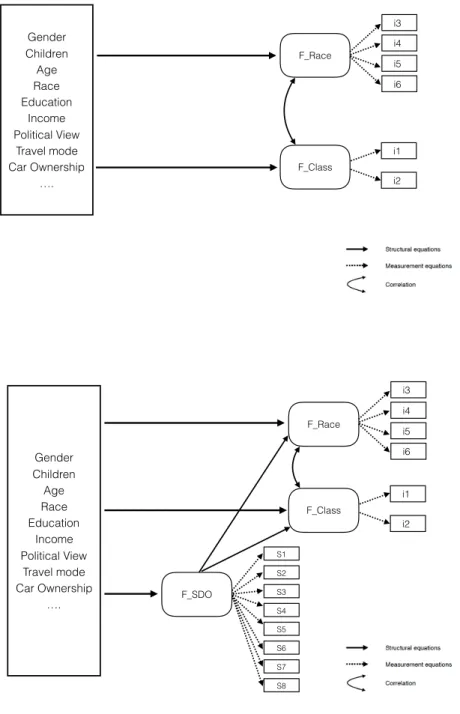
1 Hypothesized Structural Equation Models 1 and 2 . . . 43
2 Comparison of Discriminatory Attitudes by Target of Discrimination . . . 59
3 Comparison of Distributions by Target of Discrimination . . . 60
4 Lyft Economic Impact Report . . . 78
5 CPUC Zip Code Analysis . . . 82
6 Lyft Driver Forum Encouraging Drivers to Refuse NYC-bound Trips . . . 86
7 Uber driver app, before and after accepting a ride . . . 95
8 Lyft driver app, before and after accepting a ride . . . 95
9 Lyft Anti-Discrimination Policies . . . 102
10 Uber Nondiscrimination Policy . . . 102
11 Popular Support for Proposed Policies . . . 105
1 Forms of discrimination in shared mobility. . . 28
2 Demographics of respondents (2016) . . . 37
3 Preferences of respondents . . . 37
4 Cross-tabulations: Discriminatory preferences by selected rider characteristics . . . 39
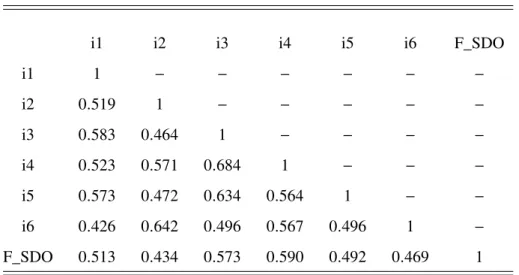
5 Correlation table for SEM analysis . . . 42
6 Standardized measurement coefficients for SEM 1 and 2 . . . 44
7 SEM 1 and 2: Standardized coefficients for sociodemographic values . . . 45
8 SEM 2: Direct, indirect, and total effects . . . 46
9 Demographics of respondents (2018) . . . 54
10 Preferences of respondents (with and without drivers present) . . . 56
11 Paired t-test results . . . 58
12 Linear regression models: ridesharing attitudes (2018) . . . 63
13 Linear regression models: AV attitudes (2018) . . . 64
14 Linear regression models: difference between AV and ridesharing attitudes (2018) . 65 15 Organizations represented in interview process . . . 73
Physical, digital, and financial access to shared transport services are valuable public goods and need thoughtful design to ensure use is possible and affordable by all ages, genders, incomes, and abilities.
Shared Mobility Principals for Livable Cities1
In the 2010s emerging transportation network companies (TNCs) like Uber and Lyft have replaced, supplemented, and disrupted traditional modes of transportation. They have transitioned from upstarts to important and potentially permanent players in the transportation industry. Furthermore, cost-reducing dynamic ridesharing and venture capital-backed rider subsidies have made TNCs more price competitive with public transit, suggesting a potentially enormous role for TNCs in the urban transportation of the future. Such scale makes equitable access to this platform an issue that is simply too big to ignore.
These ridehailing/ridesourcing services have the potential to exacerbate and extend our worst dis-criminatory tendencies as a society. From segregated buses to transit deserts to cab drivers refusing rides, the field of transportation has a long and disgraceful history of discrimination in the United States. Depending on their design, TNCs may either extend this ugly legacy or deliver a more equitable mobility system for future generations. As a society, we currently face a generational op-portunity to harness the innovations of the sharing economy to support an equitable future. To do
but rather foster a more inclusive transportation culture.
1.1 Discrimination in Ridehailing and Ridesharing
Since 2009, TNCs have been providing smartphone users with an easy way to request point-to-point
rides on-demand. While there are many TNCs in operation,2 this thesis is primarily interested in
the two leading TNCs in U.S.: Uber and Lyft. Together these two companies control 97.8 percent of the U.S. ridehailing market as of August 2017.[87] Unlike traditional taxi dispatch systems, TNC platforms link riders to one of many drivers currently connected to the company’s application. As such, Lyft and Uber claim to be technology companies rather than transportation companies, and consider their drivers to be independent contractors rather than employees. While drivers have disputed this claim in courts, drivers remain classified as independent contractors in most political jurisdictions.
Recent studies have highlighted examples of discrimination enabled by these new forms of mobil-ity. Most notably, Ge et al. (2016) argued that the pick-up decisions of individual Uber and Lyft drivers led to discriminatory outcomes for riders. Through two field experiments in Seattle and Boston, the researchers observed a significant difference in wait times and cancellations for other-wise identical riders with African American-sounding and white-sounding names, irrespective of the characteristics of the driver. The study also demonstrated that Uber and Lyft drivers take female riders for longer and more expensive rides than male riders.[44]
The 2016 study generated significant media attention, as well as a formal admonishment from Sen-ator Al Franken to the CEOs of Lyft and Uber.[42] As ranking member of the Senate’s Judiciary Subcommittee on Privacy, Technology, and the Law, Senator Franken urged application-based ser-vices not to accommodate bias and asked the companies to explain how they intend to prevent racial and gender discrimination on their platforms.
Uber’s response to Senator Franken’s letter revealed both the strengths and weaknesses of TNCs with regard to discrimination. Unsurprisingly, the response focused on the company’s strengths. For example, Uber argued that TNCs have increased the availability of for-hire rides and improved transportation equity by reducing user costs and improving accountability for drivers. In a study funded by Uber, Smart et al. (2015) found that taxis dispatched by phone to low-income Los Angeles neighborhood took 2-3 times longer to arrive than UberX rides and cost roughly twice as much.[114] In an independent study Hughes and MacKenzie (2016) found that waiting times for UberX shared rides were actually lower in low-income and minority neighborhoods in Seattle than in higher-income, majority white neighborhoods after controlling for density, suggesting that adequate access to ridehailing is not necessarily restricted to wealthier or whiter areas.[58] Despite these potential advantages of TNCs, Uber’s promises for mitigating the type of discrimination
observed by Ge et al. were vague and non-committal (e.g., reviewing policies and meeting with the researchers). The company could certainly do much more.
Whatever the merits of Uber’s arguments about discrimination, the debate between Senator Franken and Uber focused solely on discrimination from drivers to riders. Both parties ignored the very real possibility that ridehailing platforms also provide riders with the ability to discriminate against drivers through their tips and service ratings. These two features of TNC platforms that have very real impacts on drivers’ well-being; tips impact driver incomes while star ratings impact drivers’ ability to find riders and even to participate in the market.
Increasingly, many TNC rides involve not just one driver and one rider, but also a second or third rider sharing the same ride through ridesharing products (e.g., uberPOOL and Lyft Line) a special
category of ridehailing or ridesourcing services (e.g., UberBLACK).3 In addition to driver-rider
and rider-driver discrimination, it is conceivable that rider-rider discrimination will emerge as a critical issue in the future, particularly as autonomous ridesharing platforms become more
ubiq-uitous.4 Recent research at MIT has provided evidence that ridesharing users harbor feelings of
prejudice towards passengers of different social class and race, and that these riders prefer to have early information about potential co-passengers (Sarriera et al. 2016). In the future, ridesharing and ridehailing companies might somehow allow passengers to avoid riders they don’t like. Alterna-tively, TNCs may mitigate discrimination and even encourage positive social interactions between riders. However, it seems that they may need some help in achieving that goal.
1.2 Organization of this Thesis
Against this backdrop, the research questions of this thesis are: To what extent to which discrimina-tion is demonstrably occurring through ridehailing and ridesharing platforms? Beyond driver-rider interactions, how might discrimination influence the interaction between fellow passengers in a shared ride? Given these possibilities, what are the most suitable regulatory and platform design tools for cities, TNCs, and other actors to prevent and mitigate discrimination and maximize the potential social good of shared mobility platforms?
This thesis will answer this question over the course of five chapters. Chapter 2, Discrimination and Prejudice in the Shared Mobility Context, presents discrimination as a potential disadvantage of ridehailing and a likely consequence of platform design. This introductory chapter asks to what extent discrimination is present in ridehailing and ridesharing; considers parallels in other industries and other platforms; and analyzes antecedents from the traditional taxicab industry. This
input is then formulated into a definition of discrimination in the context of shared mobility. Chapter 3, Discriminatory Attitudes Between Ridesharing Passengers, expands upon existing stud-ies of discrimination by hypothesizing about potential forms of discrimination that have not yet been studied in depth, particularly the unexplored realm of rider-rider discrimination. An analysis of existing survey data provides an empirical foundation for understanding discriminatory attitudes among various social groups. Chapter 4, Discriminatory Attitudes in Driverless Rides, expands on the analysis of Chapter 3 using new survey data to consider how the advent of autonomous vehicles may affect rider-rider discrimination.
Given the types of discrimination discussed in earlier chapters, Chapter 5, Regulatory and Design Interventions, considers strategies for mitigating and preventing discriminatory behavior through regulation and platform design. This chapter draws on existing TNC regulations from around the United States to propose a list of interventions for review. Although this chapter places a strong emphasis on regulation, it also acknowledges the important role of TNCs in reducing discrimina-tion and considers what platform design intervendiscrimina-tions that these companies can apply to prevent discrimination. This chapter vets the various regulation and platform design interventions through semi-structured interviews with experts in public policy and shared mobility to evaluate the pro-posals according to their effectiveness, fairness, and implementability
The thesis closes with a discussion of next steps that researchers, government officials, and TNC executives can pursue given the findings of the thesis. Government regulators and TNC leaders will be empowered by the findings of this thesis to take action to address discrimination.
Ridehailing/ridesharing services have the potential to either exacerbate or discourage discrimina-tion in transportadiscrimina-tion. Fortunately, conscious and informed decisions on the part of policymakers and TNCs can create a more equitable mobility system. The goal of this thesis is to provide theo-retical and empirical evidence of the need for substantive interventions to support justice in shared mobility. By surveying TNC users, policymakers, advocates, and providers, this thesis will point to effective, fair, and implementable solutions that can help maximize the potential social good of the sharing economy.
Shared Mobility Context
Whether you’re a rider trying to get from A to B - or a partner wanting to earn money as a driver - your behavior matters.
Uber Community Guidelines
This chapter seeks to understand discrimination in the context of ridehailing and ridesharing. As the theoretical foundation of the thesis, this chapter begins with a description of the various meth-ods available for measuring discrimination empirically. In the next section, this chapter considers parallels in other industries and other platforms, including antecedents from the traditional taxicab industry, that shed light on new forms of discrimination in the shared mobility sector. The chap-ter then summarizes the existing evidence of discrimination in shared mobility. Specifically, the chapter considers to what extent discrimination is present in ridehailing and ridesharing through a literature review drawing upon law, sociology, technology, and other fields. This evidence is
cat-2.1 Methodologies for Measuring Discrimination
In order to make sense of the various evidence of discrimination in TNCs, it is important to un-derstand the broad methods for demonstrating discrimination in general. Several methods exist for measuring discrimination. Five general categories of measurement strategies include:
• Perceptions of discrimination; • Reports by discriminators; • Statistical analyses;
• Experimental approaches; and • Studies of law/legal reports.
Examples of each strategy abound.[18] [99] Each measurement strategy also entails inherent chal-lenges. Surveys of perceived discrimination, for example, are applicable to many industries and contexts, but may over- or underestimate discrimination according to respondents’ respective sen-sitivity to or ignorance of discrimination. An example of this strategy is the Perceived Customer Discrimination scale put forward by Klinner to understand categorize customers’ perception of discrimination during service interactions.[78] Reports from discriminators are also powerful, but likely to underrepresent discrimination due to issues of social desirability bias. Statistical analysis is a useful tool for measuring inequalities in outcomes (e.g., a residual race gap), but depends on available data and fails to control for all possible variables, leading to issues of exogeneity and endogeneity. Experimental approaches, by contrast, are highly controlled, but expensive to run and likely to produce very narrow findings. Finally, studies of legal reports offer useful summaries of instances of discrimination, but ignore acts that are not reported or litigated. Generally, these fail to correlate the number of legal complaints with the number of actual incidents of discrimi-nation, or acknowledge the fact that allegations in a lawsuit are not proof that discrimination has occurred.[52] Vague definitions of discrimination exacerbate this problem. In order to overcome the respective shortcoming of each strategy, this thesis applies and considers studies that together apply all five methods of measuring discrimination in the context of ridesharing.
2.2 Parallels in Other Industries and Platforms
There are numerous examples of studies that apply the types of measures presented in the pre-vious section to the question of discrimination in industries and platforms related to ridehailing. The following section presents evidence of discrimination in taxicabs, traditional/online consumer marketplaces, and shared economy platforms.
2.2.1 Antecedents in the Taxicab Industry
Discrimination in the taxicab industry from driver to rider and vice versa is an especially relevant case for this research. In a survey of cab drivers’ receipts in New Haven, Ayres (2005) provided evidence that black cab drivers receive tips of approximately 1/3 less than white drivers.[12] In a famous 1989 study, Ridley et al. demonstrated experimentally that black people seeking to hail a taxi from the street were seven times more likely to be passed than white people in Washington, D.C. a finding that has been replicated and verified in many other studies.[103][113][10] These claims are in keeping with the popular perception of discriminatory cab drivers (i.e., "perception of discrimination"). A 2000 poll, for example, found that 43 percent of African Americans surveyed believe taxi drivers avoid picking up black passengers and 18 percent report that they themselves have been refused a ride.[1] Consensus on this particular form of discrimination is broad enough that in the 1990s the Giuliani administration instituted New York City’s "Operation Refusal," in which law enforcement officers posed as riders and ticketed cab drivers for refusing rides. Notably, courts have held cab companies liable for the discriminatory actions of their drivers, offering a potential parallel for platforms like Uber and Lyft (see Floy-Mayers v. American Cab Co., Rhone v. Try Me Cab Co., Bolden v. J & R Inc., Greene v. Amritsar, or Mitchell v. DCX).
Arguably TNCs offer a solution to such discrimination. Ridehailing can, in theory, avoid the prob-lem that people of color often face in hailing cabs by adding anonymity to the hailing process, presenting drivers with rider ratings, and using credit cards to ensure payment. Uber in particu-lar has claimed that it reduces discrimination relative to taxicabs, arguing that 50 percent of Uber trips in Chicago begin or end in underserved neighborhoods (measured as median neighborhood income).[72] The company also boasts that it offers considerably more service to New York City’s outer boroughs than traditional taxis.[84] Nonetheless, evidence strongly suggests a long history of discrimination in the industry that TNCs are currently disrupting. This evidence justifies careful consideration of discrimination in TNCs in order to avoid perpetuating this legacy of discriminatory behavior in transportation providers.
2.2.2 Discrimination in Traditional and Online Marketplaces
Discrimination, particularly racial discrimination, in public facilities is nothing new. Long after the Civil War, many businesses in the United States refused to serve or offered inferior services to non-white customers. Such exclusion limited economic opportunities for non-white people. However, certain forms of discrimination have technically been illegal in the United States since the Civil Rights Act of 1866, which prohibited race-based discrimination in the judicial system. As both enforcement and legislative civil rights protections have grown, so too has research into
examples of discrimination in practice.
Nonetheless, discrimination persists in traditional (i.e., offline) marketplaces in ways that can in-form the research of this thesis. Discrimination against homebuyers is a well-documented phe-nomenon. Scholars have also studied the discriminatory behavior of homebuyers themselves, of-fering a noteworthy parallel for rider-driver discrimination in a TNC context.[39] In the restaurant industry, customer exit surveys have shown evidence that diners tip black servers less than white co-workers regardless of service quality.[20] Researchers have also used questionnaires to show that diners rate the performance of same-race servers more favorably than different-race servers, offer-ing a parallel to discrimination in TNC’s version of customer appraisals: tips and star ratoffer-ings.[20] Countless other studies have highlighted persistent discrimination in various other marketplaces, including employment, credit, and consumer markets (see Harris et al. 2005, Pager 2008, Massey 2005).
Whatever the status of discrimination in taxicabs and other offline markets, the arrival of online marketplaces has created new settings for discrimination. Since the early days of the Internet, there has been a persistent optimism that the anonymity of Internet users would render the web
a race-blind, discrimination-free marketplace.1 Indeed many marketplaces that match buyers and
sellers, such as Expedia or Cars.com, offer little opportunity for discrimination by requiring sellers to commit to buyers on price alone. Morton et al. (2003), for example, used automobile transaction data to demonstrate that although black and Hispanic buyers pay roughly 2 percent more in face-to-face auto sales, this mark-up all but disappears when buyers use an autonomous online price quote service to find auto dealers.[91]
However, there is significant evidence that discrimination persists in online markets when fully anonymity is not present. In a study of baseball card auctions on eBay, for example, Ayres et al. (2011) found that photographs of cards held by African-American hands sold for roughly 20 percent less than cards held by Caucasian hands.[12] Similarly, Doleac and Stein (2013) found experimentally that prospective buyers were less likely to respond to otherwise identical Craigslist advertisements for iPod Nanos that included photographs of dark-skinned rather than light-skinned hands.[33, p. 490] In the context of online lending, Pope and Sydnor (2011) observed that credit applications with photographs of black borrowers were less likely to receive loans than similar listings with pictures of white borrowers on the peer-to-peer lending website Prosper.com.[100] What’s clear from these examples is that online platform design, particularly the availability of photographs, can influence the likelihood of discriminatory outcomes.
Beyond photographs, a number of other authors have used racially distinctive names in experi-ments that have demonstrated the impact of race in online markets for apartment rentals, labor, and consumer auctions. An experimental study by Nunley et al. (2014) followed a well-known method-ology by Bertrand and Mullainathan (2004) to demonstrate differential response rates to online job
1See, among others: "In the Great Web Bazaar"; Hall, Digital Dealing. See also Peter Steiner’s famous 1993 New Yorker cartoon "On the internet, nobody knows you’re a dog."
postings in which the job applicant’s race is signaled with a white- or black-sounding name.[17, p. 2][95] A study from Carpusor and Loges (2006) used a similar methodology to demonstrate the effect of name-based ethnic stereotypes against Arabs in rental housing discrimination in Los An-geles County.[23] Hanson and Hawley (2016) extended this methodology to real estate and demon-strated experimentally that mortgage loan originators respond more frequently and with greater detail to email correspondence from loan seekers with white-sounding names.[49]
The arrival of big data analytics in the transportation sector hardly alleviates these concerns. In a study of data mining methods, Barocas and Selbst (2016) found that online databases often cap-ture and perpetuate existing patterns of discrimination against historically disadvantaged groups. This can occur in a number of ways. Algorithms may solve problems in ways that affect protected classes differently, fail to address statistical biases, and otherwise reproduce past prejudice.[14, p. 672] In 2014 the Executive Office of the President produced the so-called "Podesta Report," which found that the use of personal information and big data analytics in markets such as housing, credit, and labor big data analytics threatened to undermine longstanding civil rights protections.[96, p. 1]
2.2.3 Discrimination in the Sharing Economy
Just as the arrival of online marketplaces in the 1990s extended traditional forms of discrimination onto the Internet, the advent of the sharing economy has created new platforms for discrimination. Over the past decade the sharing economy (also known as the peer-to-peer, on-demand, or platform economy) has been connecting providers and users with increasing intensity in sectors from retail to lodging to transportation.
The sharing economy offers many benefits: efficiency, flexibility, competition, and access to new resources. However, research has shown that the design of platforms can exacerbate social bias
through the design of pricing mechanisms and ratings systems.2 It follows, then, that sharing
economy platforms have the power to channel the same explicit or implicit bias that pervades traditional and online marketplaces, as discussed in the preceding sections.
Given the growing importance of the sharing economy, researchers have begun applying experi-mental studies of discrimination to online freelancing marketplaces, including the short-term hous-ing rental service AirBnB. Edelman & Luca (2016) demonstrated that requests from AirBnB guests with distinctively African-American names are less likely to be accepted than identical guests with distinctively white names, closely paralleling the phenomenon of Uber driver cancellations identi-fied by Ge et al.[37] Similarly, Hannak et al. (2017) conducted a review of worker profiles in the freelance labor platforms TaskRabbit and Fiverr that identified correlations between gender/race
and worker ratings, position in searches, and customer reviews.[48] This finding closely parallels concerns about discrimination in Uber star ratings. Finally, Thebault (2015) conducted a survey of TaskRabbit workers in the Chicago metropolitan area and found that workers were less likely to accept requests from customers in the city’s socioeconomically disadvantaged South Side.[121, p. 272] This finding closely parallels the concern that Uber drivers may avoid neighborhoods with undesirable demographics. Together these studies point to discrimination as one important element of the larger transition from traditional modes of production to the sharing economy.
2.3 Evidence of Discrimination in Ridehailing and Ridesharing
Any argument for the existence of discrimination in ridehailing and ridesharing may be met with claims that these services actually improve equity in transportation. For example, it is likely the case that Uber and Lyft offer better service to customers in lower-income and minority neighbor-hoods than taxis ever have. Uber has used a simple regression model to argue that the probability of an Uber ride request going unfulfilled increases by 0.3 percentage points with every $1,000 in-crease in median income.[84] A 2016 survey by the Pew Research Center revealed that a majority of ridehailing users believe that ridehailing companies serve neighborhoods that taxis do not.[115, p. 30] Furthermore, it could be argued that a rising tide lifts all boats; Rayle and Cervero (2014) offered evidence that riders in San Francisco experience significantly shorter wait times for shared rides than taxi services, regardless of their personal characteristics.[102]
On a similar note, Li and Zhao used a series of interviews with stakeholders in the taxicab industry to suggest that taxi-hailing (e-hail) apps have the potential to improve rider-driver relationships by enhancing accountability and safety [82]. This paper also argued that these apps humanize these relationships by directly connecting passengers and drivers one pair at a time, thereby emphasizing the fact that there is a person at the other end of the app (relative to traditional means of taxi dispatch). The availability of names, ratings, and photos further humanizes this experience. While this paper focused on e-hailing apps rather than TNCs, many of these humanizing features also characterize ridehailing and ridesharing services.
Despite these probable improvements over the conventional taxi industry, it is certainly possible that the forms of discrimination prevalent in the traditional economy also affect the shared mobility economy. TNC riders, for example, are vulnerable to discrimination because drivers can reject or avoid them without offering any explanation.[124] However, demonstrating such discrimination is difficult. Uber may rightly claim, for example, that drivers cannot access riders’ photographs or full names until they accept a ride, and thus cannot truly discriminate (although Uber drivers do see this information after accepting a ride, and Lyft drivers have access to this information before accepting, as of October 2017). Testing such theories through statistical analysis is difficult because user data are not typically available for research. What’s more, relatively little case law has examined the problem of discrimination or civil rights violations in the platform economy to date.
However, scholars are beginning to investigate discrimination in ridehailing and ridesharing. Thebault-Spieker et al. (2015), for example, argued that TNC drivers may avoid low-income areas through a type of ridesharing "redlining" that leads to less service and higher prices in these neighborhoods.[121] More recently, Hughes and MacKenzie provided initial evidence that this is not the case. While the authors found that wait times in Seattle were shorter in denser parts of the city, they found that wait times were similar or even slightly lower in low-income and minority neighborhoods.[58] At a higher level, TNCs have also faced criticism that their official coverage areas are discrimi-natory. In 2014 Uber faced criticism that its coverage area in the Dallas-Forth Worth metro area included wealthy areas of North Dallas, but excluded poorer neighborhoods in the south side of the city.[86] More recently, the Washington Post revealed that the ridesharing service Via was vio-lating the District of Columbia’s nondiscrimination laws by excluding predominantly black neigh-borhoods from its coverage area.[118] Nonetheless, the scale of most coverage areas has increased dramatically enough to nullify such arguments. In August 2017, Lyft, for example, expanded its coverage to the entire area of 40 U.S. states and 94 percent of the U.S. population.[60] Uber’s cov-erage is smaller, but still substantial. Only the most rural areas are officially excluded from most ridehailing services.
Although geographic discrimination may be minimal, seminal research by Ge et al. (2016) dis-cussed in the introduction to this thesis provided experimental evidence that the design of Uber and Lyft’s platforms allows for discrimination on an individualized basis from drivers to riders. This study represents the most significant evidence of discrimination in TNCs to date and points to further research into cancellation and wait times across rider groups as well as the areas where drivers choose to serve and how this affects the rider experience.[44, p. 20]
Though they lack the experimental approach of Ge et al., other recent studies have highlighted the theoretical case for discrimination in TNCs. Calo and Rosenblat (2016), for example, argued the massive asymmetries of information between TNCs and their users (both riders and drivers) allow TNCs to anonymously channel the behavior of participants in potentially concerning ways. Uber, for example, has been known to manipulate consumer perceptions by exaggerating the number of cars available through the application before a rider makes a request, after which the so-called "phantom cars" disappear and a consumer faces a longer wait time than expected.[22, p. 6] Any company with such power to mislead and disadvantage participants, Calo and Rosenblat argue, de-serves close attention from scholars especially with regard to potentially discriminatory practices. Furthermore, Rosenblat et al. (2017) used a review of consumer behavior in online marketplaces and performance evaluations in managerial settings to argue that racial and gender bias is likely to influence TNC driver evaluations. Admittedly, without access to data on ratings or driver charac-teristics, such a determination is purely speculative. Anecdotally, however, online driver forums do suggest a belief that passengers’ ratings of Uber drivers are likely to be biased in the aggregate.
the platform; Uber terminates drivers whose overall star rating scores fall below a certain cutoff
for their market (roughly 4.6).3 In fact, one Uber driver has already filed a U.S. Equal
Employ-ment Opportunity Council complaint on the grounds that discriminatory reviews cost him access to Uber’s platform.[8]
Recent research has also explored how driver earnings vary according to driver characteristics. In particular, a 2018 paper published in conjunction with Uber analyzed earnings data for more than one million Uber drivers to find a 7% gender earnings gap among drivers. Cook et al. (2018) argued that this gap resulted from three factors that differ between men and women: experience on the platform (i.e., men have longer tenures), preferences over where/when to work (i.e., men have more flexibility), and preferences for driving speed (i.e., men drive faster). Notably, the authors argued that this pay gap exists "in the absence of discrimination" in a gig environment described as "gender-blind, transactional, [and] flexible."
Finally, discrimination against riders with disabilities is one form of discrimination in TNCs for which court cases and legal reports are available for review. TNCs have also been accused of dis-crimination in violation of the Americans with Disabilities Act, whose requirements apply specif-ically to taxi services. In several court cases, Uber passengers have alleged that the company
discriminates against the blind and wheelchair users by refusing to accommodate their needs.4 In
response to these claims, Uber’s attorneys have argued that as a technology company it does not fall under the jurisdiction of the ADA and that it is unable to control the actions of drivers, as they are independent contractors.[119] While Uber may deny its legal responsibility in this area, the company has launched products like UberWAV and UberASSIST to provide accessible fleets. However, the company has not attempted to accommodate riders with disabilities in its main fleet, opening the company to possible charges of segregation. Lyft, on the other hand, explicitly re-quires its riders to transport service animals in all situations.[62] When it comes to wheelchair accessibility, the company encourages drivers to make reasonable accommodations and promises to investigate any refusals of wheelchair users.[63]
Together, these studies and legal cases provide evidence of and the possibility for a wide range of discriminatory practices in the context of ridehailing. However, existing research has largely focused on the effect of discrimination from drivers to riders, in part due to the long history of such discrimination in transportation and other sectors. Additionally, much research on the sharing
3According to Uber’s Community Guidelines: "There is a minimum average rating in each city. This is because there are cultural differences in the way people in different cities rate each other. We will alert you over time if your rating is approaching this limit, and you’ll also get information about quality improvement courses that may help you improve. However, if your average rating still falls below the minimum after multiple notifications, you will lose access to your account. We may allow you to regain access to your account if you can provide proof that you completed one of these quality improvement courses." However, Uber does allow deactivated drivers the opportunity to begin driving again if they can provide proof that they’ve successfully taken a quality improvement course offered by third party experts. Furthermore, as of April 2018, Uber’s Community Guidelines indicated that the company is "exploring ways to create an appeals process for the most contentious cases."
4See: Blind of California et al v. Uber Technologies, Inc. et al, U.S. District Court, Northern District of California, No. 14-04086; Heiwa Salovitz v. Uber Technologies, Inc. United States District Court, W.D. Texas, Austin Division
economy concentrates primarily on racial discrimination from whites to blacks. While these forms of discrimination certainly warrant scholarly attention, it is important to consider the many other forms of discrimination that may exist in ridehailing and ridesharing. To that end, this thesis seeks to fill existing research gaps through a more inclusive approach to understanding discrimination that includes multiple possible targets (i.e., race, gender, ethnicity, ability, etc.) and directions of discrimination (i.e., driver-rider, rider-driver, and rider-rider), as defined in the following section.
2.4 Defining Discrimination in the Shared Mobility Context
Drawing upon the evidence and theory presented in the preceding sections, the following section offers a broad definition of discrimination to guide the remainder of this thesis. In any context, discrimination is the unequal treatment, exclusion, or disadvantage of people on the basis of their membership in a particular group. This definition incorporates both "disparate impacts" (i.e., prac-tices that are applied equally but nonetheless result in different treatment of protected groups) and "disparate treatment" (i.e., explicitly discriminatory practices). That is, discrimination includes decisions that are not explicitly based on group-level traits, but nonetheless produce outcomes fa-vorable to in-groups and unfafa-vorable to out-groups. [78]
In this thesis, discrimination is held distinct from prejudice (which refers to attitudes and expec-tations), stereotypes (which refers to beliefs and identify), and specific ideologies such as racism, sexism, ageism, and so on.[99] However, discrimination may be motivated by these phenomena. Understanding prejudice, in particular, is important for predicting, measuring, and understanding discrimination due to the common phenomenon of implicit bias - attitudes that unconsciously affect an individual’s behavior. Implicit bias is notably difficult to counteract because it can involve peo-ple who genuinely do not intend to discriminate. As such, prejudice and implicit bias are studied in greater detail in Chapter 3 of this thesis.
In the context of shared mobility, this thesis puts forward a definition of discrimination that includes the following elements:
• Targets; • Directionality; • Mechanisms;
• Settings; and • Outcomes.
Targets of discrimination in this context include the following protected classes: race, color, reli-gion, sex, national origin, and disability. The first five characteristics on this list of protected classes
disabilities in public accommodations, including transportation.
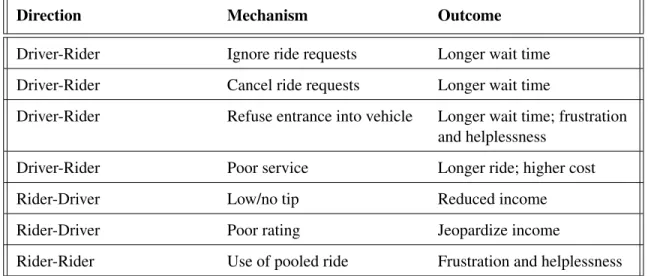
The direction of discrimination is three-fold: driver-rider, rider-driver, and rider-rider. Each direc-tion entails a variety of different mechanisms, as documented in the preceding secdirec-tion. Driver-rider discrimination, for example, is made possible through drivers’ ability to cancel or refuse rides in response to a rider’s photograph, name, or location. Rider-driver discrimination, on the other hand, is made possible through tipping and rating functions. Arguably, the former direction of discrimi-nation is easier for TNCs to address due to their control over drivers and the information available to them.
Rider-rider discrimination, finally, is an emerging area of interest considering the future of au-tonomous ridesharing (see Chapters 3 and 4 for a more detailed discussion of this topic). The setting of discrimination may be physical (i.e., single-passenger trips, pooled trips) or virtual (i.e., action/inaction through the application).
In general, the outcomes of discrimination include avoidance, rejection, verbal harassment, phys-ical attacks, and the overt or subtle denial of goods or services.[52] In this thesis, the outcome of greatest interest is subtle denial of services. For ridehailing/ridesharing users, this outcome can include longer wait times, more frequent cancellations, longer rides, lower ratings, or poor ser-vice, leading to inconvenience, inaccessibility, and lower quality of life. For drivers, the outcomes of discrimination include lower ratings, lower tips, and higher cancellations, all of which reduce drivers’ ability to earn a living. See Table 1 for a summary of the directions, mechanisms, settings, and outcomes.
Direction Mechanism Outcome
Driver-Rider Ignore ride requests Longer wait time
Driver-Rider Cancel ride requests Longer wait time
Driver-Rider Refuse entrance into vehicle Longer wait time; frustration
and helplessness
Driver-Rider Poor service Longer ride; higher cost
Rider-Driver Low/no tip Reduced income
Rider-Driver Poor rating Jeopardize income
Rider-Rider Use of pooled ride Frustration and helplessness
Table 1: Forms of discrimination in shared mobility. Targets could include race, color, religion, sex, national origin, and disability.
unpleasant emotions like frustration and helplessness.[78, p. 652-653] What’s more, discrimina-tory outcomes limit connectedness by discouraging or preventing interactions between strangers. Greater connectedness offers many benefits to society; positive social interactions between riders, exposure to diverse socio-spatial environments, and arguably happier, healthier people. It has been demonstrated, for example, that brief interactions with strangers may expand capacity to engage with different cultures and develop new social sensibilities.[21, p. 5] Transportation systems that emphasize connectedness can help support equality of opportunity, increase social capital, and even decrease the cost of dependency and institutional care.[101, p. 27]
One final issue related to discrimination and TNCs is the idea of responsibility. Arguably, a dis-criminatory action by a driver, for example, occurs at the individual level. After all, a TNC cannot control the treatment of customers over such a vast number of direct interactions. On the other hand, courts have held taxicab companies responsible for the discriminatory actions of their drivers, com-plicating the notion that Uber and Lyft are neutral platforms with no control over discriminatory outcomes. Additionally, if courts define TNCs as employers rather than simple platforms that
con-nect drivers and riders, then Title VII of the Civil Rights Act will apply.5 In that case, these firms
may be held responsible for discrimination against drivers, even if that discrimination is a product of customer preference. Regardless of the classification of TNC drivers, this thesis holds TNCs responsible for protecting riders and drivers from discrimination and governments responsible for enforcing anti-discriminatory standards. In this light, Chapter 5 investigates ways that TNCs and governments can fulfill these responsibilities respectively.
5Whether Uber meets the legal definition of "employer" is being fought out in courts and administrative agencies across the country. A 2015 decision of the California Labor Commission confirmed an individual plaintiff’s claim that she was an employee of Uber. In the 2018 ruling Dynamex Operations West, Inc. v. Superior Court, the Supreme Court of
Ridesharing Passengers
Through daily mobility, we socialize or seek solitude, negotiate our identify and per-form a range of social roles; through mobility we may contest power relationships and claim our right to participate in society or we may be excluded and ignored.
Marco Brömmelstroet [21, p. 5]
3.1 Introduction
As noted in Chapter 2, numerous studies have provided evidence for driver-to-passenger discrim-ination in the context of ridehailing. Seminal research by Ge et al. (2016), for example, provided experimental evidence that the design of Uber and Lyft’s platforms allows for discrimination from individual drivers to riders. Though lacking the experimental approach of Ge et al., other recent studies have highlighted the theoretical case for rider-to-driver discrimination in TNCs. Rosen-blat et al. (2017) used a review of consumer behavior in online marketplaces and performance evaluations in managerial settings to argue that racial and gender bias is likely to influence TNC
themselves [15]. Together, these studies and legal cases highlight the possibility of discrimination between drivers and riders in the context of ridehailing.
Rider-rider discrimination is also plausible, but no studies to date have provided evidence of dis-criminatory attitudes in the context of dynamic ridesharing. Additionally, no studies have yet considered the variation of discriminatory attitudes in accordance with ridesharing user character-istics. To address these gaps in the literature, this chapter provides an empirical assessment of the discriminatory attitudes among various social groups in cities with access to dynamic ridesharing. This chapter examines class- and race-related variations in discriminatory attitudes between fellow passengers and tests the impact of one’s generic social dominance orientation on discriminatory attitudes in the ridesharing context. To do so, this chapter uses data from a survey of 1,110 TNC users to create two structural equation models. These models address the following research topics: 1) correlation between discriminatory attitudes toward fellow passengers of differing class and race in the shared ride and respondent characteristics such as gender, age, race, and income 2) variation in these attitudes according to targets of discrimination (i.e., race and class) in ridesharing 3) the influence of respondent’s generic social dominance orientation in discriminatory preferences in the ridesharing context. The results of these inquiries will inform decisions by TNCs and policymakers as they seek to foster positive social interactions between riders and limit the ability of passengers to avoid or discriminate against one another on the basis of race and class.
Section 3.2 of this chapter provides relevant background on the rise of dynamic ridesharing. Then Section 3.3 explains the data collected and presents two structural equation models created to an-alyze discriminatory attitudes in ridesharing. The chapter then presents seven key findings from these models and summarizes the behavior and policy implications of these findings in Section 3.4.
3.2 Emergence of Dynamic Ridesharing
Before exploring the possibility of discrimination in dynamic ridesharing, the following section provides a brief introduction to rise of dynamic ridesharing since 2014. Ridesharing, in the form of carpooling or vanpooling, has existed for decades. Informal forms of ridesharing, such as Mo-rocco’s grands taxis and other forms of shared rides, have long been common across the world. Although it has always promised door-to-door service, lower per-passenger travel costs, and con-gestion reduction, traditional carpooling has been at best marginally successful in the United States. Nonetheless many studies have analyzed traditional carpool programs in order to inform policies that might increase carpooling. A seminal 1977 study of employers carpooling programs argued that the most important barriers to ridesharing were 1) the habit of private driving and 2) the resis-tance to initiating contact and starting a carpool [34, p. 688].
The arrival of the dynamic ridesharing products uberPOOL and Lyft Line in 2014 challenged these two primary barriers to carpooling: reluctance to give up individual driving and resistance to
ini-tiating contact with strangers. Regarding the former, the critical importance of individual car use seems to be eroding in light of TNCs, car-sharing services, and broader cultural shifts. Studies such as Klein and Scott, for example, have presented evidence that Americans (particularly "Mil-lenials," born in the 1980s and 1990s) are less likely to own cars than previous generations [77]. While many studies have argued that this trend may reverse as Millenials age, the fact remains that travel behavior has changed [94, 31]. Regarding the second barrier to carpooling, new rider-rider matching algorithms have made it easier for riders to initiate contact with one another through effi-cient and convenient platforms. While conventional carpooling matching programs focused largely on the daily commute, ridesharing algorithms now offer appealing on-the-fly and round-the-clock connections. What’s more, dynamic ridesharing technology also offers greater accountability,
con-venience, and social connections, adding to its general appeal.1
As a result of these evolutions, TNC rides often involve not just one driver and one rider, but also additional riders sharing the same ride. Services like uberPOOL and Lyft Line operate much like these companies’ more traditional ridehailing products, such as uberX. Riders input their locations and destinations and their app then displays the price for a solo ride, as well as a discounted price for a pooled ride (often less than 75 percent of the traditional rate). In the case of Uber and Lyft apps, the uberPOOL and Lyft Line options are the default choice for users as of this writing. Pooling is available to both single riders and pairs of riders, with a small surcharge charged for the second rider. Riders choosing the pool option may ultimately be the only rider to use the service, or they may encounter second or third pick-ups, although they pay the same price regardless of whether the ride is shared. The exact match rate is not known, but Uber has claimed that it is as high as
90 percent in high-traffic areas during commuting hours [66].2 Once a shared ride is underway,
the driver may receive a notification that there is another passenger nearby with a geographically similar location. While drivers can decline this pickup, doing so can lower their ratings, and so each request is likely to be accepted.
Of course, additional passengers increase the overall trip time for riders, creating the potential for frustration on the part of riders. Due to the potential of delaying other riders, Uber and Lyft both ask that their riders be considerate toward one another. Uber’s website asks POOL users to be ready to go before their driver arrives [67]. Lyft’s website goes one step further, encouraging Line users to be considerate with their baggage and to be mindful of language and conduct [Inc.]. However, as of this writing, neither Lyft nor Uber offer the option for riders to rate the conduct of other riders. In light of this major evolution in ridesharing, recent research at MIT investigated ridesharing users’ perceptions, positive and negative, of sharing time and space with strangers in the backseat of a car [107]. The paper To Share or Not to Share: Investigating the Social Aspects of Dynamic
ingused a survey of 1,110 TNC users across the United States to explore how people experience the social aspects of ridesharing. This survey data provides the foundation of this chapter.
Among other important findings, research by Sarriera et al indicated that many riders harbor dis-criminatory attitudes towards passengers of different social class and race. What’s more, these passengers seem to prefer additional early information about these future passengers, thus sup-porting earlier research arguing that a lack of information about potential passengers was a barrier to acceptance of ridesharing [75]. Given the findings of this paper, it is conceivable that rider-rider discrimination is already a critical issue in shared rides. While drivers currently serve as a third party moderator of rider-rider relationships, these interactions may become more prominent as driverless, autonomous ridesharing platforms become more ubiquitous (See Chapter 4 for more discussion of this possibility). While TNCs may mitigate discrimination and encourage positive social interactions between riders, efforts to build passenger-to-passenger rapport and ensure ac-countability, trust, and positive connections are still a new domain for research. By evaluating discriminatory attitudes in the shared ride, this chapter represents a first step in this effort.
Additionally, several studies have investigated attitudes such as drivers’ willingness to interact with strangers and their desire for autonomy and convenience, but few have considered the potentially discriminatory aspects of carpooling and dynamic ridesharing. Chaube et al., for example, de-termined that lack of trust deters riders from offering or accepting shared rides [24]. Deloach and Tiemann investigated the effect of personality type (i.e., introvert, extrovert), marital status, and other factors on willingness to carpool and found that the desire for socialization can affect ridesharing. This paper also found a significant relationship between personal characteristics like gender and the perceived need for autonomy and flexibility in ridesharing [32, p. 533-535]. By extension, additional research could determine whether there is a relationship between personal characteristics and discriminatory attitudes in the ridesharing context. The current chapter intends to fill that research gap.
3.3 Modeling Discriminatory Attitudes in Ridesharing
In light of the discussion above, the following section reviews and analyzes the results of Sarriera et al.’s national survey of Uber and Lyft users in order to model users’ attitudes toward potential fellow passengers and discuss their discriminatory attitudes in the context of ridesharing.
3.3.1 Data
Sarriera et al. conducted the survey in June and July 2016 through Amazon Mechanical Turk, a crowdsourcing service that allows researchers to compensate human workers to answer questions or perform other tasks. The researchers built the survey through the online survey development
service Qualtrics and used Mechanical Turk to recruit a broad sample of survey takers. One limi-tation of the use of Mechanical Turk for this task was the possibility that the survey takers may be incentivized to complete surveys quickly and without thought. As such, the researchers screened such behavior through two basic attention check questions (e.g., "Please select ’Agree’ for this question"). For this research, we also applied five further tests of attention and logical consistency to the completed responses. Responses that failed two or more of the five tests were omitted re-sponses, as were any respondents that reported zero Uber or Lyft trips in the past month. Of 1,222 respondents who completed the survey and passed the basic attention checks, 112 failed the atten-tion tests. The final sample size of the analysis was 1,110 respondents, 850 of whom had previously used dynamic ridesharing.
As shown in Table 2, the survey respondents were relatively young, male, white, and educated in comparison to the American population. These characteristics largely coincide with the charac-teristics of Mechanical Turk users more broadly [70]. Compared to the population of TNC users, the respondents were fairly representative with regard to gender, age, education, and race. Geo-graphically, the most respondents were in the metropolitan areas of Los Angeles, New York City, Chicago, San Francisco, Boston, Philadelphia, Washington, D.C., Atlanta, and Miami, which ac-curately represents the markets in which dynamic ridesharing technology first arrived and still sees heavy use.
3.3.2 Descriptive Statistics
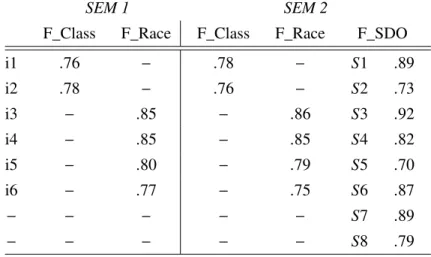
In addition to basic demographics, the survey posed questions in the following categories: general travel behavior; opinion on and experience with uberPOOL and Lyft Line; generic attitude to-ward social dominance (referenced in Section 3.3.3); and specific preferences with respect to being paired with people of different backgrounds in shared rides. The six attitudinal questions within this last category are of special interest to this chapter because they assess the existence of and potential for discrimination in ridesharing services through stated preferences. These six questions are:
Class
• i1: I would prefer to avoid being paired with a passenger of a lower social class in shared rides
• i2: Pairing passengers from all social classes in shared rides is a good idea (a "reverse" preference, i.e., more agreement indicates a less discriminatory attitude)
Race3
• i3: Sharing a ride with a passenger of a different ethnicity could make me uncomfortable • i4: Everyone should welcome passengers of all ethnicities in shared rides (reverse) • i5: Grouping passengers of different races in shared rides is a recipe for trouble
• i6: It would be great to be paired in shared rides with passengers of all different races (re-verse)
The survey asked respondents to indicate their agreement to these and other preferences according to a seven-step Likert scale (i.e., opinion statements from "strongly disagree" to "strongly agree"). In most cases, the demographic questions were structured as multiple choice questions. Table 2 presents an overview of respondent demographics while Table 3 provides an overview of responses to discriminatory preference questions. Table 3 reveals that, in general, a small but significant minority explicitly expressed discriminatory attitudes (i.e., 6.0 to 12.6 percent, depending on the attitude and the characteristics of the respondents). These stated preferences offer powerful insight, but are likely to under represent the prevalence of discriminatory attitudes due to social desirability bias [99]. However, despite the limitations of measuring discriminatory attitudes through such stated preference surveys, these descriptive statistics suggest that such attitudes do indeed exist within the population of ridehailing users.
3While each of these four questions focuses either on race or ethnicity, in practice it is difficult to differentiate the two phenomenon in measurement and modeling, so they are combined for the purposes of this chapter and referred to as racial or race preferences.
Table 2: Demographics of respondents. n=1,110
Characteristic Count Characteristic Count
Males 58.6% Black 9.1%
Parents 25.8% Asian 10.1%
Single 40.5% Hispanic 7.6%
Women w/ Children 13.3% White 69.3%
Single Women 13.8% Uses Sharing 76.5%
Unemployed 6.6% Primarily Drives 53.2%
Students 13.6% Primarily Uses Transit 20.4%
HS Education 6.8% Primarily Uses TNC 10.5%
Some College 28.7% Owns Car 68.6%
College Degree 47.8% – –
Graduate Degree 16.5% – –
Table 3: Preferences of respondents, from "Strongly Disagree" (1) to "Strongly Agree" (7). n=1,110
1 2 3 4 5 6 7
i1: I would prefer to avoid being paired with a pass. of a lower social class in shared rides
29.8% 23.7% 10.5% 24.4% 5.7% 3.8% 1.8%
i2: Pairing passengers from all social classes in shared rides is a good idea
2.4% 3.9% 6.3% 29.0% 19.5% 24.2% 14.3%
i3: Sharing a ride with a pass. of a different ethnicity could make me uncomfortable
37.8% 28.0% 9.4% 15.3% 5.7% 1.9% 1.6%
i4: Everyone should welcome passengers of all ethnicities in shared rides
1.2% 1.2% 3.6% 16.3% 14.0% 27.0% 36.5%
i5: Grouping passengers of different races in shared rides is a recipe for trouble
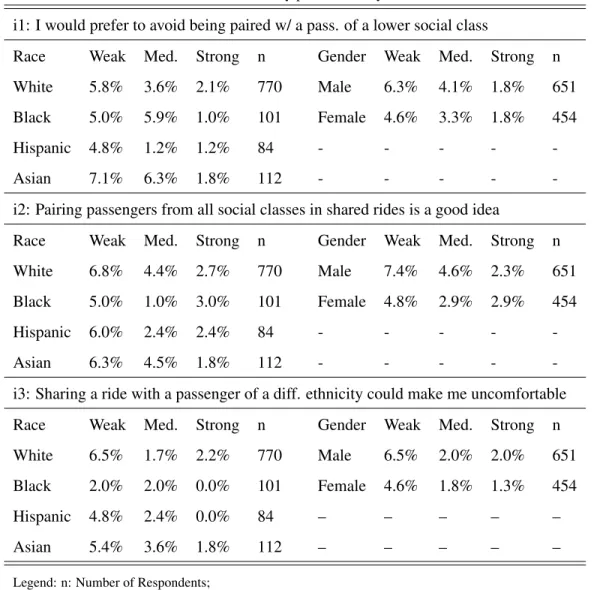
Table 4, meanwhile, presents a series of bivariate cross-tabulations between demographics (partic-ularly race and gender) and the six survey questions related to discrimination and ridesharing. This table suggests several simple correlations. Notably, a greater share of white or Asian respondents agree with discriminatory statements such as "Sharing a ride with a passenger of a different eth-nicity could make me unconformable," relative to black or Hispanic respondents. Conversely, a greater share of black respondents agree with anti-discriminatory statements such as "Everybody should welcome passengers of all ethnicities in shared rides." The relative responses of men and women suggest that men agree more with the discriminatory statements.
Furthermore, a Mann-Whitney-Wilcoxon test revealed that several of these questions have signifi-cantly different answers for different groups of riders. In particular men and women are noniden-tical populations (at the .01 significance level) for all preferences. White and nonwhite respon-dents are nonidentical populations for preferences i3 and i4. Black and non-black responrespon-dents are nonidentical populations for four out of six preferences: i2, i3, i4, and i6. Given these findings, the structural equation models presented in the following section examine the variations of dis-criminatory attitudes and the relationship between such attitudes and a generic social dominance orientation.
Table 4: Cross-tabulations: Discriminatory preferences by selected rider characteristics
i1: I would prefer to avoid being paired w/ a pass. of a lower social class
Race Weak Med. Strong n Gender Weak Med. Strong n
White 5.8% 3.6% 2.1% 770 Male 6.3% 4.1% 1.8% 651
Black 5.0% 5.9% 1.0% 101 Female 4.6% 3.3% 1.8% 454
Hispanic 4.8% 1.2% 1.2% 84 - - - -
-Asian 7.1% 6.3% 1.8% 112 - - - -
-i2: Pairing passengers from all social classes in shared rides is a good idea
Race Weak Med. Strong n Gender Weak Med. Strong n
White 6.8% 4.4% 2.7% 770 Male 7.4% 4.6% 2.3% 651
Black 5.0% 1.0% 3.0% 101 Female 4.8% 2.9% 2.9% 454
Hispanic 6.0% 2.4% 2.4% 84 - - - -
-Asian 6.3% 4.5% 1.8% 112 - - - -
-i3: Sharing a ride with a passenger of a diff. ethnicity could make me uncomfortable
Race Weak Med. Strong n Gender Weak Med. Strong n
White 6.5% 1.7% 2.2% 770 Male 6.5% 2.0% 2.0% 651
Black 2.0% 2.0% 0.0% 101 Female 4.6% 1.8% 1.3% 454
Hispanic 4.8% 2.4% 0.0% 84 – – – – –
Asian 5.4% 3.6% 1.8% 112 – – – – –
Legend: n: Number of Respondents;
i4: Everyone should welcome passengers of all ethnicities in shared rides
Race Weak Med. Strong n Gender Weak Med. Strong n
White 3.9% 0.6% 1.4% 770 Male 4.8% 1.7% 1.8% 651
Black 1.0% 2.0% 2.0% 101 Female 2.0% 0.4% 0.4% 454
Hispanic 6.0% 3.6% 0.0% 84 - - - -
-Asian 3.6% 2.7% 0.9% 112 - - - -
-i5: Grouping passengers of different races in shared rides is a recipe for trouble
Race Weak Med. Strong n Gender Weak Med. Strong n
White 5.8% 3.2% 2.5% 770 Male 6.3% 2.6% 2.3% 651
Black 5.9% 4.0% 1.0% 101 Female 5.1% 4.0% 1.5% 454
Hispanic 4.9% 0.0% 1.2% 84 - - - -
-Asian 7.1% 4.5% 0.9% 112 - - - -
-i6: It would be great to be paired in shared rides with pass. of all different races
Race Weak Med. Strong n Gender Weak Med. Strong n
White 4.0% 4.5% 1.6% 770 Male 4.8% 4.8% 2.2% 651
Black 3.0% 2.0% 1.0% 101 Female 3.3% 3.3% 1.1% 454
Hispanic 10.7% 2.4% 3.6% 84 - - - -
-Asian 1.8% 6.3% 2.7% 112 - - - -
-Legend: n: Number of Respondents;
Weak: Somewhat (dis)agree; Medium: (Dis)agree; Strong: Strongly (dis)agree
3.3.3 Factor-Based Structural Equation Models
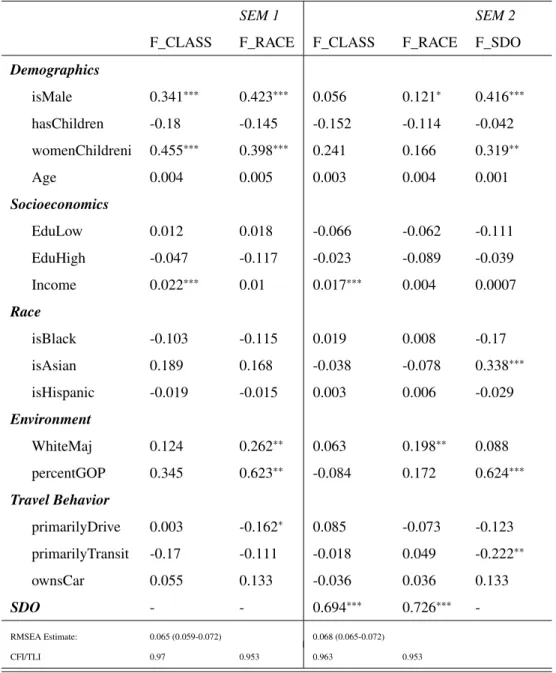
The following section uses the data described above to create conceptual models of self-reported discriminatory attitudes among various social groups. These models use factor-based structural equation models to assess the probability of a choice (i.e., the Likert-scale preferences described above) against explanatory variables (i.e., sociodemographic characteristics like age, gender, and
income).4 These models also include as explanatory variables additional information about
respon-4Explanation of coefficient names: isMale = whether the respondent is male; hasChildren = whether the respondent has 1 or more children; womenChildreni = interaction term indicating whether a respondent is a women living with a child;