MIT Joint Program on the Science and Policy of Global Change
combines cutting-edge scientific research with independent policy analysis to provide a solid foundation for the public and private decisions needed to mitigate and adapt to unavoidable global environmental changes. Being data-driven, the Joint Program uses extensive Earth system and economic data and models to produce quantitative analysis and predictions of the risks of climate change and the challenges of limiting human influence on the environment— essential knowledge for the international dialogue toward a global response to climate change.
To this end, the Joint Program brings together an interdisciplinary group from two established MIT research centers: the Center for Global Change Science (CGCS) and the Center for Energy and Environmental Policy Research (CEEPR). These two centers—along with collaborators from the Marine Biology Laboratory (MBL) at
Woods Hole and short- and long-term visitors—provide the united vision needed to solve global challenges.
At the heart of much of the program’s work lies MIT’s Integrated Global System Model. Through this integrated model, the program seeks to discover new interactions among natural and human climate system components; objectively assess uncertainty in economic and climate projections; critically and quantitatively analyze environmental management and policy proposals; understand complex connections among the many forces that will shape our future; and improve methods to model, monitor and verify greenhouse gas emissions and climatic impacts.
This reprint is intended to communicate research results and improve public understanding of global environment and energy challenges, thereby contributing to informed debate about climate change and the economic and social implications of policy alternatives.
—Ronald G. Prinn and John M. Reilly, Joint Program Co-Directors
MIT Joint Program on the Science and Policy
of Global Change Massachusetts Institute of Technology 77 Massachusetts Ave., E19-411 T (617) 253-7492 [email protected] F (617) 253-9845
November 2016
A Drought Indicator based on Ecosystem
Responses to Water Availability: The
Normalized Ecosystem Drought Index
Kuang-Yu Chang, Kyaw Tha Paw U & Liyi Xu
A Drought Indicator based on Ecosystem
Responses to Water Availability: The
Normalized Ecosystem Drought Index
Kuang-Yu Chang1,2, Kyaw Tha Paw U2, Liyi Xu3Abstract: Drought is one of the most destructive natural disasters causing serious damages to human society,
and studies have projected more severe and widespread droughts in the coming decades associated with
the warming climate. Although several drought indices have been developed for drought monitoring, most
of them were based on large scale environmental conditions rather than ecosystem transitional patterns to
drought. Here, we propose using the ecosystem function oriented Normalized Ecosystem Drought Index
(NEDI) to quantify drought severity, loosely related to Sprengel’s and Liebig’s Law of the Minimum for
plant nutrition. Extensive eddy covariance measurements from 60 AmeriFlux sites across 8 IGBP vegetation
types were used to validate the use of NEDI. The results show that NEDI can reasonably capture ecosystem
transitional responses to limited water availability, suggesting that drought conditions detected by NEDI
are ecosystem function oriented. The widely used Palmer Drought Severity Index (PDSI), on the other
hand, does not have a clear relationship with ecosystem responses to drought conditions because ecosystem
adaptation ability is not considered in PDSI calculation.
1 This report is a chapter of Kuang-Yu Chang's doctoral dissertation.
2 Department of Land, Air and Water Resources, University of California, Davis, California, USA.
3 Joint Program on the Science and Policy of Global Change, Massachusetts Institute of Technology, Cambridge, Massachusetts, USA.
1. INTRODUCTION ...2
2. METHODOLOGY ...2
2.1 NormALIZeD eCoSYSTem DroUGHT INDeX (NeDI) ... 2
2.2 moDIFIeD vArIAbLe INTervAL TIme AverAGING (vITA) ... 2
3. DATA ...3
3.1 AmerIFLUX DATASeT ...3
3.2 PDSI DATASeT ...5
4. RESULTS AND DISCUSSIONS ...5
4.1 evAPoTrANSPIrATIoN DeFICITS AND CroP CoeFFICIeNTS ...5
4.2 WATer USe eFFICIeNCY (WUe) ...6
5. CONCLUSIONS ...8
1. Introduction
Drought is one of the most devastating natural disasters
that can cause serious agricultural, economic and
so-cial impacts in the world (Wilhite, 2000). Several studies
project increased aridity over land and more widespread
droughts associated with the future warming climate
(Mpelasoka et al., 2008; Feyen, 2009; Seager et al., 2007;
2009; Dai, 2011). Therefore, it is imperative to define a
proper drought measure that can objectively quantify
drought characteristics, such as onset, severity and
dura-tion. Current drought measures often identify droughts as
the departures of soil water balance from normal
condi-tions—such as the Palmer Drought Severity Index (PDSI)
(Palmer, 1965), the self-calibrating PDSI (Wells et al.,
2004) and the Soil Moisture Deficit Index (SMDI)
(Nara-simhan and Srinivasan, 2005)—or as the deviations from
normal precipitation patterns, such as the Standardized
Precipitation Index (SPI) (McKee et al., 1993) and the
Standardized Precipitation Evapotranspiration Index
(SPEI) (Vicente-Serrano et al., 2010; Beguería et al., 2014).
Although the drought indices cited above can provide
practical information for drought monitoring, those
ap-proaches are based on large-scale, controlled
environmen-tal conditions rather than specific ecosystem responses to
limited water availability. Therefore, drought conditions
identified by those drought indices may misrepresent
actu-al ecosystem behavior, since ecosystems can have various
adaptation and acclimation mechanisms against limited
water availability (Lu and Zhuang, 2010; Liu et al., 2011).
These mechanisms are related to the issue that a particular
ecosystem found at any location may represent an
assem-blage of species that are in their fundamental ecological
niche (Peterson, 2003), which already includes historical
climatological conditions such as periodic droughts. Here,
we propose an ecosystem-function-oriented Normalized
Ecosystem Drought Index (NEDI) to quantify drought
severity. This method is based on detecting variational
sig-nals in normalized evapotranspiration strength
1through
a modified Variable Interval Time Averaging (VITA)
technique traditionally used for turbulence studies
(Black-welder and Kaplan, 1976). The general concept is inspired
by Sprengel’s and Liebig’s Law of the Minimum for plant
nutrition (van der Ploeg et al., 1999). We examined the
applicability of NEDI with evapotranspiration field
mea-surements from 60 eddy covariance towers across 8
dif-ferent vegetation types defined by the International
Geo-sphere–Biosphere Programme classification (IGBP). The
drought conditions suggested by PDSI were also analyzed
in the same fashion to compare the differences between
NEDI and PDSI.
1 Normalized evapotranspiration strength is defined as the ratio between evapotranspiration and potential evapotranspiration.
2. Methodology
2.1 Normalized Ecosystem Drought Index
(NEDI)
Similar to Vicente-Serrano et al. (2010), we use the
dif-ference between monthly precipitation (P) and
month-ly potential evapotranspiration (PET) to estimate water
availability (W) in ecosystems. However, we represent
water supply with total precipitation collected in the
pre-vious month instead of the value in the current month to
account legacy effects for precipitation become an
avail-able water source. Therefore, the water availability for the
month i can be represented as
which is positive with water surplus and vice versa,
ne-glecting groundwater storage and runoff. The monthly
NEDI is then defined by normalizing the W
iseries with
the maximum water surplus or deficit value shown in the
W
iseries for each ecosystem, which can be represented as
The NEDI defined above can quantify the water
availabil-ity at each site from –1 (driest condition) to 1 (wettest
condition).
The Thornthwaite PET (Thornthwaite, 1948), which
re-quires only the mean monthly surface air temperature and
latitude, was used to estimate the monthly water demand
required for NEDI calculation. Although limitations have
been found in using the Thornthwaite PET (Jensen et al.,
1990; Donohue et al., 2010; van der Schrier et al., 2011),
Dai (2011) showed that using the more sophisticated
Pen-man-Monteith PET only exhibits limited effects in the
PDSI calculation. Therefore, the Thornthwaite PET was
used in our calculation to bypass the extensive amount of
data required for using the Penman-Monteith PET.
2.2 Modified Variable Interval Time
Averaging (VITA)
Based on a running variance concept, the VITA
tech-nique (Blackwelder and Kaplan, 1976) has been widely
applied to detect turbulence characteristics in unsteady
flows. The localized variance used in VITA for each time
interval T is calculated as
where p and t stands for detection parameter and
obser-vation time, respectively. When the streamwise velocity
is used for the detection parameter, turbulence patterns
are then identified if rapid changes are detected in the
lo-calized variance, suggesting the existence of high velocity
fluctuations.
We extend this running variance concept to ecosystem
drought monitoring by labeling the detection
parame-ter with the corresponding NEDI, then sorting by NEDI
values in place of the time domain used in the original
VITA. This modified VITA is defined as
where i and N are the i
thNEDI and the analyzed window
size, respectively. The crop coefficient K
c, defined as the
ratio between actual evapotranspiration and potential
evapotranspiration (Doorenbos and Pruitt, 1977;
Al-len et al., 1998) and the water use efficiency (WUE)
de-fined as the Net Ecosystem Exchange (NEE) divided by
the actual evapotranspiration, were used as detection
parameters for ecosystem drought because K
crepresents
a nondimensional measure for evapotranspiration, and
WUE represents the ability of ecosystems to assimilate
carbon given their water use. Therefore, if rapid changes
in K
care detected by the modified VITA technique, the
corresponding NEDI are then recorded as thresholds for
ecosystem transitional responses to drought conditions. In
order to prevent K
cfrom being unrealistically high,
espe-cially when Thornthwaite PET is calculated as zero during
wintertime, an upper bound for K
cis assigned to 3. The
analysis window size was selected as 10 points to smooth
out high frequency variations in the raw data. Different
sets of K
cupper bounds and window sizes were tested, and
the results were similar to the values presented here.
VITA is used to test for drought as a limiting factor
follow-ing the general concept of Sprengel’s and Liebig’s Law of
Minimums for plant nutrition (van der Ploeg et al., 1999).
Here ecological drought is defined as when drought is
the dominant factor limiting ecosystem function, as
in-dicated in this case by K
cand WUE although this method
could be used with other quantifiable ecosystem values.
When drought is not the limiting factor, other variables
will then control K
cand WUE, so variability in the form
of increased variance will appear, and be detected by
VITA. The threshold for when the variance increases
thus represents the NEDI threshold.
3. Data
3.1 AmeriFlux dataset
The half-hourly based eddy covariance datasets across 60
AmeriFlux sites from 1991 to 2015 are used in this study.
2These sites encompass a variety of vegetation types and
climatic conditions (Table 1).
2 http://ameriflux.lbl.gov Table 1. The AmeriFlux sites used in this study.
Site name Lat. Long. Vegetation type (IGBP) Data period Source
ARM SGP Main (US-ARM) 36.61 -97.49 Croplands 12/31/2000–01/27/2013 Fischer et al. (2007) Audubon Research Ranch (US-Aud) 31.59 -110.51 Grasslands 06/07/2002–09/26/2011 Qi et al. (2000) Bartlett Experimental Forest (US-Bar) 44.06 -71.29 Deciduous broadleaf forest 12/31/2003–01/14/2013 Richardson et al. (2007) Blodgett Forest (US-Blo) 38.90 -120.63 Evergreen needleleaf forest 06/02/1997–10/10/2007 Goldstein et al. (2000) Bondville (US-Bo1) 40.01 -88.29 Croplands 08/25/1996–12/30/2010 Meyers & Hollinger
(2004)
Bondville Companion (US-Bo2) 40.01 -88.29 Croplands 05/13/2004–12/28/2008 Bernacchi et al. (2005) Brooks Field Site 10 (US-Br1) 41.97 -93.69 Croplands 01/01/2005–11/09/2011 Cammalleri et al. (2014) Brooks Field Site 11 (US-Br3) 41.97 -93.69 Croplands 01/01/2005–11/09/2011 Sakai et al. (2016) Canaan Valley (US-CaV) 39.06 -79.42 Grasslands 01/06/2004–11/18/2010 Yang et al. (2007) Chestnut Ridge (US-ChR) 35.93 -84.33 Deciduous broadleaf forest 05/11/2005–01/13/2011 Cammalleri et al. (2014) Duke Forest Open Field (US-Dk1) 35.97 -79.09 Grasslands 01/01/2001–12/31/2008 Katul et al. (2003) Duke Forest Hardwoods (US-Dk2) 35.97 -79.10 Mixed forest 01/01/2001–12/31/2008 Katul et al. (2003) Duke Forest Loblolly Pine (US-Dk3) 35.98 -79.09 Evergreen needleleaf forest 01/01/1998–12/31/2008 Katul et al. (2003) Florida Everglades Shark River Slough
Long Hydroperiod Marsh (US-Elm) 25.55 -80.78 Permanent wetlands 07/22/2008–12/31/2013 Schedlbauer et al. (2012) Florida Everglades Taylor Slough
Short Hydroperiod Marsh (US-Esm) 25.44 -80.59 Permanent wetlands 01/01/2008–12/31/2013 Schedlbauer et al. (2012) Flagstaff Managed Forest (US-Fmf) 35.14 -111.73 Evergreen needleleaf forest 07/29/2005–12/31/2010 Dore et al. (2010) Fort Peck (US-FPe) 48.31 -105.10 Grasslands 01/01/2000–12/28/2008 Cammalleri et al. (2014)
Site name Lat. Long. Vegetation type (IGBP) Data period Source
Freeman Ranch Mesquite Juniper
(US-FR2) 29.95 -98.00 Woody savannas 01/01/2005–12/29/2008 Heinsch et al. (2004) Freeman Ranch Woodland (US-FR3) 29.94 -97.99 Woody savannas 07/17/2004–12/31/2012 Heinsch et al. (2004) Flagstaff Unmanaged Forest (US-Fuf) 35.09 -111.76 Evergreen needleleaf forest 09/06/2005–12/31/2010 Dore et al. (2008) Flagstaff Wildfire (US-Fwf) 35.45 -111.77 Grasslands 06/15/2005–12/31/2010 Dore et al. (2008) GLEES (US-GLE) 41.36 -106.24 Evergreen needleleaf forest 10/01/2004–12/31/2012 Zeller & Nikolov (2000) Great Mountain Forest (US-GMF) 41.97 -73.23 Mixed forest 05/19/1999–12/31/2004 Lee et al. (2001) Harvard Forest (US-Ha1) 42.54 -72.17 Deciduous broadleaf forest 10/28/1991–12/31/2014 Moore et al. (1996) Howland Forest Main (US-Ho1) 45.20 -68.74 Evergreen needleleaf forest 01/01/1996–12/31/2009 Hollinger et al. (1999) Fermi Agricultural (US-IB1) 41.86 -88.22 Croplands 03/28/2005–12/31/2011 Matamala et al. (2008) Fermi Prairie (US-IB2) 41.84 -88.24 Grasslands 10/06/2004–12/31/2011 Matamala et al. (2008) Kansas Field Station (US-KFS) 39.06 -95.19 Grasslands 06/16/2007–12/31/2012 Cochran et al. (2016) Konza Prairie (US-Kon) 39.08 -96.56 Grasslands 08/22/2006–12/31/2012 Logan & Brunsell (2015) Kennedy Space Center Scrub Oak
(US-KS2) 28.61 -80.67 Closed shrublands 06/29/1999–12/31/2006 Powell et al. (2006) Lost Creek (US-Los) 46.08 -89.98 Wetland 01/01/2000–12/31/2014 Sulman et al. (2009) Metolius Intermediate Pine (US-Me2) 44.45 -121.56 Evergreen needleleaf forest 01/01/2002–12/31/2014 Law et al. (2004) Metolius Second Young Pine (US-Me3) 44.32 -121.61 Evergreen needleleaf forest 01/01/2004–12/31/2009 Sun et al. (2004) Metolius First Young Pine (US-Me5) 44.44 -121.57 Evergreen needleleaf forest 06/17/1999–12/31/2002 Law et al. (2003) Morgan Monroe State Forest (US-MMS) 39.32 -86.41 Deciduous broadleaf forest 01/01/1999–12/31/2014 Pryor et al. (1999) Missouri Ozark (US-MOz) 38.74 -92.20 Deciduous broadleaf forest 01/01/2004–12/31/2014 Gu et al. (2006) Marys River Fir Site (US-MRf) 44.65 -123.55 Evergreen needleleaf forest 01/01/2005–02/17/2012 He et al. (2015) North Carolina Loblolly Pine (US-NC2) 35.80 -76.67 Evergreen needleleaf forest 01/01/2005–12/31/2010 Noormets et al. (2010) Mead Irrigated (US-Ne1) 41.17 -96.48 Croplands 05/25/2001–05/31/2013 Suyker et al. (2004) Mead Irrigated Rotation (US-Ne2) 41.16 -96.47 Croplands 06/04/2001–05/31/2013 Suyker et al. (2004) Mead Rainfed (US-Ne3) 41.18 -96.44 Croplands 06/04/2001–05/31/2013 Suyker et al. (2004) Niwot Ridge (US-NR1) 40.03 -105.55 Evergreen needleleaf forest 11/01/1998–12/31/2014 Turnipseed et al. (2002) Ohio Oak Openings (US-Oho) 41.55 -83.84 Deciduous broadleaf forest 01/01/2004–12/31/2013 DeForest et al. (2006) Park Falls (US-PFa) 45.95 -90.27 Mixed forest 01/01/1995–12/31/2014 Desai et al. (2014) Florida Everglades Shark River
Slough Mangrove Forest (US-Skr) 25.36 -81.08 Evergreen broadleaf forest 01/01/2004–09/12/2011 Barr et al. (2009) Sky Oaks Old (US-SO2) 33.37 -116.62 Closed shrublands 01/01/1997–12/31/2006 Stylinski et al. (2002) Sky Oaks Young (US-SO3) 33.38 -116.62 Closed shrublands 01/01/1997–12/31/2006 Stylinski et al. (2002) Austin Cary (US-SP1) 29.74 -82.22 Evergreen needleleaf forest 07/01/2000–12/31/2011 Fang et al. (1998) Mize (US-SP2) 29.76 -82.24 Evergreen needleleaf forest 01/01/1999–12/31/2008 Fang et al. (1998) Donaldson (US-SP3) 29.75 -82.16 Evergreen needleleaf forest 01/01/1999–12/31/2010 Fang et al. (1998) Santa Rita Creosote (US-SRC) 31.91 -110.84 Open shrublands 01/01/2008–12/31/2014 Crow et al. (2015) Santa Rita Mesquite Savanna (US-SRM) 31.82 -110.87 Woody savannas 12/31/2003–12/31/2015 Scott et al. (2008) Sylvania Wilderness (US-Syv) 46.24 -89.35 Mixed forest 01/01/2001–12/31/2014 Desai et al. (2005) Tonzi Ranch (US-Ton) 38.43 -120.97 Woody savannas 01/01/2001–12/31/2014 Baldocchi et al. (2004) Vaira Ranch (US-Var) 38.41 -120.95 Grasslands 01/01/2000–12/31/2014 Baldocchi et al. (2004) Walker Branch (US-WBW) 35.96 -84.29 Deciduous broadleaf forest 12/31/1994–06/06/2007 Hanson et al. (2005) Willow Creek (US-WCr) 45.81 -90.08 Deciduous broadleaf forest 01/01/1998–12/31/2014 Desai et al. (2005) Lucky Hills Shrubland (US-Whs) 31.74 -110.05 Open shrublands 06/29/2007–12/31/2015 Scott (2010) Kendall Grassland (US-Wkg) 31.74 -109.94 Grasslands 05/06/2004–12/31/2015 Scott et al. (2010) Wind River Field Station (US-Wrc) 45.82 -121.95 Evergreen needleleaf forest 01/01/1998–12/31/2015 Paw U et al., (2004)
We calculated NEDI on a monthly scale based on the
half-hourly measurements to obtain the Thornthwaite
PET, K
cand NEDI at each site. These results were then
classified into needleleaf forest, broadleaf forest, mixed
forest, grasslands, savannas, shrublands, croplands and
wetlands IGBP ecosystem types.
3.2 PDSI dataset
We used the global monthly 2.5°×2.5° PDSI dataset
(Dai, 2011) from the National Center for Atmospheric
Research Climate Analysis Section.
3The AmeriFlux site
locations were matched to the PDSI dataset, to compare
the PDSI and NEDI results under potential drought
pat-terns (Table 1).
4. Results and Discussions
4.1 Evapotranspiration Deficits and Crop
Coefficients
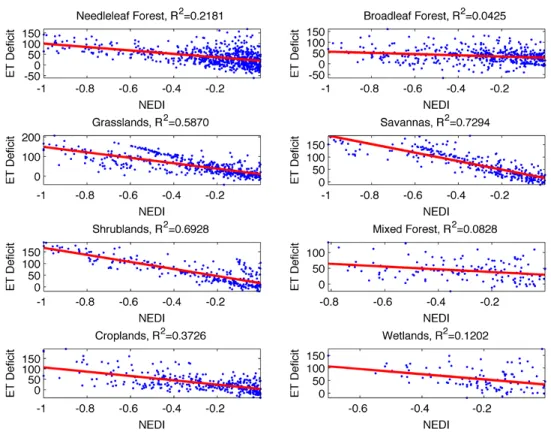
It is clear that decreasing NEDI (suggesting a shift toward
a drier regime) is associated with increasing
evapotrans-piration deficit (differences between the Thornthwaite
PET and observed evapotranspiration) across different
climatic conditions for all non-forest type ecosystems
ex-cept wetlands. This suggests that NEDI can be an useful
3 http://www.cgd.ucar.edu/cas/catalog/climind/pdsi.html
tool for drought monitoring in less complicated
ecosys-tems (Figure 1). However, the correlation between NEDI
and evapotranspiration deficit is not significant at forest
ecosystems, which suggests that evapotranspiration in
forest ecosystems is not only controlled by available
wa-ter stored in the ecosystems but by other limiting factors.
To avoid biases from the varying magnitudes of
site-de-pendent evapotranspiration deficit, the transitional
patterns of ecosystem drought were analyzed by the
modified VITA technique with the non-dimensional
crop coefficient K
cserving as the detection parameter.
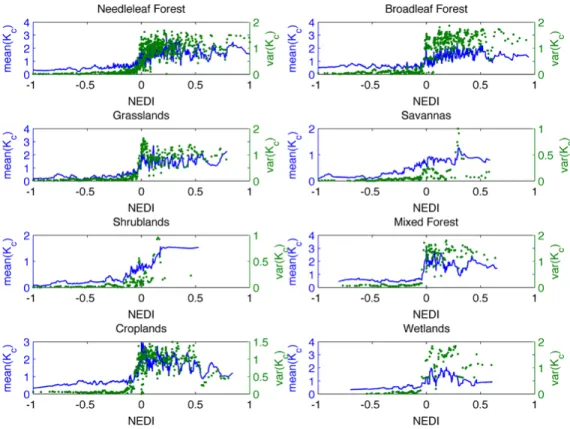
Rapid changes in local variance of K
cwere found for all
investigated ecosystem types when NEDI changes signs
(Figure 2), suggesting significant changes in normalized
evapotranspiration strength. Moreover, the local means
of K
care generally low (limited evapotranspiration) with
slight changes in local variance when NEDI is negative,
and they tend to be high (approaching potential
evapo-transpiration) with evident changes in local variance
when NEDI is positive. The highly varying normalized
evapotranspiration K
cwith positive NEDI suggests that
the available stored water is not the controlling factor
to evapotranspiration when sufficient water is provided,
whereas, water availability is Sprengel’s (Liebig’s) limiting
factor under ecosystem drought conditions. These results
indicate that, in terms of evapotranspiration, ecosystems
respond differently in wet and dry regimes, and the use
of the NEDI can successfully identify drought
condi-tions based on transitional patterns found in normalized
evapotranspiration strength.
Although the threshold separating wet and dry regimes
is universally defined by NEDI across all the investigated
ecosystem types, the results shown in Figure 2 suggest
that the sensitivity between NEDI and K
cvaries with
ecosystem type. In general, the sensitivity for grasslands,
savannas and shrublands is higher than for the other
ecosystems. This implies that water availability is the
limiting factor at these ecosystems while other
ecolog-ical limiting factors are equally important for the other
ecosystems. If we prescribe ecosystem drought severity
based on the magnitude of K
c, we can conceptually define
mild drought (K
c= 0.75), severe drought (K
c= 0.5) and
extreme drought (K
c= 0.25) with NEDI below –0.1, –0.3
and –0.8 (Figure 2), respectively. We note this ecosystem
drought severity scale may not be applicable to
broad-leaf forest and mixed forest because for them, K
cstops
decreasing at around 0.5, regardless of further decrease
in NEDI. There are two possible explanations for this
behavior: (1) Ecosystem adaptation strategy is different
in these two ecosystems, preventing further decreases in
K
ceven under extreme ecosystem drought; or (2) there
are not enough samples for extreme ecosystem drought
in our dataset for these two ecosystems, making the
in-terpretation of NEDI calculations in respect to drought
difficult.
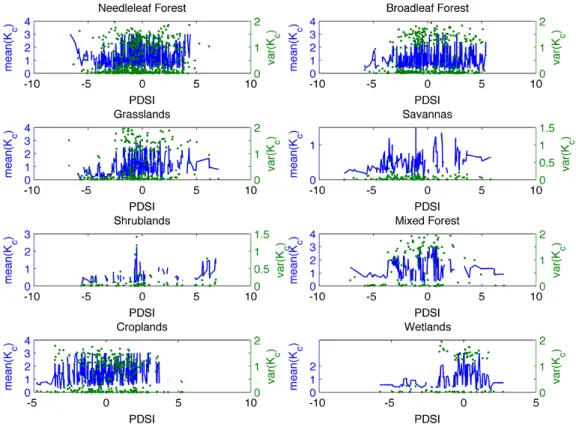
On the other hand, PDSI is only weakly correlated with
evapotranspiration deficit, and the decrease in PDSI
(increase in drought severity) is not associated with an
increase in evapotranspiration deficit (Figure 3). This
re-sult suggests that large-scale drought conditions
detect-ed by PDSI do not necessarily correspond to ecosystem
drought. Similar to the analyses with NEDI, the
depen-dence of normalized evapotranspiration K
con PDSI was
investigated by applying the modified VITA technique
for individual ecosystem types (Figure 4). Contrary to
the NEDI results, local mean and local variance of K
cdo
not have any distinguishable pattern with PDSI across
different ecosystems, and there is no clear distinction
be-tween the dry and wet regimes defined by PDSI and
nor-malized K
c. This supports our hypothesis that ecosystem
drought conditions are detected by NEDI, but are poorly
detected by PDSI.
4.2 Water Use Efficiency (WUE)
Huxman et al. (2004) found a strong relationship between
Water Use Efficiency (WUE) and precipitation, which
highlights the importance of rain-use efficiency on
eco-logical processes and suggests that water limitation can
Figure 2. The local mean (blue lines) and the local variance (green dots) of normalized evapotranspiration strength calculated by the modified vITA technique with non-dimensional crop coefficient Kc vs NeDI.
Figure 4. The local mean (blue lines) and the local variance (green dots) of normalized evapotranspiration strength calculated by the modified vITA technique with non-dimensional crop coefficient Kc vs PDSI.
impose a common constraint on net primary production.
Using a remotely sensed dataset with artificial neural
networks, Lu and Zhuang (2010) identified a two-stage
pattern in WUE changes with drought severity.
Specif-ically, their results showed that WUE increases when
the intensity of drought is moderate and WUE tends
to decrease under severe drought. Here, we further
in-vestigate the relationship between WUE and ecosystem
drought severity by using the modified VITA technique
with WUE as the detection parameter. The WUE used in
this study was defined as the ratio between monthly NEE
from eddy-covariance and monthly evapotranspiration.
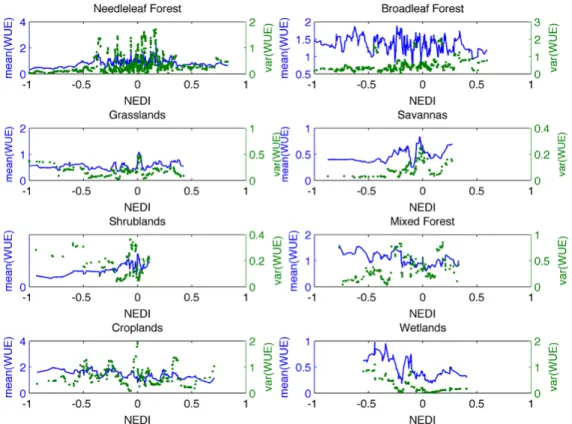
The two-stage changes in WUE proposed by Lu and
Zhuang (2010) were detected at needleleaf forest,
savan-nas and shrublands, where local means of WUE were
higher when NEDI is greater than –0.5 and then
slight-ly decreased when ecosystem drought severity became
more intense (Figure 5). Similar patterns were shown
in grasslands and croplands, although the changes in
the WUE magnitude during extreme ecosystem drought
were mild. Such two-stage patterns cannot be found in
broadleaf forest, mixed forest and wetlands, possibly
because there was no extreme ecosystem drought in the
available dataset as discussed in Section 4.1.
The WUE patterns shown in Figure 5 are strongly
de-pendent on the variations of evapotranspiration and
carbon assimilation strength in each VITA window. The
local means of WUE systematically varies with NEDI in
certain ecosystem types, although there is no rapid
tran-sition detected in local variance. In general, both
evapo-transpiration and NEE decrease when NEDI is lower
than –0.5, except for broadleaf forest, mixed forest and
wetlands (results not shown). In this regime, the
decreas-ing trend for carbon assimilation is stronger than those
for evapotranspiration, resulting in lower WUE during
severe ecosystem drought, though the change in WUE is
less significant at grasslands and croplands. On the other
hand, evapotranspiration and carbon assimilation both
increase at similar rates as NEDI decreases for broadleaf
and mixed forests, resulting in a slightly increasing trend
in WUE during severe ecosystem drought. The
differ-ence in WUE responses to ecosystem drought suggests
that broadleaf forest and mixed forest might have
dif-ferent adaptation strategy than the other vegetated
eco-system types under limited water availability. However,
more data recording ecosystem responses to drought is
needed to validate this hypothesis.
5. Conclusions
In this study, we developed the Normalized Ecosystem
Drought Index (NEDI) to objectively quantify drought
severity in terms of ecosystem transitional responses
to limited water availability. Eddy covariance
measure-Figure 5. The local mean (blue lines) and the local variance (green dots) of plant water use efficiency (WUe) calculated by the modified vITA technique plotted against NeDI.
ments from 60 AmeriFlux sites across 8 IGBP vegetation
types were used to examine the validity of NEDI. The
results show that, based on a modified VITA analysis,
normalized evapotranspiration strength K
cdecreases
correspondingly with NEDI, suggesting that NEDI can
reasonably characterize ecosystem responses to drought
severity. The same analysis was performed to PDSI;
how-ever, no clear relationship can be found between
normal-ized evapotranspiration strength and drought severity
indicated by PDSI.
Moreover, the low data requirement and simplicity
na-tures in NEDI make it straightforward to apply NEDI
to different scientific disciplines for drought detection
and analysis at various spatial and temporal scales. We
applied NEDI to investigate plant WUE dependency on
water availability, using a modified VITA analysis, and
the results show that most vegetated ecosystems
exhib-it two-stage changes in WUE (Lu and Zhuang, 2010),
except broadleaf forest and mixed forest. It is possible
that the differences found in WUE dependence on water
availability are driven by the differences in plant
adapta-tion strategy to drought, but more extensive studies are
required to evaluate this hypothesis.
Acknowledgments
We thank Dr. Ankur Desai Dr. Ge Sun for their valuable comments. We thank the principal investigators of the AmeriFlux network, and the U.S. Department of Energy’s Office of Science for funding the AmeriFlux data resources. We thank the U.S. Department of Energy Lawrence Berkeley Lab Ameriflux Network Management Project for core site support. This research was supported through the National Science Foundation award EF1137306/MIT subaward 5710003122 to the University of California Davis; and other government, industry and foundation sponsors of the MIT Joint Program on the Science and Policy of Global Change. For a complete list of sponsors and U.S. government funding sources, please visit http://globalchange.mit.edu/ sponsors/all.
6. References
Allen, R.G., L.S. Pereira, D. Raes, and M. Smith, 1998: Crop evapotranspiration: Guidelines for computing crop
requirements. Irrig. Drain. Pap. No. 56, FAO, 300, doi:10.1016/j. eja.2010.12.001.
Baldocchi, D.D., L. Xu, and N. Kiang, 2004: How plant
functional-type, weather, seasonal drought, and soil physical properties alter water and energy fluxes of an oak-grass savanna and an annual grassland. Agric. For. Meteorol., 123, 13–39, doi:10.1016/j.agrformet.2003.11.006.
Barr, J.G., J.D. Fuentes, V. Engel, and J.C. Zieman, 2009: Physiological responses of red mangroves to the climate in the Florida Everglades. J. Geophys. Res., 114, 1–13, doi:10.1029/2008JG000843.
Beguería, S., S.M. Vicente-Serrano, F. Reig, and B. Latorre, 2014: Standardized precipitation evapotranspiration index (SPEI) revisited: parameter fitting, evapotranspiration models, tools, datasets and drought monitoring. Int. J. Climatol., 34, 3001– 3023, doi:10.1002/joc.3887.
Bernacchi, C.J., S.E. Hollinger, and T. Meyers, 2005: The conversion of the corn / soybean ecosystem to no-till agriculture may result in a carbon sink. Glob. Chang. Biol., 11, 1867–1872, doi:10.1111/ j.1365-2486.2005.01050.x.
Blackwelder, R.F., and R.E. Kaplan, 1976: On the wall structure of the turbulent boundary layer. J. Fluid Mech., 76, 89, doi:10.1017/ S0022112076003145.
Cammalleri, C., M.C. Anderson, and W.P. Kustas, 2014: Upscaling of evapotranspiration fluxes from instantaneous to daytime scales for thermal remote sensing applications. Hydrol. Earth Syst. Sci., 18, 1885–1894, doi:10.5194/hess-18-1885-2014.
Cochran, F. V, N.A. Brunsell, and A.E. Suyker, 2016: A thermodynamic approach for assessing agroecosystem sustainability. Ecol. Indic., 67, 204–214, doi:10.1016/j. ecolind.2016.01.045.
Crow, W.T., F. Lei, C. Hain, M.C. Anderson, R.L. Scott, D. Billesbach, and T. Arkebauer, 2015: Robust estimates of soil moisture and latent heat flux coupling strength obtained from triple collocation. Geophys. Res. Lett., 42, 8415–8423, doi:10.1002/2015GL065929. Dai, A., 2011: Drought under global warming: A review. Wiley
Interdiscip. Rev. Clim. Chang., 2, 45–65, doi:10.1002/wcc.81. DeForest, J.L., A. Noormets, S.G. McNulty, G. Sun, G. Tenney, and
J. Chen, 2006: Phenophases alter the soil respiration-temperature relationship in an oak-dominated forest. Int. J. Biometeorol., 51, 135–144, doi:10.1007/s00484-006-0046-7.
Desai, A.R., P.V. Bolstad, B.D. Cook, K.J. Davis, and E.V. Carey, 2005: Comparing net ecosystem exchange of carbon dioxide between an old-growth and mature forest in the upper Midwest, USA. Agric. For. Meteorol., 128, 33–55, doi:10.1016/j.agrformet.2004.09.005. Desai, A.R., 2014: Influence and predictive capacity of climate
anomalies on daily to decadal extremes in canopy photosynthesis. Photosynthesis Research, 119, 31-47, doi:10.1007/
s11120-013-9925-z.
Donohue, R.J., T.R. Mcvicar, and M.L. Roderick, 2010: Assessing the ability of potential evaporation formulations to capture the dynamics in evaporative demand within a changing climate. J. Hydrol., 386, 186–197, doi:10.1016/j.jhydrol.2010.03.020. Doorenbos, J., and W.O. Pruitt, 1977: Guidelines for predicting
crop water requirements. FAO Irrigation and Draingage Paper 24. Food and Agriculture Organization of the United Nations. Rome. 145p.
Dore, S., and Coauthors, 2008: Long-term impact of a stand-replacing fire on ecosystem CO2 exchange of a ponderosa pine
forest. Glob. Chang. Biol., 14, 1801–1820, doi:10.1111/ j.1365-2486.2008.01613.x.
Dore, S., and Coauthors, 2010: Carbon and water fluxes from ponderosa pine forests disturbed by wildfire and thinning. Ecol. Appl., 20, 663–683, doi:10.1890/09-0934.1.
Fang, C., J.B. Moncrieff, H.L. Gholz, and K.L. Clark, 1998: Soil CO2 efflux and its spatial variation in a Florida slash pine plantation. Plant Soil, 205, 135–146, doi:10.1023/a:1004304309827. Feyen, L., and R. Dankers, 2009: Impact of global warming on
streamflow drought in Europe. J. Geophys. Res. Atmos., 114, 1–17, doi:10.1029/2008JD011438.
Fischer, M.L., D.P. Billesbach, J.A. Berry, W.J. Riley, and M.S. Torn, 2007: Spatiotemporal variations in growing season exchanges of CO2, H2O, and sensible heat in agricultural fields of the Southern Great Plains. Earth Interact., 11, doi:10.1175/EI231.1.
Goldstein, A.H., and Coauthors, 2000: Effects of climate variability on the carbon dioxide, water, and sensible heat fluxes above a ponderosa pine plantation in the Sierra Nevada (CA). Agric. For. Meteorol., 101, 113–129, doi:10.1016/S0168-1923(99)00168-9.
Gu, L., and Coauthors, 2006: Direct and indirect effects of atmospheric conditions and soil moisture on surface energy partitioning revealed by a prolonged drought at a temperate forest site. J. Geophys. Res., 111, 1–13, doi:10.1029/2006JD007161. Guttman, N.B., 1998: COMPARING THE PALMER DROUGHT
INDEX AND THE STANDARDIZED PRECIPITATION INDEX ’ ties of the PDSI and its variations have been the referenced studies show that the intended. J. Am. Water Resour. Assoc., 34, 113–121, doi:10.1111/j.1752-1688.1998.tb05964.x.
Hanson, P.J., S.D. Wullschleger, R.J. Norby, T.J. Tschaplinski, and C.A. Gunderson, 2005: Importance of changing CO 2 , temperature , precipitation , and ozone on carbon and water cycles of an upland-oak forest : incorporating experimental results into model simulations. Glob. Chang. Biol., 11, 1402– 1423, doi:10.1111/j.1365-2486.2005.00991.x.
He, Y., J. Yang, Q. Zhuang, J.W. Harden, A.D. Mcguire, Y. Liu, G. Wang, and L. Gu, 2015: Incorporating microbial dormancy dynamics into soil decomposition models to improve quantification of soil carbon dynamics of northern temperate forests. J. Geophys. Res. Biogeosciences, 120, 2596–2611, doi:10.1002/2015JG003130.
Heinsch, F.A., J.L. Heilman, K.J. McInnes, D.R. Cobos, D.A. Zuberer, and D.L. Roelke, 2004: Carbon dioxide exchange in a
high marsh on the Texas Gulf Coast: Effects of freshwater availability. Agric. For. Meteorol., 125, 159–172, doi:10.1016/j. agrformet.2004.02.007.
Hollinger, D.Y., S.M. Goltz, E. a Davidson, J.T. Lee, K. Tu, and H.T. Valentine, 1999: Seasonal patterns and environmental control of carbon dioxide and water vapour exchange in an ecotonal boreal forest. Glob. Chang. Biol., 5, 891–902, doi:10.1046/j.1365-2486.1999.00281.x.
Huxman, T.E., and Coauthors, 2004: Convergence across biomes to a common rain-use efficiency. Nature, 429, 651–654, doi:10.1038/ nature02561.
Jensen M.E., R.D. Burman, R.G. Allen (Editors), 1990:
Evapotranspiration and Irrigation Water Requirements. ASCE Manuals and Reports on Engineering Practices No. 70. ASCE, New York, NY, USA, 360 pp.
Katul, G., R. Leuning, and R. Oren, 2003: Relationship between plant hydraulic and biochemical properties derived from a steady-state coupled water and carbon transport model. Plant, Cell Environ., 26, 339–350, doi:10.1046/j.1365-3040.2003.00965.x.
Law, B.E., O.J. Sun, J. Campbell, V.T. S, and P. Thornton, 2003: Changes in carbon storage and fluxes in a chronoseuence of ponderosa pine. Glob. Chang. Biol., 4, 510–524, doi:10.1046/ j.1365-2486.2003.00624.x.
Law, B.E., D. Turner, O.J. Sun, S. Van Tuyl, W.D. Ritts, and W.B. Cohen, 2004: Disturbance and climate effects on carbon stocks and fluxes across Western Oregon USA. Glob. Chang. Biol., 10, 1429–1444, doi:10.1111/j.1365-2486.2004.00822.x. Lee, X., O.R. Bullock Jr, and R.J. Andres, 2001: Anthropogenic
emission of mercury to the atmosphere in the northeast United States. Geophys. Res. Lett., 28, 1231–1234.
Liu, Y., J. Xiao, W. Ju, Y. Zhou, and S. Wang, 2011: Water use efficiency of China ’ s terrestrial ecosystems and responses to drought. Nat. Publ. Gr., 1–12, doi:10.1038/srep13799.
Logan, K.E., and N.A. Brunsell, 2015: Influence of drought on growing season carbon and water cycling with changing land cover. Agric. For. Meteorol., 213, 217–225, doi:10.1016/j. agrformet.2015.07.002.
Lu, X., and Q. Zhuang, 2010: Evaluating evapotranspiration and water-use efficiency of terrestrial ecosystems in the conterminous United States using MODIS and AmeriFlux data. Remote Sens. Environ., 114, 1924–1939, doi:10.1016/j.rse.2010.04.001. Matamala, A.R., J.D. Jastrow, R.M. Miller, and C.T. Garten, 2016:
Temporal Changes in C and N Stocks of Restored Prairie : Implications for C Sequestration Strategies. Ecol. Appl., 18, 1470–1488 (http://www.jstor.org/stable/40062268). McKee, T.B., N.J. Doesken, and J. Kleist, 1993: The relationship of
drought frequency and duration to time scales. Preprints, Eighth Conf. on Applied Climatology. Anaheim, CA, Amer. Meteor. Soc., 179–184.
Meyers, T.P., and S.E. Hollinger, 2004: An assessment of storage terms in the surface energy balance of maize and soybean. Agric. For. Meteorol., 125, 105–115, doi:10.1016/j.agrformet.2004.03.001. Moore, K.E., D.R. Fitzjarrald, R.K. Sakai, M.L. Goulden, J.W. Munger,
and S.C. Wofsy, 1996: Seasonal Variation in Radiative and Turbulent Exchange at a Deciduous Forest in Central Massachusetts. J. Appl. Meterology, 35, 122–134, doi:10.1175/1 520-0450(1996)035<0122:SVIRAT>2.0.CO;2.
Mpelasoka, F., K. Hennessy, R. Jones, and B. Bates, 2008: Comparison of suitable drought indices for climate change impacts assessment over Australia towards resource. Int. J. Climatol., 1292, 1283– 1292, doi:10.1002/joc.
Narasimhan, B., and R. Srinivasan, 2005: Development and evaluation of Soil Moisture Deficit Index (SMDI) and Evapotranspiration Deficit Index (ETDI) for agricultural drought monitoring. Agric. For. Meteorol., 133, 69–88, doi:10.1016/j.agrformet.2005.07.012. Noormets, A., M.J. Gavazzi, S.G. McNulty, J.-C. Domec, G.E. Sun,
J.S. King, and J. Chen, 2010: Response of carbon fluxes to drought in a coastal plain loblolly pine forest. Glob Chang Biol, 16, 272–287, doi:10.1111/j.1365-2486.2009.01928.x.
Palmer, W., 1965: Meteorological Drought. Res. Pap., 1–65.
Paw U, K.T., and Coauthors, 2004: Carbon Dioxide Exchange Between an Old-growth Forest and the Atmosphere. Ecosystems, 7, 513–524, doi:10.1007/s10021-004-0141-8.
Peterson, A.T., 2003: Predicting the geography of species’ invasions via ecological niche modeling. Quart. Rev. Biol. 78, 419-433. Powell, T.L., R. Bracho, J. Li, S. Dore, C.R. Hinkle, and B.G. Drake,
2006: Environmental controls over net ecosystem carbon exchange of scrub oak in central Florida. Agric. For. Meteorol., 141, 19–34, doi:10.1016/j.agrformet.2006.09.002.
Pryor, S.C., R.J. Barthelmie, and B. Jensen, 1999: Nitrogen dry deposition at an AmeriFlux site in a hardwood forest in the midwest. Geophys. Res. Lett., 26, 691, doi:10.1029/1999GL900066.
Qi, J., and Coauthors, 2000: Spatial and temporal dynamics of vegetation in the San Pedro River basin area. Agric. For. Meteorol., 105, 55–68, doi:10.1016/S0168-1923(00)00195-7. Reichstein, M., and Coauthors, 2002: Severe drought effects on
ecosystem CO2 and H2O fluxes at three Mediterranean evergreen sites: revision of current hypotheses? Glob. Chang. Biol., 8, 999–1017, doi:10.1046/j.1365-2486.2002.00530.x. Richardson, A.D., J.P. Jenkins, B.H. Braswell, D.Y. Hollinger,
S.V. Ollinger, and M.L. Smith, 2007: Use of digital webcam images to track spring green-up in a deciduous broadleaf forest. Oecologia, 152, 323–334, doi:10.1007/s00442-006-0657-z. Sakai, T., and Coauthors, 2015: Varying applicability of four different
satellite-derived soil moisture products to global gridded crop model evaluation. Int. J. Appl. Earth Obs. Geoinf., 48, 51–60, doi:10.1016/j.jag.2015.09.011.
Schedlbauer, J.L., J.W. Munyon, S.F. Oberbauer, E.E. Gaiser, and G. Starr, 2012: Controls on ecosystem carbon dioxide exchange in short- and long-hydroperiod Florida everglades freshwater marshes. Wetlands, 32, 801–812, doi:10.1007/s13157-012-0311-y. Scott, R.L., W.L. Cable, and K.R. Hultine, 2008: The ecohydrologic
significance of hydraulic redistribution in a semiarid savanna. Water Resour. Res., 44, 1–12, doi:10.1029/2007WR006149. Scott, R.L., 2010: Using watershed water balance to evaluate the accuracy of eddy covariance evaporation measurements for three semiarid ecosystems. Agric. For. Meteorol., 150, 219–225, doi:10.1016/j.agrformet.2009.11.002.
Scott, R.L., E.P. Hamerlynck, G.D. Jenerette, M.S. Moran, and G.A. Barron-Gafford, 2010: Carbon dioxide exchange in a semidesert grassland through drought-induced vegetation change. J. Geophys. Res. Biogeosciences, 115, 1–12, doi:10.1029/2010JG001348.
Seager, R., and Coauthors, 2007: Model projections of an imminent transition to amore arid climate in southwestern North America. Science, 1475, 1181–1184, doi:10.1126/science.1139601. Seager, R., and Coauthors, 2009: Mexican drought: An observational
modeling and tree ring study of variability and climate change. Atmosfera, 22, 1–31.
Stylinski, C.D., J.A. Gamon, and W.C. Oechel, 2002: Seasonal patterns of reflectance indices, carotenoid pigments and photosynthesis of evergreen chaparral species. Oecologia, 131, 366–374, doi:10.1007/s00442-002-0905-9.
Sulman, B.N., Desai, A.R., Cook, B.D., Saliendra, N., and Mackay, D.S., 2009. Contrasting carbon dioxide fluxes between a drying shrub wetland in Northern Wisconsin, USA, and nearby forests. Biogeosciences, 6, 1115-1126, doi:10.5194/ bg-6-1115-2009.
Sun, O.J., J. Campbell, B.E. Law, and V. Wolf, 2004: Dynamics of carbon stocks in soils and detritus across chronosequences of different forest types in the Pacific Northwest , USA. Glob. Chang. Biol., 10, 1470–1481, doi:10.1111/ j.1365-2486.2004.00829.x.
Suyker, A.E., S.B. Verma, G.G. Burba, T.J. Arkebauer, D.T. Walters, and K.G. Hubbard, 2004: Growing season carbon dioxide exchange in irrigated and rainfed maize. Agric. For. Meteorol., 124, 1–13, doi:10.1016/j.agrformet.2004.01.011.
Turnipseed, A.A., P.D. Blanken, D.E. Anderson, and R.K. Monson, 2002: Energy budget above a high-elevation subalpine forest in complex topography. Agric. For. Meteorol., 110, 177–201, doi:10.1016/S0168-1923(01)00290-8.
van der Ploeg, R.R., W. Bohm, and M.B. Kirkham, 1999: On the origin of the theory of mineral nutrition of plants and the law of the minimum. Soil Sci. Soc. Am. J., 63, 1055–1062.
van der Schrier, G., P.D. Jones, and K.R. Briffa, 2011: The sensitivity of the PDSI to the Thornthwaite and Penman-Monteith parameterizations for potential evapotranspiration. J. Geophys. Res. Atmos., 116, 1–16, doi:10.1029/2010JD015001.
Vicente-Serrano, S.M., S. Beguería, and J.I. López-Moreno, 2010: A multiscalar drought index sensitive to global warming: The standardized precipitation evapotranspiration index. J. Clim., 23, 1696–1718, doi:10.1175/2009JCLI2909.1.
Wells, N., S. Goddard, and M.J. Hayes, 2004: A self-calibrating Palmer drought severity index. J. Climate, 17, 2335–2351.
Wilhite, D.A., 2000. Drought as a natural hazard: concepts and definitions. In: Donald, A., Wilhite, Ed., Drought: A Global Assessment, vol. IRoutledge, New York, pp. 3–18 (Chapter 1).
Yang, F., and Coauthors, 2007: Developing a continental-scale measure of gross primary production by combining MODIS and AmeriFlux data through Support Vector Machine approach. Remote Sens. Environ., 110, 109–122, doi:10.1016/j. rse.2007.02.016.
Zeller, K.F., and N.T. Nikolov, 2000: Quantifying simultaneous fluxes of ozone, carbon dioxide and water vapor above a subalpine forest ecosystem. Environ. Pollut., 107, 1–20, doi:10.1016/ S0269-7491(99)00156-6.
For limited quantities, Joint Program Reports are available free of charge. Contact the Joint Program Office to order. Complete list: http://globalchange.mit.edu/publications
MIT Joint Program on the Science and Policy
of Global Change Massachusetts Institute of Technology 77 Massachusetts Ave., E19-411 T (617) 253-7492 [email protected] F (617) 253-9845 306. A Drought Indicator based on Ecosystem Responses to
Water Availability: The Normalized Ecosystem Drought Index. Chang et al., Nov 2016
305. Is Current Irrigation Sustainable in the United States? An Integrated Assessment of Climate Change Impact on Water Resources and Irrigated Crop Yields. Blanc et al., Nov 2016
304. The Impact of Oil Prices on Bioenergy, Emissions and Land Use. Winchester & Ledvina, Oct 2016
303. Scaling Compliance with Coverage? Firm-level Performance in China’s Industrial Energy Conservation Program. Karplus et al., Oct 2016
302. 21st Century Changes in U.S. Heavy Precipitation Frequency
Based on Resolved Atmospheric Patterns. Gao et al., Oct 2016
301. Combining Price and Quantity Controls under Partitioned Environmental Regulation. Abrell & Rausch, Jul 2016
300. The Impact of Water Scarcity on Food, Bioenergy and Deforestation. Winchester et al., Jul 2016
299. The Impact of Coordinated Policies on Air Pollution Emissions from Road Transportation in China. Kishimoto et al., Jun 2016
298. Modeling Regional Carbon Dioxide Flux over California using the WRF-ACASA Coupled Model. Xu et al., Jun 2016
297. Electricity Investments under Technology Cost Uncertainty and Stochastic Technological Learning. Morris et al., May 2016
296. Statistical Emulators of Maize, Rice, Soybean and Wheat Yields from Global Gridded Crop Models. Blanc, May 2016
295. Are Land-use Emissions Scalable with Increasing Corn Ethanol Mandates in the United States? Ejaz et al., Apr 2016
294. The Future of Natural Gas in China: Effects of Pricing Reform and Climate Policy. Zhang & Paltsev, Mar 2016
293. Uncertainty in Future Agro-Climate Projections in the United States and Benefits of Greenhouse Gas Mitigation.
Monier et al., Mar 2016
292. Costs of Climate Mitigation Policies. Chen et al., Mar 2016
291. Scenarios of Global Change: Integrated Assessment of Climate Impacts. Paltsev et al., Feb 2016
290. Modeling Uncertainty in Climate Change: A Multi-Model Comparison. Gillingham et al., Dec 2015
289. The Impact of Climate Policy on Carbon Capture and Storage Deployment in China. Zhang et al., Dec 2015
288. The Influence of Gas-to-Liquids and Natural Gas Production Technology Penetration on the Crude Oil-Natural Gas Price Relationship. Ramberg et al., Dec 2015
287. Impact of Canopy Representations on Regional Modeling of Evapotranspiration using the WRF-ACASA Coupled Model.
Xu et al., Dec 2015
286. Launching a New Climate Regime. Jacoby & Chen, Nov 2015
285. US Major Crops’ Uncertain Climate Change Risks and Greenhouse Gas Mitigation Benefits. Sue Wing et al., Oct 2015
284. Capturing Natural Resource Dynamics in Top-Down Energy-Economic Equilibrium Models. Zhang et al., Oct 2015
283. Global population growth, technology, and Malthusian constraints: A quantitative growth theoretic perspective.
Lanz et al., Oct 2015
282. Natural Gas Pricing Reform in China: Getting Closer to a Market System? Paltsev & Zhang, Jul 2015
281. Impacts of CO2 Mandates for New Cars in the European
Union. Paltsev et al., May 2015
280. Water Body Temperature Model for Assessing Climate Change Impacts on Thermal Cooling. Strzepek et al., May 2015
279. Emulating maize yields from global gridded crop models using statistical estimates. Blanc & Sultan, Mar 2015
278. The MIT EPPA6 Model: Economic Growth, Energy Use, and Food Consumption. Chen et al., Mar 2015
277. Renewables Intermittency: Operational Limits and Implications for Long-Term Energy System Models. Delarue & Morris, Mar 2015
276. Specifying Parameters in Computable General Equilibrium Models using Optimal Fingerprint Detection Methods.
Koesler, Feb 2015
275. The Impact of Advanced Biofuels on Aviation Emissions and Operations in the U.S. Winchester et al., Feb 2015
274. Modeling regional transportation demand in China and the impacts of a national carbon constraint. Kishimoto et al., Jan 2015
273. The Contribution of Biomass to Emissions Mitigation under a Global Climate Policy. Winchester & Reilly, Jan 2015
272. Advanced Technologies in Energy-Economy Models for Climate Change Assessment. Morris et al., Dec 2014
271. International Trade in Natural Gas: Golden Age of LNG? Du & Paltsev, Nov 2014