104 IMAGE [&] NARRATIVE Vol. 21, No.2 (2020)
Superhero Cit : A Comic Book Reader s
Autoethnography
Jason DeHart
Abstract
In this a e hn g a hic e l a i n ba ed n Chang (2008) de c i i n f he e ea ch me h d, he a h explores their love of comic books and the ways that graphic novels and visual storytelling formed an essential aspect of their literacy history, both at home and in formal schooling. This autoethnography is presented in both narrative and visual format as the author shares four images based on the stages of literacy that took place in reflection with comic books. The author concludes with implications for literacy practices with the comic book medium.
Résumé
Dans cette exploration autoethnographique basée sur la méthode de description de la recherche de Chang (2008), l a e e l e n am le bande de in e e la fa n d n le man g a hi e et les ci i el n c n i n a ec e en iel de a ela i n la lec e, la mai n c mme l c le. Ce e a e hn g a hie e en e la f i e ellemen e i ellemen i e l a e a age a e image le a e de l a en i age de la lec e en lien a ec le bande de in e . L a e c ncl le implications des pratiques de lecture incluant le medium de la bande dessinée.
Keywords
self-exploration; autoethnography; visual storytelling; literacy history; literacy practice
Introduction
It is with a sense of appreciation for the comic book medium, and for teachers who draw on this medium, ha I endea ace m life a a c mic b k eade . F hi eflec i e k, I chiefl e n Chang (2008) view of autoethnography as a research method. According to this source, part of the challenge of writing a self-na a i e i he e helming, c m le , and m l i-face ed na e f life a an en i e f m he beginning (Chang, 2008, . 72). T ha end, hi a e hn g a h main ains a relative focus on my interest in the comic book medium and how this interest shaped me as a reader. My direct experiences with this mode of text, and how events in my life corresponded to comic book readership, form the
105 IMAGE [&] NARRATIVE Vol. 21, No.2 (2020)
structure of this narrative.
Furthermore, Chang (2008) suggested that there are narrative elements of autoethnography, as well as c l al anal i and in e e a i n ( . 46). M n e e ience i h ecific e f m a na a i e structure, while my analysis and interpretation directly lines up with cultural movements in literacy and entertainment, as well as cultural appropriations of texts as valued or undervalued means of expression. This self-exploration is directly rooted to my work in the literacy community, both as a classroom teacher and as a teacher educator. Without comic books and graphic novels, their lengthier and sometimes more regarded literary counterpart, I would not be teaching the way I am now, nor would I be reading in the same way. In fact, I regularly make use of graphic novels as part of my classroom instruction at the college level, and made comic books and graphic novels available for students to read in my Kindergarten-12th
grade public school teaching experience. At times, I even connected reading and writing practices with students by encouraging them to make their own comic books as close looks at the learning we were accomplishing in the classroom, standing in opposition to traditional test review techniques that were regarded by other teachers in my district. That work has continued as I have worked with students at post-secondary levels, and I continue to explore ways to expand traditional definitions of text, particularly in educational settings.
I will first trace a brief account of how autoethnography has been used in the literacy field, and then further define comic books and graphic novels as medium.
A Brief Look at Autoethnography in the Literacy Field
In beginning this work, I wanted to trace the previous use of autoethnography as a method in the field of literacy. I do so in order to further understand the way that others have used texts, including comic books, as a way of exploring their experiences. This brief inquiry into the research that has already been published helps me think through the way I go about asking questions, seeking sources, and explaining the details of my literacy history.
Boloz (2008) utilized autoethnography in their look at the ways literacy had been reformed over the course of more than two decades. Of central note in this work was the perspective of an administrator that the researcher was able to adopt. Sanders et al. (2015) looked at a professional development experience using an autoethnographic methods, and traced their first-hand experiences with this phenomenon in a collaborative format.
While these sources used autoethnography, they did so from a stance of systematic review of educational licie , ei he in hi ic ie in c en ac ice. In e m f iden i , I l ca ed McCl ng (2018) autoethnographic approach ha he e med ee ing a e . F m a femini e ec i e, A e e (2009) explored identity in textual response to the popular character, Wonder Woman. It was in these relationships to textual encounters that I found close alignment with what I have offered in an autoethnographic experience with visual text (in this case, comic books).
What seems to be thematic across the uses of autoethnography in literacy is the importance of a first-hand encounter with the subject matter under consideration, whether that subject be educational policies, professional development in practice, or a textual encounter. It is the latter that I propose to explore here.
106 IMAGE [&] NARRATIVE Vol. 21, No.2 (2020)
Echoing Chang (2008) once more, autoethnography is a research method that has particular applications in multicultural settings (and, in this case, I would add multi-textual settings), including work in education. The relationship of text and self is of central concern in this autoethnographic work.
Words and Pictures
What separates the comic book medium from other types of books is the ways in which words and pictures interrelate (Kukkoken, 2013). In a traditional novel, a reader is only met with a slew of words. If one is a reader who struggles with text, there is only more text to act as an aid for comprehension. The effect is somewhat like verbal quicksand, without the assistance of a teacher or expert reader to help navigate the process.
In a picture book, words and pictures interrelate, but exist in a somewhat separate continuum. Often, a story is told and pictures act as a visual representation or reinforcement. One could, theoretically, removed the pictures and create a text-only copy of the book. The same is true for the illustrated novel, the hybrid of these forms, which makes use of extended text, as in a traditional novel, but includes images interspersed. Again, one could remove the images to no adverse effect on the overall storyline.
Then comes the comic book or graphic novel. In this kind of text, words and pictures marinate a similar literary soup. The words themselves are contained within boxes that artists create, called panels, and within these panels, words take on different shapes and ways of being to relate to the reader who is speaking, how they are speaking, and at what points an outside narrator or editor might interrupt the flow of the dialogue. Some panels also work in a wordless way, and there are entire books that work without words and only rely on images to tell their stories.
The case for comics as a medium rich for classroom instruction has grown, with teachers pointing out their possibilities for engaging students who need to find a text that connects them to literacy (Marshall, 2018). In terms of my own readership, having taught literacy courses for five years and K-12 English courses for an additional eight years, I have had the chance to reflect on my experiences as a reader when considering my literacy history. Rather than offer a traditional journal, what I have endeavored to create, given the comic book nature of this article, is a visual timeline, containing both words and pictures, to trace my life as a reader.
Having placed comic books and graphic novels in a kind of literary continuum, my next question relates to how to go about this work. In this case, I will make use of a visual journal, including images that serve as a counterpoint to the comic book medium and reflect on my experiences. Chang (2008) has identified both field notes and journals as significant sources of data in autoethnographic work.
For each of the sections that follow, I offer a visual from my journal, as well as an account.
Without Words
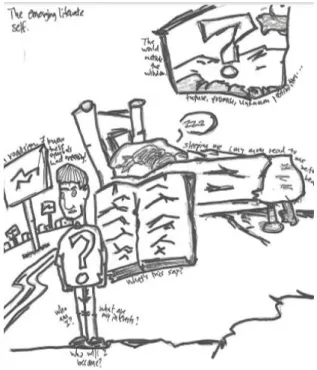
There was a time that I now recall when I was riding in a car with my mother and we would pass road signs. I remember growing up in rural West Virginia and taking the weekly trip into town to pick up groceries or toys. I also remember that I could not make out what on those signs, but that I knew that the symbols contained there had meaning and communicated. This notion of environmental print is sometimes
107 IMAGE [&] NARRATIVE Vol. 21, No.2 (2020)
incorporated into preschool classrooms in the form of visual displays called word walls, and has long been documented as a potential site for literacy development (Masonheimer, Drum, & Ehri, 1984). My earliest memories of wanting to read predate my exposure to comic books, but are a working part of my narrative. I also remember, prior to my own ability to engage with text, my mother would read stories to me before bed. I grew to know the stories by memory. Some of them were from fairy tale books, and others were from the Bible, which a central source of literacy in our household. My memory of taking those spoken words to an understanding of how to navigate print mainly consists of a Tandy computer that sat at the back of my Kindergarten classroom, on which I would practice words, and reviewing flashcards with my parents.
I represent my early formation of identity in Figure 1, below. In this figure, I have included my memories about road signs and encountering words in printed books. In the upper corner, I represent the outside world, which I did not know much about at this point in my life, other than our weekly trips to town.
Fig. 1. Emergent literacy and forming identity, created December 10, 2019.
I essentially was a child forming their identity, and in a family that included two boys that were avid hunters and outdoorsmen, I quickly found that I had other interests. How I would take up these interests and how these interests were incorporated into my life began with a narrative that is somewhat familiar among comic book readership.
The Croup Tent
When I was in the first grade, I got very sick and had to be hospitalized. I was beginning to read, although I did not always readily engage with the printed materials that I was encountering in school. In some ways, my school life failed to connect with my reading interests, a finding I will explore in a later section.
108 IMAGE [&] NARRATIVE Vol. 21, No.2 (2020)
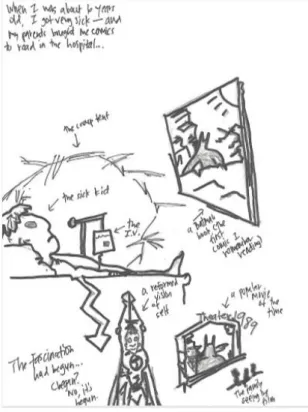
I remember the IV tube in my arm, I remember the croup tent that I had sleep in, and I remember that my parents were very concerned about me. Then, something happened. My mother brought me a stack of comics, which I presume she purchased from the pharmacy next to the hospital. In 1988, comics were displayed at pharmacies and other stores in carousels or on magazine racks. I remember the first comic book I encountered, featuring the popular character, Batman. In fact, I remember the cover, the issue, and the content, and I have some recollection of reading it in my hospital bed.
The next year, the first Tim Burton Batman film starring Michael Keaton was released, and I had an instant visual connection to this story. Though I found elements of the film frightening at this age, I remember watching the movie over and over again, and even reading a comic book adaptation of the film, comparing scenes to their depictions in the book. In our current age, this work is a Common Core State Standard in the United States, focused on comparing literary works to their dramatic counterparts. In my childhood, it was not a standard it was just fun work to do on my own as a reader. This experience of text and media, reifying my literacy practices, lines up with Jenkin (2006) k n he a ha c l e c n e ge f readers and viewers.
In the next image from my visual autoethnographic journal, these elements take shape as I depict myself in the hospital, with the text before me that would first unlock comic books as engaging, indeed a voraciously desired, medium for my literacy habits. In the bottom right corner, I depict my family seeing the 1989 film,
Batman, an experience I still vividly recall. In the bottom center portion of the page I depict myself as a
transformed superhero. Gone is the question mark of my identity as I began to increasingly identify with characters who wanted to reshape their world and do good. It is no small wonder, with these kind of textual heroes, that I would one day become a teacher, intent on helping others and making the world a better place.
Fig. 2. The move from search to identity with superhero characters, created December 17, 2019.
From this initial textual interaction, my reading life proliferated into further examples of branding and converging culture (Jenkins, 2006).
109 IMAGE [&] NARRATIVE Vol. 21, No.2 (2020)
Enactments and Explorations
Expanding on what Jenkins offered in their 2006 text, Convergence Culture, this author has taken a more recent look at how comics work alongside other elements in popular culture (Jenkins, 2020). In the book,
Comics and Stuff, the idea of comic book culture is proposed within the larger framework of branding and
media.
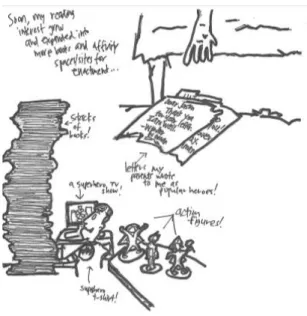
This was indeed the case for me, as I depict myself standing under a mountain of comic books. This figurative element shows the texts I began to accumulate over time. What started as a reading process issued into a writing practice as I began creating my own stories in notebooks, which are unfortunately no longer available as sources of data.
In the background of the image, the continued presence of televised media is depicted, as I found more and more incarnations of my favorite characters in cinematic form. In the current age, nearly all of the characters I knew and loved have been depicted in some way by television or film media, and I approach these incarnations with a devoted sense of nostalgia. Even a poorly constructed or critically panned superhero film is interesting to me because of my appreciation for the characters, and the medium from which their popularity first arose.
What is more, my storytelling practices extended to my use of toys and figurines. I collected toys and told stories with them, acting out films and my own stories with these tiny plastic representations. I recall stopping and restarting a play narrative with action figures if I encountered a problem in my story, in essence performing a kind of extra-literate revision process. I even incorporated popular music on cassette at key moments in my play to give the interactions a more cinematic feel. When I played with others, I experienced frustration if they bent elements of the story, such as making a known hero a villain in the story, or trying to imply that a character was no longer in existence. This practice corresponds with D n (1997) de c i i n f a e ing e al a h i ( . 70), aking m n a ache he superhero text.
110 IMAGE [&] NARRATIVE Vol. 21, No.2 (2020)
I depict myself wearing a superhero shirt in this picture, as I quickly adopted elements of these stories as ha Gee (2013) ld efe a an iden i ki . Again lining i h D n (1997) k, I was finding symbols that represented my take on reality. I made my identity known and shaped myself through these interactions with text, from my wardrobe, to my play, to my bath-time rituals (I vividly recall having bubble bath bottles in the shape of my favorite characters). Fawaz (2016) has examined the ways that comic books speak to both personal and global identities, as well. Within the stream of media I was consuming, comic books were an essential site for my literacy development and shaped me personally. At a young age, I went to school with a pair of fake glasses on, insisting to everyone that they were real, in the habit of one my favorite character dualities of the time, Clark Kent/Superman. These ideas about identity and duality likely shaped me in ways that stand beyond the limitations of this study.
In terms of the materials, what began with a fascination with major characters published by DC Comics led to interest in Marvel Comics, the two lead publishers at the time. Soon, my interests would spread to incorporate lesser-known titles from Dark Horse Comics, Valiant, and a short-lived imprint called Malibu. What began as a fascination with popular characters led into a more diffuse look at the medium on the part of a young reader, and that interest has only grown with time as I have considered more and more titles.
Educational Resistances
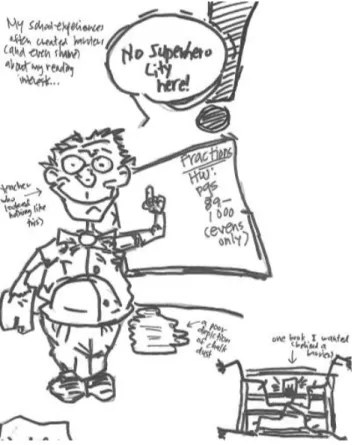
What I encountered in my formal schooling was a disconnect between the literacy practices I enjoyed at home, and the practices that were honored at ch l. Thi i n i e hen ne c n ide S ee (2003) framing of the issue, delineating between prescriptive practices that are honored in education systems and the practices which are autonomously taken up by young readers, and even older readers, in personal times. This resistance took the shape of three memories, which are depicted in another page from autoethnographic journal. The first of these is represented in the bottom corner. I remember in my first-grade year that I drew a character, in this case Godzilla, on the back of a lined piece of handwriting paper. I did not know that we would be using the back in class and finished my work early. I remember, in a scramble, erasing my character and trying to represent the letters I was learning over the messy erasure. The eache e n e a ma k he age i h a failing g ade, and he eb end he me age ha m interest in creation was under similar erasure and not welcome in the classroom community. An alternative might have been rewarding me with an additional sheet of paper on which to practice my drawing.
Dav Pilkey writes of a similar experience with school in the 2017 text, From Striving to Thriving: Growing
Confident, Capable Readers. Pilkey encountered resistance to his creative expressions, but would one day
go on to create memorable and popular characters for young readers, including Captain Underpants and
Dog Man. On page 221 of this latter text, Pilkey (2016) illustrates a subversion to the refocus form, a
popular behavior management technique that was used in schools when I was a K-12 teacher. In this depiction, the author shows how a child might creatively resist standardized attempts to deflate creativity.
111 IMAGE [&] NARRATIVE Vol. 21, No.2 (2020)
Fig. 4. Educational resistances to student interest, created January 3, 2020.
In a second event I recall, a teacher in the fourth grade took up my drawing of a puzzle I entitled, S e he Ci . The eache hen ke me af e cla inf m me ha S e he Ci had n lace in an elementary-grades math class, and that I should focus my attention on my study of fractions. This encounter takes center stage in the illustration I have created.
In the third and final memory, I recall finding a superhero book on my sixth-g ade eache helf, nl be told that I could not take the book home and read it. I now assume the teacher was afraid that I might not return the book, either because I wanted to keep it or because I might not be responsible enough to bring it back.
In these ways, my reading interests were stifled and blocked in my education. My attempts to engage with my interests when I finished an assignment early or when I asked for an additional reading experience were met with resistance, or even techniques that created embarrassment for me. It is no wonder that when I would look at comic books at the town bookstore as a young person, I would check over my shoulder with some sense of shame to make sure no one saw that I was interested in them, and then shuffle beside my mother while she paid for my books at the checkout.
Implications for Literacy Practices
Having traced my encounters with comic books both visually, and now in an autoethnographic form that has sought resonant themes with existing research literature, I turn my attention to a brief series of recommendations based on my experience. First is an affirmation that comic books and graphic novels can,
112 IMAGE [&] NARRATIVE Vol. 21, No.2 (2020)
indeed, work in complex ways, and that these books are capable of attracting and maintaining a young readership who can then take the literacy skills they practice into other texts. In essence, graphic novels and comic books can act as a gateway but, as a reader, I also recommend them as their own entertaining and informative textual terminus (Marshall, 2018). In the midst of complex human experiences, young learners should have the access to textual materials to take up the symbols with which they identify, and this work issues into both traditional textual compositions as times, as well as the composing of self in a culturally-reflective manner (Dyson, 1997).
In helping to prepare other teachers, I recommend a reconsideration of the ways that reading practices are h n ed in cla m , and hi begin b ge ing kn he eading in e e f den . Again, S ee (2003) identification of the boundaries between school and home practices echoes in this recommendation. Finding places of value, interest, and success, has the potential to encourage young readers to continue to progress through more and more challenging reading experiences, and creates a positive connection between teacher and student.
As an adult who has been a classroom teacher and is now a teacher educator, I am left to wonder how many of my teachers, particularly in my elementary school experience, actually saw me as a reader. Having an open definition of text and honoring cultural representations can be powerful starting places for fostering further literacy development with comic books and other types of texts.
Finally, having a steady supply of books many kinds of books, including graphic novels would have made my school experience a transformative one. I advocate for classroom and school library shelves that are stuffed with possibilities and invitations. From my story and experiences, with all of its personal limitations, I have formed an educational philosophy and a stance as a teacher educator that values the creative expressions of authors and the students they reach and one of more possibilities than I was sometimes afforded.
References
Averett, P. (2009). The search for wonder woman: An autoethnography of feminist identity. Affilia, 24(4), 360-368.
B l , S. (2008). A inci al a e hn g a h : Li e ac de el men and ch l-reform efforts across 22 years. (Dissertation). Northern Arizona University. Retrieved from
https://search.proquest.com/openview/fe6a8831b33af7fd154c784e80dfa329/1?pq-origsite=gscholar&cbl=18750&diss=y
Chang, H. (2008). Autoethnography as method (1st edition). London: Routledge.
Dyson, A.H. (1997). Writing superheroes: Contemporary childhood, popular culture, and classroom
literacy. New York, NY: Teachers College Press.
Fawaz, R. (2016). The new mutants: Superheroes and the radical imagination of American comics. New York, NY: NYU Press.
Gee, J.P. (2013). Reading as situated language: A sociocognitive perspective. In Alvermann, D. E., Unrau, N. J., & Ruddell, R. (Eds.). Theoretical Models and Processes of Reading, (6th Ed., pp. 136-151). Newark, DE: IRA.
113 IMAGE [&] NARRATIVE Vol. 21, No.2 (2020)
Jenkins, H. (2006). Convergence culture. New York, NY: NYU Press. Jenkins, H. (2020). Comics and stuff. New York, NY: NYU Press.
Kukkonen, K. (2013). Contemporary comics storytelling. Lincoln, NE: University of Nebraska Press. Marshall, J. (2018). The power of comics. Literacy Daily.
https://www.literacyworldwide.org/blog%2Fliteracy-daily%2F2018%2F12%2F20%2Fthe-power-of-comics
Masonheimer, P.E., Drum, P.A., & Ehri, L.C. (1984). Does environmental print identification lead children into word reading? Journal of Reading Behavior, 16(4), 257-271.
McClung, N.A. (2018). Learning to queer text: Epiphanies from a family critical literacy practice. The
Reading Teacher, 71(4), 401-410.
Pilkey, D. (2016). Dogman. New York, NY: Graphix.
Pilkey, D. (2017) In Harvey, S., & Ward, A., (Authors). From Striving to Thriving: How to Grow
Confident, Capable Readers (pp. 6-7). New York, NY: Scholastic.
Sanders, J.Y., Parsons, S.C., Mwavita, M., & Thomas, K. (2015). A collaborative autoethnography of literacy professional development work in a high-needs environment. Studying Teacher Education, 11(3), 228-245.
S ee , B. (2003). Wha ne in ne li e ac die ? C i ical a ache li e ac in he and practice. Current Issues in Comparative Education, 5(2), 77-91.
Jason D. DeHart is an assistant professor of reading education at Appalachian S a e Uni e i . DeHa s
research interests include multimodal literacy, including film and graphic novels, and literacy instruction with adolescents. His work has recently appeared in SIGNAL Journal, English Journal, and The Social Studies. https://rese.appstate.edu/directory/dr-jason-dehart