HAL Id: tel-01276555
https://hal.archives-ouvertes.fr/tel-01276555
Submitted on 19 Feb 2016HAL is a multi-disciplinary open access
archive for the deposit and dissemination of sci-entific research documents, whether they are pub-lished or not. The documents may come from teaching and research institutions in France or abroad, or from public or private research centers.
L’archive ouverte pluridisciplinaire HAL, est destinée au dépôt et à la diffusion de documents scientifiques de niveau recherche, publiés ou non, émanant des établissements d’enseignement et de recherche français ou étrangers, des laboratoires publics ou privés.
Trusting robots : Contributions to dependable
autonomous collaborative robotic systems
Jérémie Guiochet
To cite this version:
Jérémie Guiochet. Trusting robots : Contributions to dependable autonomous collaborative robotic systems. Embedded Systems. Université de Toulouse 3 Paul Sabatier, 2015. �tel-01276555�
Habilitation à diriger des recherches
présentée à
l’Université de Toulouse - Université Paul Sabatier Spécialité : Informatique et Systèmes Embarqués
par
Jérémie GUIOCHET
Laboratoire d’Analyse et d’Architecture des Systèmes, CNRS École Doctorale Systèmes
Titre de l’habilitation :
Trusting robots
Contributions to dependable autonomous collaborative robotic systems
Soutenue le 8 décembre 2015, devant le jury :
Présidente: Marie-Pierre GLEIZES Professeur Univ. Paul Sabatier, IRIT
Rapporteurs : Jacques MALENFANT Professeur Univ. Pierre et Marie Curie, LIP6 Walter SCHON Professeur Univ. Techno. de Compiègne, Heudiasyc Jean-Marc THIRIET Professeur Univ. Joseph Fourier, GIPSA-Lab Examinateurs : Charles PECHEUR Professeur Univ. Cath. de Louvain, LVL
David POWELL Directeur de Recherche CNRS, LAAS Parrain : Mohamed KAÂNICHE Directeur de Recherche CNRS, LAAS
Foreword
[in French]
Comme il est illusoire d’imaginer un travail individuel de onze années, je profite de cette page pour exprimer ma gratitude.
En premier lieu, mes remerciements vont aux membres de mon jury, Marie-Pierre Gleizes pour l’avoir présidé, Charles Pecheur en tant qu’examinateur, Jacques Malenfant, Walter Schön et Jean-Marc Thiriet pour avoir accepté d’en être les rapporteurs. Dans ce jury, il y avait également Mohamed Kaâniche que je remercie pour son parrainage, son soutien indéfectible, et aussi pour son engagement en tant que chef d’équipe de TSF au LAAS dans un esprit de recherche collaborative. Il serait long de faire la liste des remerciements que j’adresse à David Powell, tant le travail présenté dans ce manuscrit, mais aussi les méthodes que j’ai acquises aujourd’hui, sont empreintes de son enseignement. Je salue au sein du LAAS, Jean Arlat et Karama Kanoun, qui ont précédé Mohamed dans la charge de chef d’équipe de TSF et m’ont accueilli et accompagné dans ma mission de chercheur. Leur héritage est immense, et les opportunités qu’ils m’ont offertes sont inestimables. Sans tous les membres de l’équipe de recherche TSF et de l’environnement dont j’ai pu bénéficier au LAAS, je n’aurais pas tant de plaisir à remplir ma mission d’enseignant-chercheur ! merci à tous.
J’ai une pensée particulière pour deux chercheurs du LAAS, aujourd’hui disparus, qui représentent les deux directions vers lesquelles ma recherche se tourne : Georges Giralt qui m’a poussé à creuser ces histoires de robots sûrs de fonctionnement et Jean-Claude Laprie pour l’écoute et les réponses qu’il m’a données quand je suis arrivé dans TSF.
Cette habilitation n’aurait également pas vu le jour sans l’excellent contexte de travail offert par mes collègues à l’université de Toulouse III, au sein de l’IUTA, au département Génie Électrique et Informatique Industrielle. Je les remercie chaudement.
Enfin, et malgré les conventions, ceux qu’il faudrait mettre en premier, ils sont ma vie et m’ont fait avancer pendant ces années : mes amis, ma famille et par dessus tout, Audrey, je t’aime, Lou et César mes petits démons.
Vers des robots collaboratifs autonomes sûrs de fonctionnement Résumé : Ce manuscript d’Habilitation à Diriger des Recherches (HDR) présente les travaux menés par Jérémie Guiochet au LAAS-CNRS au sein de l’équipe Tolérance aux Fautes et Sûreté de fonctionnement informatique (TSF). Ces travaux se sont principale-ment articulés autour de la problématique de la sûreté de fonctionneprincipale-ment des systèmes robotique collaboratifs autonomes. Les spécificités de ces systèmes, notamment les in-teractions physiques humain-robot et la présence d’incertitudes liées aux mécanismes de perception ou de décision, font que les méthodes de sûreté de fonctionnement ou d’analyse du risque utilisées pour les systèmes critiques doivent être reconsidérées. Les principales contributions se concentrent sur deux axes : les méthodes d’analyse de la sécurité-innocuité pour des systèmes robotique collaboratifs (Identification des dangers avec HAZOP-UML et évaluation quantitative de la confiance dans un argumentaire de sécurité de type safety case), et les mécanismes de tolérance aux fautes pour des systèmes robotique autonomes (planification redondante et synthèse de règles de sécurité vérifiables en ligne). Ces travaux ouvrent également des perspectives concernant le test des systèmes autonomes dans des mondes virtuels, la gestion des incertitudes pour la certification des robots autonomes en milieu humain, et la surveillance en ligne des différents niveaux d’une architecture logicielle de robot autonome.
Mots clés : Sûreté de fonctionnement, sécurité des robots, systèmes autonomes cri-tiques, analyse du risque, tolérance aux fautes, argumentaire de sécurité, évaluation de la sécurité.
Trusting Robots – Contributions to dependable autonomous collaborative robotic systems
Abstract : This manuscript of HDR (Habilitation à Diriger des Recherches, french ac-creditation to supervise research) presents research work of Jérémie Guiochet carried out at LAAS-CNRS in the Dependable computing and Fault Tolerance (TSF) team. His research work is mainly related to the dependability of collaborative autonomous robotic systems. Specific challenges raised by these systems, including human-system physical interactions and the presence of uncertainties in the perception and decision mechanisms, induce the need to revisit dependability and risk analysis methods. The main contributions address the following topics: safety assessment of collaborative robotic systems (hazard Identi-fication with UML-HAZOP and quantitative assessment of confidence in safety cases), and fault tolerance mechanisms for autonomous robotic systems (redundant planning and synthesis of on-line verifiable safety rules). This manuscript also opens perspectives in the fields of testing of autonomous robots in virtual worlds, uncertainty management for the certification of autonomous robots in human environments, and safety monitoring at different levels in an autonomous software architecture.
Keywords : Dependability, robot safety, safety critical autonomous systems, risk analysis, fault tolerance, safety case, confidence assessment
Contents
Introduction 11
1 Can we trust collaborative autonomous robots? 15 1.1 From industrial robots to collaborative autonomous robots - Hazards and
risks . . . 16
1.1.1 Autonomous robots . . . 17
1.1.2 Autonomous software architecture . . . 18
1.1.3 Human-robot interaction. . . 19
1.1.4 Harms, Risks and Hazards . . . 21
1.2 Robot safety standards . . . 24
1.3 Dependability means . . . 25
1.3.1 Fault prevention . . . 27
1.3.2 Fault removal . . . 28
1.3.3 Fault forecasting . . . 31
1.3.4 Fault tolerance . . . 33
1.4 Challenges for dependability of autonomous systems . . . 36
1.5 Challenges addressed and contributions. . . 38
2 Model based risk analysis for human robot interactions 41 2.1 Background . . . 42
2.1.1 Unified Modeling Language . . . 42
2.1.2 HAZOP . . . 46
2.2 HAZOP-UML . . . 48
2.2.1 Guide words. . . 48
2.2.2 HAZOP-UML process and outputs . . . 51
2.2.3 A tool for HAZOP-UML . . . 55
2.3 Experiments and results . . . 55
2.3.1 HAZOP-UML applicability . . . 57
2.3.2 HAZOP-UML guide words relevance . . . 58
8 CONTENTS
2.3.4 HAZOP-UML usability . . . 60
2.4 Related work on model-based hazard identification, tools and methods . . . 61
2.5 Conclusion. . . 63
3 Safety argumentation confidence assessment 65 3.1 Related work . . . 66
3.2 Proposed approach overview . . . 70
3.3 Measuring confidence . . . 70 3.4 Propagating confidence. . . 72 3.4.1 Argument types. . . 72 3.4.2 Simple argument . . . 72 3.4.3 Alternative arguments . . . 74 3.4.4 Complementary arguments . . . 75 3.4.5 Mixed arguments . . . 77 3.4.6 Sensitivity analysis . . . 78 3.5 Conclusion. . . 79
4 Fault tolerant planning 81 4.1 Background in robust planning . . . 82
4.2 An approach of fault tolerant planning: FTPlan . . . 84
4.2.1 General principles . . . 84
4.2.2 Implementation on a real robot . . . 86
4.3 Framework for Validation . . . 90
4.3.1 Testing software architecture . . . 92
4.3.2 Workload . . . 94
4.3.3 Faultload . . . 95
4.3.4 Recorded data and measurements . . . 97
4.4 Results. . . 98
4.5 Conclusion and perspectives . . . 99
5 Active safety monitoring 103 5.1 Baseline and concepts . . . 104
5.1.1 Concepts . . . 104
5.1.2 Process overview . . . 106
5.2 Modeling with a SMOF template . . . 108
5.2.1 Behavior. . . 110
5.2.2 Interventions . . . 110
5.2.3 Properties . . . 111
5.2.4 Strategies . . . 112
5.3 The strategy synthesis . . . 112
CONTENTS 9
5.3.2 Strategy set . . . 113
5.3.3 Pruning criteria . . . 114
5.3.4 Synthesis tool . . . 116
5.4 Analysis of consistency . . . 118
5.5 Industrial case study . . . 119
5.6 Conclusion. . . 122
6 Conclusion and perspectives 123 6.1 What is here . . . 123
6.2 What is not here . . . 124
6.2.1 Game theory for safety rule synthesis. . . 124
6.2.2 A UML profile for robustness testing . . . 125
6.2.3 Geo-privacy risk assessment . . . 125
6.3 Perspectives . . . 126
6.3.1 Multi-layered safety monitoring for autonomous architecture. . . 126
6.3.2 Testing robots in virtual worlds . . . 127
6.3.3 Certification of collaborative autonomous systems. . . 128
Introduction
Even if fictional fantasies are still far from real robots, technological improvements make them approaching reality. Besides ethical discussions, how to build such systems is a crucial issue. But if we plan that some of these fantasies come to reality in next decades, another issue can be raised, which is how to better build them? It is already a main challenge in critical applications, from transportation to aeronautics, and it will be obviously a core challenge for robots deployment. "Build better systems" may be interpreted in terms of quality of the functionalities, but also in terms of reliability or safety which are encompassed in the concept of dependability.
A first step is to apply dependability techniques used in other safety critical embedded systems to robotics. Nevertheless, these techniques need to be adapted and extended in or-der to manage specificities of new robotics. Indeed if such systems actually belong to more general classes of systems such as embedded or cyber-physical systems, thecollaborative and autonomous properties induce important issues in dependability.
Collaborative robots, or cobots, enable closer collaboration between human and robots. This collaboration implements robots operating without fences, in contact with humans or other operators in the same workspace. It thereby allows collaborative activity, com-bining physical and cognitive abilities of man with machine. This decompartmentalization of space and activity between man and the machine might facilitate the deployment of robots in private or professional environments. The main curb to their deployment is then the confidence one can place during human-robot interaction. Uncertainties in robot perception or in robot and user reactions, lead to major challenges in safety analysis and argumentation that need to be addressed. A direct consequence would be to convince regulators of the ability of the system to deliver trustworthy and dependable services.
Autonomous robots are able to build plans to perform tasks without human interven-tions. This is of course a feature with unlimited potential applicainterven-tions. It is also a source of distrust (see for instance the recent open letter about autonomous weapons1), considering that zero failure is not possible in such a system. As for collaborative robots, uncertainties in the perception, combined with complex and non deterministic decisional mechanisms, limit the efficiency of classical dependability techniques.
1
12 Introduction
Hence, considering these limitations in the application of risk analysis and depend-ability techniques, how can users and regulatory bodies trust a collaborative autonomous robot? More than an application domain for the dependability community, such systems raise new challenges further discussed in the introductory Chapter 1. This review chapter shows that the issue of trusting cannot be easely answered, and even if more and more researchers are contributing, it is still an important and open issue.
My contributions to this challenge which are presented in this manuscript, fall in two topics:
• analysis methods for safety assessment • architectural mechanisms for dependability
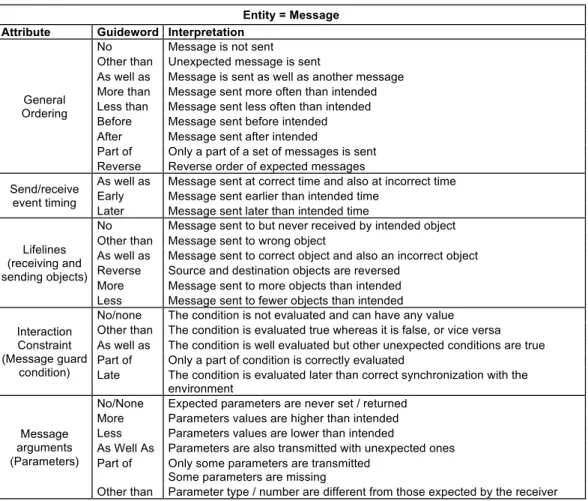
Safety assessment methods have been widely used in safety critical embedded systems for years. An important recent improvement of those methods leads to risk analysis tech-niques based on system models (architectural or behavior). Nevertheless, very few are focusing on scenario description and analysis of their deviation, and no specific method to analyse safety of human-robot interactions is actually proposed in the standards or studied in the robotic community. In Chapter 2, we propose a method for the identifica-tion of hazardous scenarios, HAZOP-UML, mixing a well-known risk analysis technique (HAZOP, Hazard Operability) and a system description notation (UML, Unified Modeling Language). HAZOP-UML main advantages are that it is applicable at the very beginning of the development process, it includes the humans as a source of hazard (human error), it provides guidance for analysts with list of guide words, and it focuses on operational hazards, i.e., hazards linked with the robot tasks and interactions. This approach was ap-plied to several real robots working in collaboration with workers. A second main issue in safety assessment, is the construction of safety argumentation or safety case (usually used for certification), initially done in safety critical systems through textual description. This activity has been recently studied through the use of graphical notations, aiming at struc-turing the arguments making more explicit the expert judgment. Such an approach might be an interesting direction in the field of autonomous and collaborative robots, where no standard actually fully covers such applications. Nevertheless, while constructing such an argument, analysts are faced to many uncertainties such as impacts of robot perception uncertainties, human or robot behaviors, or occurrence of unknown situations. Hence, if we consider that such systems will always have some uncertainties, the issue of how to assess confidence in the arguments of the safety case is raised. A recent challenge is to assess quantitatively the confidence associated to a safety case modeled in GSN (Goal Structuring Notation). We developed and present in Chapter 3 an approach based on belief theory and Bayesian Networks to define and assess the confidence in safety cases. This approach has been applied to an assistive robot for standing, walking and sitting, that has been validated during clinical trial tests.
My second research topic is motivated by the fact that even with the use of methods to reduce the number and consequences of hazards in the systems, there will still exist
Introduction 13
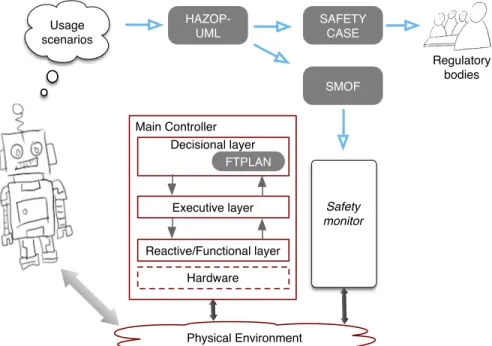
some residual hazards. To cope with these residual hazards, fault tolerance, is widely used in safety critical applications (mainly in aeronautics). It is defined in the dependability community as the mean to avoid service failures in the presence of faults. More generally, it is carried out with error or hazardous situations detection, and system recovery mecha-nisms. A first contribution to this topic is the development of a fault tolerant task planner (FTPlan) presented in Chapter 4. As the main decisional software component of the au-tonomous architecture, many errors may occur coming both from the inference mechanism or the knowledge representation. For this, we show through a fault injection campaign, that using a redundant planner for a mobile autonomous robot increases dependability without reducing performances. Another contribution in the field of fault tolerance, pre-sented in Chapter5, is the development of a safety monitoring framework (SMOF). Safety monitors are a popular form of fault tolerance mechanism, aimed at assuring that the system will stay in safe states despite faults and adverse situations occurrence. They are designed to observe the system and its environment, and to react using a safety margin to keep the system in a safe state. Specification and design of such mechanisms is usually done in an ad hoc manner, with simple safety rules implemented (e.g., in case of contact with an obstacle, an bumper directly disconnect the power of the actuator of a mobile robot). We argue that in the future, versatile autonomous systems, will have to deal with complex safety rules, that might be activated or deactivated according to the tasks, and with the possibility of reacting with many different ways that might be non consistent. This chapter presents a framework to specify such rules, starting from a hazard analysis, and using formal verification techniques to synthesized them. This framework also inte-grates the issue of assuring safety while preserving functionality of the considered system. This approach has been applied to a real case study of a robotic co-worker.
The concluding chapter6, outlines my main contributions in this field, but also present some other research activities that are not detailed in this manuscript. Finally, I present my main research perspectives in the fields of safety monitoring for autonomous architecture, robot testing in virtual worlds and certification of collaborative and autonomous robots
After my PhD on robot safety, I joined the dependable computing and fault tolerance research team at LAAS-CNRS in 2004, and had the opportunity to continue to contribute to the field of dependable robots. The work presented in this manuscript is the result of close collaborations with my colleagues at LAAS-CNRS coming from dependability re-search group but also from the robotics rere-search group. After 11 years, my activities on this multidisciplinary topic resulted in several PhDs, postdocs, co-organization of work-shops, and several French and European projects. Figure 1 presents a temporal overview of the four main contributions (and one perspective), and also my PhD students status.
14 Introduction
Fault tolerant planner Safety monitoring
HAZOP-UML Safety case confidence
2007
BL
AM MM
QD
PhD students defense: BL=B. Lussier, AM=A.Mekki-Mokthar, MM=M.Machin, QD=Q.A. Do Hoang
2004 2006 2009 2012 2015 2013 2015
Robot testing in virtual words 2014
Current PhD students : RW=R. Wang, TS=T. Sotiropoulos, LM=L.Masson
LM
RW TS
1
Can we trust collaborative
autonomous robots?
During my PhD on robot safety (defended in 2003), most publications on robot dependability were focusing on industrial automatic robots. Thirteen years later, many projects, Phds, dedicated research groups, and new standards, are focus-ing on dependable advanced robots. This chapter presents an overview of these activities and also provides some background for next chapters.
trust
| tr@st |noun
1 firm belief in the reliability, truth, ability, or strength of someone or some-thing: relations have to be built on trust | they have been able to win the trust of the others.
1* firm belief in the reliability, truth, ability, or strength of a robot: inter-actions have to be built on trust | robots have been able to win the trust of the humans.
Adapted from New Oxford American Dictionary - online version - 2015 As defined by international regulatory bodies, the accepted failure rate of a critical function in aeronautics is today 10−9 failure per hour of flight for one plane. Based on this calculation, manufacturers and end-users build a relation based on trust: (most of) people accept to travel in an aircraft, even if a failure during a flight is perceived as catastrophic. On the contrary, a failure of a robot which is actually potentially less catastrophic (compared to an aircraft, only few people are exposed), seems to be less
16 Can we trust collaborative autonomous robots?
accepted. One reason may be that robots originally replace humans, and users expect that their failures and induced consequences are less frequent and severe than human ones1.
Trust is thus partly based on the perception of that likelihood and consequences of failures (a more complete definition of trust in robotics is studied bySchaefer(2013)). Many robots developed in laboratories cannot be deployed in real life due to this lack of trust.
Nevertheless, several recent research European projects consider safety as the main challenge of human-robot cooperation like PHRIENDS (2006-2009); SAPHARI ( 2011-2015); SAFROS (2009-2013); ROBOT-PARTNER (2013-2016) or as a key objective in ROSETTA (2009-2013); BRICS(2009-2013); CHRIS(2008-2012);CARLOS(2012-2014). National projects such as ROBOSAFE (2013) in UK, SIMERO (2003) in DE, or NREC (2015) in the US, or dedicated research teams (e.g., Verifiable Robotics Research Group (2015)) also focus on robot dependability. Moreover, many research laboratories address robotics or embedded system dependability (or both like LAAS-CNRS). In this context, the number of PhD and published papers increased significantly in the last ten years. However, considering the vast and transversal domain, it is difficult to classify and review all works in this field. Hence, we focus in this section on activities which have a direct and explicit impact on dependability, and mainly on safety. Many works on robotics functions development may impact safety (for instance gripping issues), but as they do not explicitly focus on faults, they will not be reviewed in this chapter.
In order to present what is done to increase this trust, I start in Section 1.1 from a description of fundamentals elements of new robotics, i.e. autonomy and interaction, to an analysis of hazards and risks. It is followed by Section 1.2 dealing with European standards for robot safety. I also present major works done for dependability in robotics in Section 1.3. The last Section 1.4 presents main challenges in the field of dependable robots, and then focus on my research contributions, that presented in more detail in the following chapters.
1.1
From industrial robots to collaborative autonomous robots
- Hazards and risks
Among the large diversity of robotics applications and their associated ethical issues ( Roy-akkers and van Est,2015), safety is not a new concept. It has been studied for years in industry, and particularly for industrial robots use. But the development of new robots leads to consider new paradigms which impact traditionally approaches by robotic com-munity for addressing safety. This section starts from a definition of autonomy and its
1
To illustrate this statement, several newspaper articles (e.g., http://www.ft.com/cms/s/0/ 0c8034a6-200f-11e5-aa5a-398b2169cf79.html#axzz3gWie0xAT) state that it is about eight times more dangerous to work in a bar in the US than in manufacturing (including manufacturing with robots, so it should be less for manufacturing with robots)
1.1 From industrial robots to collaborative autonomous robots - Hazards and risks 17
impact on software architecture, followed by a discussion on hazards and risks such systems induce.
1.1.1 Autonomous robots
Most of the robots used in industrial processes are automatic machines, performing re-peated tasks, in a well defined workspace, segregated from operators with fences. These robots have been adapted to perform other useful tasks for humans at home, in hospitals, etc. Now, a new generation of robots, different from the industrial ones, have emerged completely dedicated to these new tasks, without any human intervention, in uncertain environments. Besides this development, autonomous mobile robots and drones are also developed to avoid human presence in the control loop.
Autonomy has several definitions in the literature; in its most generic sense, it is defined as “the ability to self-manage, to act or to govern without being controlled by others”. A less generic and more suitable definition of autonomy of robotic systems can be found in Huang et al.(2005) as:
Autonomy is the ability of integrated sensing, perceiving, analyzing, commu-nicating, planning, decision-making, and acting/executing, to achieve its goals as assigned. The autonomy level is determined by the complexity of the missions that the system is able to perform, the degrees of difficulty of the environments within which the system can perform the missions, and the levels of operator interaction that are required to perform the missions.
This definition focuses on two important aspects of autonomous robots: the first is the uncertain environment in which the system operates, the second is its ability to make decisions in this environment. Nowadays, such robots are even considered to replace classic industrial robots in factories, in order to perform collaborative tasks with human operators (known as co-workers, see e.g., Haddadin et al. (2011)). Hence, current classifications of robots, segregating industrial robots from others (see for instance definition of service robots2) are about to be outdated.
The issue of categorizing autonomous systems (and decide if a system belongs or not to autonomous systems) is actually complex. Some works present classifications (see for instanceParasuraman et al.(2000);Huang(2008)) from complete control by human (e.g., DaVinci medical robot3), to full autonomy (e.g., Mars Rover4), which permit to avoid a binary classification autonomous / not autonomous, which can be impossible for many systems at the boundaries of this classification.
2
According to ISO13482 (2014) a service robot is a Robot that performs useful tasks for humans or equipment excluding industrial automation applications
3
http://www.davincisurgery.com/
18 Can we trust collaborative autonomous robots? Physical Environment Autonomous System Decisional layer Executive layer Reactive/Functional layer Hardware Objectives
Figure 1.1: A three layer architecture for autonomy
In order to consider hazards induced by these applications, we will then consider two main characteristics of new robotics: the presence of a decisional layer which is non de-terministic in the software architecture, and a highly interactive relation between a robot and humans, including physical human-robot interactions.
1.1.2 Autonomous software architecture
Considering the previous definition for an autonomous system, several architectures can be found in the literature. As stated in the survey on deliberative systems by Ingrand and Ghallab (2014), hierarchical architectures are probably the most used in autonomous robotics. It is usually composed of several layers, from hardware level to decisional (or deliberative) level. While some architectures might be classified as two-layer architectures, one for elementary tasks (like sensing), and another one for decisional aspects (e.g. see 4D/RCS Albus et al. (2002), ORCCAD Borrelly et al. (1998), CLARATY Volpe et al. (2001); Nesnas et al. (2003)) others propose to use a three layer architecture (Gat,1998; Alami et al.,1998; Ingrand et al., 2007). In this latter case, the proposed software layers presented in Figure 1.1are:
Decisional/deliberative layer is the highest abstracted level of the architecture. Ob-jectives are received (from another system, or an operator) and it generates some plans according to an abstract representation of the system and its environment. Functions for deliberation (e.g., planning, learning or goal reasoning (Ingrand and Ghallab, 2014)) are usually composed of knowledge specific to the system’s domain of application (such as heuristics or a model of the environment) and an inference mechanism used to solve problems by manipulating this knowledge. No guarantee
1.1 From industrial robots to collaborative autonomous robots - Hazards and risks 19
can be delivered for execution time, and output is also not deterministic. The use of heuristics is not guaranteed to be optimal or perfect, but sufficient to find solutions. Executive/sequencing layer converts plans sent by the decisional layer, into primitive
functions for the functional level. Real time requirements are included.
Reactive/Fonctional level is in charge of feedback control loops coupling sensors to actuators, of perception facilities and trajectory computation. It is composed of ele-mentary functions sharing information without any global representation. Execution time is adapted to the sensors and actuators performances.
Each level sends to the highest level the results of task execution (including errors that cannot be managed at the lowest level). Hybrid versions with combined layers or direct communications links between functional and decisional layers also exist, but this simple three layer description is useful for aggregating most of the current hierarchical architec-tures.
1.1.3 Human-robot interaction
Among the topics of the research domain of human-robot interaction (seeYanco and Drury (2004) for a classification), two main branches can be cited: cognitive and social Human-Robot Interaction (cHRI), and physical Human-Human-Robot Interaction (pHRI). Cognitive HRI focus on the social and psychological aspects of interactions mixing research domains as psychology, cognitive science, human-computer interfaces, human factors, and artificial intelligence. Physical HRI deals with issues due to physical interaction, especially from the view of robot design and control. As any classification, it has some limits, and both may impact or cover each other. For instance, inMainprice et al.(2010), movement trajectories are computed to comply with users expectations and habits (human-aware movements, part of cHRI research), in the context of robot in human vicinity with potential contacts (part of pHRI research).
Apart from those human-robot interactions studies, we can first just consider the com-munication means between a human and a robot. A simple classification may be:
Remote communication : use of hardware components (teach pendant, buttons, graph-ical user interfaces, etc...)
Physical communication : physical contact between the human and a mobile part of the robot.
Cognitive communication : communication through cognitive signals like posture, move-ment, noise, speech, etc.
All these possible communication channels are bidirectional. For instance, a robot can engage an interaction through a desired physical contact with a user. Challenges in pHRI
20 Can we trust collaborative autonomous robots?
require to cover many domains (Alami et al., 2006), and an important work was done in projects like SAPHARI (2011-2015) or PHRIENDS (2006-2009)). For pHRI, the way a human and a robot may interact depends on the level of “closeness” both can achieve. Physical interaction may be direct or indirect: if the robot is carrying an object the human is touching, then the interaction is termed indirect. A direct human-robot interaction involves the robot itself or an attached tool touching the human (or vice-versa). Direct pHRI may also be termed hands-on pHRI when the operator or user is supposed to work in physical contact with the robot, thereby exchanging forces and torques between the user and the robot. An extreme form of direct pHRI is (minimally invasive) surgery where robotic devices are used to work on or inside a human body. Another term to denote indirect pHRI is hands-on-payload, which is common with intelligent assist devices (IAD). To assess the risks associated with human-robot interaction it is important to not only classify these types of physical contact, but to also specify the level of closeness as outlined in the following taxonomy we developed during the PHRIENDS project:
1. Far (no pHRI possible): Human and robot are not sharing the same workspace; a direct physical contact is not possible. The interaction with a far robot is usually carried out via remote communication. This may be through a teach pendant or jogging device (when there is a line of sight with the robot) or over some network. 2. Close (accidental pHRI possible, “hands-off” pHRI): In this case the human and
robot are sharing the same workspace. Since the human is within the robot’s reach there is a risk of unwanted, potentially harmful physical contact. An example is the programming of the robot system while the programmer is within the robot’s work cell. Another example could be the exchange of objects between a human and a robot through a dedicated exchange position within the workspace (e.g., a table or shelf).
3. Touching without simultaneous movement (direct or indirect pHRI): The robot shares its workspace with the human. Both are simultaneously moving through the workspace, but physical contact with the moving robot is avoided. In this cat-egory interaction only takes place when the robot stops. An example for this type of interaction is a robot delivering an object. The system approaches the human (or vice versa), the robot (safely) stops temporarily when the human reaches the object and only starts moving again after the interaction is completed.
4. Touching with simultaneous movement (direct or indirect pHRI): The robot shares its workspace with the human. Both are moving simultaneously and physical interaction is possible and intended. An example of direct pHRI may be a robot which is programmed by being manually guided through the workspace. Interaction could also take place during task execution. The robot may assist the human with its greater force and/or precision. An example of indirect pHRI may be a robot assisting
1.1 From industrial robots to collaborative autonomous robots - Hazards and risks 21
elderly people by feeding them. This may involve simultaneous direct and indirect pHRI with one or more manipulators.
5. Supporting (direct pHRI): Here the physical interaction occurs continuously over extended periods of time, usually in the form of exoskeletons which are worn by the user, or when the robot is carrying a human (for example in healthcare applications or rescue operations).
6. Invasive (direct pHRI): Surgical robots or their tools are designed to invade the human body, which is considered as the robot workspace.
We believe that these 6 levels should be part of a safety analysis. It is indeed obvious that the consequence of failure of the system will be strongly related to the type of closeness. A direct adaptation of such a classification could be the definition of the workspaces and associated safety rules in the case of a co-worker (Haddadin et al.,2011).
1.1.4 Harms, Risks and Hazards
The first and obvious concern when dealing with robot safety, is the possible harm due to an unwanted collision between a human and a robot. Most of work done on harm induced by robots is on the biomechanical analysis of human robot contact inducing impact, crushing, cutting, etc. and associated control loop or actuators for reducing harm severity (e.g. see Ulrich et al. (1995); Zinn et al. (2004); Povse et al. (2010); Haddadin (2014, 2015)). Some results of these researches are part of the technical specification of ISO/TS 15066 ‘Collaborative robots’, which has been analyzed by theHSE(2012). Authors note that it is still difficult in this document to validate the forces calculation, as the situations in terms of probability of exposure and complexity of interaction (human moving or not, which direction, etc.) are difficult to describe. It is hence nearly impossible to determine an acceptable speed or force, without knowing the robotic application (diversity goes against generality).
Besides these researches specific to robotics, a more generic approach to study safety is based on the concept of risk, widely used in safety critical systems. It has been defined in ISO/IEC-Guide51 (1999) as the combination of the probability of occurrence of harm and the severity of that harm, where a harm is defined as a physical injury or damage to the health of people, or damage to property or the environment. We also include in harm definition the damage to the robot itself. A risk management process is usually composed of three steps (a more complete view is given in ISO31000 (2009)): hazard (any potential source of harm) identification and analysis, induced risk estimation, and risk evaluation to decide if the risk is acceptable. If not, actions to reduce risk are performed.
A major difficulty when using the risk management approach, is the occurrence prob-ability estimation. It is hence, in such systems, very hard to estimate probabilities of failures of the software, human errors, adverse situations occurrence, etc. One approach is
22 Can we trust collaborative autonomous robots?
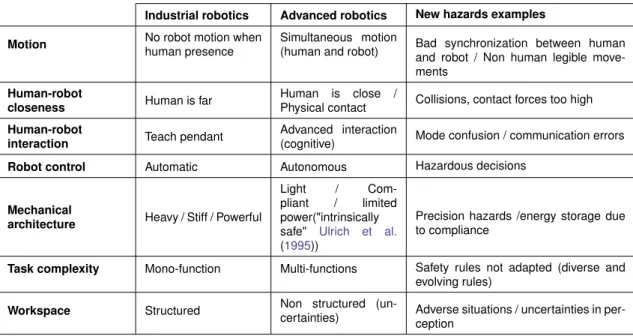
then to set probability to one, and to deal with severity, considering that everything can occur! (It is even mentioned explicitly in risk management standards like ISO/FDIS14971 (2006), p. 37). This simplification has obviously some drawbacks, the most important being that this approach can outcome many unacceptable risks, and reducing all risks has a cost (performance, physical space, development time) that may cannot be covered for the development of robots (where power and physical space are limited for instance). Another difficulty is due to the definition of hazard (any potential sources of harm) which can be used to define its origin or the nature of the expected harm (e.g., electric shock hazard, crushing hazard, cutting hazard, collision hazard, fire hazard). This thus could designate a source or a consequence. For instance, in a hazard analysis of a manipulator, a hazard might be a controller reboot due to high temperature, and an unwanted movement is also a hazard. There is a possible cause/consequence chain between those two hazards. This could lead to ambiguities and difficulties into the application of hazard analysis techniques. Main works aiming at identifying main hazards present in robotics applications are reviewed hereafter. Even if the study of Malm et al. (2010) states that crushing and clamping might be the major hazards in robot cells or in future applications, an important challenge is to identify all possible hazards that may change according to the task and the context. Most of classical hazards if robots are considered as Machines (according to the European Directive2006/42/EC(2006)) induce same hazards as other industrial machines (electric shocks, cut, etc.), and more specific ones that can be found in ISO13482 (2014), Annex A. However, as illustrated in Table 1.1, many evolutions of robot properties need to be taken into account to identify the new hazards. A study of Carlson and Murphy (2003), was on failures of indoor and outdoor robots, not all autonomous. Thirteen robots were observed for nearly two years, displaying a MTBF (Mean Time Between Failure) of about 8 hours, and a reliability of less than 50%. Outdoor robots were seen to fail more often than indoor ones (maybe because of the more demanding outdoor environment), and while hardware faults were the most common cause of failures (42%), the control systems (including the operating systems) were also significant sources of failures (29%). On the contrary, when autonomy increases, so do the failures of the software part. For instance Tomatis et al.(2003a) presents the implementation of the autonomous museum tour guide RoboX9 and a study of its failures during five months of operation. 96% of failures were caused by the software components (80% due to the non-critical human interaction process, and 16% due to the critical navigation and localization process). Same conclusions were drawn by Steinbauer (2013), who presents a review on detected faults on 17 robots of the Robocup. Failures of the mission goal are considered. Software faults in these systems are more frequent than hardware faults, and belong to operational system, middleware or robot controller (including localization, or planners). Actuators and sensors fail with a similar rate, but the sensors ones were more critical for the mission success.
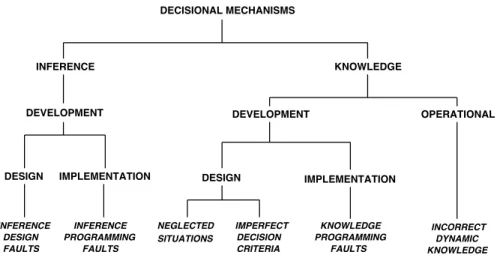
Among hazards induced by software, we identified in Lussier et al. (2005) that the software faults in decisional layer could be faults in the inference mechanism or in its knowledge representation. As presented in Figure 1.2, faults in the inference mechanism
1.1 From industrial robots to collaborative autonomous robots - Hazards and risks 23
Industrial robotics Advanced robotics New hazards examples
Motion No robot motion when
human presence
Simultaneous motion
(human and robot) Bad synchronization between humanand robot / Non human legible move-ments
Human-robot
closeness Human is far
Human is close /
Physical contact Collisions, contact forces too high
Human-robot
interaction Teach pendant
Advanced interaction
(cognitive) Mode confusion / communication errors
Robot control Automatic Autonomous Hazardous decisions
Mechanical
architecture Heavy / Stiff / Powerful
Light / Com-pliant / limited power("intrinsically safe" Ulrich et al.
(1995))
Precision hazards /energy storage due to compliance
Task complexity Mono-function Multi-functions Safety rules not adapted (diverse and evolving rules)
Workspace Structured Non structured
(un-certainties) Adverse situations / uncertainties in per-ception
Table 1.1: Core properties of industrial and advanced robotics, and examples of induced hazards
may be introduced during development of the system, either as a design fault (for example if the decisional mechanism is not adapted to the system function, or if its principle is flawed) or as a programming fault (such as a typing or algorithm error). Faults in the system knowledge may be introduced either during development (design or programming) or in operation. Design faults may be either an explicitly-specified adverse situation that has not been covered by the developers (such as a missing procedure or an action needed to treat the adverse situation, or missing example sets used in learning for neural networks), or an imperfection in the choice criterion that possibly causes wrong conclusions to be drawn by the inference mechanism (such as faults in heuristics, or facts used for decision that are wrong in particular situations). Knowledge programming faults include both missing and faulty information in the knowledge of the decisional mechanism. Operational faults are incorrect dynamic information in the knowledge of the decisional mechanism, such as the current state of the system or information learned from the environment; these faults may be caused for example by sensor failures or imperfections, or undetected memory corruption.
Most of faults presented in Figure 1.2, like neglected situations or incorrect dynamic knowledge, result from a lack of knowledge (also called epistemic uncertainties), are hardly treated using common techniques like testing or formal verification for instance.
24 Can we trust collaborative autonomous robots? 2
not all be determined in advance. When faced with unexpected
adverse situations a correct service cannot be guaranteed.
However, the user may judge after execution that, given
the unexpected situation that the system had to face, the
service, while not correct with respect to the specification, was
nevertheless acceptable. An acceptable service is generally
less successful than a correct service as the system had to
deal with unexpected adverse situations (it may achieve less
goals, or only part of the goals).
B. Decisional Mechanisms
Decisional mechanisms are central to autonomous systems,
as they embody the ability to select and choose actions to
achieve specified objectives. This section presents decisional
mechanisms and proposes a classification of possible faults
affecting those mechanisms.
1) Characterization of decisional mechanisms: A
deci-sional mechanism is composed of knowledge specific to the
system’s domain of application (such as heuristics or a model
of the environment) and an inference mechanism used to solve
problems by manipulating this knowledge. Ideally, the
infer-ence mechanism is independent from the application and can
be re-used in a different one with new appropriate knowledge.
In practice however, knowledge and inference mechanism are
often hard to dissociate; for example heuristics in planners or
weights in neural networks are intrinsic parts of the inference
mechanism.
Applied to an ideal faultless knowledge base, an inference
mechanism can be characterized by three main properties:
soundness, completeness and tractability [29]:
•
Soundness indicates that any conclusion raised by the
inference mechanism is correct.
•
Completeness indicates that the inference mechanism will
eventually produce any true conclusion.
•
Tractability characterizes the complexity of the inference
mechanism: it indicates whether the inference mechanism
can solve a problem in polynomial time and space, that
is whether the time and memory space needed to find a
solution can be defined as a polynomial function of the
problem size.
Inference mechanisms currently used in autonomous
sys-tems are often sound and complete, but intractable. In
prac-tice, completeness is often relinquished through the use of
heuristics, in order to improve tractability, and consequently
the system performance.
2) Fault classification in decisional mechanisms:
Deci-sional mechanisms introduce new faults in comparison to
classic computing systems. From the risks of error presented
in [5] and [13] we have identified internal faults in a decisional
mechanism, and interaction faults between a decisional
mech-anism and another component or system (such as a human
operator or another decisional mechanism).
a) Internal faults: Internal faults in a decisional
mecha-nism may affect either the knowledge or the inference
mech-anism (Figure 2) [23].
DECISIONAL MECHANISMS
KNOWLEDGE INFERENCE
DESIGN
DESIGN IMPLEMENTATION IMPLEMENTATION
DEVELOPMENT DEVELOPMENT OPERATIONAL
DESIGN NEGLECTED SITUATIONS IMPERFECT PROGRAMMING FAULTS FAULTS DECISION CRITERIA FAULTS PROGRAMMING KNOWLEDGE
INFERENCE INFERENCE INCORRECT
DYNAMIC KNOWLEDGE
Figure 2: Internal faults in decisional mechanisms
Faults in the inference mechanism may be introduced during
development of the system, either as a design fault (for
exam-ple if the decisional mechanism is not adapted to the system
function, or if its principle is flawed) or as a programming
fault (such as a typing or algorithm error).
Faults in the system knowledge may be introduced either
during development (design or programming) or in operation.
Design faults may be either an explicitly-specified adverse
situation that has not been covered by the developers (such
as a missing procedure or an action needed to treat the
adverse situation, or missing example sets used in learning for
neural networks), or an imperfection in the choice criterion
that possibly causes wrong conclusions to be drawn by the
inference mechanism (such as faults in heuristics, or facts
used for decision that are wrong in particular situations).
Knowledge programming faults include both missing and
faulty information in the knowledge of the decisional
mech-anism. Operational faults are incorrect dynamic information
in the knowledge of the decisional mechanism, such as the
current state of the system or information learned from the
environment; these faults may be caused for example by sensor
failures or imperfections, or undetected memory corruption.
b) Interaction faults: The main faults of decisional
mechanisms due to interaction with other components or
systems are mismatches in the exchanged information. Such
faults are not specific to decisional mechanisms and can be
classified in several categories [18].
Semantic mismatches are development faults that arise when
different languages are used by the communicating
compo-nents, and lead to information loss or modification. They are
of particular concern in autonomous systems, as in practice
semantic mismatches are common between different
compo-nents. The three-layer type of architecture for example is built
from components considering different levels of abstraction,
each generally using a distinct model of the system and the
environment. The executive component often lacks a global
view of the system to better decompose plans, whereas the
upper decisional mechanism does not possess all the relevant
information for dealing with error reports.
Other types of mismatch (including physical, syntactical,
and temporal mismatches) are similar to other computing
systems, and can also be causes of information loss or
modi-fication.
Figure 1.2: Internal faults in decisional mechanisms
1.2
Robot safety standards
In Europe, in order to commercialize a machine (including an industrial robot), the only requirement is to get a CE mark following the 2006/42/EC(2006). This is done through a process, from an auto-declaration of the manufacturer to a complete reviewing process by independent regulation bodies. ISO standards (e.g., ISO13849-1 (2006); ISO12100 (2010) for machines safety) are highly recommended as it gives confidence to the regulatory bodies to deliver certification. However, due to properties of new robots, such directives or standards are not entirely applicable, in particular due to physical contact between human and mobile parts of the robot. The generic standard IEC61508 (2010) dedicated to safety-related hardware and software, based on the concept of Safety Integrity Level (SIL), is also hard to apply because the entire robotic systems might be classified as a safety-related system. For cost reason, it is then quite impossible for a manufacturer to apply all the requirements of this standard. Moreover, in this standard it is recommended to avoid artificial intelligence technique for fault correction (IEC61508-3:2010, p48) for all the safety integrity levels except the lowest one !
More recently, the standard ISO10218-1 (2011); ISO10218-2 (2011)5, for robot in in-dustrial environment, has been followed by the standard ISO13482 (2014) for personal robots (a standard dedicated to collaborative robots is under development, current name is ISO/TS 15066 – Robots and robotic devices – Safety requirements for industrial robots – Collaborative operation). In this standard a list of typical safety related functions are given:
5
In the US, the safety standard R15.06-2012(2012) is an adoption of ISO 10218:2011 Parts 1 and 2, providing guidance on the proper use of the safety features embedded into robots, as well as how to safely integrate robots into factories and work areas.
1.3 Dependability means 25
emergency stop, protective stop, limits to workspace (including forbidden area avoidance), safety-related speed control, safety-related force control, hazardous collision avoidance. For each function a Performance Level (PL) equivalent to a Safety Integrity level (SIL), is assigned leading to a set of recommendations from ISO13849-1 (2006) (for software a more detailed list of recommendations are given inIEC61508-5 (2010)). This approach is appropriate when it is possible to clearly identify and separate the safety functions from the main robot controller. Nevertheless, if we consider for instance a mobile robot and the safety related function "hazardous collision avoidance", it is completely part of the main robot controller, with perception, decision and reaction. It then leads to assign the whole robot controller a high integrity level, which is too demanding for manufacturers. It is still hard to estimate adoption of such robotic standards by manufacturers, partly because their novelty, but considering the wide and growing variety of robots, we can expect that they may not be covered by such standards. Hence producing generic standards in this field is really challenging.
Until now, very few robots have been certified. For instance, in the technical documen-tation of the UR5 from Universal Robots (UR5-Robot,2015), it is specified that 15 safety functions have been tested by the TÜV (Technischer Überwachungs-Verein) in accordance with the "EN ISO 13849:2008 PL d, and EN ISO 10218-1:2011, Clause 5.4.3". It is im-portant to note that this certificate only validates the presence of a safety function (clause 5.4.3), with a Performance Level (PL) d. Such a level, is equivalent to an integrity level SIL2 in IEC61508 (2010) (maximum is SIL4). This does not give any guarantees when using the robot for a dedicated task, that safety will be respected. Same limitation will come with theISO13482(2014) for personal robots. Another limitation, is that few details are provided regarding the embedded software in such robots. It is important to note that this standard, explicitly does not include medical robots, which are "active medical devices" covered by the directive93/42/EEC (1993), and by a set of standards from risk analysis (ISO/FDIS14971,2006) to medical software development (IEC62304,2006). Even if this domain, more standards seem to be applicable, only a part of the standard can be applied as presented in Guiochet et al.(2012).
A direct impact is a lack of widely accepted methods for certification of robots, and particularly for autonomous robots. Alexander et al.(2007,2008,2010) conclude that even if some formal methods can be efficiently applied to autonomous systems, it is not sufficient to build a safety argumentation to obtain certification (safety case). Even if important efforts have been done in recent standards towards new robotic systems, certification of collaborative robots with a decisional layer is still an open issue.
1.3
Dependability means
Dependability is defined byAvižienis et al.(2004) as the "ability to deliver service that can justifiably be trusted". Dependability encompasses many attributes, such as reliability,
26 Can we trust collaborative autonomous robots?
safety or availability. In the dependability community, safety is defined as the absence of catastrophic consequences on the user and the environment, whereas in risk management standards it is defined as the absence of unacceptable risk. This latter definition is more adapted to the analysis of new robots, where an absolute definition of safety is actually difficult to applicable. Actually, another definition of dependability by Avižienis et al. (2004) takes into account this issue: "Dependability is the ability to avoid service failures that are more frequent and more severe than is acceptable". These authors define depend-ability’s threats as failures, error and faults. A service failure happens when delivered service deviates from correct service. An error is a deviation in the system’s state. Errors can propagate though the system and may ultimately lead to a failure. Finally, a fault is the adjudged or hypothesized cause of an error. A fault is active when it causes an error, otherwise it is dormant. To avoid service failures that are more frequent and more severe than is acceptable, dependability proposes four means:
Fault prevention : to prevent the occurrence or introduction of faults, including tech-niques coming from system engineering, good practices to design the system (sec-tion 1.3.1)
Fault removal : to reduce the number and severity of faults mainly using validation and verification techniques (section 1.3.2).
Fault forecasting : to estimate the present number, the future incidence, and the likely consequences of faults. It includes risk analysis methods. (section1.3.3)
Fault tolerance : to avoid service failures in the presence of faults using redundancy, error detections, etc. (section 1.3.4)
The term "fault" which is used in these means may actually mean failure, error or fault. In robotics the term "fault" is sometimes misleading. For instance, uncertainties in envi-ronment perception, heuristics limits, or adverse situations, are not qualified as "faults" in its common sense, where are they are typical threats to dependability. To avoid confusion, I will use in this manuscript the term fault to encompass all threats to dependability.
Many techniques traditionally used for safety critical systems development may be used for autonomous robot development like hardware redundancy to increase reliability. But main techniques are actually not adapted to deal with new hazards of collaborative autonomous robots. For instance, redundancy with error masking which is used in all aircrafts, may be ineffective for a decisional component (two different plans may be correct), which lead to an impossible detection. I thus focus in the next sections on what has been done in dependability when it is specific to analysis and development of autonomous and collaborative robots, and different from what can be found in common dependability literature. As a robot is a multi-disciplinary artifact, techniques in order to improve its dependability come from computer science, robotics, automatics, mechanical engineering,
1.3 Dependability means 27
electronics, and cognitive sciences. Of course it is impossible to review all the works done in all those domains, hence I mainly focus on contributions coming from computer science.
1.3.1 Fault prevention
In a hierarchical architecture, developers have to deal with heterogeneous models and abstractions. As it is done in other domains, fault prevention in autonomous systems software is mainly implemented through the modularity of software components and the use of appropriate development tools for dealing with this heterogeneity. Component-based software or modularity first appears in generic architectures such as LAAS (Alami et al., 1998), RAX (Muscettola et al.,1998), CLARAty (Volpe et al.,2000) or IDEA (Muscettola et al.,2002). Such layered architectures can be supported by standardized middleware like ROS (Robot Operating System) (Quigley et al.,2009;ROS,2015), OROCOS (Bruyninckx, 2001; Orocos, 2015), or Genom (Fleury et al., 1997; Mallet et al., 2010; Genom, 2015), which improves reuse, provide communication functions, and code generation.
Other environments, providing tools for formal specification and verification, has also been applied in the context of robotics (see ControlShell (Schneider et al.,1998), ORCCAD (Borrelly et al.,1998) or SIGNAL (Marchand et al.,1998)), but they were based on specific languages, which are not interfacing with current robotic development tools.
Associated to such tools, some researches also deal with model-driven engineering for autonomy (Brodskiy et al., 2014), in order the reduce the faults that may occur due to errors in specification or design. The Robotic Application development Process (RAP) (Kraetzschmar et al.,2010) proposed in the context of the projectBRICS(2009-2013), is motivated by the absence of such methods in autonomous software development.
A way of preventing the occurrence of hazardous situations, is also to limit the robot performances or tend to reach an "intrinsically safe robot" (Ulrich et al.,1995). It concerns weight, forces, power, speed, acceleration, working area, mechanical mobility etc. Some of well known manipulators are the LWR (lightweight Robot III), developed by DLR6 and commercialized by KUKA7 or Universal Robots8. Another limitation concerns the number of degrees of freedom. It is indeed sometimes recommended like in the medical field (Glauser et al., 1993), to reduce to the lowest number of DOF necessary for the task in order to reduce complexity and thus potential faults. This approach may not be applicable when the robot must adapt itself to the environment. Additionally, all the work on compliance of robot actuation (passively safe actuators, control of active compliance/stiffness, see for instance Filippini et al. (2008); Albu-Schaffer et al. (2008); Flacco et al. (2012)) also contributes to prevent hazardous situation occurrence. Indeed, more compliant movements, will avoid harmful collisions and also induce more "natural" movements. 6 http://www.dlr.de/rm/en/desktopdefault.aspx/tabid-3803/ 7http://www.kuka-labs.com/en/medical_robotics/lightweight_robotics/ 8 http://www.universal-robots.com/GB/Products.aspx
28 Can we trust collaborative autonomous robots?
Also in order to prevent hazardous situations occurrence, some work focus on human error avoidance through more human aware robot movements (see the review ofKruse et al. (2013). For instance human legible motion planning and reactive planning for collision avoidance is about calculating trajectories in order to produce movements which are more natural for humans (Mainprice et al.,2010). A robot holding an object to a human should move in front of him, and not behind; a robot arm movement should avoid to come close to human while performing a movement in its workspace (for instance move away the elbow joint from human body while interacting with him).
1.3.2 Fault removal
Fault removal aims to identify, diagnose and remove faults in the considered system. Only the first step is presented here, as the two others are quite generic. This activity includes verification activities which are mainly dynamic (run tests and detect faults through anal-ysis of logs or with a run-time monitor) or static (static analanal-ysis, model checking, theorem proving). Nevertheless, as mentioned by Pecheur (2000); Tiwari and Sinha (2003); Men-zies and Pecheur (2005), the classic issues faced by verification in control systems, are exacerbated for autonomous systems. Major issues are:
• execution contexts in autonomous systems are neither controllable nor completely known; even worse, consequences of the system actions are often uncertain.
• decisional mechanisms have to be validated in a complete architecture, since they aim to enhance functionalities of the lower levels through high-level abstractions and actions. Integrated tests are thus necessary very early in the development cycle, which is often impossible.
• the oracle problem9 is particularly difficult since (a) equally correct decisions may
be completely different (e.g., two different trajectories), (b) non-deterministic action outcomes and temporal uncertainties can cause otherwise correct plans to sometimes fail when executed, and (c) unforeseen adverse environmental situations may com-pletely prevent any plan from achieving all its goals (for example, cliffs, or some other feature of the local terrain, may make a position goal unreachable).
Note that in dynamic and static verification techniques, models and mathematical tools are usually transversal and useful for other dependability means. For instance, model checking techniques might be used to specify testing oracle, or fault tolerance detection mechanisms as presented in Chapter 5.
9
1.3 Dependability means 29
Dynamic verification
Testing is the most intuitive way to reveal a fault: a test case is provided to system inputs, then its outputs are analyzed to determine if they are correct, which constitutes the oracle issue. When a complete behavioral model exists, it is used as an oracle: system and oracle outputs are compared. Otherwise, a partial oracle is used, which verifies properties of outputs. Mainly two types of test can be carried out in robotics. Conformity testing aims at revealing faults (and remove them), and robustness testing aims at assessing system resistance to stressful environmental conditions. In robotics, it is difficult to completely specify all situations the system is designed for. During navigation testing, it is quite impossible to define the boundary between conformity and robustness testing (e.g., when do environment conditions switch from "normal" to "stressful"? this is also called the "situation coverage" issue byAlexander et al.(2015)). This issue has an important impact on techniques chosen for testing autonomous systems. Robustness testing may also be deployed at the component level in an autonomous architecture, as it is done in Powell et al.(2012), where the functional layer is tested considering timing errors (typically delays between requests coming from the decisional layer).
One conclusion of Pecheur (2000) is that for autonomous controller, "scenario-based testing provides a very limited coverage". Indeed, in autonomous systems, their role is of-ten limited to debugging rather than proving a thorough validation. Especially in the case of research platforms, developers check correct execution of the system for few situations. Intensive testing was however carried out on the RAX architecture for the DS1 project (Bernard et al., 2000): six test beds were implemented throughout the development pro-cess, incorporating 600 tests. The authors underline the relevance of intensive testing, but acknowledge particular difficulties regarding autonomous systems, notably the problem of defining suitable test oracles. However, new development of technologies (particularly in simulation and system modeling) lead to an increase of activities in this domain.
In Micskei et al. (2012), a framework has been developed to generate test cases for robustness testing of mobile autonomous systems. It is based on a model of system tasks (represented by UML sequence diagrams), and on a modeling of the environment (coming from ontology, specifying all possible objects of the environment and their properties). A complete oracle is impossible as it will be as complex as the system under test, and also because of the non-determinism of the decisional layer. Hence authors use a partial oracle described with sequence diagrams in order to compare messages occurrence (Horányi et al., 2013a). Also in the field of test case generation,Zou et al.(2014) present an approach based on genetic mutation. The goal is to generate cases to test collision avoidance between two drones. Considering that the oracle is based on estimation of a distance between drones equivalent to collision, the fitness function is easily implemented. Arnold and Alexander (2013) also generate test inputs including 2D worlds (map and obstacles), using procedural content generation as it is done in video games.
30 Can we trust collaborative autonomous robots?
A major improvement for testing is the development of simulators, allowing to plug robot controller to a simulated mechanical and hardware architecture of the robot in a simulated environnement. Testing in robotics is indeed costly in terms of time, and can be harmful for the system or its environment (when testing safety for instance), and is usually performed with a limited set of environmental conditions. Simulators will cope with these issues. Actually a few simulators are sufficiently generic to integrate several software controller architecture, able to simulate gravity, frictions, and dynamic environment. We can citeMorse(2015);Echeverria et al.(2011) based on the 3D engine BlenderBlender3D (2015), or Gazebo (Gazebo,2015) (see a comparaison inCook et al.(2014)). Most of work using those simulators for robots, aims at testing a function in relative simple conditions, and not to focus on fault identification or robustness estimation (Powell et al.,2012), but we can forecast that such testing campaigns in autonomous and collaborative robots using simulators will increase.
Another research direction in dynamic verification, is the use of runtime verification techniques reviewed by Leucker and Schallhart (2009); Delgado et al.(2004). This tech-nique generates an oracle from properties (mainly temporal properties), which are specified by adding code into the controller software. Verification is then performed during oper-ational life of the system. Such approach usually used in cyber-physical systems (e.g., Goodloe and Pike (2010),Kane et al.(2014)), has been used byGoldberg et al.(2005) for non regression testing of planning in robotics.
Static verification
The main difference with dynamic verification, is that static verification guarantees that all execution of a system are correct regarding the specifications. They are generally based on a system model which is an abstraction of the real system. It encompasses static analysis, model checking, and theorem proving. Some works address theorem proving (see Täubig et al. (2012) for obstacle avoidance algorithm proving) but most of the works applied to robotics are on model checking.
Model checking is based on the verification of properties of execution traces (or a reduced set) of a dynamic model (usually a state machine). Temporal logics, like CTL (Computation Tree Logic), are widely used to define these properties. In computer science the main drawbacks of these approaches are that the modeling step is not error prone (specific language) and also may not be representative of the real system. Tools also suffer from combinatory explosion. Nevertheless, increasing performances of calculators and algorithms should reduce such limitations, and increase model checking applicability in the future.
In robotics,Pathak et al.(2013) andO’Brien et al.(2014) propose to use model checking with an extension to estimate the probability that the properties are satisfied. In Scherer et al.(2005), the functional layer of a robot is verified using model checking. In this paper, verification is directly done on the Java code, which permits to avoid the modeling of the