Publisher’s version / Version de l'éditeur:
Laser-induced Incandescence, Quantitative interpretation, modelling, application,
p. 22
READ THESE TERMS AND CONDITIONS CAREFULLY BEFORE USING THIS WEBSITE. https://nrc-publications.canada.ca/eng/copyright
Vous avez des questions? Nous pouvons vous aider. Pour communiquer directement avec un auteur, consultez la
première page de la revue dans laquelle son article a été publié afin de trouver ses coordonnées. Si vous n’arrivez pas à les repérer, communiquez avec nous à [email protected].
Questions? Contact the NRC Publications Archive team at
[email protected]. If you wish to email the authors directly, please see the first page of the publication for their contact information.
NRC Publications Archive
Archives des publications du CNRC
This publication could be one of several versions: author’s original, accepted manuscript or the publisher’s version. / La version de cette publication peut être l’une des suivantes : la version prépublication de l’auteur, la version acceptée du manuscrit ou la version de l’éditeur.
Access and use of this website and the material on it are subject to the Terms and Conditions set forth at
Measuring accommodation coefficients using laser-induced
incandescence
Daun, K. J.; Smallwood, G. J.; Liu, F.; Snelling, D. R.
https://publications-cnrc.canada.ca/fra/droits
L’accès à ce site Web et l’utilisation de son contenu sont assujettis aux conditions présentées dans le site LISEZ CES CONDITIONS ATTENTIVEMENT AVANT D’UTILISER CE SITE WEB.
NRC Publications Record / Notice d'Archives des publications de CNRC:
https://nrc-publications.canada.ca/eng/view/object/?id=c96a024d-ad45-4660-9d3e-89c13b258c6e https://publications-cnrc.canada.ca/fra/voir/objet/?id=c96a024d-ad45-4660-9d3e-89c13b258c6eMeasuring accommodation coefficients using laser-induced incandescence
K. J. Daun∗, G. J. Smallwood, F. Liu, and D. R. Snelling
National Research Council of Canada, Ottawa, Canada
This study presents thermal accommodation coefficients between soot and different gases. The depend-ence of these values on the molecular mass of the gas is investigated.
* Corresponding author: [email protected]
International Discussion Meeting and Workshop 2006: Laser-induced Incandescence, Quantitative interpretation, modelling, application Introduction
Laser-induced incandescence has recently been used to measure thermal accommodation coefficients, αT. Although most experiments carried out to date provide soot/air or soot/flame-gas ac-commodation coefficients, a recent study [1] pre-sents αT values between soot and four other gases. The present study expands this data to include more gases and explores the relationship between αT and the molecular mass of the gas. Theory
Although the physics of gas-surface interactions is highly complex and not fully understood, several phenomenological models accurately describe the dependence of αT on different parameters, the most important being the ratio of the molecular mass of the gas and the atomic mass of the sur-face atoms, µ = mg/ma. The earliest and most robust model was proposed by Baule [2, 3], who predicted αT based on the kinetic energy trans-ferred when a moving rigid sphere representing a gas molecule collides with a stationary rigid sphere representing a surface atom,
(1) This model is physical only if µ < 1, since the surface atom could not otherwise back-scatter the gas molecule. If µ > 1, lattice forces between mul-tiple surface atoms help repel incident gas mole-cules. Burke and Hollenback [4] suggest that ma can be adjusted to account for these lattice forces. Experimental Apparatus
Soot is extracted at a height of 52 mm above a Gülder burner operating at conditions described in [5], and is induced into a motive gas in the venturi section of a mini-eductor resulting in dilution ratios between 30:1 and 100:1. The mixture flows into a closed chamber where two-color laser-induced incandescence is carried out. The thermal accom-modation coefficient is then calculated from the effective temperature time-decay following the procedure described in [5].
Results
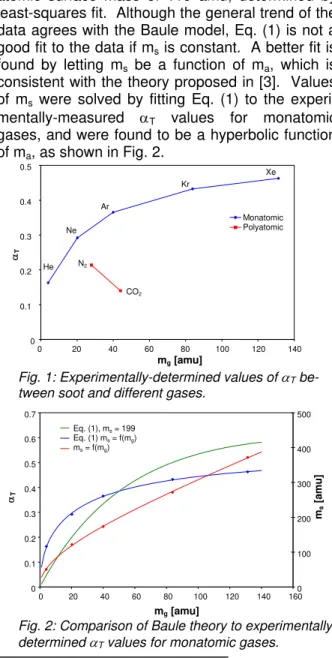
Values of αT between soot and different gases are plotted in Fig. 1. The accommodation coeffi-cient increases with increasing mg for monatomic
gases as predicted by Baule theory, but decreases for diatomic gases. Figure 2 shows the monatomic gas data plotted with Eq. (1) assuming an effective atomic surface mass of 119 amu, determined by least-squares fit. Although the general trend of the data agrees with the Baule model, Eq. (1) is not a good fit to the data if ms is constant. A better fit is found by letting ms be a function of ma, which is consistent with the theory proposed in [3]. Values of ms were solved by fitting Eq. (1) to the experi-mentally-measured αT values for monatomic gases, and were found to be a hyperbolic function of ma, as shown in Fig. 2.
Fig. 1: Experimentally-determined values of αT
be-tween soot and different gases.
Fig. 2: Comparison of Baule theory to experimentally determined αT values for monatomic gases.
[1] A. V. Eremin, E. V. Gurentsov, M. Hofmann, B. F. Kock, C. Schulz, App. Phys. B. 83, 449-454 (2006). [2] B. Baule, Ann. Physik, 44, 145-176 (1914).
[3] F. O. Goodman, Surf. Sci., 3, 386-414 (1965). [4] J. R. Burke, D. J., Hollenbach, Astrophysical J.
265, 223-234 (1983).
[5] D. R. Snelling, F. Liu, G. J. Smallwood, Ö. L. Gülder, Comb. and Flame, 136 180-190 (2004).