CLINICAL RESEARCH
Plastic Surgery After Gastric Bypass Improves Long-Term
Quality of Life
A. Modarressi&N. Balagué&O. Huber&M. Chilcott& B. Pittet-Cuénod
Published online: 25 August 2012
# Springer Science + Business Media, LLC 2012
Abstract
Background Excess skin after massive weight loss impairs patient’s health-related quality of life (HRQoL). Therefore, body-contouring surgeries can be proposed. However, few data exist concerning the effect of body contouring after bariatric surgery on HRQoL, including control group with a long-term follow-up.
Methods In a prospective study, 98 consecutive patients who had body contouring after gastric bypass for obesity (BMI > 40) were included (group A). A matched control-group containing 102 patients who had only gastric bypass was selected (group B). HRQoL was measured by Moore-head–Ardelt questionnaire before (group A1) and after (A2) body contouring, and at different time points for group B until 8 years post-gastric bypass. To evaluate the effect of body contouring by two parallel methods, HRQoL was compared between groups A1 and A2, and between A2 and B.
Results We found that body contouring procedures im-proved significantly patients’ HRQoL, in comparison to those who had only gastric bypass. Of the patients who had body contouring (group A2), 57 % evaluated their HRQoL“much better” in comparison to only 22 %
of patients before body contouring (group A1) or those who never had body contouring (group B) (p < 0.001). The improvement was significant in all sub-domains of HRQoL: self-esteem, social life, work ability, sexual activity and physical activity (p < 0.001), and remained stable over time.
Conclusions Our study confirms the important role of plastic surgery in treatment of patients after massive weight loss. We demonstrated that body contouring, despite important scars, significantly improves satisfac-tion and HRQoL of patients after gastric bypass. There-fore, the treatment of morbid obesity should not be deemed achieved unless plastic surgery has been considered.
Keywords Obesity . Plastic surgery . Quality of life . Body contouring surgery . Gastric bypass . Bariatric surgery
Introduction
Obesity carries several co-morbidities (e.g. cardiovascular diseases, diabetes, cancers) that conspire to double mortality [1]. Furthermore, most overweight patients suffer from health-related quality of life (HRQoL) impairments and other psychosocial distresses [2,3]. For these patients, the main purpose of therapy appears more to be the improve-ment of their physical image, self-esteem and quality of life rather than the search for weight loss and correction of related medical co-morbidities [4,5].
Regrettably, most medical treatments associating diet, physical exercise, eating behaviour modifications or drugs are ineffective in most cases for patients presenting a BMI more than 40 kg/m2 [6]. With a positive risk–benefit
bal-ance, bariatric surgery (from Greek baros, weight, and iatri-kos, being a part of the medicine) has become the treatment of choice of morbid obesity [7]. Among surgical options,
A. Modarressi (*)
:
N. Balagué:
B. Pittet-Cuénod Plastic, Reconstructive and Aesthetic Surgery Department, University Hospitals of Geneva,Rue Gabrielle-Perret-Gentil 4, 1211 Geneva 14, Switzerland e-mail: [email protected] O. Huber
General Surgery Department, University Hospitals of Geneva, 1211 Geneva 14, Switzerland
M. Chilcott
General Surgery Department, Hospital Riaz, 1632 Riaz Fribourg, Switzerland
Roux-en-Y gastric bypass (RYGBP) is presently consid-ered the gold standard [7–12]. In the last 15 years, these interventions have more than quintupled to reach more than 100,000 operations per year in the USA [13]. This procedure achieves the best weight loss and co-morbidity improvement [6,14] offering a 40 % decrease in mortality [15,16], with the lowest complication rate at short- and long-term follow-up. Bariatric surgery was shown to improve HRQoL too [3], but after massive surgical weight loss, up to 95.6 % of patients report residual morphology dissatisfaction associated with loose sagging skin [17]. This cutaneous excess invalidates the patients in daily life (e.g. mechanical limitation of physical activities, hygienic problems caused by intertrigo or macera-tion) and can induce, despite considerable weight loss, severe psychosocial problems because of a lack of self-confidence and a disturbed physical image [18]. More than two-thirds of patients who have undergone bariatric surgery consider their excess skin as a negative consequence of surgery [19]. They often mask their deformities by clothing and limit themselves to superficial social relations. Furthermore, the disappoint-ment is stronger if weight loss is massive [19]. The patients who have gained years of life expectation and have a new vision of life desire a corrected silhouette to fully regain self-esteem and to function normally in society.
This dissatisfaction motivates 74 % of patients to seek body contouring (BC) procedures after bariatric surgery, but only 21 % achieves at least one of them [17]. According to the American Society of Plastic Surgeons, BC concerned 52,603 patients in the USA in 2010.
The basic principle of all of these operations is to tighten the cutaneous tissue to reach a harmonious sil-houette and to eliminate physical or psychological hand-icap bound to the excess skin. It is thus essentially a functional surgery which is going to improve the sil-houette, but at the price of a scar.
Several publications have already demonstrated the cost-effectiveness of RYGBP for morbid obesity treat-ment and underlined patients’ HRQoL improvetreat-ment af-ter bariatric surgery [8–10]. With the explosion in the number of plastic surgery interventions after massive weight loss, it seems necessary to estimate its cost-effectiveness as well. Its relative costs have to be com-pared with its psychological, social and long-term func-tional results. Some outcome data following body contouring have been reported regarding HRQoL [20–22]; however, few data including control group and regarding long-term effect exist. The purpose of our study is to measure the contribution of BC on HRQoL after RYGBP by two parallel methods: firstly by comparing patients HRQoL before and after BC and secondly by comparing between a group of patients with BC after RYGBP and a control group with RYGBP alone.
Methods and Procedures Subjects
Two groups were sorted:
Group A (patients with RYGBP and BC): 98 consecutive patients (89.8 % females, mean age 42.6 [34–55 years]) who had BC procedures after RYGBP were included. All had been submitted to RYGBP for morbid obesity (BMI > 40) at least 18 months before plastic surgery, with stable body weight during the last 6 months.
Group B (patients with RYGBP only): for each patient from group A, a matched patient was randomly selected from a total of 538 patients with RYGBP alone. These patients without BC had either no demand for plastic surgery or did not undergo BC because health insurance did not cover the cost. Patients included in this group (102; 81.4 % females, mean age 38.6 [31–48 years]) were each matched to a patient in group A by decreas-ing order of criteria importance of pre- and post-RYGBP BMI, excess body weight loss (EBWL), age and gender. It has to be noted that four patients in group A had exactly the same selection criteria with two corresponding patients in group B. To reduce bias se-lection, both of them were included in this group, and group B therefore includes four supplementary patients. To evaluate the impact of BC on HRQoL in a consistent way and decrease the statistical bias, two parallel studies were designed. HRQoL was compared (a) prospectively in the same cohort of patients before (group A1) and at least 6 months after BC (group A2) and (b) between patients of group A2 and group B.
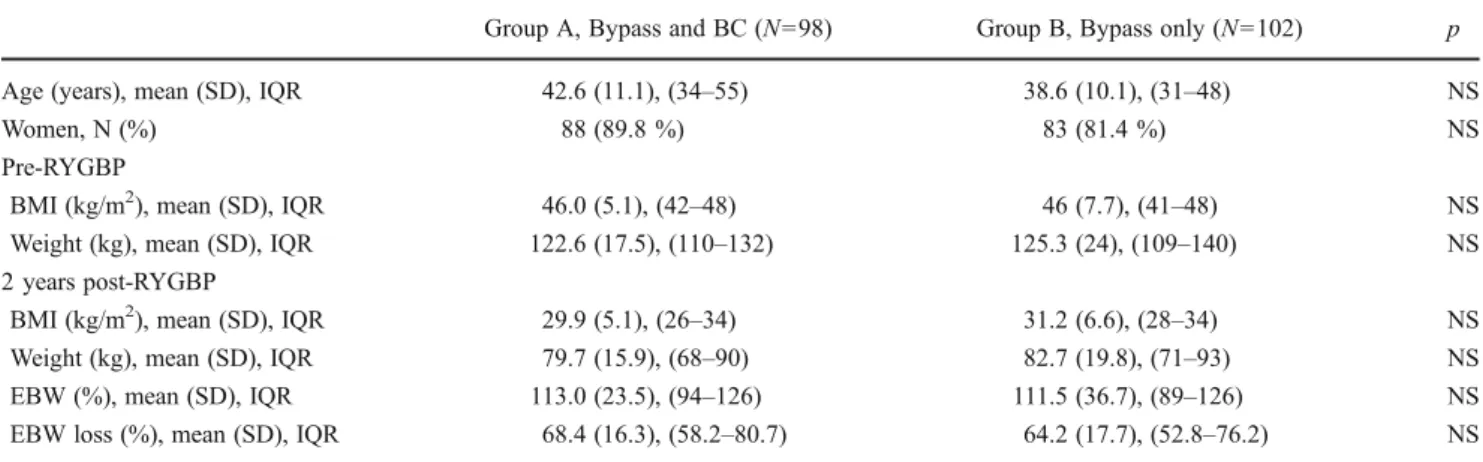
All subjects in the study originally presented BMI more than 40 kg/m2(mean BMI 46 kg/m2 [41–48]). After an initial EBWL of 68.4 % [58.2-80.7 %] with RYGBP in group A and 64.2 % [52.8-76.2 %] in group B the mean BMI was 29.9 [26– 34 kg/m2]) and 31.2 [28-34 kg/m2] resperctively, with non-significant differences between groups A and B up to 2 years post-RYGBP (p>0.05), the mean time point when BC was proposed. All other criteria (e.g. age, gender, follow-up time) were also comparable between groups A and B (Table1).
Experimental Design
Demographic, personal and weight data were prospectively collected for all patients. In group A, HRQoL was assessed during two interviews: before BC and at least 6 months (mean 26 months [18-84]) after BC. In group B, subjects were submitted to the HRQoL questionnaire only once, 18 months to 8 years post-RYGBP (mean 24 months [18– 96 months]). The study protocol was reviewed and ap-proved by the local Clinical Ethics Committee.
Surgical Procedures Bariatric Surgery
After multidisciplinary evaluation, a fully standardized RYGBP (gastric pouch≤ 30 ml, alimentary loop 150 cm, bilio-pancreatic loop 50 cm) was performed by the surgeons of our surgical department by laparotomy until 2001 and laparoscopically thereafter.
Plastic Surgery
BC was performed on group A patients only: 97 % abdom-inoplasties (with 47 % incisional hernia repair), 32 % mam-moplasties (51 % mastopexy alone, 33 % breast reduction and 16 % breast augmentation with or without breast lift), 19 % cruroplasties and 14 % brachioplasties; 45 % of the patients had a combined procedure in one or several opera-tion sessions.
Quality of Life Investigation
HRQoL was assessed at each time point by using the Moorehead–Ardelt [23] questionnaire, which is the HRQoL part of the “Bariatric Analysis and Reporting Outcome System”. This questionnaire was created to specifically evaluate the outcome of bariatric surgery, and it is widely used by national and international bariatric surgery associa-tions. It evaluates five domains of HRQoL: self-esteem, physical activity, social life, work ability and sexual activity. For each domain, patient evaluates“much better”, “better”, “same”, “worse” or “much worse” his status on the time that he answers to the questionnaire in comparison to his status before bariatric surgery. Results are summarized in a total score (−3.0 to +3.0) which is the sum of the self-esteem score (−1 to +1) and the four other domains (−0.5 to +0.5 for
each). Total score is estimated as “much better” (scores +2.25 to +3),“better” (+0.75 to +2), “same” (+0.5 to −0.5), “worse” (−0.75 to −2 points) and “much worse” (−2.25 to −3).
Statistical Analysis
Values are shown as the mean ± SD. Comparisons before and after, firstly RYGBP and secondly plastic surgery, were done by paired two-tailed Student’s t test to a significance level of 5 % (p<0.05).
Results
RYGBP Alone Improves HRQoL
The quality of life was evaluated as “better” by 65 % of patients and “much better” by 22 % after RYGBP alone (groups A1 and B) (Fig. 1). This improvement was essen-tially important for self-esteem (89 %) and physical activity (88 %). Social life and work ability were improved in 63 and 61 % of patients, respectively. Only 38 % of patients eval-uated their sexual activity as improved.
HRQoL Improvement Is Directly Related to EBWL Of patients who had more than 75 % EBWL, 97.8 % esti-mated that their quality of life improved (mean total score 1.84) (Fig.2). In comparison, among patients with 51–74 %
EBWL, HRQoL improved by 87.6 % as estimated (mean total score 1.47). The corresponding figures for the groups 26–50 % EBWL and<25 % EBWL were 72.7 and 50 %, respectively (mean total scores 1.1 and 1.0). The differ-ences between these four groups were statistically significant (p<0.01).
Table 1 Data of groups A and B: no significant difference between these two groups during the period pre-gastric bypass (RYGBP) to 2 years post-RYGBP when body contouring (BC) was proposed to patients in group A
Group A, Bypass and BC (N098) Group B, Bypass only (N0102) p Age (years), mean (SD), IQR 42.6 (11.1), (34–55) 38.6 (10.1), (31–48) NS
Women, N (%) 88 (89.8 %) 83 (81.4 %) NS
Pre-RYGBP
BMI (kg/m2), mean (SD), IQR 46.0 (5.1), (42–48) 46 (7.7), (41–48) NS Weight (kg), mean (SD), IQR 122.6 (17.5), (110–132) 125.3 (24), (109–140) NS 2 years post-RYGBP
BMI (kg/m2), mean (SD), IQR 29.9 (5.1), (26–34) 31.2 (6.6), (28–34) NS Weight (kg), mean (SD), IQR 79.7 (15.9), (68–90) 82.7 (19.8), (71–93) NS EBW (%), mean (SD), IQR 113.0 (23.5), (94–126) 111.5 (36.7), (89–126) NS EBW loss (%), mean (SD), IQR 68.4 (16.3), (58.2–80.7) 64.2 (17.7), (52.8–76.2) NS SD standard deviation, IQR interquartile range, NS non-significant (p>0.05), BMI body mass index, EBW excess of body weight
Plastic Surgery Further Improves HRQoL
After plastic surgery, in comparison to the scores achieved after RYGBP alone, the total score was significantly im-proved as in all domains of HRQoL (Fig.3, Table 2). In group A2, 98 % of patients estimated that their quality of life improved after BC (“much better” 58 %, “better” 40 %) in comparison to 85 % (group A1) before BC (“much better” 22 % and “better” 63 %) with a mean total score of 1.95 vs. 1.5 (p<0.001) (Table2, Fig.3).
This improvement was significant after BC in all domains of HRQoL comparing group A2 to A1: self-esteem (98 vs. 89 %, mean score 0.85 vs. 0.71, p<0.001), social life (87 vs. 62 %, mean score 0.3 vs. 0.2, p<0.001), work ability (76 vs. 66 %, mean score 0.24 vs. 0.19, p<0.001), physical activity (92 vs. 88 %, mean score 0.38 vs. 0.32, p<0.05) and sexual activity (65 vs. 43 %, mean score 0.18 vs. 0.07, p<0.001).
This HRQoL gain after BC was evident as well when comparing results of group A2 (RYGBP + BC) to those of group B (matched patients with RYGBP only) (Table2).
Discussion
The WHO defines quality of life as “the individuals’ per-ception of their position in life in the context of the culture and value systems in which they live and in relation to their goals, expectations, standards and concerns” [24]. It is a broad concept affected in a complex way by the person’s physical health, psychological state, level of independence, social relationships, personal beliefs and their relationship to salient features of their environment.
For bariatric-surgery-seeking patients, the quality of life is an important concern: Psychosocial impairment is the main motivation for bariatric surgery in 66 % of cases, in 0% 10% 20% 30% 40% 50% 60% 70% 80% 90% 100%
Total Self-esteem Physical activity Social life Work ability Sexual activity
Much better Better Same Worse Much worse
Fig. 1 Majority of patients estimate that their HRQoL improved in comparison to their pre-gastric bypass HRQoL, ex-cept for sexual activity domain. Data include patients of group A1 (before BC) and group B (without BC) (n0200). Total score is estimated as“much better” (scores +2.25 to +3), “better” (+0.75 to +2), “same” (+0.5 to−0.5), “worse” (−0.75 to−2 points) and “much worse” (−2.25 to −3) 0% 10% 20% 30% 40% 50% 60% 70% 80% 90% 100% <25 26-50 51-75 >75 EBW lost (%)
Much better Better Same Worse Much worse
* * * *
Fig. 2 HRQoL improvement is directly related to excess of body weight (EBW) lost. Data demonstrate total HRQoL of patient groups A1 and B (n0 200). Total score is estimated as “much better” (scores +2.25 to +3),“better” (+0.75 to +2), “same” (+0.5 to −0.5), “worse” (−0.75 to −2 points) and “much worse” (−2.25 to −3).*p<0.01
comparison to 10 % only for medical reasons [25]. And most of these psychosocial variables, including self-esteem and HRQoL, improve dramatically in the first years after bariatric surgery [26]. However, these parameters remain lower than those of the general population with the same weight but who were never obese. This could be explained partially by the excess skin resulting from massive surgical weight loss, which may be corrected by BC. Some previous publications of uncontrolled series, including small numbers of patients with short follow-up, have already suggested the benefits of BC on HRQoL [21,22,27,28]. Our study, with a rather longer follow-up comparing between pre- and post-BC and including a matched control group without post-BC, showed that (1) RYGBP improves HRQoL, (2) HRQoL improvement is directly related to weight loss, and (3) BC further improves HRQoL in comparison to RYGBP alone. Self-esteem Is Significantly Improved by Body-Contouring Surgery
Self-esteem is the most affected domain of quality of life in patients with BMI > 40 kg/m2, especially in women
between 35 to 64 years old [29]. This dissatisfaction moti-vates diverse behaviours, including weight loss, exercise and cosmetic surgery [22]. It could explain partially why women more frequently seek bariatric surgery, even if obe-sity is more prevalent in men. However, despite the clear improvement of self-esteem achieved after bariatric surgery, it remains still relatively low after the weight loss. This study shows that self-esteem is further corrected by the adjunction of plastic surgery to bariatric surgery: 85 % of patients after BC surgery estimate that their self-esteem was “much better”, versus only 48 % after bariatric surgery alone. Improvement of Physical Activity Implies Partially Improvement of Work Ability
Although physical activity is significantly improved by bariatric surgery and further by plastic surgery, the domain of work ability presented a lower improvement after weight loss, with minimal further effect by plastic surgery. This could be explained partially by the huge difficulties encoun-tered by these patients, often in disability for years before RYGBP, to find employment in a difficult job market.
0% 10% 20% 30% 40% 50% 60% 70% 80% 90% 100% Befo re A fte r Befo re A fte r Befo re A fte r Befo re A fte r Befo re A fte r Befo re A fte r
Total Self esteem Physical activity Social Life Work ability Sexual acitvity Much better Better Same Worse Much worse
*
**
**
**
**
**
Fig. 3 Body contouring improves significantly further the HRQoL total score and its different domains. Data demonstrate HRQoL of patients before (group A1) and after body-contouring surgery (group A2) (n098).*p<0.05;**p< 0.001
Table 2 Comparison of mean total score (range−3 to +3) and mean scores of health-related quality of life (HRQoL) sub-domains (self-esteem score−1 to +1, others −0.5 to +0.5) between groups
Total score Self-esteem Physical activity Social life Work ability Sexual activity
A1 1.5 0.71 0.32 0.2 0.19 0.07 A2 1.95 0.85 0.38 0.3 0.24 0.18 B 1.48 0.70 0.31 0.18 0.17 0.05 p A1 vs. A2 < 0.001 < 0.001 <0.05 < 0.001 < 0.001 < 0.001 p A2 vs. B < 0.001 < 0.01 <0.001 < 0.001 < 0.05 < 0.001 p A1 vs. B NS NS NS NS NS NS
Even with an Improved Social Life, Sexual Activity Is Only Partially Improved by Plastic Surgery
Despite a lower frequency of sexual relations than the general population (6.5 vs. 5.6 per month), most overweight patients declare themselves satisfied with their sexual life both before and after bariatric surgery. The margin of potential improve-ment is hence narrower than in the other domains of the HRQoL. This could explain that sexual activity is the only domain where the majority of patients (48 %) feel no change after RYGBP, and the improvement is only partial by BC. Some patients (11 %) declare themselves even less satisfied with their sexual life than before RYGBP, and the gain in sexual activity is only marginal after BC. One of the explana-tion could be that partners have some difficulty to adapt themselves to the new image of the other after weight loss [30]. We have demonstrated that social life is considerably im-proved after RYGBP and even more after BC. Hafner et al. had also concluded that after bariatric surgery, women con-sidered themselves more attractive and more sociable, but estimated that their husbands are less attractive than before. Symmetrically, the husbands considered their wives too so-ciable after surgery, in contrast to their pre-operative expecta-tion [31]. Furthermore, at least one study found a higher than anticipated divorce rate following bariatric surgery [32].
High Satisfaction of Body-Contouring Surgery Despite Important Scars
The vast majority of patients report satisfaction with their post-BC results. Nevertheless, it was reported that after breast reduction [22], for example, the most common reason for dissatisfaction was the scars. Interestingly, after BC which leaves numerous and visible scars, 84 % of our patients indicated that they would undergo BC surgery again.
BC should not be considered as part of the treatment for morbid obesity, but as a reconstructive surgery for sequels of massive weight loss. A perfect silhouette will never be achieved; therefore, patients have to be informed about esthet-ical outcomes, including unavoidable scars left by BC. As demonstrated by Warner et al., before bariatric surgery, only 54 % of bariatric surgeons inform patients about potential functional and morphologic consequences of massive weight loss, and minority of them refer patients thereafter to a plastic surgeons [33]. As proposed, plastic surgeons can provide writ-ten, electronic and video material that can be integrated to the multidisciplinary schedule that takes place before RYGBP.
We are still obviously in the early stages of the increase in body-contouring surgery following massive weight loss. Given the recognized importance of psychosocial factors in bariatric and plastic surgery separately, it is important to assess these issues in this new common area. The increasing interest of our health systems for cost-efficiency of treatments requires
outcome studies. In addition to morbidity and mortality analy-sis, the evaluation of HRQoL opens fascinating perspectives for the estimation of the benefits of surgery. It was shown that bariatric surgery is economically efficient [34,35], decreasing by 45 % the direct and indirect medical costs of operated morbidly obese patients in comparison to non-operated [30,
36]. This positive balance would be even more important if we were to take into consideration HRQoL improvement. Our study demonstrates clearly the benefit of the plastic surgery by a net improvement of HRQoL and a high rate of patient’s satisfaction. Further studies are needed to estimate the direct and indirect cost/benefit ratios of BC.
It has been demonstrated that 74–85 % of patients desire a BC after a bariatric surgery [17,39]. But as, in most cases, the BC is not covered by health insurances, majority of patients don’t achieve this procedure because they can’t afford it (54.7 %) or need a payment plan (28.5 %) [39]. In our study, only 32 % of patients underwent a BC proce-dure after RYGBP. In our country, health insurances do not cover BC as long as the excess skin does not achieve “a value of somatic or psychic disease”. According to the definition of the WHO, any perceived limitation of HRQoL has to be considered as a disease. As it is able to normalize HRQoL scores, BC after RYGBP should be considered as an effective therapy and reimbursed by the health system.
Even if this was a prospective matched group, there is a statistical bias limitation. It can be supposed that some patients in group B were looking for BC. But they did not undergo the procedure because they were turned down by plastic surgeons for some reasons (e.g. weight instability, lack of motivation, body dysmorphia) or because BC was not covered by health insurance. This refusal could have a negative impact on patients self-esteem and therefore on their HRQoL. However, as demonstrated, the HRQoL of patients before BC (group A1) was similar to those of group B (Table2).
We demonstrated that BC has a contributive role to help achieve the main goal of patients who seek bariatric surgery: quality of life improvement. According to Kalarchian et al., any interventions improving psychosocial functioning could also strengthen the weight loss [37]. Considering that plastic surgery improves psychosocial status, it could also encourage patients to keep their weight stable over years and prevent the 10–15 % of weight gain observed in the long-term follow-up after bariatric surgery [38]. To demonstrate, in an irrefutable way, this positive effect of plastic surgery on the long-term weight, more specific studies are necessary.
Conclusion
With increasing number of bariatric surgeries reflecting increasing prevalence of morbid obesity, candidates for BC are certainly going to increase massively too.
Excess skin after massive weight loss is evidently extremely annoying in daily life. In our knowledge, this is the first group-matched study with a long-term follow-up, demonstrating that BC, in spite of important scars, significantly improves the satisfaction and HRQoL after massive surgical weight loss.
Excellent centres of bariatric surgery should already in-clude plastic surgeons during the pre-operative visits in their multidisciplinary team to evoke, firstly, the possible cutane-ous excess after a massive weight loss and, secondly, to discuss possibilities of its corrections by BC.
Indeed, the treatment of the morbid obesity should not be considered achieved as long as the plastic surgery is not finished. We hope that our results will be used as an argu-ment in favour of BC and its coverage by health insurances.
Acknowledgments The authors would like to thank Mr. Christophe Combescure (Biostatician from the Epidemiology Department) for his contribution to the statistical analysis and Mrs. Pascale Koutny-Fong for database management.
Disclosure Statement The authors declare that they have no conflict of interest for this paper.
References
1. Berrington de Gonzalez A, et al. Body-mass index and mortality among 1.46 million white adults. N Engl J Med. 2010;363 (23):2211–9.
2. Allison DB, Saunders SE. Obesity in North America. An over-view. Med Clin N Am. 2000;84(2):305–32. v.
3. Sarwer DB, Wadden TA, Fabricatore AN. Psychosocial and behav-ioral aspects of bariatric surgery. Obes Res. 2005;13(4):639–48. 4. Kushner RF, Foster GD. Obesity and quality of life. Nutrition.
2000;16(10):947–52.
5. Di Gregorio JM, Palkoner R. Quality of life after obesity surgery, an evidence-based medicine literature review: how to improve systematic searches for enhanced decision-making and clinical outcomes. Obes Surg. 2001;11(3):318–26.
6. Buchwald H, et al. Bariatric surgery: a systematic review and meta-analysis. Jama. 2004;292(14):1724–37.
7. Maggard MA, et al. Meta-analysis: surgical treatment of obesity. Ann Intern Med. 2005;142(7):547–59.
8. Dymek MP, et al. Quality of life after gastric bypass surgery: a cross-sectional study. Obes Res. 2002;10(11):1135–42.
9. van Gemert WG, et al. Psychological functioning of morbidly obese patients after surgical treatment. Int J Obes Relat Metab Disord. 1998;22(5):393–8.
10. Hell E, et al. Evaluation of health status and quality of life after bariatric surgery: comparison of standard Roux-en-Y gastric by-pass, vertical banded gastroplasty and laparoscopic adjustable sil-icone gastric banding. Obes Surg. 2000;10(3):214–9.
11. Livingston EH. Procedure incidence and in-hospital complication rates of bariatric surgery in the United States. Am J Surg. 2004;188 (2):105–10.
12. Tice JA, et al. Gastric banding or bypass? a systematic review comparing the two most popular bariatric procedures. Am J Med. 2008;121(10):885–93.
13. Encinosa WE, et al. Use and costs of bariatric surgery and pre-scription weight-loss medications. Health Aff (Millwood). 2005;24 (4):1039–46.
14. Lee WJ, et al. Effects of obesity surgery on the metabolic syn-drome. Arch Surg. 2004;139(10):1088–92.
15. Adams TD, et al. Long-term mortality after gastric bypass surgery. N Engl J Med. 2007;357(8):753–61.
16. Sjostrom L, et al. Effects of bariatric surgery on mortality in Swedish obese subjects. N Engl J Med. 2007;357(8):741– 52.
17. Kitzinger HB, et al. The prevalence of body contouring surgery after gastric bypass surgery. Obes Surg. 2011.
18. Knol JA. Management of the problem patient after bariatric sur-gery. Gastroenterol Clin N Am. 1994;23(2):345–69.
19. Kinzl JF, et al. Psychosocial consequences of weight loss following gastric banding for morbid obesity. Obes Surg. 2003;13(1):105–10.
20. Adami GF, et al. Body image in obese patients before and after stable weight reduction following bariatric surgery. J Psychosom Res. 1999;46(3):275–81.
21. Song AY, et al. Body image and quality of life in post massive weight loss body contouring patients. Obesity (Silver Spring). 2006;14(9):1626–36.
22. Sarwer DB, et al. Psychological considerations of the bariatric surgery patient undergoing body contouring surgery. Plast Reconstr Surg. 2008;121(6):423e–34e.
23. Oria HE, Moorehead MK. Bariatric analysis and reporting out-come system (BAROS). Obes Surg. 1998;8(5):487–99.
24. The WHOQOL Group. World Health Organization Quality of Life Assessment. What quality of life? World Health Forum. 1996;17 (4):354–6.
25. Peace K, et al. Psychobiological effects of gastric restriction surgery for morbid obesity. N Z Med J. 1989;102(862):76–8. 26. Sarwer DB, Fabricatore AN. Psychiatric considerations of the massive weight loss patient. Clin Plast Surg. 2008;35 (1):1–10.
27. Cintra Jr W, et al. Quality of life after abdominoplasty in women after bariatric surgery. Obes Surg. 2008;18(6):728–32.
28. Menderes A, et al. Dermalipectomy for body contouring after bariatric surgery in Aegean region of Turkey. Obes Surg. 2003;13(4):637–41.
29. Larsson U, Karlsson J, Sullivan M. Impact of overweight and obesity on health-related quality of life—a Swedish population study. Int J Obes Relat Metab Disord. 2002;26(3):417–24. 30. Herpertz S, et al. Does obesity surgery improve psychosocial
functioning? a systematic review. Int J Obes Relat Metab Disord. 2003;27(11):1300–14.
31. Hafner RJ, Watts JM, Rogers J. Quality of life after gastric bypass for morbid obesity. Int J Obes. 1991;15(8):555–60.
32. Rand CS, Kuldau JM, Robbins L. Surgery for obesity and marriage quality. Jama. 1982;247(10):1419–22.
33. Warner JP, et al. National bariatric surgery and massive weight loss body contouring survey. Plast Reconstr Surg. 2009;124(3):926–33.
34. Fang J. The cost-effectiveness of bariatric surgery. Am J Gastroenterol. 2003;98(9):2097–8.
35. Craig BM, Tseng DS. Cost-effectiveness of gastric bypass for severe obesity. Am J Med. 2002;113(6):491–8.
36. Christou NV, et al. Surgery decreases long-term mortality, morbidity, and health care use in morbidly obese patients. Ann Surg. 2004;240(3):416–23. discussion 423–4.
37. Kalarchian MA, et al. Psychiatric disorders among bariatric sur-gery candidates: relationship to obesity and functional health sta-tus. Am J Psychiatry. 2007;164(2):328–34. quiz 374.
38. Sjostrom L, et al. Lifestyle, diabetes, and cardiovascular risk factors 10 years after bariatric surgery. N Engl J Med. 2004;351(26):2683–93. 39. Gusenoff JA, et al. Temporal and demographic factors influencing the desire for plastic surgery after gastric bypass surgery. Plast Reconstr Surg. 2008;121(6):2120–6.