ORIGINAL PAPER
Acceptance of two liquid vitamin D
3
formulations
among mothers with newborn infants: a randomized,
single-blind trial
Sebastiano A. G. Lava&Giorgio Caccia&
Silvia Osmetti-Gianini&Giacomo D. Simonetti&
Gregorio P. Milani&Mattia Falesi&Mario G. Bianchetti
Received: 13 March 2011 / Revised: 5 April 2011 / Accepted: 8 April 2011 / Published online: 27 April 2011 # Springer-Verlag 2011
Abstract In Switzerland, children are prescribed 7.5– 12.5 μg per day of vitamin D3 dissolved in alcohol, but many families do not adhere to the recommendation. The aim of the trial was to compare the acceptance of vitamin D3 dissolved in alcohol or in medium-chain triglycerides among mothers of Swiss newborn infants. The acceptance was tested in 42 healthy newborn infants (20 girls and 22 boys) aged between 2 and 7 days. Their neonatal body weight ranged between 2.225 and 4.150 kg, and the gestational age between 36 1/7 and 41 3/7 weeks. The blinded mothers rated the facial reaction of their children by pointing on a facial hedonic scale. Thirty eight of the 41 mothers, who brought the comparison to completion,
assigned a better score to the oily preparation with no difference in the remaining three cases (P<0.0001). The acceptance for the oily preparation was significantly better both among mothers whose babies were initially presented the alcoholic preparation and among mothers whose babies were initially presented the oily preparation. Furthermore, the acceptance for the oily preparation was better irrespec-tive of gender of the infant or parity of the mother. In conclusion, from the perspective of mothers, Swiss new-born infants prefer the taste of the oily vitamin D3 preparation over the alcoholic preparation.
Keywords Newborn . Palatability . Preference . Vitamin D
Introduction
Vitamin D deficiency rickets is an ancient disease, which was thought to have been cured in the early twentieth century [14]. However, despite the availability of vitamin D and demonstration of its usefulness in preventing rickets, vitamin D deficiency rickets still exists as a major health problem with significant morbidity in developing countries all over the world including Africa and South America, and has been reported with increasing prevalence in minority groups in North America and in immigrant populations in Australia, New Zealand, and Europe [14]. In many countries, there are reports of a high prevalence of subclinical vitamin D deficiency in childhood [8].
In addition to rickets and other possible consequences of disturbed calcium homeostasis, vitamin D deficiency in infancy and early childhood might increase the incidence of diabetes mellitus and the risk of tuberculosis, pneumonia, influenza, and other respiratory tract infections [1, 8, 16].
S. A. G. Lava
:
S. Osmetti-Gianini:
G. P. Milani:
M. Falesi:
M. G. BianchettiDivision of Pediatrics, Bellinzona and Mendrisio and University of Bern,
Bern, Switzerland G. Caccia
Division of Obstetrics and Gynecology, Mendrisio, Switzerland
G. D. Simonetti Pediatric Nephrology,
University Children’s Hospital Bern and University of Bern, Bern, Switzerland
M. G. Bianchetti (*) San Giovanni Hospital, 6500 Bellinzona, Switzerland
e-mail: [email protected] Present Address:
G. P. Milani
Emergency Unit, Clinica Pediatrica De Marchi, Foundation IRCCS Ca’ Granda Ospedale Maggiore Policlinico, Milan, Italy
Eur J Pediatr (2011) 170:1559–1562 DOI 10.1007/s00431-011-1477-7
Finally, vitamin D deficiency predisposes to further disease states including multiple sclerosis, systemic lupus eryth-ematosus, rheumatoid arthritis, and perhaps some forms of cancer [1,8].
In the USA, to prevent vitamin D deficiency, it is currently recommended that all children receive 10.0μg1 per day of vitamin D from their first days of life through adolescence [18]. In Switzerland, children receive 7.5 to 12.5 μg of vitamin D3 in an alcoholic solution beginning during the first month of life [11]. Unfortunately, in Switzerland, approximately 50% of the families do not adhere to the recommendation, either because they consider unsatisfactory the palatability of the alcoholic vitamin D3 preparation or because they oppose “alcoholic drugs” for socio-cultural reasons [3,7,13].
The purpose of the present study with healthy newborn infants and their mothers was to compare the acceptance of the standard alcoholic vitamin D3preparation with that of a new preparation that contains vitamin D3 dissolved in medium-chain triglycerides.
Subjects and methods
The single-blind test was performed with 42 Swiss singleton newborn infants with gestational age of 360/7weeks or more and neonatal body weight of 2.000 kg or more and their mothers. None of them had been previously exposed to a vitamin D3preparation. The infants were recruited and tested immediately before discharge from the well baby nursery, Ospedale della Beata Vergine, Mendrisio (Switzerland), from 1 March through to 30 April 2010.
Gestational age was assessed from the mother's last menstrual period, unless the mother's dates were in doubt, when gestational age was assigned postnatally using the New Ballard Score [2]. The body weight was considered appropriate for gestational age in newborn infants with a birth weight between the 10th and the 90th percentiles according to the birth weight-for-gestational age charts. An umbilical cord artery pH of 7.15 or more and a neonatal Apgar sum score of 7 or more at 1 and 5 min were used to indicate a newborn infant in good condition.
The study design had been approved by the Institutional Review Board, and informed consent was obtained from the mothers of the infants. Acceptance was determined by the single administration of two liquid cholecalciferol formulations commercialized by Wild AG, Basel, Switzer-land: (a) one drop of the standard preparation Vi-De3® (“alcoholic vitamin D3”), which contains vitamin D3 dissolved in 65% ethanol (113 μg/mL, corresponding to
2.5 μg per drop) and (b) one drop of Vitamin D3 Wild® (“oily vitamin D3”), which is available since 2009 and contains vitamin D3 dissolved in medium-chain triglycer-ides (500μg/mL, corresponding to 12.5 μg per drop). After the mother gave informed consent, the interviewer took the enrolled newborn baby and the mother to the test area. Each study consisted of a session lasting approximately 5– 10 min. The acceptance was determined by a single-blind taste test of one drop of both the alcoholic and the oily vitamin D3 formulations. Immediately thereafter, the blinded mother was asked to rate the hedonic facial reaction of the infant by pointing on a scale that depicts 4 degrees of pleasure: 4=“good,” 3=“not sure,” 2=“bad,” 1=“really bad” [6, 9]. Between the tasting of the two formulations, the baby received some milk to rinse its mouth (the time between the tasting of the two formulations was at least 3 min).
An independent statistician had generated a randomiza-tion list to balance the order of presentarandomiza-tion of the preparations so that each preparation was tasted first an equal number of times and prepared 42 sequentially numbered, opaque sealed envelopes containing the assign-ment. The envelopes were opened in sequence after accompanying the infant with the mother to the test area.
Since a sample size of 20 is considered appropriate for this type of study [6], we performed ad abundantiam the test in 42 newborns and their mothers. The scores from the hedonic scales were analyzed using the Wilcoxon matched paired signed rank test. Significance was assumed when P<0.05 (two tailed).
Results
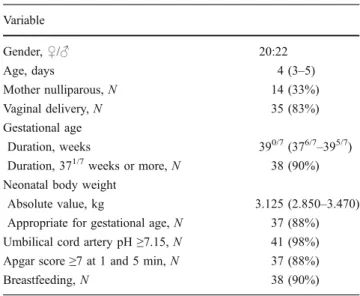
The 42 Caucasian mothers recruited for the comparison had born 20 girls and 22 boys with a neonatal body weight ranging between 2.225 and 4.150 kg and a gestational age ranging between 361/7 and 413/7 weeks (Table 1). Eighty-three percent of the infants had been delivered vaginally, and the neonatal body weight was appropriate for gesta-tional age in 88% of them. The umbilical cord artery pH and the neonatal Apgar sum score failed to detect perinatal or neonatal alarm indicators in 98% and 88% of them, respectively.
The 42 children were between 2 and 7 days of age when the acceptance test was performed. The secundi-parous mother of a vaginally born, breastfed boy with a neonatal body weight of 2.845 kg and a gestational age of 375/7 weeks initially offered the alcoholic vitamin D3 preparation was not able to rate the facial reaction of her baby. Thirty eight of the 41 mothers, who brought the comparison to completion, assigned a better facial score to the oily vitamin D3 preparation, with no difference
1
Multiply the number of micrograms by 40 to convert micrograms to international units.
between the two preparations in the remaining three cases. From the perspective of the mothers, none of the infants preferred the alcoholic preparation. The difference be-tween the two preparations was highly significant (P< 0.0001, Fig.1). Moreover, the mothers never evaluated the alcoholic vitamin D3preparation as“good” or “not sure.” The test preference was similar among 20 mothers whose babies were initially presented the alcoholic vitamin
D3preparation (better score for oily vitamin D3, N=18; no difference, N=2; P<0.0002) and among 21 mothers whose babies were initially presented the oily vitamin D3 preparation (better score for oily vitamin D3, N=20; no difference, N=1; P<0.0001). Furthermore, the acceptance for the oily vitamin D3preparation was significantly higher both among mothers of 21 boys (better score for oily vitamin D3, N=20; no difference, N=1; P<0.0001) and among mothers of 20 girls (better score for oily vitamin D3, N = 18; no difference, N = 2; P < 0.0002). Finally, the acceptance for the oily vitamin D3 preparation was significantly better both among 14 nulliparous (better score for oily vitamin D3, N=13; no difference, N=1; P<0.0002) and among 27 non-nulliparous (better score for oily vitamin D3, N=25; no difference, N=2; P<0.0001) mothers.
Discussion
The present study tested the acceptance of two liquid preparations that contain vitamin D3 dissolved either in alcohol or in medium-chain triglycerides among mothers of healthy newborn infants. The results demonstrate that the acceptance for the oily vitamin D3 preparation is signifi-cantly superior to that of the alcoholic preparation.
In this trial, the acceptance of the two vitamin D3 formulations among mothers of newborn infants was assessed with 2.5μg of alcoholic and 12.5 μg of oily vitamin D3. The use of identical doses, obviously a situation closer to reality, might have further advantaged the oily preparation.
Facial hedonic scales have achieved a large popularity to determine the degree of liking for foods and beverages [4, 5, 12]. Three- to 5-point facial hedonic scales like those used in the present trial have been widely used to evaluate the acceptance for drug suspensions and for crushed drugs with children 4 years or more of age [6]. The scales were also used to assess the taste of liquid drugs in newborns and small infants [6, 9]. Like in other trials performed with children 3 years or less of age, in the present study, infant facial reactions following drug administration were inter-preted by the parents to score acceptance [6,9].
The major limitation of the study resides in the fact that facial hedonic scales, albeit frequently used and very popular, still are unvalidated tools for assessing acceptance of drug formulation or measuring pain among newborn infants [6,17].
The clear-cut preference for oily vitamin D3observed in the present trial might be related to the burning sensation in the throat that is caused by 65% ethanol [9]. This has generated the impression that alcohol has a strong taste [3]. The poor palatability of alcoholic vitamin D3 is not associated with some toxic potential. As a matter of fact, the daily dose of this preparation contains an insignificant amount of ethanol.
11 1 2 15
26
3
4
3
2
1
Alcoholic Vitamin D3 Oily Vitamin D327
2
0
0
2 814
210
Fig. 1 Acceptance of alcoholic vitamin D3 and oily vitamin D3 among mothers of 41 Caucasian newborn infants (20 girls and 21 boys), who brought the trial to completion. The difference between the two preparations was highly significant (P<0.0001). The reaction of the child was rated using a facial hedonic scale depicting the following degrees of pleasure: 4=“good,” 3=“not sure,” 2=“bad,” 1=“really bad.” The figure indicates among others that 27 mothers graded oily vitamin D3as“really bad” and 10 graded oily vitamin D3as“good” Table 1 Characteristics of 42 Caucasian newborn infants recruited for the present study
Variable Gender,♀/♂ 20:22 Age, days 4 (3–5) Mother nulliparous, N 14 (33%) Vaginal delivery, N 35 (83%) Gestational age Duration, weeks 390/7(376/7–395/7) Duration, 371/7weeks or more, N 38 (90%) Neonatal body weight
Absolute value, kg 3.125 (2.850–3.470) Appropriate for gestational age, N 37 (88%) Umbilical cord artery pH≥7.15, N 41 (98%) Apgar score≥7 at 1 and 5 min, N 37 (88%)
Breastfeeding, N 38 (90%)
The results are given either as median with interquartile range, which includes half of the data points, or as relative frequency with percentage
Nonetheless, unfounded concerns related to the alcohol content of vitamin D preparations are not rare [3].
Most Swiss infants are currently prescribed either 10.0 μg per day of vitamin D3, i.e., four drops of the standard alcoholic preparation, or 12.5μg per day, i.e., one drop of the new oily preparation. In some cases, switching from the standard alcoholic to the new alcoholic prepara-tion resulted in an excessive intake of 50.0μg per day of vitamin D3[15].
The results of the present report are supported by those of a study which indicates that in newborn infants the acceptance for vitamin D3 dissolved in peanut oil is superior to that of vitamin D3 dissolved in ethanol [9]. Since the prevalence of peanut allergy is increasing in recent years, some authorities currently recommend not to introduce peanuts for the first 6 months of life [10]. This advice is based on the findings of studies which suggest that exposure to peanuts in early life may increase the risk of peanut allergy [10].
Conclusion
Appreciating the preference for drug preparations in childhood is of great value [6]. This small trial indicates that from the perspective of mothers of Swiss newborn infants, the taste of oily vitamin D3is significantly better than that of alcoholic vitamin D3.
Financial disclosure No financial support was provided to the study.
References
1. Baeke F, Gysemans C, Korf H, Mathieu C (2010) Vitamin D insufficiency: implications for the immune system. Pediatr Nephrol 25:1597–1606
2. Ballard JL, Khoury JC, Wedig K, Wang L, Eilers-Walsman BL, Lipp R (1991) New Ballard Score, expanded to include extremely premature infants. J Pediatr 119:417–423
3. Bartoli F, Martínez JM, Ferrarini A, Recaldini E, Bianchetti MG (2006) Poor adherence to the prophylactic use of vitamin D3in Switzerland. J Pediatr Endocrinol Metab 19:281–282
4. Birch LL (1999) Development of food preferences. Annu Rev Nutr 19:41–62
5. Chen AW, Resurrecion AVA, Paguio LP (1996) Age appropriate hedonic scales to measure food preferences of young children. J Sens Stud 11:141–163
6. Davies EH, Tuleu C (2008) Medicines for children: a matter of taste. J Pediatr 153:599–604
7. Dratva J, Merten S, Ackermann-Liebrich U (2006) Vitamin D supplementation in Swiss infants. Swiss Med Wkly 136:473–481 8. Holick MF (2008) The vitamin D deficiency pandemic and consequences for nonskeletal health: mechanisms of action. Mol Aspects Med 29:361–368
9. Martínez JM, Bartoli F, Recaldini E, Lavanchy L, Bianchetti MG (2006) A taste comparison of two different liquid colecalciferol (vitamin D3) preparations in healthy newborns and infants. Clin Drug Investig 26:663–665
10. McLean S, Sheikh A (2010) Does avoidance of peanuts in early life reduce the risk of peanut allergy? BMJ 340:593–594 11. Paunier L (1991) Prevention of rickets. Nestlé Nutr Workshop Ser
Pediatr Program 21:263–272
12. Peyram DR, Pilgrim FJ (1957) Hedonic scales method of measuring food preferences. Food Technol 11:9–14
13. Pronzini F, Bartoli F, Vanoni F, Corigliano T, Ragazzi M, Balice P, Bianchetti MG (2008) Palatability of vitamin D3 preparations modulates adherence to the supplementation in infancy. Clin Pediatr Endocrinol 17:57–60
14. Rajakumar K, Thomas SB (2005) Reemerging nutritional rickets: a historical perspective. Arch Pediatr Adolesc Med 159:335–341 15. Rauber-Luthy C, Reichert C, Kupferschmidt H (2010) Vitamin-D3-Überdosierungen bei Kleinkindern. Schweiz Ärzteztg 91:1178–1179
16. Rosen CJ (2011) Clinical practice. Vitamin D insufficiency. N Engl J Med 364:248–254
17. Slater R, Cornelissen L, Fabrizi L, Patten D, Yoxen J, Worley A, Boyd S, Meek J, Fitzgerald M (2010) Oral sucrose as an analgesic drug for procedural pain in newborn infants: a randomised controlled trial. Lancet 376:1225–1232
18. Wagner CL, Greer FR, Academy A, American Academy of Pediatrics, Section on Breastfeeding and Committee on Nutrition (2008) Prevention of rickets and vitamin D deficiency in infants, children, and adolescents. Pediatrics 122:1142–1152