HAL Id: hal-00296466
https://hal.archives-ouvertes.fr/hal-00296466
Submitted on 28 Feb 2008
HAL is a multi-disciplinary open access
archive for the deposit and dissemination of
sci-entific research documents, whether they are
pub-lished or not. The documents may come from
teaching and research institutions in France or
abroad, or from public or private research centers.
L’archive ouverte pluridisciplinaire HAL, est
destinée au dépôt et à la diffusion de documents
scientifiques de niveau recherche, publiés ou non,
émanant des établissements d’enseignement et de
recherche français ou étrangers, des laboratoires
publics ou privés.
a large metropolitan area
J. F. Mejía, L. Morawska, K. Mengersen
To cite this version:
J. F. Mejía, L. Morawska, K. Mengersen. Spatial variation in particle number size distributions in a
large metropolitan area. Atmospheric Chemistry and Physics, European Geosciences Union, 2008, 8
(5), pp.1127-1138. �hal-00296466�
www.atmos-chem-phys.net/8/1127/2008/ © Author(s) 2008. This work is distributed under the Creative Commons Attribution 3.0 License.
Chemistry
and Physics
Spatial variation in particle number size distributions in a large
metropolitan area
J. F. Mej´ıa1, L. Morawska1, and K. Mengersen2
1International Laboratory of Air Quality and Health, Queensland University of Technology, GPO Box 2434, Brisbane, Qld
4001, Australia
2School of Mathematical Sciences, Queensland University of Technology, GPO Box 2434, Brisbane, QLD, 4001, Australia
Received: 30 August 2007 – Published in Atmos. Chem. Phys. Discuss.: 26 November 2007 Revised: 25 January 2008 – Accepted: 28 January 2008 – Published: 28 February 2008
Abstract. Air quality studies have indicated that particle number size distribution (NSD) is unevenly spread in urban air. To date, these studies have focussed on differences in concentration levels between sampling locations rather than differences in the underlying geometries of the distributions. As a result, the existing information on the spatial variation of the NSD in urban areas remains incomplete. To investi-gate this variation in a large metropolitan area in the south-ern hemisphere, NSD data collected at nine different loca-tions during different campaigns of varying duration were compared using statistical methods. The spectra were anal-ysed in terms of their modal structures (the graphical repre-sentation of the number size distribution function), cumula-tive distribution and number median diameter (NMD). The study found that with the exception of one site all distri-butions were bimodal or suggestive of bimodality. In gen-eral, peak concentrations were below 30 nm and NMDs be-low 50 nm, except at a site dominated by diesel trucks, where it shifted to around 50 and 60 nm respectively. Ultrafine par-ticles (UFPs (<100 nm)) contributed to 82–90% of the parti-cle number, nanopartiparti-cles (<50 nm) to around 60–70%, ex-cept at the diesel traffic site, where their contribution dropped to 50%. Statistical analyses found that the modal structures heterogeneously distributed throughout Brisbane whereas it was not always the case for the NMD. The discussion led to the following site classification: (1) urban sites dominated by petrol traffic, (2) urban sites affected by the proximity to the road and (3) an isolated site dominated by diesel traffic. Comparisons of weekday and weekend data indicated that, the distributions were not statistically different. The only exception occurred at one site, where there is a significant drop in the number of diesel buses on the weekend. The
dif-Correspondence to: L. Morawska
ferences in sampling period between sites did not affect the results. The statistics instead suggested variations in traffic composition. However, the relative contribution of petrol ve-hicle emissions at each site could not be assessed due to the limited traffic information available.
1 Introduction
Evidence from medical studies indicates that air pollution is a major contributor to cardiovascular and respiratory health problems (e.g. Hong et al., 2002). Until recently, these stud-ies focussed on the particle mass, which is dominated by the coarse (2.5–10.0 µm) and fine (<2.5 µm) size fractions. Whilst the toxicological importance of these particles cannot be dismissed, it has been suggested that the observed effects could be better explained by the number of the ultrafine frac-tion (<100 nm) rather than the mass of the larger particles (Seaton et al., 1995). In urban air, ultrafine particles (UFPs) dominate the particle number size distribution whereas their contribution to the particle mass is negligible (Morawska et al., 1998a, b; Jaenicke, 1993). Therefore, particle number has become the most widely employed parameter for mea-suring UFP concentration.
Although they are yet to be incorporated into long-term air quality monitoring systems, since the 1990s submicrometre (<1.0 µm) and UFP number concentrations have been mea-sured in several cities around the world. Typical urban con-centrations range in the order of 103-105cm−3(e.g. Buzorius et al., 1999) with the UFPs accounting for >80% of the to-tal particle number (Morawska et al., 1998a, b; Shi et al., 2001). There is wide agreement that vehicles are the princi-pal source of UFPs in urban areas. This has been shown by the strong associations of particle number with vehicle ex-haust gases (Morawska et al., 1998b; W˚ahlin et al., 2001),
variations in particle number consistent with daily patterns of traffic (Harrison et al., 1999) and wind direction (see also Morawska et al., 2002), and higher number concentrations when the wind blows from the road (Hitchins et al., 2000), in areas of higher traffic density (Hussein et al., 2005; Harri-son et al., 1999) and during the week, when traffic levels are higher (Morawska et al., 2002).
Particle size is determined by the particle generation pro-cess and in turn it influences particle behaviour and other important chemical and physical properties. Therefore, the analysis of particle size distribution can be useful in the in-terpretation of the properties of the distribution. Different descriptors of the particle number size distribution (NSD) have been used to characterize the source signatures of differ-ent types of emissions, for instance petrol (Morawska et al., 1998b) and diesel exhaust (Morawska et al., 1998a; CON-CAWE, 2001; Virtanen et al., 2004) and the NSD spectra from different environments (e.g. Morawska et al., 1999b; Flocas et al., 2006).
Urban ambient air quality investigations have found varia-tions in the NSD spectra obtained from different locavaria-tions in the same city (e.g. Hussein et al., 2004, 2005; Salma et al., 2002) but these studies have focussed on the differences in concentration levels rather than the underlying geometries of the distributions. Therefore the existing information on the spatial variation of the NSD in urban areas remains incom-plete.
The present investigation aims to analyse the spatial vari-ation of the NSD spectra in a large city in the southern hemisphere, using data collected at nine different locations, and test the hypothesis that the spectra is evenly distributed throughout the area. The objective was to compare the aver-age spectra using different descriptive size distributions pa-rameters, and to evaluate the relative contribution of UFPs and nanoparticles (<50 nm) to the local airborne particle number.
2 Methodology of the investigation
2.1 The city of Brisbane
Brisbane is the capital of the state of Queensland, Australia, and is located in the southeast coast of the state. It has a population of about 1.8 million people, making it the third largest city in the country and the first in terms of population growth. The city straddles the Brisbane River, and is located in a low-lying floodplain, although the area is dotted by large hills reaching up to 300 m.
Brisbane’s climate is the sub-tropical humid type (Bureau of Meteorology, 1983). The warm season takes place be-tween November and April, and is characterized by high
rel-ative humidity, strong winds with average of 11–21 km h−1
and frequent rain. The cool half of the year (May–October)
is dry (0–50% relative humidity) with very low wind speeds thus increasing the persistence time of air pollutants.
The rapid population growth and consequently increasing number of vehicles on the road pose a serious challenge to the air quality of the city. In a recent five-year study in the cen-tral business district (CBD) of Brisbane (Mejia et al., 2007), we found that although particle number concentration lev-els compared favourably with other cities around the world, emissions from a nearby freeway resulted in increased total and ultrafine particle concentrations by 105.3% and 81.5% respectively whereas non-freeway emissions remained un-changed. These conclusions were based on the available data and their associations with the daily local pattern of wind di-rection.
Hazard-reduction burning, practiced during the cold sea-son in the outer agricultural and forest areas, is another important contributor to the particle number in the region. On these occasions, the city may be covered in smoke car-ried through the drainage flows. Commercial and industrial sources include a major airport and a seaport, oil refineries, a power station, and a number of manufacturing industries in the outer suburbs.
2.2 Description of the instrumentation
A TSI model 3394 SMPS was used to measured NSD data in the range 15–700 nm. Details of the operation and calibration of the instrument have been provided in previous publica-tions (e.g. Hitchins et al., 2000; Morawska et al., 1998b) and briefly summarised here. The SMPS consists of a TSI 3071A Electrostatic Classifier (EC), which classifies the particles by their ability to transverse an electric field, and a TSI 3010 Condensation Particle Counter (CPC), which measures their concentration. The SMPS was calibrated before and after the measurement period for the PSD using standard 100 nm latex spheres. The entire system is automated and is equipped with customized software. This software collects and stores sam-ple data, which can then be exported to other applications.
2.3 Location of the monitoring sites and sampling
proce-dure
Particle number size distribution and temperature data were collected at nine different locations in Brisbane. Table 1 sum-marizes the details of these locations and their corresponding databases including the area classification, distance to the CBD, number of recorded cases and the percentage of the retained observations. More details are provided below. Un-less otherwise indicated, the measurements were conducted at ground level, at an approximate height of 1.5 and 5–15 m to the road, with the principal road consisting of two lanes travelling in each direction:
1. Queensland University of Technology Air Monitoring Research Station (QUT AMRS) – A joint venture be-tween QUT and the Environmental Protection Agency.
Table 1. Summary of the monitoring sites.
Site #Type of Environment Travel Speed Monitoring Period ∗Recorded Scan Time Data Retention Approx. Distance
(km h−1) Observations (s) (%) to∗∗CBD
QUT AMRS Urban-Freeway 70–90 1 June 1995–7 Nov 2000 24 026 90 83.3 Within CBD
Brisbane Square (BSQ) Urban-Commercial 50–60 18–24 Jan 2004 6458 180 99.5 Within CBD
PAH Commercial-Suburban 60–70 30 July–23 Oct 1999 8390 300 99.9 4 km S
Tora St Freeway 100–120 16 Sep 1998–3 June 1999 8626 300 89.2 10 km S
Archerfield Industrial-Commercial 60–70 17–24 June 2002 1802 300 100.0 11 km S
ANZ Commercial-Suburban 60–70 1–8 July 2002 1917 300 98.7 11 km S
Garden City Commercial 60–70 24 June–1 July 2002 1561 300 100.0 11 km S
Mt Gravatt-Capalaba Rd (MGC Rd) Suburban 60–70 6–17 June 2002 1733 300 100.0 11 km S
Port of Brisbane (BP) Marine-Industrial 60–70 12 May–9 June 2006 5904 300 99.6 16 km NE
#With the exception of the freeway type, which is assumed to be continuous non-stop driving mode, traffic is assumed to travel in stop-start mode. ∗Based on 5-min averages of submicrometre particles.
∗∗Central Business District of Brisbane.
The station is located on the sixth floor of a building in QUT Gardens Point campus, at the southern end of the Brisbane CBD. The height of the station is about the same as that of the Southeast Freeway, located approxi-mately 100 m south to the station. The freeway consists of three lanes travelling on each direction. For the pur-pose of brevity, the site be referred here as QUT. 2. Brisbane Square (BSQ) – Located in the heart of the
Brisbane CBD, surrounded by four busy roads 15–20 m wides and buildings 15–30 m tall with one building reaching a height of 112 m.
3. Princess Alexandra Hospital (PAH) – Monitoring was conducted on a pedestrian bypass, connecting two five-story buildings, 3.5 m directly above a busy road and a traffic light.
4. Tora St – On Tora St Bridge, 3.5 m directly above the freeway, about 10 km south to the CBD. The freeway consists of three lanes travelling in each direction. 5. Archerfield – In the south-eastern corner of a fast food
restaurant car park, and a busy road. A traffic light in-tersection is located 5 m east to the site
6. ANZ sports complex (ANZ) – in the south-eastern cor-ner of the complex. The terrain around the site consists of uncovered loose soil. The sampling location was sur-rounded two busy roads, <5 m away from the site, in-tersecting at a traffic light, and a large sports complex. 7. Garden City (GC) – near the northeast corner of a
ma-jor shopping centre car park. The shopping centre was bounded by two busy roads to the east and north, inter-secting at a traffic light.
8. Mt Gravatt-Capalaba Rd (MGC Rd) – At the intersec-tion of two busy roads in a residential area.
9. Brisbane Port (BP) – at the end of a bridge connecting the mainland to Fisherman’s Island, between the road and a railway line. The road consists of one lane trav-elling on each direction. The area is surrounded by the mouth of the Brisbane River to the West and Moreton Bay to the N and E, both approximately 60 m from the site.
Monitoring was conducted continuously throughout the day, except at QUT. At this site, prior to 1998, the SMPS was used for regular “grab sampling” of NSD in triplicates everyday in the morning (9:30–10:00) and the afternoon and at regular intervals throughout the day during periods characterized by notable atmospheric conditions such as haziness or hazard reduction burning; from January 1998, the data was collected at hourly intervals on a continuous basis.
The interruptions to monitoring were generally few and short, lasting only a few hours, except at Tora St, which lasted several days, and QUT, which lasted a maximum
of three months. These two sites covered the earliest
and longest campaigns and therefore the interruptions were mainly caused by equipment maintenance and competing us-age priorities.
2.4 Preparation of the database for statistical analyses
The lognormal distribution is the most common method of representing the size distribution of atmospheric particles (e.g. Seinfeld and Pandis, 1998) for presenting and analysing the data, and was therefore the selected method for this study. There were occasional variations in the measured size range, so in order to maintain consistency concentrations outside the size range 15–300 nm were removed and the total
con-centration (i.e. N15−300)was then calculated. The selected
size range was based on the results of an earlier Brisbane investigation which found that throughout the day the num-ber concentration of particles >300 nm was between one and two orders of magnitude lower than that of particles <300 nm (Mejia et al., 2007) and therefore their contribution could be
Kilometres 0 1 3 2 4 5
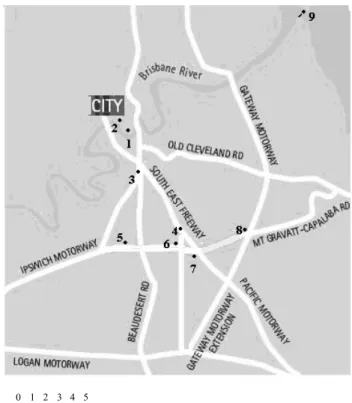
Fig. 1. Schematic representation (approximate scale: 5.4 mm=1 km) of the sampling point locations: (1) QUT, (2) Brisbane Square, (3) Princess Alexandra Hospital, (4) Tora St, (5) Archerfield, (6) ANZ Sports Complex, (7) Garden City, (8) Mt Gravatt-Capalaba Rd, and (9) Brisbane Port.
considered negligible. The second step was to obtain the rel-ative contribution of each channel to the particle number by
dividing its concentration over the N15−300. This was done
with the objective of allowing comparisons of the underlying geometry of different NSD spectra, regardless of their actual concentration levels.
The data were divided into major subsets based on wind
originating from the principal road (within ±45◦ of the
di-rection perpendicular to the road), wind towards this road, and in some cases, wind from other major physical struc-tures. These subsets were further divided into weekdays and weekends. The aim was to determine whether wind sector or day of the week had an effect on the spectra.
The datasets were subjected to outlier analysis in order to identify and remove extreme values that may lead to an incorrect interpretation of the data. There are several tech-niques available for outlier identification (e.g. Abu-el-zeet et al., 2002) and their selection depends on the characteristics of the dataset. In the present investigation, outliers were de-tected using the methodology described in Yu et al. (2004) and briefly summarized here. This is a two-stage graphical and statistical procedure used in the identification of discor-dant size distributions. The first stage uses the total
concen-tration vs. the corresponding coefficient of variation, both in the logarithmic scale in order to detect size distributions isolated from the main cluster of observations. In the sec-ond stage, individual outliers are identified by the General-ized Extreme StudentGeneral-ized Deviate (ESD) Many-Outlier Pro-cedure and the modified z-score (see also Barnett and Lewis, 1994, for more details).
After the outliers were identified and eliminated, the next move was to select those NSD properties to be analysed as well as appropriate data analysis procedure. The modal structure (the graphical representation of the shape of the number size distribution function) has the advantage of pro-viding a detailed description of the structure of the distri-bution, provided that the diameter size range has been care-fully selected in order to maximise the amount of detail of the fraction dominating the particle parameter of interest and that size intervals are of the same width in the same scale. The particle number is overwhelmingly dominated by parti-cles <300 nm (e.g. Eleftheriadis et al., 2006); therefore, the selected size range was therefore considered appropriate for this study.
The Kolmogorov-Smirnov (K-S) test was used to compare the modal distribution obtained from each site. The use and applicability of this test for comparing particle size distribu-tions containing a large number of sizing channels has been described by Heitinbrink et al. (1990) and the details of the application of this technique for measured SMPS data have provided by Morawska et al. (1999a) and further expanded here. The K-S test compares the largest distance between two cumulative distribution functions against a critical value
(Dα), which is calculated from the equation:
Where c(α) is the confidence level (α) coefficient, and
n1 and n2 are the sizes of the two samples. For a 95%
confidence level, the value of c(α) is 1.36 (Gibbons and Chakraborti, 2003). The K-S tests were performed using S-Plus 6.1 (2002, Insightful Corp.).
Two other commonly employed parameters are the num-ber median diameter (NMD), which is also calculated from the cumulative distribution function, and the geometric stan-dard deviation (GSD), which measures the width of the dis-tribution. Datasets were compared through one-way ANOVA tests. Homogeneity of variances was analysed using Lev-ene’s test. Pairs of means were then compared using least significant difference (LSD) tests in the case of equal ances and Games-Howell tests in the case of unequal vari-ances.
3 Results
3.1 Modal structure of the NSD
Figure 2 shows the average modal structure of the submi-crometre (referred in this paper, unless otherwise indicated to particles <300 nm) particle NSD obtained from each site.
Particle Diameter (nm) 10 100 1000 R e la ti v e C o n c e n tr a ti o n (% o f th e T o ta l) 0 2 4 6 8 QUT Particle Diameter (nm) 10 100 1000 R e la ti v e C o n c e n tr a ti o n (% o f th e T o ta l) 0 2 4 6 8 BSQ Particle Diameter (nm) 10 100 1000 R e la ti v e C o n c e n tr a ti o n (% o f th e T o ta l) 0 2 4 6 8 PAH Figure 2 Particle Diameter (nm) 10 100 1000 R e la ti v e C o n c e n tr a ti o n ( % o f th e T o ta l) 0 2 4 6 8 Tora St Particle Diameter (nm) 10 100 1000 R e la ti v e C o n c e n tra ti o n (% o f th e T o ta l) 0 2 4 6 8 Archerfield Particle Diameter (nm) 10 100 1000 R e la ti v e C o n c e n tra ti o n (% o f th e T o ta l) 0 2 4 6 8 ANZ Figure 2 (Cont’d) Particle Diameter (nm) 10 100 1000 R e la ti v e C o n c e n tr a ti o n ( % o f th e T o ta l) 0 2 4 6 8 Garden City Particle Diameter (nm) 10 100 1000 R e la ti v e C o n c e n tra ti o n (% o f th e T o ta l) 0 2 4 6 8 MGC Rd Particle Diameter (nm) 10 100 1000 R e la ti v e C o n c e n tra ti o n (% o f th e T o ta l) 0 2 4 6 8 BP Figure 2 (Cont’d)
Fig. 2. Average particle NSD spectra in the range 15–300 nm of data collected at nine different locations in Brisbane, Australia.
For comparison purposes, the vertical axes have been drawn to the same scale. The figures indicate the percentage of the total concentration in the range 15–300 nm. As shown by these results, the NSDs were likely to have at least two peaks, but partly masked: one occurring below 30 nm, and a second peak or protrusion suggesting its presence, is ob-served at above 50 nm. QUT was the exception by having a clearly unimodal distribution. At BP, the distribution appears to be bimodal although the second peak, at around 50 nm, has a higher concentration than the first peak, which occurs at around 40 nm. At ANZ site, no peak in the lower size range was observed, and the data suggests that it was located below the lower end of the size range measured in this study; also, the second mode is above 100 nm and its sources are yet to be determined.
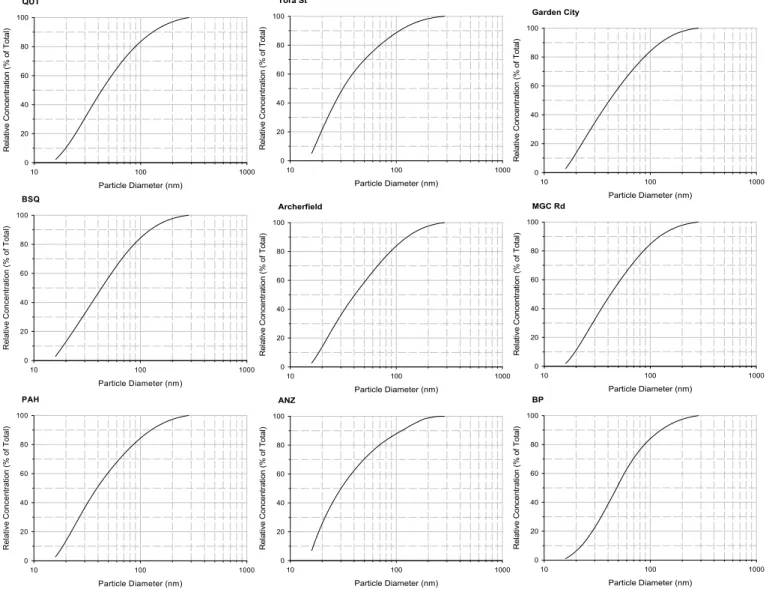
The NSD data was then used to calculate the cumulative NSD and the resulting spectra are shown in Fig. 3. The ob-jective was to assess the contribution of UFPs and nanopar-ticles (<50 nm) to the particle number and identify the loca-tion of the NMD. The results indicated that UFPs contributed to around 85% of the particle number and nanoparticles to around 60%; at ANZ and Tora St sites the contribution of UFPs and nanoparticles were, respectively, 90% and 70%, probably reflecting their close proximity to the road (<5 m). At BP, UFPs although the contribution of ultrafine particles is consistent with those from the other sites (around 83%), the contribution of nanoparticles drops to 50%, indicating the much higher contribution of diesel trucks. With regard to NMD, the plots show that most NMDs fall in the 40 nm re-gion, except at Tora St and ANZ, where it falls around 30 nm, and BP, where it shifts to nearly 50 nm.
Particle Diameter (nm) 10 100 1000 R e la ti ve C o n ce n tra ti o n (% o f T o ta l) 0 20 40 60 80 100 BSQ Particle Diameter (nm) 10 100 1000 R e la ti ve C o n ce n tra ti o n (% o f T o ta l) 0 20 40 60 80 100 PAH Particle Diameter (nm) 10 100 1000 R e la ti ve C o n ce n tr a ti o n ( % o f T o ta l) 0 20 40 60 80 100 QUT Figure 3 Particle Diameter (nm) 10 100 1000 R e la ti ve C o n c e n tr a ti o n ( % o f T o ta l) 0 20 40 60 80 100 Tora St Particle Diameter (nm) 10 100 1000 R e la ti v e C o n ce n tr a ti o n ( % o f T o ta l) 0 20 40 60 80 100 Archerfield Particle Diameter (nm) 10 100 1000 R e la ti v e C o n c e n tra ti o n (% o f T o ta l) 0 20 40 60 80 100 ANZ Particle Diameter (nm) 10 100 1000 R e la ti v e C o n c e n tra ti o n (% o f T o ta l) 0 20 40 60 80 100 Garden City Particle Diameter (nm) 10 100 1000 R e la ti v e C o n ce n tr a ti o n ( % o f T o ta l) 0 20 40 60 80 100 MGC Rd Particle Diameter (nm) 10 100 1000 R e la ti v e C o n c e n tra ti o n (% o f T o ta l) 0 20 40 60 80 100 BP Figure 3 (Cont’d)
Fig. 3. Cumulative particle NSD in the range 15–300 nm obtained from the average modal structure obtained at the nine selected sites.
The K-S test compared the distributions between each pair of spectra and the results are shown in Table 3. The tests showed that the spectra differed significantly between all of the sites, thereby indicated that the composition of the emis-sions is not evenly distributed around the area. Despite these differences, there were three major groups of spectra: the first group corresponded to the sites with peaks at around 30 nm (PAH, Archerfield, Garden City, MGC Rd, QUT and BSQ); the second group was represented by the sites dom-inated by peaks <25 nm (Tora St and ANZ); and the third group was represented by one site (BP) where particle num-ber peaked at around 50 nm. Although these results hint at differences in the vehicle mix, there was no traffic data avail-able and therefore the effect of traffic composition on size distribution could not be analysed in more detail.
Comparisons between the data subsets for each site in-dicated that there were no significant differences between wind direction sectors or between weekdays and the week-end (p>0.05). Therefore, the extracted spectra above can be considered representative of their corresponding sites. There were minor exceptions, the most significant being at BSQ between weekdays and the weekend (p=0.02). The resultant spectra are shown in Fig. 4a and b respectively. During the week, the distribution is bimodal with peaks at around 30 and 60 nm while on the weekend it is unimodal peaking at around 35 nm.
3.2 Number median diameter (NMD) and geometric
stan-dard deviation (GSD)
ANOVA tests applied to NMD found statistically significant differences between sites. Post hoc comparisons indicated
Diameter (nm) 10 100 1000 R e la ti v e C o n tri b u ti o n (% o f T o ta l) 0 1 2 3 4 Diameter (nm) 10 100 1000 R e la ti ve C o n ce n tra ti o n (% o f T o ta l) 0 1 2 3 4 (a) (b)
Fig. 4. Observed differences in NSD spectra obtained at BSQ dur-ing (a) weekdays and (b) the weekend.
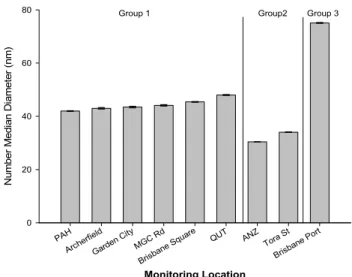
that with the exception of PAH, Archerfield, Garden City and MGC Rd, the mean values differed significantly. This was largely expected due to the large sample sizes. How-ever, the magnitudes of most of the differences were found to be very small (maximum of 5 nm) and therefore not prac-tically important, so in practice, they could be grouped as follows: Group 1 was represented by NMD in the 40–50 nm size region (the four sites above plus BSQ and QUT); Group 2 comprised those in the 30 nm region (ANZ and Tora St); and Group 3 belonged to the 60 nm region (BP). The mean values for each site are shown in Fig. 5, with the continuous lines used to separate the major groups.
The statistical tests indicated that mean GSD differed very little between sites (mean 1.94–2.02, s.d. 0.12–0.17) ex-cept at BP, where it was significantly greater (mean 2.46, s.d. 0.85). In other words, the size distribution showed more or less the same level of polydispersity, except at BP.
Monitoring Location PAH Archerf ield Garde n City MGC Rd Brisb ane S quare QUT ANZ Tora St Brisb ane P ort N u m b e r M e d ia n D ia m e te r (n m ) 0 20 40 60
80 Group 1 Group2 Group 3
Figure 5
Fig. 5. Average NMD per site. The error bars represent the corre-sponding standard errors. The continuous lines are used to group the sites into three major categories.
3.3 Effect of differences in time period
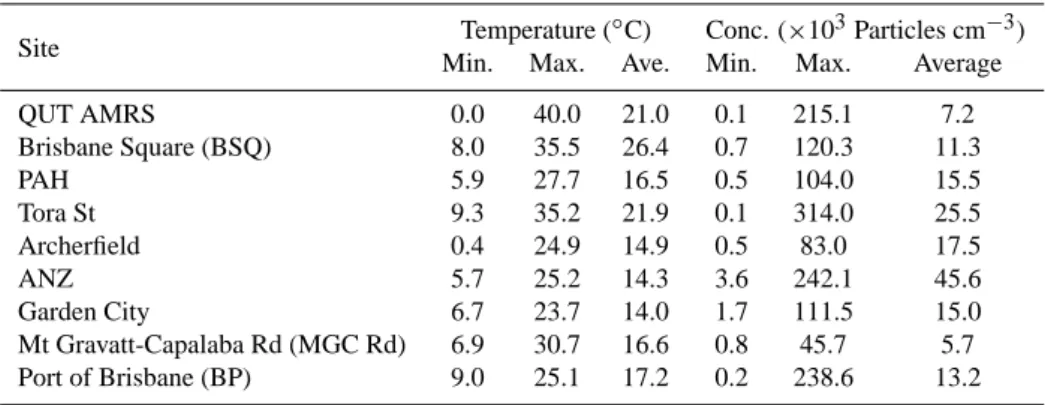
The NSD measurements were conducted during different campaigns, each having different duration, as indicated in Table 1. The results proved that despite the differences in time period the ranges of obtained values for the location of the peaks and NMD fell respectively, around 30 and 40 nm, with the exception of BP site where the corresponding values were around 50 and 60 nm. Similarly the ranges for the con-tribution of ultrafine particles and nanoparticles to the total concentration were very narrow (around 10% between their corresponding minima and maxima). The only exception was BP site but this cannot be explained by seasonal dif-ferences, particularly of temperature, as the averages range
between 14.0◦C and 26.4◦C (Table 2). As Table 2 shows,
although there are obvious differences in particle concentra-tion levels (ranging from 7.2 to 45.6×103cm−3), the range of temperatures is very narrow, with average values ranging
between 14.0◦C and 26.5◦C. Therefore, it is very clear that
the sampling periods had no effect on the distributions and particle concentration levels.
4 Discussion
The size distribution of submicrometre particle data, col-lected at nine different sites in urban atmosphere of Brisbane, in the range 15–300 nm using the lognormal scale, were anal-ysed in terms of their modal structure and NMD, covering a total period of 11 years. Larger particles were excluded from the study as we found in a previous investigation that their concentrations were between one and two orders of magni-tude lower than the above range (Mejia et al., 2007), and
Table 2. Recorded temperatures and particle concentration levels at each site.
Site Temperature (
◦C) Conc. (×103Particles cm−3)
Min. Max. Ave. Min. Max. Average QUT AMRS 0.0 40.0 21.0 0.1 215.1 7.2 Brisbane Square (BSQ) 8.0 35.5 26.4 0.7 120.3 11.3 PAH 5.9 27.7 16.5 0.5 104.0 15.5 Tora St 9.3 35.2 21.9 0.1 314.0 25.5 Archerfield 0.4 24.9 14.9 0.5 83.0 17.5 ANZ 5.7 25.2 14.3 3.6 242.1 45.6 Garden City 6.7 23.7 14.0 1.7 111.5 15.0 Mt Gravatt-Capalaba Rd (MGC Rd) 6.9 30.7 16.6 0.8 45.7 5.7 Port of Brisbane (BP) 9.0 25.1 17.2 0.2 238.6 13.2
therefore, we did not expect that they would significantly af-fect the size distribution.
4.1 Modal structures
As can be seen in Fig. 2, the modal structures and corsponding concentration levels were very similar to those re-ported from traffic and urban emissions (Morawska et al., 1999b). Particle number peaked at below 30 nm and a sec-ond peak was observed, or at least suggested by the results, in the range 50–100 nm, except at QUT, where the distribu-tion was clearly unimodal. The results are consistent with the modal structures observed in petrol and diesel exhaust, whose respective NSDs are dominated by the ranges 20–60 and 20–120 nm (Maricq et al., 1999; Gouriou et al., 2004; Morawska et al., 1998a).
The first peak (<30 nm) predominates and is indicative of the predominance of petrol emissions in Brisbane, corrob-orating earlier findings (Holmes et al., 2005; Morawska et al., 1998b, 1999b), and also hint at the presence of diesel traffic (Morawska et al., 1998a). These particles belong to a size category known as nanoparticles (<50 nm), which are formed by primary carbonaceous emissions from petrol, and the supersaturation of semivolatile precursors due to the rapid cooling of both petrol and diesel traffic exhaust gas re-sulting in homogeneous nucleation (Bukowiecki et al., 2002; Imhof et al., 2005b; Kittelson et al., 2002). This has been shown to be a process that instantly (1–3 s) yields a high number of nanoparticles (Kittelson et al., 2000).
The second peak, in the range 50–100 nm, as already dis-cussed, is indicative of diesel fuel. These particles consist predominantly of soot aggregates from incomplete combus-tion processes (Imhof et al., 2005a). Research from bench tests suggests that nanoparticles dominate the low engine load whereas the peak above 50 nm corresponds to high loads (Sturm et al., 2003). With the exception of QUT and Tora St, sampling took place close to traffic lights. During each scan, the lights changed, on average, ten times. As a result, engine loads varied regularly, being highest during acceleration.
The distributions at ANZ and Tora St are clearly domi-nated by the smaller particles, peaking at <25 nm. No peak was observed at ANZ site, and the data indicates that the peak is located below 15 nm. Modal diameters below this limit have been observed in urban air (e.g. Shi et al., 2001). Particle NSD has been observed to change with distance to the road, shifting to a larger diameter the further away down-wind (Pirjola et al., 2006; Zhu et al., 2002b). Research has found that the concentration of particles <50 nm decrease more rapidly than that of particles >100 nm and concluded that coagulation is more important than atmospheric dilution for UFPs whereas the reverse is true for larger particles (Zhu et al., 2002b). Other investigations, on the other hand, have found that dilution is as important as coagulation in chang-ing the concentration of UFPs with increaschang-ing distance to the road (e.g. Zhu et al., 2002a). Tora St and ANZ were very close to the road (<5 m) and therefore it is reasonable to con-clude that the distributions observed at these two sites reflect their close proximity to traffic.
Of the other sites, only PAH was as close to the road. At this site, however, smaller particles are less dominant than at Tora St and ANZ. There is a greater flow of diesel vehi-cles around PAH, which partially explains the results. There were similarities but also differences in sampling conditions between PAH and the two sites above. As in Tora St, sam-pling took place directly above the road. The main differ-ence was the traffic flow pattern, travelling continuously at
100–110 km h−1at Tora St whereas at PAH sampling took
place directly above a traffic light. Gouriou et al. (2004) and Imhoff et al. (2005a) observed that, for diesel fuel, particles >50 nm prevailed in stop-start traffic conditions. This can be explained by the higher engine loads associated with start-acceleration conditions near these lights, resulting in high emission rates of soot particles. At ANZ, sampling took place near a traffic light but unlike PAH it was at ground level. Research on the horizontal and vertical distribution of particles around buildings (Morawska et al., 1999a), how-ever, found no association between height and total particle
Table 3. Kolmogorov-Smirnov test results on average spectra.
Site ANZ Archerfield BP BSQ Garden City MGC Rd PAH QUT Archerfield 0.122 BP 0.171 0.098 BSQ 0.146 0.049 0.073 Garden City 0.122 0.024 0.098 0.024 MGC Rd 0.122 0.024 0.073 0.024 0.024 PAH 0.098 0.024 0.098 0.049 0.024 0.049 QUT 0.143 0.049 0.073 0.024 0.049 0.024 0.049 Tora St 0.049 0.122 0.171 0.122 0.122 0.122 0.098 0.122
number concentration. The meteorological conditions were similar at the three sites, with average wind speeds ranging between 1.5 and 2.1 m/s. Therefore, although it is obvious that the observed distributions at these sites reflect their dif-ferent environments, there are influences other than traffic or meteorological conditions yet to be identified.
A small peak above 100 nm is observed at ANZ site al-though its concentration is close to the lowest in the ultrafine range. During this campaign, there was an episode when the entire city was covered in smoke. Although this peak may explain the reduction in visibility, the episode was of very short duration, approximately one day. In addition, the spec-trum looks quite different from that associated with bushfire activity (Morawska et al., 1999b). At this stage, the causes remain unclear.
BP site differs from the other sites in that the peak in the size distribution shifts to a larger diameter, around 50 nm. Free-flowing traffic at this site is dominated by diesel trucks,
with average velocities of 70 km h−1. The smaller peak at
40 nm is consistent with the peak observed in sea breeze (Morawska et al., 1999b) probably resulting from homoge-neous nucleation in marine boundary layer (Hoppel et al., 1990). The site was located at approximately 14 m above sea level, at the northern end of a bridge connecting the mainland to the seaport and therefore it is reasonable to interpret this peak as being associated with sea breeze. However, based on the NSD on marine aerosols (e.g. Bates et al., 2000; Eleft-heriadis et al., 2006; Morawska et al., 1999b) a small peak in the range 100–200 nm was expected. The absence of this peak at the site therefore reflects the much stronger contribu-tion of diesel traffic.
4.2 Cumulative distributions
Figure 3 shows that UFPs contribute between 82 and 89% of the total particle number and nanoparticles between 60% and 70%. This is consistent with the NSD observed in urban aerosols (Morawska et al., 1998a, b; Shi et al., 2001). At BP site, although the contribution of UFP is very consistent with the other sites, the contribution of nanoparticles drops to
around 50%, reflecting the dominance of the larger ultrafine particles.
The K-S tests in Table 3 confirmed that all spectra had sig-nificantly different distributions. This supported the visible differences shown in Fig. 2. Despite the differences, the sites can be group into three major categories: (1) those with max-imum concentrations in the 30 nm region (QUT, BSQ, PAH, Archerfield, Garden City and MGC Rd), (2) those with peak concentrations <25 nm (Tora St and ANZ), and (3), a site with peak concentrations at around 50 nm (BP). The modal structures in the first category is characteristic of urban traffic emissions, particularly from petrol (Morawska et al., 1999b); the second category is clearly dominated by particles at the lower end of the size range, and it can be explained by the close proximity between the sites and the road; the spec-trum in the third category is consistent with diesel emissions (Morawska et al., 1998a). Figure 1 shows that the sites corre-sponding to the first category are very widespread around the study area, those corresponding to the second category are very close to each other, surrounded by those in the first cat-egory and the site in the last catcat-egory is clearly isolated from rest. Therefore, the interpretation of the data is influenced by the level of proximity between the sites.
The statistical analyses indicated that with only a few ex-ceptions, wind direction or day of the week did not signifi-cantly affect the NSD. Based on what has already been dis-cussed, it is reasonable to conclude that the spectra are het-erogeneously distributed probably due to local differences in the contribution of petrol vehicles. At BP, the contribution of nanoparticles becomes reduced and this can be attributed to the much larger percentage of diesel trucks at this site.
At the BSQ site, the distributions differed between week-days and the weekend and this is reflected in the location of the corresponding peaks (Fig. 4). This site was located in the heart of the CBD. This difference is explained by the differ-ence in fleet composition during these days. The CBD serves as a hub for public transport services, and 85% of buses op-erate on diesel fuel. Petrol traffic is more dominant during the weekend, resulting from a reduction in bus services, even though traffic flow rate is significantly reduced.
4.3 Number median diameters
In addition to the modal structure, the size distributions were analysed in terms of their NMDs (Fig. 5). Unlike the modal structures, some sites were found to have similar NMD val-ues. Based on the statistical results and the average values, the sites were grouped into three major groups, and these groups were consistent with those obtained for the modal structures.
Although some variations between sites were found within the groups, the magnitude of these differences was very small and not practically important. For instance, the NMDs con-sistently fall around or below the 40 nm region, which is a source signature of petrol traffic (Morawska et al., 1998b, 1999b). The only exception were BP site, where the average NMD is 59 nm, reflecting the predominance of diesel trucks (Morawska et al., 1998a).
To deepen the analysis, the GSD were also compared and there was little variability among the sites, with average val-ues falling around 1.96, although it was visibly higher at BP (2.46). In order to shed more light into the shape of the dis-tributions, the correlation between NMD and GSD was anal-ysed and although it was significant at the 99% confidence level (p<0.01), it was rather weak (r=−0.14). Therefore, the effect of NMD on the width of the distribution may not be important in practice.
4.4 Effect of seasonality
The interpretation of the results suggests that, with the ex-ception of BP site, the distributions were unaffected by the differences in sampling period. A time series investigation (Mejia et al., 2007) found that, unlike in temperate latitudes, particle size distribution in Brisbane is unaffected by season of the year. This conclusion was based on seasonal analysis results on particle number and NMD, which showed no an-nual periodic behaviour. The lack of seasonality in Brisbane can be explained by the very small variations in meteorolog-ical conditions, for example air temperature, which in this
study had a range of 10oC between the minimum and
maxi-mum averages (Table 2). There were obvious differences in particle number (Table 2), but these can be interpreted as re-sulting from varying distance to the road, traffic levels and composition rather than caused by seasonal differences.
4.5 Summary and conclusions
To summarise the findings from this study, the data were collected during different campaigns of varying durations spanning an 11-year period. The results indicated that there were statistically significant differences in the modal struc-tures and therefore they showed that particle number size was heterogeneously distributed in Brisbane. UFPs and nanopar-ticles contributed, respectively, to around 82–89% and 60– 70% of the particle number. Although the contribution of
UFPs at the BP site, was similar to the other sites, the contri-bution of nanoparticles decreased to 50%, reflecting its dif-ferent environment. Particle number peaked at around or be-low 30 nm and NMD in the 40 nm region. Although some differences were also found for the NMD, there were four sites that had similar NMD values. Where statistically sig-nificant differences were found, in most cases, their magni-tudes were very small and therefore not important in practice. Although the locations of the peaks varied between sites, in most cases half of the particle number was within approxi-mately the same size range. Based on these results, the sites were divided into three major groups: (1) urban sites domi-nated by petrol traffic emissions, (2) sites domidomi-nated by the smaller particles probably caused by the proximity between the measurement points and the road, and (3) a site clearly dominated by diesel traffic. The average NSDs were clearly unaffected by differences in sampling periods. The locations of the peaks and NMD values consistently indicate that petrol vehicles are the dominant source, and therefore the results from the statistical tests hint at differences in traffic com-position, as expected. At this stage, however, no association between traffic composition and size distribution could be es-tablished due to the limited traffic information available for this study. Future investigations should benefit by including traffic composition data.
Acknowledgements. The authors wish to express their appreciation
to R. Jayaratne, G. Johnson and N. Holmes, from the International Laboratory of Air Quality and Health (ILAQH) and M. Jamriska (formerly from ILAQH and currently from the Australian Defence Academy), for supplying their data for the purposes of this project. Funding from the Australian Research Council is also gratefully acknowledged.
Edited by: V.-M. Kerminen
References
Abu-el-zeet, Z. H., Becerra, V. M., and Roberts, P. D.: Combined bias and outlier identification in dynamic data reconciliation, Comput. Chem. Eng., 26, 921–935, 2002.
Barnett, V. and Lewis, T.: Outliers in statistical data, Chichester, Wiley, 1994.
Bates, T. S., Quinn, P. K., Covert, D. S., Coffman, D. J., John-son, J. E., and Wiedensohler, A.: Aerosol physical properties and processes in the lower marine boundary layer: a comparison of shipboard sub micron data from ACE 1 and ACE 2, Tellus B, 52, 258–272, 2000.
Bukowiecki, N., Dommen, J., Prevot, A. S. H., Richter, R., Wein-gartner, E., and Baltensperger, U.: A mobile pollutant measure-ment laboratory–measuring gas phase and aerosol ambient con-centrations with high spatial and temporal resolution, Atmos. En-viron., 36, 5569–5579, 2002.
Bureau of Meteorology: The Climate of Brisbane, Canberra, 1983. Buzorius, G., Hameri, K., Pekkanen, J., and Kulmala, M.: Spatial variation of aerosol number concentration in Helsinki city, At-mos. Environ., 33, 553–565, 1999.
CONCAWE: Measurement of the Number and Mass Weighted Size Distributions of Exhaust Particles Emitted from European Heavy Duty Engines (Report No. 01/51), Brussels, CONCAWE, Report No. 01/51, 2001.
Eleftheriadis, K., Colbeck, I., Housiadas, C., Lazaridis, M., Mi-halopoulos, N., Mitsakou, C., Smolik, J., and Zdimal, V.: Size distribution, composition and origin of the submicron aerosol in the marine boundary layer during the eastern Mediterranean “SUB-AERO” experiment, Atmos. Environ., 40, 6245–6260, 2006.
Flocas, H. A., Assimakopoulos, V. D., and Helmis, C. G.: An exper-imental study of aerosol distribution over a Mediterranean urban area, Sci. Total Environ., 367, 872–887, 2006.
Gibbons, J. D. and Chakraborti, S.: Nonparametric Statistical Infer-ence, New York, Marcel Dekker Inc., p. 583, 2003.
Gouriou, F., Morin, J.-P., and Weill, M.-E.: On-road measurements of particle number concentrations and size distributions in ur-ban and tunnel environments, Atmos. Environ., 38, 2831–2840, 2004.
Harrison, R. M., Jones, M., and Collins, G.: Measurements of the physical properties of particles in the urban atmosphere, Atmos. Environ., 33, 309–321, 1999.
Heitinbrink, W. A., Baron, P., and Willeke, K.: Coincidence in time-of-flight aerosol spectrometres: phantom particle creation. Aerosol Sci. Tech., 14, 112–126, 1990.
Hitchins, J., Morawska, L., Wolff, R., and Gilbert, D.: Concentra-tions of submicrometre particles from vehicle emissions near a major road, Atmos. Environ., 34, 51–59, 2000.
Holmes, N. S., Morawska, L., Mengersen, K., and Jayaratne, E. R.: Spatial distribution of submicrometre particles and CO in an urban microscale environment, Atmos. Environ., 39, 3977–3988, 2005.
Hong, Y. C., Lee, J. T., Kim, H., Ha, E. H., Schwartz, J., and Chris-tiani, D. C.: Effects of air pollutants on acute stroke mortality, Environ. Health Persp., 110, 187–191, 2002.
Hoppel, W. A., Larson, R., and Vietti, M. A.: Aerosol size distribu-tions and optical boundaries found in the marine boundary layer over the Atlantic Ocean, J. Geophys. Res., 95, 3659–3686, 1990. Hussein, T., Hameri, K., Aalto, P. P., Paatero, P., and Kulmala, M.: Modal structure and spatial-temporal variations of urban and suburban aerosols in Helsinki–Finland, Atmos. Environ., 39, 1655–1668, 2005.
Hussein, T., Puustinen, A., Aalto, P., Makela, T., Hameri, K., and Kulmala, M.: Urban aerosol number size distributions, Atmos. Chem. Phys., 4, 391–411, 2004,
http://www.atmos-chem-phys.net/4/391/2004/.
Imhof, D., Weingartner, E., Ordonez, C., Gehrig, R., Hill, M., Buch-mann, B., and Baltensperger, U.: Real-World Emission Factors of Fine and Ultrafine Aerosol Particles for Different Traffic Sit-uations in Switzerland, Environ. Sci. Technol., 39, 8341–8350, 2005a.
Imhof, D., Weingartner, E., Vogt, U., Dreiseidler, A., Rosenbohm, E., Scheer, V., Vogt, R., Nielsen, O. J., Kurtenbach, R., and Corsmeier, U.: Vertical distribution of aerosol particles and NOx close to a motorway, Atmos. Environ., 39, 5710–5721, 2005b. Jaenicke, R.:, Tropospheric aerosols, in: Aerosol-Cloud-Climate
Interactions, edited by: Hobbs, P. V., London, Academic Press, 1993.
Kittelson, D., Watts, W., and Johnson, J.: Diesel Aerosol Sampling
Methodology – CRC E-43, Final report, Coordinating Research Council, 2002.
Kittelson, D. B., Johnson, J., Watts, W., Wei, Q., Drayton, M., Paulsen, D., and Bukowiecki, N.: Diesel sampling in the atmo-sphere, 2000.
Maricq, M. M., Podsiadlik, D. H., and Chase, R. E.: Examination of the Size-Resolved and Transient Nature of Motor Vehicle Par-ticle Emissions, Environ. Sci. Technol., 33, 1618–1626, 1999. Mejia, J. F., Wraith, D., Mengersen, K., and Morawska, L.: Trends
in size classified particle number concentration in subtropical Brisbane, Australia, based on a 5 year study, Atmos. Environ., 41, 1064–1079, 2007.
Morawska, L., Bofinger, N., Kocis, L., and Nwankwoala, A.: Sub-micrometer and superSub-micrometer particles from diesel vehicle emissions. Environ. Sci. Technol., 32, 2033–2042, 1998a. Morawska, L., Jayaratne, E. R., Mengersen, K., Jamriska, M., and
Thomas, S.: Differences in airborne particle and gaseous concen-trations in urban air between weekdays and weekends. Atmos. Environ., 36, 4375–4383, 2002.
Morawska, L., Thomas, S., Bofinger, N., Wainwright, D., and Neale, D.: Comprehensive characterization of aerosols in a sub-tropical urban atmosphere: particle size distribution and correla-tion with gaseous pollutants, Atmos. Environ., 32, 2467–2478, 1998b.
Morawska, L., Thomas, S., Gilbert, D., Greenaway, C., and Rijn-ders, E.: A study of the horizontal and vertical profile of sub-micrometer particles in relation to a busy road, Atmos. Environ., 33, 1261–1274, 1999a.
Morawska, L., Thomas, S., Jamriska, M., and Johnson, G.: The modality of particle size distributions of environmental aerosols, Atmos. Environ., 33, 4401–4411, 1999b.
Pirjola, L., Paasonen, P., Pfeiffer, D., Hussein, T., H¨ameri, K., Koskentalo, T., Virtanen, A., R¨onkk¨o, T., Kesniken, J., Pakka-nen, T. A., and Hillamo, R.: Dispersion of particles and trace gases nearby a city highway: mobile laboratory measurements in Finland, Atmos. Environ., 40, 867–879, 2006.
Salma, I., Dal Maso, M., Kulmala, M., and Zaray, G.: Modal char-acteristics of particulate matter in urban atmospheric aerosols, Microchem. J., 73, 19–26, 2002.
Seaton, A., Godden, D., MacNee, W., and Donaldson, K.: Particu-late air pollution and acute health effects, The Lancet, 345, 176– 178, 1995.
Seinfeld, J. H. Pandis, S. N.: Atmospheric Chemistry and Physics, New York, John Wiley & Sons, Inc., p. 545, 1998.
Shi, J. P., Evans, D. E., Khan, A. A., and Harrison, R. M.: Sources and concentration of nanoparticles (<10 nm diameter) in the ur-ban atmosphere, Atmos. Environ., 35, 1193–1202, 2001. Sturm, P. J., Hausberger, S., Engler, D., Bacher, M., Lechner,
B., and Rodler, J.: PM size distribution measurements in en-gine exhaust in context to road tunnel and ambient air measure-ments, Fifth international technion symposium, Vienna, Austria, http://www.technion.org/Pages/pdf/A P3.pdf, 2003.
Virtanen, A. K. K., Ristimaki, J. M., Vaaraslahti, K. M., and Keski-nen, J.: Effect of Engine Load on Diesel Soot Particles, Environ. Sci. Technol., 38, 2551–2556, 2004.
W˚ahlin, P., Palmgren, F., and Van Dingenen, R.: Experimental stud-ies of ultrafine particles in streets and the relationship to traffic, Atmos. Environ., 35, 63–69, 2001.
R.: Quality control of semi-continuous mobility size-fractionated particle number concentration data, Atmos. Environ., 38, 3341– 3348, 2004.
Zhu, Y., Hinds, W. C., Kim, S., Shen, S., and Sioutas, C.: Study of ultrafine particles near a major highway with heavy-duty diesel traffic, Atmos. Environ., 36, 4323–4335, 2002a.
Zhu, Y., Hinds, W. C., Kim, S., and Sioutas, C.: Concentration and size distribution of ultrafine particles near a major highway, J. Air Waste Ma. Assoc., 52, 1032–1042, 2002b.