Publisher’s version / Version de l'éditeur:
Vous avez des questions? Nous pouvons vous aider. Pour communiquer directement avec un auteur, consultez la
première page de la revue dans laquelle son article a été publié afin de trouver ses coordonnées. Si vous n’arrivez pas à les repérer, communiquez avec nous à [email protected].
Questions? Contact the NRC Publications Archive team at
[email protected]. If you wish to email the authors directly, please see the first page of the publication for their contact information.
https://publications-cnrc.canada.ca/fra/droits
L’accès à ce site Web et l’utilisation de son contenu sont assujettis aux conditions présentées dans le site LISEZ CES CONDITIONS ATTENTIVEMENT AVANT D’UTILISER CE SITE WEB.
Research Report (National Research Council of Canada. Institute for Research in
Construction), 2004-03-31
READ THESE TERMS AND CONDITIONS CAREFULLY BEFORE USING THIS WEBSITE.
https://nrc-publications.canada.ca/eng/copyright
NRC Publications Archive Record / Notice des Archives des publications du CNRC : https://nrc-publications.canada.ca/eng/view/object/?id=1c4da25c-3cb3-413b-914b-8a1e491abf8b https://publications-cnrc.canada.ca/fra/voir/objet/?id=1c4da25c-3cb3-413b-914b-8a1e491abf8b
NRC Publications Archive
Archives des publications du CNRC
For the publisher’s version, please access the DOI link below./ Pour consulter la version de l’éditeur, utilisez le lien DOI ci-dessous.
https://doi.org/10.4224/20377101
Access and use of this website and the material on it are subject to the Terms and Conditions set forth at
Cigarette Ignition Propensity Testing - Third Series
Cigarette Ignition Propensity Testing – Third Series
Su, J.Z.; Lerous, P.
IRC-RR-164
March 31, 2004
CIGARETTE IGNITION PROPENSITY TESTING – Third Series
By
Joseph Z. Su and Patrice Leroux
Fire Risk Management Program Institute for Research in Construction National Research Council of Canada
ABSTRACT
In the previous testing series, More Menthol, Merit Ultra Light and Merit Ultima cigarettes had been found to have a lower ignition propensity relative to other cigarette brands tested. The third testing series was conducted to further determine the ignition propensity of the More and the Merit cigarettes as well as selected tobacco sticks (for a total of 7 brands of cigarettes). The relative ignition strength was determined by observing the percentage of the cigarettes that burned their full length. Test results showed again that the More and the Merit cigarettes had relatively low numbers of full-length burns, compared to most cigarettes tested in the previous 2 series. In addition to the determination of the ignition strength, the length of the cigarette butt was measured for all those cigarettes that self-extinguished during the test.
CIGARETTE IGNITION PROPENSITY TESTING – Third Series
Joseph Z. Su and Patrice Leroux
1.0 INTRODUCTION
Unintentionally dropping a lit cigarette onto a bed or a piece of upholstered furniture is a common cause of residential fires. In order to reduce cigarette-ignited fires and associated fatalities and property damage, Health Canada is proposing to regulate the ignition propensity of cigarettes [1]. As part of its background research, Health Canada commissioned the National Research Council (NRC) to conduct cigarette ignition propensity testing using a facility recently built by NRC in accordance with ASTM E2187-02b [2, 3].
NRC completed two series of testing which included 62 brands of cigarettes sold in Canada and 2 brands of Philip Morris Merit cigarettes sold in the U.S. [3, 4]. A majority of the cigarettes tested burned their full length 90 to 100% of the time on the 15-layer filter paper assembly. Three brands of cigarettes tested (More Menthol, Merit Ultra Light and Merit Ultima) were found to have significantly lower ignition propensity relative to the other brands tested.
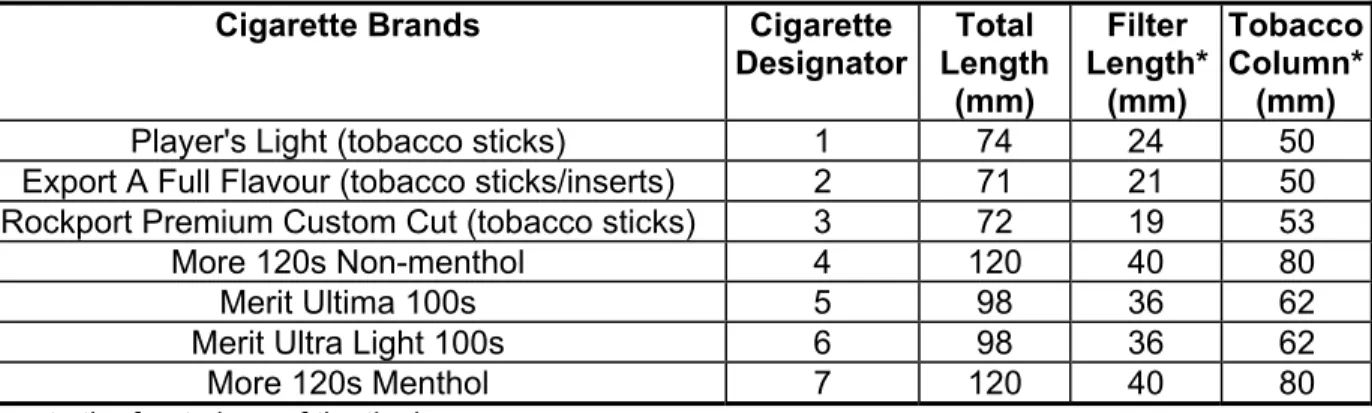
A third series of testing was conducted at NRC to further test the More and the Merit cigarettes as well as selected tobacco sticks, as listed in Table 1. The objective was to determine the ignition strength of these cigarettes using the approved ASTM test method [2] and to establish a potential Canadian benchmark using the More 120s Menthol cigarettes. This report documents the results.
TABLE 1 – Test Cigarettes Cigarette Brands Cigarette Designator Total Length (mm) Filter Length* (mm) Tobacco Column* (mm)
Player's Light (tobacco sticks) 1 74 24 50 Export A Full Flavour (tobacco sticks/inserts) 2 71 21 50 Rockport Premium Custom Cut (tobacco sticks) 3 72 19 53 More 120s Non-menthol 4 120 40 80 Merit Ultima 100s 5 98 36 62 Merit Ultra Light 100s 6 98 36 62 More 120s Menthol 7 120 40 80
* up to the front plane of the tipping paper
2.0 EXPERIMENTS
2.1 Test Facility
The test facility includes a conditioned test room, 4 test chambers and equipment for controlling and measuring temperature, humidity and ventilation in the room. The facility and equipment were set up and calibrated in accordance with the requirements of the ASTM test
method. Both the temperature and humidity were stabilized within the required conditions — a relative humidity of 55% ± 5% and a temperature of 23°C ± 3°C. A detailed facility description has been given in the previous reports [3, 4].
2.2 Test Method
The methodology is fully described in the ASTM standard [2]. In brief, this test method uses a set number of layers of filter paper as standard substrates to determine the propensity of a cigarette to ignite upholstered furnishings. A lit cigarette is placed on the substrate supported by the filter paper holder inside the test chamber. The filter paper substrate acts as a heat sink, absorbing heat from the lit cigarette. Depending on the strength of a cigarette as a heat source and the number of layers of the filter paper, a lit cigarette may or may not burn its full length. Relative ignition strength of a type of cigarette is determined by testing 40 cigarette samples (of the same type) on a set number of layers of filter paper and observing the percentage of the cigarettes that burn their full length.
2.3 Quality Assurance and Conditioning of Filter Papers
Whatman #2 filter paper was used to assemble the standard substrates. Quality assurance of the filter papers was conducted according to the ASTM Standard. The
top-removed boxes of the filter paper were conditioned in the test room (at a relative humidity of 55% ± 5% and a temperature of 23°C ± 3°C) for a week prior to the cigarette testing.
2.4 Storage and Conditioning of Cigarettes
The cigarettes were conditioned in the test room at a relative humidity of 55% ± 5% and a temperature of 23°C ± 3°C for 48 hours prior to testing. To minimize the risk of contamination, all cigarettes were stored at -4 to 0°C before they were conditioned.
2.5 Test Procedure and Parameter Randomization
The procedure specified in the ASTM standard method was followed in conducting the ignition strength determination of the cigarettes. Experimental variables, such as cigarette types, test chambers and test samples were randomized for the experiment sequence to eliminate systematic errors. Appendix A shows an example of test sequence randomization for tests with a 15-layer substrate assembly.
The 7 brands of cigarettes were tested on the substrate assemblies of 15 layers of filter paper. For the cigarettes that produced less than 90% of full length burning on the 15-layer substrate assembly, additional tests with 10 layers of filter paper were conducted. In order to consider a potential a calibration cigarette, five repetitive tests were conducted for the More 120s Menthol cigarettes on 10 layers of filter paper (each test involved the determination of full length burns for 40 cigarette samples randomly selected from 10 cartons). For the cigarettes that produced less than 90% of full length burning on the 10-layer substrate assembly, additional tests with 3 layers of filter paper were conducted.
self-extinguished during the test, including those that self-self-extinguished on the cigarette holder (before moving onto the filter paper assemblies).
3.0 RESULTS
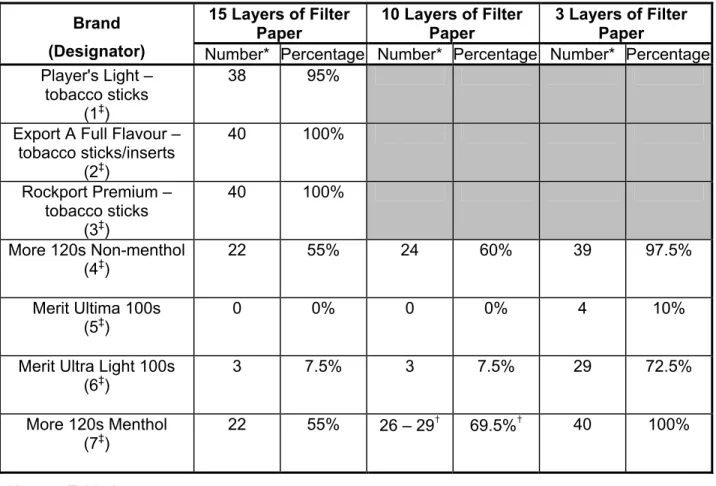
Nineteen tests were conducted and each test involved forty determinations. Table 2 shows the ignition propensity test results.
TABLE 2 – Full Length Burns for Tested Cigarettes 15 Layers of Filter Paper 10 Layers of Filter Paper 3 Layers of Filter Paper Brand
(Designator) Number* Percentage Number* Percentage Number* Percentage
Player's Light – tobacco sticks
(1‡)
38 95%
Export A Full Flavour – tobacco sticks/inserts (2‡) 40 100% Rockport Premium – tobacco sticks (3‡) 40 100% More 120s Non-menthol (4‡) 22 55% 24 60% 39 97.5% Merit Ultima 100s (5‡) 0 0% 0 0% 4 10%
Merit Ultra Light 100s (6‡) 3 7.5% 3 7.5% 29 72.5% More 120s Menthol (7‡) 22 55% 26 – 29† 69.5%† 40 100% Notes to Table 2 N.A. – not available
* Number of cigarettes that burned to full length (out of 40 cigarettes) ‡
Cigarette brand designator
† The range of number and the average of percentage of full length burns for five repetitive tests.
For all cigarettes that self-extinguished during the test (i.e., those that did not burn to their full length), the length of the cigarette butt was measured at the closest point of the char line after each determination. Figures 1-16 show the fractions of remaining tobacco column after each test (excluding the filter length). Each missing bar in the figures represents a full-length burn.
3.1 Results of Tests with 15-Layer Substrate Assembly
A total of 280 cigarettes (40 cigarettes for each of the 7 brands) were tested on the 15-layer substrate assembly.
Figure 1. Fraction of remaining tobacco column after the test on 15 layers (Player's Light tobacco sticks)
Determination 1 2 3 4 5 6 7 8 9 10 11 12 13 14 15 16 17 18 19 20 21 22 23 24 25 26 27 28 29 30 31 32 33 34 35 36 37 38 39 40 Fract ion 0.0 0.1 0.2 0.3 0.4 0.5 0.6 0.7 0.8 0.9 1.0 Tobacco column = 50 mm
Figure 2. Fraction of remaining tobacco column after the test on 15 layers (More 120s Non-menthol)
Determination 1 2 3 4 5 6 7 8 9 10 11 12 13 14 15 16 17 18 19 20 21 22 23 24 25 26 27 28 29 30 31 32 33 34 35 36 37 38 39 40 Fract ion 0.0 0.1 0.2 0.3 0.4 0.5 0.6 0.7 0.8 0.9 1.0 Tobacco column = 80 mm
Figure 3. Fraction of remaining tobacco column after the test on 15 layers (Merit Ultima 100s) Determination 1 2 3 4 5 6 7 8 9 10 11 12 13 14 15 16 17 18 19 20 21 22 23 24 25 26 27 28 29 30 31 32 33 34 35 36 37 38 39 40 Fraction 0.0 0.1 0.2 0.3 0.4 0.5 0.6 0.7 0.8 0.9 1.0 Tobacco column = 62 mm
Figure 4. Fraction of remaining tobacco column after the test on 15 layers (Merit Ultra Light 100s)
Determination 1 2 3 4 5 6 7 8 9 10 11 12 13 14 15 16 17 18 19 20 21 22 23 24 25 26 27 28 29 30 31 32 33 34 35 36 37 38 39 40 Fraction 0.0 0.1 0.2 0.3 0.4 0.5 0.6 0.7 0.8 0.9 1.0 Tobacco column = 62 mm
Figure 5. Fraction of remaining tobacco column after the test on 15 layers (More 120s Menthol)
Determination 1 2 3 4 5 6 7 8 9 10 11 12 13 14 15 16 17 18 19 20 21 22 23 24 25 26 27 28 29 30 31 32 33 34 35 36 37 38 39 40 Fract ion 0.0 0.1 0.2 0.3 0.4 0.5 0.6 0.7 0.8 0.9 1.0 Tobacco column = 80 mm
Two types of tobacco sticks (Export A Full Flavour and Rockport Premium) burned their full length 100% of the time. Player's Light tobacco sticks burned their full length 95% of the time. The 2 More brands of cigarettes (both Menthol and Non-menthol) burned their full length 55% of the time. The Merit Ultra Light cigarettes burned their full length 7.5% of the time; 37 out of the 40 lit Merit Ultra Light cigarettes did not burn their full length, including 4 lit cigarettes which extinguished while in the cigarette holder. The Merit Ultima cigarettes burned their full length 0% of the time; all of the 40 lit Merit Ultima cigarettes did not burn their full length, including 5 lit cigarettes that extinguished while in the cigarette holder.
3.2 Results of Tests with 10-Layer Substrate Assembly
The 2 More brands and the 2 Merit brands of cigarettes were further tested on 10 layers of filter paper. In addition, the More 120s Menthol brand of cigarettes were tested repeatedly in an effort to determine suitability as a calibration cigarette.
Figure 6. Fraction of remaining tobacco column after the test on 10 layers (More 120s Non-menthol)
Determination 1 2 3 4 5 6 7 8 9 10 11 12 13 14 15 16 17 18 19 20 21 22 23 24 25 26 27 28 29 30 31 32 33 34 35 36 37 38 39 40 Fraction 0.0 0.1 0.2 0.3 0.4 0.5 0.6 0.7 0.8 0.9 1.0 Tobacco column = 80 mm
Figure 7. Fraction of remaining tobacco column after the test on 10 layers (Merit Ultima 100s)
Determination 1 2 3 4 5 6 7 8 9 10 11 12 13 14 15 16 17 18 19 20 21 22 23 24 25 26 27 28 29 30 31 32 33 34 35 36 37 38 39 40 Fraction 0.0 0.1 0.2 0.3 0.4 0.5 0.6 0.7 0.8 0.9 1.0 Tobacco column = 62 mm
Figure 8. Fraction of remaining tobacco column after the test on 10 layers (Merit Ultra Light 100s) Determination 1 2 3 4 5 6 7 8 9 10 11 12 13 14 15 16 17 18 19 20 21 22 23 24 25 26 27 28 29 30 31 32 33 34 35 36 37 38 39 40 Fraction 0.0 0.1 0.2 0.3 0.4 0.5 0.6 0.7 0.8 0.9 1.0 Tobacco column = 62 mm
Figure 9. Fraction of remaining tobacco column after the first test on 10 layers (More 120s Menthol)
Determination 1 2 3 4 5 6 7 8 9 10 11 12 13 14 15 16 17 18 19 20 21 22 23 24 25 26 27 28 29 30 31 32 33 34 35 36 37 38 39 40 Fraction 0.0 0.1 0.2 0.3 0.4 0.5 0.6 0.7 0.8 0.9 1.0 Tobacco column = 80 mm
Figure 10. Fraction of remaining tobacco column after the second test on 10 layers (More 120s Menthol)
Determination 1 2 3 4 5 6 7 8 9 10 11 12 13 14 15 16 17 18 19 20 21 22 23 24 25 26 27 28 29 30 31 32 33 34 35 36 37 38 39 40 Fraction 0.0 0.1 0.2 0.3 0.4 0.5 0.6 0.7 0.8 0.9 1.0 Tobacco column = 80 mm
Figure 11. Fraction of remaining tobacco column after the third test on 10 layers (More 120s Menthol) Determination 1 2 3 4 5 6 7 8 9 10 11 12 13 14 15 16 17 18 19 20 21 22 23 24 25 26 27 28 29 30 31 32 33 34 35 36 37 38 39 40 Fraction 0.0 0.1 0.2 0.3 0.4 0.5 0.6 0.7 0.8 0.9 1.0 Tobacco column = 80 mm
Figure 12. Fraction of remaining tobacco column after the fourth test on 10 layers (More 120s Menthol)
Determination 1 2 3 4 5 6 7 8 9 10 11 12 13 14 15 16 17 18 19 20 21 22 23 24 25 26 27 28 29 30 31 32 33 34 35 36 37 38 39 40 Fraction 0.0 0.1 0.2 0.3 0.4 0.5 0.6 0.7 0.8 0.9 1.0 Tobacco column = 80 mm Determination 1 2 3 4 5 6 7 8 9 10 11 12 13 14 15 16 17 18 19 20 21 22 23 24 25 26 27 28 29 30 31 32 33 34 35 36 37 38 39 40 Fraction 0.0 0.1 0.2 0.3 0.4 0.5 0.6 0.7 0.8 0.9 1.0 Tobacco column = 80 mm
In 5 repetitive tests (i.e. 5 x 40 cigarette samples), the More Menthol cigarettes burned their full length 65%, 72.5%, 72.5%, 65%, 72.5% of the time, respectively (the average value is 69.5%). The absolute number of full-length burns was 26, 29, 29, 26 and 29 for every 40 cigarettes (the average = 27.8 and the standard deviation = 1.64). The More Non-menthol cigarettes burned their full length 60% of the time. The results for the More Menthol are
surprising considering that during the second testing series none of the More Menthol cigarettes burned their full length when tested on 10 layers of filter paper. However, we have since
learned that the More cigarettes are now being made with different paper. This could explain the observed difference in ignition propensity.
The Merit Ultra Light cigarettes burned their full length 7.5% of the time; 37 out of the 40 lit Merit Ultra Light cigarettes did not burn their full length, including 3 lit cigarettes which
extinguished while in the cigarette holder. None of the Merit Ultima cigarettes burned their full length; 6 lit cigarettes extinguished while in the cigarette holder.
3.3 Results of Tests with 3-Layer Substrate Assembly
Additional tests with 3 layers of filter paper were conducted for the 2 More brands and the 2 Merit brands of cigarettes. The More Menthol cigarettes burned their full length 100% of the time. The More Non-menthol cigarettes burned their full length 97.5% of the time. The Merit Ultra Light cigarettes burned their full length 72.5% of the time (11 out of the 40 lit
cigarettes did not burn their full length). The Merit Ultima cigarettes burned their full length 10% of the time (36 out of the 40 lit cigarettes did not burn their full length, including 6 extinguished while in the cigarette holder).
Figure 14. Fraction of remaining tobacco column after the test on 3 layers (More 120s Non-menthol)
Determination 1 2 3 4 5 6 7 8 9 10 11 12 13 14 15 16 17 18 19 20 21 22 23 24 25 26 27 28 29 30 31 32 33 34 35 36 37 38 39 40 Fract ion 0.0 0.1 0.2 0.3 0.4 0.5 0.6 0.7 0.8 0.9 1.0 Tobacco column = 80 mm
Figure 15. Fraction of remaining tobacco column after the test on 3 layers (Merit Ultima 100s) Determination 1 2 3 4 5 6 7 8 9 10 11 12 13 14 15 16 17 18 19 20 21 22 23 24 25 26 27 28 29 30 31 32 33 34 35 36 37 38 39 40 Fract ion 0.0 0.1 0.2 0.3 0.4 0.5 0.6 0.7 0.8 0.9 1.0 Tobacco column = 62 mm
Figure 16. Fraction of remaining tobacco column after the test on 3 layers (Merit Ultra Light 100s)
Determination 1 2 3 4 5 6 7 8 9 10 11 12 13 14 15 16 17 18 19 20 21 22 23 24 25 26 27 28 29 30 31 32 33 34 35 36 37 38 39 40 Fract ion 0.0 0.1 0.2 0.3 0.4 0.5 0.6 0.7 0.8 0.9 1.0 Tobacco column = 62 mm 4.0 SUMMARY
The More and the Merit cigarettes were again found to have relatively low ignition strength, compared to most cigarettes tested in the previous 2 series. The results reconfirmed that the Merit Ultima brand had a lower ignition propensity than the Merit Ultra Light. In 5 repetitive tests with the More Menthol cigarettes on the 10-layer filter paper assembly, the average number of full-length burns was 27.8 for every 40 cigarettes with a standard deviation of 1.64.
5.0 ACKNOWLEDGEMENTS
6.0 REFERENCE
1. Health Canada, Tobacco Control Programme, "Regulatory Proposal for Reducing Fire Risks from Cigarettes, A Consultation Paper," Health Canada, Ottawa, ON, December 2002. 2. ASTM E2187-02b, "Standard Test Method for Measuring the Ignition Strength of
Cigarettes," ASTM International, West Conshohocken, PA, 2002.
3. Su, J.Z., Leroux, P., Latour, J.C., "Ignition Strength of Ten Brands of Canadian Cigarettes," National Research Council Canada, Ottawa, ON, Client Report B-4140.1, March 14, 2003. 4. Su, J.Z., Leroux, P., Latour, J.C., “Ignition Strength of Cigarettes Sold in Canada - Second Testing Series,” National Research Council Canada, Ottawa, ON, Client Report B-4146.1, pp. 12, September 15, 2003.
APPENDIX A. RANDOMIZATION FOR EXPERIMENTAL SEQUENCE – For Tests with 15 Layers of Filter Paper
Randomization for 7 brands of cigarettes (40 test samples for each brand)
Chamber A Chamber B Chamber C Chamber D
CB 1 2 3 4 5 6 7 1 2 3 4 5 6 7 1 2 3 4 5 6 7 1 2 3 4 5 6 7
NR 1 2 3 4 5 6 7 8 9 10 11 12 13 14 15 16 17 18 19 20 21 22 23 24 25 26 27 28
Note: CB – cigarette brand designator (for example, CB = 5 designates the Merit Ultima 100s) NR – digit relating a cigarette brand to a test chamber (for example, NR = 19 means to test a
Merit Ultima 100s cigarette in Test Chamber C)
The sampling sequence was selected at random from digits NR = 1 to 28 (28 items without replacement) using the XLISP-STAT software. The function, (dotimes (i 10)(princ (sample
(iseq 1 28)28))), generated the following 10 sets of the digits at random for the testing
sequence: (21 27 8 22 18 6 4 7 14 1 20 24 26 11 9 15 13 2 3 19 28 5 25 17 16 23 10 12) (17 20 22 5 2 14 19 16 24 10 6 21 4 28 9 11 1 13 15 23 27 18 12 3 8 7 26 25) (7 21 15 9 20 17 24 25 2 18 8 23 16 6 5 14 3 11 26 10 12 19 28 22 1 13 27 4) (9 25 13 20 23 12 17 18 6 27 4 24 1 26 8 5 22 14 28 10 16 3 19 15 11 7 2 21) (6 12 11 19 3 8 17 1 25 4 24 16 14 5 21 10 27 18 13 7 22 2 20 15 28 9 26 23) (6 5 1 27 11 9 25 4 21 10 22 7 13 23 24 28 19 12 2 15 20 3 17 26 16 18 14 8) (15 13 23 8 24 16 27 10 18 4 20 6 7 19 26 25 9 1 12 2 21 3 28 17 22 14 5 11) (6 18 22 13 7 12 19 14 24 25 2 20 4 15 8 11 10 27 9 5 21 28 17 16 23 1 26 3) (7 12 21 1 13 2 24 25 19 8 6 14 3 27 23 5 17 4 18 16 15 11 20 22 9 10 28 26) (8 9 11 14 20 21 28 27 6 25 16 19 10 23 22 7 17 18 5 15 3 2 4 26 24 1 13 12)