Publisher’s version / Version de l'éditeur:
Physical Review B, 42, 13, pp. 7769-7776, 1990-11
READ THESE TERMS AND CONDITIONS CAREFULLY BEFORE USING THIS WEBSITE. https://nrc-publications.canada.ca/eng/copyright
Vous avez des questions? Nous pouvons vous aider. Pour communiquer directement avec un auteur, consultez la
première page de la revue dans laquelle son article a été publié afin de trouver ses coordonnées. Si vous n’arrivez pas à les repérer, communiquez avec nous à [email protected].
Questions? Contact the NRC Publications Archive team at
[email protected]. If you wish to email the authors directly, please see the first page of the publication for their contact information.
NRC Publications Archive
Archives des publications du CNRC
This publication could be one of several versions: author’s original, accepted manuscript or the publisher’s version. / La version de cette publication peut être l’une des suivantes : la version prépublication de l’auteur, la version acceptée du manuscrit ou la version de l’éditeur.
For the publisher’s version, please access the DOI link below./ Pour consulter la version de l’éditeur, utilisez le lien DOI ci-dessous.
https://doi.org/10.1103/PhysRevB.42.7769
Access and use of this website and the material on it are subject to the Terms and Conditions set forth at
27Al nuclear-spin dephasing in the ruby frozen core and Cr3+
spin-flip-time measurements
Szabo, A.; Muramoto, T.; Kaarli, R.
https://publications-cnrc.canada.ca/fra/droits
L’accès à ce site Web et l’utilisation de son contenu sont assujettis aux conditions présentées dans le site LISEZ CES CONDITIONS ATTENTIVEMENT AVANT D’UTILISER CE SITE WEB.
NRC Publications Record / Notice d'Archives des publications de CNRC:
https://nrc-publications.canada.ca/eng/view/object/?id=474de7ea-a7aa-4ccd-9093-8b3b17d4c6b8
https://publications-cnrc.canada.ca/fra/voir/objet/?id=474de7ea-a7aa-4ccd-9093-8b3b17d4c6b8
Al
nuclear-spin
dephasing
in
the
ruby
frozen
core
and
Cr +
spin-flip-time
measurements
A.
Szabo,T.
Muramoto, *andR.
KaarliDivision
of
Physics, National Research Councilof
Canada, Ottawa, Canada E1AOR6(Received 7March 1990;revised manuscript received 1June 1990)
Nuclear-spin-echo decay has been measured in the 'Al frozen coresurrounding Cr +in ruby us-ing optical Raman heterodyne detection. Bloembergen's frozen-core model was directly verified by
the observation of
—
1-msec dephasing times in the corecompared with 60@secinthe bulk. Obser-vation ofechoes in the ground and optically excited states of"Cr
and"Cr
allowed separation of direct and indirect Cr +spin-flip contributions to dephasing and hence measurement ofthe Cr-Crspin-flip time. The direct dephasing time follows a square-law dependence onconcentration, in ac-cord with theory. Indirect dephasing has a square-root dependence on concentration, similar to
that observed for optical echoes. Contrary toearlier studies, it isconcluded that optical dephasing
in ruby, in the concentration range 0.0034 to0.05wt
%
Cr203,isprimarily due tomagnetic fluctua-tions produced by Cr +spin flipping; i.e.,that indirect rather than direct dephasing isdominant.I.
INTRODUCTIONRaman heterodyne spectroscopy (RHS) has been
demonstrated' to be a highly sensitive technique for detection
of
nuclear magnetic resonance (NMR)of
hyperfine (hf) transitions in low-temperature solids.
Re-cently RHS has been extended ' to
superhyperfine (shf)
transitions in ruby. In the latter case the radiofrequency (rf) and optical photons interact with different atoms (Al and Cr, respectively), whereas in the former, these pho-tons interact with the same atom. In this paper we
demonstrate that the ability to observe NMR spin echoes
of
coupled atoms allows direct measurementof
spin-flipping rates along with new insights into the mecha-nisms
of
optical dephasing.One such capability is to perform, forthe first time we
believe, a direct measurement
of
the NMR dephasingtime for nuclei in the frozen
core.
The conceptof
the frozen core (or diffusion barrier ) was introduced byBloembergen in
1949.
In the caseof
a8
spin undergoing dephasing due tomagnetic field fluctuations produced by flipping host-lattice A spins, it is evident that an A spinin the immediate vicinity
of
the8
spin cannot flip-flopwith those in the bulk because
of
detuning resulting from,e.
g.,exchange and dipolar interactions. The regionof
de-tuned spins is called"the
frozen core."
NMR spectra inthe frozen core have been measured in ruby using
EN-DOR
(electron-nuclear double resonance) andPENDOR
(photon echo nuclear double resonance) techniques. As discussed by Mims, the frozen core leads to a substantial reduction
of
the effectsof
flipping host spins on theelec-tron paramagnetic resonance
(EPR)
dephasing timeof
impurity atoms. Another example
of
frozen-core effects is evident for optical transition dephasing. ' Thus, theR& transition
(693.
4nm) in+Cr
in dilute ruby (involvingan electronic spin) has a similar dephasing time (
—
10 @sec)(Ref.9) as does theH4~'D2
transition (592.5nm)of
+Pr
in LaF3 (Ref. 10}involving only aweaker nuclear spin interaction betweenPr-F.
The explanation is the same as that outlined by Mims forEPR, i.e.
, a largefrozen core forms around the
Cr
+ electronic spin thatsuppresses magnetic field fluctuations due to nearby
host-lattice spin flips. Since the inverse dephasing time T2
'-S(bHo)'
(whereS,
the magnetic splitting rate,—
=
Bv/BH, v is the transition frequency,H
is the applied magnetic field, and b,Ho isthe mean-field fluctuation), the corresponding largerS
for electronic spins is balanced by the smaller mean field becauseof
the frozencore.
Thispaper describes measurements that directly verify the
frozen-core concept by observations
of
Al nuclear-spin dephasing in the core and comparisonof
these times with those in the bulk sapphire lattice.Some time ago,
"
itwas concluded that opticaldephas-ing
of
theR,
line in ruby was produced by direct Cr-Crspin flips. This paper sheds new light on this question with the realization that the Al nuclear dephasing in the frozen core gives a lower limit on the
+Cr
spin-flip-flop time (Sec.III
B).
Finally, we show that the Al nuclear and Cr optical dephasing times, at low-Cr concentrations, are both controlled by fluctuating magnetic fields gen-erated by various nuclear and electron spin flips.II.
EXPERIMENTFigure 1 shows the experimental setup. The echo gen-eration and detection scheme was similar to that de-scribed by Mlynek et a/.' A four-turn Helmholtz coil
pair allowed the application
of
strong (—
1G
rms)rf
magnetic field pulses (15—70
@sec width} oriented per-pendicular to the ruby C3 axis. Therf
frequency wasad-justed to a ground- or excited-state Al NMR resonance in the first shell surrounding
+Cr, i.e.
, in the frozencore.
In all this work, the A2(—
—',)~E( —
—,')[R
&(—
—',)]
opti-cal transition (at14418.
32 cm ' for theCr
isotope) in+Cr
was excited with a 50-mW single-frequency laser beam from a Coherent 699-21 ring dye laser. Thecircu-larly polarized laser beam was propagated parallel to a
magnetic field
of
-3.
7 kG applied precisely(+0.
1') along the crystal C3axis. The beam diameter in the sam-ple was—
1.
5 mm. The sample temperature was7770 A. SZABO,
T.
MURAMOTO, ANDR.
KAARLI 42DBM
~
MP ~BOXCAR
DIODE AMP AMP
ATTEN 5 PHASE RUBY
IRF swlTCHI
LASER
TO '=
COIL AMP SWITCH SYNTH
OFF CPi PULSE SEQUENCER MAGNET RF GEN 8 SWITCH TR IG MULTI PROG RF ON OFF ~A~ ECHO LASER BEAM AO MOD 699-21 DYE LASER
FIG.
1. Schematic of experimental setup used for Raman heterodyne detection of 'Al nuclear-spin echoes in ruby.Z.'
g
93
Z'. CC
tored and maintained by a Lakeshore
93C
controller inthe range
1.
8—2.
2K.
The ruby samples ranged in con-centration from0.
0034 to0.
1wt%
Cr203 and were allCzochralski grown.
The coherent optical Raman signal due to an Al
nuclear-spin echo was first heterodyned against the exci-tation laser on the photodiode. The resulting
rf
signal was then amplified and phase sensitively detected bymix-ing the signal and
rf
driving power (with amplitude and phase adjustment) in a double-balanced mixer. Finally, the signal was amplified by a low-noise dc amplifier(Ithaco 1201) and displayed on real-time and averaging oscilloscopes (Fig. 2). The optical pulse sequence,
rf
pulses, and boxcar trigger were digitally controlled by a
computer. The echo signal was measured by aboxcar
in-tegrator whose output was digitized and processed giving
a plot
of
the echo amplitude versusrf
pulse spacing on the computer graphics screen.An important feature
of
the measurement procedurewas the gating
of
the laser relative to therf
pulse se-quence. We found thatif
the laser was left on during the pulse sequence, the observed nuclear dephasing time de-pended on laser intensity. The reason for this isthe inter-ruptionof
the Al nuclear coherence caused byabsorp-FIG.
3. Laser and rfpulse sequence used inthe experiments. Typical pulse values are5
l=
10 msec, v0=
200 @sec, and5~=40
@sec.tion or stimulated emission
of
optical photons by the+Cr.
This idea is qualitatively supported by a simplerate equation calculation. The pulsing scheme shown in
Fig.
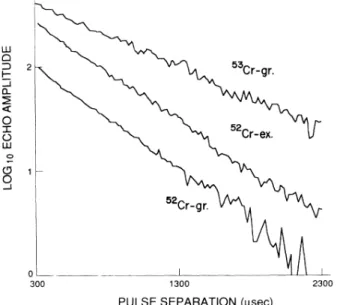
3 avoids these problems and provides large signals at full laser power, however, as will be discussed later, it re-quires an empirical correction to the dephasing time.Log plots
of
the echo decays are shown inFig. 4.
The de-cay curve consistsof
100points which were stored on afloppy disc along with run parameters and later fit to an exponential decay by regression analysis. A pulse repeti-tion rate
of
25 Hz with a 1-secboxcar output timecon-stant and adwell time
of
3sec gave an averageof
75 echomeasurements per point.
III.
RESULTS A. Correction time measurementsReferring
to
the laser andrf
pulse sequence shown inFig.
3,the purposeof
the first long laser pulse (width b,&)is to create polarized Al nuclei in the frozen core
of
theUJ CI 2 CL
0
CO LU CD U0
200 400 600 800 0—
' 300 1300PULSE SEPARATION (@sec)
2300
TIME(psec)
FIG.
2. Averaged echo signal (output from dc amplifier shown inFig. 1).FIG.
4. 'Al nuclear-spin-echo decay associated with ground(gr) and excited (ex) "Crand
"Cr
ions for0.0034wt.% Cr203 ruby.I 1O0
3+ The details
f
howw wever, the
e,
213 roduced by h ~ Cr isotope, clear polariz Interesting y 1 ser polanzat'of
E
R
transitio jthout ld be seen a laserecho sig' nals cou
ects in
mos p
laser in
rf
s d ear ier,1' to avoid
h 1 rned o time, t e a n again ne as
It
isclear fromfthee
RHS
detection o h p risesn the end
oft ep
b
edec
o r t for this, we g p dephasing time T2„ist
en O (h E 10— E I— 52 Crex 52 & Crg, 53 ~ Crgr ~ Optical R, (——1/2) OI
tI) 10 e E CD C'. C CL CI —1 —1 —1 2n 2nm 1 retical ' echo amp(2t
/Tz„)—
,n)(n—
,+n,
)exp—
E(t)
~(n,
nz n—, (2) he echo time ' ns resent a e 1 r populations p ~ are nuclear p where n;2t.
Since e (i.e., twiceAld'
h asing time i i .4). For
F
+C
f
opulatlo rises because o p rrection arisescor
by ed valueof
T,/2.
sd'd"'
f
theo 01 01I
O CI
O lOI
O U 0 01 0.01 0001 Concentration w de hasing time ef
"Al
nuclear ep ) d ration ( r { t t~ Ald
for a efield of 3.5 p (2t/Ts n;=n,
oexp— ce,then 1/T2n+
2/Ts )E(t)
~exp
—
[
f
the echose-' n at the start o is the population at where n;0 is t e quen 52
T
d state Cr, 'asso ' ith groun
ue
of
o'
td
ited-state va u Al nuclei assoFor
ate we e h o d in the six tical branching veraEPR
1 minesec
(Ref
14) resp ears to b however, app ant factor,o
as discusse secto msec as ' ethe polarized dFor
were nonexp ndgo
38 d se leng 1 it did no p po A Al dephasing i affecte theT
forf
Al near r hos
in is h r isotopescot
e ndee
1 ctronic spinin d C 1 which resus'
GHz) Frequencyt"1
'nt'n"t
'nd Al Raman p er frequency endence of nal(J
line at R d-st t si 1 h h ' pie. appears a 'ted-state s'g Cr. The exci e-52C R 17772 A. SZABO, T.MURAMOTO, AND
R.
KAARLI 42B.
'Al dephasing times inthe frozen coreFigure 5shows the dependence on concentration
of
thedephasing time
T2„of
Al nuclei associated withground-state Cr and Cr ions and excited-state Cr
ions. The results for excited-state Cr ions were the same as for the ground state (the two highest
concentra-tions were not measured however). The times represent averages
of
decays taken for various lines in theI,
J,
K,L
Al sets. We did not exhaustively study all 40 lines, however, there was no marked (
&20%)
variationof
T2„for various lines.
For
0.05%
ruby, ground-state echoesfor Al associated with
'
Crcould not be observed and a dephasing time was inferred from linewidth measure-ments discussed inSec.
IVC.
SSC
C. Optical spectral dependence ofRaman heterodyne signal
Figure 6 shows the optical spectral dependence
of
theRHS spectra reported earlier. The echo intensities
fol-low a similar dependence. Especially noteworthy for this more concentrated sample is that the Al NMR signals
are
—
10X
larger for Cr than for Cr in the groundstate ( Cr abundance is
9.65%,
Cr is83.
8%).
It
isprobable that the Al signals reported for the ground
state in
Ref.
3are for Crwhile the excited-state ones arefor
Cr.
We also note that the temperature dependenceof
the spectra reported earlier (for0.
05%
ruby) becomes less marked for lower concentrations and both ground-and excited-state spectra appear at 2K.
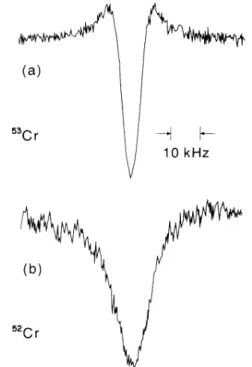
FIG.
7."Al
NMR line shapes (Lline at 6.4 MHz) (Ref.3) associated with ground-state (a)"Cr
and (b)'
Cr ions for a 0.03-wt% Cr203 ruby. For the most dilute crystal (0.0034%%uo),"Al
linewidths associated with'
Crequaled the"Cr
value of6 kHz shown here.IV. DISCUSSION
A. Verification ofthe frozen-core concept
A unique capability
of
superhyperfine RHS isthat ital-lows NMR echo studies
of
host ( Al) ions immediately surrounding a paramagnetic ( +Cr) ion in ruby, i.e.
, inthe frozen core as discussed in the Introduction. Earlier
ENDOR
(Refs. 16 and 17) andPENDOR
(Ref.6) studies have shown that the Al ions surrounding +Cr in ruby have their NMR frequencies substantially shifted from those in the bulk. Calculations' show that the core ex-tends out at least as far as-400
Al for theS
= —
—', stateof +Cr.
Since flip-flops are absent in the core, one wouldexpect that the Al dephasing time should be longer in the
core than in the bulk. This expectation is indeed verified from the data in
Fig.
5 which shows an Al-coredephas-ing time
)
1 msec (for0.
0034%
ruby), a value consider-ably longer than the bulk time'of
-60
psec.
Thus, the—
10 kHz linewidth shown inFig.
7is primarilyinhomo-geneous with a homogeneous width
of
1/(~T2„)-300
Hz. The inhomogeneity arises from the slow time
vary-ing magnetic field '
of
nearby Crand Al spins and possi-bly from static variations in the Al shf parameters'
(di-polar, exchange, and quadrupole) due to crystal defects.However, theoretical' and experimental ' studies
indi-cate that dipole interactions account for most
of
theob-served Al NMR linewidth
(-8
kHz) in the bulk. Theobservation, in this work,
of
a similar linewidth in thecore suggests that dipole interactions also determine this width. Finally, it appears that, even for our most dilute
concentration
of
0.
0034%,
the Al dephasing time isstill being determined by Cr-Cr spin flips. Presumably, at sufficiently low concentration, the Al dephasing timewill be determined by Al-Al spin flips outside the core
and remaining Crdephasing processes.
B.
Dephasing due to direct and indirect spin flippingThe Al dephasing in
Fig.
5shows an interesting vari-ation with concentration. We attemptto
analyze these results using a modelof
host or dopant spin-flip-induced dephasing used previously for nuclear- and electron-spin resonance ' and optical transitions."
In this model,dephasing can occur by a direct spin
Pip
between aB
atom in a coherent superposition state (henceforth calleda "coherent atom") and other incoherent
B
atoms.For
optical dephasing
of
the inhomogeneousR
& line in ruby,this process (in the ground-state A2 spin levels) removes
the
B
atom (Cr) from the coherent system similar to a spontaneous emission event.For
the NMR dephasingof
Al in the frozen core, a Cr(—
3)~Cr(
—
—,
'),
(where thebracketed numbers indicate the electronic-spin state) spin flip, involving acoherent Al attached tothe Cr(
—
—
,
'),
willdephase the NMR coherence because
of
the large changein NMR frequency that occurs when the Crchanges spin
state.
For
the field used in this work, this change isAf„—
1—3 MHz when theCr
spin changes fromS
= —
—',to
—
—,',
an amount well outside the NMR linewidthof
—
10kHz. We note that evenif
the Cr flips back to its original state after a timeht,
the associated Al will bede-phased by a (random) amount
hf„At.
There are,of
course, other processes that dephase frozen-core Alnu-clei, in particular, indirect spin jlips, as will be discussed further below. However, an important conclusion is that
the observed Al dephasing time gives a lower limit tothe
Cr-Cr spin-flip time.
Indirect spin /tips create a fluctuating magnetic field that produces random frequency shifts and hence dephas-ing.
For
Al dephasing in the frozen core there are atleast two contributions. One is due to Cr-Cr spin flips
in-volving Cr's not participating in the Raman detection process (because
of
optical inhomogeneous broadening}or in electronic spin states other than
S
= —
—,'.
Theform-er will be predominant since the ratio
of
the R& opticalinhomogeneous tohomogeneous width is
-10
. Another sourceof
indirect spin Pip dephasingof
the Al NMR willbe Al-Al flips outside the frozen core. This contribution isexpected to be small and isapparently not significant is this work since
T2„,
the nuclear dephasing time, was found to be Cr concentration dependent over the entire range studied.Consider now the Al dephasing associated with Cr in
the ground
[(
A2(—
—,')]
or optically excited[(E
—
(—,')]
state. In the excited state only indirect Cr-Cr and Al-Al spin flipping is important. Direct Cr flips are negligible because the number
of
Cr in the excited state will be much smaller, becauseof
hole burning, than theground-state population by about a factor equal to the ratio
of
optical inhomogeneous tohomogeneous widths. Also, we
note that the level spacings are different in the ground and excited states, so that excited-state ions cannot flip
with those in ground state. These arguments allow a
deconvolution
of
the direct and indirect spin-flip-induced dephasing. Since all decays are exponential, we write forthe Al dephasing time
Tz„(
—
—',} associated with a ground-state A2(—
—',)+Cr
spin,(3) where Dand
I
stand for direct and indirect.For
theex-cited state,
(4)
since TD(
—
—,') is very long. Also, we haveTt(
—
—,')=Tt( —
—,')
since Tt is proportional to themag-netic splitting rate
of
Al which is independentof
the+Cr
spin state. Finally, we assume (1)that thefluctuat-ing magnetic field generated by Cr-Cr spin flips at a
par-ticular
+Cr
site are independentof
the spin stateof
thatsite and (2) that the field due to Al-Al flips are much smaller that that due to Cr-Cr flips. Equations (3) and (4} then allow calculation
of
the direct and indirectdephas-ing times from the observed
T2„values
inFig.
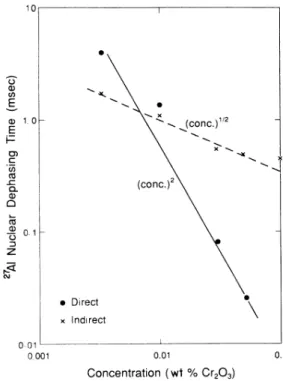
5. These times are shown plotted inFig.
8. We see that thein-direct dephasing time varies with concentration
c
asc
'while the direct time varies as
c
. The direct and indirect times are equal forc-0.
01%%uo and for concentrationsabove this value, Al nuclear dephasing is predominantly determined by direct Cr-Cr spin flips. The square-law
concentration dependence
of
TD=
Tf
(the Cr-Cr spin-flip10 1,0— E CD (h l5 Q) Ci tg 0.1— CO O
z
~ Direct x Indirect 0 01 0 001 0.01 Concentration (wt %Cr, 03) 0.1FIG.
8. Deconvoluted (from Fig. 5, see text) direct andin-direct spin-induced 'Al NMR dephasing time dependence on %Cr,03 concentration. Lines showing a square-law and
square-root dependence on concentration are fit to the direct
and indirect data points.
time) may be compared with standard theories
of
spinflipping. '
For
dipolar broadening by randomly posi-tioned like spins in a solid, astatistical theory givesbee]&2
—
3.
8Ayn,
Tf
'=
—,'(2b,
co,i~)=2X10'
f,
(6)where
f
is the fractionof
+Cr
in Al sites (forW
=
wt %%uo Cr203, then W=
149f).
Equation (6) predictsa spin-flip time much shorter than observed and also a linear dependence on concentration, contrary to experi-ment. This estimate for
Tf
is incorrect, however, since itassumes that the only source
of
broadening is due to Cr-Cr interactions. In fact, the rubyEPR
linewidth only varies a small amount (36—
40 MHz FWHM) in the con-centration range0—
0.
05%%uo and is mainly due to Cr-Alsuperhyperfine interactions. ' Most
of
this broadeningis inhomogeneous and hence T&will lengthen because
of
a decrease
of
line overlap.For
an inhomogeneous half-widthhco;„„»hco,
&2,Mims estimates a flip time (with a numerical error correction here)where b.co», is the
'
Cr (HWHM)EPR
linewidth,y=g»P,
and n is the impurity density. Partof
this linewidth is quasistatic (inhomogeneous or alternatively called heterogeneous ) and part is dynamic (homogene-ous) arising fromS S
spin-flip terms in the dipolar in-teraction Hamiltonian. One-thirdof
b, co,&2 is estimatedto be homogeneous, yielding a spin-flip
time"
(in sec ')7774 A.SZABO,
T.
MURAMQTO, ANDR.
KAARLI 427TAco&/2
Tf
'=b, co„,
(7)26COlng
where Ace;„b is the HWHM
+Cr EPR
linewidth due tothe Al-Cr interaction. The physical basis
of
Eq. (7) is clear, two+Cr
ions can only flipif
they are"dressed"
with energetically equivalent Al spin orientations. Equa-tion (7) predicts a square-law dependence for
TP
on con-centration in accord with our observations. TakingAce;„z=(2m)18X10
and calculating bco,&~=1.34X10,
we obtainTf
=40
psec for0.
0034%
ruby which is some-what faster than the observed valueof
—
5 msec.If
weuse, more properly, the homogeneous part
of
Ace&&2 inEq. (7),
i.
e., 3bco,&2, thenTf
-0.
4 msec. This is still anorder
of
magnitude faster than our observation. A plau-sible argument isthat it is incorrect to assume that allof
the homogeneous linewidth, Theo,&2,isdue to direct spin
flipping, part
of
it is certainly due to indirect flips.To
agree with experiment, the direct-spin flipping part should be
—
—,'of
the total homogeneous width. Thus, thespin-flip time is determined by
—
—,of
the dipolar width inagreement with the —,', factor estimated by Bloembergen
and used in the Monte Carlo dephasing calculations
of
Defoe
etal.
The
c'
variationof
nuclear dephasing time is not ex-plained by theory. A basic difficulty is that all theories predict a nonexponential decay contrary to experiment.For
an echo intensity decayI
(t)
0-exp(kt)",
the v—arious theories gave n=
—,',
=,',
2, or 3 depending on how thedipolar-induced frequency fluctuations are modeled. We refer to the excellent article by Mims for a discussion
of
these theories.
It
is interesting to note that a square-root dependence on concentration has also been observed forphoton echo dephasing times in ruby suggesting a
con-nection between nuclear and optical dephasing as will be discussed later.
C. Comparison with other work onCr-Cr spin-flip times The subject
of
spin-flip time arises in many contexts,e.
g., calculationof
photon echo and opticalfree-induction decay, ' optical hole-burning
experi-ments, ' as well as in
EPR
studies which refer tothe process as "resonant cross relaxation"
(RCR).
While harmonic cross-relaxation times involving multiple spinflips have been measured in detail (e.g., in ruby ),direct
RCR
measurements have remained experimentallyelusive because
of
the resonant natureof
the process. A unique aspectof RHS
shf nuclear echoes is that we now have a sensitive probe for detectionof
spin flippingof
the coupled Cr ion. Apart from the interpretationgiven in the previous section, we may firmly conclude
that the Cr-Cr spin-flip time cannot be shorter than the observed 'Al dephasing time.
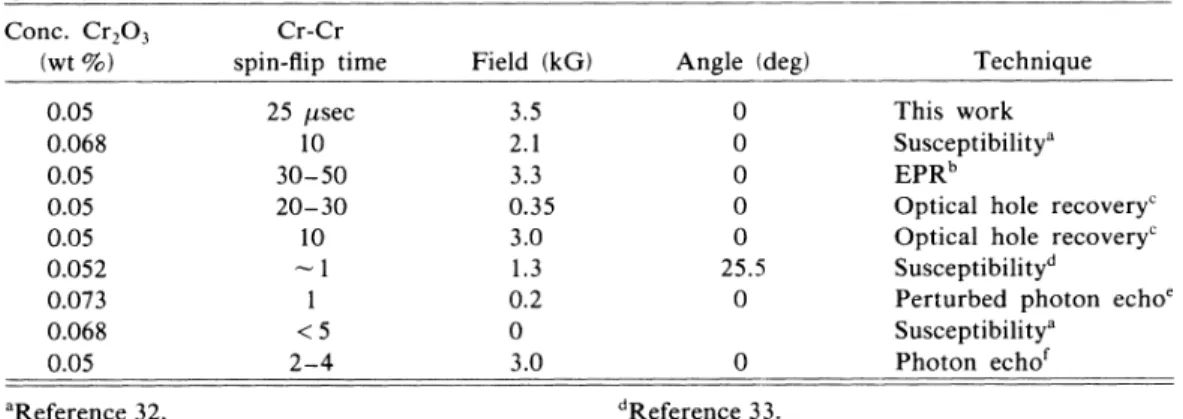
It
isof
interest to compare our spin-flip data with those estimated using othertech-niques as shown in Table
I.
The comparison is for-0.
05%
concentration, a popular value becauseof
its use in maser and laser devices. Unfortunately for thisconcentration, we were unable to see echoes and we
es-timated the spin-flip time from the increase in NMR
linewidth from 6to 15 kHz as the Cr concentration is
increased from
0.
0034 to0.05%
(Fig. 7). A Voightdeconvolution procedure was used taking a 6-kHz Gauss-ian shape [due to Al interaction broadening
—
thecal-culated value is 6.6 kHz (Ref. 16)] broadened by a
Lorentzian contribution bvL (due to lifetime broadening
by Cr-Cr flips) to a total width
of
15 kHz and settingb, vL
=
1/(~Tf).
We note good agreement between this work and most
other data taken at high fields. The faster cross relaxa-tion at low fields (Ref. 29 is an exception, however) is consistent with the known decrease in optical dephasing time with decreasing field. This decrease may be due to
an increase in the
+Cr
spin-flip rate becauseof
the small-er shf splitting and corresponding ease in conserving en-ergy in a Cr-Cr flip. Earlier studies in this laboratory (TableI,
Ref. 36), however, disagree with the current work. This disagreement is ultimately due to the fact that our current conclusion that optical dephasingof
0.05%
ruby is mainly due to indirect spin flipping is in-consistent with the observed ratioof
dephasing timesfor the Rt(
—
—,')
andR,
(—
—
',)transitions,Tq,(
—
,
')/T2.
(—
—)=
1—.23p,sec/0
45 @sec.=
2. 73 .TABLE
I.
Summary of Cr-Cr spin-flip times in the ground state ofruby obtained in this work and elsewhere using other techniques.Conc. Cr203 (wt%%uo) 0.05 0.068 0.05 0.05 0.05 0.052 0.073 0.068 0.05 Cr-Cr spin-flip time 25 psec 10
30-50
20-30
10—
1 1(5
2—4 Field (kG) 3.5 2.1 3'3 0.35 3.0 1.3 0.2 0 3.0 Angle {deg) 0 0 0 0 0 25.5 0 Technique This work Susceptibility' EPROptical hole recovery' Optical hole recovery' Susceptibility
Perturbed photon echo' Susceptibility' Photon echo' 'Reference 32. Reference 31. 'Reference 29. Reference 33. 'Reference 35. Reference 36.
For
indirect decay this ratio should be equal to the ratioof
R,
(—
=,')
toR,
(—
—,')
magnetic splitting rates, i.e.,7.
6.A possible explanation for this disagreement is that the
field fluctuations due to spin flipping are not the same at spin
—
—,' and—
—',+Cr
sites,i.e.
, that spin correlationsexist. This could be a consequence
of
the fact that the Al frozen core surrounding a+Cr
islarger at spin—
—',sites than at
—
—,' sites. ' This would tend to inhibit+
—',~+
—,' spin flips compared to+
—,'~+
—,' flips. Since a+
—,
'spin
would have a tendency to have close to it a+
—',spin (to preserve local magnetic neutrality), then it
fol-lows that the magnetic field fluctuation would be slower
for
+
—,'
spins than for+
—,' spins. This would tend to pushTz,(
—
—,')/Tz,
(—
—,')
to smaller values consistent withex-periment.
D.
'
CrresultsFigure 5 shows that the dephasing time
of
Al nuclei near ground state Cr has asquare-root dependence on aconcentration over most
of
the range studied similar tothe excited-state Cr results. This indicates that the
(ground-state) spin-flip time
Tf
forCr~
Cr andCr~52Cr
is much longer than for 52Cr~s2Cr. The Cr+-+ Cr flip time is longer becauseof
the relative iso-tope populations which lengthenTf
by—
100(assuming a square-law dependence forTf
as established earlier).The Cr+ CrAip time is longer essentially because Cr
has a nuclear spin
I
=
—',.
This splits the electronic spinlevels into four levels as described by the Hamiltonian'
H
A ~IS
+
A,
(I
S
+IySy)
where A~~
=
A=50.
4 MHz for the ground state and&6
MHz for the excited state. Thus, the
EPR
linesof
Crare detuned from Cr by
+
A/2(mi=+
—,')
and+32/2(mi=+
—',) resulting in a longer flip time.Tf
varies with line overlap as2
E.
Relation between Alnuclearand Croptical dephasing times
Figure 5 shows the concentration dependence
of
theoptical dephasing time T2,
of
theR,
(—
—,')
transitionob-tained from measurements in our laboratory and else-where.
It
is clear that both optical and nucleardephas-ing times are still controlled by Cr concentration effects
even for our most dilute sample
of
0.
0034wt%
Cr203.While earlier we concluded that the Al nuclear dephasing time
T2„was
determined by direct Cr spin flips forcon-centrations &
0.
01%,
we conclude fromFig.
5that T2, isdetermined by indirect spin flipping for concentrations as high as
0.05%.
This conclusion is based on the fact thatT2,
—
1 psec for0.
05%
ruby compared with thespin-flip time
Tf-25
IMsec and disagrees with Compaan's"conclusion that optical dephasing is caused primarily by direct Crspin flips.
For
the most dilute crystal,if
the Al nuclear and Cr optical dephasing are due to a common Auctuatingmag-netic field (a reasonable assumption since they are adja-cent) produced by flipping Cr spins, then the two
dephas-ing times should be related by their magnetic splitting
rates
S.
For
theR,
(—
—,') optical transitionS,
=
(g,
—
gg )p, /2, while for the nuclear transitionS„=g„P„,
where for Cr,g,
=2.
445, gg=1.
984, andP,
=
1400 kHz/G and for Al,g„P„=
l.
1kHz/G.
Thera-tio
of
these splitting factors isS,
/S,
=290
comparedwith the observed dephasing times ratio
T2„
/T2,
=
(1.
2 X 10)/(1
X10 )=
120.We believe that this approximate correspondence
pro-vides support for the indirect spin-Aipping model. How-ever, additional complexities need to be considered, in particular, Al-Al spin Aips, frozen-core effects, and possi-ble spin correlations as discussed earlier.
V. CONCLUSIONS
Tf
'~exp
—
21n2 (9)where b,v is the FWHM
EPR
linewidth (Gaussian lineshape assumed) and v,
—
vz is the line separation.For
electronic spin flipping between Cr and the
mr=+
—,'lines
of
'
Cr['
Cr(m,= —
—3~
—
—,')
and'Cr(m,
=
—
—,'~
—
—3,mz=+
—,')],
Tf
is lengthened by afactor 2 andby a factor 600 for
mr=+
—',, assuminghv=36
MHz.Thus, it appears that the echoes observed at higher con-centration arise from Al associated with
ml=+
—', Crions.
Finally, the effect
of
the slower spin-Aip rate for Cron the optically induced nuclear polarization is clearly evident in Fig. 6. Although Cr is
—
10X
less abundantthan Cr, the Cr Raman NMR signal is
—
10X
largerthan for Cr (0.
03%
ruby).For
0.
1%
ruby, the latterra-tio is much larger and the Cr signal is completely
swamped by the tail
of
the Crsignal.Raman heterodyne NMR echoes
of
superhyperfinespectra allows measurement
of
the spin-flip timeof
thecoupled ion. Bloembergen's frozen-core model was
directly verified by observation
of
dephasing times in the core. Optical dephasing ion ruby in the concentrationrange
0.
0034—
0.
05 wt% Cr203 is due to indirect+Cr
spin Aipping. Al nuclear and+Cr
optical dephasing times are approximately related by the magnetic splitting ratesof
the transitions. The deviation suggests the pres-enceof
spin correlations for which different+Cr
spin states see different magnetic fluctuations.ACKNOWLEDGMENTS
The excellent technical assistance
of
J.
Froemelthroughout this work is acknowledged as are useful dis-cussions and advice from
Dr.
L.
E.
Erickson.7776 A. SZABO,
T.
MURAMOTO, ANDR.
KAARLI 42 'Now at Shiga University, Otsu 520, Japan.~Now at the Institute of Physics, Tartu, Estonian S.S.
R.
,U.S.S.
R.
J.
Mlynek, N.C.Wong, R. G.DeVoe,E.
S.Kintzer, andR.
G. Brewer, Phys. Rev. Lett. 50, 993 (1983); N. C.Wong,E.
S. Kintzer,J.
Mlynek,R.
G. DeVoe, andR.
G.Brewer, Phys.Rev.
8
28,4993(1983).A preliminary description ofthis work is given in
T.
Muramo-to,
R.
Kaarli, and A.Szabo, in Laser Spectroscopy IX,editedby M.S.Feld,
J.
E.
Thomas, and A. Mooradian (Academic,New York, 1989),pp.362-364.
A. Szabo,
T.
Muramoto, andR.
Kaarli, Opt. Lett. 13, 1075(1988).
4G.
R.
Khutsishvili, Comments Solid State Phys. 5,23 (1972),and references therein.
~N.Bloembergen, Physica 15, 386 (1949).
P.
F.
Liaoand S.R.
Hartmann, Phys. Lett. A38,452(1965);P.F.
Liao, P.Hu,R.
Leigh, and S.R.
Hartmann, Phys. Rev.A9, 332(1974).
7W.
B.
Mims, in Electron Paramagnetic Resonance, edited by S.Geschwind (Plenum, New York, 1972), pp.
263-351.
R.
M. Shelby, C. S.Yannoni, andR.
M. Macfarlane, Phys.Rev.Lett. 41, 1739 (1978). A.Szabo, Opt. Lett.8, 486 (1983).
'oR. M.Macfarlane and R.M.Shelby, in Spectroscopy ofSolids Containing Rare Earth Ions, edited by A.A.Kaplyanskii and
R.
M. Macfarlane (North-Holland, Amsterdam, 1987), pp.51-184.
"A.
Compaan, Phys. Rev.B5,4450(1972).J.
Lambe, N. Laurance,E.
C.McIrvine, andR.
W.Terhune, Phys. Rev. 122,1161(1961).' C. D. Jeffries, Dynamic Nuclear Orientation (Interscience, New York, 1963).
'
K.
J.
Standley andR.
A. Vaughn, Electron Spin Relaxation Phenomena in Solids (Hilger, London, 1969).S.Geshwind, G.
E.
Devlin,R.
L. Cohen, and S.R.
Chinn,Phys. Rev. 137, A1087 (1965).
N. Laurance,
E.
C.McIrvine, andJ.
Lambe,J.
Phys. Chem. Solids 23, 515 (1962).' P.
F.
Liaoand S.R.
Hartmann, Phys. Rev.B8,69(1973). ' A.Szabo,J.
Opt. Soc.Am. B 3,514 (1986).R.
Boscaino,F.
M. Gelardi, andR.
N. Mantega, Phys. Lett.103A,391(1984).
R.
G. DeVoe, A. Wokaun, S.C. Rand, andR.
G. Brewer, Phys. Rev. B23, 3125 (1981).C. M.Verber, H. P.Mahon, and W. H. Tantitila, Phys. Rev. 125, 1149 (1962).
P.Hu and S.
R.
Hartmann, Phys. Rev.B9,1(1974).~3A. Abragam, The Principles
of
Nuclear Magnetism (Oxford,New York, 1961).
~4M. Mehring, Principles
of
Kigh Resolution NMR in Solids (Springer-Verlag, Berlin, 1983).~~W.
J.
C. Grant and M. W. P. Strandberg, Phys. Rev. 135,A727 (1964).
~6R.
F.
Wenzel, Phys. Rev.B1, 3109 (1970).P.
F.
Liao and S.R.
Hartmann, Opt. Commun. 8, 310 (1973). A. Szabo, Phys. Rev.B 11,4512 (1975);P.E.
Jessop,T.
Mu-ramoto, and A.Szabo, ibid. 21, 926{1980).
T.Endo, T.Hashi, and T.Muramoto, Phys. Rev. B34, 1972
(1986).
N.Bloembergen, S.Shapiro, P.S.Pershan, and
J.
O.Artman, Phys. Rev. 114,445{1959).'R.
L. Kyhl andB.
D.Nageswara-Rao, Phys. Rev. 158,284(1967).
R.
Cremer, Phys. Status Solidi 42, 507(1970).V.A. Atsarkin, Fiz. Tverd. Tela (Leningrad) 17, 2398 (1975) [Sov.Phys.
—
Solid State 17,1582(1975)].34W.
B.
Mims andJ.
D.McGee, Phys. Rev.119,1965(1960).3~V.S.Lobkov, S.A. Moiseev, and
E.
J.
Shtyrkov, Opt.Spek-trosk. 64,79 (1988).