HAL Id: inria-00584926
https://hal.inria.fr/inria-00584926
Submitted on 2 May 2011
HAL is a multi-disciplinary open access
archive for the deposit and dissemination of
sci-entific research documents, whether they are
pub-lished or not. The documents may come from
teaching and research institutions in France or
abroad, or from public or private research centers.
L’archive ouverte pluridisciplinaire HAL, est
destinée au dépôt et à la diffusion de documents
scientifiques de niveau recherche, publiés ou non,
émanant des établissements d’enseignement et de
recherche français ou étrangers, des laboratoires
publics ou privés.
Further development of learning techniques
Antonia Bertolino, Antonello Calabro, Sofia Cassel, Yu-Fang Chen, Falk
Howar, Bengt Jonsson, Maik Merten, Antonino Sabetta, B. Steffen
To cite this version:
Antonia Bertolino, Antonello Calabro, Sofia Cassel, Yu-Fang Chen, Falk Howar, et al.. Further
development of learning techniques. [Research Report] 2011. �inria-00584926�
ICT FET IP Project
Deliverable D4.2
Further development of
learning techniques
Project Number : 231167
Project Title : CONNECT – Emergent Connectors for Eternal Software
Inten-sive Networked Systems
Deliverable Type : R
Deliverable Number : D4.2
Title of Deliverable : Further development of
learning techniques
Nature of Deliverable : R
Dissemination Level : Public
Internal Version Number : 1.2
Contractual Delivery Date : 31 Jan. 2011
Actual Delivery Date : 17 Feb. 2011
Contributing WPs : WP4
Editor(s) : Bengt Jonsson (UU), Bernhard Steffen (TUDo)
Author(s) : Antonia Bertolino (CNR), Antonello Calabr `o (CNR), Sofia
Cas-sel (UU), Yu-Fang Chen (UU), Falk Howar (TUDo), Bengt Jons-son (UU), Maik Merten (TUDo), Antonino Sabetta (CNR), Bern-hard Steffen (TUDo)
Reviewer(s) : Amel Bennaceur (INRIA), Val ´erie Issarny (INRIA), Massimo
Abstract
The CONNECT Integrated Project aims at enabling continuous composition of networked systems, by developing techniques for synthesizing connectors. A prerequisite for synthesis is to learn about the interaction behavior of networked peers. The role of WP4 is to develop techniques for learning models of networked peers and middleware through exploratory interaction.
During Y1 of CONNECT, exploratory work was performed to understand the requirements for learning techniques in the CONNECTprocess, and to develop concepts for using a priori knowledge about com-ponent interfaces as a basis for learning. During Y2, a major goal has been to develop techniques for automatically learning models of networked peers and middleware, based on the concepts developed during Y1 (cf. D4.1). This deliverable surveys the significant progress made on problems that are im-portant for realizing this goal. We have developed techniques for drastically improving the efficiency of active learning, meaning to explore significantly larger parts of component behavior within a given time. We verified the power of our approaches by winning the ZULU challenge in competition with several very strong groups in the language learning community. We have also made significant breakthroughs for learning of rich models with data. We have developed a novel compact and intuitive automaton model for representing learned behavior in a canonical way. Canonicity is very helpful for organizing the resuls of exploratory interactions, since it allows the extension of stable techniques for learning clas-sical finite-state automata (such asL∗) to richer models with data. We confirm this by using the new
automaton as a basis for an extension ofL∗to richer automaton models. During Y1, we have identified
abstractions as an important concept in the process of learning behavioral models of realistic systems: we introduce a method for refining a given abstraction when needed during the learning process. We also present a specialization of learning, which does not generate complete models of behavior, but concentrates on aspects that are relevant in a specific context. Finally, the deliverable reports on our efforts to learn non-functional properties, the development of a monitoring infrastructure, and further development of the learning tool infrastructure, based on LearnLib.
Document History
Version
Type of Change
Author(s)
1.0
Initial version for internal review
All
1.1
Revised version including first review feedback
All
1.2
Version after internal review
All
Document Review
Date
Version
Reviewer
Comment
18.01.2011
1.0
Massimo
Tivoli,
Amel Bennaceur
–
Table of Contents
L
IST OFF
IGURES. . . 9
L
IST OFT
ABLES. . . 11
1
I
NTRODUCTION. . . 13
1.1 The role of Work Package 4 . . . 13
1.2 Brief Summary of Achievements in Y1 . . . 15
1.3 Review recommendations . . . 15
1.4 Challenges for Y2. . . 17
1.5 Overview of Achievements in Y2. . . 17
1.6 Enhancement of the Tool Infrastructure . . . 20
2
R
ECAP ANDE
XAMPLE. . . 21
2.1 TheL∗M Learning Algorithm . . . 21
2.2 Experimental Setup . . . 24
2.3 An Introductory Example . . . 25
2.4 Automated Test-driver Generation. . . 28
3
I
MPROVINGC
LASSICA
LGORITHMS. . . 31
3.1 The ZULU Competition . . . 31
3.2 A Configurable Inference Framework . . . 32
3.3 Continuous Equivalence Queries . . . 34
3.4 Results . . . 36
3.5 Discussion of the ZULU Rating Approach. . . 37
4
A C
OMPACT ANDI
NTUITITIVER
ICHA
UTOMATONM
ODEL. . . 39
4.1 Introduction . . . 39
4.2 An Illustrating Example . . . 41
4.3 Data Languages and Register Automata . . . 42
4.4 Constrained Word Representation of Languages . . . 43
4.5 A Compact Automaton Model. . . 45
4.6 A Succinct Nerode Equivalence . . . 48
4.7 Minimization . . . 49
4.8 A Hierarchy of Automata Models . . . 50
4.9 Conclusions and Future Work . . . 51
5
A
UTOMATEDL
EARNING OFM
ODELS WITHD
ATA. . . 53
5.1 Introduction . . . 53
5.2 Data Languages and Automata . . . 56
5.4 Inference of Data Automata. . . 58
5.4.1 Observation Tables . . . 59
5.4.2 Constructing Hypotheses . . . 60
5.4.3 Handling Counterexamples . . . 61
5.4.4 Correctness and Complexity . . . 63
5.4.5 Example Run of the Algorithm . . . 64
5.5 Experimental Results . . . 64
5.6 Conclusions and Future Work . . . 66
6
D
YNAMICR
EFINEMENT OFA
BSTRACTIONS. . . 69
6.1 Alphabet Abstraction Refinement. . . 70
6.1.1 Determinism Preserving Abstraction. . . 70
6.2 Automated Alphabet Abstraction Refinement . . . 72
6.3 An Example Run of the Algorithm. . . 75
6.4 Conclusion . . . 77
7
E
FFECT-D
IRECTEDL
EARNING. . . 79
7.1 Connect Model Requirements . . . 79
7.2 Accelerated Learning and Effect Guarantees . . . 81
7.3 Example . . . 82
7.4 Conclusion and Future Work . . . 83
8
L
EARNINGN
ON-
FUNCTIONALP
ROPERTIES. . . 85
8.1 Architecture of Extended Test-drivers . . . 85
8.2 The XMPP Case Study. . . 87
8.3 Conclusion and Future Work . . . 89
9
T
HEC
ONNECTR
UNTIMEM
ONITORINGI
NFRASTRUCTURE. . . 91
9.1 The Place of Behaviour Monitoring in Connect . . . 91
9.2 Architecture . . . 92
9.3 Implementation . . . 94
9.4 Runtime Operation . . . 96
9.5 Related Work . . . 98
10
C
ONCLUSION ANDF
UTUREW
ORK. . . 101
B
IBLIOGRAPHY. . . 103
List of Figures
Figure 1.1: Data-Flow in the Connect System . . . 14
Figure 2.1: Structure of Active Learning Algorithms (modeled in XPDD [67]) . . . 22
Figure 2.2: Experimental learning setup . . . 24
Figure 2.3: Test-driver & Alphabet Generation (modeled in XPDD [67]) . . . 25
Figure 2.4: Message Sequence Chart for Connected Implementations . . . 26
Figure 2.5: Behavioral Model of the Seat Booking System . . . 28
Figure 3.1: Extended Observation Packs . . . 33
Figure 3.2: Evolving Hypothesis. . . 35
Figure 3.3: Continuous Equivalence Query. . . 36
Figure 3.4: ZULU Rating for all hypotheses in a learning attempt, Problem 85173129 . . . 38
Figure 4.1: A canonical automaton, recognizing Llogin . . . 41
Figure 4.2: Our canonical automaton, recognizing Llogin . . . 41
Figure 4.3: Prefix of minimal DCDT for Llogin. . . 45
Figure 5.1: Final hypothesis (partly defined) . . . 65
Figure 5.2: Partial models for Queue, Stack, Bag, and a fragment of XMPP (from left to right) . . . 66
Figure 6.1: traditional use of abstraction (left) and abstraction as part of the learning process (right) 69 Figure 6.2: Processing of counterexamples . . . 73
Figure 6.3: Pseudocode of protocol entity . . . 76
Figure 6.4: Observation Table and hypothesis at the end of the first learning phase . . . 76
Figure 6.5: Treatment of a counterexample . . . 77
Figure 7.1: Communicating Components . . . 80
Figure 7.2: Transition in Inferred Model. . . 81
Figure 7.3: Behavioral model of a small example system. . . 82
Figure 7.4: Learned model of the example system . . . 83
Figure 8.1: Parallelized learning / equivalence approximation . . . 86
Figure 8.2: Sequence chart probe integration. . . 87
Figure 8.3: Behavioral model of subscription part of XMPP . . . 88
Figure 8.4: Batch sizes for XMPP case study . . . 88
Figure 9.1: The architecture of glimpse . . . 94
Figure 9.2: Sequence diagram of a classical interaction into glimpse Monitoring Bus . . . 95
Figure 9.3: ConnectBaseEvent Interface . . . 98
List of Tables
Table 2.1: Interface Descriptions . . . 25
Table 2.2: Parameter Structure and Effects . . . 27
Table 2.3: Abstract Input Alphabet . . . 27
Table 3.1: Algorithms: Configuration and Ranking . . . 37
Table 3.2: Detailed Training Example: Problem 49763507 . . . 37
Table 5.1: Observation Table (only showing a subset of all prefixes). . . 64
Table 5.2: Experimental Results. . . 65
1 Introduction
The CONNECT Integrated Project aims at enabling continuous composition of networked systems to
respond to the evolution of functionalities provided to and required from the networked environment. In this context, being able to automatically learn the behavior of networked components is vital.
At present the efficacy of integrating and composing networked systems depends on the level of inter-operability of the systems’ underlying technologies. However, interoperable middleware cannot cover the ever growing heterogeneity dimensions of the networked environment.
CONNECT aims at dropping the interoperability barrier by adopting a revolutionary approach to the seamless networking of digital systems, that is, synthesizing on the fly the connectors via which networked systems communicate. Connectors are implemented through a comprehensive dynamic process based on (i) extracting knowledge from, (ii) learning about and (iii) reasoning about, the interaction behavior of networked systems, together with (iv) synthesizing new interaction behaviors out of the ones exhibited by the systems to be made interoperable, and further (v) generating and deploying corresponding connector implementations.
This aim raises challenges for modeling and reasoning about system and connector behaviors, and for
synthesizing specifications of connector behavior. A high level view of CONNECT operation is described
in Section 5.1 of D1.11, as a system of various enablers that exchange information about the networked
system to be constructed, as shown in Figure 1.1.
Work Package 4 provides CONNECTwith the Learning enabler. In the CONNECTscenario, one cannot
expect all networked systems to provide formal specifications of their interaction behavior. For this reason, it is then necessary to have learning algorithms and techniques to dynamically infer specifications or models of the connector-related behavior of networked peers and middleware.
In particular, the Learning enabler (represented by the box labeled “WP4: Learning” in Figure 1.1) takes interface descriptions of components in the networked system, along with information on used data domains, to create a formal model of the behavior of networked systems using exploratory interaction, i.e., analyzing the messages exchanged with the environment. The resulting formal model can be in the form of a Mealy machine or a Labeled Transition System (LTS).
A major challenge for WP4 in CONNECTis to develop techniques for learning rich models of
compo-nents in networked systems. Such models will describe both control and data aspects of a component’s behavior, and also cover non-functional aspects. This will be performed by significantly advancing the state-of-the-art techniques for active learning of behavioral models that capture control and data aspects. Furthermore, the learning enabler should be able to introduce non-functional properties into models, us-ing information about metrics that are measurable when interactus-ing with the networked systems. This can be done, partly by cooperating with the monitoring system, developed in WP5 (see D5.1), which can be used to get information about the (in-)correctness of inferred models, and about observed metrics.
1.1
The role of Work Package 4
It is the task of Work Package 4 to develop techniques to realize the Learning enabler, i.e., to develop techniques for learning and eliciting representative models of the connector-related behavior of networked peers and middleware through exploratory interaction. The objectives, as stated in the Description of Work (DoW)2, are:
’... to develop techniques for learning and eliciting representative models of the connector-related behavior of networked peers and middleware through exploratory interaction, i.e., an-alyzing the messages exchanged with the environment. Learning may range from listening to instigating messages. In order to perform this task, relevant interface signatures must be
1CONNECT Deliverable D1.1,’Initial Connect Architecture’ 2CONNECT Grant Agreement, Annex I
Code of CONNECTor
Running Networked Systems (Before CONNECTor construction)
Running CONNECTed System (Networked Systems and
CONNECTors) WP1 WP4 WP3 Synthesis Code Generation WP5
Monitoring Dependability Analysis
Security Enforcement Trust Management Interface desc. of NS Metrics of interest provided by NS Ontology mapping on data domain
Guarantees and conditions to check in the CONNECTed
System Measurements and
logs that match specified conditions Mealy m/c of NS LTS of NS LTS of CONNECTor Dependability model Expected distributions of metrics Trust assessment deployment Data-flow during CONNECTor Construction Interaction with System Act ive 1 4 6 6 8 9 10 11 17 13 14 19 Data-flow after Deployment 9 22 21 12 9 Passive 20 24 17 Security policy of NS CONNECTor security Contract Active 17 5 15 16 21 2 3 Guarantees provided by NS 7 9 18 23 8 Ontology mapping between message sequences Transformation Data Work Package Activity System Discovery Learning
Figure 1.1: Data-Flow in the CONNECTSystem
available. A bootstrapping mechanism should be developed, based on some reflection mech-anism. The work package will investigate minimal requirements on the information about inter-faces provided by such a reflection mechanism in order to support the required bootstrapping mechanism. The work package will further support evolution by developing techniques for monitoring communication behavior to detect deviations from learned behavior, in which case the learned models should be revised and adaptors resynthesized accordingly.’
In the DoW, Work Package 4 is structured into three subtasks.
Task 4.1: Learning application-layer and middleware-layer interaction behaviors in which techniques are developed for learning relevant interaction behavior of communicating peers and middleware, and building corresponding behavior models, given interface descriptions that can be assumed
present in the CONNECTenvironment, including at least signature descriptions.
Task 4.2: Run-time monitoring and adaptation of learned models in which techniques are developed for monitoring of relevant behaviors, in order to detect deviations from supplied models.
Task 4.3: Learning tools in which learning tools will be elaborated, by building upon the learning frame-work developed by TU Dortmund (LearnLib), and considerably extending it to address the
demand-ing needs of CONNECT.
The work in WP4 is based on existing techniques for learning the temporal ordering between a finite set of interaction primitives. Such techniques have been developed for the problem of regular inference (i.e., automata learning), in which a regular set, represented as a finite automaton, is to be constructed from a set of observations of accepted and unaccepted strings. The most efficient such techniques use the setup of active learning, where the automaton is learned by actively posing two kinds of queries: a membership query asks whether a string is in the regular set, and an equivalence query compares
a hypothesis automaton with the target regular set for equivalence, in order to determine whether the learning procedure was (already) successfully completed. The typical behavior of a learning algorithm is to start by asking a sequence of membership queries, and gradually build a hypothesized automaton using the obtained answers. When a “stable” hypothesis has been constructed, an equivalence query finds out whether it is equivalent to the target language. If the query is successful, learning has succeeded; otherwise it is resumed by more membership queries until converging at a new hypothesis, etc. A more detailed account of active automata learning is presented in Chapter 2.
1.2
Brief Summary of Achievements in Y1
During Y1, work in CONNECTfocused on establishing a basis for addressing the hard challenges for the
learning enabler, as described in the Y1 deliverable D4.1: Establishing basis for learning algorithms. A large number of case studies were performed. Briefly, the achievements were in the following directions. Prerequisites for the learning process: From the large number of case studies, we inferred under which
conditions learning can be practically conducted, and derived conditions under which the learning
enabler will be able to fulfill its role in the CONNECT architecture. In order to learn a model of a
component, it is necessary to be able to reset it to a well-defined initial state between successive experiments, and it is assumed that it behaves deterministically at the level of abstraction that is considered.
Handling interface descriptions and data domain information: A major challenge in WP4 is to handle data in the learning enabler. We developed a framework for incorporating information about interface primitives, their parameters, data types, and their ranges, from an interface description, e.g., in WSDL, and for automatically transforming this information into a form usable by the learning tool LearnLib.
Bridging between abstract formal models and concrete system interfaces: The learning enabler must take into consideration that learning can only be performed in terms of concrete interaction with a networked peer, whereas the learning algorithms and the desired output of the learning enabler are in terms of abstract models, e.g., in the form of LTSs. We developed a systematic approach for bridging between these different levels of abstraction, by means of an explicitly added module that concretely performs the translation between different levels of abstraction. This allows to use finite-state learning techniques to generate models of infinite-state modules. This technique was
used, e.g., to generate models of (fragments of) the SIP and TCP communication protocols [8], and
of the new biometric passport [9]. Another technique was used to learn a model of a rather complex
gateway protocol [29].
Tool support: We upgraded LearnLib, our main learning tool, and ported it to the Java platform, ensuring that it is deployable on a range of platforms. Another emphasis was put on the ease of use and
intuitive handling of the tool in order to provide it for experimentation within the whole CONNECT
consortium.
1.3
Review recommendations
The review for WP4 contained the following passage:
The work of the first year is mainly a work plan which has to be carried out in the remaining time of the project.
Our view is that progress in WP4 during Y2 was achieved in correspondence with the work plan, including to develop techniques for automating learning with data, to initiate work on learning nonfunctional proper-ties, and to push the development and distribution of LearnLib. The review of D4.1also raised the following questions to be considered in future deliverables, which we tried to address in this year’s work.
1. Are meaningful abstractions related to ontologies? And how? What additional input is needed to
obtain meaningful abstractions?
We have addressed this remark at several levels. In order to produce meaningful abstractions, we have analyzed the semantic requirements of models, leading to different approaches for producing abstractions. Some of these use semantic (ontological) input; some do not:
Following our roadmap from D4.1, we investigated the prerequisites of abstraction and developed different approaches to abstraction in Y2. As we argue in Chapter 2 and Chapter 7, the learning enabler will have to produce semantically rich (i.e., annotated with pre- and postconditions) models
in order to enable synthesis of CONNECTors. In Chapter 5, we present a general pattern for learning
systems with data. The presented algorithm will construct abstract symbolic models directly. We expect that this pattern can be further improved by semantic (ontological) information about types of parameters and relations between data types.
On the other hand, in Chapter 6, we present an automated way of producing (behaviourally) mean-ingful abstractions without semantic input. The resulting models will be correct abstractions of a concrete system. However, without additional input, this method will obviously not infer concepts (e.g., not even numbers).
2. It seems reasonable to learn sequential components with a relatively restricted interface behaviour.
Blackbox components may well be of complex dynamic nature with internal concurrency? Can this situation be avoided?
This remark points out two problems that regular inference methods in practice have to face. These are (a) the fact that realistic systems, especially systems of systems, are non-deterministic to some extent, and (b) that real systems, consisting of numerous components, may be very complex. We have tried to address both of these points in our work, according to the following:
(a) Though not addressed explicitly in this deliverable, our pattern for test-drivers (cf. Chapter 8) can be used to hide certain degrees of non-determinism from the learning algorithms. We spent some effort on analyzing the prerequisites for automatic generation of test-drivers and developed a general scheme for the automatic generation of test-drivers (cf. Chapter 2).
(b) In order do deal with complex, large systems (in terms of the number of states), we improved classic learning algorithms to work with a minimal amount of queries, which is necessary for handling large models (cf. Chapter 3). We also developed a new learning algorithm that infers control be-havior and relations on data parameters and internal variables. We expect the algorithm, which will be presented in Chapter 5, to improve on the state-of-the-art wrt. size of models (that is contained information) by at least one order of magnitude.
3. The tool supposes input complete components and absence of resource related problems.
Never-theless, the usual question of “how to detect quiescence” should occur also in this context.
This remark emphasized possible limitations of the learning approach from a tester’s perspective; there are certain phenomena that models produced by state-of-the-art regular inference methods
do not capture. Considering the restricted scenario of CONNECT, however, we feel that both input
completeness and quiescence do not hamper the learning process. Most interaction with networked components is envisioned to happen on the protocol level. Sending an invalid packet to a system will then only lead to an increased amount of tests, not to failure of the system.
Wrt. quiescence, in D4.1 we introduced and discussed the usual assumption that networked com-ponents have ’stable’ states from which no further output occurs and input is enabled. Regular inference will (for now) only deal with stable states. However, we will investigate ways of relaxing this assumption in Y3, especially when learning non-functional properties, such as reliability. The design pattern for test-drivers presented in Chapter 8 could be the basis for extending learning beyond stable states.
4. It is also supposed that components can be accessed directly and there is no interference between
component and network properties. Is this realistic?
The focus of this remark is the potential pitfalls of the practical application of a theoretic approach. We adressed this remark in two ways, referring to Chapter 8 for details. On the one hand, as with most of the other remarks, we developed a method for “hiding” reality from the regular inference algorithms. On the other hand, we also spent some effort of learning non-functional properties, such as latency and reliability, and making this explicit in the learning process.
The following sections provide an overview on the challenges and achievements.
1.4
Challenges for Y2
During Y2, the main challenge has been to develop techniques for automated learning of rich component models, based on the findings during Y1. The overall goal has been to make the conceptual breakthroughs
that will enable the learning enabler to fulfill its purpose in the CONNECTarchitecture. The challenges that
have been addressed include the following.
Extending automated automata learning to rich models State of the art learning algorithms work on rather unexpressive finite-state models. To support all the phenomena that are typically used in the specification of networked components (parameterized actions, functional and non-functional parameters, state- or global variables) in a feasible fashion, the underlying models will have to be extended accordingly.
Thus, the challenge is to extend learning techniques to handle richer models including data of var-ious form. Within a suitable general framework, we should develop appropriate specializations to handle learning for specific types of systems. Examples of such classes include communication protocols, which require a proper treatment of parameters, and web services, where associated metadata descriptions should be exploited by suitable techniques. These specializations should result in modules of learning tools.
Handling QoS. The CONNECT framework also takes QoS parameters into account. We will develop
techniques for monitoring and learning QoS properties of interaction behavior. A first approach should cover latency behaviors. A satisfactory incorporation of QoS requires, however, a robust incorporation of nondeterminism into the learning framework.
Integration with Monitoring. In the CONNECTprocess, learned models of components should be mon-itored to detect evolutions of or previously unknown deviations from actual behavior. Therefore,
the challenge is to devise and implement mechanisms to observe running CONNECTed systems, in
order to provide feedback to the learning enablers in such a way that existing learned behavioral models can be continuously updated, based on actual observations taken in the field.
Tool support The tool support should be extended to support the conceptual advances made in CON
-NECT. Support should be included for data parameters, abstractions, and QoS properties. An easily
deployable “learning studio” should be made available to project partners. Tool-integration with mon-itoring tools should be realized.
1.5
Overview of Achievements in Y2
This deliverable D4.2 describes our progress and achievements in Y2. In this section, we survey our achievements while providing an overview of the material in this deliverable. As background for the techni-cal presentation in the subsequent chapters, we provide in Chapter 2 a summary of the basic technologies that make up the foundation for work in WP4. We first give a short overview of classical automata learning
techniques, including the L∗
Mlearning algorithm, and also describe how a concrete learning setup can be
constructed. A small example illustrates the process and the chapter concludes with a list of nontrivial issues that must be considered in a workable learning setup.
Algorithmic Improvements for Effective Learning Active learning relies on performing a significant number of membership queries (which can roughly be thought of as test cases) in order to generate a faithful model of a networked component. A major function of these queries is to search for yet undiscov-ered parts of the component’s behavior. In some theoretical work on learning, the search for undiscovundiscov-ered behavior is encapsulated into complexity-hiding concepts, sometimes called “equivalence queries”. Real learning must face the challenge to carry out this search efficiently. First, the number of employed queries has to be optimized significantly. Especially for equivalence approximation, which is theoretically con-sidered to use a number of test runs that is exponential in the size of the model, a pragmatic approach has to be found. Second, and even more fundamentally, a feasible way of realizing (i.e., approximating) equivalence queries has to be found.
During Y2, we have made significant progress towards more efficient exploration of the behavior of a component. In Chapter 3, we present a learning algorithm that can be configured to have different characteristics wrt. resource consumption. Especially it can be used to save a considerable amount of membership queries compared with classic algorithms. We verified the power of our new approaches in
the ZULU challenge [42], which we won, in competition with several very strong groups in the language
learning community.
Learning Rich Automata Models with Data One of the main challenges for Y2 has been to extend
learning techniques to handle rich models including data of various forms. During Y1, we have approached this problem by manually adding an abstraction module, which connects a rich model to a finite-state abstraction, which can be learned by classical techniques. To address the challenge of automating this activity, we must face the problem to make learning algorithms data-aware in a deeper sense. This means that the learning algorithm must be able to produce carefully selected membership queries that involve data, and to organize their results in a well-defined way. In the absence of manual guidance, the organization should be done according to principles for how to structure state machines extended with data. Unfortunately, there exist almost no good candidates in the research literature for how to “best” structure such state machines. For many classes of such machines, there are no known minimal forms, and so already here there is a challenge to overcome.
In Chapter 4, we present a solution to the above challenge, by developing a canonical form for au-tomata with data, which significantly improves on previous work in this area. The result is a canonical form of register automata, i.e., finite-state machines extended with data variables, which is intuitive and succinct. The remarkable aspect of our work is that it allows to define a unique canonical automaton for any behavior, by means of generalizing the classical Myhill-Nerode theorem. In itself, this represents a significant contribution to the automata and modeling communities, since Myhill-Nerode theorems have been difficult to obtain for most extensions of finite automata. It also provides a very suitable basis for de-veloping learning algorithms, since the Myhill-Nerode theorem allows most of the principles of finite-state automata learning to be carried over.
Based on this breakthrough, it is thereafter much more straightforward to develop learning algorithms for behaviors that combine control and data. In Chapter 5, we present an extension of the active learning
algorithm L∗ to generate rich component models. We have implemented our algorithm in the framework
of the LearnLib tool [72], and applied it to a number of case studies.
Dynamic Refinement of abstractions During Y1, we have identified abstractions as an important con-cept in the process of learning behavioral models of realistic systems. We developed techniques for augmenting finite-state learning with abstractions in order to learn behavior of systems with data. In the previous paragraph, we described our progress during Y2 towards automating this process. One impor-tant part of such techniques is the ability to refine the abstraction when it is found to be inadequate. The typical sign of an inadequate abstraction is that it becomes non-deterministic. Intuitively, this can be un-derstood as a manifestation of the fact that the abstraction blurs information in the input to the component so that the learning algorithm can no longer generate a causal link between input and output. The remedy in such a situation is to refine the abstraction so that the detrimental blurring is removed.
In Chapter 6 we introduce a method for refining a given abstraction to automatically regain a deter-ministic behavior on-the-fly during the learning process. Thus the control over abstraction becomes part
of the learning process, with the effect that detected non-determinism does not lead to failure, but to a dynamic alphabet abstraction refinement. Like automata learning itself, this method in general is neither sound nor complete, but it also enjoys similar convergence properties even for infinite systems as long as the concrete system itself behaves deterministically, as illustrated along a concrete example.
In the context of CONNECTthis method will also be valuable when it comes to automatic generation of
test-drivers (cf. Chapter 2). A major step in the automation of test-driver generation will be the automatic production of abstractions. It is highly unlikely that an approach can be found that always immediately generates a correct and meaningful abstraction. Automated alphabet abstraction refinement will enable the automatic correction of “good” abstractions (in a sense to be defined more precisely below) rather
than trying to produce perfect abstractions. The remainder of this chapter is published as [60].
Effect-Directed Learning Within the context of the CONNECT project, automata learning is employed in ways that diverge considerably from, e.g., automata learning in the context of system validation. It thus
makes sense to evaluate the requirements on automata learning techniques in a CONNECT-specific usage
scenarios.
For instance, in a CONNECT scenario there may be a priori “relevant” information about scenarios.
This includes the observance of preconditions for system actions, such as, e.g., the precondition that in an e-commerce system a user has to be logged in before any business transactions can be concluded. A model useful for synthesis can be restricted to those scenarios where any such preconditions are obeyed and, obviously, should also contain information on how to operate all relevant system features. Still, to
ease the task of CONNECTor synthesis, it is desirable that the learned models only contain information on
such system properties which are needed for proper operation of the CONNECTed system. This implies
that a careful balance between (feature) completeness and model compactness has to be found.
In Chapter 7, we outline what the requirements are and propose a concept of “effect-centric” learning, which aims at decreasing time spent on learning while still guaranteeing a certain concept of “complete-ness”, i.e., that the models contain relevant information.
Learning Non-functional Properties In the CONNECTframework, the learning enabler is supposed to
gather information about non-functional properties while inferring functional models of networked systems. We are pursuing two lines of approach. One line is to consider latencies between interactions as a data parameter (e.g., in the form of time stamps), and use techniques like those mentioned under “Learning Rich Automata Models with Data” above to infer them. This line of work has progressed during Y2 with he work on [51].
Another line or work, is to augment an existing functional model with constraints on latencies between actions. In Chapter 8, we introduce the necessary extensions to learning technology alongside some
results of a prototypical application of this new method. Considering the CONNECT architecture and
data-flow (cf. Fig. 1.1), the learning enabler will get from the discovery enabler interface description of networked systems, ontology on data domain, and metrics of interest provided by networked system. While the first two will be used by the learning enabler to construct a test-driver and abstraction(s) as discussed in the previous chapters, the metrics of interest will be used to generate fitting probes into the learning process (see below). The learning enabler will produce guarantees provided by the networked
system as (non-functional) output, which will be used during dependability analysis. Consider latency, i.e.,
response time as an example of such a guarantee: the learning enabler can provide the information that a networked system did react to some message within 20 ms in 95% of the cases and did always react within 200 ms. Further examples are throughput, failure rates or influence of load on the aforementioned metrics.
The CONNECT runtime monitoring infrastructure A challenge for Y2 has been to build and integrate
an infrastructure to continuously monitor the runtime behavior of the CONNECTed systems to respond to
the growing needs of evolution and adaptation. The events to be observed, belonging to guaranteed func-tional and non-funcfunc-tional properties, can themselves vary in scope and along time. To address this need,
Such requirements are briefly summarized in Section 9. In particular, we expand here on the
require-ments of modularity and flexibility, which are key to support the integration with the various CONNECT
enablers.
In Chapter 9, we describe the implemented infrastructure and show how it can be applied to parame-terized models for various types of runtime analyses.
Algorithms for comparing automata, e.g., in equivalence queries The work on developing efficient algorithms for comparing hypothesis and target automata when performing equivalence queries in a
white-box context [12], which was reported in D4.1 received the EATCS (European Association for Theoretical
Computer Science) award for best theoretical paper at ETAPS 2010. The effort has been continued with
the development of so far best algorithms for comparing automata over infinite behaviors [11].
1.6
Enhancement of the Tool Infrastructure
During Y2 many new concepts, as sketched above, were conceived, and subject to experimental evalua-tion. To enable this experimentation, our central tool, the LearnLib framework for automata learning, had
to be extended accordingly. An overview on LearnLib is given in [84]. Work items on LearnLib included:
Implementation of test-drivers with data history: In many protocols values formerly transmitted play a key-role during communication. Thus a test-driver was created, which keeps a history of data values that can be used to construct learning queries. This functionality is important for automating
the construction of abstraction modules, as in [8,9]. The example presented in Section 2.3 employs
this test driver.
Development of fast equivalence oracles: This was key to participating and and eventually winning
the ZULU competition, giving valuable insight into concerns relevant to CONNECT scenarios. See
Chapter 3 for an overview.
Initial support for rich models with data: During Y2 a rich, data aware model formalism was created, as described in Chapter 5. The implementability of this approach was verified using an early real-ization within the foundations of the LearnLib framework.
Implementation of automatic alphabet refinement: To obtain experimental results on our method of alphabet refinement (cf. Chapter 6), an implementation was created and tested on a scenario previ-ously examined by Aarts et al. in [9].
Prototypical modules for effect-directed learning: In the context of CONNECT, it is important to create models fit for synthesis. Thus it is desirable to focus on relevant aspects of the system, while
ensuring that all necessary information on the target systems is contained (cf. Chapter 7 and [58]).
A proof-of-concept implementation was created.
Support for batches of learning queries: This enables parallel processing of queries, which allows to inflict high load on examined target systems. As a result non-functional data concerning the explored system can be collected in a more state approximating real-life load scenarios. More details can be found in Chapter 8.
Apart from extending the functionality of the LearnLib, work was also done on consolidation and doc-umentation. A stable version of LearnLib was made available on http://www.learnlib.de.
2 Recap and Example
This chapter briefly recalls the basic concepts of active learning. The introduced notation will be be used in most remaining chapters. We also provide a small motivating example that shows the application
of active learning in a CONNECT-specific case study.
2.1
The L
∗MLearning Algorithm
Query learning (or active learning) attempts to construct a deterministic finite representation, e.g., a Mealy machine, that matches the behavior of a given target system on the basis of observations of the target system and perhaps some further information on its internal structure. Here, we only summarize the basic
aspects of our realization L∗
M for Mealy machines [79], which is based on Angluin’s learning algorithm L
∗
for finite state acceptors [16]. A more elaborate version of this summary and an extended discussion of
the practical aspects of active learning is given in [101].
Definition 1. A Mealy machine is defined as a tupleSys = hQ, q0, Σ, Ω, δ, λi where • Q is a finite nonempty set of states (let n = |Q| be the size of Sys),
• q0∈ Q is the initial state, • Σ is a finite input alphabet, • Ω is a finite output alphabet,
• δ : Q × Σ → Q is the transition function, and • λ : Q × Σ → Ω is the output function.
Intuitively, a Mealy machine evolves through states q ∈ Q, and whenever one applies an input symbol (or action) a ∈ Σ, the machine moves to a new state according to δ (q, a) and produces an output according
to λ (q, a)1. We write q−→ qi/o ′ to denote that on input symbol i the automaton moves from state q to state
q′producing output symbol o.
Query learning is also referred to as active learning as it constructs Mealy machine models by actively querying the target system. It poses membership queries that test whether certain strings (potential runs) are contained in the target system’s language (its set of runs), and equivalence queries that compare inter-mediately constructed hypothesis automata for equivalence with the target system. Learning terminates successfully as soon as an equivalence query signals success.
In its basic form, active learning starts with a hypothesis automaton with only one state and refines this automaton on the basis of query results iterating the three main steps shown in Fig. 2.1: refining
the hypothesis, conformance testing, and analyzing counterexamples, until a state-minimal deterministic
(hypothesis) automaton consistent with the target system is produced. Key to achieving this result is the Nerode-like dual characterization of states:
• by a set, S ⊂ Σ∗, of access sequences. This characterization of state is too fine, as different words
s1, s2∈ S may lead to the same state in the target system. L∗Mwill construct such a set S, containing
access sequences to all states of the target automaton. It will also maintain a second set, SA, which together with S will cover all transitions of the target system (SA will during the course of learning always be SA = (S · Σ) \ S).
• by an ordered set, D ⊂ Σ∗, of distinguishing sequences. L∗
M realizes the characterization of
hypo-thetical states q simply in terms of vectors row(s) = hr1, . . . , rki (with ri ∈ Ω), characterizing states by means of subsequent outputs: For rows(s), let ri= λ(δ(q0, s), di).
1 In the remainder of this deliverable, we will use an extended version of the transition function: δ′
: Q × Σ∗
→ Qwith δ′
(q, aw) = δ′
(δ(q, a), w)), where q, q′
Extrapolating behavioral models with LearnLib
test-driver setup learning algorithm abstract interface
alphabet
make tests to refine hypothesis hypothesis counterexample found? analyze counterexample yes no conformance test counterexample return result final model
Figure 2.1: Structure of Active Learning Algorithms (modeled in XPDD [67])
The set S will be initialized as {ǫ}, containing only the access sequence to the initial state; SA will accord-ingly be initialized as Σ, covering all transitions originating in the initial state. The ordered set D will be initialized as Σ, allowing to identify a state by the output that is produced along the transitions originating in this state. The learning procedure then proceeds as shown in Fig. 2.1 by:
Refining the Hypothesis: This first step again iterates two phases. The first phase checks whether the constructed automaton is closed under the one-step transitions, i.e., each transition from each state of the hypothesis automaton ends in a well defined state of this very automaton. This is the case if for every r ∈ S · Σ there exists a s ∈ S with row(s) = row(r). Otherwise, S will be extended by the corresponding r until closedness is established (and SA will be extended accordingly). This extension is guaranteed to result in a unique fixpoint, independent of the order in which the rows are processed.
The second phase then checks whether two access sequences s1, s2 ∈ S with the same bit
vec-tor, row(s1) = row(s2), have also the same outgoing transitions, a necessary precondition for them to
represent the same state. This condition, which is called consistency, can be formalized as follows: ∀s1, s2∈ S ∀a ∈ Σ . row(s1) = row(s2) ⇒ row(s? 1· a) = row(s2· a).
It is easy to see that detected inconsistencies can be removed by elaborating the set D of distinguishing futures in a way that makes some of the difference observed on a distinguishing transition visible before that transition: one simply needs to prefix the distinguishing future that separates the two target states on the distinguishing transition by the label of this very transition.
Unfortunately, such additions to D may break the previously achieved completeness, which requires to re-iterate the completion procedure. This, in turn, may lead to new violations of consistency. However, successive iteration of these two steps is guaranteed to result in a unique, well-defined, closed, and complete hypothesis automaton whose states are characterized by the bit vectors. In more detail:
• every state q ∈ Q of the hypothesis automaton is reachable by at least one word s ∈ S, i.e., row(s) corresponds to q,
• there exists a transition δ(q, a) = q′ iff there exists s ∈ S with s reaching q (or with row(s)
corre-sponding to q) and row(s · a) correcorre-sponding to q′,
• The output function can be constructed from the row()-vectors as well. As D is initialized as Sigma, the values for all λ(q, a), where a ∈ Σ, are contained in the row(s) vector corresponding to q. Conformance Testing & Counterexamples: After closedness and consistency have been established, an equivalence query checks whether the language of the hypothesis automaton coincides with the lan-guage of the target automaton. If this is true, the learning procedure successfully terminates. Otherwise, the conformance test returns a counterexample, i.e., a word which distinguishes the hypothesis from the target automaton. All prefixes of a counterexample will be added to S (SA will be extended accordingly). This will lead to inconsistency, which in turn will lead to a new distinguishing suffix [79].
The correctness argument for the whole approach follows a straightforward pattern.
1. The state construction guarantees that the number of states of the hypothesis automaton can never exceed the number of states of the smallest (minimal) automaton, behaviorally equivalent to the target system.
2. The treatment of counterexamples guarantees that at least one additional state is added to the hypothesis automaton each round. Thus, due to 1), such treatments can happen only finitely often. 3. The conformance testing (or equivalence query) provides new counterexamples as long as the
lan-guage of the hypothesis automaton does not match the desired result.
Put together, this guarantees that the learning procedure terminates after at most n rounds with a minimal automaton, behaviorally equivalent to the target system, where n is the number of states of this automaton.
Figure 2.2: Experimental learning setup
2.2
Experimental Setup
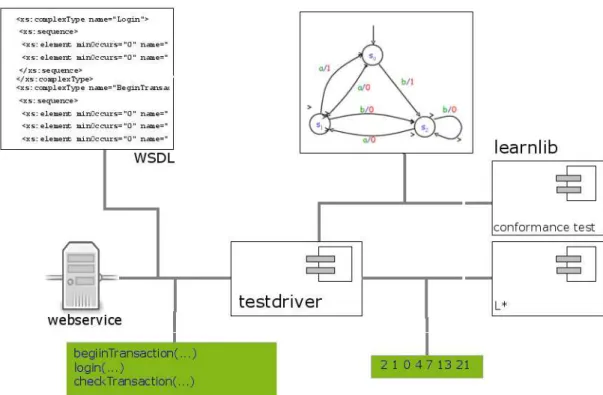
One can identify a simple pattern in all practical scenarios: a learning algorithm is instantiated with an (abstract) set of input symbols for the system to be inferred. The membership queries (sequences of input symbols) the algorithm produces in the course of learning, are then passed to a special test driver. The test driver operates the system to be inferred by 1) translating the membership queries into sequences of actions on the real system and 2) performing these actions one-by-one on the system. For each performed action a third component, a logging facility, records the reactions of the actual system. After the execution of a sequence of inputs has finished, the resulting sequence of reactions is translated into a sequence of (abstract) symbols understood by the learning algorithm and passed back (to the learning algorithm).
This leads to an experimental setup as shown in Fig. 2.2. A learning algorithm (e.g. from LearnLib) is connected to a special runtime environment (in this case, e.g., containing means to communicate with a web service). The runtime environment instantiates a connection to the system under test and exposes some test driver. The test driver then executes actions on the system under test on behalf of LearnLib, while the virtual machine (or some other adequate facility) monitors the system reaction. The reactions are translated by the test driver and the translated versions are reported to LearnLib.
Active automata learning is characterized by its specific means of observation, i.e., its proactive way
of posing membership queries and equivalence queries. Thus it requires some effort to realize this query-based interaction for the considered application contexts. The general requirements are shown in Fig. 2.3. As shown in Fig. 2.3, a test-driver can be generated from an interface description of the system under test (SUT), an instance pool, and a reset strategy. Sometimes, by considering a learning purpose, un-interesting parts of the SUT can be hidden from the learning algorithm. The interface description will be used to generate code to instrument the SUT. The instances that shall be assumed for data values in the communication with the SUT and the purpose allow the formulation of a mapping between abstract interface symbols and concrete actions on the SUT. Finally, the reset strategy will ensure that all tests on the SUT will be executed under the same initial conditions.
Preparations for extrapolation of abstract, parameterized models with LearnLib
generate abstract/concrete mapping
generate instrumentation layer interface description
build test driver
test-driver instance pool abstract interface alphabet learning purpose reset strategy SUT instrumentation
Figure 2.3: Test-driver & Alphabet Generation (modeled in XPDD [67])
2.3
An Introductory Example
Let us introduce a small example to illustrate the discussed ideas. Imagine a system for booking seats in events. A user of this system has to provide his credentials and can then browse through a list of venues. For each venue a list of available seats can be accessed. Finally, from these lists of seats a single seat can be booked, which will be confirmed in a corresponding receipt.
Table 2.1: Interface Descriptions
Interface 1 Interface 2
- session← openSession(user,pwd)
venue[]← getVenues(user,pwd) venue[]← getVenues(session)
seat[]← getSeats(user,pwd,venue) seat[]← getSeats(session,venue)
receipt← bookSeat(user,pwd,seat) receipt← bookSeat(session,venue,seat)
For this system we will define two slightly different interfaces. The signatures of the interfaces’ methods are given in Table 2.1. The differences between the two interfaces are:
1. In Interface 1 credentials have to be provided in all invocations, while in Interface 2 the credentials are only used once to create a session identifier. This identifier will then be used in subsequent invocations.
2. Assuming that the methods of the interfaces will be called from top to bottom in order to actually book a seat, calling the first method of Interface 1 corresponds to calling the first two methods of
Interface 2.
3. While in Interface 1 to book a seat, only the identifier for this seat has to be provided, in Interface 2 the identifier of the corresponding venue has to be provided as well.
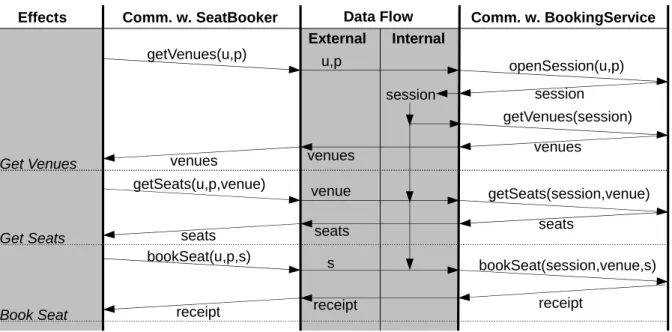
openSession(u,p) getVenues(u,p) getVenues(session) venues venues session getSeats(u,p,venue) getSeats(session,venue) bookSeat(u,p,s) bookSeat(session,venue,s) seats seats Get Seats Get Venues u,p session venue s seats venues
Effects Comm. w. SeatBooker Comm. w. BookingService
External Internal Data Flow receipt receipt receipt Book Seat
Figure 2.4: Message Sequence Chart for Connected Implementations
We now want to connect a front-end of the system, which uses Interface 1, to a back-end using Interface 2.
While the actual construction of a CONNECTor for the two parties is out of the scope of this deliverable, we
will consider here the general requirements on the inferred models of the two networked components that can be derived from this example. Naturally, there will arise a number of other problems when generating a CONNECTor, like transforming data parameters from one format into another, or actually instrumenting the components, etc. However, these problems do not directly lead to requirements on the obtained models.
In the message sequence chart in Figure 2.4, it is shown how the two implementations can be con-nected. The first column of the figure shows the synchronization of the two implementations on the shared effects. The second column shows the communication between the component using Interface 1 and the CONNECTor, while the fourth column shows the communication between the CONNECTor and the second implementation using Interface 1. In the third column, the data-flow between the two implementations is visualized. Here, it is interesting to observe that there exist parameters which do not exist in both inter-faces (e.g., session). We refer to those parameters as control-parameters as they are only used to control one party and need not to be passed to the other party. The model that is to be constructed by regular inference is now expected to expose exactly this kind of causal relations between the formal parameters of the different primitives (that is has to be same session identifier in all the calls).
Learning the seat booking service Imagine a web service realizing the seat booking system and
using the interface from the right half of Table 2.1. For the interface description WSDL-S [13] is used,
which allows
1. annotating primitives with effects,
2. annotating parameters with (abstract) data types.
Technically, this is realized by references into an ontology. A common ontology can then be used to link several heterogeneous systems with the same intention on a semantic level.
We generated Java proxy-classes for the web service. Using standard Java APIs, the proxy classes were inspected for methods, which are used as learning alphabet. Also, the WSDL-S document was analyzed for data types and effects.
Using the information about data types, a parameter structure was generated: The return values of method invocations were stored in the local parameter structure of the test-driver for usage in future invocations of the target system. The type and name of the output symbol determined the parameter, a returned
Table 2.2: Parameter Structure and Effects
Symbol Output-Parameters Store as Effect
openSession(user,pwd) Session Identifier session
-getVenues(session) List of Venues venues GetVenues
getSeats(session,venue) List of Seats seats GetSeats
bookSeat(session,venue,seat) Receipt receipt BookSeat
(output-)value will be stored in. The resulting parameter structure is shown in Table 2.2. Input-values for method invocations were either
• predetermined values, e.g., for user and pass in the openSession primitive, • references to parameters, e.g, for session in all primitives, or
• simple expressions over parameters, e.g., !session (not session) and (in)venues (denoting a venue from a list of venues).
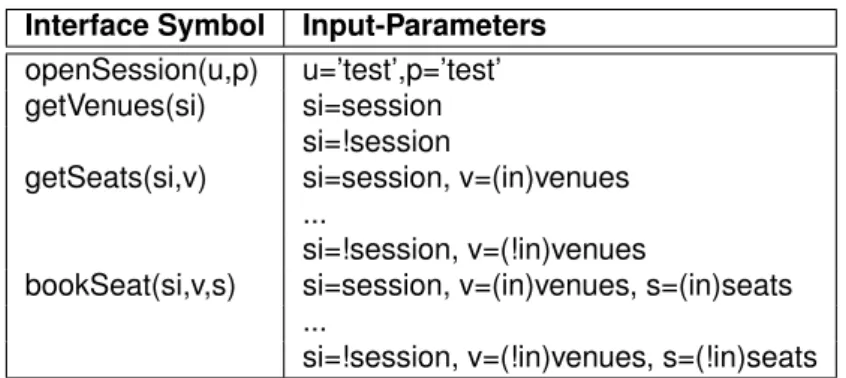
The abstract interface alphabet was generated over all possible combinations of data and primitives. The resulting abstract input alphabet is shown in Table 2.3. The corresponding test-driver (cf. Section 2.4) invokes methods on the WSDL proxy according to the alphabet symbol currently processed.
Table 2.3: Abstract Input Alphabet
Interface Symbol Input-Parameters
openSession(u,p) u=’test’,p=’test’
getVenues(si) si=session
si=!session
getSeats(si,v) si=session, v=(in)venues
...
si=!session, v=(!in)venues
bookSeat(si,v,s) si=session, v=(in)venues, s=(in)seats
...
si=!session, v=(!in)venues, s=(!in)seats
All data values used in this examples were sequences of characters. The !-function was realized by adding some characters to the corresponding sequence. The (in)-function was realized by picking the first element of a list, which would also ensure that two subsequent applications of (in) return the same value. The (!in)-function was realized by constructing a value, which was not contained in the corresponding list.
To distinguish (i.e., classify) states in active learning, some kind of output is needed from the system under test. As the returned values in this example are stored in the parameter structure and thus are treated symbolically, we used the WSDL ’fault’ returns as classifiers: In WSDL, every interface method can return with a normal or with a fault answer. In Java, this fault case corresponds to an exception being thrown. The test-driver would simply catch and evaluate these exceptions. In the example, three effects were annotated to the normal return of the interface methods (cf. Table 2.2).
Since we treat the return values symbolically, an error message that is encoded within a normal answer will, without further analysis, not be treated as a fault. Thus, if the SUT does not use use fault answers for error signaling, resorting to encapsulating error messages in regular messages, an introspection of received messages is necessary to determine error cases. An approach to detect errors by inspecting
returned messages was implemented in the StrawBerry tool, presented in [26]. This tool, developed by
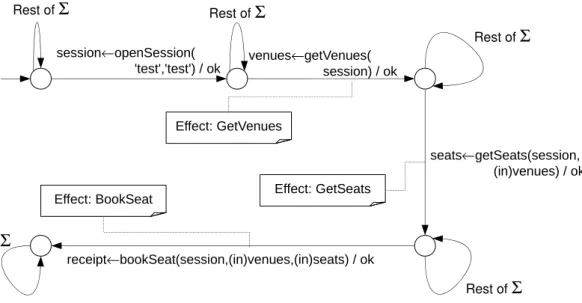
venues←getVenues( session) / ok Effect: GetVenues session←openSession( 'test','test') / ok seats←getSeats(session, (in)venues) / ok Effect: GetSeats receipt←bookSeat(session,(in)venues,(in)seats) / ok Effect: BookSeat
Σ
Rest ofΣ
Rest ofΣ
Rest ofΣ
Rest ofΣ
Figure 2.5: Behavioral Model of the Seat Booking System
Results and conclusion for this example The behavior of the web service was learned using LearnLib
[92], the automata learning framework developed at TU Dortmund. The resulting model with 5 states is
shown in Figure 2.5. This model clearly shows what steps are necessary to book a seat from start to finish and also shows what data values are to memorized and where to use them later on. With this information, it is easy to derive a client that accesses the provided service and mediates successful transactions.
This example demonstrates how automata learning can be employed to learn a real system. For this example only a very small system was learned, yet it is demonstrated how concerns like interfacing to the system, abstraction, alphabet construction, and data-handling come into play.
2.4
Automated Test-driver Generation
For the presented example, the test-driver was put together manually from • automatically generated instrumentation code,
• manually constructed and analyzed information from the WSDL-S description, • manually provided fixed values,
• manually implemented functions on data parameters.
To fully automate the generation of adequate test-drivers, the single steps will subsequently have to be automated (where possible). Implementing solutions will be tightly coupled to the integration work that is a key focus for Y3, as relevant technology is either preexisting or developed by project partners within their work packages:
Generation of instrumentation code: For services employing standardized remote invocation tech-niques, there usually exist tools that create networked proxies that expose functionality as described in interface description. E.g., for WSDL services and the Java platform, there does exist the standard tool wsimport, which creates proxy classes that can be directly called to invoke methods on the remote sys-tem. Similar tools are available for other remote invocation schemes, such as CORBA. Thus the task to generate instrumentation code can be delegated to a library of tools that generate instrumentation code from interface descriptions.
Determining relations between methods and data values: For meaningful interaction with the target system, most remote method invocations have to include data values, as demonstrated in the example above. To determine what remote methods can potentially produce data valuable for other method invo-cations, the system’s interface description has to be analyzed. The generated information of this analysis
is of direct use for creating the parameterized alphabet of the learning process. In [26] an approach and
tool for the analysis of WSDL descriptions is presented, which will be integrated during Y3.
Providing fixed data values: Some predetermined data values, such as, e.g., credentials, are not com-municated during normal interaction with remote systems. These values, however, are often necessary to access crucial parts of the target system, and should either be included in the interface description or
3 Improving Classic Algorithms
One purpose of the CONNECTarchitecture is the (online) generation of CONNECTors at runtime: the
CONNECT enablers will detect when a networked system tries to interact with another system. At some
point in the process of producing a fitting CONNECTor, the learning enabler will learn a model of both
networked systems. As discussed in the introduction, learning usually is an expensive enterprise (in terms of tests that have to be executed in order to produce a model).
The costs in learning have two sources: (1) the membership queries (test runs) used in the learning process and (2) the test runs used to approximate equivalence queries (equivalence cannot be computed with a finite amount of tests). Additionally, in practice even single test runs can be quite expensive. For these reasons unoptimized learning algorithms will fail to produce models for real systems with more than a couple of states and interface actions in a feasible amount of time.
To enable the online generation of CONNECTors in practice, learning has to be optimized in two
re-spects. First, the consumption of test runs (both in terms of membership queries and equivalence queries) has to be reduced drastically. Especially for equivalence approximation, which is usually considered to use a number of test runs that is exponential in the size of the model, a solution has to be found.
Second, and even more fundamentally, a feasible way of realizing (i.e., approximating) equivalence queries has to be found. In simulation scenarios conformance testing methods are often used to approx-imate equivalence queries. These, however, rely on additional assumptions on the system under test (SUT), which in general cannot be made, e.g., a fixed upper bound on the size of the SUT (in terms of the number of states) is assumed. The additional assumptions are used as termination criteria. They determine when a sufficient coverage with tests is reached.
In this chapter, we present a learning algorithm that can be configured to have different characteris-tics wrt. resource consumption; indeed, it can be used to save a considerable amount of membership queries compared with classic algorithms. Furthermore, we present a novel approach to equivalence approximation: It has turned out that changing the view from ‘trying to prove equivalence’, e.g., by using conformance testing techniques, to ‘finding counterexamples fast’ has a strong positive impact.
We verified the quality of the new approaches in the ZULU challenge [42], which we won. Thus,
the remainder of this chapter, which has been published as part of [59], discusses the improvements
mainly in the context of ZULU. The improvements, however, will have a significant impact in the CONNECT
context, too (e.g., the patterns presented here will be the essential basis of the framework for learning non-functional properties that will be introduced in Chapter 8).
The chapter also summarizes our experience with the ZULU challenge on active learning without equivalence queries, presents our winning solution, and
• investigates the character of ZULU’s rating approach, which ranks solutions according to their pre-diction quality for language containment based on a ZULU-generated test suite, and
• discusses how this approach can be taken further to establish a framework for the systematic inves-tigation of domain-specific, scalable learning solutions for practically relevant application.
Especially the second topic is relevant in the context of CONNECT.
3.1
The ZULU Competition
ZULU [41] is a competition in active learning from membership queries: contestants had to develop active
learning algorithms (following the general approach due to Dana Angluin [16]). Essential to ZULU have
been two main ideas:
No equivalence queries: Equivalence queries (in the theoretical formulation of active learning) compare a learned hypothesis model with the target system for language equivalence and, in case of failure, return a counterexample exposing a difference. Their realization is rather simple in simulation sce-narios: if the target system is a model, equivalence can be tested explicitly. In practice, however,

![Figure 2.1: Structure of Active Learning Algorithms (modeled in XPDD [67])](https://thumb-eu.123doks.com/thumbv2/123doknet/12769237.360327/23.892.133.760.312.883/figure-structure-active-learning-algorithms-modeled-xpdd.webp)
![Figure 2.3: Test-driver & Alphabet Generation (modeled in XPDD [67])](https://thumb-eu.123doks.com/thumbv2/123doknet/12769237.360327/26.892.142.763.122.523/figure-test-driver-amp-alphabet-generation-modeled-xpdd.webp)