Variation in Escape Behavior of Red and Green
Clones of the Pea Aphid
Christian Braendle1,3and Wolfgang W. Weisser1,2 Accepted February 19, 2001; revised March 13, 2001
Many insect species have evolved a number of antipredator tactics among which the animal can choose when attacked by a natural enemy. While it is known that individuals may differ in how the antipredator tactics are employed, quantitative studies are rare. In the pea aphid, it has been suggested that dif-ferent clones differ in their propensity to escape from a predator and that this propensity is linked to the body color of the aphid. We tested clonal variation in the escape behavior in red and green clones of the pea aphid. In three ex-periments the responses of clones to artificial stimuli and a natural predator were quantified. The results indicate that (1) clones differ considerably in their propensity to show escape behavior, (2) red clones are more likely to drop off the host plant when subjected to an artificial stimulus than green clones are, and (3) the patterns of clonal variation in the escape behavior were not consistent through all three experiments, as clones did not differ in their behavior when attacked by a real predator. The differences in the responses of a clone toward different stimuli supposed to mimic predator attack suggest that extrapolating from laboratory experiments to a field situation may be difficult.
KEY WORDS: Acyrthosiphon pisum; antipredator behavior; clonal variation; color
polymor-phism; escape behavior; predator–prey interactions.
1Zoology Institute, University of Basel, Rheinsprung 9, 4051 Basel, Switzerland.
2Present address: Institute of Ecology, Friedrich-Schiller-University, Dornburger Str. 159, 07743 Jena, Germany.
3To whom correspondence should be addressed at Laboratory for Development and Evolution, University Museum of Zoology, Department of Zoology, University of Cambridge, Downing Street, Cambridge CB2 3EJ, U.K. Fax: +44 1223 336776. E-mail: [email protected].
497
INTRODUCTION
Predation has been shown to be a major selective force in the evolution of insect behavioral and life-history strategies (Price, 1997). Many insect species have evolved various behavioral antipredator strategies to reduce the risk of being killed by a natural enemy (Lima and Dill, 1989). Individuals may choose among these antipredator tactics to match, for example, their defense to the type of attacking predator. While it is known that individuals may differ in how the antipredator tactics are employed (e.g., Andrade and Roitberg, 1995), quantitative studies are rare. In aphids, different clones may differ in host plant preference, life cycle characteristics, or individual life-history traits (Lamb and Mackay, 1979; M ¨uller, 1980; Simon et al., 1991; Rispe et al., 1996). Clones have been characterized by body color, body size, host plant specificity, or rate of reproduction and are generally referred to as biotypes, host races, or strains (e.g., M ¨uller, 1962). Unfortunately, quantitative studies of the variation in life history and behavior across a range of clones are rare (e.g., Groeters, 1989), and the significance of any observed variation remains difficult to interpret.
Aphids are attacked by a wide range of natural enemies which may significantly reduce the growth and persistence of colonies (e.g., Campbell and Mackauer, 1977; Frazer and Gill, 1981; Cappuccino, 1988). Aphids, in turn, have evolved a wide range of antipredator strategies (Dixon, 1998; Weisser et al., 1999). As in many herbivorous insects, the vast majority of aphid species use simple behavioral strategies to avoid and escape predators (Montgomery and Nault, 1978; Gross, 1993; Dixon, 1998). These strategies primarily consist of dropping and walking off the host plant when disturbed or attacked by a predator (Dixon, 1958; Klingauf, 1967; Roitberg and Myers, 1978, 1979; Losey and Denno, 1998a). Variation in defensive behavior has been fairly well studied at the species level (e.g., Dixon, 1958; Losey and Denno, 1998b), yet only few studies have examined the variation of this trait between aphid clones or between different color morphs (Lowe and Taylor, 1964; M ¨uller, 1983).
In the pea aphid, Acyrthosiphon pisum Harris, a well-known but intri-cate complex of color morphs exists (Harrington, 1945; M ¨uller, 1961, 1962, 1971; Frazer, 1972). A genetically determined dimorphism of red and green color morphs appears to be most widespread (M ¨uller, 1961; Miyazaki, 1987). Intriguingly, a study by Lowe and Taylor (1964) indicates that red and green clones of the pea aphid differ drastically in their life history and behavior. In one of their experiments, a red clone showed a much higher dropping propen-sity in response to an artificially induced stimulus compared to a green clone. This and another study (M ¨uller, 1983) implied that variation in the escape response between clones, especially between color morphs, may be common.
However, since these studies considered only two or three clones for compar-ison, it is equivocal whether color morphs show any consistent differences in their antipredator behavior. Clegg and Barlow (1982) and Brodsky and Barlow (1986) concluded from their studies that pea aphid escape responses are not heritable, but this conclusion has since been challenged (Dill et al., 1990; Andrade and Roitberg, 1995).
We quantified the variation in antipredator behavior of seven clones of red and green color in the pea aphid, A. pisum. We designed three manipula-tive experiments, using artificial stimuli and a natural predator, to answer the following questions: (1) Is there evidence for clonal variability in the escape responses shown by pea aphids? (2) Are red clones more prone to drop off a host plant than green clones, as suggested by Lowe and Taylor (1964)? and (3) Do the escape responses shown by clones depend on the experimental design used to elicit escape behavior?
MATERIALS AND METHODS
Experimental Animals and Plants. We used three red and four green
clones of pea aphid, A. pisum. Each clone was descended from an individual parthenogenetic female collected at the following locations: clones ‘Green BG’ and ‘Red BP’ were collected in Bayreuth, Germany; clones ‘Green LG’ and ‘Red LP’ were collected near London; clones ‘Green NG’ and ‘Red NP’ were obtained from Prof. A. F. G. Dixon’s Laboratory in Norwich, U.K.; and clone ‘Green SG’ was collected in Ascot, U.K. In the laboratory, aphids were reared on borad bean, Vicia faba L. var Sutton Dwarf, potted in a commercial
growing medium (pot:φ, 10.0 cm; height, 7.4 cm). Aphids and plants were
kept in constant-temperature chambers under long-day conditions (16:8 L:D)
at 20± 1◦C. All bean plants used in experiments were 3 weeks of age. Adults
of the seven-spot ladybird, Coccinella septempunctata L., used in the third experiment originated from individuals collected in the Canton of Wallis, Switzerland. Ladybird larvae and adults were fed on pea aphids and were kept under the same light and temperature regime as described above.
General Experimental Procedure. Aphids drop off their host plant not
only in response to direct predator contact, but also in response to other stimuli that may signal predator attack. For instance, aphids may drop off the plant when exposed to a puff of air or when the host plant is shaken (Clegg and Barlow, 1982; Lowe and Taylor, 1964). We designed two experiments (1 and 2) using artificial stimuli to measure clonal variation in escape behavior in a standardized procedure. Additionally, we tested how clones differed in their response to a foraging predator (experiment 3). For each clone we isolated 36 wingless (apterous) asexual females after birth and reared them
individually on bean plants. These asexual females (virginoparae) descended themselves from wingless virginoparae kept at low densities (five adults per plant) for one generation to avoid the production of winged offspring which is induced under crowded conditions (Dixon, 1998). At the beginning of the experiment, all aphids had reached maturity and were eight to nine days old. We conducted experiments 1 to 3 sequentially within 1 day. For each experiment, the order in which clones and individuals were subjected to the experimental treatments was randomly chosen. Individuals which were not feeding on the host plant at the start of the experiment were excluded from this and further experiments.
Experiment 1. The bean plants were lifted carefully to a height of 12
cm and dropped onto a wooden surface. Aphids feeding on the plant re-sponded in one of two ways: drop—the aphid dropped off the host plant; or
no reaction—the aphid continued to feed. No other escape response (e.g.,
walking away from the feeding site) was observed.
Experiment 2. The individuals used in the first experiment were
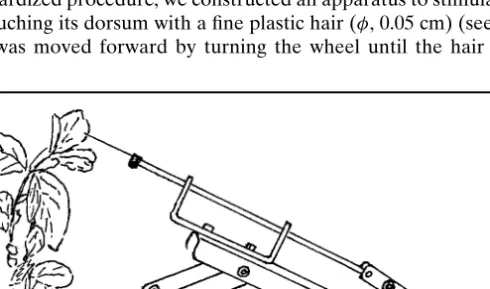
trans-ferred to new bean plants which had all leaves removed to ensure that aphids fed on the tip. Aphids were then allowed to settle on the plant for 2 h be-fore beginning the experiment. To simulate repeated predator attacks in a standardized procedure, we constructed an apparatus to stimulate the aphid
by touching its dorsum with a fine plastic hair (φ, 0.05 cm) (see Fig. 1). The
hair was moved forward by turning the wheel until the hair touched the
Fig. 1. Apparatus used in experiment 2 to simulate repeated predator attacks by touching the
aphid. Preliminary experiments had shown that responses to the stimulus were limited largely to either dropping off the host plant or walking away from the feeding site. For example, kicking behaviour or cornicle secretion (e.g., Dixon, 1958) by the aphid were observed in fewer than 1% of trials. We therefore did not include these rare responses into our analysis. The follow-ing behavioral responses were recorded: walk—the aphid walked away from the feeding site; drop—the aphid dropped off the plant; and no reaction—the aphid continued to feed. When the aphid did not show an escape reaction (dropping or walking away) in response to the first stimulation, it was sub-jected to another stimulation 10 s later. Aphids were touched no more than 10 times, and we recorded the number of stimulations needed to elicit the escape reaction.
Experiment 3. At the end of the second experiment, the aphids were
allowed to settle for a further 2 h on the same plants. An adult ladybird (C. septempunctata) which had been starved for 24 h prior to the experiment was then released at the base of the bean plant. The predator was allowed to search the plant for at most 5 min. If the ladybird had not encountered the aphid within this time period, the trial was stopped and the replicate discarded. The following outcomes were recorded: killed—the aphid was killed by the ladybird; walk—the aphid escaped by walking away from the feeding site; drop—the aphid escaped by dropping off the plant; and no
reaction—the aphid continued to feed. The experiment ended when the aphid
had been killed by the ladybird, had dropped off, or had left the plant by walking away.
Data Analysis. Statistical analysis was performed using the SAS
statis-tical package (v 6.12; SAS Institute, 1989). Procedure GENMOD with link function Logit and binomial error structure was used to analyze dichoto-mous responses by aphids. The variables used in the analysis were body color and clone nested in body color (experiments 1–3). For some analyses it was not possible to use procedure GENMOD because of nonconvergence when most individuals showed the same escape response (experiment 3). In this case, contingency tables were constructed separately for the variables clone and color. The number of stimuli administered to aphids was analyzed with procedure GLM (variables body color and clone nested in color). Data were checked for homogeneity of variance and normality of error and were transformed where necessary (Sokal and Rohlf, 1995). For correlations we
used Spearman’s rank correlation. All means are given±1 SE.
RESULTS
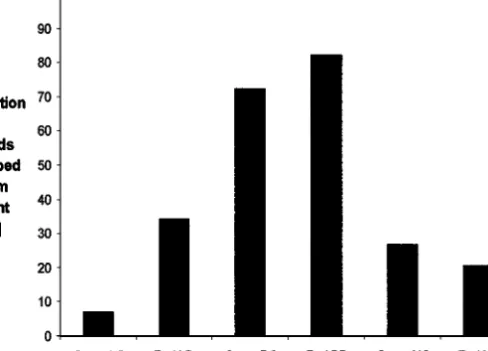
Experiment 1. The propensity to drop off the host plant differed
Fig. 2. Responses of clones to dropping the host plant from a height of 12 cm onto a wooden
surface.
P= 0.009) and between clones [clone (body color): df = 5, χ2 = 53.56, P <
0.00001] (Fig. 2). Red clones were more prone to drop off the host plant than
green clones: 45.7± 18.6%(N = 3) of individuals of red clones dropped off
the host plant compared to 30.5 ± 14.5%(N = 4) of individuals of green
clones.
Experiment 2. The most common escape response of aphids was
drop-ping off the host plant. Because the number of aphids walking away from the feeding site was very low, we analyzed the propensity to escape by pooling these two behaviors. The propensity to escape in response to up to 10 physi-cal stimulations differed significantly between clones of different body color
[GENMOD, body color, df= 1, χ2 = 9.79, P = 0.002; clone (body color),
df= 5, χ2 = 7.94, P = 0.16] (Fig. 3). In red clones, 40.0 ± 8.2%(N = 3) of
individuals showed an escape response, in contrast to 20.9 ± 3.8%(N = 4)
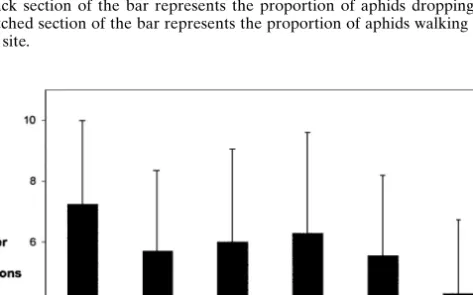
of individuals in green clones. The mean number of stimulations needed to elicit an escape reaction did not differ between color morphs or clones [GLM,
body color, F1,47 = 1.51, P = 0.23; clone (body color), F5,47 = 0.90, P =
0.49] (Fig. 4).
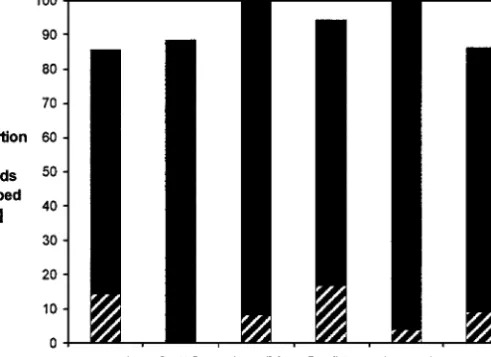
Experiment 3. Irrespective of clone and color, the vast majority of
indi-viduals escaped the predator by either dropping or walking off the host plant. Of a total of 155 individuals, only 10 individuals (6.45%) were killed by the ladybird. A few individuals became trapped in a plant struture (e.g., the base
Fig. 3. Responses of clones to up to 10 stimulations with a fine hair (experiment 2; cf. Fig. 1).
The black section of the bar represents the proportion of aphids dropping off the plant. The hatched section of the bar represents the proportion of aphids walking away from the feeding site.
Fig. 4. Mean number of stimuli needed to elicit an escape response in experiment 2 (dropping
from the plant or walking away from the feeding site; only individuals that showed an escape response).
Fig. 5. Proportions of aphids of different clones that escaped from the predator in experiment 3
by walking or dropping from the host plant. Black section, proportion of aphids dropping off the plant, hatched section, proportion of aphids walking away from the feeding site.
of a leave) after dropping and were subsequently found and killed by the ladybird. These cases were omitted from the analysis. Clones did not differ in their propensity to escape (dropping or walking off the host plant) when
exposed to the natural predator (chi-square test for clones only, df= 6, χ2 =
4.98, P = 0.55), and the escape rate was marginally nonsignificant between
color morphs (chi-square test for color morphs only, df= 1, χ2= 3.29, P =
0.07). In contrast to the first two experiments, aphids of green clones tended to drop at a higher rate compared to aphids of red clones (Fig. 5). Nine-teen of a total of 160 aphids escaped (dropped off the plant or walked away from the feeding site) prior to any physical contact with the foraging lady-bird. This escape propensity before predator contact did not differ among
color morphs (chi-square test for color morphs only, df= 1, χ2= 1.61, P =
0.21) or among clones (chi-square test for clones only, df = 6, χ2 = 7.91,
P= 0.24).
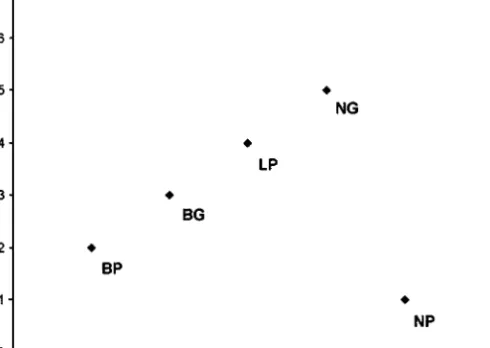
When the propensities of clones to show an escape reaction were ranked for each experiment, the propensity shown in experiment 1 was not
corre-lated with that shown in experiment 2 (Spearman rank correlation, rS =
0.61, P = 0.15) (Fig. 6). However, when the outlier ‘Red NP’ was omitted,
this correlation was positively significant (rS = 0.94, P = 0.005) (Fig. 6).
Fig. 6. Correlation among clonal rank scores in experiments 1 and 2. The seven clones were
ranked from 1 to 7 according to their escape propensity shown (dropping off the host plant and walking away from the feeding site). Rank 1, lowest escape propensity; Rank 7, highest escape propensity. See text for explanations.
clones shown in experiments 1 and 3 and in experiments 2 and 3 (experiments
1–3, rS= 0.37, P = 0.41; experiments 2–3, rS= −0.22, P = 0.63).
DISCUSSION
In three experiments, we measured clonal variation in escape behavior of red- and green-colored clones of the pea aphid. The results indicate that (1) there is considerable interclonal variation in escape propensity, (2) red clones are more likely to drop off the host plant in response to artificially induced disturbances, and (3) the patterns of clonal variation in the escape behavior were not consistent through all three experiments.
In experiments 1 and 2, the dropping response varied greatly between the different clones. For example, in the clone Green LG, fewer than 10% of the individuals dropped, whereas in another clone (Red BP) more than 80% of the individuals dropped in response to the artificial stimulus. On average, clones of the red color morph showed a significantly higher propensity to escape than green clones. However, green clones did not always exhibit a weaker dropping response than red clones: in experiment 1, individuals of
one of the four green clones (Green NG) dropped more frequently than individuals of a red clone (Red NP). With the exception of one clone (Red NP) which showed a much lower response in experiment 1, all clones showed a similar escape propensity in experiments 1 and 2.
In constrast to the first two experiments, there were no differences be-tween clones in the escape propensity when aphids were confronted by a natural predator (experiment 3). Whereas in all red clones at least a few in-dividuals were killed, three of the four green clones showed a 100% dropping rate. This difference was, however, not significant. In all clones the vast ma-jority of aphids escaped the predator successfully and only about 5% of all individuals were killed. Thus, when directly approached by a predator, aphids showed a much higher propensity to escape in comparison to the propensity in response to artificial stimuli. The differences in the results between the first two experiments and the third experiment imply that aphids are capable of distinguishing between indirect cues and the presence of a predator on the host plant. This suggests that there is increased clonal variation in the sensi-tivity to indirect disturbances which may indicate a future threat compared to the sensitivity in response to the presence or contact of a predator on the host plant.
It is well known that dropping behavior can be elicited in response to various artificially induced stimuli (Clegg and Barlow, 1982; M ¨uller, 1983; Roitberg and Myers, 1978, 1979). It is not entirely clear why some of these stimuli provoke the aphids to drop off their host plant, especially in the cases where aphids respond to strong stimuli. Whereas weak vibrations of the host plant are assumed to reflect the movements of an arthropod predator on a plant, stronger disturbances may reflect attacks of vertebrate predators (e.g., Dunn, 1960; Gibb and Brett, 1963) or, more likely, disturbances caused by mechanical harvesting or feeding by a large mammalian herbivore. It is un-clear to what extent mowing or herbivore feeding reduces aphid colonies in the wild, however, an immediate escape from the host plant may be ad-vantageous in both cases. Alternatively, aphids may react to any disturbance above certain threshold level regardless of the factor causing the disturbance. In most studies on aphid escape behavior, artificial stimuli have been used to examine escape or defense behavior (e.g., Lowe and Taylor, 1964; Roitberg and Myers, 1978, 1979; Clegg and Barlow, 1982; Dill et al., 1990; Stadler et al., 1994). Our results indicate that extrapolating from the behavioral responses to artificial stimuli may be potentially misleading.
Dropping off the host plant results in an immediate reduction in preda-tion risk, but this behavior also incurs substantial physiological costs, as the aphid is forced to seek a new feeding site, possibly on a new host plant. In addition, ground-foraging predators or high ground temperatures may dras-tically decrease aphid survival after dropping off the host plant (Roitberg
and Myers, 1978, 1979; Dill et al., 1990; Losey and Denno, 1998a,b). Thus, the propensity of aphids to drop off the host plant is likely to reflect a trade-off between the benefits of a reduction in predation risk and the costs associated with the antipredator behavior. Habitat characteristics, such as the preda-tion risk on the host plant or climatic variables, will therefore shape and act upon the sensitivity threshold of cues which elicit escape behavior. Variability in these habitat characteristics may therefore result in variability in escape behavior.
This and other studies demonstrate that pea aphid clones differ in many aspects of their biology, such as abundance, distribution, host plant prefer-ence and performance, behavior, fecundity, and winged morph production (Frazer, 1972; Honek, 1982; Markkula, 1963; Markkula and Roukka, 1970, 1971; Weisser and Braendle, 2001). In agreement with a previous study (Lowe and Taylor, 1964), our study suggests that body color and antipredator be-havior are correlated in pea aphid clones. It is possible that body color in its own right is responsible for these differences in the dropping propensity. For instance, it has been hypothesized that different color morps suffer differen-tial predation pressure. Red aphids are more conspicuous to visual preda-tors, such as ladybirds, on a green background than are green aphids (Losey
et al., 1997). Hence, selection may favor an increased dropping propensity
in red morphs. In our experiment, however, red color morphs were slightly less efficient in escaping the predator. We did not establish whether this was due to an easier recognition of the red morphs by the ladybirds. On the other hand, red morphs were not more likely to drop off host plants when a predator was foraging on the plant (experiment 3). If anything, red morphs were more likely to by captured by the ladybird. Differential drop-ping propensity may also have contributed to an increased predation rate of red morphs relative to green morphs in Losey and co-workers’ (1997) experiment.
A substantial body of research has shed light on the proximate factors causing variation in the escape behavior of aphids. These environmental factors may be plant, aphid, enemy, or habitat related (Evans, 1978; Losey and Denno, 1998a,b; McConnell and Kring, 1990; Montgomery and Nault, 1978; Roitberg and Myers, 1978; Stadler et al., 1994). While these studies indicate that there is a great amount of plasticity in the escape propensity within a single aphid clone, the results of our experiments demonstrate that variation in escape behavior may be considerable among clones.
ACKNOWLEDGMENTS
Aphid clones and ladybirds were kindly provided by Christine M ¨uller, Tony Dixon, Ulrich Schw ¨orer, Wolfgang V ¨olkl, and Beat Reber. We thank
Titus Braendle for constructing the aphid stimulator and Nathan Pike and Alex Shingleton for helpful comments on an early version of the manuscript. C.B. was supported by the Swiss Study Foundation. W.W.W. was supported by the Novartis-Stiftung, the Roche Research Foundation, and Grant 3100-053852.98 from the Swiss National Science Foundation.
REFERENCES
Andrade, M. C. B., and Roitberg, B. D. (1995). Rapid response to intraclonal selection in the pea aphid (Acyrthosiphon pisum). Evol. Ecol. 9: 397–410.
Brodsky, L. M., and Barlow, C. A. (1986). Escape responses of the pea aphid, Acyrthosiphon
pisum (Harris) (Homoptera: Aphididae): Influence of predator type and temperature. Can. J. Zool. 64: 937–939.
Campbell, A., and Mackauer, M. (1977). Reproduction and population growth of the pea aphid (Homoptera: Aphididae) under laboratory and field conditions. Can. Entomol. 109: 277– 284.
Clegg, J. M., and Barlow, C. A. (1982). Escape behaviour of the pea aphid Acyrthosiphon
pisum (Harris) in response to alarm pheromone and vibration. Can. J. Zool. 60: 2245–
2252.
Dill, L. M., Fraser, A. H. G., and Roitberg, B. D. (1990). The economics of escape behavior in the pea aphid, Acyrthosiphon pisum. Oecologia 83: 473–478.
Dixon, A. F. G. (1958). Escape responses shown by certain aphids to the presence of the coccinellid, Adalia decempunctata (L.). Trans. R. Entomol. Soc. London 10: 319–334. Dixon, A. F. G. (1998). Aphid Ecology, Chapman & Hall, London.
Dunn, J. A. (1960). The natural enemies of the lettuce root aphid, Pemphigus bursarius (L.).
Bull. Entomol. Res. 51: 271–278.
Evans, H. F. (1978). The role of predator-prey size ratio in determining the efficiency of capture by Anthocoris nemorum and the escape reactions of its prey, Acyrthosiphon pisum. Ecol.
Entomol. 1: 85–90.
Frazer, B. D. (1972). Population dynamics and recognition of biotypes in the pea aphid (Homoptera: Aphididae). Can. Entomol. 104: 1729–1733.
Frazer, B. D., and Gill, B. (1981). Hunger, movement and predation of Coccinella californica on pea aphids in the laboratory and in the field. Can. Entomol. 113: 1025–1033.
Gibb, J. A., and Betts, M. M. (1963). Food and food supply of nestling tits (Paridae) in Breckland pine. J. Anim. Ecol. 32: 489–533.
Groeters, F. R. (1989). Geographic and clonal variation in the milkweed-oleander aphid, Aphis
nerii (Homoptera: Aphididae), for winged morph production, life history, and morphology
in relation to host plant permanence. Evol. Ecol. 3: 327–341.
Gross, P. (1993). Insect behavioral and morphological defenses against parasitoids. Annu. Rev.
Entomol. 38: 251–273.
Harrington, C. D. (1945). Biological races of the pea aphid. J. Econ. Entomol. 38: 12–22. Honek, A. (1982). Color polymorphism in Acyrthosiphon pisum in Bohemia (Homoptera,
Aphididae). Acta Entomol. Bohemoslovaca 79: 406–411.
Lamb, R. J., and Mackay, P. A. (1979). Variability in migratory tendency within and among natural populations of the pea aphid, Acyrthosiphon pisum. Oecologia 39: 289–299. Lima, S. L., and Dill, L. M. (1989). Behavioral decisions made under the risk of predation: A
review and prospectus. Can. J. Zool. 68: 619–640.
Losey, J. E., and Denno, R. F. (1998a). The escape response of pea aphids to foliar-foraging predators: Factors affecting dropping behaviour. Ecol. Entomol. 23: 53–61.
Losey, J. E., and Denno, R. F. (1998b). Interspecific variation in the escape responses of aphids: Effect on risk of predation from foliar-foraging and ground-foraging predators. Oecologia
Losey, J. E., Ives, A. R., Harmon, J., Ballantyne, F., and Brown, C. (1997). A polymorphism maintained by opposite patterns of parasitism and predation. Nature 388: 269–272. Lowe, H. J. B., and Taylor, L. R. (1964). Population parameters, wing production and behaviour
in red and green Acyrthosiphon pisum (Harris)(Homoptera: Aphididae). Entomol. Exp.
Appl. 7: 287–295.
Markkula, M. (1963). Studies on the pea aphid, Acyrthosiphon pisum Harrish (Hom., Aphidi-dae), with special reference to the differences in the biology of the green and red forms.
Ann. Agr. Fenniae 2: 1–30.
Markkula, M., and Roukka, K. (1970). Resistance of plants to the pea aphid Acyrthosiphon
pisum Harris (Hom., Aphididae). I. Fecundity of the biotypes on different host plants. Ann. Agr. Fenniae 9: 127–132.
Markkula, M., and Roukka, K. (1971). Resistance of plants to the pea aphid Acyrthosiphon
pisum Harris (Hom., Aphididae). III. Fecundity on different pea varieties. Ann. Agr. Fenniae 10: 33–37.
McConnell, J. A., and Kring, T. J. (1990). Predation and dislodgement of Schizaphis graminum (Homoptera: Aphididae), by adult Coccinella septempunctata (Coleoptera: Coccinellidae).
Environ. Entomol. 19: 1798–1802.
Miyazaki, M. (1987). Forms and morphs of aphids. In Minks, A. K., and Harrewijn, P. (eds.),
Aphids, Their Biology, Natural Enemies and Control, Vol. 2A, Elsevier, Amsterdam,
pp. 163–195.
Montgomery, M. E., and Nault, L. R. (1978). Effects of age and wing polymorphism on the sensitivity of Myzus persicae to alarm pheromone. Ann. Entomol. Soc. Am. 71: 788–790. M ¨uller, F. P. (1961). Stabilit ¨at und Ver ¨anderlichkeit der F ¨arbung bei Blattl ¨ausen. Arch. Freunde
Naturgeschichte Mecklenburg 7: 228–239.
M ¨uller, F. P. (1962). Biotypen und Unterarten der “Erbsenlaus” Acyrthosiphon pisum (Harris).
Z. Pflanzenkrankheiten Pflanzenschutz 69: 129–136.
M ¨uller, F. P. (1971). Isolationsmechanismen zwischen sympatrischen Rassen am Beispiel der Erbsenblattlaus Acyrthosiphon pisum (Harris) (Homoptera: Aphididae). Zool. Jahrb ¨ucher
System. 98: 131–152.
M ¨uller, F. P. (1980). Wirtspflanzen, Generationenfolge und reproduktive Isolation intraspezifis-cher Formen von Acyrthosiphum pisum. Entomol. Exp. Appl. 28: 145–157.
M ¨uller, F. P. (1983). Differential alarm pheromone responses between strains of the aphid
Acyrthosiphon pisum. Entomol. Exp. Appl. 34: 347–348.
Price, P. W. (1997). Insect Ecology, John Wiley & Sons, New York.
Rispe, C., Simon, J.-C., and Pierre, J.-S. (1996). Fitness comparison between clones differing in their ability to produce sexuals in the aphid Rhopalosiphum padi. Entomol. Exp. Appl.
80: 469–474.
Roitberg, B. D., and Myers, J. H. (1978). Adaptation of alarm pheromone responses of the pea aphid Acyrthosiphon pisum (Harris). Can. J. Zool. 56: 103–108.
Roitberg, B. D., and Myers, J. H. (1979). Behavioural and physiological adaptations of pea aphids (Homoptera: Aphididae) to high ground temperatures and predator disturbance.
Can. Entomol. 111: 515–519.
Simon, J. C., Dedryver, C. A., Pierre, J. S., Tanguy, S., and Wegorek, P. (1991). The influence of clone and morph on the parameters of intrinsic rate of increase in the cereal aphid Sitobion
avenae and Rhopalosiphum padi. Entomol. Appl. Exp. 58: 211–220.
Sokal, R. R., and Rohlf, F. J. (1995). Biometry, 3rd ed. Freeman, New York.
Stadler, B., Weisser, W. W., and Houston, A. I. (1994). Defense reactions in aphids—The influ-ence of state and future reproductive success. J. Anim. Ecol. 63: 419–430.
Weisser, W. W., and Braendle, C. (2001). Body colour and genetic variation in winged morph production in the pea aphid. Entomol. Exp. Appl. 99: 217–223.
Weisser, W. W., Braendle, C., and Minoretti, N. (1999). Predator-induced morphological shift in the pea aphid. Proc. R. Soc. Ser. B 266: 1175–1181.