Bulletin suisse de linguistique appliquée © 2018 Centre de linguistique appliquée No 107, 2018, 65-82 • ISSN 1023-2044 Université de Neuchâtel
Lecturing strategies of non-native EMI lecturers
on an International Business programme
Sarah KHAN
Universitat de Vic – Universitat Central de Catalunya Sagrada Família, 7, 08500 Vic, Spain
Dans l'anglais en tant que langue d’instruction (EMI), les stratégies employées par les enseignants peuvent être plus cruciales pour déterminer la qualité des cours que leur maîtrise de l'anglais (Björkman 2010). Cette étude exploratoire visait à identifier les stratégies de cours efficaces de quatre enseignants non-natifs qui enseignaient dans un programme d'Administration des affaires dans une université suisse de sciences appliquées. Les cours ont été enregistrés par vidéo et les stratégies ont été codées, quantifiées et comparées entre les différents enseignants. Les résultats sont décrits par rapport aux mesures de qualité totales des cours, ainsi qu'évaluées par les étudiants et les chercheurs dans une étude connexe (Studer, ce volume; Gautschi, ce volume). Nous avons identifié vingt-cinq types différents de stratégies dont la fonction pourrait améliorer la compréhension des cours (17 étaient utilisées pendant les longues périodes de discours monologique, 7 pendant des épisodes interactifs plus courts et une seule stratégie (demande de clarification) a été repérée concernant les cas, très peu nombreux, de malentendus qui ont été observés. Neuf des stratégies les plus fréquemment employées feront l’objet de cet article: inciter, susciter, baliser, souligner, paraphraser, évaluer, définir, vérifier la compréhension et indiquer les apprentissages antérieurs. Tous les enseignants ont obtenu de très bons résultats en termes de qualité et les deux avec les meilleurs résultats ont employé plus d'incitation et d'élicitation, ce qui correspond à d'autres recherches (par exemple, Morell 2004) qui préconisent des cours interactifs. Les implications pour la formation à la stratégie sont discutées.
Mots-clés:
Normes de qualité, enseignement en anglais (EMI), stratégies, cours magistral, administration des affaires, discours académique.
Keywords:
Quality standards, English-medium instruction (EMI), strategies, lecture, Business Administration, academic discourse.
1. Introduction
Lecturing is the most widely recognised form of teaching at university so effective lecturing is fundamental to learning and has long been the focus of much language research (see Fortanet-Gómez 2005, for a review). Studies have recognised the value of lectures as a teaching methodology (effectively conveying facts, summarising and simplifying complex information, linking research findings to every-day practice), as well as their drawbacks (students unable to remember, understand, critically reflect on or apply the knowledge conveyed). These drawbacks become even more accentuated when the language of instruction is not the student's first language (L1), as in EMI (English-medium instruction) contexts, and even more so when English is not the lecturer's L1. The sharp rise of EMI at universities across Europe (Wächter & Maiworm 2014) has therefore brought with it corresponding concerns about the quality of lectures given by non-native English lecturers.
In their review of EMI research in higher education, Pinyana and Khan (2014) found that much research so far has focused on institutional policy (Marsh 2006; Lasagabaster & Ruiz de Zarobe 2010; Fortanet-Gómez 2013) or teacher and student perceptions (Wilkinson 2005; Pinyana & Khan 2007; Tatzl 2011; Aguilar & Rodriguez 2012). Fewer EMI studies have observed university lecturers (Miller 2002; Dafouz-Milne & Sánchez García 2013; Airey 2011) and fewer still have addressed the question of the quality in EMI (Dafouz et al. 2014; Kling & Dimova 2015; Gundermann this volume).
Although the linguistic competence of non-native lecturers is a key element in EMI lecture quality, many researchers point to strategic competence as being equally, if not more, important (Dafouz & Nuñez 2010; Björkman 2011). A native speaker may be linguistically competent but lack the necessary strategies to be able to lecture effectively. In terms of effective lecturing strategies, novice native and non-native lecturers in higher education begin on a level playing field, as usually neither have had training, rather they learn "on the job".
The term 'strategy' has been defined and used in many different and overlapping ways. In education, the terms teaching strategy or instructional strategy are used to refer to techniques, tasks or activities teachers use to help students achieve learning goals and become more autonomous learners, guided by underlying theories of learning (e.g. Tobin et al. 1994). Strategies are viewed as positive pedagogical techniques which function to facilitate learning.
In second language research, communication strategies, accommodation strategies, discourse strategies and pragmatic strategies are all terms which describe strategies in oral communication. These strategies are mainly viewed as problem-solving devices (Poulisse 1990; Dörnyei & Scott, 1997), triggered by a breakdown in communication or overt disturbance (Björkman 2011). Such breakdowns have been documented in conversations or dialogic speech, between non-native speakers (NNS) and native speakers (NS) or NNS and NNS, but they also occur among native speakers (NS), albeit to a lesser extent. Examples of strategies that overcome communicative breakdown include clarification, repetition or paraphrasing. However, in communication strategy research, strategies are also viewed as having a negative effect on communication (mumbling, topic avoidance, message abandonment). Therefore, in these areas of research effective communication is indicated by successfully overcoming instances of communicative breakdown.
Strategies do not only occur as a response to a communicative breakdown but are used to enhance communication. For example, in university lectures, strategies which structure the lecture, such as the use of discourse markers e.g. now, so, however (Dafouz & Nuñez 2010), are not produced in response to indications of non-comprehension, but in response to the lecturer foreseeing potential comprehension problems. In fact, as lecturing involves mainly monologic speech, few instances of interaction, and, therefore, overt
communicative breakdown, occur, so lecturers ability to foresee such potential problems and use strategies becomes particularly important.
The strategies identified in this study draw from previous inventories of communication strategies (Dörnyei & Scott 1997), pragmatic strategies (Björkman 2011) and discourse analysis studies (Fortanet-Gómez 2005). The term lecturing strategies will be used here to refer to strategies which are used 1) in the context of the university lecture 2) in spoken academic discourse and 3) with or without any overt instances of communicative breakdown occurring. In identifying these strategies the assumption is that lecturers employed them consciously or automatically in foreseeing potential learning or communication problems. Although, non-verbal communication, such as gestures and eye contact are also considered strategies (Dörnyei & Scott 1997), they were not included in this analysis.
Other researchers have examined strategies in EMI but from slightly different perspectives to this study, focusing on native-speaker lecturers (Flowerdew & Miller 1996), lecture comprehension strategies (Flowerdew & Miller 1996) or small sets of strategies such as discourse markers or questions (Dafouz & Nuñez 2010; Dafouz-Milne & Sánchez García 2013). Flowerdew and Miller carried out a series of ethnographic studies and investigated how English-speaking lecturers delivered lectures in English to Cantonese-English-speaking students (Flowerdew & Miller 1996) and Flowerdew et al. (2000) described the perceptions of Chinese lecturers lecturing in English to Chinese students. Miller (2002) sums up the results as "Their lecturers' main strategies to help students comprehend the lectures were to modify their language and use plenty of examples". A natural follow-up to these results therefore seems to be to determine more precisely which strategies non-native lecturers use to get their meaning across to students, which was the aim of this study.
A substantial amount of research has investigated EMI lectures from the standpoint of lecturer discourse (Thøgersen & Airey 2011; Braga Riera & Maíz Arévalo 2013; Dafouz-Milne & Sánchez García 2013) and to a lesser extent pragmatic strategies in ELF (English as a lingua franca) settings (Björkman 2011; Smit 2010) and codeswitching (Airey 2009; Ljosland 2011). Summarising the findings relevant to this study, research has shown that 1) In Denmark, L2 lecturers' speech rate is slower in English than L1, but not necessarily due to a lack of fluency, as strategies are used to provide more comprehensible input through repetition, synonyms or defining (Thøgersen & Airey 2011), 2) fewer pragmatic strategies are used by lecturers compared to students working in groups in Sweden (Björkman 2011), 3) translation strategies employed during lecture preparation, structuring and exemplification strategies improve students' comprehension in Spain (Braga Riera & Maíz Arévalo 2013) and 4) checking comprehension, the lecturers answering their own questions, and display questions, which are questions teachers already know the answer to (Mehan
1979), were the most common types of strategies non-native lecturers employed in Spain, similar to L1 lecturers, and similar across disciplines (Dafouz-Milne & Sánchez García 2013).
Although taxonomies have been published for small sets of pragmatic strategies (Björkman 2011) or accommodation strategies (Tsai & Tsou 2015), to the authors' knowledge, there does not seem to be any full exploratory study of lecturing strategies. Hence, the following research questions were posed:
1. What types of lecturing strategies do non-native EMI lecturers use?
2. Which lecturing strategies are used more frequently?
3. Are there any differences in strategy use between EMI lecturers? In this paper, an exploratory study is described which aims to further our understanding of the lecturing strategies of non-EMI lecturers. It was part of a larger project, Internationalisation in Universities of Applied Sciences, (Studer, this volume) carried out in Switzerland on an international business programme. The main focus of this paper is lecturing strategies, but references will be made to qualitative and quantitative data from the larger project to gain a better understanding of the context in which strategies were employed. A brief description of the four lectures is provided, summarised from classroom observation, researcher field notes and post-class interviews. This is followed by quantitative data on lecturing strategies identified in the lecture transcripts. The most frequently occurring strategies are then compared across lecturers and the paper ends with some recommendations for teacher training.
2. Method
One aim of the project Internationalisation of Universities of Applied Sciences (Studer, this volume) was to assess non-native lecturers in EMI classes on the International Programme in Business Administration (BSc) at BFH Bern University of Applied Sciences in Switzerland. A quality parameters observation protocol was designed taking into consideration existing descriptors, such as those in the Test of Oral English Proficiency for Academic Staff (TOEPAS) by Kling & Dimova (2015) and those used at the University of Freiburg (Gunderman & Dubow, this volume). It contained 16 positively worded, assessor-oriented and analytical parameters on a 4-point rating scale, which were divided into five competence areas: linguistic, monological, dialogical, strategic and didactic, matching those of the CEFR (Common European Framework of Reference). In November 2016, ten classes (90-100 min) were observed and video-recorded by two researchers sitting at the back of the class with a camera pointing at the lecturer. During the class researchers took field notes and rated the lecturers using the quality parameters observation protocol. After the class the lecturers were interviewed as described in Pinyana (this volume).
An overall quality rating for each lecturer was obtained by taking mean scores for the 16 different parameters from the two researchers who observed each lecturer, and from students who assessed the lectures by answering a questionnaire based on the same parameters (Gautschi, this volume). Figure 1 shows the overall quality ratings for the four lectures in the present study. Although this is a very limited sample size, it generated sufficient data to identify lecturing strategies.
Overall quality rating
Lecturer Student mean
rating * Researcher mean rating
1 3.67 .93
2 3.38 .84
3 3.36 .82
4 3.05 .76
*Student mean rating was on a Lickert scale converted numerically (1=low score, 4=high score) Figure 1: Overall quality rating of the EMI lectures
As seen in Figure 1 the overall quality rating of all four lectures was high, not only according to researchers (.76-.93) but also students (3.05-3.67), so the four lecturers were considered effective lecturers with expert profiles (Pinyana, this volume). Lecturer 1 was evaluated highest, Lecturers 2 and 3, slightly lower and Lecturer 4 slightly lower than the other three lecturers.
While reference will be made to these quality ratings, the main aim of the present paper is to describe lecturing strategies. To do so, video recordings were carefully watched to identify four comparable classes which included mainly monologic speech in order to obtain a dataset which would yield the most lecturing strategies, as opposed to classroom interaction strategies more common in group work or student-led activities. From each lecture the first 60 minutes were transcribed using ATLAS.ti 7 and analysed for strategies. This resulted in an EMI corpus of 240 minutes and approximately 25,000 words. Transcriptions were then coded for lecturing strategies and the different types of strategies were quantified. To ensure a measure of reliability for the strategy coding, another researcher recoded one of the four lectures. Inter-rater reliability for the strategy coding was 90%.
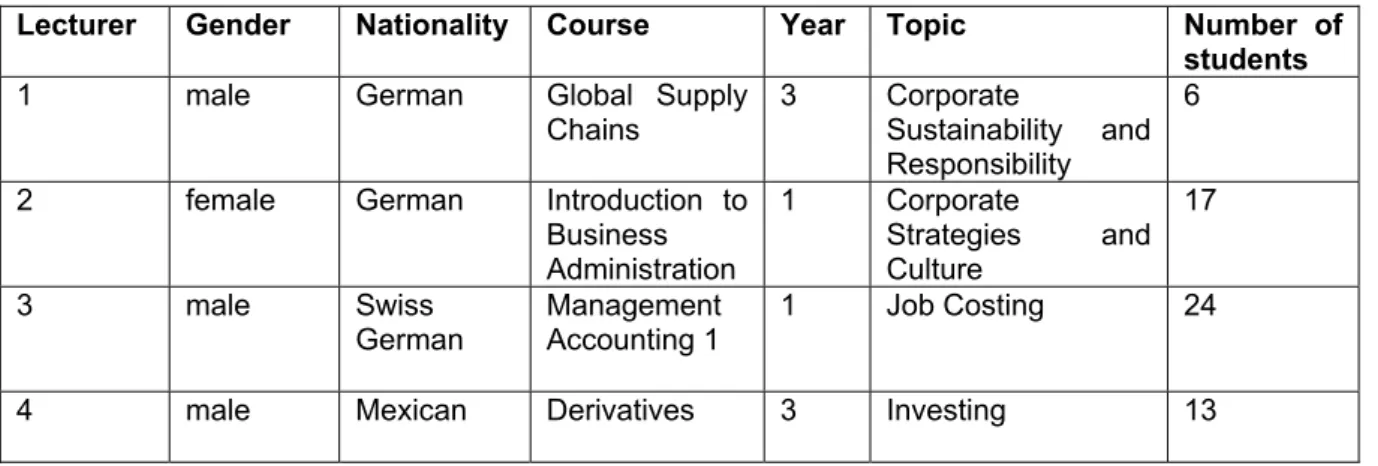
Figure 2 summarises the main characteristics of the four lectures. Three of the lecturers were male and one female. Two of the lecturers were German, one was Swiss and one was Mexican. Two courses were first-year subjects: Introduction to Business Administration and Management Accounting 1 whereas the other two were third year subjects: Global Supply Chains and Derivatives. The number of students attending the classes varied between 6 and 24, most students (62-75%) being local Swiss students with German as an
L1 and the remainder (25-38%) international students from different language backgrounds.
Lecturer Gender Nationality Course Year Topic Number of students
1 male German Global Supply
Chains 3 Corporate Sustainability and Responsibility
6
2 female German Introduction to Business Administration 1 Corporate Strategies and Culture 17 3 male Swiss
German Management Accounting 1 1 Job Costing 24 4 male Mexican Derivatives 3 Investing 13 Figure 2: Characteristics of the EMI lectures
3. Results and Discussion
Firstly, a brief descriptive summary of each lecture is provided to contextualise the quality indicators and strategy use. Secondly, lecturing strategies are presented and then the most frequently employed strategies are compared across the four lecturers.
3.1 Description of Lectures
Drawing from lecturers' comments in post-class interviews, some common points in all the lectures were 1) students' behaviour (e.g. level of participation, affective state) had not been affected by the classroom observation, 2) classes had gone as planned and 3) lecturers had provided students with their presentation slides prior to the class.
Lecturer 1 was the most highly evaluated by both researchers and students (See Figure 1) and rated his level of English as proficient. He was a fluent and fast speaker with no foreign accent or discernible lexical or grammatical errors. He gave a third-year lecture on Corporate Sustainability and Responsibility to a group of six students. The lecturer began with a very brief introduction to the topic and then lectured using presentation slides. All through the lecture, Lecturer 1 interacted with the students by addressing the whole class with different questions. He gave students ample time to respond and make comments, prompting them to provide more answers or more well-developed ones. Student interventions were the longest and most complex in this lecture, nevertheless, these interventions were mainly from the same student, while the other students were observed off-task (on computers or mobile phones). One observer's comment was that explanations were long and it was easy to get lost.
Lecturer 2 was the second most highly evaluated (0.84). She was a fluent and fast speaker with only a hint of a German accent and very few lexical or grammatical errors. She rated her level of English as proficient. Her lecture was a first-year lecture on Corporate Strategies and Culture to a class of 17 students. This lecturer began by eliciting student's knowledge of concepts learnt the previous week, writing them up on the whiteboard and linking them to the lesson. Lecturer 2 lectured and then addressed the whole class with different questions and elicited answers. Students were given an exercise to do followed by whole class feedback. After a 5-minute break the students watched a video, followed by a brief whole-class discussion. Aspects of the lecture that may have caused some students difficulty were that Lecturer 2 spoke very fast and did not allow students much time to think before responding to her questions.
Lecturer 3 was rated only 0.02 points lower (0.82) than Lecturer 2 and he rated his level of English as proficient. His lecture was a first-year lecture on Job Costing to a class of 13 students. He was a fluent speaker who spoke slowly and clearly with a noticeable German accent and very few grammatical errors. Lecturer 3 began by addressing questions on the previous topic and then listed the course content to show students where they had reached in the syllabus. He began his lecture, asked the whole class questions at one point and then continued lecturing. After a 5-minute break students were given an exercise to do followed by whole-class feedback. The lecturer then continued lecturing, which was briefly interspersed by a couple of student-initiated interactive episodes triggered by students' requests for clarification.
Lecturer 4 was rated lowest (0.76) and he rated his level of English as advanced. He gave a third year lecture on Investing to a class of 24 students. Lecturer 1 was quite fluent with a Mexican Spanish accent and some noticeable grammatical errors. He began by making small talk, joking and discussing class administration. The lecturer thought aloud as he went through a problem with the whole class prompted by a student's request for clarification and then started lecturing. During the lecture he highlighted the importance of particular concepts, used analogies and, on several occasions, referred to the class exam. Lecturer 4 used humour, made frequent asides and used social strategies: addressing students by name and using personal examples and his knowledge of individual students to illustrate points. Lecturer 4 communicated clearly but did not give students enough time to think about and answer questions. His class seemed less structured and objectives were not referred to explicitly. All in all, the lectures were representative of the lecturers' normal practice, they were mainly monologic with shorter interactive episodes. As expected from expert lecturers, they were able to communicate the content effectively with little overt communicative breakdown. Overall lecture style could be summed up as follows: Lecturer 1 was interactive, Lecturer 2 was structured and interactive, Lecturer 3 was structured and Lecturer 4 was interactive and social.
3.2 Lecture strategies
In order to validate these descriptions summarised from classroom observation, field notes and interviews, EMI lecturers' strategies were examined in more depth in answer to Research Question 1) What types of lecturing strategies do non-native EMI lecturers use? and Research Question 2) Which lecturing strategies are used more frequently? Lectures were transcribed and coded for strategies. A total of 819 strategies were coded from the 240-minute corpus of four lectures stored in Atlas.ti software. Figure 3 shows that in 60 minutes of lecturing between 114 and 264 strategies were used, showing that all the lecturers, whether they were conscious of doing so or not, employed strategies. The highest-rated lecturers (1 and 2) employed the greatest number of strategies, followed by Lecturer 4, while Lecturer 3 was the least strategic lecturer.
Very high quality High quality
Lecturer 1 2 3 4 TOTAL
Total number of strategies 264 243 114 198 819
Figure 3: Total numbers of strategies used by non-native EMI lecturers
The 25 most frequently-used strategies are presented in Figure 4 as a percentage of the total number of strategies employed. Lecturers used 17 types of strategies to help communicate their message during monologic speech: signposting, emphasising, paraphrasing, evaluating content, defining, indicating prior learning, giving an example, analogy, commenting on course structure, rhetorical question, cultural reference, repetition, referring to students by name, asides, commenting on affective state, commenting on evaluation, commenting on own affective state. During the briefer interactive episodes, 7 strategies were identified: prompting, eliciting, checking comprehension, recasts, referential questions, evaluating students and clarification. As expected, very few instances of overt communicative breakdown occurred and these were marked by the use of one strategy, requesting clarification, by either students (data not included) or lecturers (strategy 19 in Figure 4; 1.2%). These instances of breakdown, in each case, were promptly resolved, suggesting the strategy to be effective.
Strategy % total strategy use 1 prompting 12.1 2 eliciting 10.1 3 signposting 9.8 4 emphasising 9.3 5 paraphrasing 7.9 6 evaluating content 7.2 7 defining 5.1 8 checking comprehension 5.1 9 indicating prior learning 5.1 10 giving an example 4.4
11 analogy 3.5
12 recast 3.1
13 referential question 3.1 14 evaluating students 2.3 15 commenting on course structure 1.8 16 rhetorical question 1.8 17 cultural reference 1.7
18 repetition 1.3
19 requesting clarification 1.2 20 referring to students by name 1.0
21 small talk 1.0
22 commenting on students' affective state 0.7
23 clarification 0.5
24 commenting on evaluation 0.5 25 commenting on own affective state 0.2
Figure 4: Percentage of strategies used by non-native EMI lecturers
Comparing these results with other EMI research on non-native lecturers, three strategies in this study (defining, signposting and emphasising) were equivalent to pragmatic strategies identified by Björkman (2011) at a Swedish university: commenting on terms and concepts, commenting on discourse structure and signalling importance, respectively. Five strategies: eliciting, emphasising, giving examples, signposting and defining were also identified as non-native
lecturer accommodation strategies by Tsai and Tsou (2015) in their study on an international MBA in Taiwan. In addition, six strategies were equivalent to those included in Gerakopoulou's (2011) scaffolding taxonomy for secondary school CLIL teachers in the Netherlands: giving examples (referred to as modelling in Gerakopoulou 2011), indicating prior learning (bridging), analogy (contextualising), evaluating (developing metacognition), prompting and eliciting (elicitation) and paraphrasing (elaborating and redefining).
3.3 Strategy differences between higher and lower-rated EMI lecturers So far we can see that at least 25 different effective lecturing strategies were used by the expert non-native lecturers. In answer to Research Question 3, Are there any differences in strategy use between EMI lecturers?, this section will compare nine of the most frequently used strategies. The remaining 16 strategies were less instrumental in determining effective lecturing as strategy use was low, below 5%, as seen in Figure 4, and so results could be considered anecdotal and may not be generalisable to other non-native lecturers.
% of total strategy use Very high quality High quality
Strategy Lecturer 1 Lecturer 2 Lecturer 3 Lecturer 4 Total
1 prompting 14.4* 15.2* 4.4 9.6 12.1 2 eliciting 14.0* 10.0* 3.5 9.1 10.1 3 signposting 5.3 17.7* 11.4* 5.1 9.8 4 emphasising 7.2 9.5 12.3* 10.1* 9.3 5 paraphrasing 8.7 6.2 13.2* 6.1 7.9 6 evaluating 11.7* 1.6 3.5 10.1* 7.2 7 defining 5.3 9.1 2.6 1.5 5.1 8 checking comprehension 1.9 1.6 1.8 15.7* 5.1 9 indicating prior learning 0.8 13.6* 1.8 2.5 5.1 * over 10% of total strategy use
Figure 5: Comparison of lecturer strategy use of nine of the most frequently used strategies
Figure 5 compares the nine most frequently-used strategies across lecturers. 1. Prompting or the use of follow-up questions was the most frequently used strategy and it was always used in combination with eliciting, the next most frequent strategy. When lecturers elicited information from students they often followed up with further questions, comments or clues to the answers they were expecting. The function of this strategy was to guide students towards a solution to the question elicited, to extract further information or reflections from them, or to guide them along a particular line of thought. Examples of this strategy were (1)-(2):
(1) L1_ Any idea why they prefer electronic version? eliciting
L1_ Who reads a sustainability report ? prompting L1_ No idea? prompting
L1_ Have you ever read a sustainability report? prompting S1_ …
L1_ Did you read the whole thing? prompting S1_ …
L1_ Which part did you read? prompting S1_ …
L1_ But you didn't read the whole thing? prompting S1_...
L1_ The summary! …
L1_ Who else reads the sustainability reports? prompting
(2) What is the mission statement? eliciting
…
L2_Anything else? prompting
L2_There is one other mission statement. prompting L2_It's a little bit more hidden. prompting
L2_any idea? prompting
Rather than the lecturer answering their own questions, lecturers who prompted provided students with extra support, so that students could observe lecturers' sequential thinking in reaching a solution, as seen in excerpt 1 above. This would make the process of thinking more transparent and also give students more time to process and understand the information. Figure 5 shows that the two highest rated lecturers, Lecturers 1 and 2, prompted more than the others (14.4% and 15.2%, respectively).
2. Eliciting was used nearly as frequently, and in combination with prompting. This is a common instructional strategy (Mercer 1994; Gerakopoulou 2011; Björkman 2011; Tsai & Tsou 2015), whose function is to help students to reflect on the information communicated and think of solutions. It is also used to find out the extent of students' knowledge of a topic. Eliciting involves different types of display questions (Mehan 1979), which are questions whose answer is known by the lecturer. Examples of this strategy were (3)-(6):
(3) L1_ Does anyone have ideas of a broad definition of CSR?
(4) L2_When you look at those elements that we discussed last week, where do you find
them in this company goal hierarchy that we discussed in part 2 earlier in this semester?
(5) L3_and let's assume that this maintenance work has cost 100,000 Swiss francs because
it's for a whole year. Now it's included here (lecturer points to a calculation). And what's the problem if it's in here?
(6) L4_ … I have hedged very fast. I bought stock relatively cheap. The premium paid is more
than enough to compensate my costs. What would have happened?
Figure 5 shows that the two highest-rated lecturers, Lecturers 1 and 2, also used this strategy most, followed by Lecturer 4. Eliciting alone, as an instructional strategy is an effective tool to make students think. However, as mentioned above, if the teacher or a particular student immediately provides the answer, not all students will be able to grasp the steps involved in reaching the answer.
It is the combined use of eliciting and prompting, or what is commonly known in classroom discourse studies as IRF (Initiation-Response-Follow-up) patterns (Sinclair & Coulthard 1975), that provides a more powerful instructional tool or supportive scaffolding (Saxena 2010). The difference between eliciting and combining eliciting and prompting is illustrated by comparing the two extracts, (7) and (8), below.
(7) ELICITING
L3_ So the cost allocation base here will most probably be the cost per hour and the cost per hour is 60 dollars, 150,000 dollars divided by 2,500 hours and now we have the cost allocation base. What does it mean? Or what is the advantage of having this base? (pause) eliciting/paraphrasing
L3_If number 5 is this robot then we can measure how many hours it has worked for job A…(the lecturer answers the question himself)
(8) ELICITING AND PROMPTING
L2_You actually mention strategic goals (referring to a student's previous answer), which was not that wrong because it connects some of the goals we have in the company in the hierarchy with the strategy. Where do you put them? (pause) eliciting
L2_ or anyone else? (pause) prompting L2_ Because strategy isn't here. (pause) L2_Which level is strategy? (pause) prompting S1_Corporate goals.
L2_Corporate goals right
L2_That is the strategy (lecturer writes on whiteboard) L2 Do we find other things? (pause) prompting
L2_Do we find other structure or culture? (pause) prompting L2_ in this hierarchy
L2_ What is this vision mission about? prompting
S2_what the company would like to… what the company sees as its reason to exist. L2_ Yes, what is the reason for the company to exist, who we are, what do we do - that is the vision and mission.
In excerpt (7), Lecturer 3 makes a calculation and asks students what it means. He waits for an answer, indicated by a pause, but he then answers the question himself. In general, this lecturer used little eliciting (3.5%) and prompting (4.4%). In comparison, in excerpt (8), Lecturer 2 elicits and then uses several prompts, which involve the participation of two students. Lecturer 2 presents the information more concisely and simply, including repetition, rephrasing and more student participation.
Both Lecturers 1 and 2, the highest rated lecturers, elicited and prompted a lot more, confirming perceptions from observations that these lecturers were more interactive. These kinds of episodes are known to provide key supportive scaffolding (Saxena 2010) that facilitate learning, and may be particularly important in EMI contexts to lighten the extra cognitive load for the student who is learning in a foreign language, and to indicate to the lecturer the extent of students' understanding.
3. Signposting was another frequently used strategy. The function of this strategy is to structure the content by signalling to the listener what the speaker will talk about next or what they have just talked about, by organising the content
using sequencing words (firstly, next…) and by linking content either forwards or backwards in the discourse. Examples of this strategy were (9)-(12):
(9) L1_ As I was saying Nestle employ… (10) L2_ Next step how do we get there…. (11) L3_We want to look now at how… (12) L4_ So let's see how it works…
Lecturer 2 used signposting much more frequently (17.7%), followed by Lecturer 3 (11.4%), again confirming classroom observations that their lectures were highly structured or organised. Signposting has been found to be a strategy EMI students appreciate in lecturers (Björkman 2011; Tsai and Tsou 2015; Dafouz & Nuñez 2010, among others). Lecturers 1 and 4 employed this strategy far less, but could have benefitted from it, as "easy to get lost" was a comment on their quality parameter observation forms.
4. Emphasising functions to draw students' attention to key or problematic features of the content. Examples of this strategy (13)-(16) were:
(13) L1_ So this highlights the problem…
(14) L2_ The most important point of this strategy development is…
(15) L3_ Anyway, before we start with that I would like to just to draw your attention to some
terms.
(16) L4_ Please remember what it means…
This strategy was used frequently by all lecturers, but especially by Lecturers 3 (12.3%) and 4 (10.1%). Emphasising was a frequently used strategy in other EMI studies (Tsai & Tsou 2015) and to a lesser extent in Björkman (2011). 5. Paraphrasing presents information using different language, by rephrasing. It is often preceded by "I mean…", "what I mean…" (Tsai & Tsou 2015; Mauranen 2009). Again, this strategy makes the information more understandable through repetition and approximation with the use of alternative language, which gives students more time to pay attention to and process information. Examples of this strategy (17)-(20) were:
(17) L1_the thing is that most continuous production is already harming the system. I mean you
do have some sort of waste or you're using up energy…
(18) L2_ there is long term competitive advantage about them and again it's on long term and
it's an advantage
(19) L3_ we have to be able to trace and to allocate the cost and to trace the revenue which
this job creates, that is what I mean with this last sentence here
(20) L4_ Well please remember what it means this number what it means this thing
Paraphrasing was another frequently used strategy, particularly by Lecturer 3 (13.2%). Lecturer 3 chose paraphrasing and emphasising to make his lecture more comprehensible rather than the more interactive prompting and eliciting strategies.
6. Evaluating content was a strategy which lecturers used to qualitatively assess what they were discussing, often involving adjectives: difficult, easy, good, sophisticated, simple, old fashioned, or expressions: it doesn't make sense, it's a no-go. It shows students that the lecturer is thinking critically about the concept under discussion and comparing it to an ideal. Examples of this strategy (21)-(24) were:
(21) L1_ …which I support greatly
(22) L2_ …so it's a very sophisticated analysis
(23) L3_ it's a good explanation of a topic which is not so easy to grasp (24) L4_ so it's very straight forward
Lecturers 1 (11.7%) and 4 (10.1%) used this strategy more frequently, as seen in Figure 5. Both these lecturers were teaching third-year courses, therefore, one explanation for the use of this strategy could be that as course complexity increases over time more critical thinking is required. Another explanation could be that the lecture topics (Investing and Corporate Sustainability and Responsibility) naturally lend themselves to a more critical approach.
7. Defining (5.1%) was a strategy that the highest-rated lecturers, Lecturers 1 (5.3%) and 2 (9.1%) used more, although in both cases less than 10% of all strategies used. This strategy involves explaining the meaning of terminology or concepts. Again, it is a strategy which involves breaking down the content, making it more comprehensible. This strategy would be more frequently used for a new topic where terms are unfamiliar, which could have been the case for the first-year class on Corporate Strategies and culture (Lecturer 2), and the third-year class on Corporate Sustainability and Responsibility. However, another explanation could be that these lecturers were experienced in giving such explanations and definitions to help students process the new information presented, and that this difference contributed to the higher ratings of their lectures.
Examples of this strategy (25)-(28) were:
(25) L1_ So CSR is the way of going about sustainability in a very broad sense…
(26) L2_ structure, the second of the structuring forces, and it's basically about how to
coordinate all the activities in the company.
(27) L3_ A cost pool is also an important term when we talk about job costing. A cost pool is a
department or any other grouping of individual or indirect cost items
(28) L4_ swaps are symmetrical instruments which are mostly traded stochastic…
8. Checking comprehension is a strategy used to see if students are following the lecturers' explanations. Examples of this strategy (29)-(32) were:
(29) L1_ Sounds ok?
(30) L2_Somebody can see the numbers or is it too small? (31) L3_ Does this help?
This strategy was used distinctly more by Lecturer 4 (15.7%). This lecturer had slightly lower linguistic competence (advanced) and he was an L1 Spanish speaker addressing a mainly (75%) German-speaking audience. Awareness of these facts may have prompted Lecturer 4 to use this strategy more frequently to ensure he was understood.
9. Indicating prior learning was a strategy that Lecturer 2 used much more (13.6%) than the other lecturers. During her lectures she was continually and explicitly linking to concepts taught previously. This strategy has long been considered important in learning theories (Information Processing, Schema Theory, Constructivism) and language learning. It helps learners to connect what they know with the new information presented. Lecturer 2's lecture, as previously mentioned, was also highly structured, therefore it is quite plausible that the combination of signposting and linking to prior learning gives students' the essential scaffolding they need to comprehend the content, link it to their present knowledge and appropriately develop this knowledge in the L2.
Examples of this strategy (33)-(36) were:
(33) L1_ Remember this model? What's it called?
(34) L2_ and this is what we discussed when we discussed the decision making… (35) L3_ which we learnt in the second unit and which are becoming important again (36) L4_ we talk about it last week but I'm going to do it again
4. Conclusion
The aim of this paper was to identify non-native lecturer strategies in an EMI setting, compare differences in strategy use across four lecturers and relate them to quality ratings. Results revealed that non-native lecturers use a repertoire of effective strategies (25) that could have contributed to the quality rating of the lectures. It seems likely that experienced lecturers transfer these strategies from their L1 to L2 lecturing. This finding clearly dispels concerns that non-native lecturers cannot provide quality EMI.
The most frequently used strategies (prompting, eliciting, signposting, emphasising, paraphrasing, defining, indicating prior learning) functioned as scaffolding for learners by either breaking down the complexity of information provided, structuring the content, linking new concepts to what learners were familiar with or focusing learners' attention on important points. The strategy evaluating content introduced learners to critical thinking, and the use of comprehension checks by Lecturer 4 compensated for his slightly lower linguistic competence. Furthermore, the two highest-rated lecturers employed more prompting and eliciting, a finding in line with other research (Morell 2004, among others), which advocates interactive lecturing.
These findings have implications for lecturer training, as in making lecturers more aware of strategies they may benefit by incorporating the ones they use
less frequently or changing their strategies. For example, interactive Lecturer 1, although the most highly-rated lecturer, could include more signposting and indicating prior learning, strategies which he used less frequently. Structured and interactive Lecturer 2 could incorporate more evaluating into her lectures and encourage longer and more complex student responses and more critical thinking. Lecturer 3 could employ more eliciting and prompting to encourage student participation, and Lecturer 4 could include signposting and indicating prior learning, which could help students follow and organise his lecture content. The results of this study may be of particular interest to those working in similar academic settings (EMI in business-related degrees with expert non-native lecturers). However, it must be acknowledged that the small sample size in this study makes it difficult to generalise about strategy use in other contexts. The analysis of more student-centred classes involving group work might reveal a different set of strategies at work, as would the investigation of lecturers or students with lower English proficiency.
It may be that lecture quality is determined mainly by linguistic competence and that the strategies described in this study play a minor role. As mentioned, Lecturers 1, 2 and 3 were more proficient compared to Lecturer 4. Therefore, it follows through that Lecturer 4 could improve his quality rating by improving his linguistic competence. Nevertheless, improving vocabulary range, phonological control, cohesion and fluency, components of linguistic competence, is no simple feat. Hence, in the short term it may be more effective for lecturers to undergo strategy training to improve their lecturing skills. Other EMI researchers (Klaassen & de Graaf 2001; Björkman, 2011) suggest that student-centred teaching or the use of pragmatic strategies in EMI are more important than linguistic competence once lecturers have reached advanced linguistic competence.
Further understanding of non-native lecturing strategies could be gained by building up a larger corpus of EMI lectures. Lecturers and students' level of L2 proficiency or the nature of the academic discipline (engineering, law, mathematics, literature) may be important factors determining the kinds of strategies employed. Finally, a longitudinal study of a series of lectures by the same lecturer would reveal if lecturers use the same repertoire of strategies or if they change over time. Smit (2010), for example, in her longitudinal study on classroom discourse found that lecturers moved from display to referential questions over time. This kind of data could be complemented with students' recall of the lecture, which may point to hidden comprehension problems or confirm the effectiveness of the strategies used. This would provide a broader picture of lecturing strategies and their contribution to the quality of lectures in EMI settings.
REFERENCES
Aguilar, M., & Rodríguez, R. (2012). Lecturer and student perceptions on CLIL at a Spanish university.
International Journal of Bilingual Education and Bilingualism, 15(2), 183-197.
Airey, J. (2011). The disciplinary literacy discussion matrix: A heuristic tool for initiating collaboration in
higher education. Across the Disciplines.
Björkman, B. (2010). So you think you can ELF: English as a lingua franca as the medium of instruction.
HERMES-Journal of Language and Communication in Business, 23(45), 77-96.
Björkman, B. (2011). Pragmatic strategies in English as an academic lingua franca: Ways of achieving communicative effectiveness? Journal of Pragmatics, 43(4), 950-964.
Dafouz, E. & Núñez, B. (2010). Metadiscursive devices in university lectures: A contrastive analysis of L1 and L2 teacher performance. In C. Dalton-Puffer, T. Nikula & U. Smit (eds.), Language Use
and Language Learning in CLIL Classrooms (pp. 213-231). Amsterdam/Philadelphia: John
Benjamins.
Dafouz, E., Camacho, M., & Urquia, E. (2014). 'Surely they can't do as well': a comparison of business students' academic performance in English-medium and Spanish-as-first-language-medium programmes. Language and Education, 28(3), 223-236.
Dafouz Milne, E., & Sánchez García, D. (2013). 'Does everybody understand?' Teacher questions across disciplines in English mediated university lectures: An exploratory study. Language Value,
5(1), 129-151.
Dörnyei, Z., & Scott, M. L. (1997). Communication strategies in a second language: Definitions and taxonomies. Language learning, 47(1), 173-210.
Flowerdew, J., & Miller, L. (1996). Lecturer perceptions, problems and strategies in second language lectures. RELC Journal, 21(1), 23-60.
Flowerdew, J., Miller, L., & Li, D. (2000). Chinese lectures' perceptions, problems and strategies in lecturing in English to Chinese-speaking students. RELC Journal, 31(1), 116-137.
Fortanet-Gómez, I. & Bellés-Fortuño, B. (2005). Spoken academic discourse: An approach to research on lectures. Revista española de lingüística aplicada, (1), 161-178.
Fortanet-Gómez, I. (2013). CLIL in Higher Education: Towards a Multilingual Language Policy. Bristol: Multilingual Matters.
Gerakopoulou, O. (2011). Scaffolding oral interaction in a CLIL context: A qualitative study. Unpublished Masters Thesis. Universidad Complutense de Madrid. Spain.
Klaassen, R. G., & De Graaff, E. (2001). Facing innovation: Preparing lecturers for English-medium instruction in a non-native context. European Journal of Engineering Education, 26(3), 281-289. Kling, J. & Dimova, S. (2015). The Test of Oral English for Academic Staff (TOEPAS): Validation of
standards and scoring procedures. In A. Knapp & K. Aguado (eds.), Fremdsprachen in Studium
und Lehre – Chancen und Herausforderungen für den Wissenserwerb. Frankfurt am Main: Peter
Language International Academic Publishers.
Lasagabaster, D., & de Zarobe, Y. R. (2010). CLIL in Spain: Implementation, results and teacher
training. Newcastle upon Tyne, UK: Cambridge Scholars.
Ljosland, R. (2011). English as an Academic Lingua Franca: Language policies and multilingual practices in a Norwegian university. Journal of Pragmatics, 43(4), 991-1004.
Marsh, D. (2006). English as a medium of instruction in the new global linguistic order: Global characteristics, Local Consequences. Second Annual Conference for Middle East Teachers. Mauranen, A. (2009). Chunking ELF: Expressions for managing interaction. Intercultural Pragmatics,
Mehan, H. (1979) Learning lessons: Social organization in the classroom. Cambridge, MA: Harvard University Press.
Mercer, N. (1994). Neo-Vygotskian Theory and Classroom Education. In B. Stierer & J. Maybin (eds.),
Language, Literacy and Learning in Educational Practice. Clevedon: Multilingual Matters.
Miller, L. (2002). Towards a model for lectures in a second language. Journal of English for Academic
Purposes, 1(2), 145-162.
Morell, T. (2004). Interactive lecture discourse for university EFL students. English for specific purposes,
23(3), 325-338.
Pinyana, À. & S. Khan, (2007). Integrating content and language: The students' perspective. In R. Wilkinson & V. Zegers (eds.), Researching content and language integration in higher
education (pp. 179-189). Maastricht, NL: Maastricht University Language Centre
Pinyana, À. & Khan, S. (2014). A review of second language acquisition research in CLIL contexts in European higher education. Proceedings from HEPCLIL UVic-UCC. Eumo Editorial.
Poulisse, N. (1990). The use of compensatory strategies by Dutch learners of English. Berlin: Mouton de Gruijter.
Saxena, M. (2010). Reconceptualising teachers' directive and supportive scaffolding in bilingual classrooms within the neo-Vygotskyan approach. Journal of Applied Linguistics & Professional
Practice, 7(2), 163-184.
Sinclair, J. & Coulthard, M. (1975). Towards an Analysis of Discourse. Oxford: Oxford University Press. Smit, U. (2010). English as a lingua franca in higher education: A longitudinal study of classroom
discourse (Vol. 2). Berlin: Walter de Gruyter.
Tatzl, D. (2011). English-medium masters' programmes at an Austrian university of applied sciences:
Attitudes, experiences and challenges. Journal of English for Academic Purposes, 10(4), 252-270.
Thøgersen, J. & Airey, J. (2011). Lecturing undergraduate science in Danish and in English: A comparison of speaking rate and rhetorical style. English for Specific Purposes, 30(3), 209-221. Tobin, K., Tippins, D. J., & Gallard, A. J. (1994). Research on instructional strategies for teaching
science. Handbook of research on science teaching and learning, 45, 93.
Tsai, Y.-R. & Tsou, W. (2015). Accommodation strategies employed by non-native English-Mediated Instruction (EMI) teachers. Asia-Pacific Educational Research, 24(2), 399-407.
Wächter, B. & Maiworm, F. (2014). English-taught programmes in European higher education: The state
of play in 2014. Bonn, Germany: Lemmens.
Wilkinson, R. (2005). The impact of language on teaching content: Views from the content teacher. In Conference at Helsinki (Vol. 1).