HAL Id: inria-00521230
https://hal.inria.fr/inria-00521230
Submitted on 27 Sep 2010HAL is a multi-disciplinary open access archive for the deposit and dissemination of sci-entific research documents, whether they are pub-lished or not. The documents may come from teaching and research institutions in France or abroad, or from public or private research centers.
L’archive ouverte pluridisciplinaire HAL, est destinée au dépôt et à la diffusion de documents scientifiques de niveau recherche, publiés ou non, émanant des établissements d’enseignement et de recherche français ou étrangers, des laboratoires publics ou privés.
Control Verbs, Argument Cluster Coordination and
MCTAG
Djamé Seddah, Benoît Sagot, Laurence Danlos
To cite this version:
Djamé Seddah, Benoît Sagot, Laurence Danlos. Control Verbs, Argument Cluster Coordination and MCTAG. 10th International Conference on Tree Adjoining Grammars and Related Formalisms (TAG+10), 2010, New Haven, United States. pp.0. �inria-00521230�
Control Verbs, Argument Cluster Coordination and MCTAG
Djamé Seddah
Alpage & Univ. Paris-Sorbonne Paris, France [email protected] Benoit Sagot Alpage, Inria Paris, France [email protected] Laurence Danlos
Alpage & Univ. Paris 7 Paris, France
Abstract
In this paper1 we present an extension of MCTAGs with Local Shared Deriva-tion (Seddah, 2008) which can handle non local elliptic coordinations. Based on a model for control verbs that makes use of so-called ghost trees, we show how this extension leads to an analysis of argument cluster coordinations that provides an ade-quate derivation graph. This is made pos-sible by an original interpretation of the MCTAG derivation tree mixing the views of Kallmeyer (2005) and Weir (1988).
1 Introduction
Elliptic coordinate structures are a challenge for most constituent-based syntactic theories. To model such complex phenomena, many works have argued in favor of factorized syntactic struc-tures (Maxwell and Manning, 1996), while oth-ers have argued for distributive structures that in-clude a certain amount of non-lexically realized elements (Beavers and Sag, 2004). Of course, the boundary between those two approaches is not sharp since one can decide to first build a factor-ized syntactic analysis and then construct a more distributive structure (e.g., logical or functional).
So far, the Combinatorial Categorial Grammar (CCG) framework (Steedman, 2001) is considered as one of the most elegant theories in accounting for coordination. Indeed, the CCG syntactic layer, which is closely tied to an syntax-semantic inter-face handled in a lexicalized way, permits the co-ordination of nonstandard constituents that cause a nontrivial challenge for other frameworks. Nev-ertheless, some phenomena such as coordination of unlike categories are still a challenge for theo-ries based on strict atomic category coordination.
1
The first and second authors gratefully acknowledge the support of the ANR SEQUOIA (ANR-08-EMER-013). We thank Pierre Boullier, Éric de La Clergerie, Timm Lichte, Grzegorz Chrupala and our anonymous reviewers for their comments. All remaining errors would be ours.
In the broader context of ellipsis resolution, Dalrymple et al. (1991) propose to consider elided elements as free logical variables resolved using Higher Order Unification as the solving operation. Inspired by this approach and assuming that non-constituent coordination can be analyzed with el-lipsis (Beavers and Sag, 2004),2 we consider el-liptic coordination as involving parallel structures where all non lexically realized syntactic elements must be represented in a derivation structure. This path was also followed by Seddah (2008) who pro-posed to use the ability of Multi Component TAGs (MCTAGs) (Weir, 1988) to model such a paral-lelism by including conjunct trees in a same tree set. This simple proposal allows for a straightfor-ward analysis of gapping constructions. The cov-erage of this account is then extended by introduc-ing links called local shared derivations which, by allowing derivations to be shared across trees of a same set, permit to handle various elliptic coor-dinate structures in an efficient way. This work showed that, assuming the use of regular opera-tors to handle n-ary coordinations, a broad range of coordinate structures could be processed us-ing a Tree-Local MCTAG-based formalism named Tree Local MCTAG with Local Shared Deriva-tions. Nevertheless, being tied to the domain of locality of a tree set, the very nature of this mech-anism forbids the sharing of derivations between different tree sets, thus preventing it from analyz-ing non-local elliptic coordinations.
In this paper, we introduce an extension of this model that can handle non-local elliptic coordi-nation — close to unbounded ellipsis (Milward, 1994) —, which can be found in structures involv-ing control verbs and elliptic coordinations. We also show how our model can cope with ar-gument cluster coordination and why an interpre-tation of the derivation tree mixing David Weir’s (1988) original view of MCTAG derivation tree, where each MC set is interpreted as a unique
2See (Abeillé, 2006; Mouret, 2006) for discussions about
α-aimer 8 > > > > > > < > > > > > > : a) S N0↓ V [aimer] N1↓ b) Sc N0↓ V ε N1↓ 9 > > > > > > = > > > > > > ; α-et S S↓ et Sc↓ α-X N X={Jean|Marie|Paul|Virginie} α-et α-aimer(a) α-Jean α-Marie α-aimer(b) α-Paul α-Virginie
Figure 1: Sketch of an analysis for “Jean aime Marie et Paul Virignie”
The root label of α-aimer(b) is subscripted in order to avoid overgeneration cases such as *”Paul ε Virginia and John lovesi
Mary”. The same procedure is applied for the remaining analysis although the marks are not displayed.
node, and the one introduced by Laura Kallmeyer (2005), where the derivations are the ones from the underlying TAG grammar, is required to yield a derivation tree as close as possible to a proper predicate-argument structure.
2 Standard elliptic coordinate structures
An MCTAG account of many coordinate struc-tures involving ellipsis has been proposed by Sed-dah (2008). The core idea is to use the extended MCTAG’s domain of locality to enforce a some-what strict parallelism between coordinate struc-tures.
For example, gapping, as in (1) can be modeled, without any specific operation, by including in a same MC-Set two trees that are identical except for one thing: one is fully lexicalized whereas the other one is anchored by an empty element.
(1) Jean aimeiMarie et Paul εiVirginie
John lovesiMary and Paul εiVirginia
Calling this second lexically unrealized tree a
ghost tree, the missing anchor can be retrieved
simply because the tree it anchors is in the same MC-Set as its ghost tree. In other words, the label of the MC-Set includes the anchor of its fully lex-icalized tree. The application of this model to (1) is shown in Figure 1.
Note that this account only requires the expressiv-ity of Tree-Local MCTAGs and that unlike other approaches for gapping in the LTAG framework (Sarkar and Joshi, 1996; Seddah and Sagot, 2006; Lichte and Kallmeyer, 2010), this proposal for gapping does not require any special device or modification of the formalism itself.
In order to model derivations that involve the elision of one syntactic verbal argument as in right node raising cases (RNR) or right subject elision coordinations, the formalism is extended with oriented links, called local shared
deriva-tion (local SD), between mandatory derivaderiva-tion site
nodes: whenever a derivation is not realized on a given node and assuming that a local SD has been defined between this node and one possible an-tecedent, a derivation between those nodes is in-serted in the derivation structure.3
Furthermore, if the constraint of having identical tree schema in a tree set (one being fully lexical-ized and the other anchored by an empty element) is relaxed, one gets the possibility to give more flexibility to the structure parallelism enforced by this model of gapping. This is what is needed to handle coordination of unlike categories and zeugma constructions (Seddah, 2008).
In the same spirit, by viewing the anchoring pro-cess as a regular derivation4, and hence allowing local SDs to occur on anchoring derivations as well, one can get a very flexible model allowing for trees, sharing the same tree schema but with different anchors, to be coordinated. Thus, RNRs are simply analyzed in this framework by having two identical tree schema anchored by two differ-ent verbs and with one local shared derivation oc-curring from the N 1 node of the right conjunct tree to the N 1 of its left counterpart. Such an analysis of RNR for (2) is shown on Figure 2.
(2) Jean fabrique εiet Marie vend [des crêpes]i
John makes εiand Mary sells pancakesi
3 MCTAG with Local Shared Derivations
Following Kallmeyer (2005), we define an MC-TAG as a tuple GM CT AG = hI, A, N, T, Si,
where I (resp. A) is the set of initial (resp. aux-iliary) trees, N (resp. T ) the set of nontermi-nal (resp. terminontermi-nal) labels and S the set of ele-mentary MC-Sets. A MCTAG with Local Shared
3
Note that a real derivation always has precedence over a local shared one.
4Represented, for simplicity, as a special case of
α-et S S↓ et Sc↓ α-N0VN1 8 > > > > > > < > > > > > > : a) S N0↓ V Vanchor↓ N1↓ b) Sc N0↓ V Vanchor↓ N1↓ 9 > > > > > > = > > > > > > ; Vanchor [fabriquer] Vanchor [vendre] α-X N X={Jean|Marie|des crêpes}
Figure 2: Sketch of a right node raising derivation for: Jean vend εi et Marie fabrique [des crepes]i
(John makes εi and Mary sells pancakesi) (Seddah, 2008). Note that the tree set αN0VN1 includes all possible
Local Shared Derivation links, even though only the link between the two N0 nodes is used here.
Derivations (MCTAG-LSD) G whose
underly-ing MCTAG is GM CT AG is defined as G =
hI, A, N, T, S, Li, where L is the set of oriented links between two leaf nodes of two trees in a same MC-Set in S.
MCTAG-LSD derivations extend derivations of the underlying MCTAG by allowing for local
shared derivations, that we shall now define.
Let Γ = {γ0, . . . , γn} be an MC-Set in S. Let
LΓbe the set of (oriented) links in Γ, i.e. pairs of
the formhNL, NRi where NLand NR are nodes
in two different trees in Γ. Let us suppose that: • a tree γ′is substituted on a node N
Lin a tree
γi
• there exists a node NRin another tree γj ∈ Γ
such thathNL, NRi is in LΓ
Then, a local shared derivation can be created as follows:
• a substitution link between γ′and γ
jis added
in the derivation structure; thus, γ′has at least
two ancestors (γi and γj) in the derivation
structure, which becomes a DAG instead of a tree;
• an initial tree anchored by an empty element is substituted on the node NR.5
Note that this also applies for mandatory adjunc-tions, besides substitutions.
Any MCTAG derivation is a valid MCTAG-LSD derivation. However, local shared deriva-tions allow for performing additional derivation operations. Therefore, the language generated by G strictly contains the language generated by GM CT AG. However, these additional derivations
5Another possibility would be to merge N
Rwith NL, as
for example in (Sarkar and Joshi, 1996). However, this leads to derived DAGs instead of trees.
can be simulated in a pure MCTAG fashion, as fol-lows. For a given MCTAG-LSD MC-Set that con-tains a unique local shared derivation link, we can generate two MCTAG MC-Sets, one that would enforce the substitution by lexicalized trees at both ends of the link, and one that would enforce the substitution of a lexicalized tree at the starting node of the link and the substitution of a ghost tree at the other end of the link. This mechanism can be generalized to MC-Sets with more than one lo-cal shared derivation. This skteches the proof that the set of languages generated by MCTAG-LSDs is the same as that generated by MCTAGs. There-fore, MCTAG-LSDs and MCTAGs have the same weak generative capacity. Moreover, these con-siderations still hold while restricting GM CT AG
to be TL-MCTAG. Therefore, TL-MCTAG-LSDs and TL-MCTAGs have the same weak generative power.
In order to cope with very large grammar size, the use of regular operators to factorize out TAG trees has been proposed by (Villemonte de La Clergerie, 2005), and has lead to a drastic reduction of the number of trees in the grammar. The resulting for-malism is called factorized TAGs and was adapted by Seddah (2008) to the MCTAG-LSD framework in order to handle n-ary coordinations. The idea is to factorize MCTAG-LSD sets that have the same underlying MCTAG set (i.e. they are identical if links are ignored). Indeed, all such MC sets can be merged into one unique tree set associated with the union of all corresponding link sets. However, as with factorized TAGs, we need to add to the re-sulting tree set a list of constraints, R, on the con-struction of local shared derivations. The result is an extended formalism, called factorized
MCTAG-LSD, which does not extend the expressive power
of MCTAG-LSD but allows for more compact de-scriptions. Our resulting coordination scheme is shown on Figures 3 and Figure 4.
S
S↓ (’,’ Sc↓)* et Sc↓
Figure 3: Factorized α-et with n conjuncts α-N0VN1 8 > > > > > > > > < > > > > > > > > : a) S N0↓ Vanchor↓ N1↓ 0 B B B B B B @ b) Sc N0↓ Vanchor↓ N1↓ 1 C C C C C C A *9 > > > > > > > > = > > > > > > > > ;
Figure 4: Factorized MC-Set with Local SDs. Con-straints are not displayed.
4 The case for Unbounded Ellipsis
The problem with this model is its heavy depen-dence on the domain of locality of a tree set. In fact, if creating a link between two derivation site nodes inside the same tree set is straightforward, things become complicated if the derivations that must be shared involve two nodes from different tree sets. For example, in cases involving a con-trol verb and right-subject ellipsis such as in (3), the subject is shared among the three verbs, al-though the control verb elementary tree (see Fig-ure 6) cannot be in the same tree set as the others.6
(3) Jeanironfle et εiespère εi dormir
Johnisnores and εihopes εito sleep
4.1 Control Verb and MCTAG
Regarding the control verb phenomenon, an LTAG analysis was proposed by Seddah and Gaiffe (2005)7 involving a complex parsing device, the
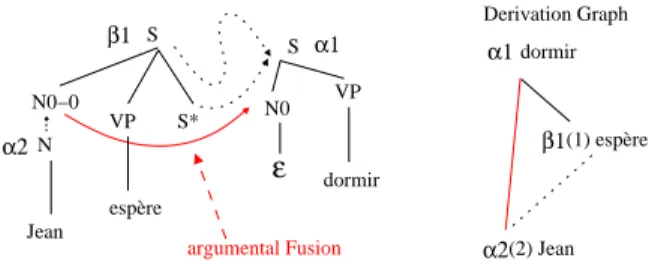
so-called argumental fusion, and a lexicon based information structure, the control canvas, stating which argument is controlled by the verb (e.g. sub-ject for to hope and obsub-ject for to forbid). The idea there was to view control verbs as capable of transferring their controlled argument to the trees in which they adjoin by the means of partial derivations, allowing for the creation of a
pseudo-derivation between the argument of the control
verb tree (i.e. Control Tree) and the embedded verb. This pseudo-derivation accounts for the fact that a syntactic argument of the embedded verb is not realized whereas its morphological features are actually transfered from the Control Tree sub-stitution node through percolation of its feature
6We assume a non-VP coordination analysis of (3). 7The pure LTAG analysis of French control verbs was
ini-tially proposed by Abeillé (1998).
structure,8 thus making the underlying unrealized
derivation explicit.9 Figure 6 gives an overview of the process leading to a derivation graph.
argumental Fusion (1) espère β1 (2) Jean α2 dormir α1 Derivation Graph α2 β1 ε α1 Jean VP dormir S VP N0 espère S S* N0−0 N
Figure 6: Overview of control verb analysis, (Sed-dah and Gaiffe, 2005)
This analysis can be rephrased in our frame-work by associating the control tree with a single node sharing a derivation with the node controlled by the verb, as illustrated in Figure 7.
β-espèrer 8 > > > > > < > > > > > : S N0↓ V espère S* N0 9 > > > > > = > > > > > ;
Figure 7: MC-Set for control verb espérer (to
hope) and derivation tree for 3.
Note that similarly to the initial LTAG imple-mentation discussed above, where the argumental
fusion could only occur on the node of a tree where
the control tree was to adjoin, it is necessary to re-strict the substitution of the control verb MC set’s
single node in the same way. In other words, to
avoid overgeneration, in the case of chain of con-trols ( e.g., John hopes to forbid Mary to sleep), the derivations of a control verb MC set’s trees must be tree local.10
4.2 Control Verb and Coordination
Until now, we have assumed that only initial trees anchored by verbs could be described in an MC-Set together with their ghost trees. Therefore, there is no way to create derivation links between different MC-Sets for providing an elegant anal-ysis of (3) while remaining in TL-MCTAG-LSD.
8
See this example of feature transfer in French:
Mariei espère εi être belle.
Mary-FEM-SGi hopes εi to be pretty-FEM-SG.
9This mismatch between the derivations underlying a
de-rived structure and the real derivation structure is also noted by Kallmeyer (2002) for quantifier and verb interrelations.
10Thanks to Timm Lichte for bringing this case to our
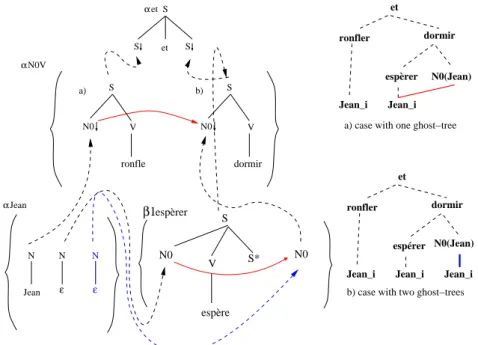
b) case with two ghost−trees Jean_i ronfler dormir espèrer N0(Jean) et Jean_i Jean_i a) b) ronfle dormir β1 ε
a) case with one ghost−tree
αet αJean ε αN0V N0(Jean) ronfler dormir espérer et Jean_i Jean_i S* V S N0 N0 V S N0 S N S S et espèrer N Jean N V S espère N0
Figure 5: MCTAG-LSD derivation for “Jean ronfle et espère dormir” (John snores and hopes to sleep)
For the sake of legibility, anchoring derivations of verbal trees are not displayed in this figure.
Nevertheless, nothing prevents us from allowing nominal trees to be characterized in the same way. This allows a (lexically) anchored tree to substi-tute into a tree of a given MC-Set while one of its ghost trees substitutes into another tree from a different tree set. Thus, it becomes possible to substitute a tree anchored by Jean into the tree anchored by dormir, while its unrealized coun-terpart will substitute into the argument node of the control verb, therefore allowing the derivation tree displayed in Figure 5a. As one tree is derived into one MC-Set and its ghost tree into another, this analysis falls beyond TL-MCTAG, and bene-fits from the larger expressivity of NL-MCTAGs. It shall be noted that having an unrestricted poten-tial number of unrealized ghost trees inside a nom-inal MC-Set means that a substitution of such a
ghost tree can occur in lieu of a shared derivation,
thus allowing coindexations of derivation nodes instead of sharing (cf. Figure 5b).
This potential source of ambiguity could be cir-cumvented by stating precedence rules between shared derivations and ghost derivations (i.e. derivation of ghost trees). Nevertheless, such an ambiguity is precisely what is needed to provide an analysis of argument cluster coordination in our framework, as we shall now demonstrate.
5 Argument cluster coordination
Assuming an ellipsis analysis for argument clus-ter coordination (ACC; (Beavers and Sag, 2004)),
sentences such as (4) can be simply analyzed as a case of gapping plus a right subject elision in our framework. This requires an MC-Set α-donner which includes a tree anchored by donner/give and its ghost tree, as depicted in Figure 8.
(4) Jeani donnej une fleur à Marie et εi εj une
bague à Paul
John gives Mary a flower and Paul, a ring
However, let us assume an analysis involving a right subject elision and a gapping of the main verb. Then, using the extension of our framework that we defined for handling unbounded ellipsis (section 4), the subject of εj can be obtained in
two different ways: (i) via a local shared deriva-tion as sketched in the previous secderiva-tions (no ghost
tree is needed in the MC-Set α-Jean, which
con-tains one unique tree); or (ii) as a ghost tree that belongs to the MC-Set α-Jean.
Note that if we follow Weir’s (1988) original definition of MCTAG derivation, both ways to ob-tain the subject lead to the same derivation struc-ture. Our own model implies that derivation steps with LSD or involving ghost trees will lead to dif-ferent structures. This comes from the fact that our model is based on Kallmeyer’s per-tree interpreta-tion of MCTAG derivainterpreta-tion.
More precisely, Weir’s definition of MCTAG derivation always implies a sharing, whereas Kallmeyer’s own definition leads to two different, possibly co-indexed, nodes. These two possible
α-donner 8 > > > > > > > > < > > > > > > > > : a) S N0↓ Vanchor [donner] N1↓ PP à N2↓ 0 B B B B B B @ b) Sc N0↓ Vanchor ε N1↓ PP à N2↓ 1 C C C C C C A *9 > > > > > > > > = > > > > > > > > ; A B C
Figure 8: MC-Set α-donner(Constraints on links are defined as follows: {(A, {B|C})})
interpretations of derivation can handle the differ-ence between (i) an elided anchor that refers to the same individual or event as the anchor of the lex-icalized tree in the same MC-Set (as Jean in (4)) and (ii) an elided anchor that refers to another (co-indexed) instance of the same class of individuals, or events, (as fleur/flower in (5)).
(5)
Jeani donnej une fleurkbleue à Marie et
Johni givesj a blue flowerk to Mary and
εi εj une εkrouge à Paul
εi εj a red (one)k to Paul
Therefore, what we need is a mechanism that can determine whether a given MC-Set denotes a unique event or individual, the latter correspond-ing to the sharcorrespond-ing case or a list of events or individ-uals that are instances of the same class of events or individuals. Such a mechanism requires more than just syntactic information, typically it needs to rely on an adequate type system.
Let us consider again example (5). Whatever the interpretation of the derivation operations, the derivation runs as follows. Nominal MC-sets α-fleur and α-Jean include ghost trees, whereas the auxiliary trees β-bleu and β-rouge have no ghost
trees.11 The auxiliary tree in β-bleu adjoins to the non-ghost tree in α-fleur while the one in β-rouge adjoins to the ghost tree in α-fleur. The de-terminers are treated in the same way. Next, the tree based on the non-ghost tree in α-fleur substi-tutes in the non-ghost tree in α-donner, whereas the other tree substitutes in the ghost tree in α-donner.12 The gapping and right subject elision are then handled as in Section 2.
11Allowing unlimited adjunction of ghost auxiliary trees
would lead to many spurious ambiguities, whereas having modal verbs or adverbs together with their ghost trees in a MC set would certainly be a step toward an elegant treatment of elided modifiers.
12To avoid spurious ambiguities when ghost trees are
sub-stituted, Local Shared Derivations could be used to check that the right ghost tree has been derived wrt to its antecedent.
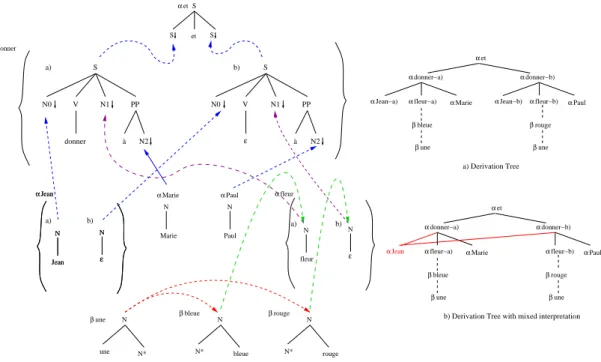
Now, let us suppose that we associate the MC-Set Jean with a type <e> and the MC-MC-Set α-fleur with type <e, t>. Let us postulate that we use Kallmeyer’s per-tree interpretation for MC-Sets with type <e, t> and Weir’s interpretation for MC-Sets with type <e>, the resulting derivation structure would be exactly the expected predicate-argument structure as shown in Figure 9b and will only require the expressive power of Set Local MCTAGs.
To show how such a structure could be gener-ated, we assumed a rather naive syntax-semantics interface where all elements of a nominal MC-set have the same scope, regardless of their semantic types. That is, as pointed out by an anonymous reviewer, if an NP is right-node-raised, or under-goes a right-subject elision,13 we can have an NP with type <e, t> that leads to a wide scope read-ing which would imply a sread-ingle node in the deriva-tion tree. In fact, should we want to distinguish be-tween narrow and wide scope readings, we would need a richer model that could infer scope infor-mation from all trees of a MC-set. It would be very interesting to see how a model à la Kallmeyer and Joshi (2003) could be integrated in our framework. In fact, the idea of adding another type of node carrying scope information through the derivation structure seems natural considering the nature of our proposal.
6 Discussion
If syntactic and semantic structures were tied by a strict isomorphism, the TAG derivation tree, with its strict encoding of subcategorized arguments, could have been considered as a proper predicate-argument structure. Unfortunately, due to a lack of expressive power, most of the complicated cases of mismatch between syntax and semantics can-not be formalized without breaking the elegance of
13e.g., [Someone from NY]
iseems to have won the cup and
TAGs’ main property, namely that dealing with el-ementary trees means dealing with partial depen-dency structures. Over the last fifteen years, solv-ing this problem has mobilized many teams, and, as noted by (Nesson and Shieber, 2006), led to the emergence of two schools. One focusing on giving more expressive power to the formalism in order to ease either a tight integration between the logi-cal and the syntactic layers (Kallmeyer and Joshi, 1999; Gardent and Kallmeyer, 2003) or a capac-ity to handle, for instance, free word order lan-guages (Lichte, 2007). The other school focuses either on keeping the syntactic TAG backbone as pure as possible, by designing a new derivation op-eration to handle coordination (Sarkar and Joshi, 1996) or on carefully designing a syntax-semantic interface built upon TAG derivations (Shieber and Schabes, 1990; Shieber and Nesson, 2007). Our proposal stands in between as we acknowledge that pure TAGs are not powerful enough to carry on simple analysis of complex phenomena while bringing the derivation tree closer to a predicate-argument structure. Recent proposals in the syn-chronous TAG framework share the same concern. In fact, Shieber and Nesson (2007) use Vector MCTAG (Rambow, 1994), for its ability to under-specify dominance relations and provide the syn-chronized logical layer with a derivation structure suitable for the analysis of control verbs. How-ever, as we have shown, our solution for control re-quires a generalization of the mechanism designed for handling elliptic coordination that needs the expressive power of Non Local MCTAGs and tight integration of our proposal with a syntax-semantic interface. This raises two open questions: What generative power do we really need to build ap-propriate derivation structures? More importantly, where do we want syntax to stop?
7 Conclusion
We have shown how to extend an MCTAG ac-count of coordination with a simple mechanism added on top of its extended domain of locality and which enables the handling of more complex constructions involving control verbs and elliptic coordinations. We have also shown how argu-ment cluster coordinations could be treated in our framework without any special treatment besides the inclusion of a small type inference system if one wants to provide a proper dependency struc-ture. Our work also shows that our treatment of
such coordinate constructions needs the expressive power of Non Local MCTAGs to cope with un-bounded ellipsis and Set Local MCTAGs for ACC.
References
Anne Abeillé. 1998. Verbes “à monté” et auxili-aires dans une grammaire d’arbres adjoints. LINX, (39):119–158.
Anne Abeillé. 2006. In defense of lexical coordina-tion. In P.Cabredo O.Bonami, editor, Empirical Is-sues in Formal Syntax and Semantics 6. CSSP online Proceedings.
John Beavers and Ivan A. Sag. 2004. Coordinate el-lipsis and apparent non-constituent coordination. In Proceedings of the HPSG04 Conference, pages 48– 69.
Mary Dalrymple, Stuart M. Shieber, and Fernando C. N. Pereira. 1991. Ellipsis and higher-order unifi-cation. Linguistics and Philosophy, 14(4):399–452. Claire Gardent and Laura Kallmeyer. 2003.
Seman-tic construction in feature-based tag. In EACL ’03: Proceedings of the tenth conference on European chapter of the Association for Computational Lin-guistics, pages 123–130, Budapest, Hungary. Asso-ciation for Computational Linguistics.
Laura Kallmeyer and Aravind Joshi. 1999. Factor-ing predicate argument and scope semantics: Under-specified semantics with LTAG. In Proceedings of the 12th Amsterdam Colloquium, December. L. Kallmeyer and A. Joshi. 2003. Factoring Predicate
Argument and Scope Semantics: Underspecified Se-mantics with LTAG. Research on Language & Com-putation, 1(1):3–58.
Laura Kallmeyer. 2002. Enriching the tag derivation tree for semantics. Proceedings of KONVENS 2002, pages 67–74.
Laura Kallmeyer. 2005. A declarative characteriza-tion of a declarative characterizacharacteriza-tion of multicom-ponent tree adjoining grammars. In Proceedings of Traitement automatique des langues Naturelles -TALN’05, Dourdan, France.
Timm Lichte and Laura Kallmeyer. 2010. Gapping through TAG derivation trees. In Proceedings of The 10th International Conference on Tree Adjoin-ing Grammars and Related Formalisms (TAG+10), Yale, USA, June.
Timm Lichte. 2007. An MCTAG with Tuples for Coherent Constructions in German. In Proceedings of the 12th Conference on Formal Grammar 2007., Dublin, Ireland.
John T. Maxwell, III and Christopher D. Manning. 1996. A theory of non-constituent coordination based on finite-state rules. In Miriam Butt and Tracy Holloway King, editors, On-line Proceedings of the LFG96 Conference.
a) Derivation Tree Jean αJean−a) αdonner−a) αdonner−b) αMarie αfleur−a) βbleue βune αJean−b) αfleur−b) βrouge αPaul αet βune a) b) a) b) a) b)
b) Derivation Tree with mixed interpretation
αJean ε ε αMarie αPaul αdonner βbleue βune αfleur αet αJean ε βrouge αdonner−a) αdonner−b) αMarie αfleur−a) βbleue βune αfleur−b) βrouge αPaul αet βune α N PP à N2 S N0 V N1 donner une N* N Jean N N N* rouge N S N fleur N Marie S S N Paul N Jean PP à N2 S N0 V N1 ε N bleue N N* et
Figure 9: Sketch of derivations for Argument Cluster Coordination of sentence 5 (Johni givesj a blue
flowerkto Mary and εiεja red (one)kto Paul)
For the sake of readability, local shared derivations (from (a)N0 to (b)N0 and (b)N1 to (a)N1) are not displayed in this figure.
David Milward. 1994. Non-constituent coordination: Theory and practice. In Proceedings of the 15th in-ternational conference on Computational linguistics (COLING94), volume 2, pages 935–941.
François Mouret. 2006. A phrase structure approach to argument cluster coordination. In Stefan Müller, editor, Proceedings of the 13th International Confer-ence on Head-Driven Phrase Structure Grammar, pages 247–267, Stanford. CSLI Publications. Rebecca Nesson and Stuart M. Shieber. 2006.
Sim-pler tag semantics through synchronization. In Pro-ceedings of the 11th Conference on Formal Gram-mar, Malaga, Spain, pages 29–30.
Owen Rambow. 1994. Formal and Computational Aspects of Natural Language Syntax. Ph.D. thesis, University of Pennsylvania.
Anook Sarkar and Aravind K. Joshi. 1996. Handling coordination in a tree adjoining grammar. Techni-cal report, Dept. of Computer and Info. Sc., Univ. of Pennsylvania, Philadelphia, PA.
Djamé Seddah and Bertrand Gaiffe. 2005. How to build argumental graphs using TAG shared forest: a view from control verbs problematic. In Proceed-ings of the 5th International Conference on the Log-ical Aspect of Computional Linguistic - LACL’05, Bordeaux, France, Apr.
Djamé Seddah and Benoît Sagot. 2006. Modeling and analysis of elliptic coordination by dynamic ex-ploitation of derivation forests in LTAG parsing. In Proceedings of TAG+8, Sydney, Australia.
Djamé Seddah. 2008. The use of MCTAG to Process Elliptic Coordination. In Proceeding of the Ninth In-ternational Workshop on Tree Adjoining Grammars and Related Formalisms (TAG+9), Tuebingen, Ger-many, June.
Stuart M. Shieber and Rebecca Nesson. 2007. Extrac-tion phenomena in synchronous tag syntax and se-mantics. In Proceedings of the Workshop on Syntax and Structure in Statistical Translation, Rochester, New York, volume 26.
Stuart Shieber and Yves Schabes. 1990. Synchronous Tree Adjoining Grammars. In COLING, volume 3, pages 253–260, Helsinki.
Mark J. Steedman. 2001. The Syntactic Process. The MIT Press, Cambridge, MA.
Éric Villemonte de La Clergerie. 2005. From metagrammars to factorized TAG/TIG parsers. In Proceedings of the Fifth International Workshop on Parsing Technology (IWPT’05), pages 190–191, Vancouver, Canada, October.
David J. Weir. 1988. Characterizing mildly context-sensitive grammar formalisms. Ph.D. the-sis, Philadelphia, PA, USA. Supervisor-Aravind K. Joshi.

![Figure 2: Sketch of a right node raising derivation for: Jean vend ε i et Marie fabrique [des crepes] i](https://thumb-eu.123doks.com/thumbv2/123doknet/14567559.539208/4.892.134.727.87.243/figure-sketch-right-raising-derivation-marie-fabrique-crepes.webp)