HAL Id: hal-00408001
https://hal.archives-ouvertes.fr/hal-00408001
Submitted on 6 May 2020
HAL is a multi-disciplinary open access
archive for the deposit and dissemination of sci-entific research documents, whether they are pub-lished or not. The documents may come from teaching and research institutions in France or abroad, or from public or private research centers.
L’archive ouverte pluridisciplinaire HAL, est destinée au dépôt et à la diffusion de documents scientifiques de niveau recherche, publiés ou non, émanant des établissements d’enseignement et de recherche français ou étrangers, des laboratoires publics ou privés.
Fluid systems in foreland fold-and-thrust belts : on
overview from the Southern Pyrennees
A. Travé, Pierre Labaume, J. Vergès
To cite this version:
A. Travé, Pierre Labaume, J. Vergès. Fluid systems in foreland fold-and-thrust belts : on overview from the Southern Pyrennees. O. Lacombe; F. Roure; J. Lavé; J. Vergés. Thrust belts and foreland basins, from fold kinematics to hydrocarbon systems, Springer, pp.93-115, 2007, �10.1007/978-3-540-69426-7_5�. �hal-00408001�
Fluid Systems in Foreland Fold-and-Thrust Belts:
An Overview from the Southern Pyrenees
Travé, A. · Labaume, P. · Vergés, J.
Abstract.
The analysis of three different regions of the South-Pyrenean fold-and-thrust belt reveals that during the Tertiary compression the hydrological system was compartmental-ised in time and space. During the early-middle Eocene, when the thrust front affected marine soft-sediments in the Ainsa basin, the thrust fault zones were dominated by formation fluids derived from Eocene marine waters trapped in the un-derlying Eocene marls, although influences of meteoric wa-ters were also present. During the middle-late Eocene, when the thrust front emplaced marine rocks over continental red-beds in the eastern Catalan basin (L’Escala thrust), the thrust fault zones were dominated by meteoric fluids. These fluids flowed preferentially along these faults, draining laterally the meteoric fluids and acting as barriers hindering their flowing towards more external parts of the belt. During the Oligo-cene, the most external part of the fold-and-thrust belt in the eastern Catalan basin developed on top of a salt detachment horizon. The thrust front affected continental materials of late Eocene-Oligocene age. At this moment, the thrusts were con-duits for meteoric fluids arriving from the surface and also for evolved meteoric fluids migrating over short distance up-wards after being in contact with the underlying evaporitic beds.
Most of the fractures show a similar sequence of micro-fractures. Microfractures of stage 1 formed when the sedi-ment was poorly lithified. Microfractures of stage 2 represent the main episode of vein formation which developed when a progressive induration of the host sediment occurred. During microfracture stage 3, formed in an extensional regime, the host sediment was more indurated. The repetition of this se-quence of microfractures in different fracture generations of the same outcrop indicates that the sediment induration was restricted to the vicinity of the vein. Away from the veins, the sediment remained poorly lithified during the entire defor- mation cycle. Calcite cement within the host rock precipitat-ed later than the syn-compressive veins, when the sediment was more indurated.
Elemental geochemistry and stable isotopes of the calcite veins indicates that early generation of microfractures is in- filled by local fluids (either marine or meteoric), whereas ex-ternal fluids (meteoric or evolved meteoric) infilled the main compressive stage of microfractures. The hot temperature of these fluids (157ºC to 183ºC in the Atiart-Arro example) indi-cates their circulation through deep parts of the thrust belt. The progressive increase of the 87Sr/86Sr ratio through time is due to the progressive uplift, exposure and erosion of the in-ternal Pyrenean Axial Zone.
1 Introduction
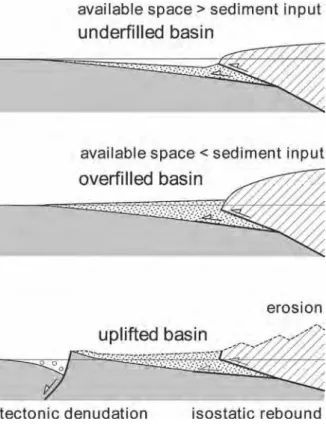
Geofluids are related to the formation and deforma-tion of the fold-and-thrust belts and sedimentary fore-land basins. The geodynamic evolution of the belt - foreland basin system moves geofluids and, in their turn, geofluids condition the geodynamic evolution of the system by controlling the propagation of frac-tures and faults and the dynamics of fault activity. The fluid sources are likely to change during this coupled evolution, in particular because most foreland basins evolve from marine and largely underfilled to conti-nenta overfilled and largely bypassing (e.g. Allen et al., 1986) (Fig. 1). Fractures and faults may have a major control on fluid distribution and migration pathways, acting as barriers or as conduits. The etailed petrolo-gy of the vein filling fractures, coupled with their dis-tribution, geometry and microstructural study, is a key to understanding the coupling between fractures, faults and fluid, in particular 1) the mechanisms and kinematics of fluid-deformation relationships, 2) the fluid flow events and their relative timing, and 3) the synchronism, or not, between fracturation and fluid flow. Thegeochemical composition of the fracture-fill-ing minerals and their comparison with the geochem-istry and mineralogy of their host rocks allow to assess 1) the physico-chemical characteristics of the fluid, and therefore the fluid type and origin, 2) the degree of fluid/rock interaction (high versus low), 3) the type of fluid flow regime (closed versus open), and 4) the fluid pathways (pervasive versus channelized). Finally, the integration of all these data within a specific geo-logical setting constrains the relative timing of fluid flow and the fluid driving force.
Themain fluid flow systems in foreland-orogen con-texts are driven by tectonics (Oliver, 1986; Burkhard & Kerrich, 1988; Machel & Cavell, 1999) and topography (Garven 1985, 1989, 1995). Structural and microstruc-tural study of faults related to compression indicates
that a high-fluid pressure highly favours thrusting (Roure et al., 1994, 2005) although it is not a prereq-uisite (Dietrich et al., 1983; Cosgrove, 1993). Orogenic compression may drive fluid migration directly (Oli-ver, 1986), and significant fluid flow may migrate to-wards the foreland coevally with thrusting (Ge and Garven, 1992; Qing & Mountjoy, 1992). Bradbury & Woodwell (1987) inferred that each thrust sheet act-ed as a separate hydrodynamic unit for expulsion of fluids into the foreland. Geochemical studies of cal-cite cements in compressive fault zones indicate in some cases high fluid-rock interaction and relatively closed palaeohydrogeological regime (Dietrich et al., 1983; Budai, 1985; Kyser & Kerrich, 1990; Muchez et al., 1995; Calvet et al., 1996; Travé et al., 1997, 1998; Ferket et al., 2004) but, in other cases calcite cements indicate low fluid-rock interaction and relatively open palaeohydrogeological regime (Burkhard & Kerrich, 1988; Marquer & Burkhard, 1992). Quantitative mod-elling of fluid migration in active foreland basins re-veals that fluid flow derived from basin sediment com-paction is subordinate to that resulting from the rising hinterland topographic relief of the orogen (Ge & Gar-ven, 1992; Bethke & Marshak, 1990; Bitzer et al., 1998).
Ge & Garven (1994) calculated that the total volume of fluid expelled during thrusting is in the order of 1% of the total volume of pore fluid that moved through the section after thrusting (i.e., by topographically-driv-en flow), and these fluids did not travel more than a few km into the foreland. Low fluxes of tectonically-expelled fluids are also indicated in the Rocky Moun-tain Foreland Basin (Machel & Cavell, 1999) and in the Variscan foreland because recrystallization and lithifi-cation of the host rocks occurred earlier than thrust-ing (Muchez et al., 1995).
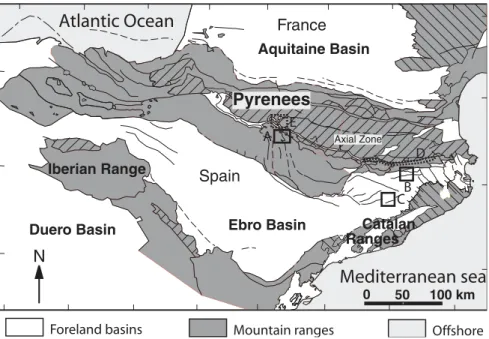
TheSouth-Pyrenean fold-and-thrust belt represents an ideal natural fi ld laboratory for the study of fluid migration during orogenic compression because the evolution of the foreland basin from marine under-filled to continental overunder-filled and the coupled thrust front propagation are particularly well recorded. The aims of this paper are to compare the type and ori-gin of the synkinematic fluids and the type of palaeo-hydrogeological regime at diff rent moments of the thrust front propagation. For this, we use data from three areas in three diff rent parts of the belt repre-sentative of the main situations of the belt front dur-ing the main tectonic events: the Atiart-Arro thrust-fold system in the Ainsa basin, and the L’Escala thrust and El Guix anticline, both located in the eastern Cat-alan basin (Fig. 2). Data from Atiart-Arro and El Guix are synthesised from detailed works already published separately elsewhere (Atiart-Arro: Travé et al., 1997, 1998; El Guix: Travé et al., 2000), whereas data from L‘Escala are new data presented here for the first time. Details of analytical techniques and methods, as well as the detailed petrology in the cases of Atiart-Arro and El Guix, are not presented in this paper and the readers are referred to the previouly published papers.
We will also discuss the place of oil migration in the fluid history from an example in the eastern Cat-alan basin (Caja et al., 2006), and compare fluid flow in the thrust front with that associated with the em-placement of basement thrust sheets in inner parts of the belt (Grant et al., 1990; Banks et al., 1991; McCaig et al., 1995).
2 South-Pyrenean Fold-and-Thrust Belt
The continental collision of Iberia and Europe pro-duced the formation of the Pyrenean orogen with a partial subduction of the Iberian lithosphere to the north (Choukroune et al., 1989; Roure et al., 1989; Mu-ñoz, 1992; Beaumont et al., 2000). Convergence began during the Campanian and most of compressional de-formation ceased during the early Miocene. Two large flexural foreland basins formed on both sides of the growing mountain chain: the Aquitaine retroforeland and the Ebro foreland basins (Fig. 2). After an early
Fig. 1. Evolution of a foreland basin from marine and largely
underfilled to continental. overfilled and largely bypassing. Post-orogenic vertical motions are mainly controlled by the in-terplay between tectonic and surficial denudation with con-comitant isostatic rebound.
period of low subsidence rate and mainly continental or marine platform sedimentation, the South-Pyrene-an forelSouth-Pyrene-and basin developed as underfilled South-Pyrene-and ma-rine during the early-middle Eocene, with turbiditic troughs both in the eastermost and westernmost parts (the eastern Catalan and the Ainsa-Jaca basins, respec-tively). Subsequently, the basin became overfilled and continental from the middle-late Eocene to the end of shortening during the late Oligocene (Puigdefàbregas et al., 1986, 1992; Vergés et al., 1995, 1998). At the mid-dle-upper Eocene boundary (~37 Ma) the uplift of the Western Pyrenees triggered the end of the marine fore-land basin stage and originated an intermountain ba-sin limited by the Pyrenees, the Catalan Coastal Rang-es and the Iberian Range (Vergés & Burbank, 1996). An internal fluvial network delivered sediments to the Ebro Basin characterized by a large central lake (e.g., Anadón et al., 1979; Arenas & Pardo 1999). In the east-ern Catalan basin, the deposition of the Cardona salts (~37 Ma) coincides with this transition from marine to continental conditions. The end of deformation along the South-Pyrenean thrust front occurred during the late Oligocene as determined by magnetostratigraphy on growth strata (~24.7 Ma) (Meigs et al., 1996). Fis-sion track cooling ages in the Axial Zone of the central Pyrenees, however, reveal that basement uplift in the back of the fold-and-thrust belt ended its major up-lift at about 30 Ma (Fitzgerald et al., 1999), and that younger movements occurred around 20 Ma along the southern edge of the Axial Zone (Sinclair et al., 2005; Campani et al., 2005). The Ebro basin infilled up to the late Miocene times when it was captured by Med-iterranean rivers and thus ending its endorheic
char-acter (e.g., Coney et al., 1996; García-Castellanos et al., 2003).
During Pyrenean shortening there was a gener-al migration of tectonic activity towards the foreland as well as of the sedimentary depocentres. Three main periods of thrust sheet movements can be diff renti-ated with diff rent rates of motion (e.g. Vergés et al., 2002), namely:
1. An early period during the Late Cretaceous-Pa-leocene, related to the emplacement of the upper-most thrust sheets, with very low rates of about 0.5 mm/a;
2. A second period, during the early and middle Eo-cene, which is characterized by fast rates of thrust sheet emplacement in the order of 4.0 to 4.4 mm/a in submarine conditions;
3. During the third period (late Eocene – Oligocene) there was a decrease of the rates of thrust emplace-ment down to 1.5 to 2.6 mm/a.
Thesecond and third periods largely coincide with the underfilled and overfilled stages of basin evolution, re-spectively.
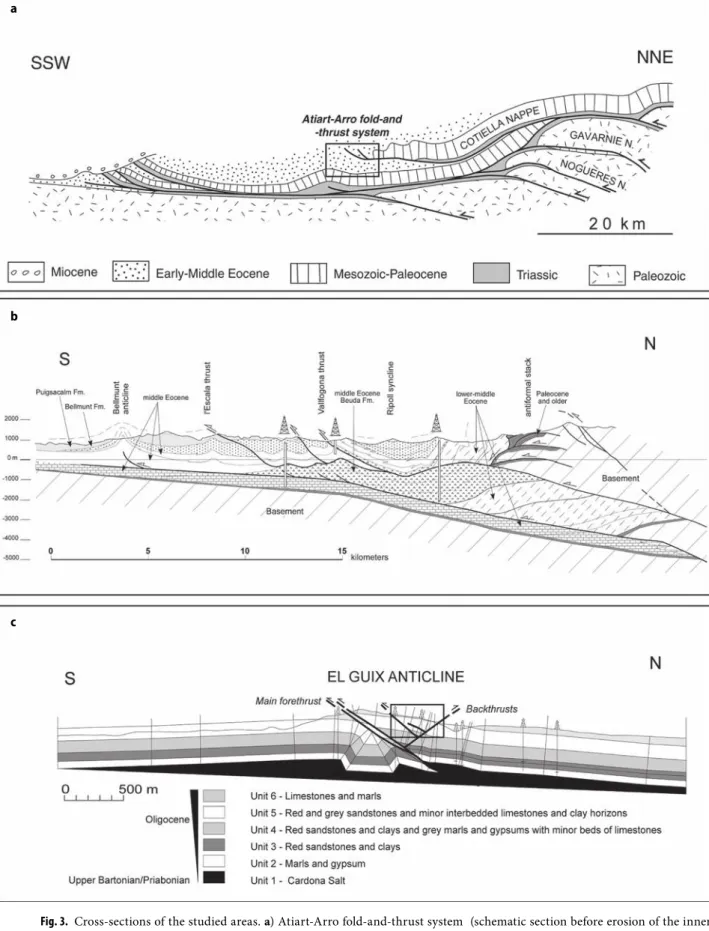
The three selected structural domains (Fig. 2) to conduct this geofluid study are representative of the two last stages of the thrust front – foreland basin tem migration. The Atiart-Arro fold-and-thrust sys-tem represents the submarine stage, during the ear-ly-middle Eocene. The L’Escala thrust represents an intermediate stage, during the middle-late Eocene in transitional marine-continental conditions. The El Guix anticline represents the latest stage, during the Oligocene, with continental conditions (Fig. 3).
Fig. 2. Structural sketch of the
Pyrenean belt and location of the studied outcrops. A: Atiart-Arro (early-middle Eocene); B: L’Escala (middle-late Eocene); C: El Guix (Oligocene); D: outcrop zone of Armanciès Formation marls (lower Eocene); E: outcrop area of Gavarnie basement thrust discussed in the text.
Fig. 3. Cross-sections of the studied areas. a) Atiart-Arro fold-and-thrust system (schematic section before erosion of the inner
part of the Cotiella nappe). The box corresponds to Fig. 4. b) L’Escala thrust. c) El Guix anticline. The box corresponds to Fig. 8
a
b
3 Early Development
of Submarine Thrust Front:
Atiart-Arro Fold-and-Thrust System
3.1 Geological Framework
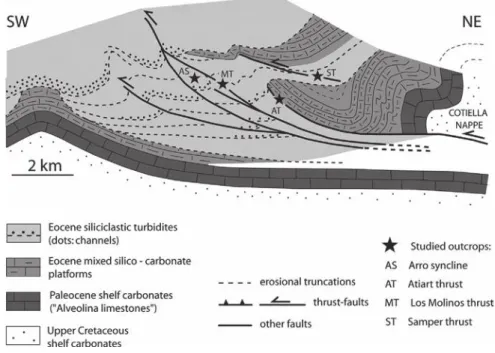
The Atiart-Arro fold-and-thrust system is located in the eastern part of the Ainsa sub-basin, a marine dep-ocentre in the inner part of the central South-Pyrenean basin. The Ainsa sub-basin is mainly filled up by low-er and middle Eocene marls with sandstone and con-glomerate intercalations forming turbiditic channel-levee complexes, and comprises westward prograding outer-shelf/slope facies intercalations in the eastern part (e.g. Mutti et al., 1988). Th se deposits rest above Upper Cretaceous-Paleocene shelf carbonates, Permo-Triassic marls and sandstones, and a Paleozoic base-ment. The northern part of the basin-fill is thrust by the Cotiella Nappe, detached in the Triassic sediments and mainly consisting of Upper Cretaceous-Paleocene carbonates (Fig. 4) (Séguret, 1972). The nappe moved southwards for at least 20 km and was probably root-ed in the Paleozoic basement of the Axial Zone of the belt, although this root cannot be precisely identifi d due to subsequent deformation and erosion (e.g. Mar-tinez-Peña & Casas-Sainz, 2003). TheAtiart-Arro fold-and-thrust system is a SW-verging imbricate structure developed in the basin-fill at the front of the nappe. Erosional surfaces and unconformities related to the fold-and-thrust system show that the main movement of the Cotiella Nappe occurred during the early
Eo-cene (Ypresian), and that deformation continued dur-ing the middle Eocene (Mutti et al., 1988).
The study of the fluid behaviour was carried out on four hectometric-scale outcrops, correspond-ing to three thrust-fault zones and one syncline: the Sampert, Atiart, and Los Molinos thrusts, from the NE to the SW (and structurally from top to bottom), and the Arro syncline in the footwall of the Los Moli-nos thrust (Fig. 4) (Travé et al., 1998). The Atiart and Los Molinos thrusts probably root within the Cotiella thrust, whereas the Samper thrust is a rootless “out-of-the-syncline” thrust. The Arro syncline is asymmet-ric, with a steeply-dipping eastern limb and a gently-dipping western limb.
The studied mesostructures aff ct mainly marly li-thologies. The thrust fault zones consist in a-few-me-tres thick intervals where deformation is marked by the association of shear bands in marls and calcite shear veins. Calcite veins are also observed over a few tens of metres in the thrust-fault footwalls, but they are rare or absent in the hangingwalls. Theshear bands feature S-C structures related to the development of pressure-solution cleavage. The most intensely strained shear bands have mineral assemblages characterised by the occurrence of dickite, which is absent in the protolith as well as in the less strained domains of fault zones (Buatier et al., 1997). Many calcite veins show a three-stage evolution of their microstructure with 1) diffuse veinlet networks associated with sand disaggregation, 2) crack-seal shear microstructures forming most of the vein volume, and 3) late extensional openings. The geometry of stage 1 and 2 microstructures is coher-ent with the syn-thrust shearing kinematics and their
Fig. 4. Detailed cross-section of
the Atiart-Arro fold-and-thrust system.
chronology relates to the progressive induration of the sediment during vein formation, whereas stage 3 corresponds to a syn- or post-shear boudinage of the veins forming tabular bodies more competent than the surrounding marls. Thecrack-seal microstructures at-test the episodic nature of fault slip and calcite precipi-tation. Similar shear veins are also present in the Arro syncline, with three generations that formed before, during and after folding, respectively. The most-abun-dant ones are the syn-folding veins, which formed along the bedding planes in relation to bedding-slip in the steep limb of the syncline. In the Arro syncline, as well as in the Samper and Los Molinos thrusts, calcite veins contain minor amounts of celestite. Other pe-trographic features of the veins are described in Travé et al., (1997).
Macroscopic deformation is weak outside the thrust fault zones and regional cleavage is absent. However, a locality in the western limb of the Arro syncline fea-tures oval burrows that attest about 20% of NE-SW horizontal shortening prior to sediment lithification (Travé et al., 1998). Sand disaggregation observed in the earliest stages of shear vein formation also shows that deformation aff cted initially poorly-lithifi d sed-iments.
3.2 δ
18O and δ
13C of Host Rock and Calcite Veins
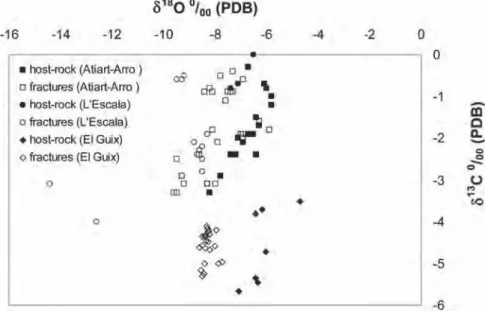
The d18O and d13C values from the host marls range
from -8.2‰ to -5.8‰, and from -3.3 ‰ to -0.7‰ PDB, respectively (Fig. 5, Table 1). Th y are thus lower than those of the Eocene marine carbonates which range from -4‰ to +2‰ and from -0.3‰ to +2.8‰ PDB, respectively (Shackleton & Kennett, 1975; Veizer &
Hoefs, 1976; Hudson & Anderson, 1989), this deple-tion most probably resulting from burial diagenesis.
Calcite cements from the three microscopic stages of vein development, as well as the pre-, syn- and post-syncline veins at Arro do not show significant diff r-ences of isotopic values. On each outcrop, the oxygen isotopic values of the calcite cements in veins are sys-tematically depleted between 1.3 and 2.8‰ PDB in re-lation to the host marl calcite, probably indicating a higher temperature of the fluid from which the vein calcite precipitated with respect to its adjacent host rock (Marshall, 1992), or a deeper setting of precipi-tation.
The Atiart and Los Molinos thrusts, which are deep-rooted thrusts, also show depletion in 13C of
the calcite in veins with respect to the host marl cal-cite. This is interpreted as an input of an external 13
C-depleted mineralising fluid channelized through the thrust-fault zones. On the contrary, in the Arro syn-cline and the Samper thrust, which have no roots to-wards deeper domains, the similar d13C in the calcite
from veins and host marls shows that the d13C of the
mineralising fluid was mainly controlled by that of the host sediment.
The isotopic values of calcite from the dickite-bear-ing marls in thrust zones range from -9.0‰ to -5.8‰ PDB in d18O, and from -2.6‰ to -1.5 ‰ PDB in d13C,
respectively, i.e. without significant diff rences with respect to calcite from the less deformed marls. How-ever, the calcite veinlets inside these dickite-bear-ing marls show higher d18O values (from 7.3‰ to
-4.4‰ PDB in d18O, and from -2.5‰ to -1.6‰ PDB in
d13C), probably resulting from in situ clay-water
reac-tions, i.e. the dickite formation through partial disso-lution of illite and drainage of potassium by fluid flow
Fig. 5. d18O versus d13C of calcite
cements in the veins and host-rocks.
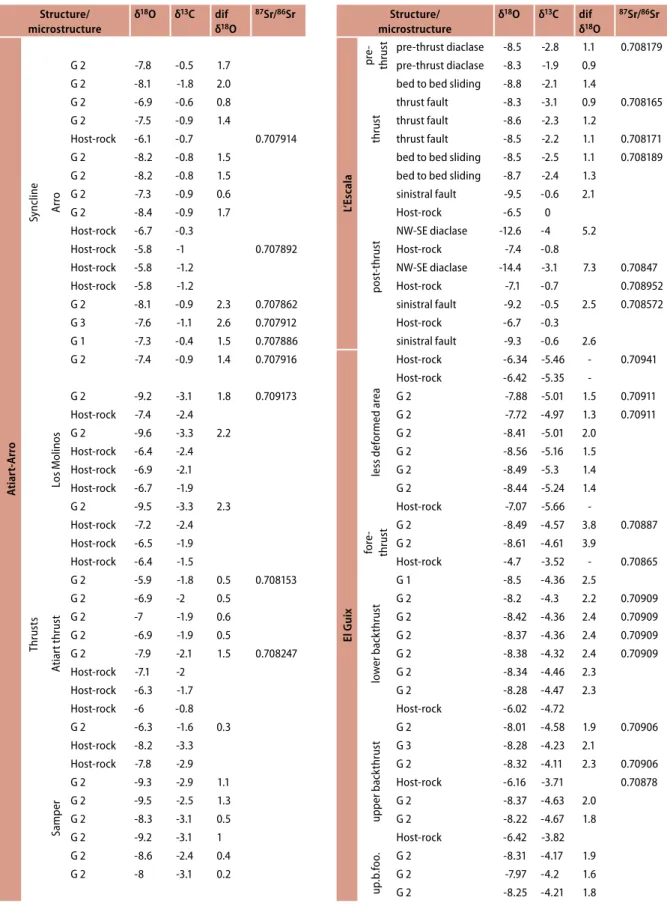
Structure/ microstructure δ18O δ13C dif δ18O 87Sr/86Sr Structure/ microstructure δ18O δ13C dif δ18O 87Sr/86Sr A ti a rt -A rr o Sy n cl in e A rr o L‘ E sc a la p re -th ru st pre-thrust diaclase -8.5 -2.8 1.1 0.708179 G 2 -7.8 -0.5 1.7 pre-thrust diaclase -8.3 -1.9 0.9 G 2 -8.1 -1.8 2.0 th ru st
bed to bed sliding -8.8 -2.1 1.4
G 2 -6.9 -0.6 0.8 thrust fault -8.3 -3.1 0.9 0.708165 G 2 -7.5 -0.9 1.4 thrust fault -8.6 -2.3 1.2
Host-rock -6.1 -0.7 0.707914 thrust fault -8.5 -2.2 1.1 0.708171 G 2 -8.2 -0.8 1.5 bed to bed sliding -8.5 -2.5 1.1 0.708189 G 2 -8.2 -0.8 1.5 bed to bed sliding -8.7 -2.4 1.3
G 2 -7.3 -0.9 0.6 p o st -t h ru st sinistral fault -9.5 -0.6 2.1 G 2 -8.4 -0.9 1.7 Host-rock -6.5 0 Host-rock -6.7 -0.3 NW-SE diaclase -12.6 -4 5.2 Host-rock -5.8 -1 0.707892 Host-rock -7.4 -0.8
Host-rock -5.8 -1.2 NW-SE diaclase -14.4 -3.1 7.3 0.70847 Host-rock -5.8 -1.2 Host-rock -7.1 -0.7 0.708952 G 2 -8.1 -0.9 2.3 0.707862 sinistral fault -9.2 -0.5 2.5 0.708572 G 3 -7.6 -1.1 2.6 0.707912 Host-rock -6.7 -0.3 G 1 -7.3 -0.4 1.5 0.707886 sinistral fault -9.3 -0.6 2.6 G 2 -7.4 -0.9 1.4 0.707916 E l G u ix le ss d e fo rm e d a re a Host-rock -6.34 -5.46 - 0.70941 T h ru st s Lo s M o lin o s Host-rock -6.42 -5.35 -G 2 -9.2 -3.1 1.8 0.709173 G 2 -7.88 -5.01 1.5 0.70911 Host-rock -7.4 -2.4 G 2 -7.72 -4.97 1.3 0.70911 G 2 -9.6 -3.3 2.2 G 2 -8.41 -5.01 2.0 Host-rock -6.4 -2.4 G 2 -8.56 -5.16 1.5 Host-rock -6.9 -2.1 G 2 -8.49 -5.3 1.4 Host-rock -6.7 -1.9 G 2 -8.44 -5.24 1.4 G 2 -9.5 -3.3 2.3 Host-rock -7.07 -5.66 -Host-rock -7.2 -2.4 fo re -th ru st G 2 -8.49 -4.57 3.8 0.70887 Host-rock -6.5 -1.9 G 2 -8.61 -4.61 3.9 A ti ar t t h ru st Host-rock -6.4 -1.5 Host-rock -4.7 -3.52 - 0.70865 G 2 -5.9 -1.8 0.5 0.708153 lo w e r b ac k th ru st G 1 -8.5 -4.36 2.5 G 2 -6.9 -2 0.5 G 2 -8.2 -4.3 2.2 0.70909 G 2 -7 -1.9 0.6 G 2 -8.42 -4.36 2.4 0.70909 G 2 -6.9 -1.9 0.5 G 2 -8.37 -4.36 2.4 0.70909 G 2 -7.9 -2.1 1.5 0.708247 G 2 -8.38 -4.32 2.4 0.70909 Host-rock -7.1 -2 G 2 -8.34 -4.46 2.3 Host-rock -6.3 -1.7 G 2 -8.28 -4.47 2.3 Host-rock -6 -0.8 Host-rock -6.02 -4.72 G 2 -6.3 -1.6 0.3 u p p e r b ac k th ru st G 2 -8.01 -4.58 1.9 0.70906 S am p e r Host-rock -8.2 -3.3 G 3 -8.28 -4.23 2.1 Host-rock -7.8 -2.9 G 2 -8.32 -4.11 2.3 0.70906 G 2 -9.3 -2.9 1.1 Host-rock -6.16 -3.71 0.70878 G 2 -9.5 -2.5 1.3 G 2 -8.37 -4.63 2.0 G 2 -8.3 -3.1 0.5 G 2 -8.22 -4.67 1.8 G 2 -9.2 -3.1 1 Host-rock -6.42 -3.82 G 2 -8.6 -2.4 0.4 u p. b. fo o . G 2 -8.31 -4.17 1.9 G 2 -8 -3.1 0.2 G 2 -7.97 -4.2 1.6 G 2 -8.25 -4.21 1.8
Table 1. δ18O, δ13C and 87Sr/86Sr ratio of calcite cements in the veins and host-rocks. The column dif δ18O indicates the difference
between de δ18O of the calcite cement in the veins and its adjacent host-rock. For Atiart-Arro and El Guix, G1, G2 and G3 refer to
along the shear zones (Buatier et al., 1997). Altera-tion of rock-fragments and feldspars has been proved to produce an 18O increase in the fluid (Yeh & Savin,
1977; Longstaff , 1993). In the context of the Atiart-Arro thrust system, the kinematics of dickite forma-tion are inferred to have been promoted by strain and fluid flow (Buatier et al., 1997), rather than by temper-ature as classically described in diagenetic or hydro-thermal environments. Comparing the values of the four outcrops, both the host marl calcite and the cal-cite cements in veins show a progressive depletion in both 18O and 13C from the Atiart thrust and Arro
syn-cline to Los Molinos thrust and to the Samper thrust (Travé et al., 1997). The structural location and buri-al history of the four outcrops make it difficult to ex-plain the trend of isotopic depletion by diff rences in burial of the structures. A possible explanation could be a higher meteoric influence in the structures locat-ed closer to the emerglocat-ed part of the belt (i.e. the Sam-per thrust).
3.3
87Sr/
86Sr Values of Host Rock and Veins
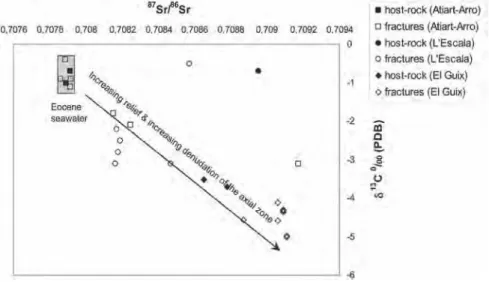
In the Arro syncline, the calcite and celestite veins and the calcite fraction of the host marls, show 87Sr/86Sr
ra-tio ranging between 0.70774 and 0.70795, without a significant diff rence between the pre-, syn- and post-syncline veins (Fig. 6, Table 1). This range of values is consistent with the 87Sr/86Sr ratio of the Eocene
seawa-ter (Katz et al., 1972; Burke et al., 1982; DePaolo & In-gram, 1985), indicating that the source of strontium to precipitate the calcite and celestite in veins and the calcite cement in the host sediment was the same. The later was controlled by the 87Sr/86Sr ratio of the
Eo-cene seawater during the whole evolution of the Arro syncline. The34S values of the celestite also indicates
precipitation from an Eocene marine water (Travé et al., 1997). Th refore, the vein-forming fluid was prob-ably the interstitial water trapped in the Eocene ma-rine marls derived from the Eocene seawater, or a fluid equilibrated with the Eocene calcitic sediments.
The siliciclastic detrital fraction in the marls has substantially higher 87Sr/86Sr ratios (0.71723–0.71894)
with respect to the Eocene seawater, giving rise to the more radiogenic 87Sr/86Sr ratios in the bulk marl
(0.70976–0.70987) than in the calcite fraction. This in-dicates that this detrital fraction originates from the erosion of Paleozoic rocks outcropping in the paleo-Axial Zone.
In the Atiart and Los Molinos thrust-fault zones, the 87Sr/86Sr ratios in vein calcite range from 0.70815
to 0.70927, i.e. more radiogenic than the Eocene sea-water values. Th se relatively high values indicate that the vein calcite in fault zones precipitated from a flu-id with a diff rent composition than the fluflu-id present outside the fault zones and, consequently, that these zones acted as fluid conduits during shear deforma-tion. This more radiogenic fluid composition could originate from 1) interaction with the Paleozoic rocks or the Eocene marls existing in deeper settings, 2) in-situ mineralogical transformations of the Eocene marls in the intensely strained sediments (e.g. the il-lite to dickite transformation), or 3) the weathering by meteoric water of the Paleozoic rocks in the emerged part of the belt. In the case that the source was the Eo-cene marls, either from deeper settings or from local more deformed part of the thrust-fault zones, the de-trital phyllosilicates submitted to higher temperature and/or pressure could have expelled their more radio-genic Sr during dissolution and mineralogical trans-formations. The three sources are possible and they could have acted alone or simultaneously.
Fig. 6. 87Sr/86Sr ratio versus d13C
values of calcite cements in the veins and host-rocks.
3.4 Elemental Geochemistry
The elemental composition of the fluid from which calcite precipitated was determined from the elemen-tal geochemistry of the calcite cements (Travé et al., 1997). The results show that the elemental composi-tion of the fluid from which all types of calcite precip-itated had a Mg/Ca ratio between 0.006 and 0.126, a Sr/Ca ratio between 0.012 and 0.39, a Mg/Sr ratio be-tween 0.089 and 4.938, a Ca/Fe ratio bebe-tween 79 and 8286, and a Mn/Ca ratio between 0.1 × 10⁻⁴ and 4 ×
10-4. Most of these values are consistent with
forma-tion water and not with unmodifi d marine waters or oxidizing/reducing meteoric waters. Thesamples from the Atiart thrust and Arro syncline have higher val-ues of Sr/Ca and lower valval-ues of Mg/Sr than the sam-ples from the other two outcrops, reflecting original seawater composition to a certain extent (Travé et al., 1997).
3.5 Fluid Circulation in the Early Development
of the Submarine Thrust Front
Syn-kinematic fluid flow in the submarine thrust front during the early-middle Eocene is evidenced macro-scopically by the abundance of calcite shear veins within the marls involved in the Atiart-Arro fold-and-thrust system.
Microstructures indicate that deformation aff cted initially poorly lithifi d sediment, and the crack-seal mechanism of formation of the shear veins attests the episodic nature of fault-slip and associated fluid flow in fractures. Distribution of the veins suggests that the main source of fluid was dewatering of the poorly per-meable marls from the thrust footwalls, probably relat-ed to both (i) vertical compaction due to burial under thrust sheets, and (ii) tectonic horizontal shortening. Th se fluids were drained upwards towards the thrust-fault zones, in which they migrated laterally towards the thrust front due to the anisotropy of the fracture permeability in these zones.
The87Sr/86Sr ratios of the host marl calcite and of
the calcite and celestite in the veins away from the thrust-fault zones indicate that the original water trapped interstitially in the marls was Eocene seawa-ter. This is corroborated by the d34S in the vein celestite
from the Arro syncline, which yielded values ranging from 18.3 to 21.7‰ (CDT) (Travé et al., 1997), consis-tent with those of the Eocene seawater sulphate (Clay-pool et al., 1980). Thed18O and d13C values of the same
samples reveal a change of the porewater composi-tion from marine to formacomposi-tion-water during the ear-ly burial stage. Fluid inclusion microthermometry of the celestite in the Arro syncline veins, indicating
ho-mogenization temperatures ranging between 157 and 183ºC and salinities around 7 wt% eq. NaCl (Travé et al., 1998), reveal the presence of a hot, saline ascending fluid restricted to the veins, where it was mixed with the local formation water (Travé et al., 1998). Th se two types of fluids were drained towards the thrust-fault zones where they acquired a higher 87Sr/86Sr
ra-tio, probably related to local fluid-sediment reactions (the dickite formation). The d13C depletion in vein
cal-cite from the Atiart and Los Molinos thrusts may re-sult from the input along the thrust zones of 13
C-de-pleted mineralising fluids, whereas the d18O depletion
in the calcite from the structurally highest/innermost thrust-fault zones suggests also the influence of mete-oric water derived from the emerged part of the belt in these structures.
The earliest fluid regime in the Ainsa basin was an intergranular (porous) flow of the local fluid (compac-tional flow) allowing for a pervasive isotopic and ele-mental exchange with the marls prior to vein forma-tion. With the onset of compressional deformation, channelized flow along tectonic slip surfaces became dominant, contributing to local sediment dewatering, but also to the input of external fluids along the thrust fault zones. The geochemical data do not record sig-nificant evolution of fluid composition during the suc-cessive episodes of vein formation along the slip sur-faces at a same locality. Such a fluid regime dominated by the dewatering of local sediments is consistent with the submarine context of deformation that aff cted re-cently deposited, poorly lithifi d sediments. This tec-tonic context suggests that fluids may have been over-pressured.
4 Intermediate Development
of the Fold-and-Thrust System
within a Marine-Continental
Transitional Environment: L’Escala Thrust
4.1 Geological Framework
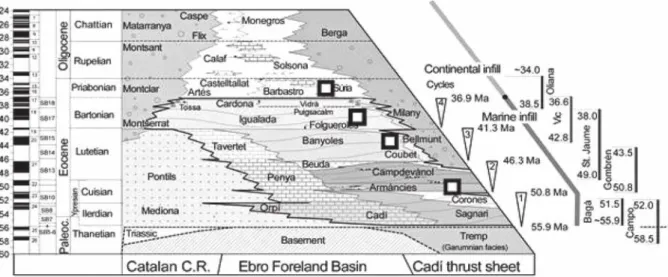
The L’Escala thrust is part of the Alpens-L‘Escala an-tiformal structure within the south-eastern Pyrene-an forelPyrene-and basin (eastern CatalPyrene-an basin) (Muñoz et al., 1986). The structure is constituted by thrusts and folds aff cting the middle and upper Eocene alluvial fan and deltaic syn-tectonic deposits of the Bellmunt and Puigsacalm Formations, respectively (Fig. 7). The folded foreland is limited at the north by the Vallfogo-na thrust and, at the south, by the Bellmunt anticline from the subhorizontal sediments of the Ebro basin (Fig. 3b).
The L’Escala anticline developed in the hanging-wall of a thrust which places middle-upper Lutetian continental sediments of the Bellmunt Formation over
lower Bartonian marine sediments of the Puigsacalm Formation (Muñoz et al., 1986).
The Bellmunt Formation is constituted by a clastic succession evolving from fluvio-deltaic to alluvial red deposits prograding from the Pyrenean Axial Zone to-wards the south margin of the Lutetian basin (Ramos et al., 2002). The limit between the Bellmunt Forma-tion and the Puigsacalm FormaForma-tion is sharp and cor-responds to a marine transgression at a basin scale. The Puigsacalm Formation is constituted by grey mi-croconglomerates and sandstones with glauconite prograding from the east and forming metric-thick sequences interpreted as deltaic systems.
In the studied outcrop, the Bellmunt Formation is formed by decimetric to metric intervals of clays, silt-ites, sandstones, and conglomerates interpreted as channel and flood plain deposits. ThePuigsacalm For-mation in the studied outcrop basically consists of cal-cite cemented sandstones.
The sampled section comprises three diff rent thrust fault zones. The main fault places materials of the Bellmunt Formation on top of the Puigsacalm Formation, and the other two faults aff ct only the Bellmunt Formation. Three sets of cross-cut calcite-filled fractures have been recognised: 1) extensional pre-thrust fractures (cut and deformed by the thrust plane), 2) thrust-related shear-fractures (thrust faults and associated bed to bed sliding), and 3) post-thrust fractures cutting the thrust planes. The latter consists of: 3a) sinistral strike-slip faults, and 3b) NW-SE ex-tensional fractures. The pre-thrust fractures have only been observed in the Bellmunt Formation. Calcite ce-ments within the thrust faults have been observed in the three thrust faults and calcite cements in the bedding planes have been only observed in the
Bell-munt Formation. Calcite cements in the thrust faults and in the bedding planes precipitated synchronous-ly to thrust activity due to successive shear openings, as indicated by the occurrence of shear bands formed by the crack-seal mechanism. The post-thrust sinis-tral strike-slip faults and NW-SE fractures have been only observed in the footwall of the lower thrust in the Puigsacalm Formation. The former are filled by cal-cite cement precipitated synchronously to shear-fault opening, whereas the NW-SE fractures correspond to extensional diaclases, parallel to the compression-re-lated cleavage planes, and filled by calcite cement not aff cted by pressure-solution related to cleavage for-mation.
The pre-thrust fractures are diaclases with sharp, straight or undulated walls and are filled by calcite ce-ments constituting veins from 1 cm to 5 cm thick and up to several metres long. Th se fractures are filled by two generations of cement: a first generation constitut-ed by a non isopachous rim of euhconstitut-edral calcite crystals and a second generation of anhedral sparry calcite ce-ment from few millimetres up to 2 centimetres thick, with deformed mechanical twin planes and undulat-ing extinction.
Thethrust fractures are the thrust faults and the as-sociated stratification planes which moved synchro-nously to the thrust movement due to bed to bed slid-ing and are filled by calcite cements constitutslid-ing veins from 1 to 10 cm thick. Theveins within the thrust frac-tures are constituted by calcite cement, forming diff r-ent shear bands (up to 6 successive shear bands have been observed in a single fracture) parallels to the frac-ture wall. Locally, the limits between the shear bands are stylolitic surfaces. Each shear band is formed by a crack-seal mechanism. The calcite crystals are
brown-Fig. 7. Stratigraphic framework of the south-eastern Pyrenean foreland basin with location of the El Guix outcrop (upper square),
ish-greenish, anhedral or subeuhedral, locally elon-gated, variable in size from 30 µm up to 2 mm, small-er close to the crack-seal bordsmall-er and increasing in size farward. The bigger crystals show abundant mechani-cal twinning planes and undulating extinction.
The post-thrust fractures include two sets of frac-tures: the sinistral faults and the NW-SE fractures. The veins filling the sinistral faults are constituted by cal-cite crystals, with planar or interpenetrated borders. The crystals are transparent and up to 5 mm large and show mechanical twinning planes and undulating ex-tinction. The NW-SE fractures are diaclases. The frac-ture walls are sharp and straight. The fracfrac-tures are filled by euhedral sparry transparent calcite crystals up to 5 millimetre large, with planar or interpenetrat-ed borders, abundant deforminterpenetrat-ed mechanical twinning planes and undulating extinction.
4.2 δ
18O and δ
13C of Host Rock
and Calcite Veins
The d18O of the Puigsacalm Formation host rock
range from -7.4 to -6.5‰ PDB and the d13C range
from -0.8 to 0.0‰ PDB (Fig. 5, Table 1). Th se values are more depleted in d18O and within the same range
for d13C than the isotopic values of the Eocene marine
carbonates (from -4 to +2‰ PDB and from -0.3 and +2.8‰ PDB, respectively). Th se depleted d18O values
of the bulk host rock are probably a mixture of deplet-ed d18O values of the calcite cement precipitated in the
interparticle porosity during relative burial conditions and a more enriched d18O values of the marine
com-ponents. The d13C values around 0‰ probably
indi-cate that the main source for C to produce the calcite cements may have been the marine bioclastic compo-nents (Discocyclines, Nummulites, echinoderms, bi-valvia, bryozoans,..) which form 50% of the Puigsa-calm Formation host rock.
The carbonate fraction of the Bellmunt Formation host rock has not been analysed because the texture of the rock did not allow to analyse separately the calcite cement from the abundant Paleozoic, Mesozoic and older Tertiary carbonate clasts.
The d18O and the d13C values of the calcite cement
in the pre-thrust fractures range from -8.5 to -8.3‰ PDB and from -2.8 and -1.9‰ PDB, respectively. The d18O and the d13C of the calcite cement in fractures
related to bed to bed sliding and in the thrust faults are very similar, ranging from -8.8 to -8.3‰ PDB and from -3.1 to -2.1‰ PDB, respectively. The similarity of the d18O and d13C between the calcite cements within
pre-thrust and thrust-related fractures indicates that both precipitated from the same fluid or from diff r-ent fluids with similar composition, which is less prob-able. Hence, during thrusting, the pre-thrust fractures
became open for fluid circulation and for precipitation of calcite cements.
The d18O of the calcite cement in the post-thrust
strike-slip faults range from -9.5 to -9.2‰ PDB and the d13C range from -0.6 to -0.5‰ PDB. Th se d18O
values are on average 2-3‰ more depleted than those of the Puigsacalm Formation bulk host rock, whereas the d13C values are within the same range as those of
the host rock. The similarity between the d13C values
between the host rock and the calcite cement within the fractures indicates host-rock buff ring. The diff r-ence in d18O between the bulk host rock and the calcite
cement within the pre-thrust and thrust-related frac-tures and post-thrust strike-slip faults, is probably be-cause d18O of the bulk host rock is a mixture between
a lower d18O of the interparticle calcite cement and
a d18O closer to 0‰ of the marine bioclastic
compo-nents, whereas the d18O of the calcite cements within
the fractures reflect only the composition of the calcite cement which has a non marine origin, either precipi-tated from meteoric or from formation waters.
The d18O of the calcite cement in the post-thrust
NW-SE fractures range from -14.4 to -12.6‰ PDB and the d13C range from -4.0 to -3.1‰ PDB. The d18O of
the calcite cement in the post-thrust NW-SE fractures is in average 6-7‰ more depleted than the Puigsacalm Formation host rock, and the d13C is in average 3-4‰
more depleted than the host rock. The very low d18O
values suggest a relatively hot fluid. The depleted d13C
values indicate that this external fluid was probably, in origin, a meteoric fluid enriched in 12C probably due
to the ingress of isotopically light soil-CO2 (Cerling,
1984; Cerling et al., 1989). This fluid did not interact with the Puigsacalm Formation host rock.
4.3
87Sr/
86Sr Values of Host Rock
and Calcite Veins
The87Sr/86Sr ratio of the Puigsacalm Formation bulk
host rock is 0.70895. In the calcite cements, values are 0.70818 in the pre-thrust fractures, 0.70816 to 0.70817 in the thrust fault zones, 0.70819 in the bedding-par-allel veins, 0.70857 in the post-thrust strike-slip faults, and 0.70847 in the post-thrust NW-SE fractures (Fig. 6, Table 1).
The87Sr/86Sr ratio of the Bartonian sea (age of the
Puigsacalm Formation) was 0.7077–0.7078 (DePaolo & Ingram, 1985; Hess et al., 1986; Koepnick et al., 1985; Mead & Hodell, 1995; Palmer & Elderfi ld, 1985) and, therefore, all the studied cements are non marine in origin.
The87Sr/86Sr ratio of the Puigsacalm Formation
bulk host rock (0.70895) reflects the mixture of the bioclastic Eocene marine components and the
silici-clastic fraction derived from an external source, prob-ably the interaction of fluids with Paleozoic rocks.
The87Sr/86Sr ratio homogeneity of calcite cements
in the pre-thrust fractures, thrust fault zones and bed-ding-parallel veins, indicates a common origin for the fluid, as already suggested by the oxygen and car-bon isotopic values. This radiogenic fluid composition could originate from 1) interaction with the Paleozo-ic rocks or the PaleozoPaleozo-ic silPaleozo-icPaleozo-iclastPaleozo-ic components of the Puigsacalm Formation host rock existing in deep-er settings, 2) in-situ mindeep-eralogical transformations of the Paleozoic siliciclastic components of the host rock, or 3) the weathering by meteoric water of the Paleozo-ic rocks in the emerged part of the belt.
The calcite cements in the post-thrust strike-slip faults and in the post-thrust NW-SE fractures show
87Sr/86Sr values closer to the Puigsacalm Formation
host rock values than the cements in the former frac-tures indicating a higher contribution either of the Pa-leozoic rocks or of the PaPa-leozoic siliciclastic compo-nents of the host rock. In the case of the post-thrust strike-slip faults, the similar d13C values are more in
agreement with a high contribution of the Paleozo-ic silPaleozo-icPaleozo-iclastPaleozo-ic components of the host rock, whereas in case of the post-thrust NW-SE fractures the low-er d18O and lower d13C of the calcite cement better
ac-count for an origin of the 87Sr/86Sr values by
miner-alogical transformations of the underlying Paleozoic rocks, at higher temperature.
4.4 Elemental Geochemistry
The calcite veins filling the pre-thrust and thrust-re-lated fractures show a similar range of values charac-terised by low Fe (between 405 and 2770 ppm), low Sr values (from below the detection limit up to 1735 ppm of Sr), Mn content from 370 up to 1815 ppm, and Mg content between 645 and 7945 ppm.
The calcite veins filling the post-thrust strike-slip faults are characterised by a very high Fe content (be-tween 2915 and 9105 ppm), be(be-tween 365 and 1260 ppm of Mn, between 885 and 5715 ppm of Mg and from be-low the detection limit up to 1515 ppm of Sr.
Thecalcite veins filling the post-thrust NW-SE frac-tures are characterised by very high Sr content (from 655 and 3535 ppm), between 345 and 1185 ppm of Mn, between 400 and 3195 ppm of Fe, and from below the detection limit up to 1795 ppm of Mg.
The calcite cement filling the porosity within the Puigsacalm Formation host rock has a composition similar to the post-thrust strike-slip faults, with Mn content between 265 and 705 ppm, Fe content between 2595 and 6900 ppm, Mg content between 1230 and 3605 ppm and from below the detection limit up to 445 ppm of Sr.
The cement in the pre-thrust and thrust-related fractures precipitated from a fluid consistent with a meteoric water composition.
The cement in the Puigsacalm Formation host rock and in the post-thrust strike-slip faults precipitated from a fluid consistent with a formation water compo-sition, probably because a deeper burial location of the structure after the thrust emplacement.
The cement in the NW-SE fractures precipitated from a fluid consistent either with a meteoric modifi d to a formation water composition.
4.5 Fluid Circulation During
the Intermediate Development of
the Fold-and-Thrust System within a
Marine-Continental Transition Environment
The diff rent stages of vein formations, characterised by diff rent geochemical signatures, attest the evolu-tion of the fluid system during the tectonic history.
4.5.1 Prior to the Main Tectonic Shortening
No evidences of fluid circulation exist during the de-velopment of the thrust fractures because no pre-cipitation of cement took place. Prepre-cipitation of calcite cements within these fractures did not occurred until the main tectonic shortening.
4.5.2 The Main Thrust Event
Compressive deformation and thrust emplacement occurred while sedimentation was still active in the basin. The veins related to the main tectonic shorten-ing occur either in the thrust faults or related to bed-ding slip during flexural folbed-ding. The concentration of veins inside and in the few tens of metres below and above the thrust faults and their absence far from the thrust faults indicates that these zones were zones of preferential fluid flow during compressive deforma-tion. As it also occurred in the Ainsa area, the crack-seal mechanism of formation of the calcite shear veins indicates synchronicity between vein formation and fault movement within the thrust-related fractures and attests the episodic nature of fault-slip and asso-ciated fluid flow.
A meteoric fluid, with relatively low Fe, low Sr and high Mg content, d18O ranging from -8.8 to -8.3‰
PDB and d13C ranging from -3.1 to -2.1‰ PDB, and 87Sr/86Sr ranging from 0.70816 to 0.70819, circulated
through the thrust-related fractures as well as through the pre-thrust fractures during thrust development. This fluid had no or very low interaction with the host
rock. Theidentical chemical composition of the calcite cement filling the three main thrust faults, the bed-ding planes and the previously formed fractures indi-cates that they belonged to the same interconnected fluid system and therefore, the presence of a wide-spread distributed homogeneous fluid.
The meteoric fluids, derived from the emerged part of the belt and arriving to the thrust fault zones, flowed preferentially along these zones, in a drainage pattern dominated by higher fracture permeability parallel to the thrust faults. Due to this lateral drainage, the thrust fault zones probably acted as barriers hindering their flowing towards more external parts of the belt.
The diff rences in the 87Sr/86Sr ratio and d13C
be-tween the calcite cement in the pre-thrust and thrust-related fractures and the Puigsacalm Formation host rock indicates that the geochemistry of cement was poorly controlled by that of the host rock and, there-fore, that the fluid was not buff red by the host rock and an open palaeohydrological system during the main thrust event.
4.5.3 The Post-Thrust Strike-Slip Event
Calcite shear veins precipitated synchronously to strike-slip fault activity following thrusting. The el-emental geochemistry of the calcite cements in these faults is consistent with precipitation from a fluid with a formation water composition. The calcite cements precipitated from this fluid are characterised by very high Fe content, d18O ranging from -9.5 to -9.2‰ PDB,
d13C ranging from -0.6 to -0.5‰ PDB and 87Sr/86Sr of
0.70857. Th se 87Sr/86Sr ratio and d13C values are
clos-er to the Puigsacalm Formation bulk host rock values than the calcite cements in all the other fractures in-dicating the higher intensity of fluid-rock interaction. A high interaction between the fluid and the host rock seems to be restricted, in the studied section, at this episode of the geodynamic evolution, and cementa-tion of the Puigsacalm Formacementa-tion host rock proba-bly occurred at this time. The d18O values of the
Puig-sacalm Formation bulk host rock probably indicate a mixture between the marine contribution of the bio-clastic components and a more depleted contribution of the calcite cement precipitated during burial condi-tions. Thed13C values indicate that the main source for
carbon to produce the calcite cements may have been the marine bioclastic components which form 50% of the host rock. The87Sr/86Sr ratio indicates the non
ma-rine origin of the fluid trapped in the sediment, and the great influence of the siliciclastic components of the host rock. The87Sr/86Sr anomaly in the calcite
ce-ment in the fault probably results from local clay min-eral reactions.
4.5.4 The Late Extensional Tectonic Phase
The post-thrust NW-SE extensional fractures are the latest observed features, formed by the opening of the pre-existing cleavage planes. Th y thus post-date the compressional deformation.
The calcite cements in these NW-SE fractures, with relatively low Mg and Fe and relatively high Sr content, low d18O values ranging from -14.4 to -12.6‰ PDB,
d13C ranging from -4.0 to -3.1‰ PDB and 87Sr/86Sr
ra-tio of 0.70847, are interpreted as precipitated from a hot meteoric fluid. This fluid had no or very low inter-action with the carbonate frinter-action of the Puigsacalm Formation host rock, whereas the 87Sr/86Sr ratio
indi-cates contribution of the Palaeozoic rocks. The high temperature during calcite precipitation indicates a deep-circulating fluid.
Thus, at this stage, the paleohydrogeological system remained open to external meteoric fluids arriving from more internal and emerged parts of the belt, but with rather long circulation in relatively deep struc-tures.
The extensional character of these fractures is in-terpreted as a stage of compressive stress relaxation as-sociated with tectonic uplift nd relief formation.
5 Late Development of Continental Thrust
and Fold system: El Guix Anticline
5.1 Geological Framework
The El Guix anticline corresponds to the southern-most structure of the south-eastern Pyrenean fore-land basin, detached above the Priabonian Cardona salt separating the non-deformed strata from the fold-ed and thrustfold-ed strata. Compressional activity in the area represents the latest stages of the Alpine compres-sional tectonics (Sans & Vergés, 1995).
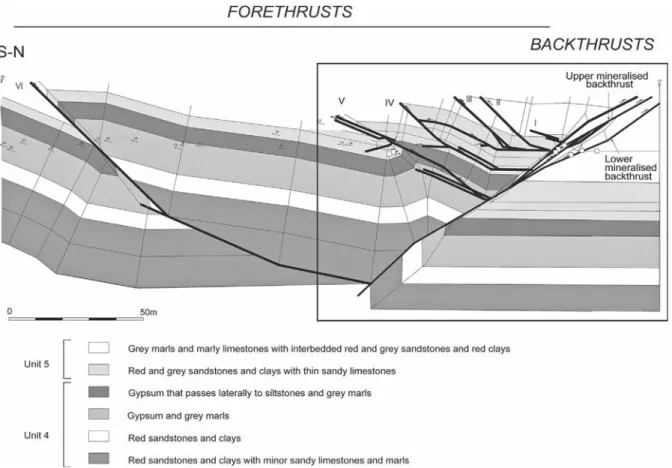
The El Guix anticline is a double structure com-posed of two anticlines (Fig. 3c). The sampled section displays two sets of linked fractures rooted at diff rent depths and aff cting diff rent lithologies. Structurally, it is located in the northern anticline in which a major north-directed thrust (backthrust) merges with sever-al south-directed thrusts (forethrusts) (Fig. 8). Short-ening across the anticline is approximately 21%, con-sisting of 16% of layer-parallel shortening prior to folding and thrusting, and only 5% during folding and thrusting (Sans et al., 2003).
The deformed sedimentary pile is made up of fine-grained, fluvio-lacustrine deposits, consisting of clays, sandstones and limestones of late Eocene-Oligocene age, overlying the evaporite sequence. Th se rocks are located approximately 300 metres above the
detach-ment horizon. During thrusting, the maximum burial determined by vitrinite reflectance was 2 km, indicat-ing that the foldindicat-ing and thrustindicat-ing occurred at depth (Vergés et al., 1998), which is consistent with the pre-growth nature of the deformed rocks.
The backthrust is an intensely deformed, 2 m thick zone, which has an offset of 30 m, formed by an ar-ray of four north-directed faults. Only two of them present calcite veins, and they henceforth are refered as lower and upper mineralised backthrust. The foot-wall of the upper mineralised backthrust presents mi-nor fractures filled with calcite veins. The sediments located between the main forethrust and the back-thrust array are deformed by a set of south-directed thrusts (forethrusts) which branch in layer parallel de-tachments and, at a deeper level, merge with the back-thrust (Fig. 8). Foreback-thrusts I to IV only cut sandstone beds, whereas forethrusts V and VI cut sandstone beds and a lower gypsum horizon. None of these forethrusts is mineralised and their slip ranges from half a metre to a few metres. The footwall of forethrust V presents a set of cross-cutting south and north-directed minor faults with an offset of several centimetres. Th se mi-nor faults are filled with calcite veins.
Less deformed areas of the anticline also present small fractures filled with calcite. We studied fractures located about 20 m to the north of the backthrust ar-ray aff cting subhorizontal beds of grey marls and fine sandstones, and 200 m above the other samples aff ct-ing horizontal lacustrine limestones in the hangct-ing- hanging-wall of the backthrust array.
In the El Guix anticline, calcite veins are mostly found where the host rocks are clays and limestones, and are almost absent in the fractures aff cting sand-stones. The calcite veins range from millimetres to centimetres in thickness and show slickensides.
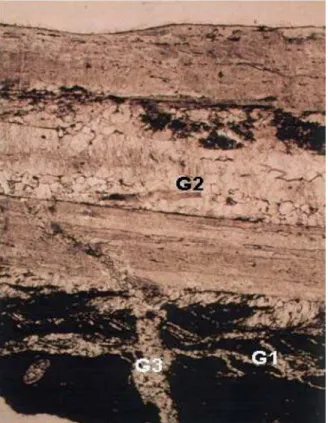
The evolution pattern of the calcite-sealed frac-tures consists of three stages (Fig. 9) which reflect an evolution of the microstructures very similar to that observed at Atiart-Arro. In each fracture, deforma-tion started with a network of discontinuous micro-fractures (stage 1), slightly oblique to the sedimentary lamination and associated with a ductile deformation of the host sediment. Later, crack-seal shear veins, lo-cally aff cted by micro-stylolitic surfaces, record the main thrust activity (stage 2). Finally, extensional fractures, cross-cut at a large angle the microfractures of stage 2 (stage 3).
The cement filling microfracture stage 3 also fills the vuggy porosity aff cting the calcite cement filling microfracture stage 2 and the intergranular porosity of the host rock.
Further petrographic features of the veins are de-scribed in Travé et al. (2000).
5.2 δ
18O and δ
13C Values
of Host Rock and Calcite Veins
Thed18O values of the host rock (lacustrine limestones
and carbonate fraction in the marls) range from -7.1‰ to -4.7‰ PDB, and the d13C values vary between
-5.7‰ and -3.5‰ PDB (Fig. 5, Table 1), which are con-sistent with freshwater limestones and meteoric calcite cements (Veizer, 1992).
The oxygen and carbon isotopic composition of the calcite cements filling the diff rent fractures (from – 8.6 to -7.7‰ PDB and from -5.3 to -4.1‰ PDB, respec-tively) plot within a much narrower range of values than the isotopic composition of the host rocks adja-cent to the fractures.
Thecalcite veins filling the upper mineralised back-thrust have more negative isotopic values than the val-ues of their adjacent host rock by 1.8 to 2.3‰ for d18O
values and 0.4 to 0.9 ‰ for d13C. The calcite veins
fill-ing small fractures in the upper mineralised back-thrust footwall have d18O values between 1.6 and
1.9‰ and d13C values 0.4‰ more negative than the
values of their adjacent host rock. Thecalcite veins fill-ing the lower mineralised backthrust have d18O
val-ues between 2.2 and 2.5‰ more negative and d13C
values between 0.3 and 0.4 more positive than the val-ues of their adjacent host rock. The calcite veins filling minor faults in the forethrust footwall have d18O
val-ues between 3.8 and 3.9‰ and d13C values 1.1‰ more
negative than the values of their adjacent host rock. The calcite veins filling small fractures in the less de-formed areas have d18O values between 1.3 and 2.0‰
more negative than the values of their adjacent host rock and d13C values between 0.4 and 0.5‰ more
pos-itive than their adjacent host rock (Fig. 5, Table 1). The oxygen isotopic compositions of all the calcite veins in the El Guix anticline are consistent with pre-cipitation from a meteoric or an evolved meteoric flu-id (Hudson, 1977; Marshall, 1992). Thecarbon isotopic compositions of the calcite veins with values within the same range of values as the calcite fraction of the host rocks indicate that the carbon for these veins pro-ceeded from homogenising C derived from the host rock.
The values of the calcite cements in microfracture stages 1, 2, and 3 are all within the same range, be-tween -8.6‰ and -7.7‰ PDB for d18O and between
-5.3‰ to -4.1‰ PDB for d13C, indicating a common
fluid responsible for calcite precipitation during the diff rent stages.
5.3
87Sr/
86Sr Values of Host Rock
and Calcite Veins
The calcite fractions of the host rock have a 87Sr/86Sr
ratio ranging from 0.70865 to 0.70941 (Fig. 6, Table 1). The calcite veins in the diff rent fractures have a 87Sr/ 86Sr ratio varying from 0.70887 to 0.70911. The
ha-lite and gypsum samples from the underlying Cardo-na Salt Formation have values ranging from 0.70793 to 0.70797, which are slightly higher than the late Eo-cene-early Oligocene marine signal ranging from 0.7077 to 0.7079 (Hess et al., 1986; Hess et al., 1989; Denison et al., 1993).
Although the host rocks adjacent to the diff r-ent fractures have a diff rr-ent 87Sr/86Sr ratio, the
cal-cite veins in the diverse fractures plot within a nar-row range of values, averaging those of the host rocks, as has been already obseved for the stable isotope val-ues. An 87Sr/86Sr versus d13C plot gives a well defined
correlation of the 7 values (r=0.91), with the two ex-treme values determined by the calcite fraction of the host rocks and the intermediate values defined by the
Fig. 9. Petrology of the veins showing the three microfracture
calcite veins in the fractures. This correlation indicates that the 87Sr/86Sr isotopic composition of the calcite
veins in the fractures was sourced within the adjacent host rocks. Influences from the underlying Cardona Salt Formation are not reflected by the 87Sr/86Sr ratio
of the calcite veins in the fractures.
5.4 Elemental Geochemistry
The elemental composition of the fluid from which calcite precipitated was determined from the elemen-tal geochemistry of the calcite cements (Travé et al., 2000). The results show that most of the mineralising fluids for the analysed calcite veins have Mg/Ca molar ratios lower than 0.2, which is consistent with a forma-tion water composiforma-tion. Only three samples from the small fractures in the upper mineralised backthrust footwall have a Mg/Ca molar ratio higher than 0.2, which is consistent with a meteoric water composition. The Sr/Ca molar ratio of the mineralising fluid for cal-cite veins in the small fractures in the upper miner-alised backthrust footwall, in the lower minerminer-alised backthrust, and in the minor faults in the forethrust footwall is higher than 0.007, which is consistent with a formation water composition. The Sr content in the upper mineralised backthrust and in the small frac-tures in the less deformed areas is always below the detection limit. Most of the mineralising fluids for cal-cite veins in the upper mineralised backthrust have a Ca/Fe molar ratio higher than 1000, consistent with a meteoric water composition. By contrast, most of the mineralising fluids for calcite veins in the small frac-tures in the upper mineralised backthrust footwall, in the lower mineralised backthrust, in the minor faults in the forethrust footwall and in the small fractures in the less deformed areas have a Ca/Fe molar ratio low-er than 1000, consistent with a formation watlow-er com-position. Most of the mineralising fluids for calcite veins in all the studied samples have a Mn/Ca molar ratio higher than 0.0002, consistent with a meteoric water composition. The presence of Na is restricted to the upper mineralised backthrust, the small fractures in the upper mineralised backthrust footwall and the lower mineralised backthrust, indicating that only the backthrust array allowed precipitation from a fluid de-rived from the underlying Cardona Salt Formation.
To sum up, the fluid precipitating the calcite veins in the upper mineralised backthrust was basical-ly consistent with a meteoric origin, whereas the flu-id precipitating the calcite veins in the other fractures was basically consistent with a formation water ori-gin. However, the presence of Na in all the fractures of the backthrust array including the upper mineralised backthrust indicates that these fractures also served as
a pathway for a fluid which has been in contact with the underlying evaporites.
Diff rences between the three microfracture stages are not evident in the Mg/Ca, Ca/Fe and Mn/Ca mo-lar ratios of the precipitating fluids. However, the pres-ence of Sr and Na only in microfracture stage 2 indi-cates that during this stage the topographycally-driven fluid flow, arrived deeper, at the underlying Cardona Salt Formation.
The intergranular porosity of the host rock was filled during precipitation of cement in microfracture stage 3.
5.5 Fluid Circulation During
the Late Development of
Continental Fold-and-Thrust System
In the El Guix area, meteoric fluids, with high Fe/Mn and Fe/Mg ratios, without Na and Sr, enriched with
13C and with low 87Sr/86Sr with respect to their host
rock were widely distributed in the structure through-out all its evolution, within a relatively open palaeohy-drological system. Evolved meteoric fluids, with lower Fe/Mn and Fe/Mg ratios, with Na and Sr, depleted in
13C and with high 87Sr/86Sr with respect to their host
rock were only present during thrust faults develop-ment within a relatively closed palaeohydrological system. The underlying evaporites acted as the lower boundary of the aquifer.
6 Discussion and Conclusions
In this section we summarize the existing links be-tween fluid history and tectonic evolution in the South-Pyrenean foreland basin during the Tertiary. Th se relationships show a mutual interaction, also detected in other foreland basins, which are working together during the forwards propagation of tecton-ic stresses through the sedimentary basin. The under-standing of the role of fluids before, during and after thrusting as well as the role of the thrust faults as con-duits or seals for fluid migration are key questions to be addressed. Understanding this interaction may help to clarify and better explore the migration of hydro-carbons in fold-and-thrust belts and foreland basins.
Timing of Thrusting, Fluid Migration, Thermal His-tory and Relationships With Hydrocarbons
Fluid migration has been detected through the entire Tertiary evolution of the South-Pyrenean thrust front as revealed by the three analysed examples
(Atiart-Arro, L‘Escala and El Guix) with diff rent ages of de-formation (Table 2).
In Atiart-Arro and El Guix sites, a similar sequence of microstructures, formed during the main compres-sive event, has been recognised. Microfracture stage 1 is characterised by sediment disaggregation showing that vein formation began in poorly lithifi d sediment. Microfracture stage 2 corresponds to the main episode of shear vein formation indicating a change in the de-formation mechanism due to progressive induration of the host sediment. Microfracture stage 3 indicates a decrease of intensity of compressive deformation and could correspond to local extensional rebound in the veins that form tabular bodies more competent than the host-sediment host sediment.
Because veins of diff rent generations in a same outcrop show a similar chronology of microfractures, we conclude that sediment induration was restricted to the vicinity of the vein, probably due to cement pre-cipitation in the vein, and that the sediment away from the veins remained poorly lithifi d during the whole deformation sequence.
In both areas, Atiart-Arro and El Guix, geochem-ical characteristics of the calcite cements in the three microfracture stages are similar, and the main episode of bulk host-rock cementation by calcite occurred af-ter compressive deformation. This occurred because in this foreland basin the front of deformation advanced within the soft ediment early after its deposition.
Diff rently, in the L’Escala site, the sequence of mi-crofractures coeval with thrusting has not been recog-nised. In this outcrop, the analysed structures corre-spond to pre-thrusting fractures, probably developed coevally to the first shortening events characterised by intense spread layer-parallel shortening (Casas et al., 1996; Sans et al., 2003), syn-thrusting fractures, and post-thrusting fractures. As occurred in the other two areas, the main episode of bulk host-rock cementation by calcite occurred after the main compressive defor-mation, i.e., synchronously to the development of the post-thrust strike-slip faults.
The sequence of calcite veins in the Atiart-Arro fold-and-thrust system developed under submarine thrusting during early-middle Eocene times. The se-quence of calcite veins in the L‘Escala thrust precipi-tated during middle-late Eocene times under transi-tional marine-continental conditions. And finally, the calcite veins filling the fractures at the El Guix anti-cline precipitated during early Oligocene times un-der continental conditions (Fig. 10). Th se continen-tal conditions were established in the entire basin at the Priabonian (late Eocene), when the uplift of the western Pyrenees closed up the foreland connection to the Atlantic (e.g., Vergés et al., 1995; Serra-Kiel et al., 2003a, b).
A good correlation for the 87Sr/86Sr values of the
calcite veins in the Arro fold (Atiart-Arro fold-and-thrust system) with the Eocene marine waters is ob-served (Fig. 6). However, the samples from L‘Escala
Evolution pattern
Structures Fractures Fluids Hydrologic system Fluid type
Atiart-Arro 3 thrusts faults
1 footwall syncline
3 stages of microfractures in syn-thrust shear veins
local and deep derived hot fluids (in the syncline) +
larger distance* (in the thrusts)
closed (in the syn-cline) and more open* (in the thrusts)
Seawater to formation water (in the syncline)
and
Deep derived + meteoric + local transformations* (in the thrusts)
L’Escala pre-thrust diaclases
3 thrust faults post-thrust sinistral faults post-thrust NW-SE diaclases 3 stages of macrofractures (pre, syn and post-thrust) no fluid recorded larger distance* local larger distance open* closed open Meteoric* Evolved meteoric Hot meteoric or deeply derived El Guix forethrusts backthrusts 3 stages of microfractures in syn-thrust shear veins local larger distance* local closed open* closed Meteoric Evolved meteoric* Meteoric
Table 2. Evolution pattern of the structures, microstructures, fluids, hydrologic regime, and fluid type. The “*” indicate the main