DATA STORAGE HIERARCHY SYSTEMS FOR DATA BASE COMPUTERS
by Chat-Yu Lam B.Sc. Massachusetts Institute of (1974) M.Sc. Northwestern (1976) Technology University
SUBMITTED IN PARTIAL FULFILLMENT OF THE REQUIREMENTS FOR THE
DEGREE OF
DOCTOR OF PHILOSOPHY at the
MASSACHUSETTS INSTITUTE OF TECHNOLOGY (August, 1979)
Chat-Yu Lam 1979
Signature of Author
Sloan School of Management, ^ I August 1, 1979 nl Certified by ... ... ..- .- ...-... Thesis Supervisor Accepted by ... - /-111
Data Storage Hierarchy Systems for Data Base Computers
by Chat-Yu Lam
Submitted to the Alfred P. Sloan School of Management on August 1979 in partial fulfillment of the requirements
for the degree of Doctor of Philosophy
ABSTRACT
The need for efficient storage and processing of very large databases to support decision-making coupled with advances in computer hardware and software technology have made research and development of specialized architectures for database management a very attractive and important area.
The INFOPLEX data base computer proposed by Madnick
applies the theory of hierarchical decomposition to obtain a specialized architecture for database management with
substantial improvements in performance and reliability over conventional architectures. The storage subsystem of
INFOPLEX is realized using a data storage hierarchy. A data storage hierarchy is a storage subsystem designed
specifically for managing the storage and retrieval of very large databases using storage devices with different
cost/performance characteristics arranged in a hierarchy. It makes use of locality of data references to realize a low cost storage subsystem with very large capacity and small access time.
As part of the INFOPLEX research effort, this thesis is focused on the study of high performance, highly reliable data storage hierarchy systems. Concepts of the INFOPLEX data base computer are refined and new concepts of data storage hierarchy systems are developed. A preliminary design of a general structure for the INFOPLEX data storage hierarchy system is proposed.
Theories of data storage hierarchy systems are developed. Madnick's model of a generalized storage hierarchy is
extended and formalized for data storage hierarchy systems. The Least Recently Used (LRU) algorithm is extended to
incorporate the read-through strategy and page overflow strategies to obtain four classes of data movement
algorithms. These algorithms are formally defined.
Important performance and reliability properties of data
-2-storage hierarchy systems that make use of these algorithms are identified and analyzed in detail. It is proved in Theorems 1 and 2 that depending on the relative sizes of the
storage levels and the algorithms used, it is not always possible to guarantee that the contents of a given storage
level 'i' is a superset of the contents of its immediate higher storage level 'i-l', i.e., multi-level inclusion
(MLI) does not hold. Necessary and sufficient conditions for MLI to hold are identified and proven in Theorems 3 and 4. A property related to MLI is the multi-level overflow inclusion (MLOI) property. MLOI holds if an overflow page from storage level 'i' is always found to already exist in storage level 'i+l'. A data storage hierarchy avoids
cascaded references to lower storage levels if MLOI holds. Necessary and sufficient conditions for the MLOI to hold are identified and proven in Theorems 5 and 6. It is possible that increasing the sizes of intermediate storage levels may actually increase the number of references to lower storage levels, resulting in decreased performance. This is
referred to as the multi-level paging anomaly (MLPA).
Conditions necessary to avoid MLPA are identified and proven in Theorems 7 and 8.
A sinlified structure of the INFOPLEX data storage
hie:-rchy is rived from its general structure. Protocols for supporting tile read-through and store-behind algorithms are specified. Two simulation models of this system are
developed. The first .s - incorporates one functional
processor and three storage levels. Results from this model provide significant insights to the design and its
algorithms and reveals a potential deadlock in the buffer management schemes. The second model corrects this
potential deadlock and also incroproates five functional processors and four storage levels. Results from this model show that the store-behind operation may be a significant system bottleneck because of the multi-level inclusion requirement of the data storage hierarchy. By using more parallelism in the lower storage levels and by using smaller block sizes it is possible to obtain a well-balanced system which is capable of supporting the storage references
generated by the INFOPLEX functional hierarchy. The effects of using projected 1985 technology for the data storage
hierarchy are also assessed.
Thesis SCprv<-ar: Prof. Stuart E. Madnick
Associate Professor of Management Science M.I.T. Sloan School of Management
-3-ACKNOWLEDGMENT
I would like to sincerely thank the following individuals who helped and encouraged me in carrying out this work.
My thesis advisor, Prof. Stuart Madnick, has been a great teacher and a concerned and understanding advisor. He has spent considerable time and effort supervising this thesis.
It is a priviledge to be his student.
Members of my thesis committee, Prof. John Little, Prof. Hoo-min Toong, and Dr. Ugo Gagliardi, have taken time in spite of their tight schedules to review this work. I am truely grateful for their interest and enthusiasm.
My colleagues, Sid Huff and Mike Abraham, have at various times suffered through some of my ill-formed ideas. Their patience is greatly appreciated.
My wife, Elizabeth, has stood by me throughout this work with her patience, encouragements and care. She makes all this worthwhile.
I would like to acknowledge the sources of funding for this work, and for my doctoral studies.
This research is funded by the National Science
Foundation Grant No. MCS77-20829 and by the Navy Electronics Systems Command Contract No. N00039-78-G-0160.
My doctoral studies have been made possible by the above fundings, several Sloan School tuition fellowships, an IBM Information Systems Fellowship, and research funds from the NEEMIS Project and the RADC Decision Support Systems
Project. I am grateful for these financial support. A large portion of this thesis was typed by Waterloo
SCRIPT. Chapter 4 was typed by Marilyn Whatmough and Portia Smith who have been kind enough to undertake this task that nobody else would, due to the large number of mathematical symbols in the chapter.
-4-TABLE OF CONTENTS
Chapter page
I. INTRODUCTION AND PLAN OF THESIS . . . . 9
Introduction . . . . 9
Related Research . . .. .. . ... 11
New Instructions Through Microprogramming . . 14
Storage Hierarchy Optimization . . . . . . . 15
Intelligent Controllers . . . . . . . . . . . 16
Back-end Processors . . . . . . . . . . . . . 18
Data Base Computers . . . . . . . . . . . . . 19
Research Goals and Accomplishments . . . . . . . 22
Structure of Thesis . . . . . . . .. ... 25
Chapter 2 : The INFOPLEX Data Base Computer Architecture . . ..... . ... 26
Chapter 3 : A General Structure of the INFOPLEX Data Storage Hierarchy . . . . 26
Chapter 4 : Modelling and Analysis of Data Storage Hierarchy Systems . . . . . . . 26
Chapter 5 : Design of the DSH-ll Data Storage Hierarchy System .... . . . . . . .27
Chapter 6 : Simulation Studies of the DSH-ll Data Storage Hierarchy System . . . . . 27
Chapter 7 : Discussions and Conclusions . . . 28
II. THE INFOPLEX DATA BASE COMPUTER ARCHITECTURE . . . 29
Introduction... . . . . . . . . ... . . 29
The INFOPLEX Functional Hierarchy . .. ... .31
Rationale for Functional Decomposition . . 32
Example of a Functional Decomposition . . . 33
Entities and Entity Sets . . . . . . . . . 33
Binary Relations . . . . . . . . . . . . . 35
N-ary Relations . . . . .. . . ... 37
Links Among N-ary Relations . . . . ... 41
Virtual Information . . . .. . . . . . . 42
Data Verification and Access Control . . . 44
High-level Language Interface . . . . . . 48
INFOPLEX's Approach to Functional Decomposition . . . . . . . . . . . . . 51
The INFOPLEX Data Storage Hierarchy . . . . . . 53
Example of a Physical Decomposition . . . . . 56
General Structure . .. .. . . . ... .56
Storage Devices . . . . . . . . . . . . . 60
Strategies for Information Movement . . . 61
INFOPLEX's Approach to Physical Decomposition . . . . . . . . . . . . . 69
Research Issues Addressed in This Thesis . . . . 69
III. A GENERAL STRUCTURE OF THE INFOPLEX DATA STORAGE HIERARCHY . . . . . . . . . . . . . . . . . . 71
Introduction . . . . . . . . . . . . . . . . . . 71
Design Objectives . . . . . . . . . . . . . . . 71
Virtual Address Space . . . . . . . . . . . . 72
Very Large Address Space . . . . . . . . . . 72
Permanent Data Storage . . . . . . . . . . . 73
Support Multiple Processors . . . . . . . . . 73
Generalized Multi-level Storage System 74 Direct Inter-level Data Transfer .... .... .74
High performance . . . . . . . . . . . . . . 75 Availability . . . . . . . . . . . . . . . . 75 Modularity . . . . . . . . . . . . . . . . . 76 Low Cost . . . . . . . . . . . . . . . . . . 77 e-n-ral Structure of DSH-1 . .. .. .... 77 ThL DSH-1 Interface . . . . . . . . . . . . . 79
The HBighest Performance Storage Level - L(l) 83 A Typical otoragp Level - L(i) ... 85
Further Design, T , s- . .... ... 86
Support of Read and Write Operations 87 Multiple Cache Consistency . . . . . . . . 87
Bus Communication Protocols . . . . . . . 88
Multiple Directory Update . . . . . . . . 89
Multiple Resource Arbitration . . . . . . 89
Transaction Handling . . . . . . . . . . . 89
Multiple Data Redundancy Properties . . . . . 90
Automatic Data Repair Algorithms . . . . . . 90
Performance Evaluation . . . . . . . . . . . 91
Summary . . . . . . . . . . . . . . . . . . . . 91
IV. MODELLING AND ANALYSIS OF DATA STORAGE HIERARCHY SYSTEMS . . . . . . . . . . . . . . . . . . . 93
Introduction . . . . - - - - - * - - - - 93
Research on Storage Hierarchy Systems &. .. .. 94
Model of a Data Storage Hierarchy . . . - - -. 96
Storage Management Algorithms . . . . - - -. 98
i Model of a Data Storage Hierarchy . . . 105
Formal Definitions of Storage Management Algorithms . . . - - - - 107
Properties of Data Storage Hierarchy Systems . - 112 Summary of Properties . . . . 117
Derivation of Properties . . . . . . . . . .122
Summary . . . . . . . . . . . . . . . . . . . 150
V. DESIGN OF THE DSH-ll DATA STORAGE HIERARCHY SYSTEM Introduction . . . ... . ... . 151
Structure of DSH-ll ... . ... 151
The DSH-ll Interface . ... 153
The Highest Performance Storage Level A Typical Storage Level - L(i).. 155
Algorithms for Supporting the Read Operation 156 The Read-Through Operation . ... 156
Overflow Handling... . . . .. . 159
Pathological Cases of Read-Through . . . . 160
Racing Requests . . . . . . . . . . . . 160
Erronous Overflow . . . . . . . . ... 161
Overflow to a Partially-assembled Block 162 Transactions to Handle the Read Operation . 163 The read-through Transaction . . . . . . 165
The retrieve Transaction . . . . . . . . 166
The read-response-out Transaction . 167 The read-response-packet Transaction 168 The read-response-in Transaction . . . . 169
The store Transaction . . . . . . . . . 171
The overflow Transaction . . . . . . . . 171
Algorithms to Support the Write Operation . . 172
The Store-Behind Operation . . . . . . . . 172
Lost Updates . . . . . . ... 178
Transactions to Support the Write Operation 178 The store-behind Transaction . . . . . . 181
The update Transaction . . . . . . . . . 182
The ack-store-behind Transaction . . . . 182
Multi-level Inclusion Properties . . . . . . . 183
Importance of MLI . . . . . . . . . . . . . 183
A Model of DSH-ll . ... ... 184
MLI Properties of DSH-ll. ... 186
Summary . . . . . . . . . . . . . . . . . . . 187
VI. SIMULATION STUDIES OF THE DSH-ll DATA STORAGE HIERARCHY SYSTEM . . . . . . . . . . . . . 189
Introduction ... .... . ... .189
A Simulation Model of DSH-ll The PlL3 Model 191 An Illustration of the DSH-ll Algorithms 191 The PlL3 Model Parameters . . . . . . . . . 194
Simulation Results of the PlL3 Model ... 195
Preliminary Studies Using the PlL3 Model . 195 More Extensive Studies Using the PlL3 Model 201 A Plausible Theory of Operation . . . . . . 205
Deadlock-free Buffer Management Schemes . . . A Deadlock-free Buffer Allocation Algorithm Another Simulation Model of DSH-ll : The P5L4
Model . . . . . . .
The P5L4 Model and its Parameters.... . . Preliminary Studies Using the P5L4 Model Tuning the P5L4 Model . . . . . . .
Comparing the Performance of DSH-ll 1979 and 1985 Technologies . Summary . . . . . . . . . . . . . . .
using . . .
VII. DISCUSSIONS AND CONCLUSIONS . . . .
Introduction . . . . . . . . . . Summary of Thesis . . . . . . . Directions for Further Research
REFERENCES . . . . . . . . . . . . . . .
Appendix
A. LIS2TNG OF THE PlL3 MODEL . . . . . B. FLOW CHART u? THE P5L4 MODEL . . .
C. LISTING OF THE 5T EL . . . . . - 8 -210 211 216 217 220 227 230 234 235 235 236 238 241 page 249 272 291
Chapter I
INTRODUCTION AND PLAN OF THESIS
1.1 INTRODUCTION
The effective and efficient storage and processing of very large data bases to support better decision-making has been a major concern of modern organizations. Though
advances in computer technology are impressive, the rate of growth of information processing in organizations is
increasing even more rapidly. A key technological advance in providing better information processing systems is the development of Data Base Management Systems (DBMS's)
(Mar-tin, 1975). Most organizations today make use of some kind of DBMS for handling their large databases. Efforts to develop even more effective DBMS's remain very active and
important (Mohan, 1978).
Current DBMS's are capable of handling large databases on the order of trillion bits of data (Simonson and Alsbrooks, 1975), and are capable of handling query rates of up to one hundred queries per second (Abe, 1977). Due to the increas-ing need for better information, and the declinincreas-ing costs of processors and storage devices, it is expected that future
high performance DBMS's will be required to handle query rates and provide storage capacities several orders of mag-nitude higher than today's (Madnick, 1977). Furthermore, with such high query rates (generated by terminal users as well as directly from other computers), it is essential that a DBMS maintains non-stop operation (Computerworld, 1976).
Thus, guaranteeing the reliability of the DBMS becomes very difficult.
Current improvements in processor and storage device
technology alone do not seem to be able to meet these orders of magnitude improvements in performance and reliability. The nex section reviews several research efforts aimed at modifying the t-enventional computer architecture for better
information handling. One such research effort is the INFO-PLEX Project (Lam and Madnick, 1979). The INFOPLEX approach to obtaining a high performance, highly reliable DBMS is to design a new computer specifically for data management.
This thesis is a study of the storage subsystem of the INFO-PLEX data base computer. Research goals and specific accom-plishments of this thesis will be described in a following
section. The structure of this thesis is then described.
-1.2 RELATED RESEARCH
In the past, computers were designed primarily for numer-ical computation. We now find that processing of large
databases has become a major, if not dominant, component of computer usage. However, current computer structures still have the 'von Neumann' structure of twenty years ago. As Mueller (Mueller, 1976), President of System Development Corporation, noted: 'the computer industry has gone through three generations of development to perfect machines
optim-ized for 10 percent of the workload'. It is not surprising then, that many organizations find their supercomputers run-ning 'out of steam' as new applications with large databases are installed.
Figure 1.1 illustrates a simplified typical computer
architecture. It consists of a processor directly accessing a main memory (with access time in the order of microse-conds), an I/O processor that controls the movement of data between main memory and secondary storage devices, an I/O controller and its associated secondary storage devices
(with access times in the order of milliseconds). Current DBMS's are software systems that reside in the main memory
together with other software subsystems and application pro-grams. To provide a high level view of data for application programs a DBMS has to manage all the data residing in
sec-CENTRAL PROCESSOR
MAIN MEMORY
Figure 1.1 A Typical Computer Architecture
-12-ondary storage devices and coordinate all the data movement and processing activities. Two potential deficiencies of adapting the conventional computer architecture for data base management become evident. First, the processor becomes strained as new functions are added to the DBMS. These new functions include high level language support, better security and data integrity mechanisms, support of
multiple data models, ... , and so on. Second, due to the
large differential in access times of main memory and secon-dary storage devices (referred to as the 'access gap'), the
speed of processing becomes limited by how fast'useful data can be brought into main memory from secondary storage dev-ices. Thus, many organizations find the performance of
their data management system either limited by the available processor cycles or limited by the speed of I/O operations, depending on the DBMS used and the applications supported.
These problems have been recognized for some time. Cur-rent advances in LSI technology make it feasible to consider new software and hardware architectures to overcome the
above deficiencies. Several such approaches are discussed below.
1.2.1 New Instructions Through Microprogramming
Conventional processor instructions are usually not well suited to the requirements of database management systems. Using firmware, it is possible to augment or enhance the
instructions thus effectively increase the efficiency of the processor. This approach has been adopted in several
sys-tems. One of the earliest efforts occurred as part of the LISTAR information retrieval system developed at M.I.T.'s Lincoln Laboratory (Armenti et al., 1970), where several frequently used operations, such as a generalized List
Search operation, were incorporated into the microcode of an IBM System/360 Model 67 computer. The Honeywell H60/64 uses special instructions to perform data format conversion and hashing corresponding to frequently used subroutines of Honeywell's IDS database system (Bachman, 1975). More
recently the IBM System/38 (Soltis and Hoffman, 1979) was announced with microcode to perform much of the operating system and data management functions. The performance advantages of this approach are highly dependent upon the frequency of use of the new instructions and the extent to which they fit into the design of the overall database sys-tem software.
-1.2.2 Storage Hierarchy Optimization
It is possible to close the 'access gap' between main memory and secondary storage devices by using a more conti-nuous storage hierarchy, thus improving the performance of the storage subsystem.
Madnick (Madnick, 1973) proposed a model of a generalized storage hierarchy system and its data movement algorithms. This storage hierarchy makes use of multiple page sizes
across the storage levels for high performance and maintains multiple data redundancy across the storage levels for high performance and high reliability. This type of storage
hierarchy systems have great potentials as storage subsys-tems for high performance, highly reliable DBMS's. Unfortu-nately, the lack of better understanding of this type of storage hierarchy systems is a major obstacle in the devel-opment of practical storage subsystems in spite of the fact that a continuous spectrum of storage devices with different cost/performance characteristics will persist (Dennis et. al., 1978; Hoagland, 1979; Smith, 1978a).
There has been much work on studying storage hierarchy systems and their algorithms. We shall review these work in a later chapter. These studies usually do not consider the effects of multiple page sizes across different storage
across the storage levels, as in the system proposed by Madnick. Developing theories for generalized storage hier-archy systems specifically for managing large database
remains a challenge.
1.2.3 Intelligent Controllers
Another approach to improving information processing efficiency is to use intelligent controllers. The
control-ler provides an interface between the main memory and the devices. Recently, more and more intelligence has been
introduced into these controllers. For example, many con-trollers can perform the search key operation themselves
(Ahern et al., 1972; Lang et al., 1977). Since only
selected data items are brought to the main memory, the I/O traffic is reduced and the efficiency of the storage subsys-tem is increased.
Two major types of intelligent controllers have emerged. The first type specializes in automating the data transfer between the storage devices, i.e., the physical storage man-agement functions. For example, IBM's 3850 Mass Storage System (Johnson, 1975) uses an intelligent controller to automatically transfer data between high-capacity,
slow-speed tape cartridges and medium-capacity, fast moving-head disks. Thus, the processor is relieved of the burden to manage these data movements.
-The second type of intelligent controllers is designed to handle some of the logical storage management functions,
such as searching for a specific data record based on a key. This latter type of device is sometimes referred to as a database computer, and is often used to perform associative
or parallel searching (Langdon, 1978). Most parallel asso-ciative search strategies are based on a head-per-track sto-rage device technology (for example, magnetic drums, LSI shift registers, and magnetic bubbles) and a multitude of comparators. As each data record rotates, either mechani-cally or electronimechani-cally, past a read/write head, it is com-pared with a match record register, called the mask. Exam-ples of this type of intelligent controllers include CASSM
(Copeland et al., 1973; Healy et al., 1972; Su and Lipovski, 1975; Su, 1977; Su et. al., 1979), the Rotating Associative Relational Storage (RARES) design (Lin et al., 1976), and
the Rotating Associative Processor (RAP) (Ozkarahan et al., 1975; Schuster et al., -1976; Ozkarahan et al., 1977; Schus-ter, 1978; SchusSchus-ter, et. al., 1979).
Although the decline in the costs of comparator electron-ics, due to advances in LSI technology, makes parallel
search strategies quite promising for the future, they are only well suited to storage technologies that lend them-selves to low cost read/write mechanisms, and for optimal
performance and operation they tend to require a fairly sim-ple and uniform database structure (e.g., relational flat files). To use these intelligent controllers in conjunction with other storage devices, such as mass storage, some
"staging" mechanisms have to be used. Furthermore, these intelligent controllers only support part of the information management functions, much of the complex functions of lan-guage interpretation, support of multiple user interfaces, etc., of an information management system cannot easily be performed in these controllers.
1.2.4 Back-end Processors
The fourth approach is to shift the entire database man-agement function from the main computer to a dedicated com-puter thus increasing the processor power available for per-forming the data management function. Such a computer is often called a back-end processor. The back-end processor
is usually a minicomputer specifically programmed to perform all of the functions of the database management system.
Back-end processors have evolved rapidly in recent years. Some of the earliest experimental efforts include the
loosely coupled DATACOMPUTER (Marill and Stern, 1975), developed by the Computer Corporation of America using the
DECSystem-10 computer, and the tightly coupled XDMS (Canady
-et al., 1974), developed by Bell Laboratories by modifying the firmware of a Digital Scientific META-4 minicomputer. More recent developments include the Cullinane Corporation's
IDMS on a PDP/ll compuater. Since the back-end processor is still a conventional computer whose architecture has been designed for computational purposes, not for information management, its performance is still quite limited.
1.2.5 Data Base Computers
The fifth.approach to providing improved information pro-cessing efficiency is the database computer. The difference between this approach and the fourth approach (back-end pro-cessor) is that the database computer has a system architec-ture particularly suitable for database operations while a back-end processor merely adapts a conventional computer to database applications.
There has been relatively little research on the develop-ment of true database computers (as opposed to work on
intelligent controllers and/or dedicated back-end processors
-- which are sometimes referred to as database computers).
Current data base computer research efforts include the DBC (Hsiao and Kannan, 1976; Banerjee, et. al., 1978; Banerjee, et. al., 1979) at the Ohio State University, the GDS (Hako-zaki et al., 1977) at the Nippon Electric Co., Japan, and
the INFOPLEX effort at M.I.T. (Madnick, 1975b; Lam and Mad-nick, 1979; MadMad-nick, 1979).
Data Base Computer seems to be a long term solution to the DBMS requirements of future computer systems. The DBC approach at Ohio State University makes use of specialized
functional processors for performing the data management functions thus eliminating the processor bottleneck that exists in current DBMS's. To improve the efficiency of the storage subsystem, the DBC makes use of the idea of a parti-tioned content addressable memory (PCAM). The entire
address space is divided into partitions, each of which is content addressable. To realize content addressability cost effectively, the DBC makes use of multiple intelligent con-trollers at the secondary storage devices.
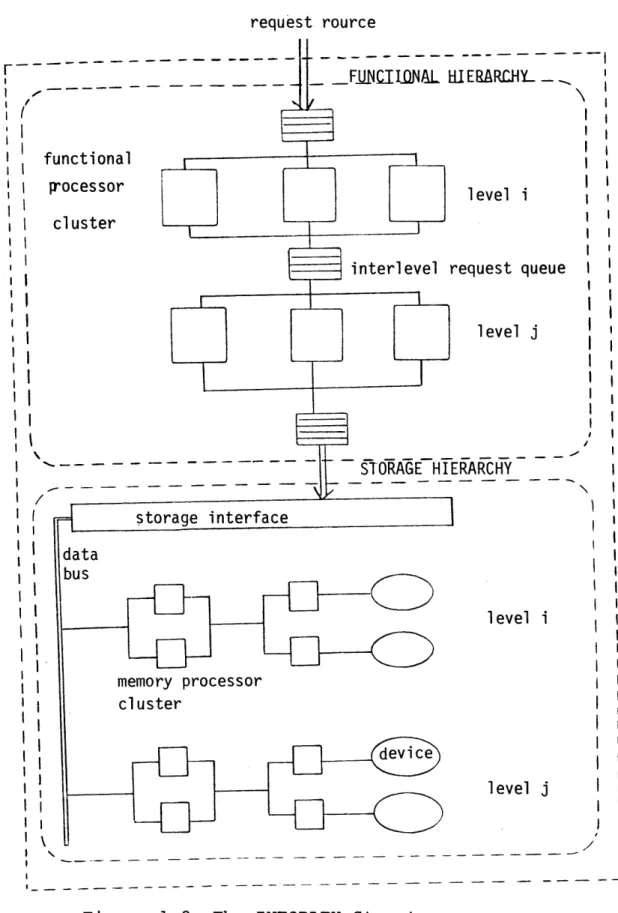
The INFOPLEX architecture also makes use of multiple functional processors. However, to obtain a flexible, high performance, and highly reliable storage subsystem, INFOPLEX makes use of a storage hierarchy system based on the Madnick proposal (Madnick, 1973). Conceptually, the INFOPLEX data-base computer consists of a functional hierarchy and a phy-sical (storage) hierarchy (See Figure 1.2). The INFOPLEX functional hierarchy is a hierarchy of specialized micropro-cessors. It implements all the information management
func-tions of a database manager, such as query language
-request rource
rFMNCIINAL
HIERARCHY-functional rocessor cluster
interlevel request queue I
level STORAGE HIERARCHY storage interface data us level i memory processor cluster - level
j
interpretation, security verification, and data path accessing, etc. The hierarchy of functional processors establishes a pipeline. Within each stage of the pipeline, multiple processors are used to realize parallel processing and provide multiple redundancy. The INFOPLEX storage hier-archy is designed specifically to support the data storage requirements of the functional hierarchy. To provide high performance and high reliability, it makes use of a highly parallel and reliable architecture, implements distributed
control mechanisms, and maintains multiple data redundancy.
1.3 RESEARCH GOALS AND ACCOMPLISHMENTS
This thesis is a study of the INFOPLEX data storage hier-archy. We have studied data storage hierarchy systems from
five different and related points of view: (1) development of concepts for INFOPLEX and data storage hierarchy systems,
(2) architectural design of data storage hierarchy systems, (3) theoretic analysis of data storage hierarchy systems, (4) algorithm development for data storage hierarchy sys-tems, and (5) performance evaluation of data storage hier-archy systems. Specific goals and accomplishments of this thesis are listed below.
-1. Develop and extend concepts of data base computers and data storage hierarchy systems: Since Mad-nick's (Madnick,1975b) proposal to develop a high performance, highly reliable data base computer,
called INFOPLEX, there has been many alternative approaches to develop special architectures for data base management. We have reviewed these
pro-posals and categorized these efforts into: (1) new instructions through microprogramming, (2) storage hierarchy optimization, (3) intelligent controllers, (4) back-end processor, and (5) data base computers. Concepts of the INFOPLEX data base computer have been refined and leads to the development of the concept of a data storage hier-archy.
2. Architectural design of data storage hierarchy systems: Although storage hierarchy systems with
two or three levels are very common in current computer systems, there is no.known storage
hier-archy with more than three storage levels that has been designed specifically for large databases. A preliminary design of the general structure of a data storage hierarchy with an arbitrary number of
is the basis for future designs of data storage hierarchy systems for the INFOPLEX data base com-puter.
3. Theoretic analysis of data storage hierarchy sys-tems: Madnick (Madnick\-i1973) proposed the model of a generalized storage hierarchy system that
incorporates multiple page sizes and maintains multiple data redundancy for high performance and high reliability. This model is extended and for-malized for data storage hierarchy systems. The
Least Recently Used (LRU) algorithm is extended to incorporate the read-through strategy for managing the data movement in data storage hierarchy sys-tems. Four classes of algorithms are obtained and
formally defined. The multi-level inclusion
(MLI), multi-level overflow inclusion (MLOI), and multi-level paging anomaly (MLPA) properties of
data storage hierarchy systems using these algor-ithms are analyzed in detail and formally proved as eight theorems and nine lemmas.
4. Develop algorithms for data storage hierarchy sys-tems: A simplified structure of the INFOPLEX data storage hierarchy is obtained from the general structure. Protocols to support the read-through
-and the store-behind data movement algorithms are developed for this structure.
5. Performance evaluation of data storage hierarchy systems: Two GPSS/360 simulation models of the INFOPLEX data storage hierarchy are developed. Simulation results reveal several unexpected pro-perties of the data storage hierarchy design and its algorithms. A well-balanced system is used to compare the performance differential of using
technology in 1979 versus projected technology in 1985. These simulation results indicate that the current INFOPLEX data storage hierarchy design is capable of supporting the read and write traffic generated by the INFOPLEX functional hierarchy.
1.4 STRUCTURE OF THESIS
This thesis is an important step towards developing sto-rage hierarchy systems specifically for data base computers. Existing models of storage hierarchy systems are extended to obtain a formal model of storage hierarchy system which
incorporates multiple page sizes and maintains multiple data redundancy. Key properties of such systems are analyzed in detail. Architectures of storage hierarchy systems for
are evaluated. Details of this research are presented in seven chapters. Chapter one is self-explainatory. The fol-lowing outlines the contents of the other chapters.
1.4.1 Chapter 2 : The INFOPLEX Data Base Computer Architecture
This chapter introduces the objectives and approaches of the INFOPLEX data base computer. Concepts and research
approaches used in the INFOPLEX functional hierarchy and the INFOPLEX data storage hierarchy are described. This chapter provides the background and motivation for the research on data storage hierarchy systems.
1.4.2 Chapter 3 : A General Structure of the INFOPLEX Data Storage Hierarchy
A preliminary design of the INFOPLEX data storage hier-archy, DSH-1, is proposed. The design objectives of DSH-1 are discussed. Then the structure of DSH-1 is introduced. This design can be used to explore design issues associated with the INFOPLEX data storage hierarchy. Key design issues
are identified.
1.4.3 Chapter 4 : Modelling and Analysis of Data Storage Hierarchy Systems
Current research efforts in storage hierarchy systems are briefly reviewed. A formal model of data storage hierarchy
-systems incorporating multiple page sizes and maintain mul-tiple data redundancy is developed. Extensions to the Least Recently Used (LRU) algorithm are developed to incorporate the read-through strategy. Important performance and relia-bility properties of these systems are formally proved.
These results provide valuable insights to designing data storage hierarchy systems. The formalisms developed provide a solid basis for further theoretic analysis of data storage hierarchy systems.
1.4.4 Chapter 5 : Design of the DSH-ll Data Storage Hierarchy System
The general structure of the INFOPLEX data storage hier-archy is used to derive a simpler structure, DSH-ll. This structure is used as a basis for developing protocols for supporting the read and write operations. Specifications for these protocols are presented.
1.4.5 Chapter 6 : Simulation Studies of the DSH-ll Data Storage Hierarchy System
A simulation model of DSH-ll with one processor and three storage levels is developed. Results from simulation stu-dies using this model provide valuable insights to the
DSH-ll design and its algorithms. This knowledge is incor-porated into another simulation model of DSH-ll that con-sists of five processors and four storage levels.
Simula-tion studies from this model reveal further interesting properties of the read-through and store-behind algorithms. The simulation results also indicate that the current design is capable of supporting the very high rate of storage
references generated by the INFOPLEX functional hierarchy.
1.4.6 Chapter 7 : Discussions and Conclusions
Chapter 7 summarizes this thesis and indicates fruitful areas for further research.
-Chapter II
THE INFOPLEX DATA BASE -COMPUTER ARCHITECTURE
2.1 INTRODUCTION
This chapter discusses the INFOPLEX data base computer concepts and its approaches. Specific areas of contribution of this thesis to the development of the INFOPLEX data base computer are then listed.
The key concepts of the INFOPLEX architecture are hier-archical decomposition and distributed control. Techniques of hierarchical decomposition are applied to organize the information management functions to obtain a highly modular functional hierarchy. Each level of the functional hier-archy is implemented using multiple microprocessors. Tech-niques of hierarchical decomposition are also applied to organize the storage subsystem to obtain a modular storage hierarchy capable of supporting the storage requirements of the functional hierarchy. Microprocessors are used at each level of the hierarchy to implement the storage management algorithms so the hierarchy appears as a very large, highly
Due to the high modularity of these organizations, both the functional hierarchy and the storage hierarchy can take advantage of distributed control mechanisms. Each level in
a hierarchy only communicates with its adjacent levels and each module within a level only communicates with its adja-cent modules. Thus, no adja-central control mechanism is neces-sary. Distributed control enhances reli'ability since there is no single component in the system whose failure renders the entire system inoperative. Distributed control also enhances performance since there is no system bottleneck as would exist in a centrally controlled system.
A functionally decomposed hierarchy, implemented using multiple microprocessors, can support pipeline processing naturally. That is, multiple requests for information can be at various stages of processing at different levels of
the hierarchy simultaneously. Such an architecture also enhances reliability since errors can be isolated within a level in the hierarchy thus simplifying error detection and correction.
Parallel processing is made possible by the hierarchical decomposition and implementation using multiple microproces-sors. For example, there may be several identical modules that implement the same function within a level. All these modules can be simultaneously operating on different
-requests, at the same time, providing potential backup for one another.
Thus, the distributed control, pipeline and parallel pro-cessing capabilities of INFOPLEX provide very high
reliabil-ity and high performance.
In addition to providing high performance and high relia-bility, a viable data base computer must be able to take advantage of new technological innovations. It must be able
to easily upgrade to incorporate new algorithms, e.g., a new security checking technique, or new hardware innovations, e.g., a new storage device. Due to its modular structure, the INFOPLEX functional hierarchy can take advantage of new techniques and technologies as they are developed. The INFOPLEX storage hierarchy is specifically designed to be able to handle any type of storage devices. Thus rather than being specialized to a particular data structure, or type of storage device, INFOPLEX is designed to adapt to the changing application needs as well as to take advantage of new technological innovations.
2.2 THE INFOPLEX FUNCTIONAL HIERARCHY
An information management system performs a spectrum of very complex functions in response to user requests for
high level languages and often come from many different
sources simultaneously. There are many ways that these com-plex functions can be implemented. The technique of
hier-archical functional decomposition has been found to be very effective for advanced information systems (Donovan and Jacoby, 1975). Similar techniques have been used success-fully in operating systems (Dijkstra, 1968; Madnick and
Donovan, 1974), basic file systems (Madnick and Alsop, 1969; Madnick, 1970), and a wide range of complex systems (Pattee,
1973).
This is the approach used in INFOPLEX. The information management functions are systematically decomposed into a
functional hierarchy, referred to as the INFOPLEX functional decomposition. The functional modules in the hierarchy are then implemented using multiple microprocessors.
2.2.1 Rationale for Functional Decomposition
The central idea underlying the hierarchical functional decomposition approach involves decomposing the system into
a hierarchy consisting of a number of levels, such that each level interacts only with the levels below it in the hier-archy. Proper selection of the hierarchy allows design or operating problems that previously impacted the entire
sys-tem, to be isolated to one or a few specific hierarchical levels, and thereby more easily handled (Parnas, 1976).
-Isolating the information management functions into mini-mally interrelated modules facilitates the use of multiple
identical modules for performing the same function, so that reliability and parallelism are enhanced. Furthermore, this approach provides great flexibility in the technologies used
for implementating each type of functional module. For example, a particular data structure may be selected from a spectrum of indexing techniques for a given module without affecting the design of other types of modules.
2.2.2 Example of a Functional Decomposition
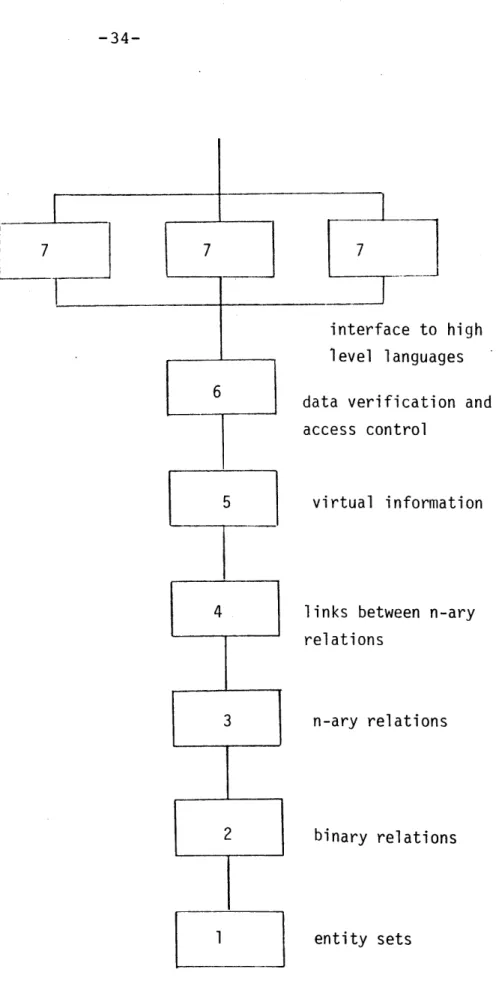
To illustrate the hierarchical functional decomposition concept, a specific example of a functional decomposition is discussed in this section. Figure 2.1 illustrates a plausi-ble hierarchical functional decomposition. Each level of the functional hierarchy is described below.
2.2.2.1 Entities and Entity Sets
At the most fundamental level, a database system stores information about things, or entities. Also, it is usually the case that entities represented in a database fall natur-ally into logical groups, or "entity sets". The way in which a database system (a) represents and stores tion about entities themselves, and (b) represents informa-tion about the logical grouping of entities into entity sets, forms the bedrock architecture of the system.
7
interface to high level languages data verification and access control
virtual information
links between n-ary relations
n-ary relations
binary relations
entity sets
Figure 2.1 An Example Functional Hierarchy
-34-7 7
There are many schemes available for logically and physi-cally representing entities (i.e., coding, storing, and
addressing entities) and various algorithms for structuring entity sets. The choice of implementation scheme at this level affects the performance of the entire system but does not affect how the functions of the other levels are imple-mented.
2.2.2.2 Binary Relations
All relationships among entities can be expressed in terms of binary relationships between pairs of entities. This functional level makes use of the entity level con-structs to provide a collection of binary relations
(rela-tions between pairs of entity sets). An element of a binary relation can be viewed as a triad, consisting of a relation
identifier plus two entities, each from one of the entity sets participating in the binary relation. Thus a binary relation can be viewed as a collection of triads with the same relation identifier.
Perhaps the simplest possible implementation of a set of binary relations would be as a sequential file of triads, for example,
(HASSALARYOF , SMITH , 1200) (HAS SALARY OF , JONES , 1500)
(WORKSINDEPT SMITH , 02) (WORKSINDEPT , JONES , 07)
The difficulties with this approach are manifest: there is great data redundancy and thus waste of storage (the
rela-tion identifiers are stored in each triad); inserrela-tion of additional triads would either have to be done out of order, or else insertions and deletions would be extremely time-consuming.
Triads could also be stored as linked lists. Alterna-tively hashing algorithms could be employed to locate any triad, given two of its three components. The use of linked
lists can improve access speed and reduce storage require-ments. On the other hand, the use of hashing algorithms would provide extremely rapid access, but would be poorer in terms of storage space utilization.
Since a database may contain billions of triads, the log-ical and physlog-ical structures of binary relations have seri-ous performance implications. Many implementation schemes
for binary relations are possible. Although the choice of these implementation schemes has various cost and perfor-mance implications it does not affect how the functions of the next level are implemented.
-2.2.2.3 N-ary Relations
Conceptually, an n-ary relation may be thought of as a table of data, with rows of the table (usually called
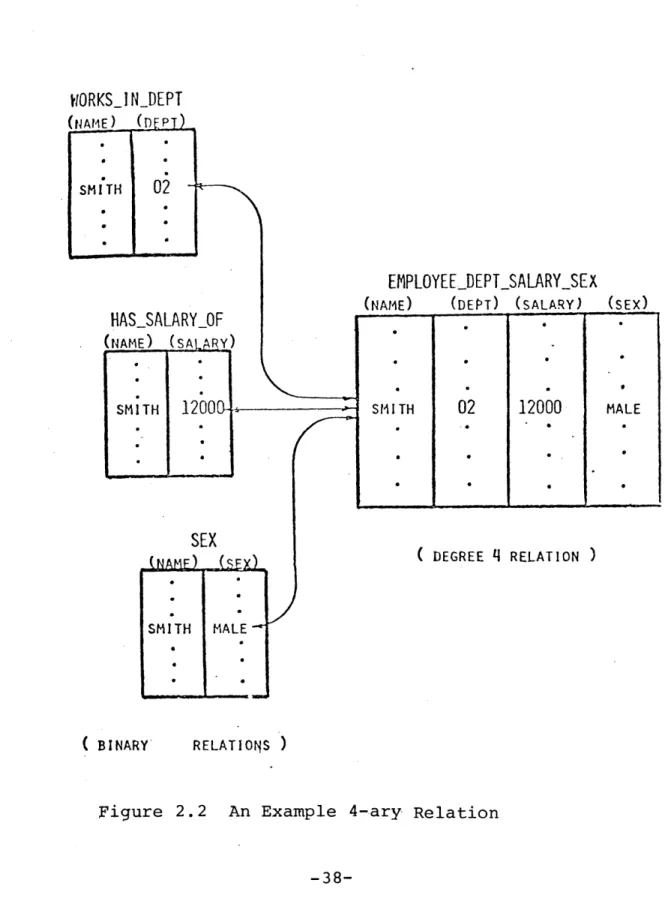
tuples) corresponding approximately to records in a tradi-tional data file, and columns (or domains) corresponding to fields. Furthermore, n-ary relations may be constructed out of sets of basic binary relations. For example, the degree
4 relation EMPLOYEE DEPT SALARY SEX, for which a typical entry might be
(SMITH, 02, 1200, male),
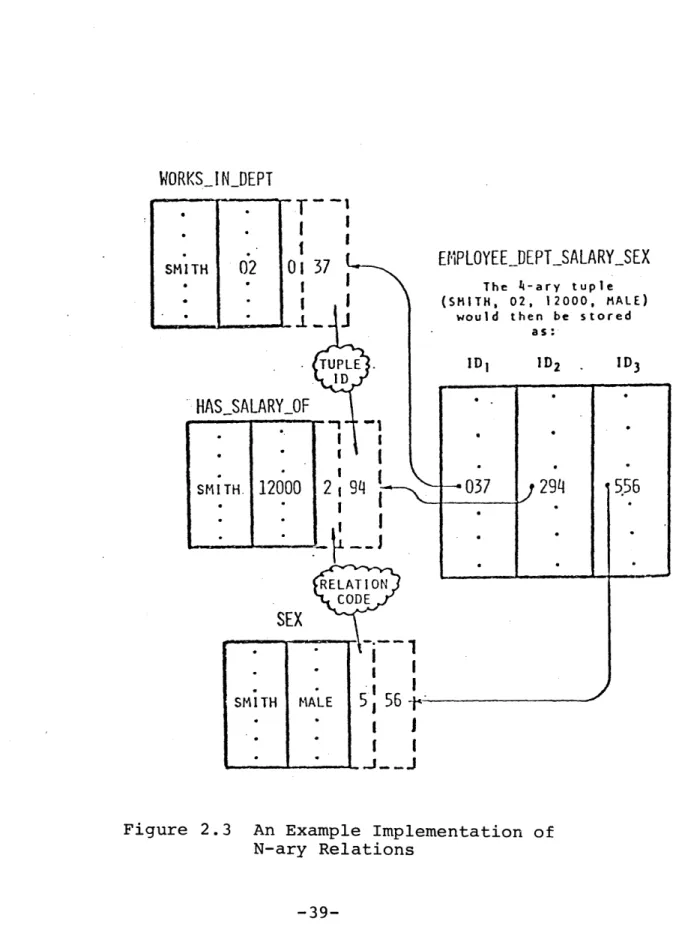
is semantically equivalent to (i.e., contains the same information as) the three binary relations WORKSINDEPT, HASSALARYOF and SEX, as illustrated in Figure 2.2. We could build up n-ary relation tuples out of tuple-ids of binary relations, as illustrated in Figure 2.3. In this approach, the original data entities (SMITH, 01, 1200, male), would be stored in permanent binary relations, and
all other relations would be constructed out of binary tuple ids. Tuple ids, being uniform binary numbers, are easy and efficient to manipulate.
A number of other implementations of n-ary relations is also possible. The point is, however, that once we have an
WORKSINDEPT
(NAME) (DEPT SMITH 02-HASSALARYOF
(NAME) (SALARY) SMITH1200
SEX
SMITH MALE ( BINARYEMPLOYEEDEPT_SALARY_SEX
(NAME) (DEPT) (SALARY) (SEX)
( DEGREE
4
RELATION )XI
RELATIONS )
Figure 2.2 An Example 4-ary Relation
-38-SMITH
02
12000
MALEWORKSINDEPT SMITH 02
-T
I OI 01 I I IEMPLOYEELDEPTSALARYSEX
The 4-ary tuple (SMITH, 02, 12000, MALE)would then be stored
Figure 2.3 An Example Implementation of N-ary Relations
-39-RELATION A
(NAME) (AGE) (SKILL) ID
SMITH 27 WELDER 2 2
SMITH 27 JOINER 2
"META-
RELATIOfI"
COMMON_SKILL
(A ID) (B ID)
Figure 2.4 Links Among N-ary Relations
-40-efficient implementation of binary relations, general n-ary relations may be constructed in a straightforward fashion out of the binary relations without actually having to
retreat -- conceptually or physically -- back to the level
of basic entities or entity sets. In other words, n-ary relation functions (to manipulate n-ary relations) can be
implemented by appropriately combining binary relation func-tions.
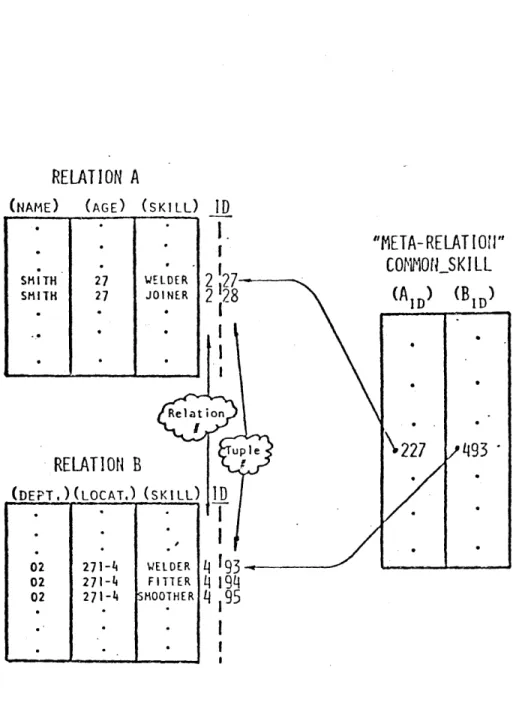
2.2.2.4 Links Among N-ary Relations
The various n-ary relations in a typical database would generally possess a number of logical interconnections. For example, one relation might contain data on employees and
the skills each employee possesses, while another might involve data on departments and the skills each department requires to function. The logical relationship between the tuples in these relations could be employed to extend the database structure further, by incorporating a set of
"meta-relations" for storing information about such links between the regular n-ary relations. The role of the meta-relations would be to identify related tuples, and to pro-vide some semantic information regarding the nature of the interrelationships. In the example cited above, it would make sense to establish a meta-relation connecting the appropriate tuples in the original two relations on the
basis of "common skill", as shown in Figure 2.4. Under the implementation approach illustrated in Figure 2.4, meta-re-lations would themselves be n-ary remeta-re-lations. The only dif-ference between them and regular n-ary relations-lies in the interpretation of their entries. Therefore, all of the pre-viously designed mechanisms for building and managing n-ary relations could also be used with the meta-relations. Only the interpretation of the elements within these relations would be different.
By incorporating linking information among the different n-ary relations in a database, either permanently or tempo-rarily, directly into the database structure itself, it would be possible to generate more complex systems that
would be capable of presenting different interfaces to dif-ferent users, depending on the needs and objectives of the users themselves.
2.2.2.5 Virtual Information
It is not always necessary, or even desirable, that a database contain all the information that users might wish
to access. Sometimes data interrelationships are algor-ithmic in nature, such that certain values may be unambigu-ously derived from others that are already stored in the database. This gives rise to the concept of "virtual"
information (Folinus et al., 1974).
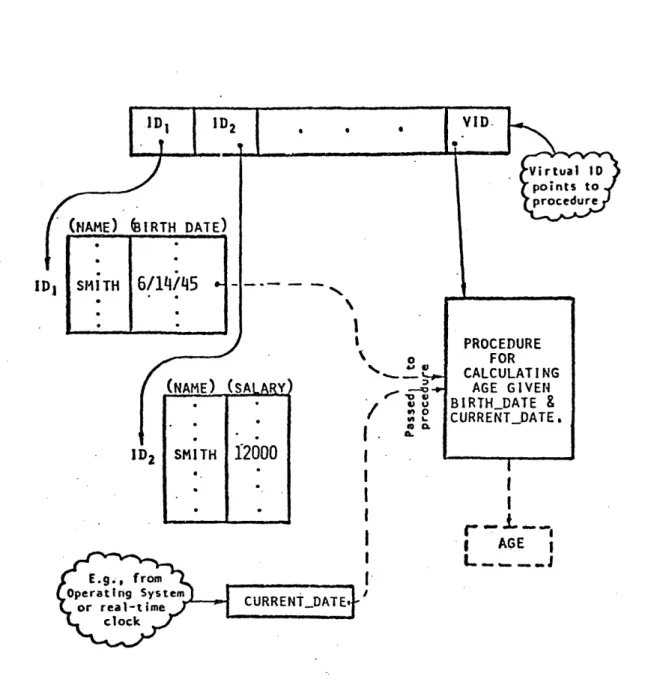
-If an employee's BIRTHDATE is stored in a database, and the CURRENTDATE is also available, then the employee's AGE could be calculated by a simple algorithm and need not also be stored. If this is in fact done, then the employee's AGE would be an example of "virtual" data -- information that
appears (to the database user) to be stored there, but which is not actually present as an entity in the database.
There are a number of advantages to "virtualizing" data in a database. These include:
1. Greater accuracy: for example, an employee's AGE could be calculated as accurately as necessary if included as virtual data, whereas it would always be somewhat "old" if it were simply stored as a database entity;
2. Elimination of updating: virtual data items them-selves never need updating;
3. Reduced redundancy: including, for example,
BIRTHDATE, CURRENTDATE, and AGE as three sepa-rate items in a database is redundant, and incon-sistent data relationships can easily result if some of the items are updated independently of others;
4. Savings in storage: in many cases, the database storage space required to store items such as AGE directly would be much larger than that required
to store the coded algorithm for calculating AGE from other data.
One way of implementing a virtual information capability is to'extend the definition of n-ary relations to include tuple
identifiers ("ids") that would in fact not refer to binary relation tuples, but rather would point to procedures for calculating the virtual data items. Consider a simple
employee relation of degree four, containing real data items NAME, BIRTHDATE, and SALARY, plus a virtual data item AGE. The organization of this 4-tuple would then appear as in Figure 2.5.
2.2.2.6 Data Verification and Access Control
Data verification is the process of checking entries into a database for qualities such as reasonableness (e.g., a person's age should be no greater than, say, 125 years), and consistency (e.g., the sum of the months worked in various departments by an employee should sum to the number of
months worked for the company). Access control is the pro-cess of controlling the database with regard to data
retrieval, update, deletion, database reorganization, etc.
-(NAME) BIRTH DATE) SMITH
6/14/45
ID2 0 e, PROCEDURE FOR CALCULATING AGE GIVEN BIRTH-DATE & CURRENT_DATE. g AGE 1 L----6fj E.g., fromI-Operating System CURRENDATE. or real-time
clock
Figure 2.5 Representation of Virtual Information
-45-IDI
(DEPT,) Passed to procedure Other necessary - . Information A PROCEDURE TO VERIFY ENTITY ON~ UPDATE OR INSERTION ddress "p"t
I
Appropri ate actionFigure 2.6 An Example Data Verification Scheme
-46-SMI T H 12000
U
For example, department managers may be granted authoriza-tion to view the employee records of only the employees working in their own departments; the database
administra-tor, on the other hand, may have access to all the records in the database. The database administrator may also be the only person with authority to reorganize the entire
data-base.
Access control also involves considerations such as the identification of valid users through use of passwords and other such techniques, mechanisms for allowing users to spe-cify the type of access (read only, read/write, execute
only, etc.) for files, and allowing users to segment files, so as to restrict parts of interconnected programs or data files from certain kinds of access by certain specified
users (an example of a system that has implemented this suc-cessfully is the MULTICS system).
Both data validity and access control could be imple-mented in the hierarchical structure being discussed here in
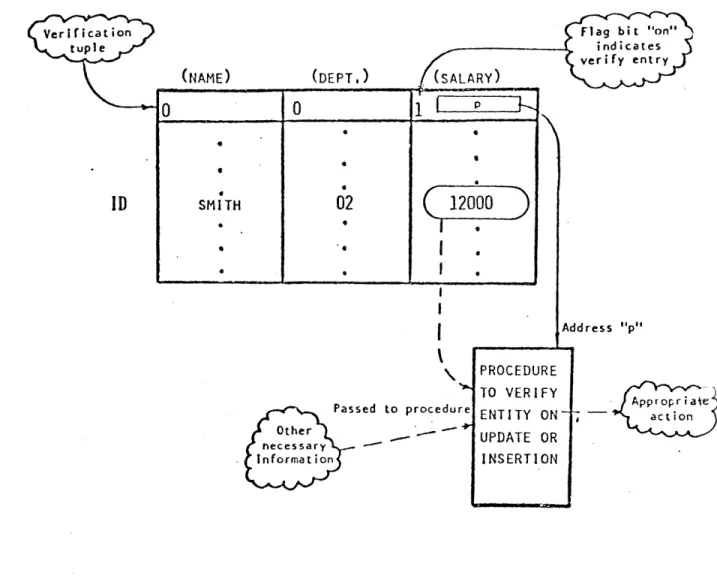
a variety of ways. For example, the basic n-ary relations could be further extended to include special control and verification tuples. If data verification were to be per-formed upon data entries in a certain domain of a relation, that domain could be flagged in a "verification tuple", and a data verification routine would be called upon data
inser-tion or update to check the appropriateness of each entry (see Figure 2.6).
Similarly, control of access to various domains or tuples could be performed by setting control bits in a special con-trol tuple or domain, and including, for example, an address pointer to a list of authorized user passwords, against
which the current user could be checked. These control
tuples or flag bits would serve to describe certain "views", or combinations of data elements, that each user would be permitted to access. Alternately, they could be used to describe elements, domains, tuples, or entire relations that a user was not permitted to view.
Note that these implementations would utilize the mechan-isms employed to provide virtual information as discussed above (i.e., certain ids are used to point to verification procedures, as they pointed to "virtual information
computa-tion procedures" in the preceding seccomputa-tion). Thus, the veri-fication and access control functions can be realized in terms of those responsible for virtual information.
2.2.2.7 High-level Language Interface
The user interface, through the data manipulation lan-guage, basically specifies the way in which the database may be accessed by the users. In this regard, there are three main approaches to manipulating a database, corresponding
-roughly to the three basic models of database organization (network, hierarchical, and relational.):
1. An application programmer may wish to 'navigate' (Bachman, 1975; Codasyl, 1971) a database by using the data manipulation language to trace through the data groupings (relations) and interconnecting linkages (links between n-ary relations). This approach to database manipulation is usually more complex than some others, and demands a greater sophistication on the part of the applications programmer. He must, for example, be fully aware of the existence of all the links connecting the various data groupings, whereas this knowledge is not necessarily demanded of programmers using other data manipulation languages. In return for the greater complexity, the navigational approach usually offers greater accessing efficiency and better overall database manipulation performance, especially when dealing with large and complex databases.
2. A user may wish to organize and manipulate the database as a hierarchical tree structure, wherein the logical interconnections between data
sense, the manipulation of a hierarchical tree structure is a special case of the general naviga-tional approach. Hierarchical structures do, how-ever, allow a number of simplifications to be made in designing the database management system, as well as in the data manipulation language. Furth-ermore, a surprisingly large number of situations
in the real world may be effectively represented with a hierarchical tree data organization, so it
is worthwhile to treat hierarchical structure as an important special case.
3. Finally, in many cases it is appropriate for the applications programmer to access the database directly in terms of its underlying binary or n-ary relations (Codd, 1970; Codd, 1974). Such
"direct" manipulation may be made at a relatively low level, in terms of individual relations and primitive operations (using the relational alge-bra) upon them. Alternately, a higher-level
interface could be used to translate more general-purpose commands (using the relational calculus)
into lower-level operations. Such low-level
accessing methods generally provide greater effi-ciency, at the expense of greater programming detail.
-2.2.3 INFOPLEX's Approach to Functional Decomposition The above discussions illustrate one possible decomposi-tion of the informadecomposi-tion management funcdecomposi-tions into hierarchi-cal levels. Other decompositions are possible. For exam-ple, the work of (Senko, 1976; Yeh et al., 1977; Toh et al., 1977; ANSI, 1975) also decomposes the various information management functions into several levels (e.g., (1) physical data storage, (2) logical data encoding, (3) access path,
(4) internal schema, and (5) external schema). A common weakness of these functional decompositions, including our example decompositon, is that although any particular
decom-position may make good sense and impose a reasonable concep-tual structure on the information management function, there are no commonly accepted criteria with which to evaluate any given decomposition.
A common qualitative criteria often used to decompose complex functions into sub-modules is that of modularity. A decomposition is considered to attain high modularity when each individual module is internally coherent, and all the modules are loosely coupled with one another. One of the INFOPLEX research focuses is to develop methodologies to formalize this notion of modularity quantitatively, and to use it to evaluate a given decomposition, thus systematic techniques for obtaining an optimal functional decomposition