
End of range defects in Ge
Texte intégral
Figure
Documents relatifs
In this paper, a numerical model developed by the authors is used to test and optimize two technological solutions, aimed at reducing the geometrical defects : a localized
The manuscript was prepared while one of the authors (LS) was a collaborates etranger at SRMP, C. Recently, however, there has been some indi- cation that one might to able
From transmission electron microscopy and heat capacity measurements radiation induced da- mage in A-15 compounds was found to be inhomogeneous, consisting of samll disordered
In view of the occurrence of interstitial defects in various ionic compounds (e.g. AgCl, AgBr and compounds with the CaF, structure) it therefore seemed of interest
A simple kinetic model of the solar corona has been developed at BISA (Pier- rard & Lamy 2003) in order to study the temperatures of the solar ions in coronal regions
3. The inclusion of the second neighbours did not alter the situation very much.This reveals that the LVIvi mode can be accounted in an interstitial configuration with a
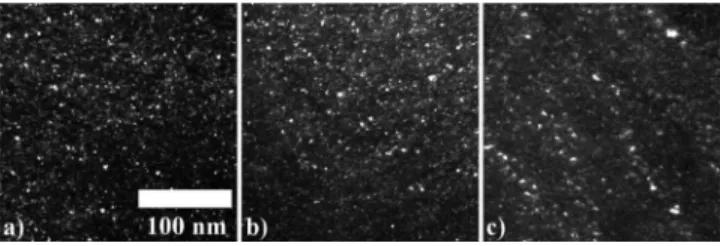
13 on a defect population produced by a nonamorphizing implant shows de- fects in germanium having an average size of about 10–15 nm that do not change in size during thermal
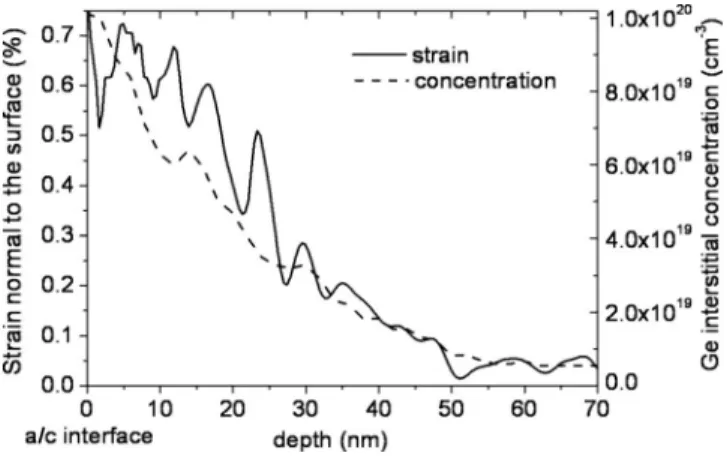
After an accurate quantitative analysis that has taken also into account the defects background induced by the TEM sample preparation, we observed that these defects dissolve
